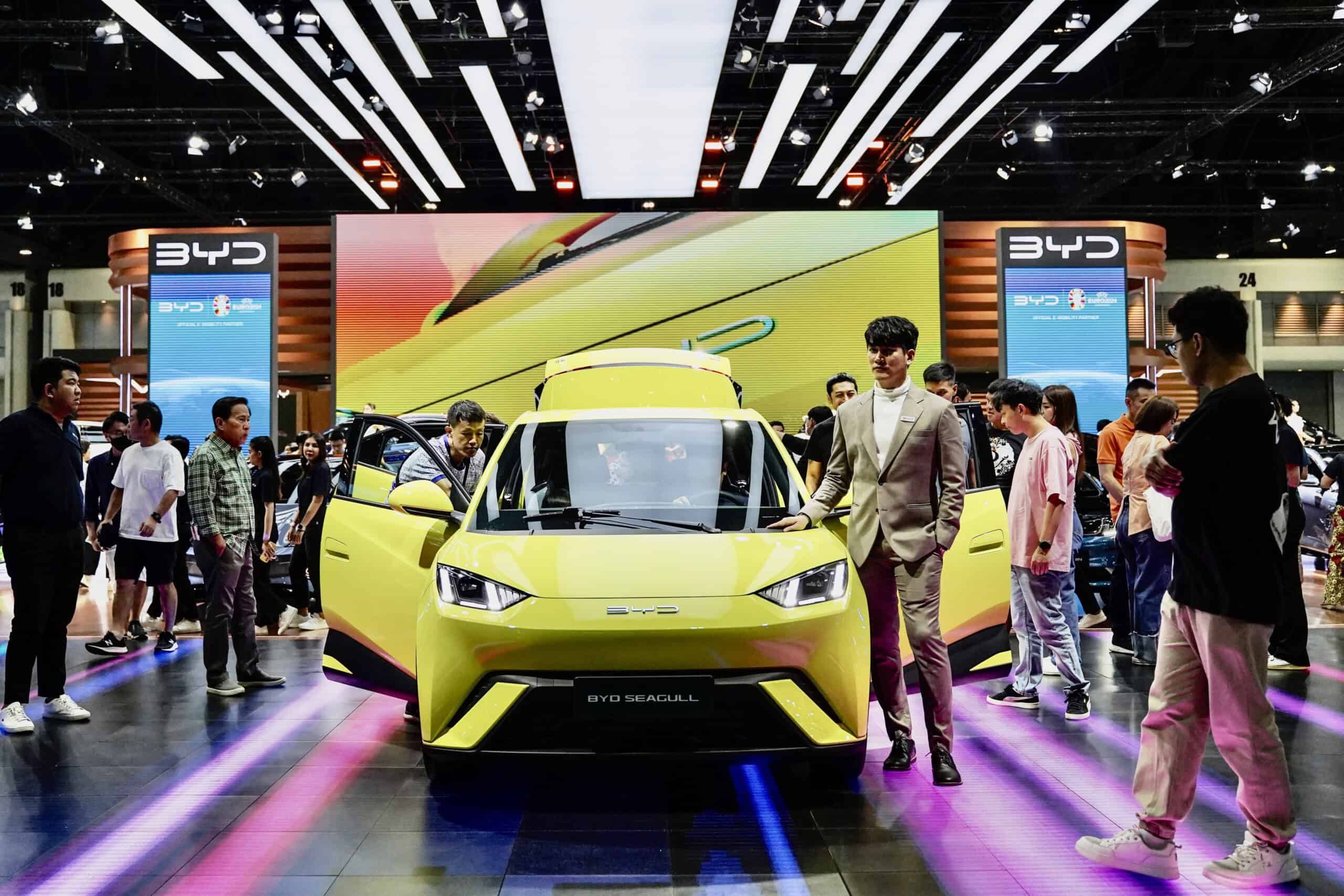
In December 2023, ahead of a regional summit in Tokyo, Thai prime minister Srettha Thavisin sought an audience with heads of Japan’s largest carmakers. Thavisin’s desire to meet with auto industry leaders was not surprising. From the early 1960s Japanese firms had built Thailand into “Asia’s Detroit”, opening hundreds of production lines and creating more than 700,000 jobs. By 2023 they had invested almost $21 billion in Thailand, equivalent to 10 percent of its GDP. In the 1990s, Toyota, Nissan, Suzuki, Isuzu, Mazda and others swatted away their U.S. and Korean rivals, making Japanese cars a near-ubiquitous sight on the streets of Bangkok — as they were in Jakarta, Kuala Lumpur, Manila or any other major city in Southeast Asia.

But Thavisin wanted the attendees to know things were beginning to change. “You are not alone in the world,” he warned them in an interview with local media. Everybody knew what he meant: the Chinese were coming.
Japanese marques commanded almost 90 percent of vehicle sales that year, while electric vehicles (EVs) — a segment dominated by emerging Chinese manufacturers — comprised 76,000 units, or 12 percent.
But that 12 percent market share had been less than 2 percent just a year earlier, and Thavisin’s government wanted EVs to account for 30 percent of domestic production by 2030. Several of Thailand’s Southeast Asian neighbours had pledged similar transformations that would primarily benefit Chinese makers including MG, SAIC and, most significantly, Shenzhen-headquartered BYD. Weeks before Thavisin’s visit BYD, which stands for “build your dreams” and is known as Bi Ya Di in its home country, had surpassed Volkswagen as China’s most popular domestic marque.

BYD had only entered the Thai market in 2022. Largely shut out of the U.S. and EU by tariffs, it had gone full-throttle, signing local distribution deals and offering huge consumer discounts. Its Atto 3 SUV cost about half what Tesla’s smallest car, the Model 3, did. Within a year BYD was selling over a quarter of all EVs in Thailand, and had similar shares across the region.
Japan’s OEMs, by contrast, had no such products to offer. Thavisin, himself a business mogul before entering politics, agreed on a suite of tax incentives to help the Japanese build more EVs in his country. But, he said, they needed to adapt fast. “The others,” he added, “are making decisions.”
Thavisin’s warnings were sage. Chinese carmakers have obliterated the foreign competition in their home market, by far the world’s largest. China’s annual vehicle sales of 31 million account for over two-thirds of all new passenger vehicles sold globally. But that is not hugely surprising in a country where local brands have benefitted from years of government subsidies, low labor costs and a supply chain for critical materials that has greatly reduced their overheads. More concerning, from Japan’s point-of-view, is the fact that since 2019 its auto giants have lost the most market share in Southeast Asian countries where their Chinese rivals do not enjoy a similar scale of government support.

This damage has been compounded by U.S. President Donald Trump’s tariffs (now 15 percent after being negotiated down from 25 percent) which have cost Honda, Nissan, Toyota and Subaru billions of dollars in profits at at time when Japan’s domestic market, like its population and economy, is shrinking. Honda recently shelved an $11bn EV expansion in Canada, while Nissan has stopped shipping U.S. orders for Mexico-built SUVs.

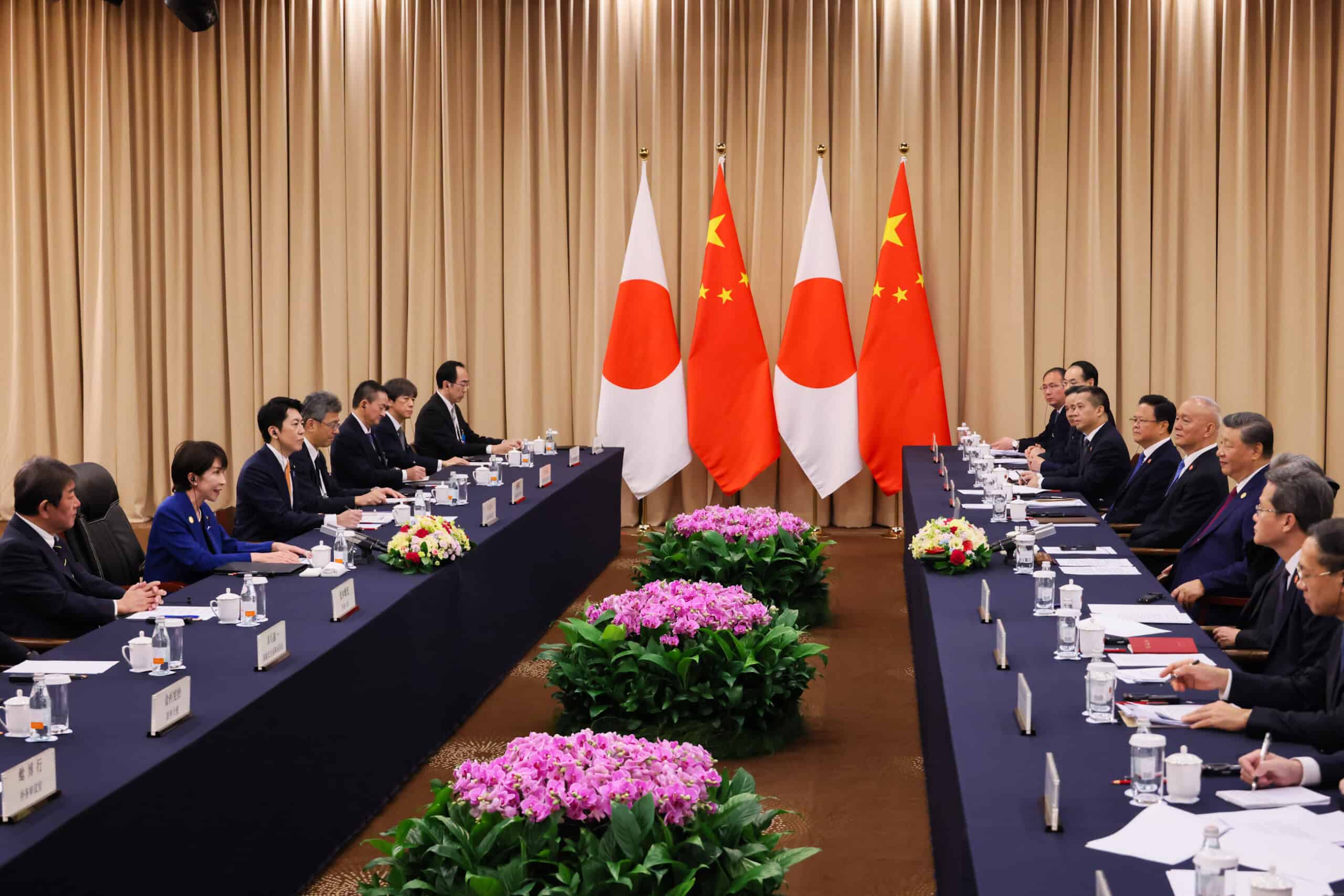
The island nation’s reliance on mineral and silicon imports has also left it vulnerable in this new age of protectionism. Add to these factors a deepening diplomatic crisis with Beijing over new Japanese Prime Minister Sanae Takaichi’s November comments concerning Taiwan, and some experts have begun drafting obituaries for Japan’s $343 billion auto sector. It employs more than eight percent of the country’s workforce and is more integral to its economic security than any other industry.
China’s consul-general in Osaka responded to Takaichi’s remarks with a threat to behead her, and Beijing has promised action should Japan dare to “intervene militarily in the Taiwan Strait”. China has pulled Japanese movies from cinema screens and urged its citizens to avoid visiting Japan, a move that could cost Tokyo billions in tourism revenue.
We learned carmaking from Germany and America, and we advanced by production technology — but not innovative technology. Japan actually never led in innovation.
Hisashi Taniguchi, founder and CEO of automotive robotics firm ROBO-HI
Last year Japan’s top five carmakers’ combined market share of new car sales in Thailand fell from 75 percent to 65 percent. “If you’re used to unveiling a new car in five years and [Chinese competitors] can do it in 18 months, what can you do?” asks Tu Le, founder of Detroit-based consultancy Sino Auto Insights. “The legacy makers, they’re still playing checkers and they’re getting faster at playing checkers. But the Chinese are playing a different game. They’re playing chess.”
“The industry was first talking about [being in] ‘China for China,’” adds Patrick Ziechmann, a Kuala Lumpur-based automotive expert for PwC. “But, more and more, the German manufacturers, and probably also the Japanese, are admitting that it’s ‘China for the world’.”
Speaking at an Asian investment conference early last year, Toyota’s chairman Akio Toyoda admitted that “Japan needs to think carefully about a new strategy in Southeast Asia.” The question that follows from Toyoda’s admission is whether Japan’s conservative, hierarchical automakers can turn their ships around in time to fend off the Chinese onslaught.
IN NISSAN’S SLIPSTREAM
Ford established Thailand’s first auto assembly plant, a joint venture with Thai Motor Industry Company, in 1960. It pulled out sixteen years later.
Instead it was Yokohama-headquartered Nissan that stayed the course, after opening a Bangkok factory in 1961. That year, Thai car sales totaled 6,080 — or less than five per 1,000 citizens — and only 525 of them were manufactured in Thailand.

This would soon change. Isuzu (1963), Toyota, (1964), Honda (1964), Mitsubishi (1966), Suzuki (1967) and Mazda (1975) followed Nissan’s lead. Their strategy across the region was to help local partners produce their vehicles, then launch joint ventures. By 1971 Thailand produced 11,000 vehicles, almost all of them Japanese. Across Southeast Asia, “Made in Japan” became shorthand for reliability and value.
China didn’t pass a law allowing joint ventures until 1979, just after Deng Xiaoping initiated his “reform and opening” policies. By 1985 China was producing just 5,200 cars annually. Japan, by contrast, had recently outstripped the U.S. as the planet’s largest auto producer, with an annual output of 12.3 million units. By 1990 it built a record 13.5m vehicles.

By then, however, the Japanese economic bubble had burst, wiping out half the value of the Nikkei stock index. Rising costs forced Japan’s carmakers to accelerate their investments in Thailand, Vietnam and China, as well as markets farther afield such as India, Mexico and Brazil. In 1985 Isuzu inaugurated the first Sino-Japanese auto joint venture, which produced trucks in Chongqing. By 2003 every major Japanese OEM had a rapidly expanding presence in China, where domestic production had soared to 4.5 million cars annually. This propelled it past France to become the world’s fourth largest auto market, behind the U.S., Japan and Germany.
Also in 2003, Marin Eberhard and Marc Tarpenning founded Tesla Motors. (Elon Musk, who is often credited as the company’s third founder, joined in 2008.) Silicon Valley may have moved first in the race to build an EV market that would eventually challenge the might of the internal combustion engine. But no country was better poised to capitalize on the coming revolution than China. Its domestic makers were smaller and nimbler than their counterparts in Japan, Germany and the U.S. More crucial was China’s stranglehold on rare-earth elements required to compose the massive, next-generation batteries to power EVs: by 2004, it produced 95 percent of such minerals.

For the most part, Japan’s major automakers did not bite on the EV bait. Toyota had pioneered the hybrid electric-gasoline drivetrain in 1997 with the introduction of the Prius, an affordable sedan that offered unrivaled fuel efficiency — especially at the low average speeds that tormented drivers in large cities such as Tokyo and Bangkok. Hybrids also made for great trucks, buses and other urban commercial vehicles.
But even by 2010, when EVs were recognized across Asia as an integral part of the auto industry’s future, the Japanese held back on them. In the U.S., Europe and Japan, where most Japanese brands sold between 50 to 80 percent of their vehicles, that reticence made sense: ICEs were still king and electrification was slow. Besides, ICEs and hybrids worked. Furthermore, Japanese corporate cultures are often slow and consensus-based. Innovation is usually systematic rather than systemic, and the maxim “if it ain’t broke don’t fix it” reigns supreme.
[Japanese executives] can’t say, ‘Our management team fell asleep at the wheel and by the time we woke up our Chinese competitors caught up to us.’ They can’t say that to [investors].
Tu Le, founder of Detroit-based consultancy Sino Auto Insights
“If you look at the Germans, they were also very successful in the past,” says Hisashi Taniguchi, founder and CEO of automotive robotics firm ROBO-HI. “We learned carmaking from Germany and America, and we advanced by production technology — but not innovative technology. Japan actually never led in innovation.”

DOING SOMETHING NEW
Kanzari Yamamoto, founder of self-driving startup Turing AI, is attempting to change this. At the entrance to Turing AI’s Tokyo office is a slogan, written in bold white font, that reflects the upbeat outlook of the company’s founder: ‘We Overtake Tesla’.
Yamamoto, 39, shot to national fame in 2017 when his algorithm, Ponanza, beat Amahiko Sato, a title-winning professional player of shogi, also known as ‘Japanese chess’. He founded Turing AI in 2021, naming it for Britain’s famed wartime codebreaker Alan Turing, with a view to plugging the huge gap in Japan’s driverless technology market. This November the startup — which focuses on leading-edge ‘neural networks’ rather than more traditional, modular AI — partnered with auto parts behemoth Denso as part of a $63m equity funding round, valuing the company at almost $400m.

The sign says ‘We Overtake Tesla’ precisely because, according to Yamamoto, “nobody in Japan says that. If someone does something new in Japan … many people complain about it.”
Greater Tokyo, the world’s most populous urban area with around 40 million people, is home to just 1,200 startups (Silicon Valley has around 40,000).

Yamamoto had struggled to interest Japan’s major carmakers in his technology. ROBO-HI’s Taniguchi shifted his startup’s focus from driverless taxis to autonomous vehicles in factories, having also been snubbed by industry giants. Given the march of Chinese firms into EVs and autonomous driving, such conservatism is a mistake. Japan’s domestic market, and Japanese makers’ dominance in Asia, have shielded them from Chinese innovation — until now. “We are lucky because we’ve never fought directly against Chinese technologies,” says Yamamoto.
Japanese bureaucrats have been slow to embrace AI, Yamamoto adds, and to loosen regulation to allow driverless vehicles on public roads. But the country’s problem isn’t just bureaucracy.
Turing AI has a fleet of driverless vehicles navigating the streets of Tokyo each day (albeit with a driver on standby at the wheel), helping the company bulk up its neural network. But when The Wire China visited in October, it had only clocked 15,000 driving hours. Tesla’s AI, the industry standard, has over a billion hours.
Wang Ting, a senior specialist in energy and economics at the Japan Research Institute in Tokyo, doesn’t believe Japan’s OEMs can go it alone on tech. “Because the Japanese market is small,” she says, “I think it’s better that Japanese companies try to collaborate or do the testing not only in Japan but in America.”
Turing AI’s latest funding round at least appears to be a step in the right direction. And the country’s pedigree in science should lend it a natural advantage. “What does the customer want? A good product, a good price, and a good service,” says Ziechmann. “How will the Japanese be able to fulfill this? On product, they have strong loyalty and a good history. People are very happy with Japanese cars — so if they catch up with the software-defined vehicle, and also powertrain options, I wouldn’t be too worried. But they do need to catch up.”
THE SENKAKUS PRECEDENT
Geopolitics will also remain a perennial factor. In September 2010, Japanese Coast Guard patrol boats collided with a Chinese fishing vessel near the disputed Senkaku Islands, a tiny, uninhabited archipelago known as the Diaoyu in China. When the Chinese skipper was detained, Beijing restricted the export of rare earths to Japan. It was a critical vulnerability — Japan relied on China for 90 percent of its supply. “China was considered not to be [a] reliable partner,” says Kei Koga, head of the Public Policy and Global Affairs Program at Singapore’s Nanyang Technological University.
There is an established base; the OEMs have their plans; the suppliers have their plans, sometimes in a joint venture; after-sales structures, dealer structures – this is all there … This is what the Japanese should use to defend their market.
Patrick Ziechmann, a Kuala Lumpur-based automotive expert for PwC
Japan has since reduced its reliance on Chinese rare earths to about 60 percent. But while the reluctance to embrace EVs makes sense given this supply chokepoint, it has allowed Chinese carmakers to take market share from their Japanese competitors across Southeast Asia. As recently as 2019, almost every car and truck on Indonesia’s roads — 96.3 percent — was Japanese. Investments by Chinese firms quickly made Indonesia the world’s largest miner of nickel — a metal essential for EV batteries. Last year Indonesia excavated 70 percent of the world’s raw supply of the metal.

Asia’s second most populous nation now wants to move down the supply chain and master refining, battery and EV production as well. It aims to become the world’s third-largest batterymaker by 2027 and produce 600,000 EVs by 2030. China, which processes 90 percent of all rare earths, is a natural partner.

Japan has no such advantages. Its population has been shrinking since 2009, falling by 900,000 last year to 123.4 million. It mines little compared to other countries of its size — either at home or abroad — and is a net importer of minerals. There are only 40,000 EV charging stations in Japan. The Netherlands, with just 11 percent of Japan’s land area and only 18 million people, has 180,000 stations. EVs comprise just 3.4 percent of new vehicle sales inside Japan, and BYD has sold just a few thousand cars since it entered Japan in January 2023. As Koga says: “If you want to really pursue (EVs) you need to set up the infrastructure.”
“For battery electric cars you need all this lithium and nickel and cobalt and whatnot,” says PwC’s Ziechmann. China, he adds, “controls a lot of raw materials that go into the batteries, and the leading companies are Chinese. So if you work with them then you basically give them a share of the dividend.”
Japan produces many computer chips that are vital to the global economy. But it does not make any that are critical to the cutting edge of today’s automotive industry — the “software-defined vehicle” or SDV.

“This is where [European, Japanese and South Korean companies] are more bystanders,” says Tu Le. “When it comes to the most cutting-edge technology, they don’t have domestic champions that they can lean into. Even the battery side with the Koreans and the Japanese, they don’t have expertise on the [cheaper] LFP (lithium iron phosphate) side, they have expertise on the [costlier] NMC (nickel manganese cobalt) side — which most companies are only putting in their highest-end vehicles.”
These are not the vehicles that sell well in Asia. In China, foreign marques are unwilling to offer the kinds of discounts that have vaulted BYD and others to the top of the country’s domestic sales charts. Even the market share of Volkswagen, deeply embedded in the Chinese supply chain since the 1980s, has fallen from 20 percent as recently as 2019 to less than 15 percent.

U.S. political developments are not helping either. Trump’s 15 percent tariff on imported Japanese cars has cost their manufacturers billions — especially Honda and Subaru, which sell a large majority of their output in America. To protect domestic automakers from the 1960s until its economic crisis beginning in the late 80s, Tokyo issued its own prohibitive tariffs, which Washington tolerated because Japan was a valued Cold War ally. “President Trump is concerned about Japan’s unfair practices in the auto industry, which actually happened [in the past], particularly in the 1980s,” says Koga. “That image got really stuck in his head.”
Japanese firms are faring even worse in the world’s largest car market. But they are attempting a comeback. Honda recently opened EV factories in Wuhan and Guangzhou. Toyota will open the second wholly-owned auto factory in China (Tesla’s Shanghai plant was the first) for its luxury Lexus models in 2027. “I don’t know if it makes a difference, but I think it’s at least the right direction,” says Lei Xing, an independent Chinese auto industry analyst. Building such plants, Xing adds, “is a way to … move faster, utilizing more of the local supply chain, supply base, and more decision-making locally … You have to do it.”
Inside Honda’s New Energy Vehicle (NEV) production factory in Guangzhou, China. Credit: GAC Honda
Mazda is the worst performing Japanese carmaker in its home region. Its share of total industry volume (TIV) in ASEAN-member nations fell 23 percent in 2025. Mazda’s China sales are down 72 percent from their 2017 high, leaving it with less than 4 percent market share.
It has pledged to turn its Chinese JV, Chang’an Mazda in Nanjing, into a primarily EV maker over the coming years.
Tu Le says Mazda has been “largely irrelevant for a number of years,” and notes that Nissan is in a similar predicament. As such, they are extreme examples of the crisis facing all foreign carmakers in China, and Japanese ones in particular.
“While some Japanese brands have withdrawn or reduced their presence, Mazda maintains sales, development, and production bases,” says a company spokesperson. “While reorganizing its sales network, Mazda has jointly developed and introduced the new energy vehicles EZ-6 and EZ-60 with Changan Automobile.”
It might take “double-digit increases in market share in other countries to make up for … losses in China,” adds Le. Japanese executives “can’t say, ‘Our management team fell asleep at the wheel and by the time we woke up our Chinese competitors caught up to us.’ They can’t say that to [investors].”
“Sometimes it’s just easier to try to find a bottom and protect the share that you still are able to have.”
That isn’t to say Japanese firms can’t compete in this new world. “Toyota grew quite significantly last year, so this is a signal that the Japanese are not doing that bad globally,” says PwC’s Ziechmann. “The Chinese are definitely seeking 30 percent market share in [Southeast Asia] … Is this a full-blown crisis? I think it very much depends on the OEM. Toyota no, because they are still growing faster than the overall market. But Honda, Mazda — they’re [at] almost half [peak] volume already.”
Japan’s car giants have plenty of advantages, adds Ziechmann. “There is an established base; the OEMs have their plans; the suppliers have their plans, sometimes in a joint venture; after-sales structures, dealer structures. This is all there … This is what the Japanese should use to defend their market.”

Sean Williams is a British reporter and photographer based in New Zealand. His work has been published by The New Yorker, Harper’s Magazine, GQ, The Daily Beast, The New Republic, Wired, The Economist and more. @swilliamsjourno