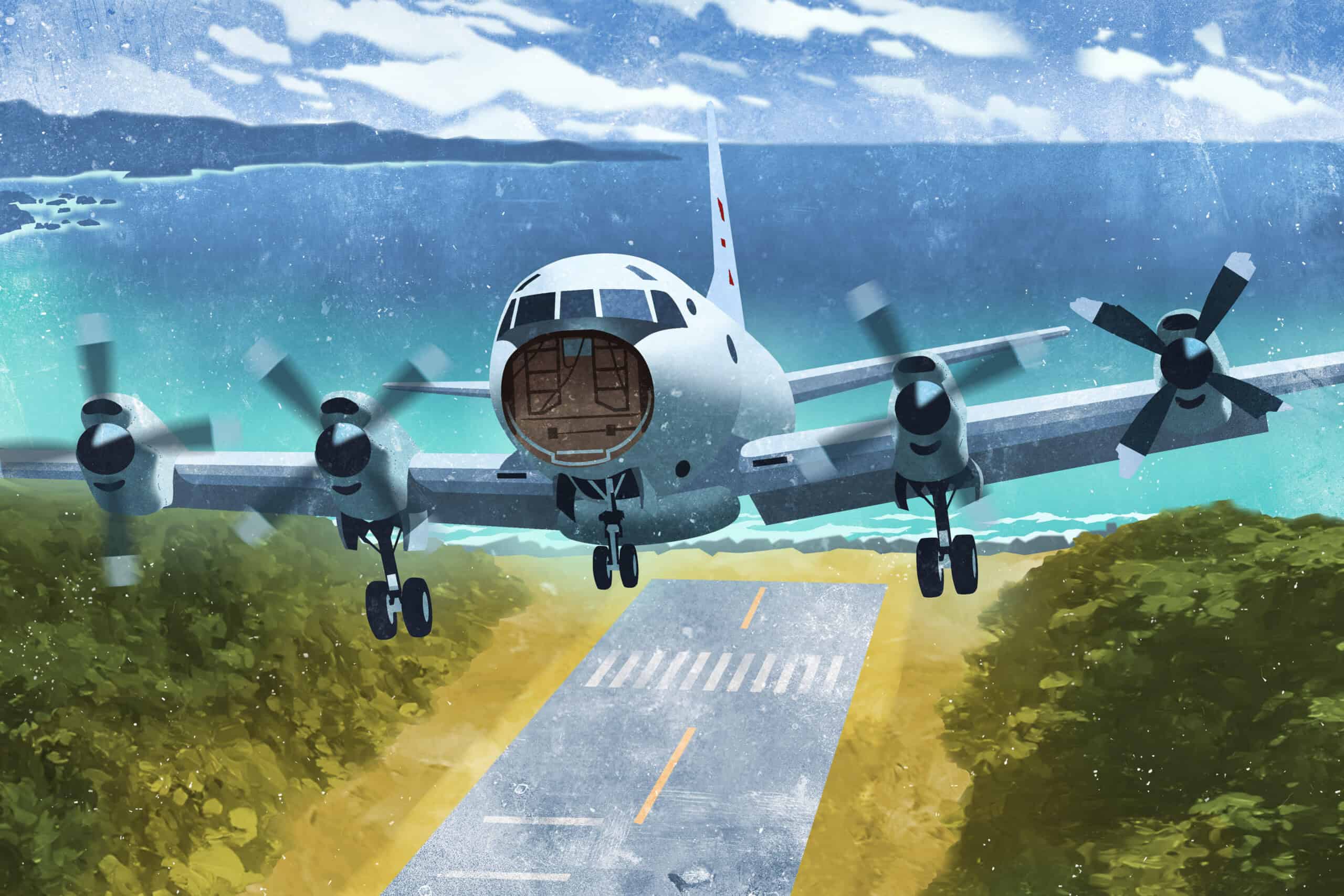
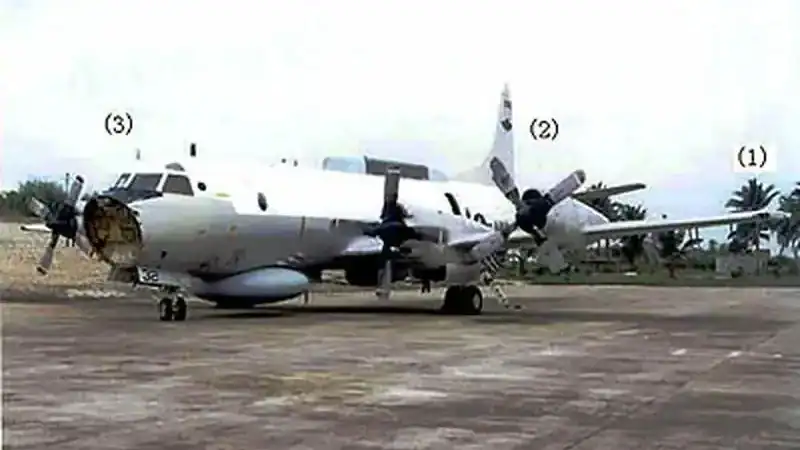
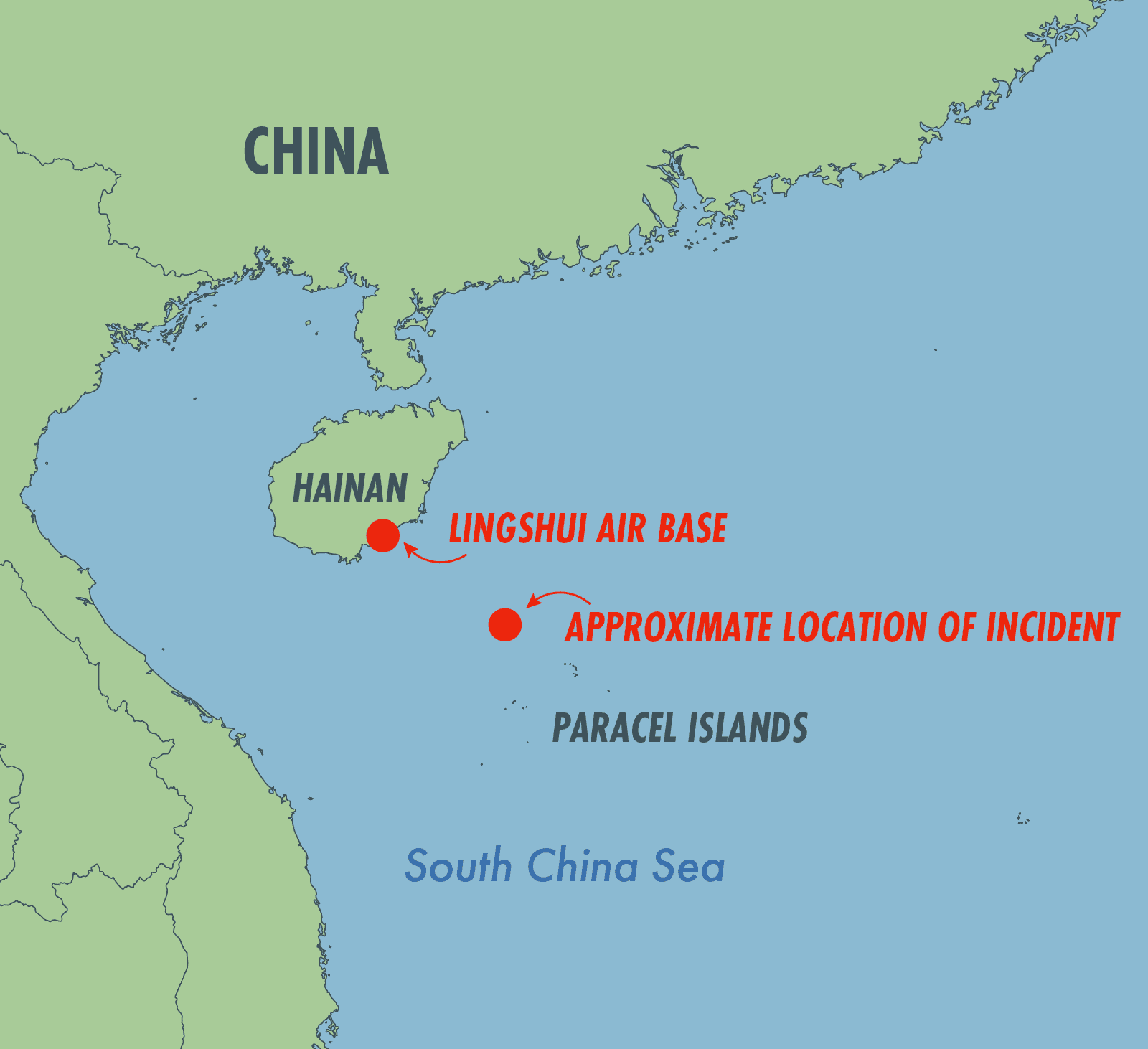
Twenty-five years ago this week, on April 1, 2001, a Chinese fighter jet collided with a U.S. Navy spy plane over the South China Sea near Hainan island. The fighter jet plunged into the ocean; its pilot was never found.
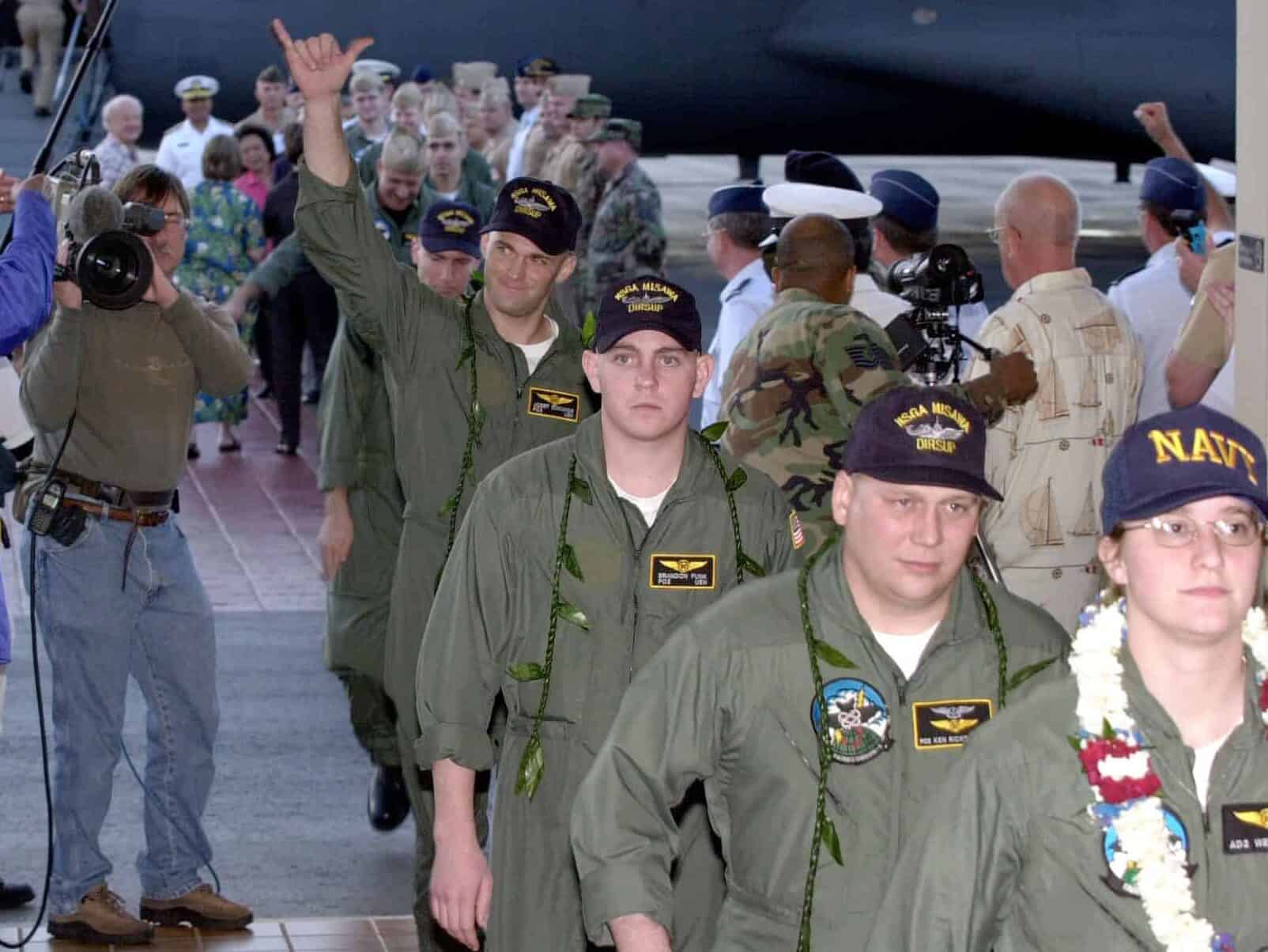
The badly damaged U.S. plane made an emergency landing at a coastal People’s Liberation Army air base, and its 24-member crew was held for 11 days. The incident was the first major foreign policy challenge for President George W. Bush’s new administration.
In the first of a two-part series on the Hainan spy plane crisis, The Wire China speaks with four participants about their experiences, reviews two first-person accounts of the incident, and asks what lessons it holds in a far more tense era for Sino-U.S. relations.
The six sections in Part I run to 6,300 words. Readers who prefer can jump to each of the sections by clicking on the hyperlinks below. Part II of the series will be published in our April 5 edition.

The Ambassador — Joseph Prueher (U.S. Navy Admiral, retired)
The Embassy got a call on a Sunday morning, the first of April. My wife Suzanne and I were out with another couple in Beijing. We had a place where we went to worship on Sunday mornings. We got a call from the embassy. They had gotten a call from CENTPAC headquarters that the EP-3 had a collision and was on the ground safely at Hainan Island. We dropped off Suzanne at home at the embassy residence, and went in and were trying to contact the foreign ministry to talk to them about it. They weren’t accepting any phone calls from us at that time.
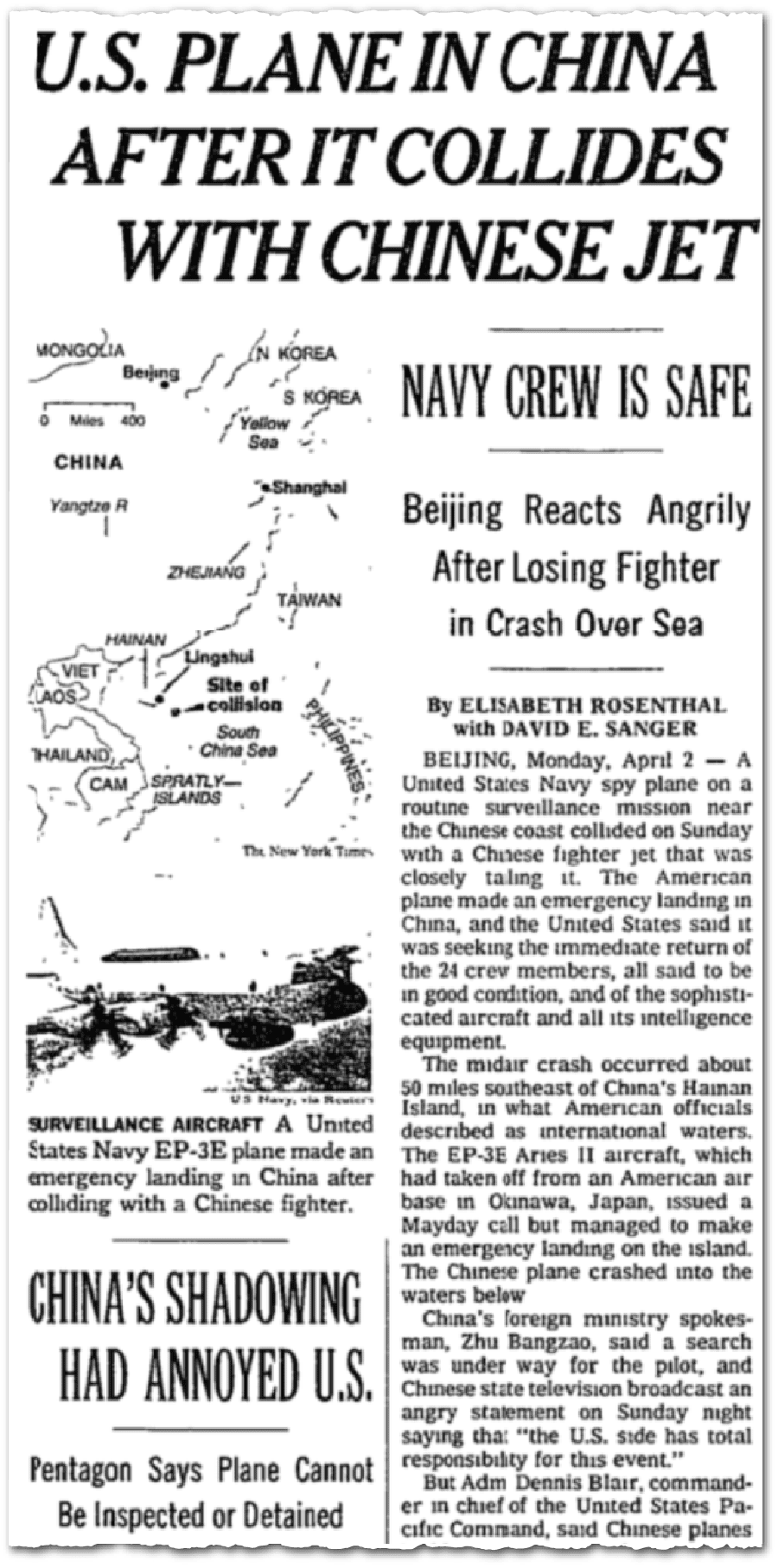
I called [Secretary of State Colin Powell] and he was aware of it already. I told him I was trying to get the foreign ministry, and they weren’t answering the phone, and I would keep him informed.
That Sunday, we confirmed that the crew was on deck and they were safe.
It wasn’t until about nine o’clock that Sunday night that I got an urgent call from the foreign ministry that they needed to see me right away. The Chinese in those days, and probably still, their hierarchy is such that before they start talking to anybody, they want to have a pretty good game plan together. And so when I walked into the foreign ministry, which wasn’t too far from where our residence was, they had in place the person with whom I was going to deal, [Assistant Foreign Minister] Zhou Wenzhong, who had just [gotten] back about three days earlier from being their ambassador to Australia. He’s a fluent English speaker, and though I had a bevy of interpreters with me, we conducted the negotiations thenceforth in English, which was unusual for them.
Their immediate five accusations were: “You invaded our airspace, you rammed our airplane, you landed without permission, we demand an apology, and we demand reparations.” And I responded that I disagreed with every point.
So I called [Powell] with that initial set of points from the Chinese. From an aviation point of view, it was almost an impossibility that our big, lumbering aircraft could have hit their more maneuverable aircraft. Our people had called for an emergency landing, and the people at the airport in Hainan had done the right thing in letting an aircraft in extremis land.
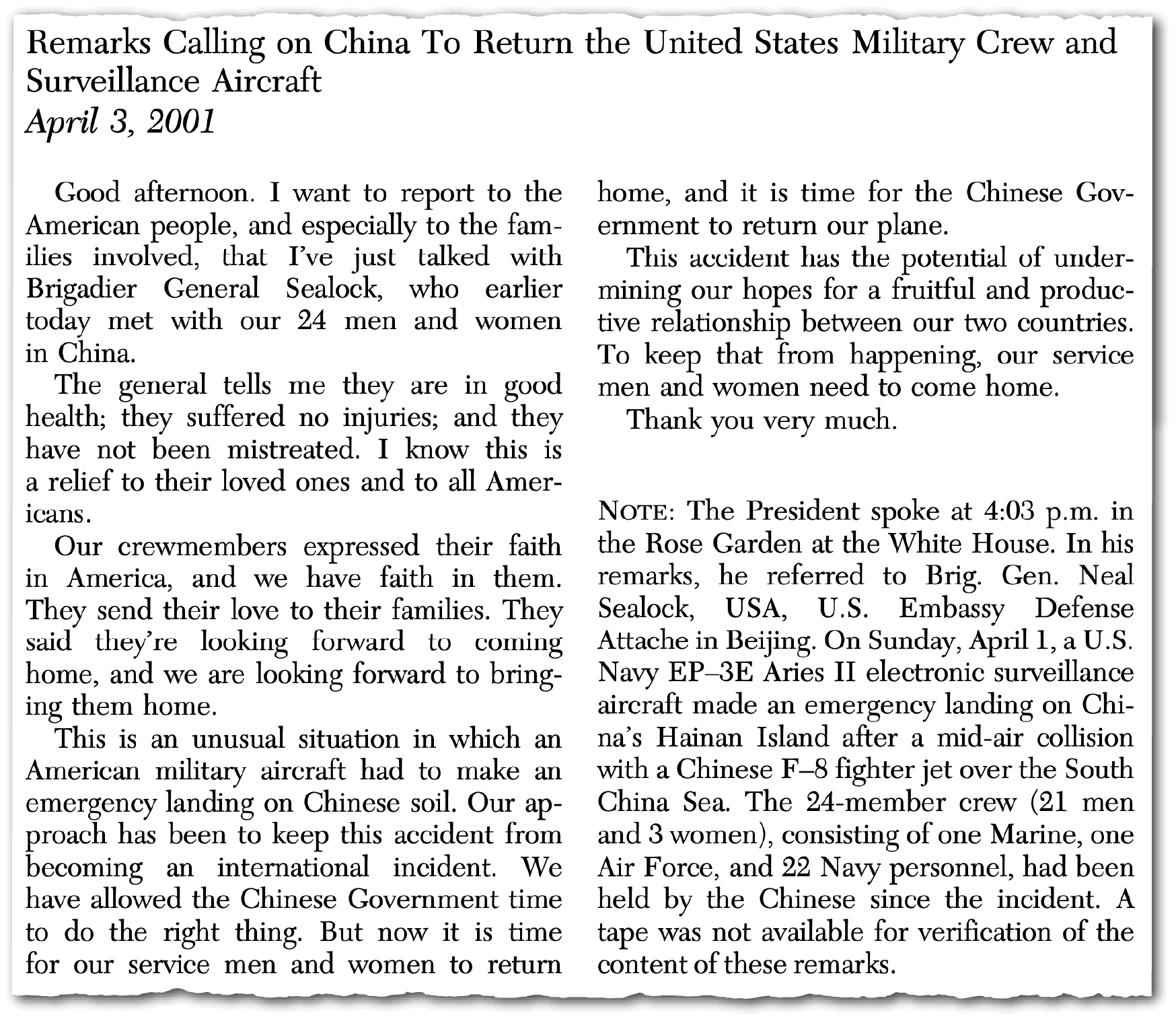
I said we have nothing to apologize for, and we shouldn’t have [to pay] reparations. We all went to bed and got up the next morning to go at it again.
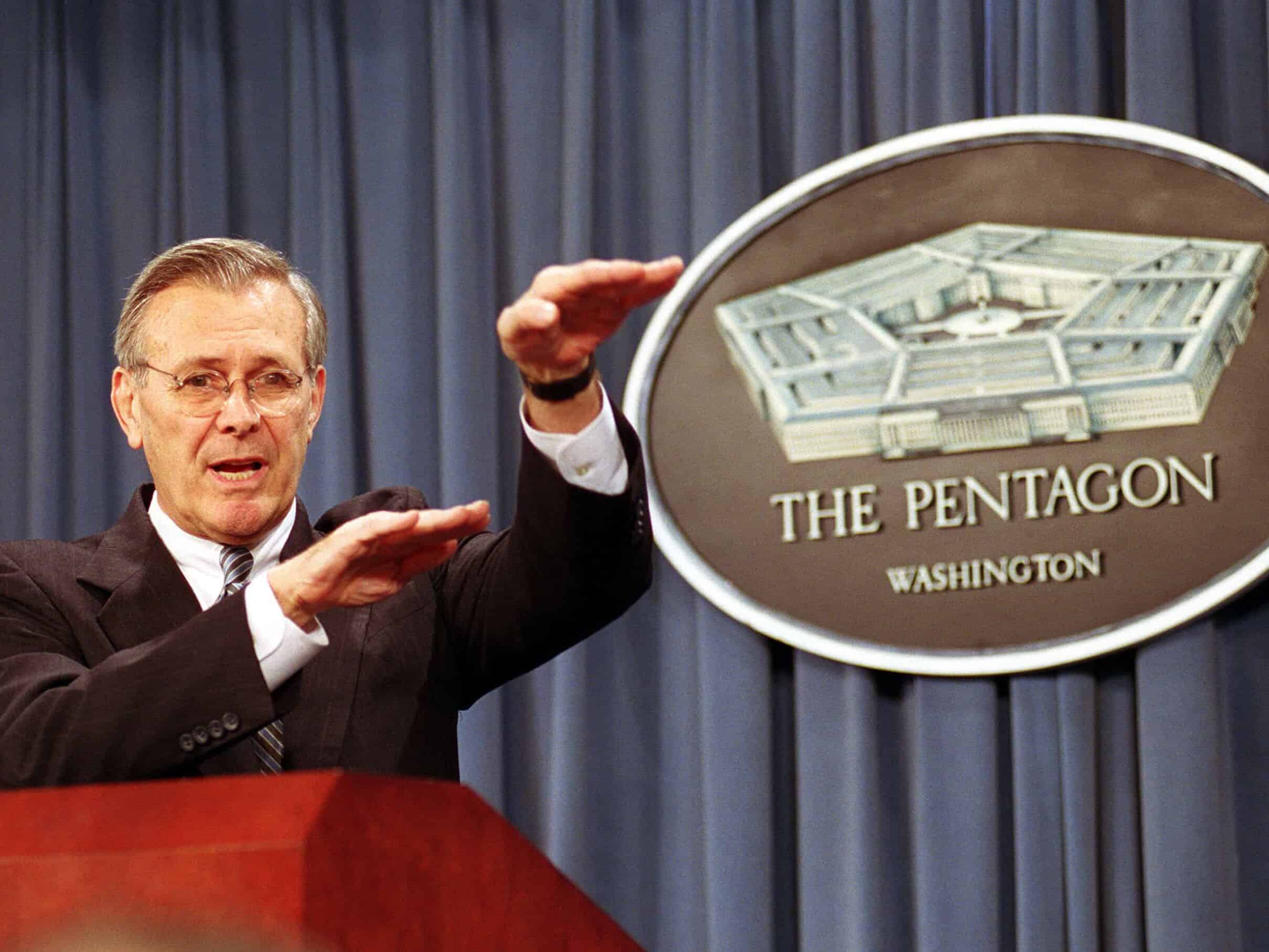
The other thing that Secretary Powell and I discussed is there had to be something for the President [George W. Bush] to say. Secretary Powell’s allowing us in Beijing to handle the negotiation was somewhat unusual for the State Department but it was what they did. His access to the president, to get quick turnaround on decisions, was just amazing and contributed greatly to the success of the negotiations to get our crew out of there.
Shane Osborn was the command pilot on that EP-3, and they did a great job from an airborne emergency point of view. They had to get rid of materials that they had that were highly classified. And aerodynamically, to get a wounded airplane on deck was quite a good aviation feat. We felt very much that they’d done the right thing.
One of the other seasoned ambassadors, when I got to China, talked about negotiating with the Chinese. He described it as “diplomacy with the Chinese is always a matter of building ladders for them to climb down.” They will take a very strong and outrageous position to start with. It’s not necessarily reasonable.
As we started the negotiating, [President] Jiang Zemin had a person who was like his chief of staff, whom I had called on when I first got there to be ambassador. He commented that the foreign ministry will not always present your views as you would like to have the president [Jiang] hear them. If you need to have that done, he said there are two people [to contact]. One was Liu Mingkang, who was the president of the Bank of China then, and another one was Dai Bingguo, who was the head of the Communist Party School. [They] were very close to Jiang Zemin. Before [the Hainan incident] I had gotten in touch with each of those people, and we’d gone to have a cup of tea together to establish that relationship, which we did use during the time of negotiation, when I thought the word was not getting through the Foreign Ministry correctly. I described that as sort of the capillaries — as opposed to the main arteries — in the discussion.
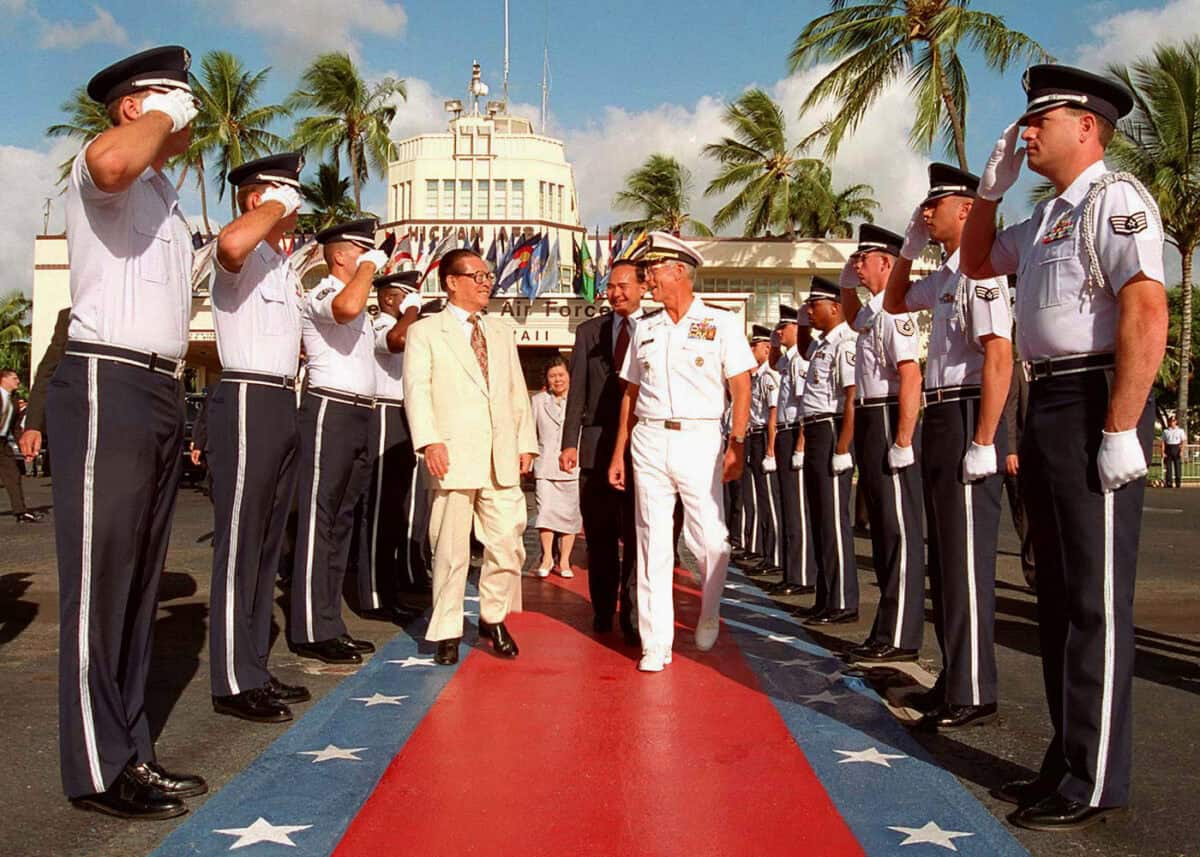
Jiang had come to Hawaii a couple of times [when Prueher was the head of U.S. Pacific Command]. We [Jiang’s chief of staff and Prueher] had been at a dinner table together. The embassy people, when I went to call on him, said, “What are you doing that for?” And I said, “Well, you never know.”
We spent a lot of time the first couple of days talking about whose fault it was. They said “your airplane rammed our airplane.” I had an advantage here that I didn’t usually have. I knew what I was talking about. I was a pilot. I rendezvoused on Russian bears and badgers [planes] myself, and then in command of other squadrons. I knew a lot about it, and I knew that the big airplane didn’t ram the other airplane. I could throw language at them that they were unfamiliar with about aviation. They just backed away from making that point.
We wasted two days talking about whose fault it was. [Sinologist] Ken Lieberthal, who was on the National Security Council in the Clinton administration, happened to be in Beijing, and I asked him to come by the embassy. We went into the secure trailer to talk, and he made the point that they’re never going to admit it was their fault. He said, “If you can get by that, you might get on with solving the problem.”
So I talked to Colin Powell and [said we should take] a change in tack here [and stop] discussing whose fault it was, and just call it a collision. I don’t want to admit it was our fault, but I just want to take that out of the discussion. He said, “Okay, do that.”
The Chinese view is they like to be seen to be strong militarily, but war is not something they welcome at all. In the last 75 years, they’ve not spent trillions of dollars on various wars. Being seen to be strong is very important, but they think the strength of it is in deterrence…
Joseph Prueher
We also had some films of the Chinese pilot making rendezvous previously on other airplanes that were barely under control, and doing some things where he could be recognized. They didn’t want those films to come out, and we never used them publicly at all. So we took whose fault it was out of the discussion.
We had hard information on where the collision occurred, and it was in international airspace. That left the landing without permission. Well, our guys had called for permission, but they did not get a response.
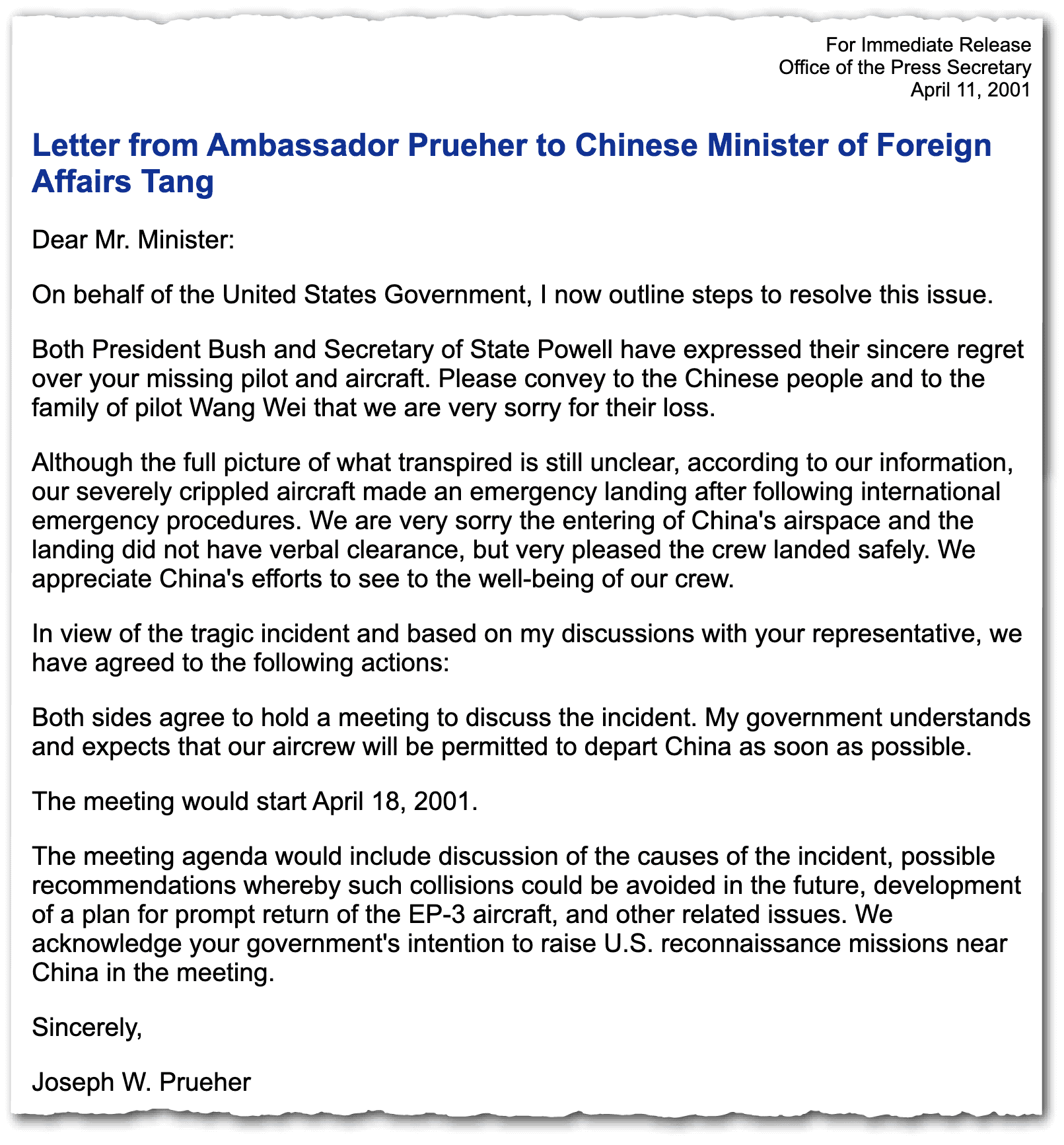
That left the issue of apologies. I’d said “we don’t have anything to apologize for.” Well, this went on for a while. I said, “We regret that you lost the airplane.” And we went through a long bit of linguistic nuances about the difference between regret and being sorry. Finally, to get an agreement, I agreed to say we were sorry that their pilot had been lost and we were sorry that they had not heard us when we called for landing.
Thus came the “letter of the two sorries”. I thought long and hard about that. Is that something I can live with? Colin Powell was protective of me and he didn’t want to do that, especially. But he said, “let’s say that it’s not the president, it’s not me, it’s that stupid ambassador that did that.” So we signed that letter.
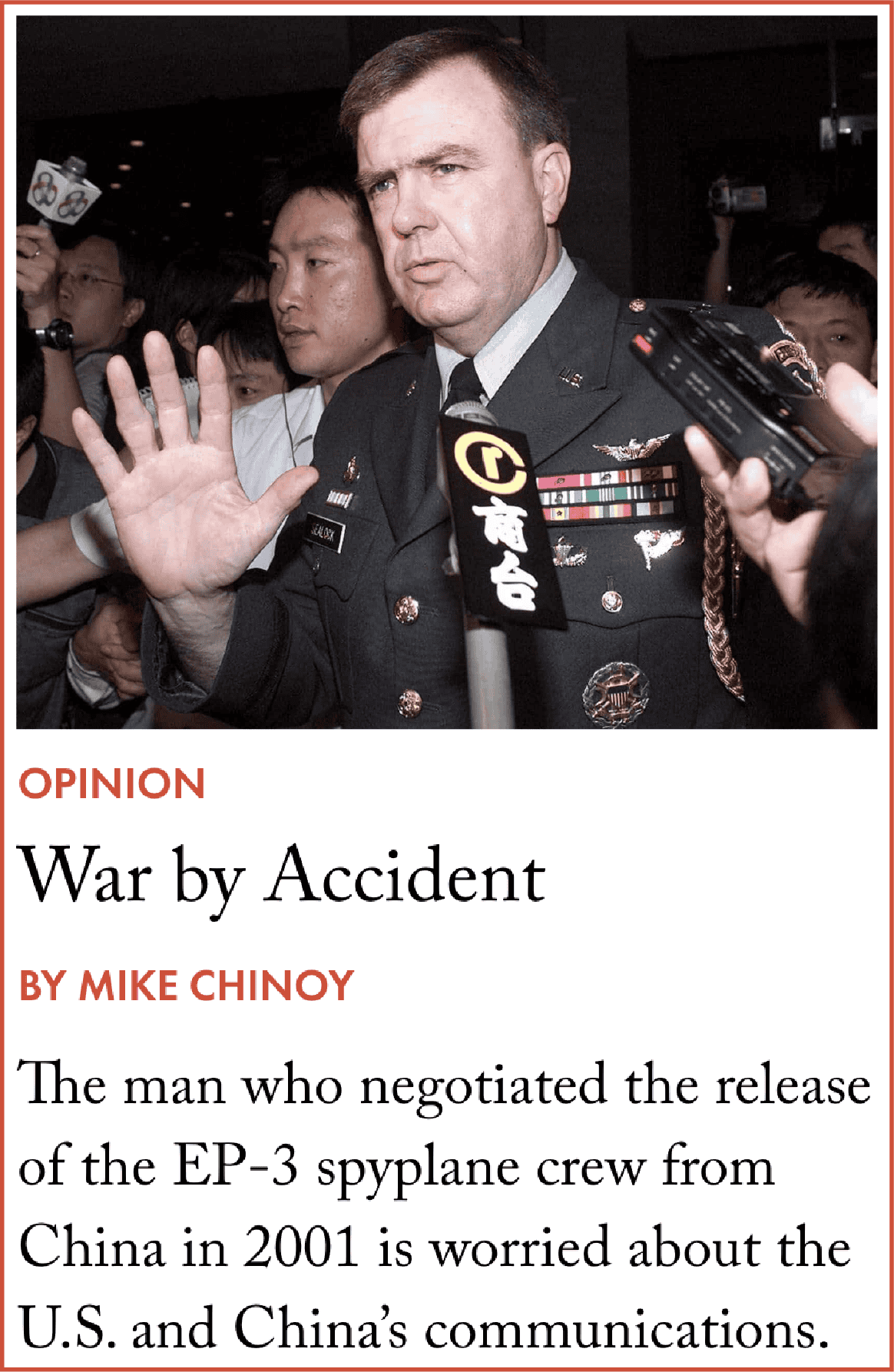
I was at the embassy with two great defense attachés. The first one was Karl Eikenberry, who was fluent in Chinese. And the second one was Neal Sealock. Neal was my agent, and I had full trust in him. And he went and spent the time down at Hainan to make sure our people were being cared for.
Jim Moriarty was a political counselor [at the embassy], and he had an interpreter, a brand new woman named Fay Sim, whose name is now Fay Bennett, who does interpreting in Washington now, and they and then a couple of other people who were really good linguists would be with me so that we would understand the nuances. They would pick up the side discussions the Chinese were having in Mandarin.
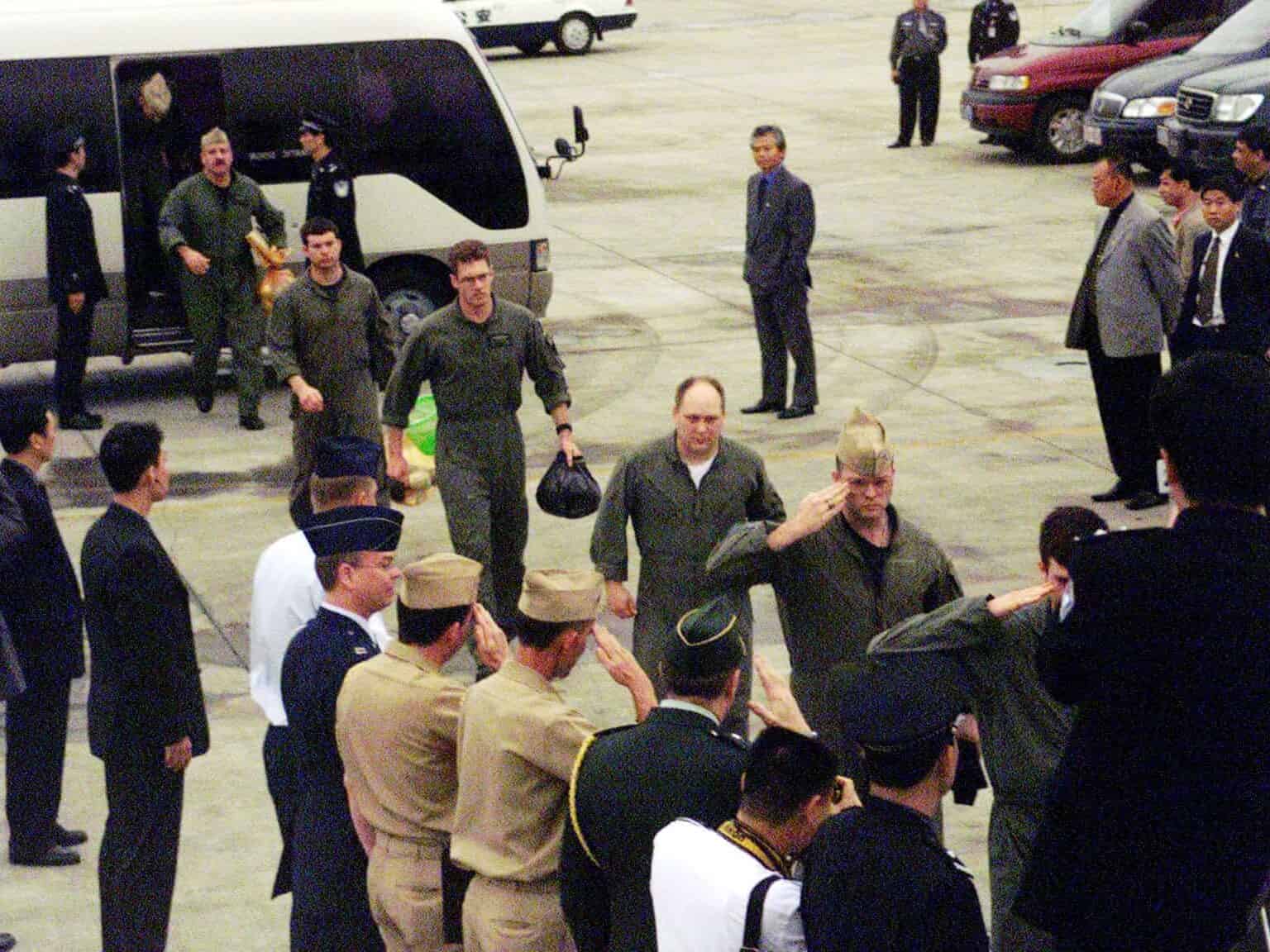
It worked out well. We got the people out of there in 11 days. The one other thing is the Chinese would have let us fly the airplane out the end of May. They had told me that on the side, but when we got the crew out in Washington, it shifted where it took Colin Powell out of the loop and put [Defense Secretary Donald] Rumsfeld in the loop, and he sent over an agent for him, who was a deputy assistant secretary of defense for something or another, who came over and started to dictate to the Chinese, a hardball approach of negotiating to get the airplane out. The Chinese response was sort of “Okay, watch this.” And they asked me, “What’s going on?” I said, “I can’t help it.” There’s been a change in Washington.
The relationship with Jiang Zemin was a very, very strong one. We communicated with each other. We trusted each other, and we were actually in a mode to try to solve things, rather than just be confrontational about everything. That helped a lot. It also helped the Chinese [wanted to host] the 2008 [Summer] Olympics. We had a say in that. [And] after the Clinton administration, one of the big things that they worked on was getting China into the World Trade Organization. That was pending at that time. Plus we were their biggest trading partner. Those three things made their reaction a little more measured than it might otherwise have been.
I don’t want to make too much of this, but [my wife and I] actually had a fairly warm personal relationship with Jiang Zemin and his wife. We sat with them at the Special Olympics. They invited us to sit with them. It was residual from the time I was [Commander-in-Chief of U.S. Pacific Command] when we tried to do some things with the PLA to solve problems rather than just be confrontational all the time. We got along pretty well. We could laugh and talk candidly about things, and I think that helped.
Are you confident it would be solved as easily now?
I think it would be more difficult now. I don’t know that Xi Jinping has a relationship with anyone. He is just a very different character than Jiang Zemin. The Chinese view is they like to be seen to be strong militarily, but war is not something they welcome at all. In the last 75 years, they’ve not spent trillions of dollars on various wars. Being seen to be strong is very important, but they think the strength of it is in deterrence rather than actually fighting.
The Chinese are certainly not a monolith. It’s like saying all Americans think this. Xi Jinping seems to have a grip, getting rid of some pretty high powered people. He’s as close to monolithic as you can get, but he’s got a lot of things to worry about.
Each nation really thinks their way is the best way to run things. And Jiang Zemin, one time when we were talking, he said, “I’d love it if China were a democracy, that sounds really nice. [But] there’s no way we could run this country as a democracy. And you may find out you can’t [run] yours [as one] either.”
As told to Noah Berman.

The Foreign Minister — Tang Jiaxuan
By Rachel Cheung and Tom Mitchell.
On April 1, 2001, Foreign Minister Tang Jiaxuan was overseas, transiting through the airport in Nice, France, when his man in Paris rushed up to him. Tang wrote in his memoirs, Heavy Storm & Gentle Breeze (2011), that China’s ambassador to France, Wu Jianmin, spoke “in hushed tones before even sitting down”, with news of the collision over the South China Sea.
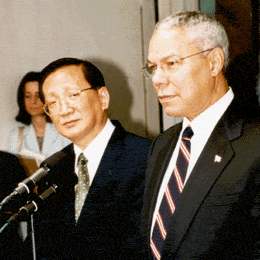
“It seemed accidental, but actually it had a certain inevitability to it,” Tang writes. “Ever since the founding of the People’s Republic of China, the U.S. had never stopped reconnaissance flights along the edge of China’s waters.
“From the second half of 2000, the flights had grown more and more frequent and closer to China’s territorial waters. China had repeatedly lodged representations to the U.S. through various channels, demanding that it stop such reconnaissance activities, but the U.S. turned a deaf ear and stuck to its old ways.”
The next day, after a meeting with French President Jacques Chirac in Paris, Tang spoke to reporters about the crisis. He insisted that “the U.S. plane had suddenly veered towards a Chinese military aircraft that was flying normally” and “there was a mass of evidence that the U.S. plane was responsible”. But Tang also notes in his memoir that throughout the crisis, China needed “to bear in mind the broader situation of China-U.S. relations”.
Like the U.S. officials interviewed by The Wire China, Tang says that resolution of the crisis ultimately hinged on the wording of an American apology. But while Washington saw the apology as a means to an end — or “building ladders for [the Chinese side] to climb down” — Beijing saw it as a deeply serious matter.
“The issue of apology lay at the heart of the struggle concerning the air collision incident,” Tang writes. “In my view it was not simply a matter of semantics or rhetoric, but a political issue for history. So, I instructed the Department of North American and Oceanian Affairs to have the U.S. letter translated and polished by veteran experts, to ensure the accuracy and flavor of the Chinese version.
“[Chinese linguistic experts] concluded that ‘sorry’ was certainly an expression of apology when used between governments of two countries, and was usually modified by ‘very’ or ‘deeply’ to intensify the tone. Thanks to our arduous efforts, important progress was made in our initial diplomatic struggle by forcing the United States to meet all our demands and formally hand over a letter of apology. For the occasion I chose to wear a dark suit.”
Tang could not be reached for comment.
The Chinese Pilot — Wang Wei
By Rachel Cheung.
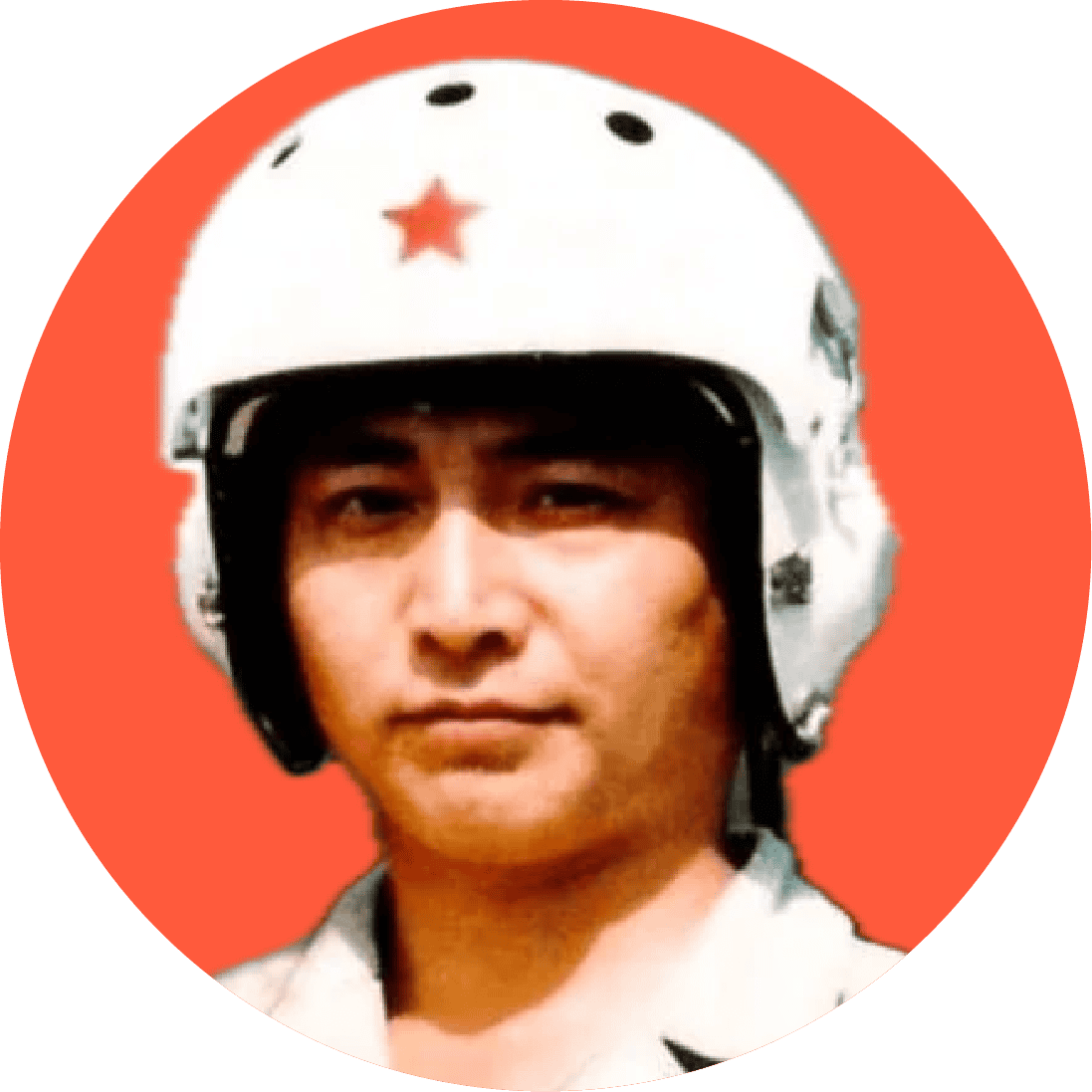
As soon as the alert siren at the Lingshui air base went off, Wang Wei and his wingman Zhao Yu immediately rushed out of the duty room and took off in their F-8 fighter jets to intercept the U.S. reconnaissance plane.
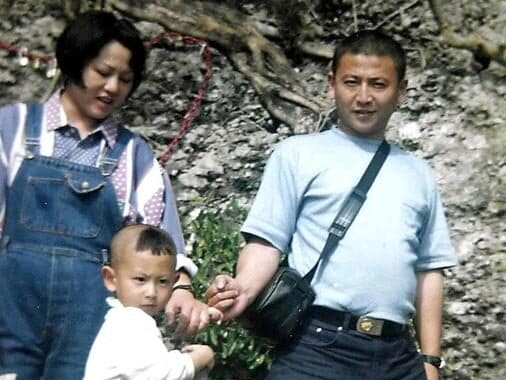
It was Wang’s 15th year with the Chinese military and the 33-year-old was among the Chinese navy’s top pilots, his widow Ruan Guoqin wrote in her memoir Calling 81192, (the number being Wang’s call sign). Calling 81192 was published last year around the 24th anniversary of his death. The night before, he had briefly returned home to see Ruan and their young son before heading back to the military base for yet another shift. She stood in front of the building and watched as he rode away on his bicycle. That was the last she saw of him.
Wang, born in Huzhou, Zhejiang, had aspired to be a pilot since he was a child. He grew up wearing hand-me-downs. The first new clothes he ever owned were a set of green military uniforms. His parents were ordinary workers, but his aunt and uncle took part in the Long March and fought in the war against the Japanese Imperial Army.
In 1986, Ruan writes, Wang applied to join the air force without his parents’ knowledge. The military made him get their permission before he could enter.
Looking for the best China coverage?
Subscribe to The Wire China today.
He would also join the Chinese Communist Party. “I wish to join the Party, not to gain ‘political capital’ nor to seek promotion or wealth,” he wrote in his application. “I only wish to hold myself to the standards of a Party member, and to contribute my everything for the interests of the Party and the people, even my life.”
Wang spent five years at the military academy where he excelled in aviation but also stood out for a Maverick-like Top Gun temperament.
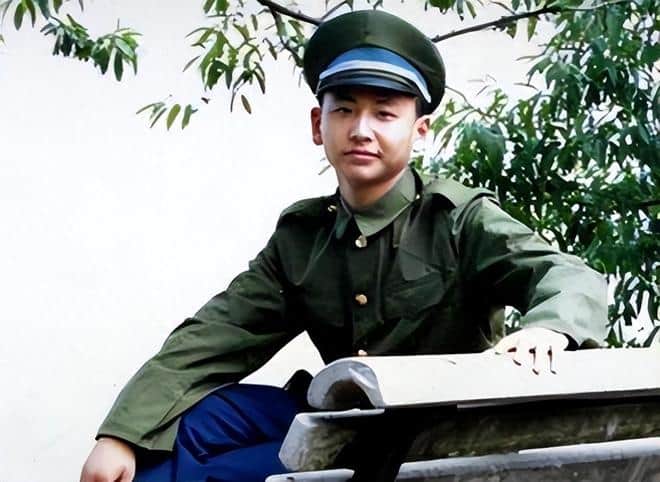
“I performed 18 barrel rolls. The binoculars at the control tower were fixed on me, and the instructors were a bit shocked,” Wang wrote in a letter to his wife in 1989, when he was 23. “Consequently, I’ve become quite famous for having a strong physique. The group leader explicitly instructed me that I could only perform maneuvers in the inner airspace during solo aerobatics.
“Being impatient and unable to stay calm is a major flaw of mine,” he added.
Ruan writes that Wang gave up a more stable military career for opportunities to fly newer and newer planes. (Transferring to new jet fighter types meant retraining and sacrificing a faster advance up the ranks.) Wang told his peers: “I don’t care about being an officer; I just want to fly the best planes.” By 2001, he had flown 2,000 sorties and 1,152 accident-free hours, according to the memoir and Chinese media reports at the time.
Chinese state media said the two F-8 fighter jets piloted by Wang and Zhao followed and monitored the U.S. plane. According to this version of events, Wang was flying in parallel with the EP-3 when it allegedly made a sharp turn to the left, veering into his jet. “The U.S. plane’s nose and left wing rammed the tail of the Chinese plane, causing it to lose control and plunge into the sea,” a Chinese foreign ministry spokesperson said. Chinese officials said Wang parachuted from the jet before it crashed into the sea, suggesting that he may have been alive in the water. (In Part II of this series, one of the members of the EP-3 crew tells The Wire that he also saw a parachute.)
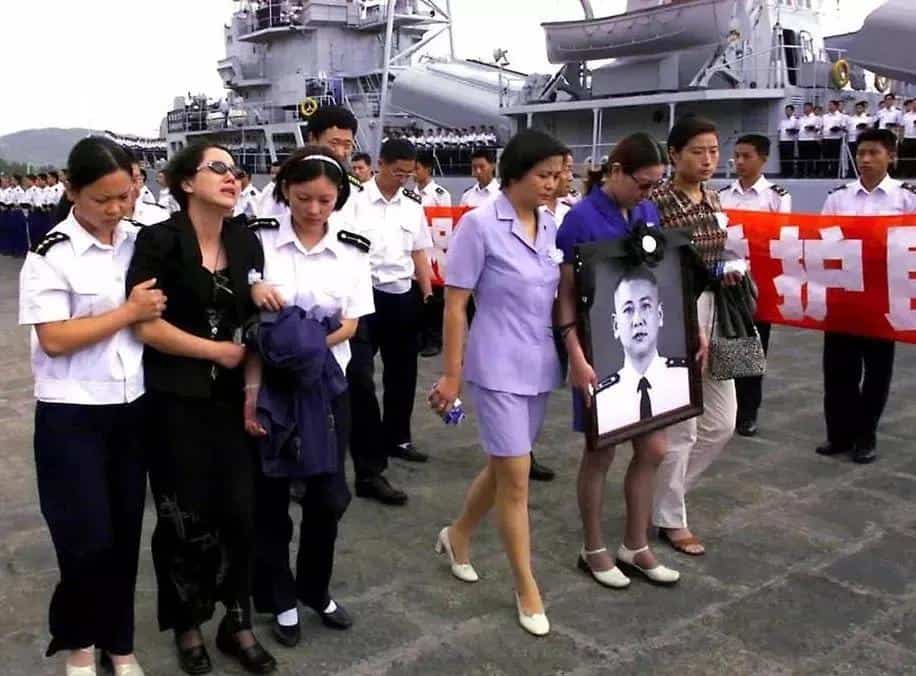
“Every comrade participating in the search did their utmost,” Ruan wrote, “racing against death every second … At that time, the South China Sea was in the monsoon season, with average winds of force 5 to 6 and waves about 3 meters high.”
China dispatched 113 warship missions and 115 aircraft sorties to search for Wang. Tens of thousands of military personnel and civilians joined in the 14-day operation, scrutinizing every floating object in the water.
Wang was declared a “revolutionary martyr” on April 14. In a memorial speech, Ruan said she would “turn grief into strength, work hard, and raise our child well so that he may inherit Wang Wei’s legacy and complete his unfinished work.” In 2024, Wang and Ruan’s son, Wang Zi, graduated from Peking University and became a naval officer.
Ruan’s publisher did not respond to The Wire China’s requests for an interview with her.
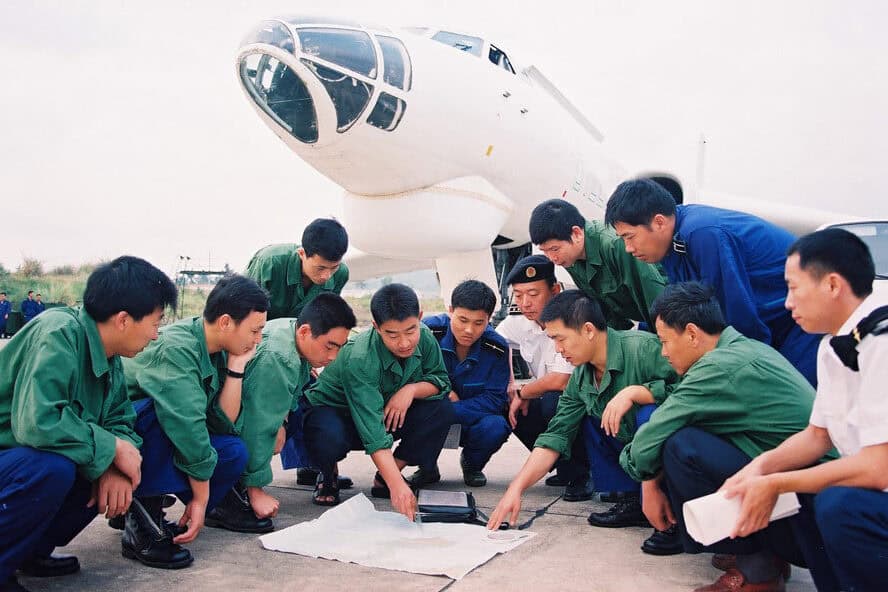
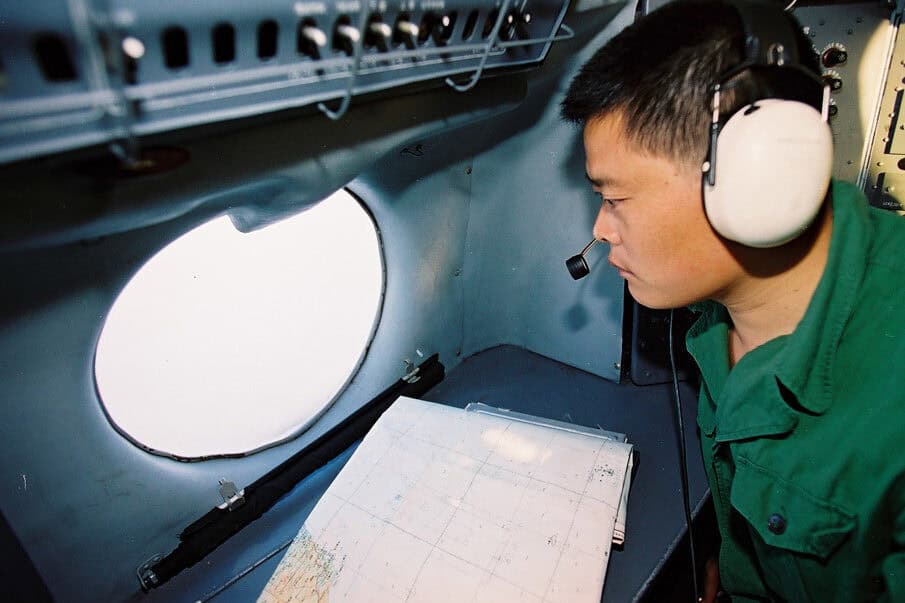
Air crew conduct search and rescue missions to find Wang, April, 2001. Images via China Aviation Media.

The U.S. Pilot — Shane Osborn
Back then, the Chinese naval air forces didn’t even train off their own aircraft for flying formation, so they didn’t have the training to be flying formation, let alone on a big, slow prop airplane that’s going way too slow at that altitude for them to have controllability. Usually they come out, they’d intercept us, they’d break away, and then they’d leave.
In this case, they all of a sudden started coming back again, and we were already heading home. I was calling up the navigator to confirm we’re in international airspace because my first concern was that we had wandered off. [Our] airplane, back in that day, did not have the most sophisticated system. The only GPS we had was back at the navy station, so the pilots had no access to that. I couldn’t believe how aggressive they were being.
He came in too fast, and so he tried to slow his aircraft down by pitching the nose up. Well, when you pitch your nose up, what happens? The aircraft goes up. He started out below my [left] wing and quickly rammed into my wing. Right where his tail meets his fuselage is where my far left engine literally cut him in two … We were flipping inverted because of the impact on my left wing. As we rolled, we had a separate impact. His nose hit my nose and tore my nose off. Next thing I know, I’m in this big, lumbering aircraft upside down, looking up at the South China Sea. I thought we were dead for sure.
[Wang Wei] was trying to be aggressive and intimidate us, and frankly made a tragic error. It almost killed 25 of us instead of just one.
We started to fall. I just wanted to get my bearings. I want to get control of it. We lost almost 9,000 feet [of altitude while] inverted. Then we lost another 7,000 feet as we came out of the dive. And we finally got into thick enough air, down low enough that I could somewhat control the airplane, but it was taking all the strength I had.
I think that the overall effect was positive, because it made the Chinese realize that reckless behavior by pretty junior people can lead to serious pressures on the government. And the Chinese, above all, want to control things.
Dennis Blair
I had to have the yoke full right over and full right rudder just to hold the airplane up, because that far [left] prop that had cut his aircraft in half was what we call windmilling. It’s out there spinning with a flat blade, and the aerodynamic equivalent would be like tying a parachute to your left wing. It’s that much drag.
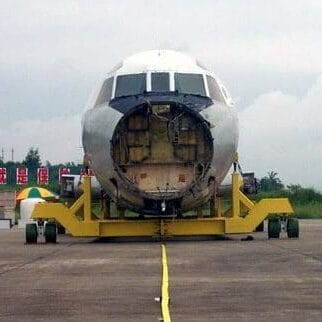
Because [our] nose was torn off there are cables flapping up against the windscreen and I was worried that prop was going to fly off the airplane … In the meantime, the other fighter rolled in our six [taking up position behind the EP-3] and … asked for permission to shoot us down. They told him no, thank God.
Our plane was disintegrating. I had one engine gone, another engine damaged [and] severe controllability issues. We had to activate the destruction checklist for the crypto gear and tried calling on the emergency frequency [for permission to land], but they wouldn’t answer us.
Now we’re on the base where their pilot didn’t come home, so I’m sure they’re not really happy. And they’re trying to figure out what’s going on. I’m trying to get calls out to let everybody know we’re alive for now … About 20 armed soldiers came up and started surrounding the airplane.
I’m not going to get into a standoff over this. Everybody’s alive. We did our job and now it’s time to take care of my crew and make sure I brought them home with their honor intact. I told the crew, nobody speaks to these authorities unless I’m standing there telling you to talk because I was the mission commander as well as the pilot command, and they followed it to a tee. My crew did a great job. My whole goal is just to get them home.
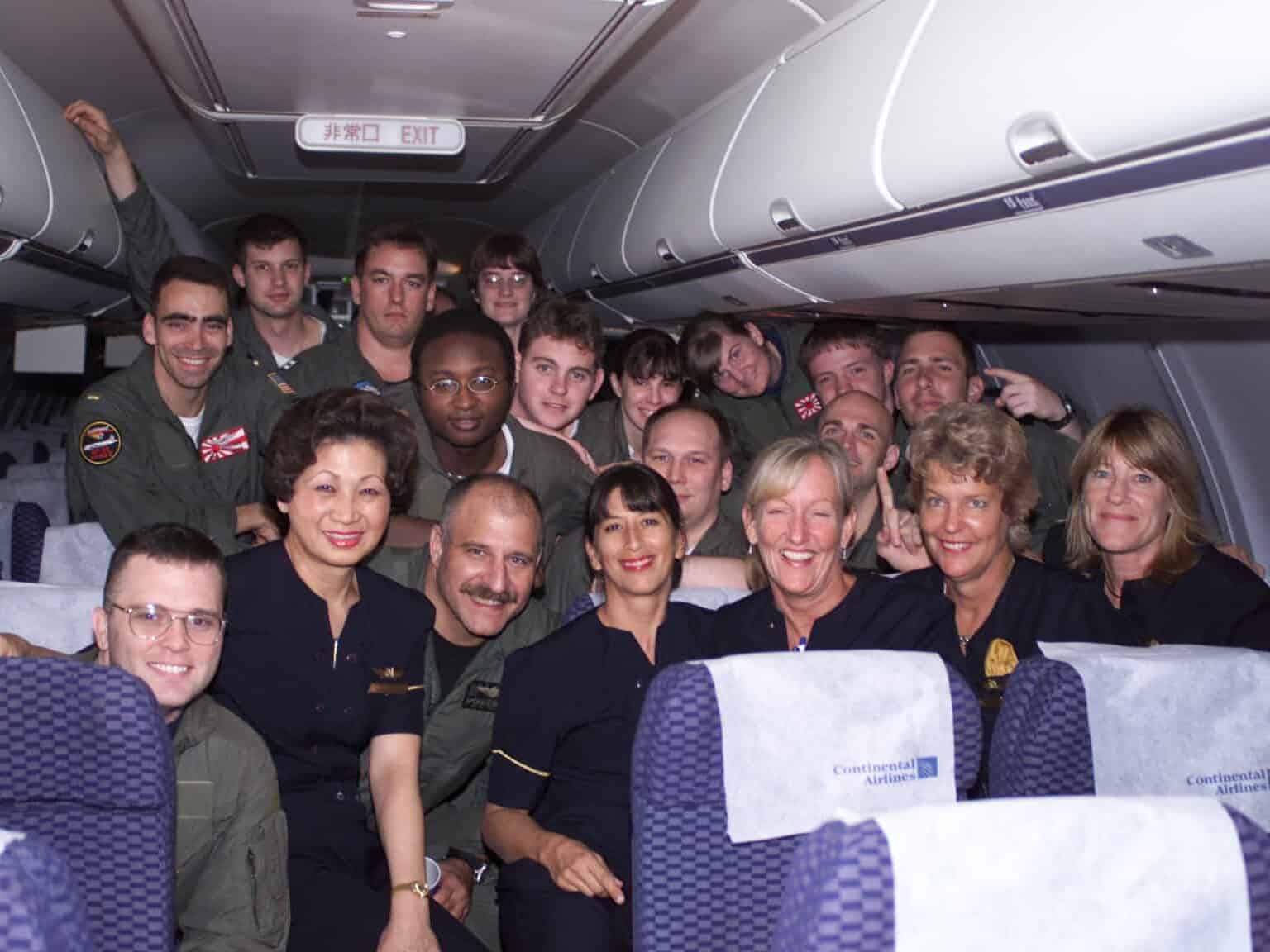
I’m getting interrogated eight hours at a time. They let me doze off for like a minute and then wake me up and scare me. They had me fairly convinced for several days that I was going to a prison, that they may release my crew on humanitarian grounds, but I was going to be tried for murder and [espionage].
I wasn’t happy that [Wang Wei] died. I told them, listen, this was an accident. But there’s a difference between that and apologizing. I was in international airspace, flying straight and level on autopilot and got hit. I don’t need to apologize for anything. Am I sorry for the loss of life? Absolutely. We all are. But there’s a difference between the two.
People would ask, what kept you in it after days and days? I had a saying: the blood wasn’t going to go thin on my watch. If I did get home, I would have to face everybody the rest of my life, and I’m not going to come home a coward. That was my attitude and [the Chinese interrogators] knew it. They knew I wasn’t going to break.
It’s frustrating to me still to this day that they take no responsibility and act like it was our fault. It is what it is. I think the world saw what happened and I don’t think anybody took [China’s version of events] seriously. But I also understand the importance in the culture there of saving face.
Did it shape your view of China?
Oh, I don’t think it shaped it one way or the other. I think the Chinese people are good, kind, and hard working people. I’m just not a fan of their government. I’m an American. I don’t think our system is perfect, no, but it’s a heck of a lot better.
We just pray that someday China opens up more to freedom and democracy. That would be an awesome thing to see. It would be amazing. But it may not happen in my lifetime.
Are there risks of a similar incident happening today?
Absolutely. [Chinese pilots] are better trained though, so they’re a much more professional air and naval air force than they were 25 years ago. Their capabilities are higher, but anytime you’re hot-dogging, you run that risk.
I think the Chinese leadership has some uneasiness to say the least. If they would have a chance to look strong, I think they would take it. It’s kind of like what they’re doing around Taiwan, flexing a little muscle there.
I’m so thankful that calmer heads prevailed back then. Frankly, that could have escalated into a cold war had we died. I can’t tell you who told me that, but it was somebody very, very senior in our intelligence agency that thought it could have turned out much, much worse had we not lived … We were able to tell the story [that] it was an accident. If we had died, the Americans [may] have said, you shot our plane down. It could have gone in a different direction, that’s for sure.
I just think we were very, very fortunate that the two governments came together in the way they did and managed to move on from it. It wasn’t pretty, but we moved on from it. And then people don’t realize, you know, six months later September 11, hit, so I extended my tour. I flew some of the first missions in Afghanistan. 2001 was a hell of a year for me. I flew over 300 combat hours in 34 days. I was getting shot at every night. And I tell you, you just really have to just find out what your priorities are in life. And for me, it’s prayer and the crew as well.
As told to Rachel Cheung.

The Admiral — Dennis Blair (head of U.S. Pacific Command)
When I first got the call, I was at a friend’s house in Washington, in the hot tub in their backyard. The command center rang and started telling me, and I stopped them and said, “Now I’ve got a pretty good sense of humor, but if this is an April Fool’s joke, let’s stop it right now.”
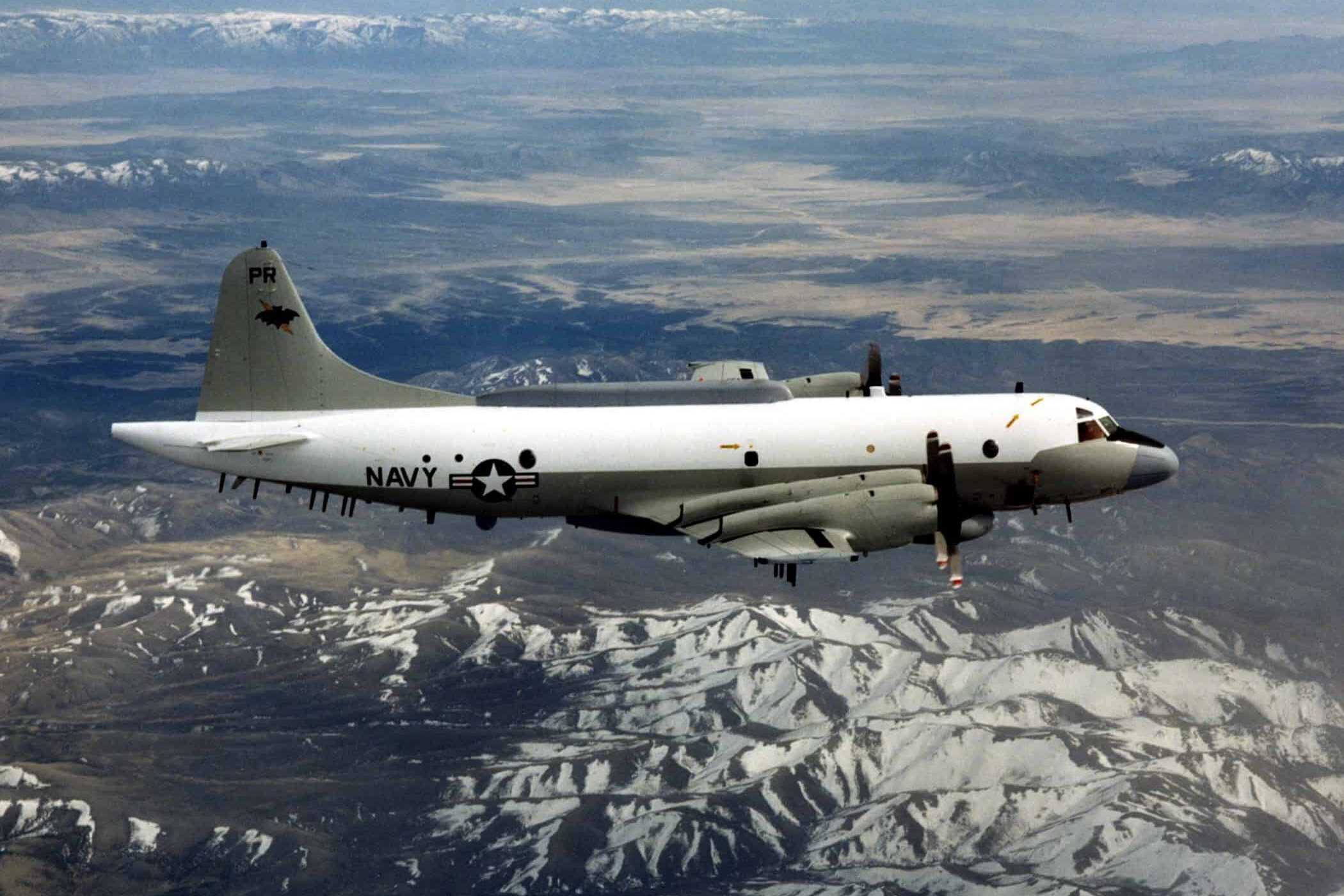
It wasn’t completely unexpected, because we had reports of this behavior by Chinese pilots who were intercepting our reconnaissance aircraft that were flying out of Japan and going on well known routes … off the Chinese coast. Sometimes they would call our air crews on international frequencies and say, “You’re in Chinese airspace, get out.” Our crews would respond, “Nope, this is international airspace. We’re still going.” That had been going on for a while.
A couple of months previously, we began to see this pattern, particularly from this naval air squadron down on Hainan. The aviators call it “flat hatting.” It’s when a plane tries to buzz another airplane or buffet it, which means crossing just ahead of it to create a turbulence and shake the other plane around. And they were coming dangerously close.
A few weeks before the collision I approved a message to our defense attaché in Beijing, Neal Sealock. I said “go talk to the people in the Ministry of Defense or the PLA, and tell them that this is going on and it’s dangerous and somebody’s going to be hurt.” I received the report back that they had delivered the démarche, and then nothing happened for a while. I was never able to establish if the information got any further in the PLA than the initial meeting. It didn’t seem to, because a couple weeks later, this incident happened. It was something that I’d feared.
One of our airplanes landing in Hainan was not something I had spent a lot of time thinking about. My thinking was that if they actually collided, then both planes would go down. We would be in a search and rescue situation.
We were able to get the information sent out by the crew 15 or 20 minutes before they actually landed in Hainan. They were throwing the secure code books out the hatch and trying to stay alive. And then when they landed, things went into a black hole, and there was just no communication from the Chinese side.
I basically said this is unacceptable behavior. If this had happened off of an American coast, we would have provided the Chinese with an immediate report on the health and welfare of the crew, and we would send them back. And we expect that from the Chinese. The next question was who was responsible for the collision? I said to reporters, “Just picture a big, multi-engine propeller airplane that’s been flying for several hundred miles in a straight line, and a smaller, maneuverable fighter aircraft. Who do you think was responsible for it?”
I went to a seminar several years later on the EP-3 incident in Beijing. I can’t remember the group that arranged it. It might have been the Carnegie Endowment, who were running a series of conferences at the time about crisis management.
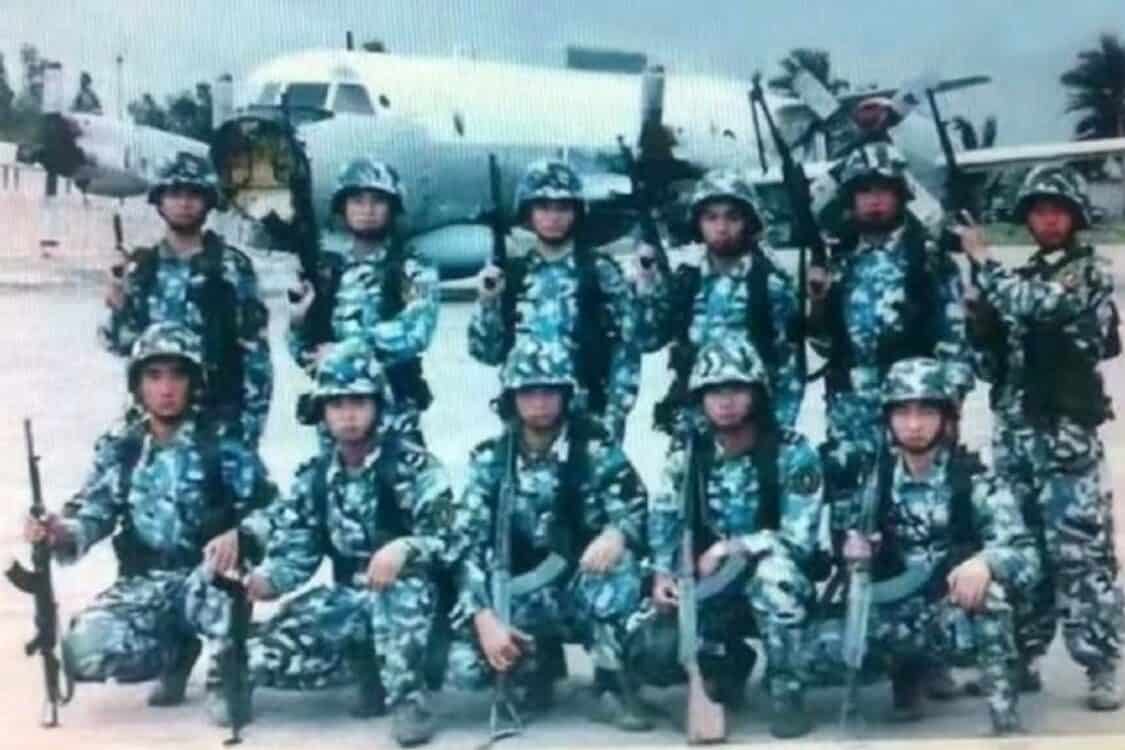
I had noticed that neither Ambassador Prueher in Beijing, nor Secretary Powell or anybody in Washington was getting any answers from the Chinese … It was pretty clear that the Chinese did not have a smooth-running crisis management team. They really didn’t know what to do. If you don’t know what to do, it’s probably best just not to return the phone calls from the other side. Chinese participants confirmed that they just hadn’t figured out what to do. And at that conference, they proudly presented a new system that they had developed for managing crises.
I also learned at that seminar that five different reports of what had happened went from Hainan up to Beijing. The PLA Navy sent one. The PLA Army commander sent one. The senior party official sent one. The governor sent one. And they were all different. So officials in Beijing were wondering, “What really happened?” And it took them a while to sort that out.
I was very sure that this was not some sort of manufactured incident that the Chinese were doing to kick off some move in either Taiwan or the South China Sea. We had none of the other intelligence indications that you would see if this were an intentional incident.
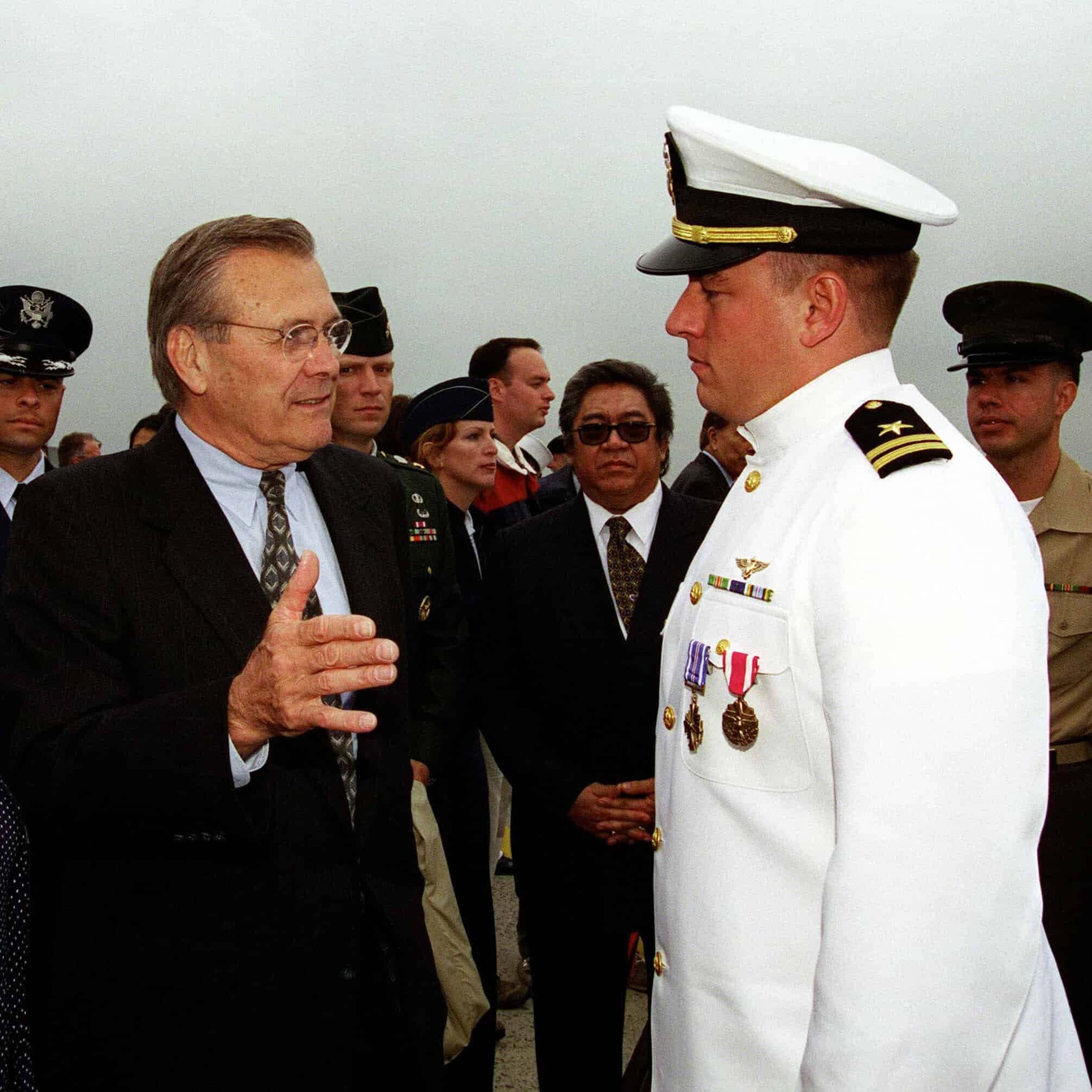
I was convinced that the Chinese were as surprised by this as we were. [Defense] Secretary [Donald] Rumsfeld called me and asked that very question. And I told him, “This pilot was not carrying out a direct order. He was a junior pilot who was reading the propaganda that was being put out by China [about U.S. surveillance aircraft violating Chinese sovereignty]. He was following the implied order to do something about it in his own ignorant way, and not as part of a plot.” And that turned out to be the case.
I knew right from the beginning that we just weren’t going to stand down reconnaissance flights. We did stop flights for a couple of months. And then came the time that we really had to start again, not only to begin collecting intelligence again, but also so that we would not have been run off the range by the Chinese.
At that time we did a lot of planning for escorting the flights when they resumed, having our own jet fighters right with them, or just slightly away watching. The Chinese know that they’re there, and we made no secret of our intention to start flying again and that we wouldn’t have big, unarmed planes flying alone. We would have fighters close by. And we did start flying again, and the Chinese discipline was immediately much better than we had seen in the weeks and months before the collision.
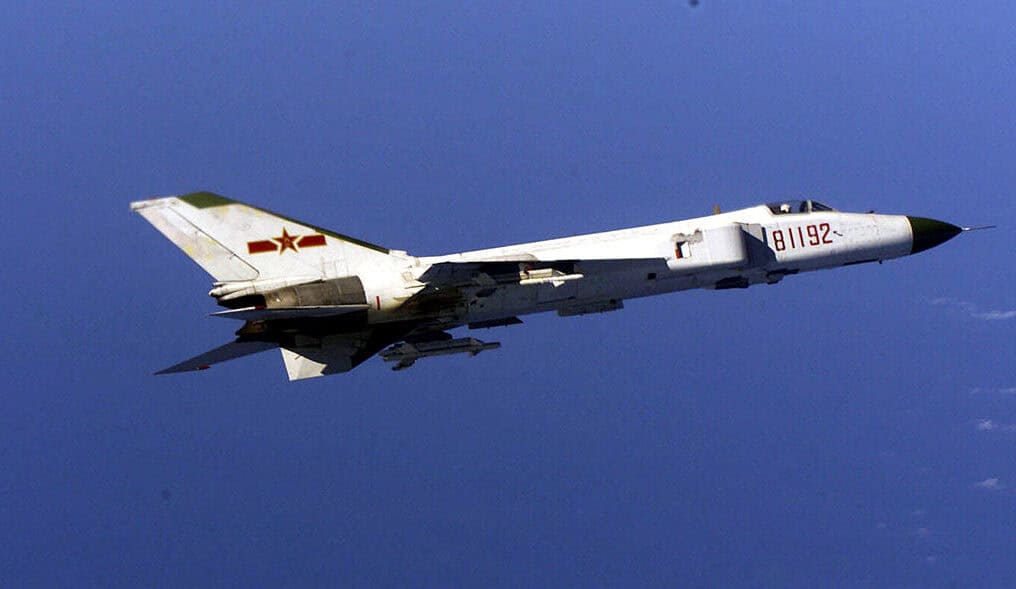
I think that the overall effect was positive, because it made the Chinese realize that reckless behavior by pretty junior people can lead to serious pressures on the government. And the Chinese, above all, want to control things. They hate it when something unexpected happens … Overall, it made China more responsible in trying to manage the relationship in which military forces are operating in the same airspace and the same sea space.
Maritime incidents and air incidents, especially incidents in international airspace, are unique in that there are only military personnel involved. The governments involved control all of the information. You don’t have somebody out there with an iPhone taking a picture of it and putting it on social media. Unlike incidents that take place on land, there are not civilians being killed, property being damaged.
There is a chance that some young aviator will decide, “I know what my orders are but if I’m going to be a hero, I know what my leadership really wants is to be a lot more aggressive.” I honestly think that the reaction would be the same today. I just can’t figure out a way it’s to the advantage of either side to escalate. It’s certainly not to the American advantage.
As told to Noah Berman.

The Academic — Shen Dingli
I was director of Fudan University’s foreign affairs office at the time. We had to handle responses from Chinese and foreign students and faculty members on the campus at that time, in the hopes that this incident would not affect their emotions and that academic exchanges with American universities could go on as usual.
It was April 1, April Fool’s Day … When I first heard the radio announcement [about the incident], I thought it was a joke. Unfortunately, the incident was real.
According to the Chinese announcement, the incident happened 18 nautical miles south of the Lingshui Airport, beyond China’s territorial waters. If it had happened over our territorial waters … [the U.S.] would have been viewed as an “invader”. But it did not. [Editor’s note: territorial waters and airspace extend to 12 nautical miles from the coastal baseline.]
If there are any takeaways from revisiting this incident, the most important is how to abide by international rules. The incident happened in an area where international law does not prohibit the conducting of reconnaissance by foreign planes. Of course international law also doesn’t prohibit countries from sending their own aircraft to observe, approach and “pressure” foreign aircraft outside their territorial space. Surely this incident wasn’t a deliberate collision by either side.
Frankly, that could have escalated into a cold war had we died. I can’t tell you who told me that, but it was somebody very, very senior in our intelligence agency that thought it could have turned out much, much worse had we not lived.
Shane Osborn
During the negotiations, China made three demands: the U.S. apologize for this event; promise that such incidents will never recur; and pay China compensation. The U.S. refused all of these but committed to repay the cost of room and board of its crew’s stay in Hainan, and the expenses associated with [disassembling] its plane for transport out of China. The U.S. argued, “We did nothing wrong, why apologize? And since we did nothing wrong, why guarantee not to send similar reconnaissance missions there again?”
Per media reports, the Chinese chief negotiator was the then Director General of American and Oceania Affairs Lu Shumin. His American counterpart was the then ambassador to China, Joseph Prueher, a [former] Navy admiral. Prueher’s previous position was head of the U.S. Pacific Command. He and Chinese negotiators worked out a creative solution: the U.S. offered two “deeply regrets” to China. The U.S. deeply regrets this collision and the EP-3’s unauthorized entry into China’s territorial space to land at Lingshui. Second, the U.S. deeply regrets the loss of Chinese life and property.
Reportedly the U.S. pilot sent SOS signals a few times during the landing process, requesting the Chinese side to permit its landing. The EP-3 landed anyway without receiving China’s response. As the U.S. plane lost its left propeller and nose cone, it was dangerous if the plane could not land as quickly as possible.
[In Chinese] “regrets” translates as bao qian and sounds similar to dao qian (“apology”), which helped diplomatically.
As told to Rachel Cheung.
In next week’s issue: the consular officer, the embassy political counselor, the undersecretary of state, the cryptologic technician, the freelance intermediary, the reporter and the flight engineer.

Noah Berman is a staff writer for The Wire based in New York. He previously wrote about economics and technology at the Council on Foreign Relations. His work has appeared in the Boston Globe and PBS News. He graduated from Georgetown University.

Rachel Cheung is a staff writer for The Wire China based in Hong Kong. She previously worked at VICE World News and South China Morning Post, where she won a SOPA Award for Excellence in Arts and Culture Reporting. Her work has appeared in The Washington Post, Los Angeles Times, Columbia Journalism Review and The Atlantic, among other outlets.

Savannah Billman is a Staff Writer for The Wire China based in NYC. She previously worked at the National Committee on U.S.-China Relations.

Tom Mitchell is features editor at The Wire. He previously worked at the Financial Times, where he was China bureau chief and deputy news editor, and also at the South China Morning Post as deputy business editor and Guangzhou correspondent.