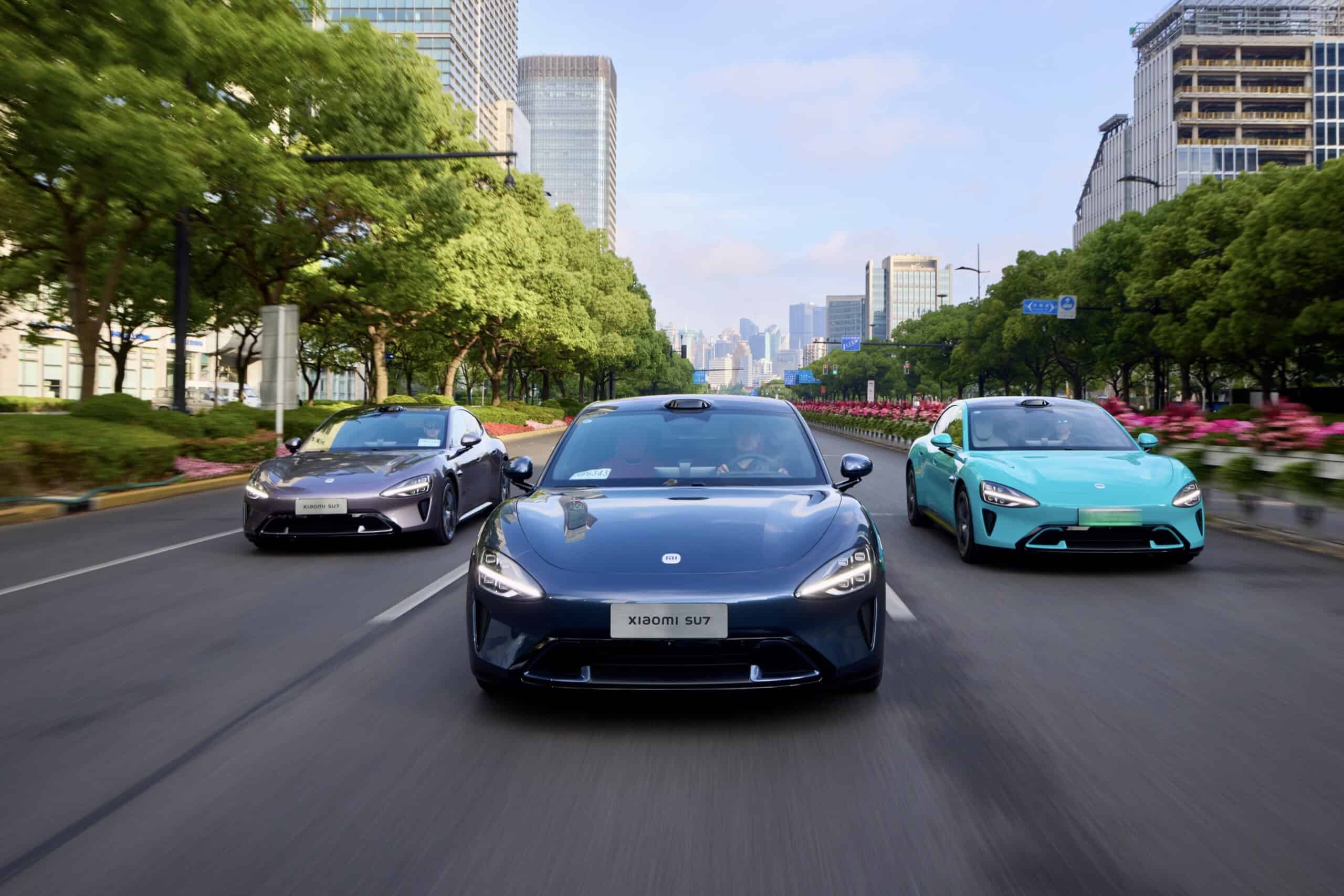
The intense rivalry between Chinese auto companies has helped drive the country to pole position in the global race to develop self-driving cars. But as the speed of travel accelerates, concerns are rising that the industry is taking on too many risks.

Late last month, a SU7 electric vehicle manufactured by Xiaomi had its autopilot function switched on as it approached a construction area on a highway in the eastern province Anhui. Though the system warned about obstacles ahead, according to a company statement, the driver was only able to take over steering just seconds before the vehicle collided with a concrete barrier, killing three people.
Statistics on such incidents involving cars with autonomous technology in China are hard to come by. But as intelligent driving features become more common, Chinese media is reporting more accidents related to the technology.
In another example, three people died last April after an electric car co-developed by Huawei and the carmaker Seres Group crashed into a truck in the northern province Shanxi, prompting questions about the vehicle’s autonomous emergency braking function. Last July, a driverless robotaxi, operated by tech giant Baidu, hit a jaywalker in Wuhan.
Level three is the crux of the full automation, and it’s very hard to crack because at that phase, you have to factor in human drivers and many dynamic environments.
Mohit Sharma, an analyst at market research firm Counterpoint Research
The latest tragedy could threaten Xiaomi’s electric vehicle ambitions, only a year after the Beijing-based company, known primarily for its smartphones, launched its first electric car — the same model involved in last month’s crash.
But the accident has also intensified a wider debate within China about the safety of autonomous driving technology. The reckoning could have implications for Chinese EV manufacturers and also complicate Tesla’s plan to bring its self-driving functions to the market.
“The world has not fully tested these technologies, whether it is China or elsewhere,” says Liu Shaoshan, co-founder of PerceptIn, a California-based visual intelligence company and a former senior architect in Baidu’s autonomous driving division. “Due to fierce competition, Chinese [original equipment manufacturers] have over-promoted this feature, and are thus misleading consumers to believe that it is more ready than it is.”
The fierce price war between Chinese carmakers has placed them under increasing pressure to launch new intelligent driving features to differentiate their models from those of their competitors.
In February, BYD, now the world’s largest EV maker by sales, unveiled a new advanced driving assistance system (ADAS) system it calls ‘God’s Eye’, while Hangzhou-based Geely followed suit last month by equipping all models with its new AI-powered system, G-pilot. A new ad issued by Zeekr, one of the Geely group’s brands, showed its vehicle easily bypassing obstacles, even while moving at high speed and under low light conditions.
A demonstration of Zeekr’s ‘General Automated Evasion System’, or G-AES. Credit: Zeekr via Weibo
Several industry observers have forecast that this year could see Chinese manufacturers shift their vehicles’ autonomous driving capabilities up a further gear.
Chinese electric vehicles are on course to reach their ‘next frontier’, says Tu Le, founder of the consultancy Sino Auto Insights. That involves moving to so-called Level 3 (L3) autonomy, up from Level 2 — a rise that would in effect put more onus on companies to ensure vehicle safety.
Levels of Vehicle Automation
| Level | Automation Label | Description |
|---|---|---|
| L0 | Momentary Driver Assistance | Driver is fully responsible for driving the vehicle while system provides momentary driving assistance, like warnings and alerts, or emergency safety interventions. |
| L1 | Driver Assistance | Driver is fully responsible for driving the vehicle while system provides continuous assistance with either acceleration/braking OR steering. |
| L2 | Additional Driver Assistance | Driver is fully responsible for driving the vehicle while system provides continuous assistance with both acceleration/braking AND steering. |
| L3 | Conditional Automation | System handles all aspects of driving while driver remains available to take over driving if system can no longer operate. |
| L4 | High Automation | When engaged, system is fully responsible for driving tasks within limited service areas. A human driver is not needed to operate the vehicle. |
| L5 | Full Automation | When engaged, system is fully responsible for driving tasks under all conditions and on all roadways. A human driver is not needed to operate the vehicle. |
“The simplest way to explain [this step] is that the liability moves from the driver to the company, meaning that at L3, folks can stop paying attention and the system completely takes over,” he says.

Xpeng, another leading EV maker, said in an earnings call last month that it would be “the first in China” to offer L3 software and user experience, putting the timeline at the second half of this year.
“Level three is the crux of the full automation, and it’s very hard to crack because at that phase, you have to factor in human drivers and many dynamic environments,” says Mohit Sharma, an analyst at market research firm Counterpoint Research. One of the hurdles, for instance, is identifying ‘edge cases’, meaning unusual scenarios that the system hasn’t been trained to navigate.
Some countries, including Germany, already allow certain cars to operate L3 systems under strict conditions, such as on selected roads and with speed limits. Chinese regulators have so far only given a handful of automakers the green light to conduct road tests of cars with L3 systems. Cities including Beijing and Shenzhen, have also introduced regulations to pave the way for their deployment.

Even so, Chinese consumers are using social media platforms like Weibo to question whether automakers are overhyping their capabilities or launching new models with advanced systems before they are ready. In one recent post, a commentator complained about the tendency of some automakers to claim their entry-level models are equipped with autopilot functions, when in reality, its use is often limited to highways only.

Criticism has also emerged within the industry. A day after BYD launched God’s Eye, a Huawei executive took a not-so-subtle dig at the company. “Making autonomous driving passable and making it safe and reliable are completely different standards,” Richard Yu Chengdong, who leads Huawei’s consumer business group, wrote in a post on Weibo.
Speaking at an industry conference earlier this month, Yu Qian, co-founder of QCraft, a Chinese startup focused on autonomous driving solutions for urban environments, called on his peers not to trade safety for lower cost.
“Some problems may not be apparent when your volume is small, but when you are delivering tens of thousands [of vehicles], you would realize safety is a grave matter,” he warned.
A mismatch can also exist between customers’ expectations of intelligent driving features and their actual performance.
A lot of people in the industry would agree that [Tesla’s] system is quite advanced and works very well in the U.S., but China is a very different environment for cars to navigate.
Jason Low, an analyst at market research firm Canalys
“In a lot of advertisements, [companies] demonstrate the top line version of the vehicle, which has the full capabilities of the products,” says Yue Ma, author of The Xiaomi Formula. “But a lot of the time, consumers only buy the standard model, which might have half of the capability.”
A demonstration of Tesla’s Autopilot at work in a U.S. neighborhood. Credit: Tesla
More cautious consumers could spell bad news for Tesla, which has already been losing luster in the Chinese market as its efforts to introduce autonomous technology to its cars have stalled.
“A lot of people in the industry would agree that [Tesla’s] system is quite advanced and works very well in the U.S.,” says Jason Low, an analyst at market research firm Canalys. “But China is a very different environment for cars to navigate.”
Caught between data laws in both China and the U.S., Tesla hasn’t been able to train its vehicles’ autonomous driving systems locally and has instead relied on online footage of Chinese streets and traffic to adapt its technology. The company is “in a bind,” as Musk himself admitted in an earnings call in January.
Tesla’s Full Self-Driving (FSD) technology at work in China, March, 2025. Credit: Aaron Li via X
Tesla has partnered up with Baidu for its map and navigation services since 2020, but it’s unclear how far the collaboration can go in solving the automaker’s quandary. In the latest hiccup, Tesla had to suspend the trial of its self-driving software in China last month, until it receives regulatory approval.
“They have a lot of work to do in localizing it and making sure people are paying for it as well,” Low adds.
Despite the recent controversy, the rollout of autonomous cars in the world’s second largest economy could yet unfold rapidly. By next year there could be over a million passenger vehicles with L3 capabilities in China, according to forecasts by Counterpoint Research, while Goldman Sachs predicts that by 2040, nine out of ten cars sold in China will be L3 or above.
“That cat’s already out of the bag, because there are so many vehicles in China that have the capability already,” says Tu Le. “There could be a short pause as companies and governments recalculate, but the momentum has already been created.”

Rachel Cheung is a staff writer for The Wire China based in Hong Kong. She previously worked at VICE World News and South China Morning Post, where she won a SOPA Award for Excellence in Arts and Culture Reporting. Her work has appeared in The Washington Post, Los Angeles Times, Columbia Journalism Review and The Atlantic, among other outlets.