In late 2020, outgoing Secretary of State Mike Pompeo gave a speech at the Georgia Institute of Technology during which he accused the Chinese Communist Party of “poisoning the wells” of American higher education institutions.
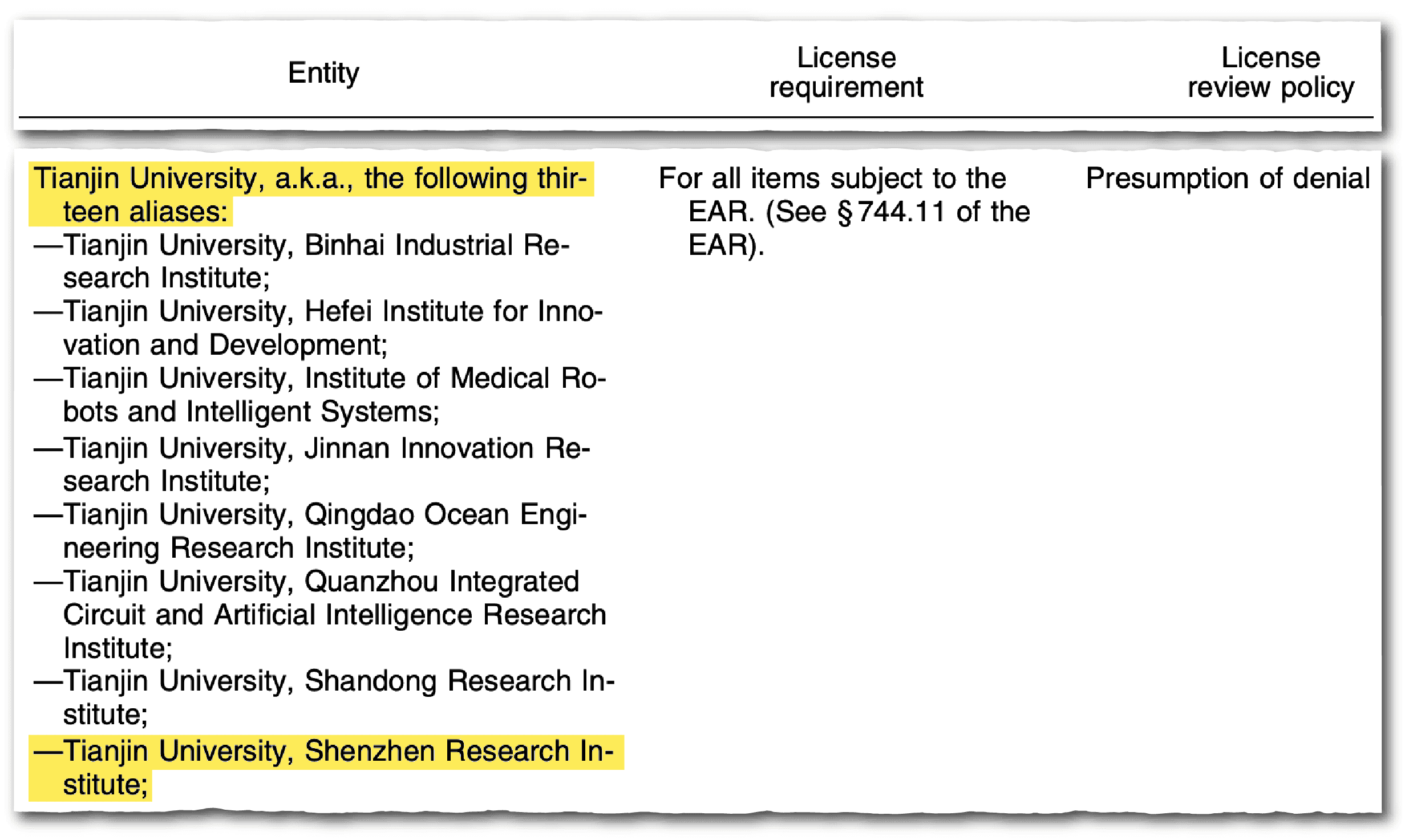
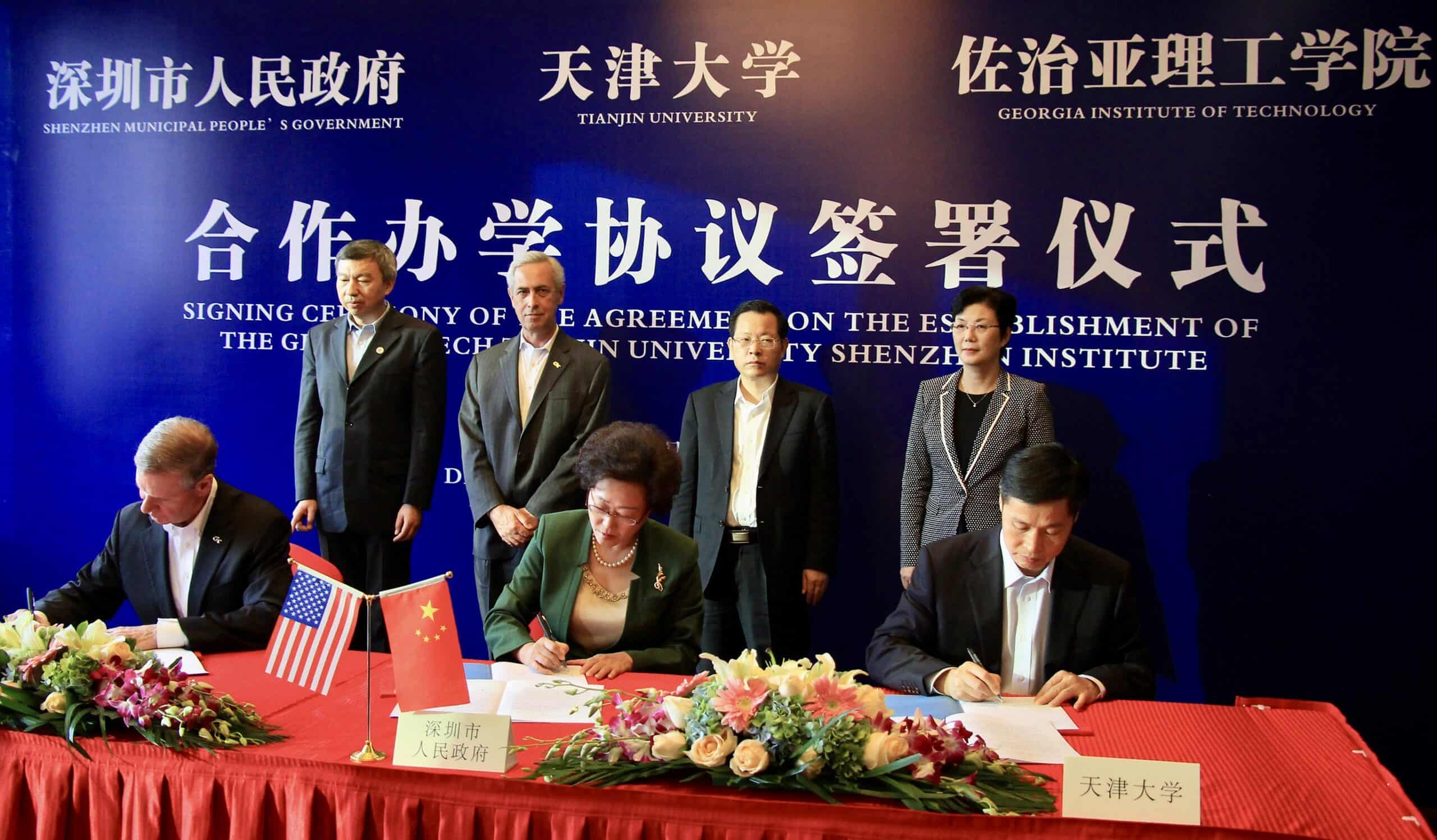
In the years since, it’s become ever harder for colleges such as Georgia Tech to maintain ties with China. The Commerce Department placed its Chinese partner, Tianjin University, on its Entity List in December 2020, leading Georgia Tech to cancel a planned PhD program at its joint venture, the Georgia Tech Shenzhen Institute.
This month, following a congressional investigation by the House’s select committee on the CCP in May, Georgia Tech announced that its partnership with Tianjin University is no longer tenable, and that it would stop offering any degree programs at the Shenzhen Institute.
Georgia Tech researchers demonstrate the Fully Immersive Threat Reaction Environment (FITRE) system, designed to train the Air National Guard. Credit: GTRI
Georgia Tech is in a particularly sensitive position given its expertise in military technologies. Even so, political scrutiny of universities is becoming more widespread. Congress is currently considering three laws that would make academic partnerships and exchanges with “foreign countries of concern”, like China, more problematic for all colleges that receive federal funding.
In turn, that has led to growing uncertainty among colleges across the U.S. over whether to maintain ties with China.
“The problem is that today, both countries find national security in every corner, and there’s a national securitization of too much,” says William Kirby, professor of China studies at Harvard University. “We need to be intelligent about where we need to draw lines, and where we want to maintain very strong open lines of communication to a place which is home, because of its population and high level of education, to more of the best human capital than any other place on Earth.”
Whether or not national security interests should outweigh the chances of technological progress lies at the core of concerns over the Georgia Tech-Tianjin University partnership.
In January this year, researchers from the two institutions independently developed and jointly published research on the world’s first functional graphene-based semiconductor, an advance that could, in time, greatly increase computer chip speeds. The House’s select committee on China has, though, warned these could be used to power “advanced autonomous weapons systems, cyber activities, and more.”
“The choice to end our many years of successful educational development initiatives to grant Georgia Tech degrees in the region was a difficult one,” university provost Steven McLaughlin said in a statement.
Ending such research cooperation will not in the long run hinder China’s technological progress, Kirby believes. “The question to ask is,” he adds “Where is the evidence that Georgia Tech’s research partnership with Tianjin University harmed the school? Where is the evidence that it harmed Americans?”
Other academic ties between the U.S. and China are getting harder to maintain. Chinese leader Xi Jinping shared a goal last November of having 50,000 American students in China over the next five years: That looks a tall order, given there were just 800 American students in China in April this year. The number of Confucius Institutes in the U.S., Chinese-language learning centers embedded in universities, has dropped from around 100 in 2019 to three last year, according to the Government Accountability Office.
Four major joint ventures remain between American and Chinese universities: New York University Shanghai, Duke Kunshan University, Wenzhou-Kean University and the Tianjin Juilliard School. On paper, they operate with considerable autonomy and can recruit students using different standards than other Chinese universities. There are also more than 200 cooperative educational institutions set up in China between Chinese and foreign universities, which have different management structures to the four JVs, along with hundreds more smaller collaborative projects, according to China’s Ministry of Education.
Congress, particularly the House under Republican control, is not a huge fan of universities, especially elite universities, at the moment, and so I think that creates a context… everybody’s watching to see what the next congressional investigation is going to be.
Jacques deLisle, director of the Center for the Study of Contemporary China at the University of Pennsylvania
“It was rewarding because the notion of bringing together young Chinese and young Americans and other international students together in the same place where they could study and learn, and interact with one another inside and outside the classroom was a great way for us to promote greater cross-cultural understanding,” says Denis Simon, who served as executive vice chancellor of Duke Kunshan University from 2015 to 2020. The institution is a joint venture between Duke University and Wuhan University.
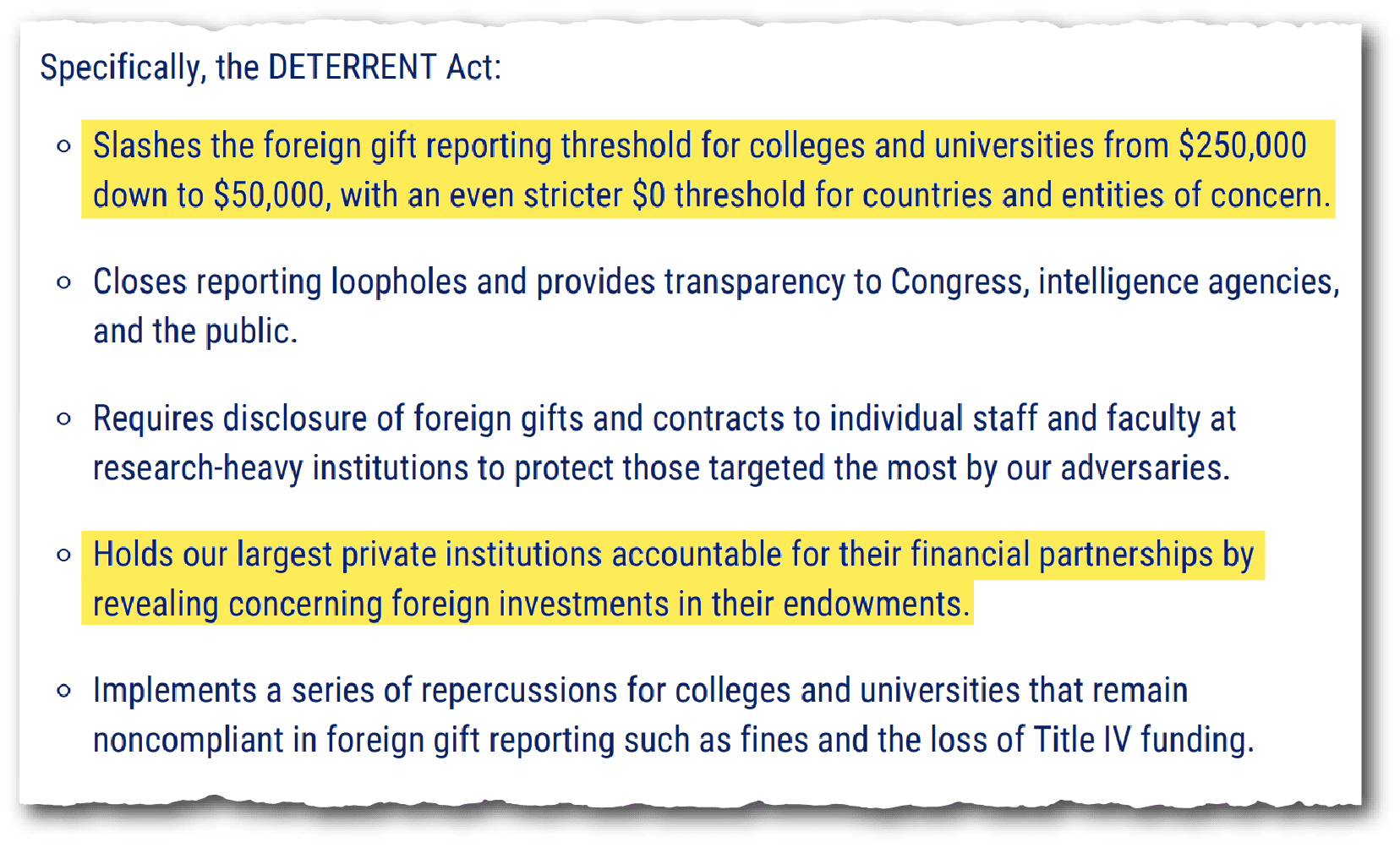
Yet the future of such JVs looks in doubt. Last December, the House passed the DETERRENT Act, which would prohibit universities from entering into contracts with a ‘foreign country of concern’ unless they obtain a waiver from the Secretary of Education. The Senate must vote on the bill by the end of this year for it to become law.
This month, the House passed the DHS Restrictions on Confucius Institutes and Chinese Entities of Concern Act, which would deny federal funding to universities that have relationships with a Chinese institution involved in the country’s military modernization. The House also passed a bill reviving a controversial Department of Justice program called the China Initiative, which sought to uncover examples of research collaborations with China considered damaging to national security.
John Moolenaar (R-MI) speaks in support of H.R. 1516, September 11, 2024. Credit: Select Committee
“Congress, particularly the House under Republican control, is not a huge fan of universities, especially elite universities, at the moment, and so I think that creates a context,” says Jacques deLisle, director of the Center for the Study of Contemporary China at the University of Pennsylvania. “It’s a fraught moment, and everybody’s watching to see what the next congressional investigation is going to be.”
The agreement establishing Duke Kunshan is up for renewal in 2028, according to the Duke Chronicle. The student newspaper also reported that Duke president Vincent Price expressed uncertainty about the venture’s future in 2022, saying that “we’ve got to be clear-eyed. The world is conspiring to make that kind of a project really hard these days.” The university did not respond to a request for comment.
Experts such as Glenn Tiffert, distinguished research fellow at the Hoover Institution, blame China more for the chill affecting academic ties.
“If you work in a STEM field in which China wants to acquire the knowledge that you have, then they roll out the red carpet, and they appear very open,” he says. “[But] if you’re in a field, particularly in the humanities and social sciences, and you study China, it is a completely different country, because they’re generally not terribly interested in what you have to say at the governmental level, and they may find what you have to say especially threatening.”
Other academics predict that the joint venture model will not survive as their autonomy comes under threat from Chinese professors inculcated with ideological training.
“They are pushing for a full change, because they want no other universities, especially foreign joint venture universities, to have some kind of leeway and some exceptional treatment,” says Xia Ming, professor of political science at the City University of New York (CUNY), who once taught at China’s elite Fudan University.

There are some positive indicators. NYU Shanghai opened a new 114,000-square meter campus in China in spring 2023, signaling a commitment to the joint venture. Portland State University (PSU) is now in the third year of its Portland Institute Nanjing program, a joint initiative with Nanjing University of Posts and Telecommunications. Such initiatives become harder if the House-backed bills become law.
“There’s a variety of bills before Congress, some better-intentioned than others, but many of which are blunt force instruments,” says Tiffert from the Hoover Institution. “Risk is subject to all of the usual question words: risk to whom? Risk to what? Risk when? These are the kinds of discussions we need to be having at a granular level, instead of simply saying that some activity represents risk and we must therefore shut it all down.”

Aaron Mc Nicholas is a staff writer at The Wire based in Washington DC. He was previously based in Hong Kong, where he worked at Bloomberg and at Storyful, a news agency dedicated to verifying newsworthy social media content. He earned a Master of Arts in Asian Studies at Georgetown University and a Bachelor of Arts in Journalism from Dublin City University in Ireland.