At the beginning of Donald Trump’s first presidency, export control lawyer Doug Jacobson urged senior Commerce Department officials to release his client from the binds of an obscure policy tool that was making it difficult to buy American products.
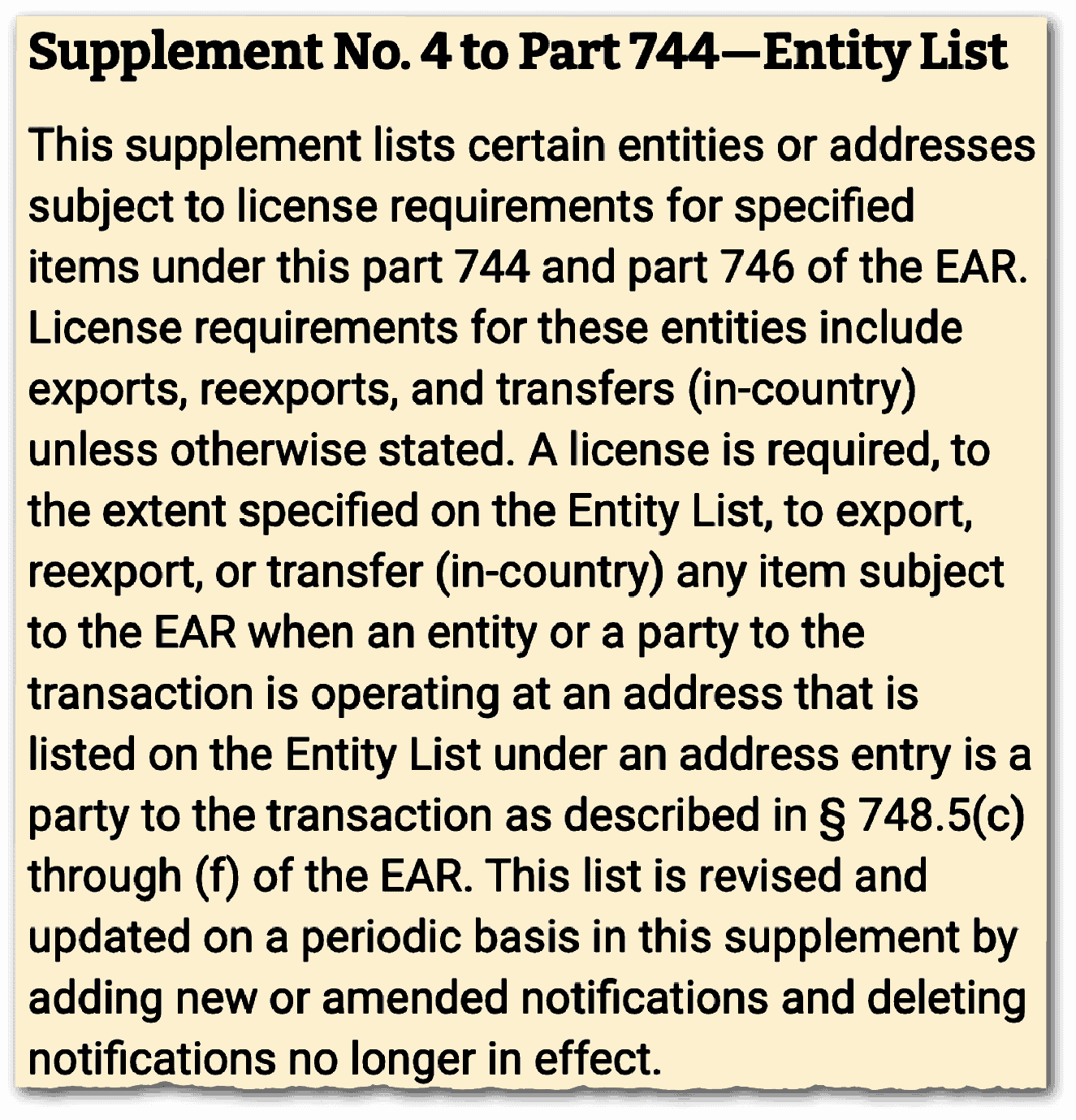
Jacobson says the Singaporean company he represented was “in limbo” when he made his appeal to senior aides to Wilbur Ross, the newly confirmed commerce secretary. The Obama administration had agreed to remove the firm from the government’s blacklist — better known as the Entity List — but it hadn’t gotten around to the paperwork.
The Trump team’s reaction surprised Jacobson. He summarises it as: “Wow, this is a really powerful tool — all we have to do is name [a] party and they’re restricted from receiving U.S. origin goods.”
During his first term, Trump used the Entity List to target dozens of major Chinese firms including Huawei and Semiconductor Manufacturing International Corporation, two companies critical to China’s chip ambitions. President Joe Biden added hundreds more to the list, while also deploying country-wide export controls on sales of advanced semiconductor technologies to China. Trump and Biden administration officials have argued these restrictions are needed to maintain the U.S. lead in artificial intelligence and other cutting-edge tech with potential military applications.
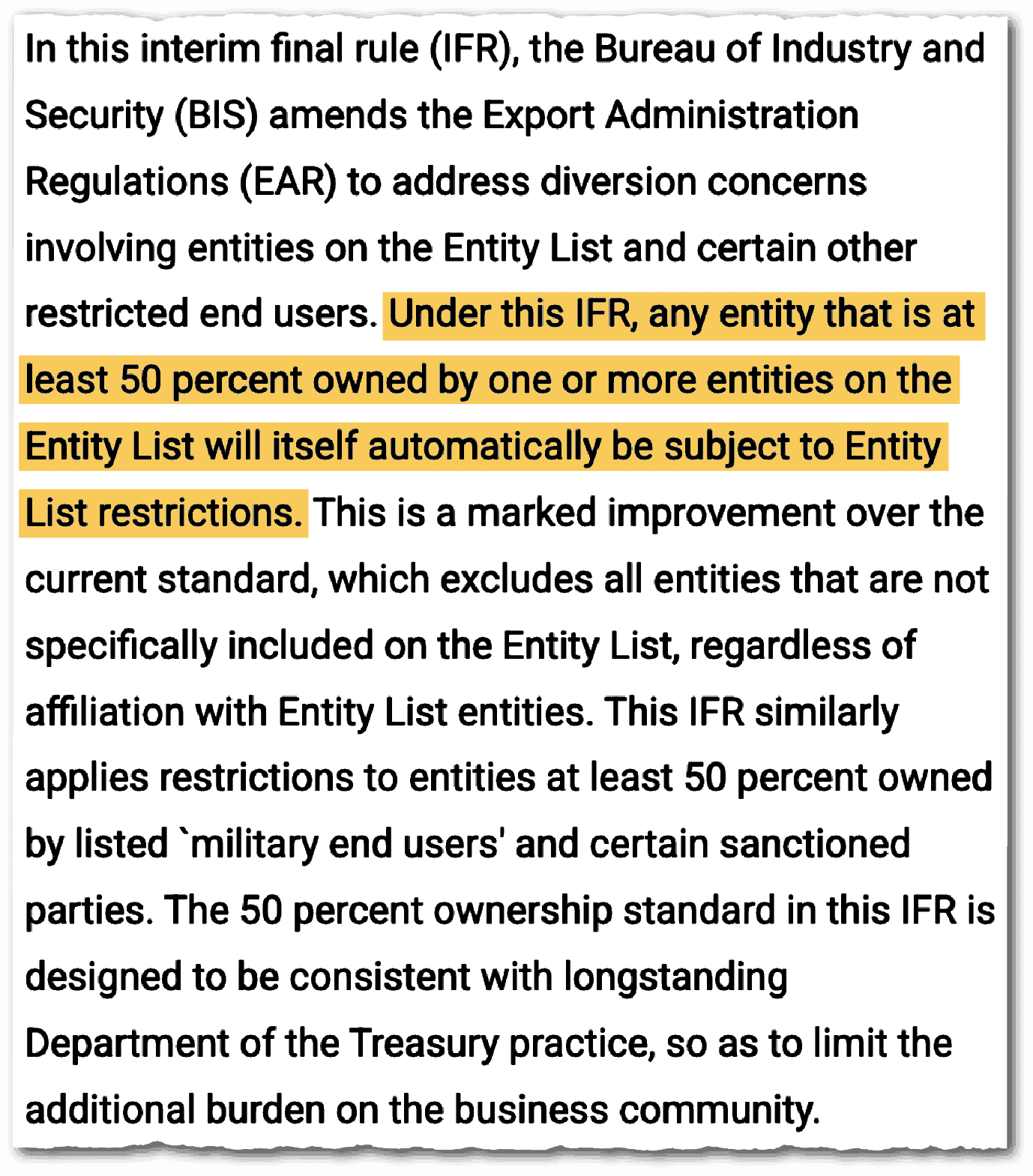
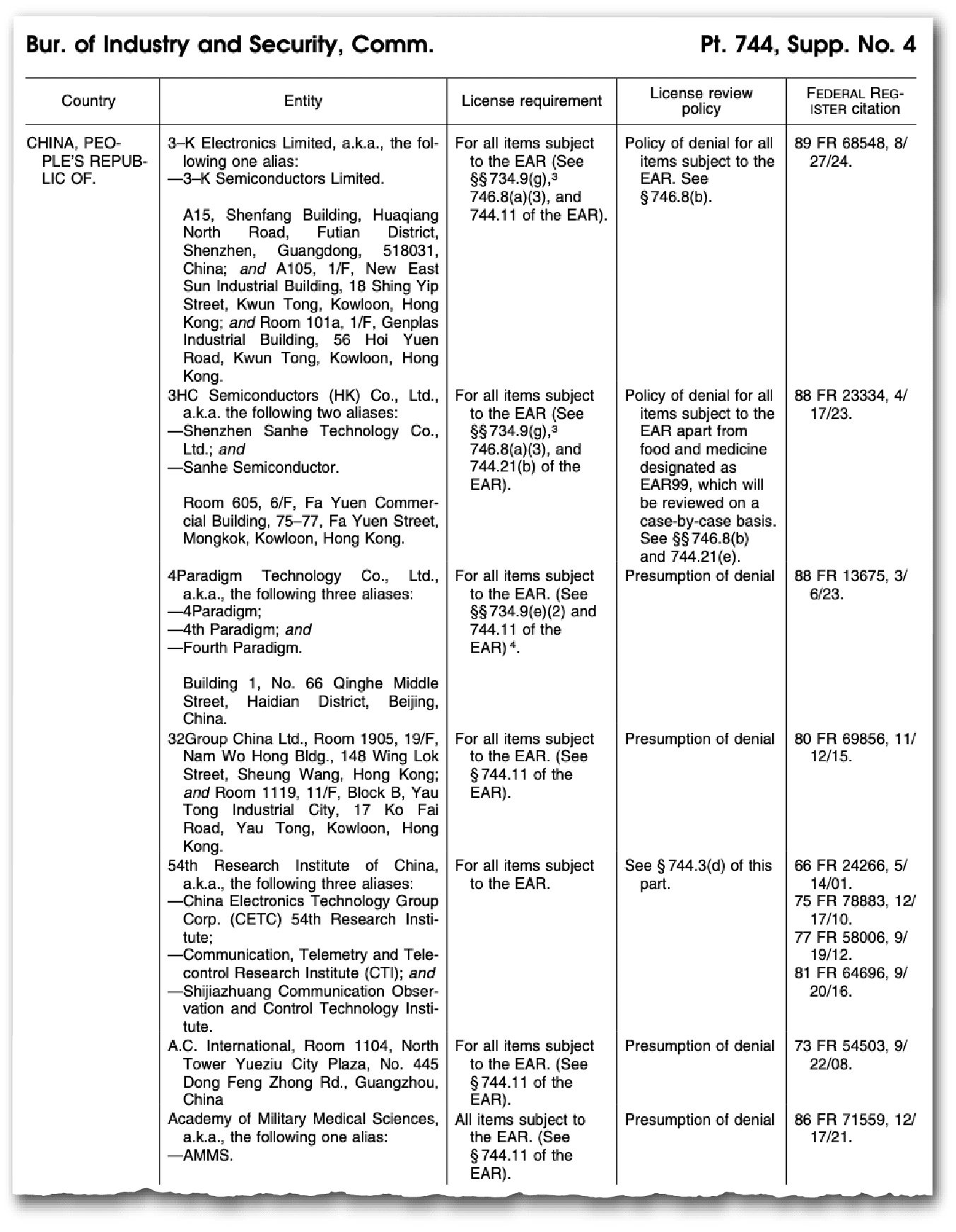
The Entity List does not technically ban exports; it instead requires companies to seek a license from the Commerce Department’s Bureau of Industry and Security (BIS) before selling certain goods to a blacklisted firm. But exports bound for Chinese advanced chip factories must overcome “a presumption of denial.”
BIS expanded the Entity List on September 29 with its so-called Affiliates Rule, which subjects majority-owned subsidiaries of companies already on the list to the same restrictions as their corporate parents.
Prior to the Affiliates Rule, the U.S. restricted exports to around 1,400 Chinese firms on the Entity List, according to WireScreen data. The expansion closed what many in the U.S. viewed as a damaging loophole and brings the total, including companies based outside China, to more than 20,000.
In response to questions on October 12, a spokesperson for China’s commerce ministry said the expansion of the Entity List and other recent U.S. trade measures had “severely damaged China’s interests and seriously undermined the atmosphere [for China-U.S. trade talks].”
In Europe, the Affiliates Rule had immediate and dramatic consequences. The day after the U.S. announced it, the Dutch government moved to seize control of Nexperia, a Netherlands-based chipmaker owned by Chinese firm Wingtech. BIS had placed Wingtech on the Entity List in December 2024.
Then, on October 1, a Dutch court approved Nexperia’s petition to suspend its chief executive, Zhang Xuezheng. Zhang, who goes by “Wing,” is also the founder of Wingtech and its largest shareholder. U.S. officials had previously warned their counterparts in the Netherlands that Zhang’s position as Nexperia’s CEO was “problematic,” Dutch court documents show.
The warning was conveyed in a June meeting, according to minutes of it in the court document. U.S. officials said it was “almost certain” that Zhang would have to be replaced at Nexperia for it to win an exemption to the Affiliates Rule.
The demand demonstrated how the U.S. can use the Entity List to get allies to cooperate in its efforts to isolate China’s semiconductor ecosystem.
Over the last decade, the U.S. government has gone to the Entity List as the first line of attack, even though it’s had some gaping holes and vulnerabilities. It’s not a silver bullet.
Jimmy Goodrich, senior fellow at the University of California Institute on Global Conflict and Cooperation
“The Affiliates Rule was a way of putting a timer on the Dutch government to finish the job of clawing back Nexperia from Chinese ownership,” says Reva Goujon, a director at the research firm Rhodium Group. “That issue was very much on the Dutch government’s radar. They were working on resolving it in a much quieter and instrumental fashion. The U.S. used its tool kit to speed things along.”
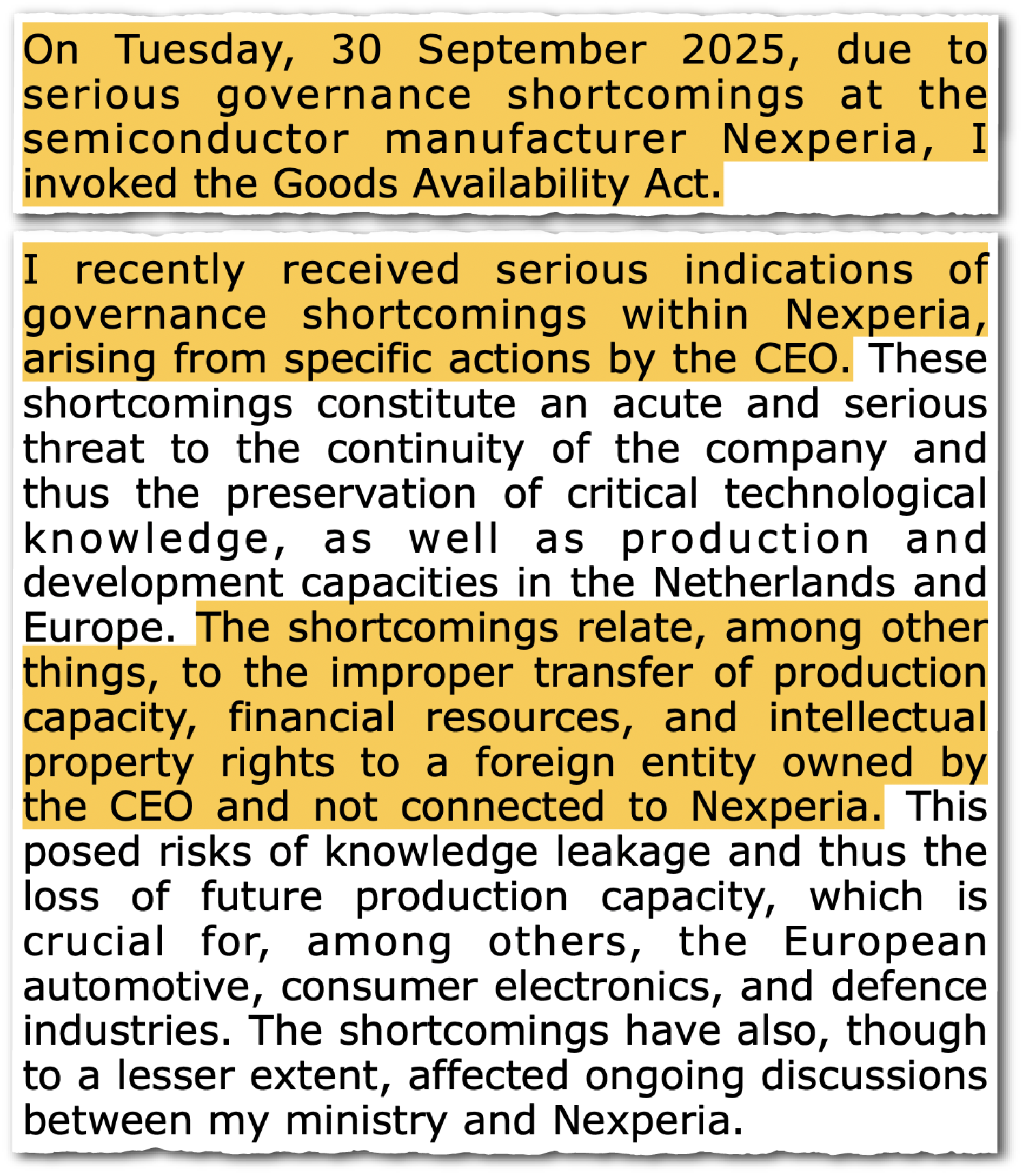
Dutch Economic Affairs Minister Vincent Karremans said, in a letter to Parliament dated October 14, that the decision to seize control of Nexperia was made due to governance concerns — such as moving manufacturing, money and intellectual property to China — and without pressure from any other country.
A spokesperson for Karremans said in an email to The Wire China that Nexperia initiated the removal of Zhang and that the law the Dutch government used to take control of the company does not allow it to suspend or dismiss executives. Hannes Van Raemdonck, a spokesperson for Nexperia, added that “the measures that were taken were to prevent a continued mismanagement by Nexperia’s former CEO, regardless of his nationality.”
According to the court documents, Nexperia executives had also grown concerned about Zhang placing more than $120 million of what they believed were excess orders with Wingskysemi, a company he controlled in China.
Wingtech called the move an “excessive intervention based on geopolitical bias” and said it would sue. Wingtech did not respond to a request for comment.
Nexperia said the Chinese Ministry of Commerce had prohibited its Chinese subsidiary and subcontractors from exporting certain components, upending the supply chain for the maker of legacy semiconductors — and potentially for the global automotive industry that relies on them.
WEAPONS OF CHOICE
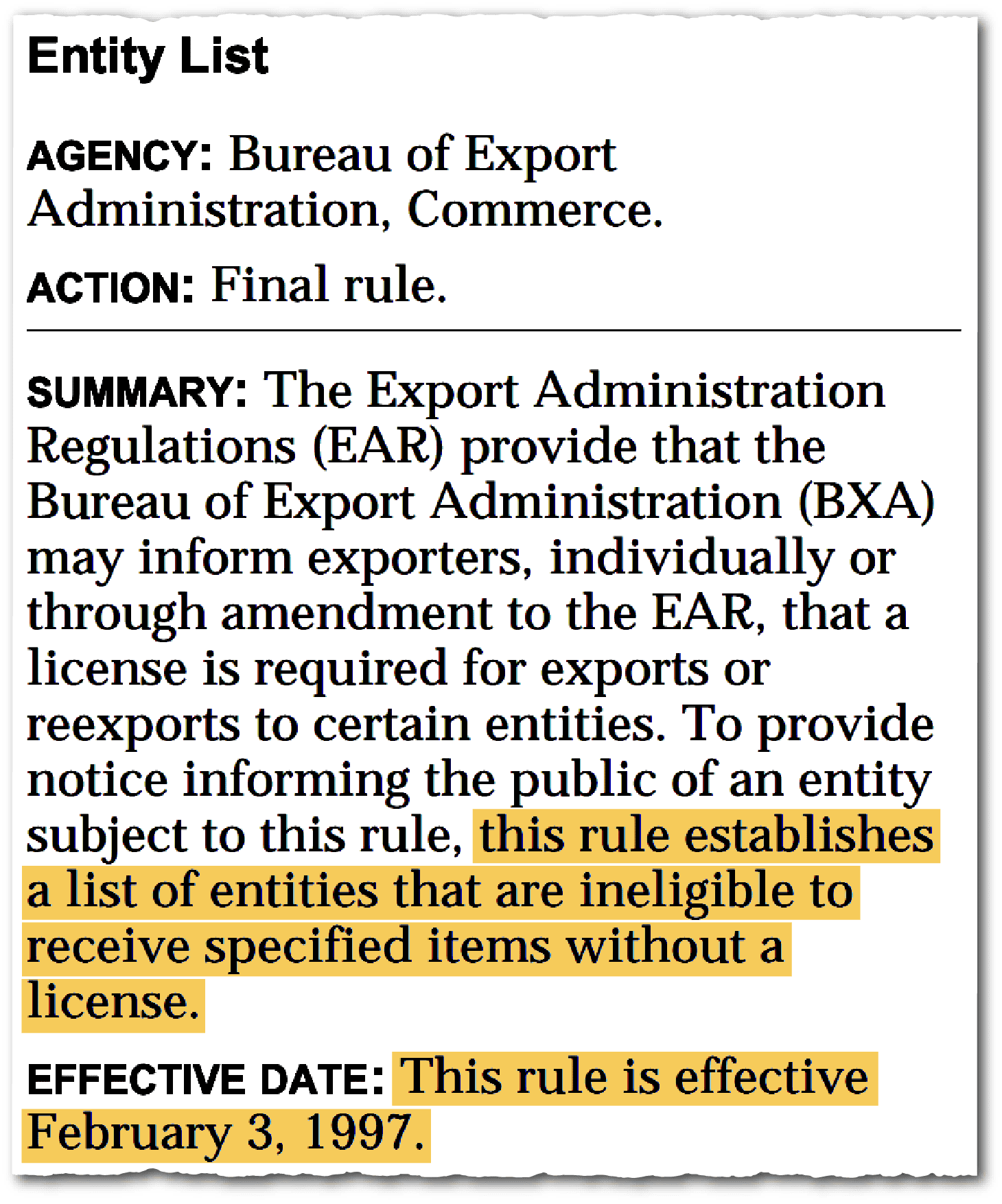
BIS first published the Entity List in 1997 as a way to slow the proliferation of weapons of mass destruction. The Obama administration was the first to use it as a tool of China policy, targeting telecom giant ZTE in 2016. But it was the Trump and Biden administrations that made it famous — or, in Beijing’s view, infamous.
The Entity List has become “the primary tool the U.S. has used to inhibit China’s technology development,” says Christopher Wall, assistant secretary of commerce for export administration during the George W. Bush administration. “It basically cuts Chinese companies off from access to the most advanced U.S. technology.”
Less than two weeks after BIS implemented the Affiliates Rule, China vastly expanded its own export controls on rare earths, a group of critical minerals necessary for the manufacture of products including cars and fighter jets.
President Trump discusses China, in a Fox Business interview, October 17, 2025. Credit: Fox Business
The gambit was the trade equivalent of threatening mutually assured destruction, says Yun Sun at the Stimson Center. “If you have a conventional war, you don’t resort to nuclear weapons,” she says. “China resorted to the nuclear option, or at least the threat.” She adds that the move was designed to catch Trump’s attention, but that his response — including a threat to cancel a planned meeting with Chinese President Xi Jinping later this month — called Beijing’s bluff.
On October 10, Trump threatened to subject software sales to China to export controls and announced plans to impose an additional 100 percent tariff on Chinese goods. Both sides blamed each other for reigniting the trade war.
The escalation reinforced the crucial role chokepoints play in modern trade combat. China and the U.S. dominate, respectively, rare earths and the semiconductor supply chain.
Each side has since softened its rhetoric, and Trump and Xi are still likely to meet on the sidelines of an upcoming summit in South Korea, but neither has backed down. “Both sides want to play ball,” Sun says.
THEY’RE STILL STANDING
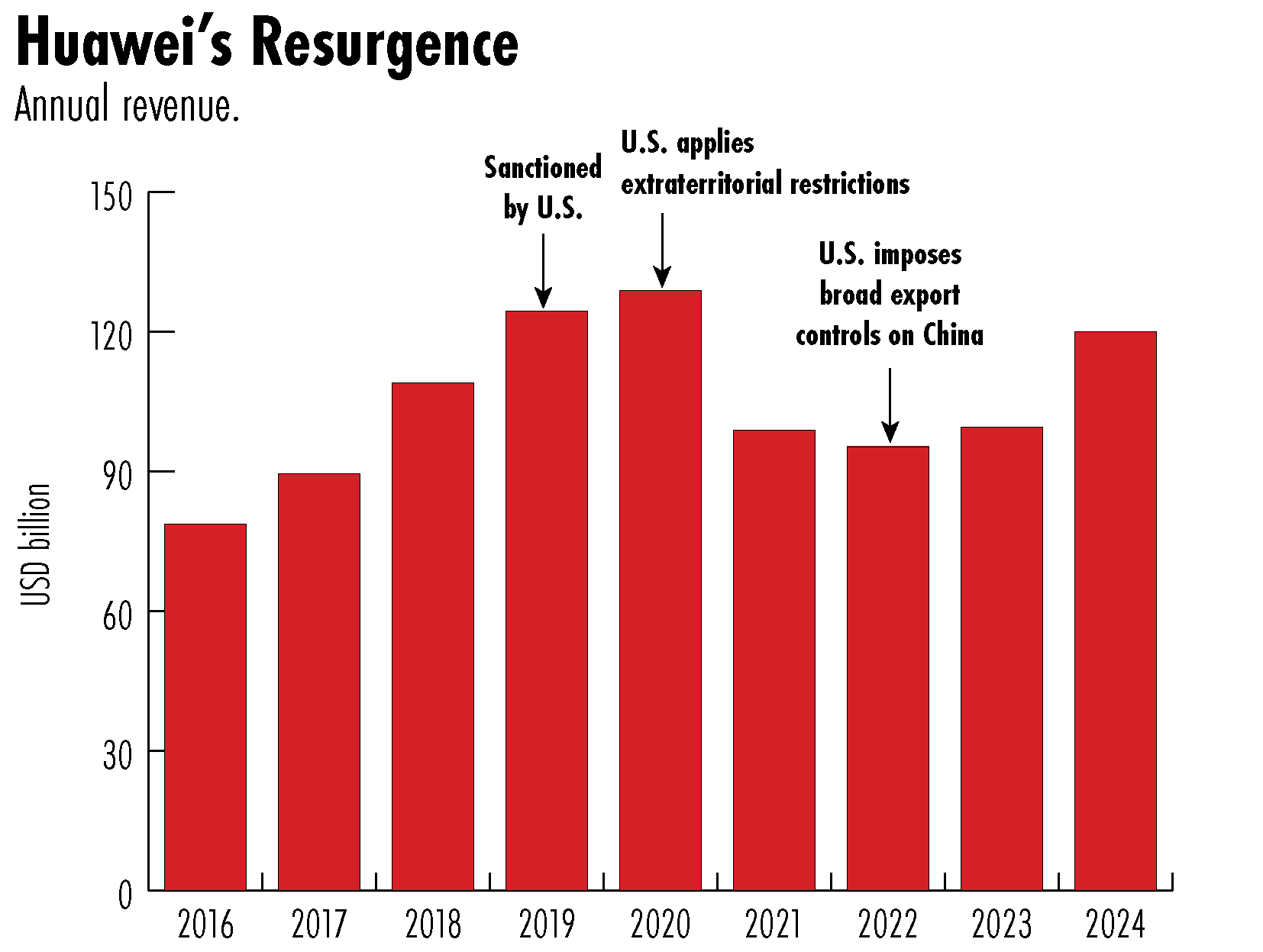
Several Chinese chip makers have thrived despite Entity List sanctions. Huawei has remained a linchpin of China’s technological advancement, despite being restricted from buying goods from the U.S. — or, due to a regulation known as the Foreign Direct Product Rule (FDPR), products made anywhere in the world with American inputs. Cambricon, a Beijing-based chip designer blacklisted in 2022, is China’s hottest stock, even though American components and software remain crucial to semiconductor technology.
Enforcement is one challenge — BIS has just two export control officers in mainland China and a third in Hong Kong. Smuggling of export-controlled products has been widely documented. Research groups say Huawei chips still contain foreign tech.
“Over the last decade, the U.S. government has gone to the Entity List as the first line of attack, even though it’s had some gaping holes and vulnerabilities,” says Jimmy Goodrich, senior fellow at the University of California Institute on Global Conflict and Cooperation. “It’s not a silver bullet.”
The Entity List also subjects U.S. companies to tighter restrictions than it does, say, to their rivals in Europe or Japan, many of whom are pivotal players in semiconductor supply chains.
“The [Entity List’s] strength is it catches a lot of companies,” says Kevin Wolf, a former official at BIS. “The weakness is that no other country on the planet has Entity List rules.”
Controls on advanced semiconductor manufacturing equipment (SME) are particularly critical to America’s China trade policy because Chinese companies cannot yet produce the most advanced tools on their own, says Martijn Rasser at the Special Competitive Studies Project, a Washington think tank. “It goes straight at the heart of Beijing’s efforts to create a self-sufficient domestic industry.”
The [Entity List’s] strength is it catches a lot of companies. The weakness is that no other country on the planet has Entity List rules.
Kevin Wolf, a former official at BIS
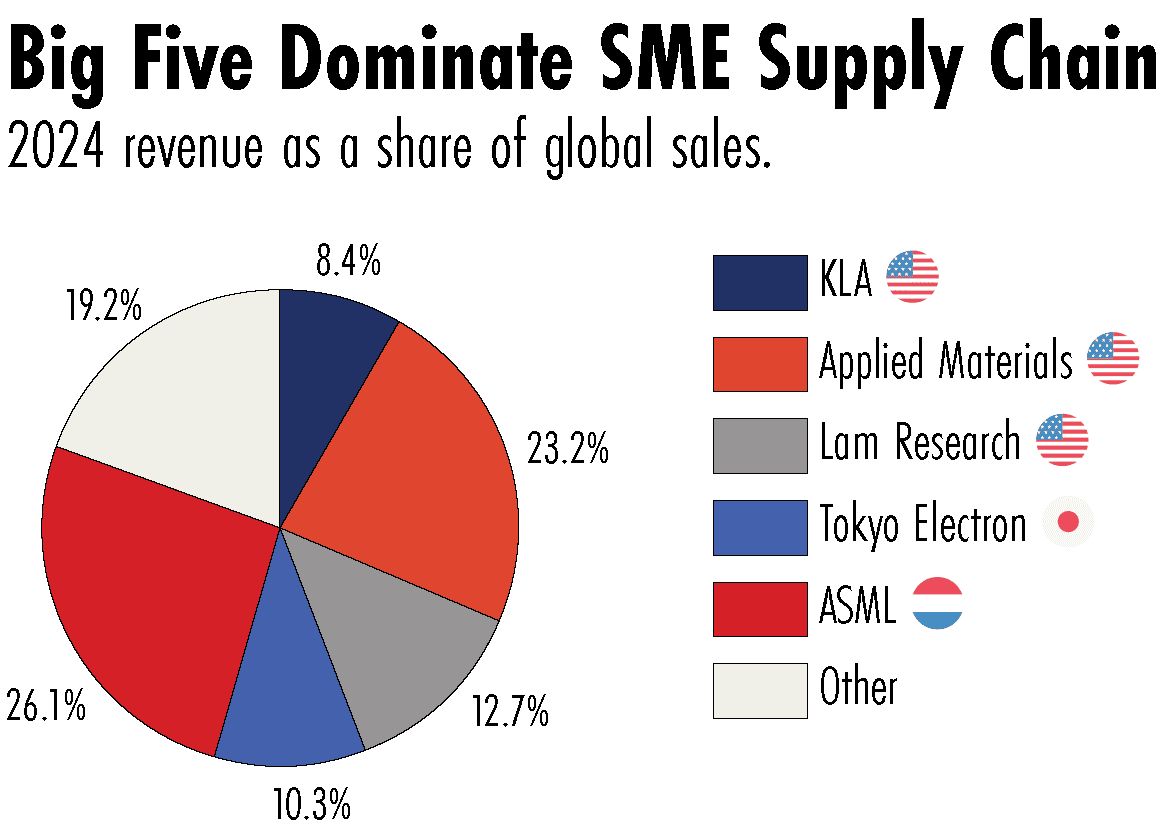
Japan and the Netherlands are home to two of the five most important SME firms. The three major U.S. players — Applied Materials, KLA, and Lam Research — as well as Japan’s Tokyo Electron and the Dutch ASML together hold about 80 percent of the global SME market.
U.S. measures aimed at restraining China’s semiconductor capabilities therefore need participation from Tokyo and The Hague to carry more bite, but must also balance Dutch and Japanese concerns about Chinese retaliation.
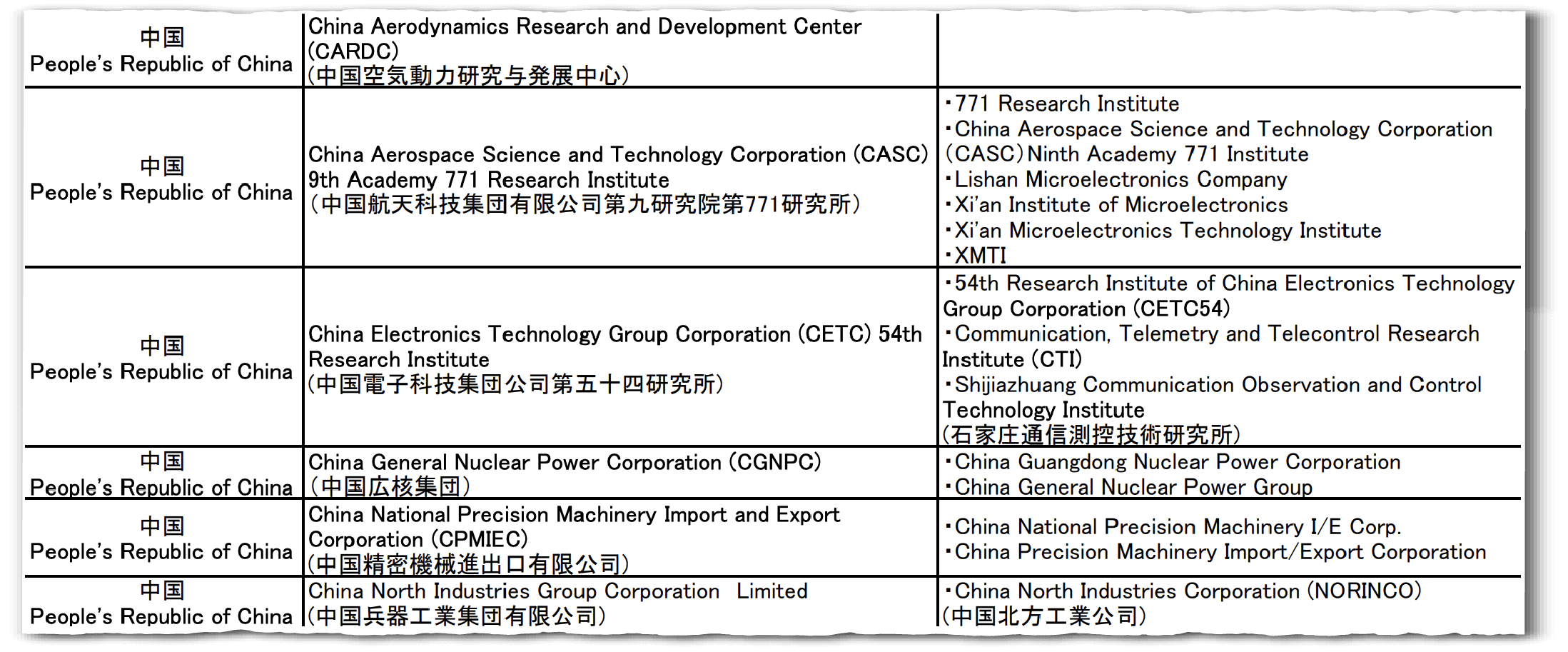
Japan and the Netherlands have their own broad export controls on advanced SME, but they do not use public blacklists like the Entity List to enforce them. (Japan has an “End User” list, limited to companies that Tokyo says could be involved with weapons production.)
Still, U.S. officials say the two countries restrict exports to certain Chinese chip factories, known as fabs. A report released earlier this month by the House Select Committee on the Chinese Communist Party noted that “the Netherlands and Japan have also implemented some restrictions on the export of specified tools produced by ASML and [Tokyo Election] on an end-user basis, beyond their China-wide controls on certain advanced SME.”
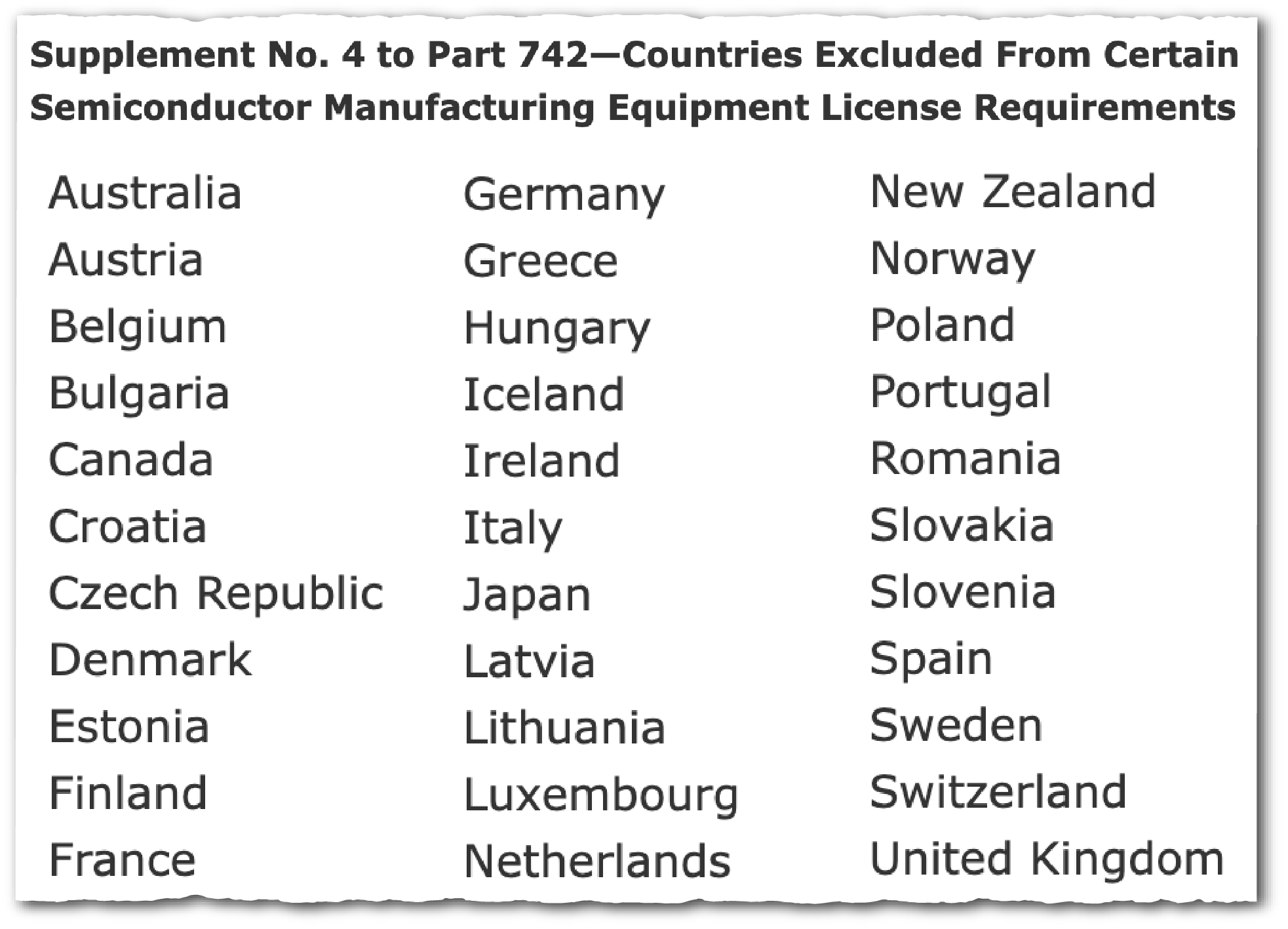
Countries excluded from certain license requirements. Credit: LII
In December, the U.S. used the FDPR to tighten restrictions on exports to China of advanced SME made anywhere in the world with U.S. technology. But it carved out exemptions for 33 countries, including Japan and the Netherlands. Washington also imposed additional restrictions on a subset of 16 Chinese companies and research centers on the Entity List, marking them with a designation known as “Footnote 5.”
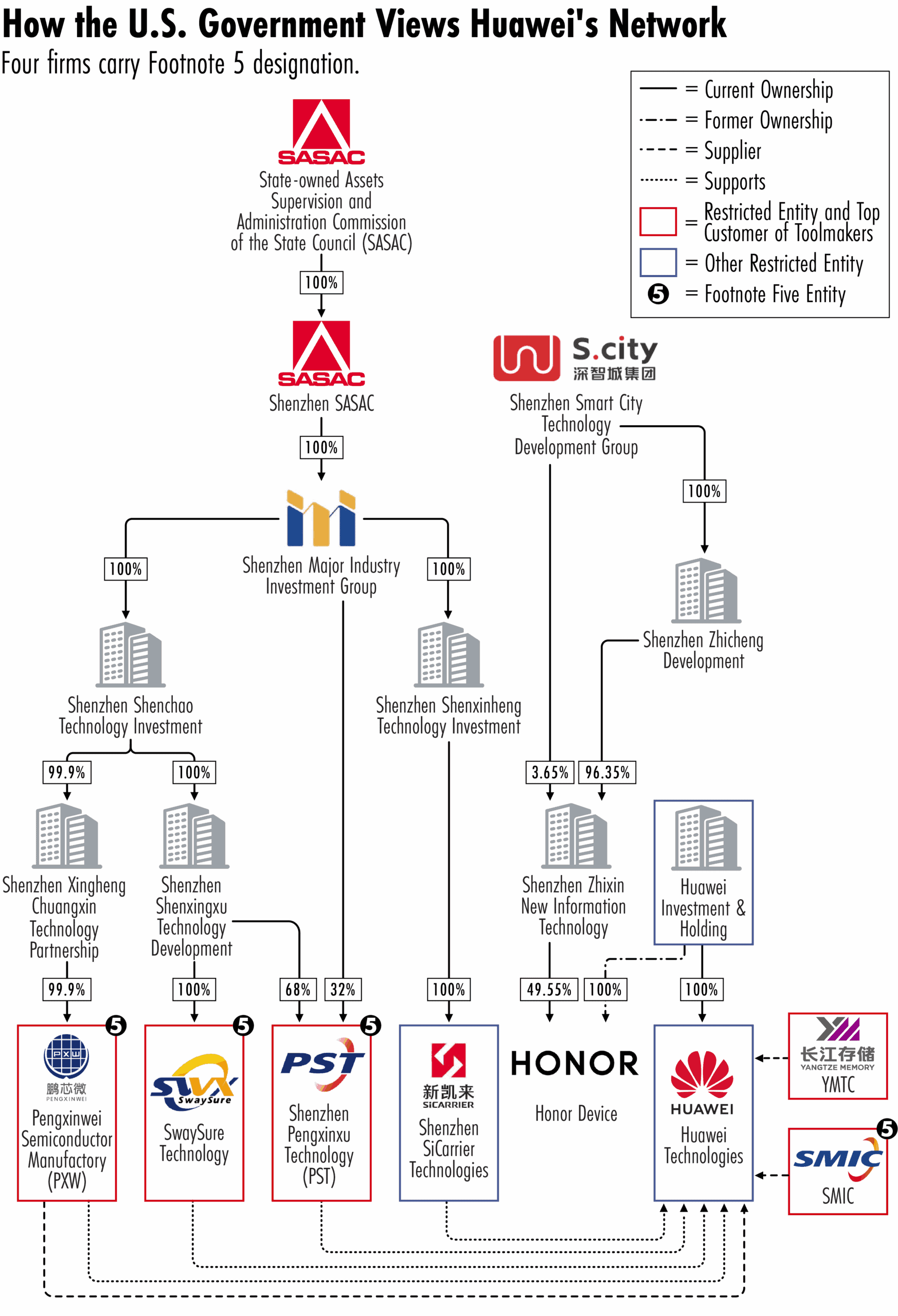
According to three people familiar with the matter, Japan and the Netherlands have agreed to reject licenses for certain sales to the Footnote 5 entities. The firms with this designation include fabs that the U.S. government says are affiliated with Huawei and SMIC.
The Footnote 5 designation “was centered on the Huawei-SMIC nexus,” says Goujon, of Rhodium.
THE FOOTNOTE 5 ENTITIES
| COMPANY | DATE ADDED TO ENTITY LIST |
|---|---|

Chinese Academy of Sciences Institute of Microelectronics
|
December 2, 2024 |

Fujian Jinhua Integrated Circuit Company, Ltd.
|
October 30, 2018 |

Northern Integrated Circuit Technology Innovation Center (Beijing) Co., Ltd. (STIC)
|
December 2, 2024 |

PXW Semiconductor Manufactory Co., Ltd.
|
December 16, 2022 |

Semiconductor Manufacturing International (Beijing) Corporation (SMIC Beijing)
|
December 18, 2020 |
|
Semiconductor Manufacturing International Corporation (SMIC)
|
December 18, 2020 |
|
Semiconductor Manufacturing South China Corporation (SMIC South)
|
December 18, 2020 |
|
Shanghai Integrated Circuit Equipment & Materials Industry Innovation Center Co., Ltd. (CICEM)
|
December 2, 2024 |

Shanghai Integrated Circuit Research and Development Center (ICRD)
|
December 16, 2022 |

Shenzhen Pengxinxu Technology Co., Ltd (PST/PXX)
|
December 2, 2024 |

Si’En Qingdao Co. Ltd.
|
December 2, 2024 |
|
SMIC Advanced Technology R&D (Shanghai) Corporation
|
December 2, 2024 |
|
SMIC Northern Integrated Circuit Manufacturing (Beijing) Co., Ltd (SMIC North)
|
December 18, 2020 |

SwaySure Technology Co., Ltd
|
December 2, 2024 |

Wuhan Xinxin Semiconductor Manufacturing Company Limited
|
December 2, 2024 |

Zhangjiang Laboratory
|
December 2, 2024 |
Note: Entities highlighted in red are affiliated with Huawei and entities highlighted in blue are affiliated with SMIC, according to the U.S. government. Source: Federal Register; Select Committee on the Chinese Communist Party; WireScreen
The cooperation did not begin when the U.S. introduced Footnote 5 last December. In January 2023, the allies reached a trilateral agreement, the details of which have not been made public.

Under the agreement, say six people familiar with its terms, the U.S., Japan and the Netherlands agreed to create a shared list of restricted Chinese fabs, with Tokyo and The Hague committing to stricter export controls on those firms than they impose country-wide. But even so, overall Dutch and Japanese limits on sales to China are weaker than America’s.
The Wire China could not determine the exact companies on the unpublished list, but one person said an expansion of the annex in 2024 focused on a growing network of fabs linked to Huawei. Others suggested that it contains factories associated with SMIC.
BIS and Japan’s Ministry of Economy, Trade and Industry did not respond to requests for comment. The Dutch Foreign Ministry declined to comment but said that in general it makes licensing decisions based on its own national security assessments while confidentially discussing export controls with international partners.
TROUBLE IN PARADISE
Some former U.S. officials are frustrated with the arrangement, especially as Japanese and Dutch sales of SME to China continue to increase. The report by the select committee said the Entity List-based approach to export controls had not “sufficiently prevented China from advancing its indigenous semiconductor manufacturing capability,” and that U.S. SME firms are more constrained than their foreign competitors.
Emily Kilcrease, senior fellow at the Center for a New American Security, says the lack of public Entity Lists in allied countries is “a huge problem.”
“Otherwise we will just continue to have gaps,” she says. While she notes that other countries don’t have the same legal framework as the U.S., “if there was political will, I think they could find a way to do it.”
…you can find your way to buying American products if you really want to. But if a Chinese technology champion is forced to spend billions or hundreds of billions… that is a win, because even if innovation does happen, it happens at an extraordinary price.
Ryan Fedasiuk, a State Department technology advisor during the Biden administration
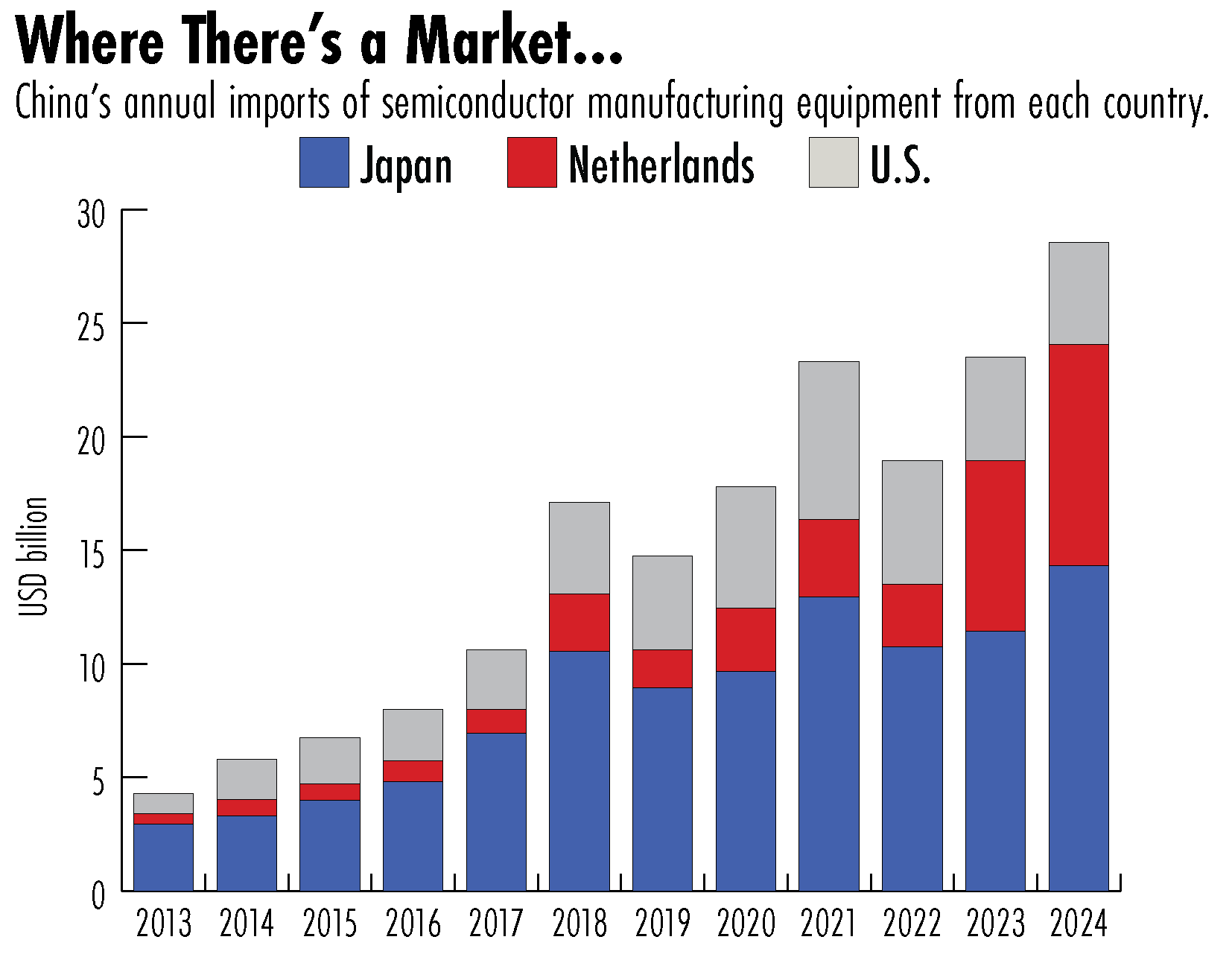
The gaps are apparent in trade data, which shows that China imported more semiconductor manufacturing equipment last year than ever before. Meanwhile, Japanese and Dutch companies increased their shares of the China market, while that of U.S. firms declined.
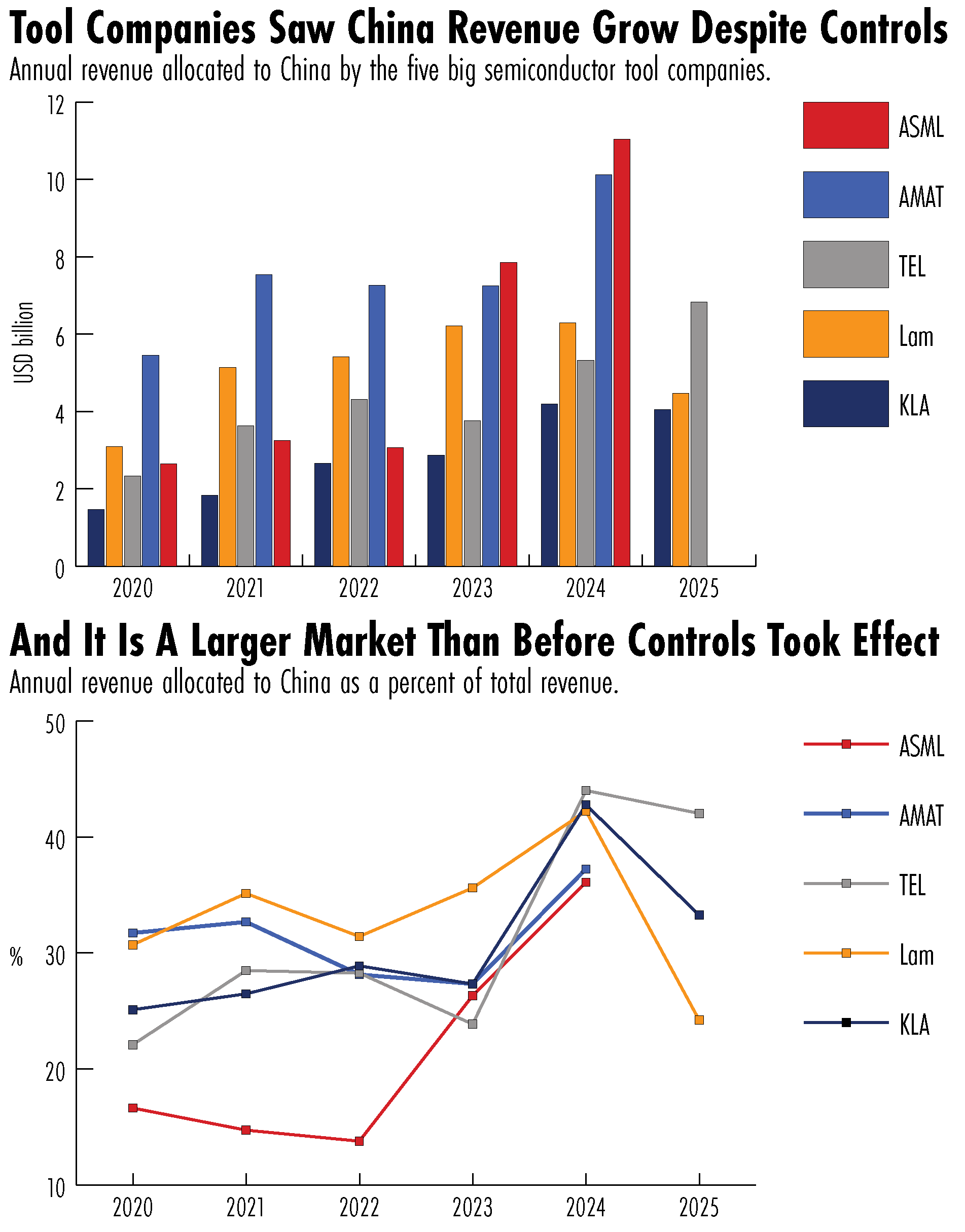
In 2024, China accounted for a greater proportion of the revenue of all five of the industry-leading firms than it did in 2022, when the Biden administration first introduced export controls.
Foreign firms have seen particularly rapid sales growth in the China market. ASML and Tokyo Electron’s revenues from China, as a share of total revenue, doubled between 2020 and 2024.
But this trend may have peaked. The three SME companies that have reported 2025 figures all noted a relative decline in China revenue as a share of total sales. On an October 15 earnings call, ASML Chief Executive Christophe Fouquet said that he expects demand from China to “decline significantly” next year.
Mathieu Duchâtel, at Institut Montaigne in Paris, says Europe is broadly converging with the U.S. on the need for export controls on companies that supply the Chinese military, but it is unlikely to adopt its own Entity List regime any time soon. “It’s a practical step to make an export control system work, but if you want to go through the procedures for the EU to legalize this, it’s a long way away.”
The China sales of the big five SME companies have also included business with firms on the Entity List, according to the select committee’s report. All five count blacklisted companies SMIC Beijing, SwaySure, PST, SiEN, and Yangtze Memory Technologies Co., Ltd. (YMTC) among their top 30 customers in China, the report said, citing documents on file with the committee. (The U.S. added YMTC to the Entity List in 2022 but does not subject it to Footnote 5.)
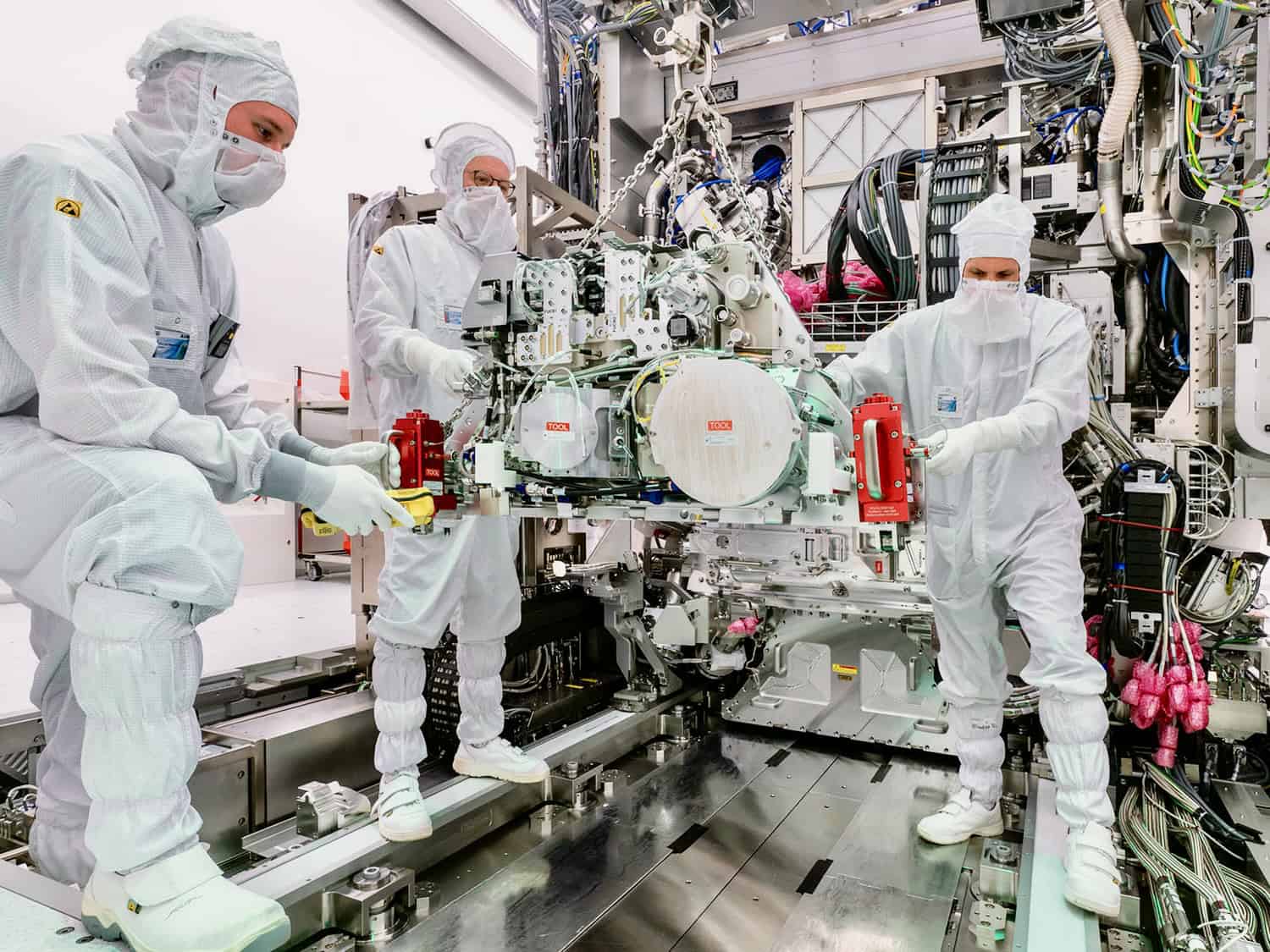
It added that the three U.S. toolmakers sold equipment worth $786 million to restricted entities last year; TEL and ASML’s 2024 combined sales to restricted entities reached $4.2 billion, accounting for nine percent of total revenues, the report found.
A spokesperson for ASML said the company “complies with all applicable license requirements and potential license conditions.” Applied Materials and KLA declined to comment. Tokyo Electron and Lam Research did not respond to requests for comment.
(The report’s definition of “restricted” included lists managed by the Defense and Treasury Departments as well as the Entity List. It did not say that the sales were illegal or a violation of export controls.)
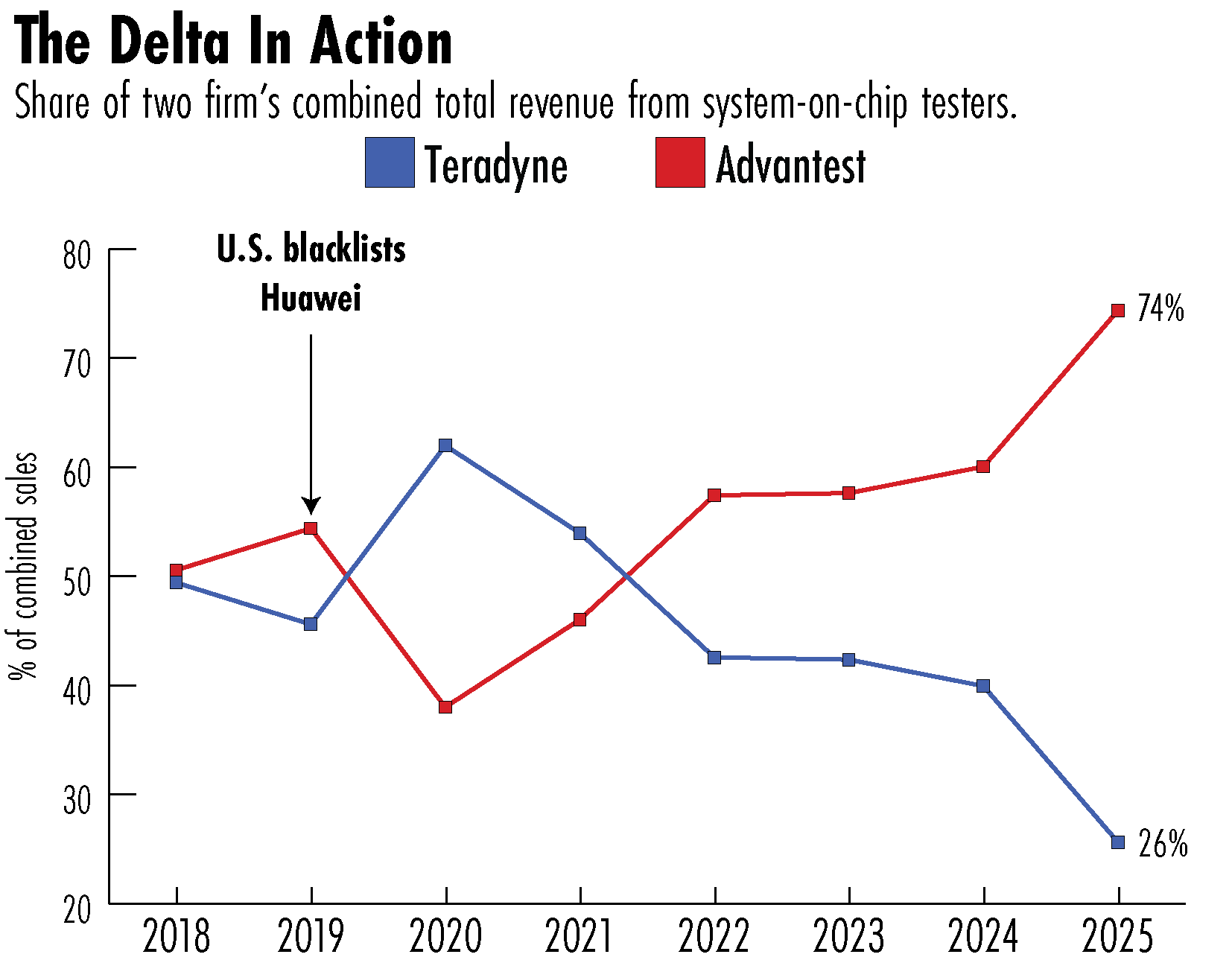
Smaller U.S. companies are also ceding market share to overseas rivals. Teradyne, a Massachusetts-based supplier of semiconductor testing equipment, was overtaken by Japanese rival Advantest after the U.S. sanctioned Huawei. Greg Smith, Teradyne’s chief executive, has called Huawei the “biggest single chunk” of the Chinese market for semiconductor testing equipment.
Teradyne declined to comment. Advantest did not respond to a request for comment.
To level the playing field, the select committee recommended using the Foreign Direct Product Rule, “if necessary,” to prohibit U.S. allies from selling to restricted Chinese fabs. That would mean rescinding current exemptions for Japanese and Dutch firms.
From a compliance standpoint, this is certainly very challenging. You can’t possibly know every company or every entity.
Doug Jacobson, an export control lawyer
But there is a “widespread” view that doing so could anger partners which the U.S. values for many other reasons, says Chris Miller, author of Chip War. Japan, for example, hosts around 55,000 U.S. military personnel, more than any other country. “Even the current administration thinks the diplomatic costs are significant,” Miller says.
‘AN EXTRAORDINARY PRICE’
The Entity List is not the only way the U.S. can blacklist a Chinese semiconductor company. In January BIS implemented new rules that made it more difficult to sell to Chinese makers of dynamic random-access memory (DRAM) chips.
The rules effectively bar U.S firms from selling to the largest fabs at ChangXin Memory Technologies, the leading Chinese memory chip firm. CXMT is not currently on the Entity List.
At the same time, the U.S. made a deal with Japan and the Netherlands to tighten their restrictions on CXMT, according to two people familiar with the matter.
CXMT was previously a customer of four of the five major SME firms, the select committee’s report said. Applied Materials has not sold any products to the firm since January, according to an industry source.
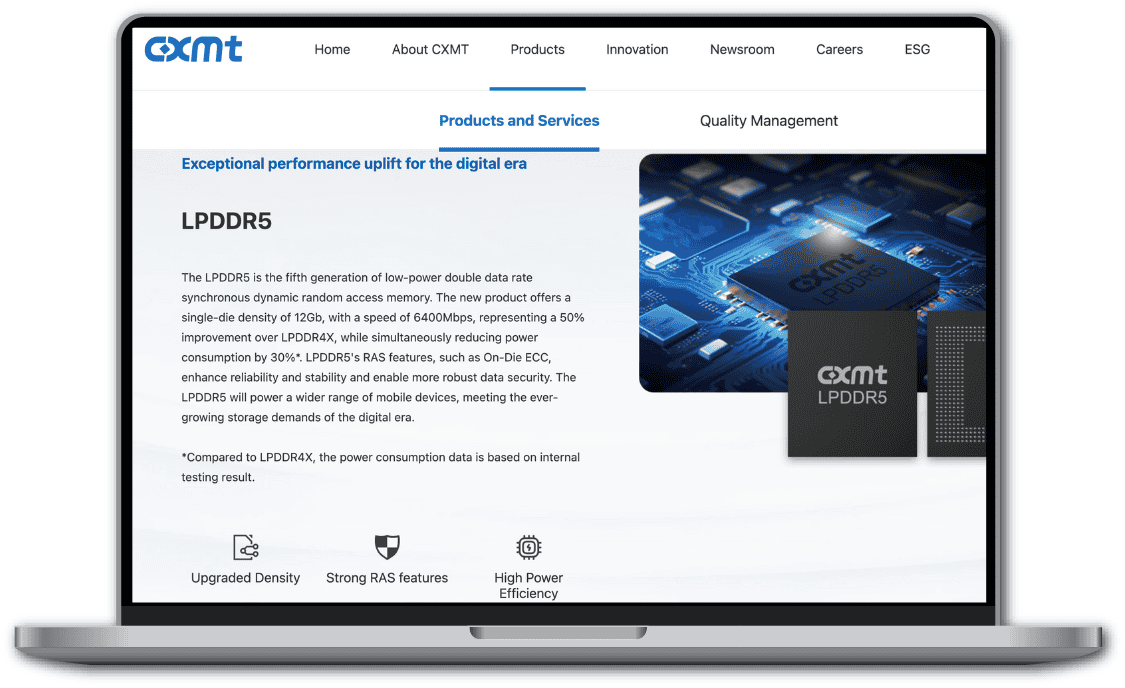
The workaround is imperfect. For example, if CXMT claims a fab is making chips that are not sophisticated enough to trigger the U.S. ban, American exporters may not have a way to verify the claim. But if the company were added to the Entity List, its majority-owned affiliates — it has 19, according to WireScreen — would be automatically covered by the new Affiliates Rule.
Biden administration officials had informally discussed the Affiliates Rule as early as 2022, but BIS ultimately decided it “wouldn’t be executable,” according to people with knowledge of the matter.
It will now be up to suppliers to figure out whether their Chinese customers are covered by the expanded Entity List. “From a compliance standpoint, this is certainly very challenging,” says Jacobson, the export controls lawyer. “You can’t possibly know every company or every entity.”
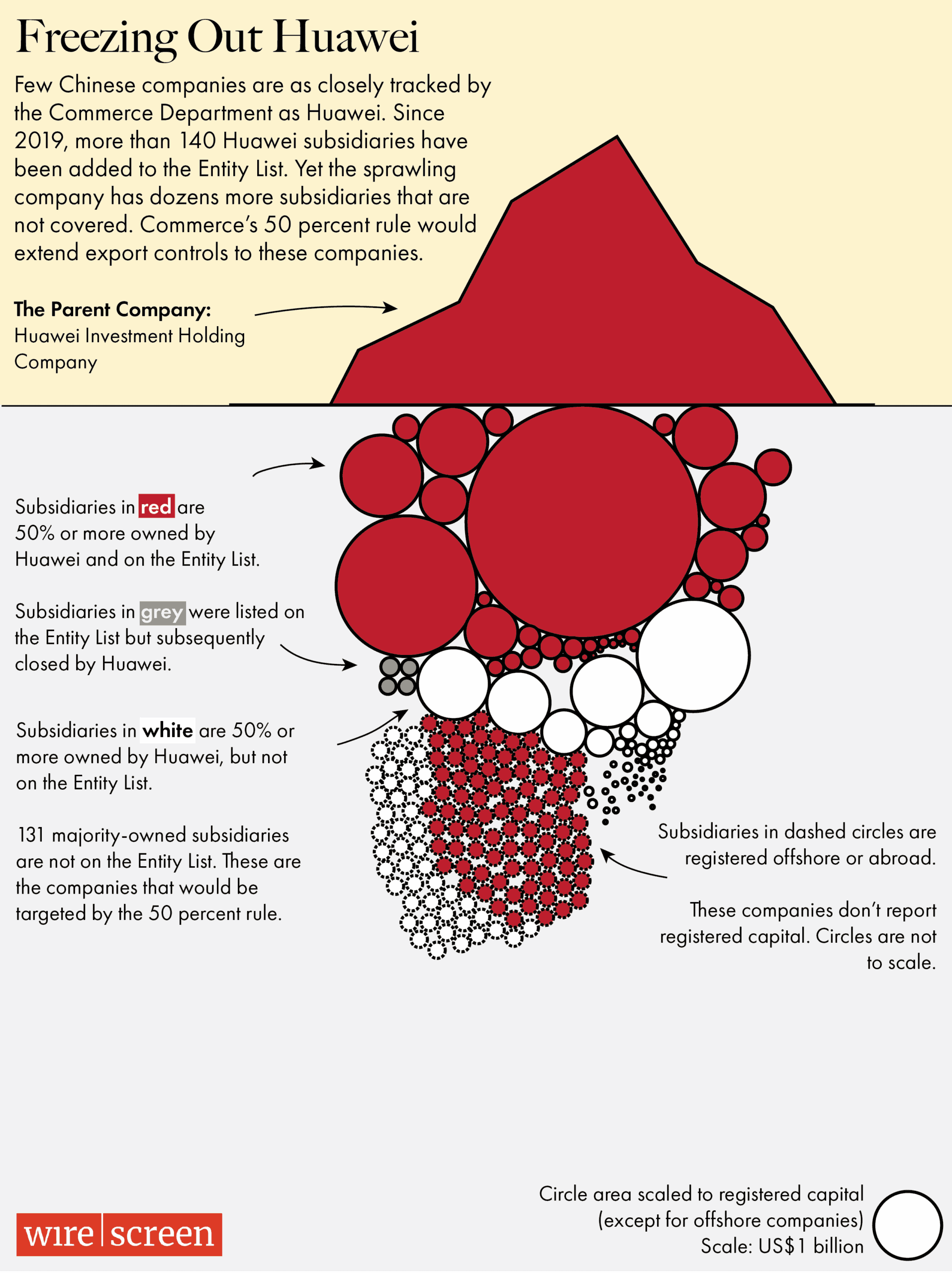
Huawei alone had 131 majority-owned subsidiaries that were not on the Entity List as of July, according to WireScreen. It did not respond to a request for comment.
Applied Materials has warned that it will take a $710 million hit — equivalent to about 2.6 percent of last year’s revenue — as a result of the new rule.

As for how Chinese tech firms will be affected, Poe Zhao, a China technology analyst, says previous additions to the Entity List have had an “uneven” impact.
“Companies dependent on U.S. technology and overseas markets faced significant pressure, while those anchored in China’s domestic demand have been more resilient,” he says. Being added to the list “delays products, raises costs, and narrows international access,” at least initially, Zhao adds. “But it has also pushed companies to localize supply chains, diversify into new sectors, and draw on policy-oriented capital.”
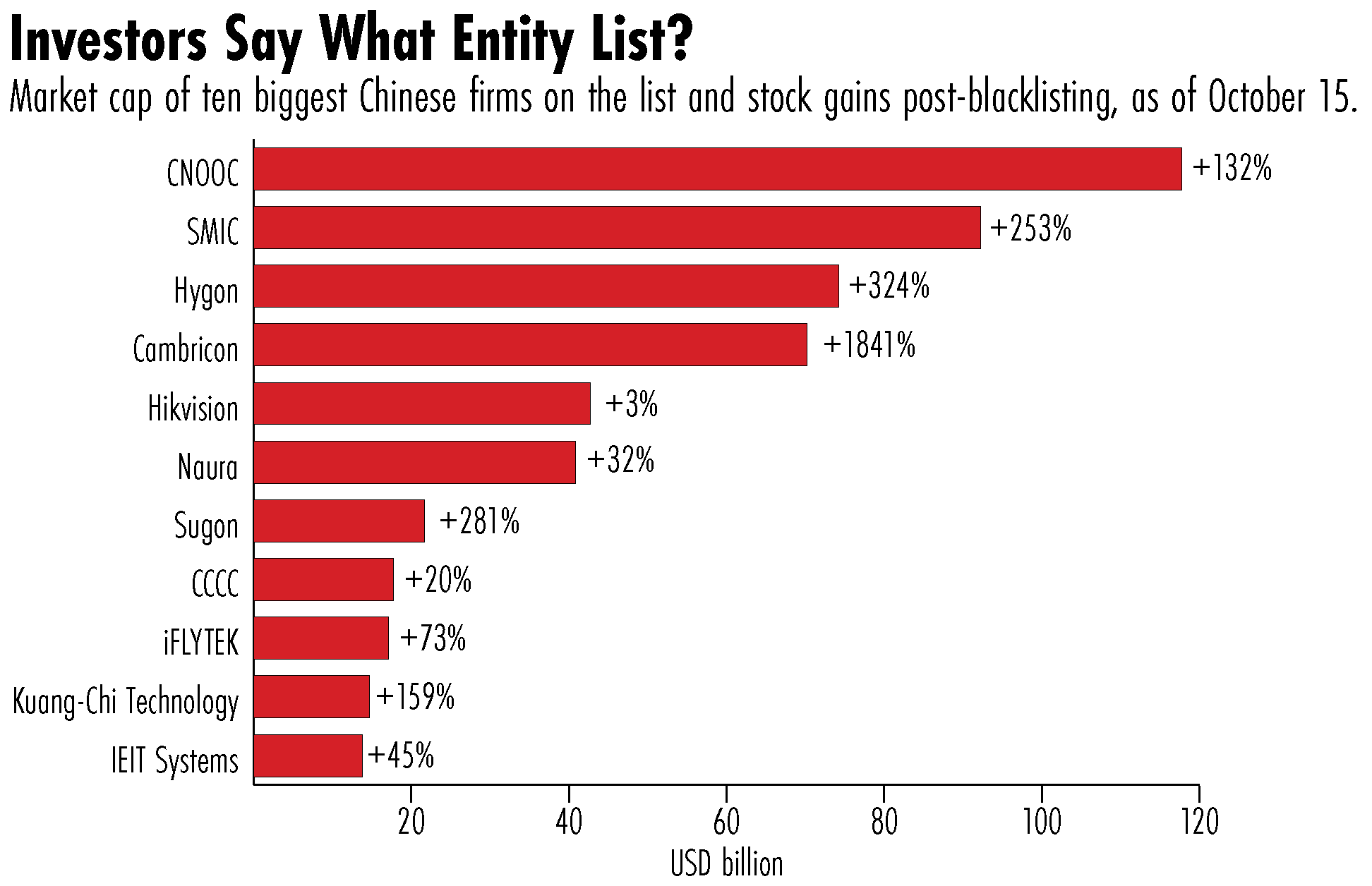
Of the ten largest publicly traded firms on the Entity List, the share prices of six have more than doubled after being blacklisted, reflecting investor confidence despite the disruption.
“You may kneecap a firm for a couple of years, but it can come back … once it figures out the supply chain difficulties and other markets,” says Lian Jye Su, chief analyst at tech research firm Omdia.
But Ryan Fedasiuk, a State Department technology advisor during the Biden administration, says making innovation more costly for China’s would-be chip champions is justification enough for the Entity List regime.
“If you’re willing to pay enough money, like the People’s Liberation Army [is], you can find your way to buying American products if you really want to,” he says. “But if a Chinese technology champion is forced to spend billions or hundreds of billions… that is a win, because even if innovation does happen, it happens at an extraordinary price.”

Noah Berman is a staff writer for The Wire based in New York. He previously wrote about economics and technology at the Council on Foreign Relations. His work has appeared in the Boston Globe and PBS News. He graduated from Georgetown University.