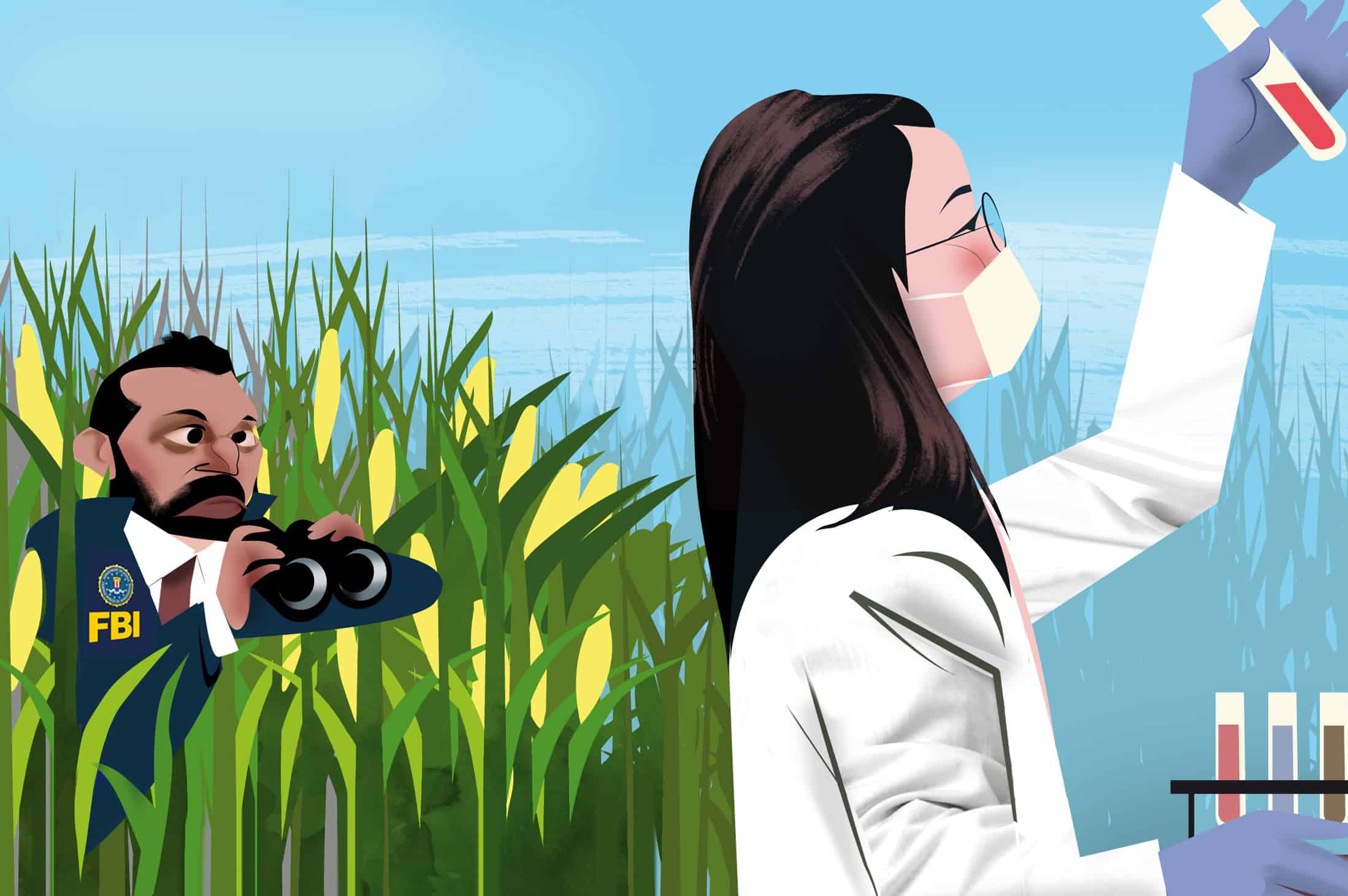
In June, Kash Patel, the combative pundit-turned-FBI director, made an alarming announcement. A young Chinese researcher at the University of Michigan had been arrested by federal agents after allegedly helping to smuggle a fungus into the United States called Fusarium graminearum, “an agroterrorism agent,” Patel said on X.

The widely-studied fungus can cause head blight, a fatal disease for wheat, barley, maize and rice crops. The researcher, Yunqing Jian, had allegedly colluded with her boyfriend, another plant pathologist named Zunyong Liu, to smuggle it into the U.S. “This case is a sobering reminder that the [Chinese Communist Party] is working around the clock to deploy operatives and researchers to infiltrate American institutions and target our food supply, which would have grave consequences,” Patel said.
With Patel’s announcement and the concurrent federal indictment, the two scientists were suddenly thrust into the national spotlight as alleged enemies of the state bent on sabotaging America’s food supply. It also came in the middle of a trade war in which agriculture has played a central role. When the two countries’ heads of state met last week for face-to-face trade talks, Donald Trump said Xi Jinping agreed to resume suspended Chinese purchases of American soybeans. According to China’s commerce ministry, U.S. concessions included suspending plans to vastly expand the number of Chinese-controlled companies subject to export controls.

Jian is originally from Sichuan province. In 2020, she earned a PhD at Zhejiang University in Hangzhou, on the mechanisms of how fungi deal with environmental stresses. Three years later, she joined the Molecular Plant-Microbe Interaction laboratory at the University of Michigan to research plant proteins, after a postdoctoral appointment at Texas A&M University. Her boyfriend, Liu, who had joined the lab in 2018, studied the interactions between Fusarium and cotton.
“What we have to realize is that every Chinese national is leveraged by the Chinese Communist Party,” Rep. John Moolenaar (R-MI), chairman of the House Select Committee on Strategic Competition between the United States and the Chinese Communist Party, told The Wire. “We have to recognize that any [scientific] advances that we help Chinese researchers with could ultimately be used against our men and women serving our country and against the interests of the United States. We need to be very selective on how we engage.”
There’s nobody that I’ve spoken to that thinks these scientists were doing this for nefarious reasons. It’s the politics that’s driving this more than the science.
Ruth Dill-Macky, who studies cereal crops at the University of Minnesota
In the wake of Jian’s arrest, the Select Committee threatened to rescind federal research grants awarded to the lab where she worked.

The charges sounded bad. In July 2024, Liu had been searched at the Detroit airport after traveling from Shanghai. Agents found four small plastic baggies containing samples of Fusarium. By law, such pathogens may only be imported through proper USDA procedures. Liu initially denied knowing how they got there, according to the DOJ complaint, but ultimately admitted that he planned to study them at the lab “where his girlfriend worked”, even though he was traveling on a tourist visa and legally barred from conducting research.
When agents interviewed Jian, she strenuously denied having any knowledge of Liu’s plans. But when agents searched her and Liu’s electronic devices, they found WeChat messages that indicated she was fully aware; Jian had deleted the messages from her phone. The messages also revealed that Liu had smuggled in other pathogens from China in the past.

Additionally, the complaint noted, agents found a scientific article in Liu’s phone titled “Plant-Pathogen Warfare under Changing Climate Conditions” which “references Fusarium graminearum as an example of a destructive disease and pathogen for crops”. The article , however, investigates the impacts of climate change on plant diseases; it does not discuss military applications. They also discovered a document on Jian’s phone that allegedly “describ[ed] her membership and loyalty to the Chinese Communist Party.”
At the Detroit airport, Liu was sent back to China. In Ann Arbor, Jian was arrested and charged with smuggling, conspiracy to commit smuggling and making false statements. She faces up to thirty years in prison.
Jian plead not guilty to the charges. Jian and Liu’s lawyers did not respond to requests for comment.

Jian’s case underscores the heightened scrutiny that many Chinese scientists in the U.S. are working under. Days before Jian’s arrest, Secretary of State Marco Rubio announced that the Trump administration would “aggressively revoke visas for Chinese students, including those with connections to the Chinese Communist Party or studying in critical fields.”
It also highlights just how far U.S.-China collaboration has fallen in the critical field of agriculture science, the intellectual bedrock of American food security. Since the 1970s, the two countries had nurtured close agricultural collaboration to mutual gain. Those ties are all but threadbare now.

“Our agriculture really, really benefited from our relationship with China and it’s suffering right now from this current relationship with China,” says Karen Mancl, an agricultural science professor at Ohio State University who has researched U.S.-China agricultural collaboration.
In the Weeds
Following Director Patel’s lead, hawks have framed this incident as a clear case of attempted agroterrorism directed at the American heartland by the Chinese state. But many plant pathology experts reach a different conclusion.
“There’s nobody that I’ve spoken to that thinks these scientists were doing this for nefarious reasons,” says Ruth Dill-Macky, who studies cereal crops at the University of Minnesota. “It’s the politics that’s driving this more than the science.”

The more likely explanation, multiple experts speculated, was that the two young Chinese scientists opted to neglect USDA importation protocol because it can be bureaucratic and time-consuming. No expert defended the researchers’ alleged smuggling but stressed that this hardly constituted “agroterrorism.”
In past situations where scientists have illegally circumvented procedure, offenders received “somewhere between a slap on the wrist and a fine,” says Allen. “I’m not aware of any situation in which anyone got jail time for moving a plant pathogen.”
In the same month that Jian was arrested, a Chinese student was arrested for illegally shipping biological pathogens to another University of Michigan lab, where she was a visiting scholar; the material was nematode growth medium, which is used to cultivate parasitic worms for research purposes.

In announcing the indictment, United States Attorney Jerome F. Gorgon, Jr. described the case as “part of an alarming pattern that threatens our security”.
“The American taxpayer should not be underwriting a PRC-based smuggling operation at one of our crucial public institutions,” Gorgon added. The student, Chengxuan Han, was convicted on smuggling charges, sentenced to three months of time served and deported to China.
Many researchers in the University of Michigan lab where Jian worked are Chinese, including the lab’s principal investigators, Shan Libo and her husband He Ping. In June, the House Select Committee sent letters to the National Institute of Health and the National Science Foundation urging a “review” of $9.6 million worth of grants awarded to the couple even though they have not been accused of any wrongdoing.
“It is our position that Chinese researchers tied to the PRC defense research and industrial base have no business participating in U.S. taxpayer-funded research with clear national security implications — especially those related to dangerous biological materials,” the letters read.
Shan and He did not respond to requests for comment. Earlier this year, following similar pressure from Select Committee lawmakers, the University of Michigan ended a longstanding academic partnership with Shanghai Jiao Tong University.
The university did not respond to multiple requests for comment.
Hawks have used the Jian case to highlight what they see as the vulnerability of American food systems to sabotage. Many have conflated it with other supposed instances of Chinese biological subterfuge, like the Covid-19 lab leak theory and the discovery of an unregistered biolab in southern California owned by a Chinese national that contained deadly pathogens. Others have noted that the University of Michigan has also had Chinese students federally convicted for taking photographs of U.S. military installations, in 2020 and 2023. Still others have tied it to the supposed national security risk of U.S. farmland being owned by Chinese nationals.

All of these cases have contributed to a consensus among China hawks that Beijing is conducting regular clandestine acts of espionage and biowarfare against rural America.
“There are no civilians or noncombatants in Beijing’s book,” wrote Michael Sobolik, a senior fellow at the Hudson Institute, on Jian’s arrest. “This was a clear attempt at bioterrorism and the [Chinese Communist Party] must be held accountable,” tweeted Rep. Mark Green (R-TN.) The North Carolina Republican congressman Greg Murphy, speaking on a podcast, said it “almost is an act of war, but it’s done by a private citizen.”
Yet what hawks have apparently failed to consider is the actual evidence supporting the agroterrorism claims against Jian. Official rhetoric notwithstanding, Jian has not been charged with attempted terrorism. This may be because, in the official USDA Select Agents and Toxins List of plausible agroterrorism threats, Fusarium graminearum is not even listed.

“If you did want to commit agroterrorism, there are better ways to do it,” says Caitilyn Allen, a plant pathologist at the University of Wisconsin-Madison. This is because Fusarium, though destructive when it erupts into head blight, is notoriously difficult to weaponize, even in lab settings. If agroterrorism was the goal, there are other far more reliable and destructive pathogens one would choose.
Eric Olson, a plant pathologist at Michigan State University who studies Fusarium, says that the plant pathogen, though potentially devastating, is “kind of a diva when they don’t have the right conditions”. “You need,” he adds, “the exact conditions of moisture, temperature, humidity levels — they have to be just perfect.”
Meanwhile, as Beijing continues to invest heavily in agricultural research, the Trump administration is rescinding or putting on hold research grants, which is demoralizing for government research scientists. It is these trends which experts believe may really threaten American food security, not Chinese scientists working in the U.S.
The U.S.-China trade war [started during President Donald Trump’s first term] made Beijing even more aware of the geopolitical risk in trade related to agricultural commodities. But even before that, the consensus of Chinese leadership was, ‘We want to hold our own rice bowl filled with Chinese rice.’
Wendong Zhang, an agricultural economist at Cornell University
“Along with the quantity, the quality of research publications in our field that are coming out of China in the last five years has just skyrocketed,” says Allen. “That’s what happens when you invest. If you want to think of this as a kind of intellectual arms race, the Chinese are pulling ahead.”

Fresh Shoots
The first-ever bilateral agreement between the U.S. and the People’s Republic of China was rooted in plants. A 1978 “oral understanding” between U.S. Secretary of Agriculture Robert Bergland and China’s agriculture minister, Yang Li-kung, led to several exchanges of agricultural scientists between the two countries. The next year, following formal diplomatic recognition of China’s Communist government, American scientists visited China to study pest control and collect seeds and other plant material.
Since then more than 2,000 American agricultural scientists have conducted similar research trips, with a comparable number of Chinese scientists coming to America, says Mancl, who has scoured American government archives on this period.

The Americans gained access to unique genetic materials, especially for crops such as citrus and soybeans, which originated in China. Chinese techniques in mulching and greenhouse use were also helpful. Conversely, American scientists helped their Chinese counterparts establish sophisticated seed banks; shared knowledge about storage, transportation and other agricultural infrastructure; and helped improve Chinese livestock feeding practices and protein supplementation.
“There were lots of teams of scientists going back and forth between the United States and China because we were both benefiting so much from it,” says Mancl.

Food security has concerned Chinese leaders since imperial times. China is home to 17 percent of humanity but only eleven percent of its land is arable. By contrast the U.S. has four percent of the planet’s population and sixteen percent of its land is arable, according to 2023 World Bank data.
In per capita terms, China has just .08 hectares of arable land per person, compared to .45 hectares per person in the U.S.
In China, systematic agricultural errors can have enormous impacts. In the 19th and 20th centuries, China suffered at least four famines with a million deaths or more — far more, in the case of Mao Zedong’s Great Leap Forward famine (1959–1961). Precipitated by Mao’s agricultural collectivization campaign, it caused upwards of 55 million fatalities, according to some historians.
After the Party accelerated its experiments with private farm ownership in the late 1970s, China’s food systems stabilized and the country was able to feed itself.
But as the population ballooned, reaching one billion in 1982, China began turning to imports. After decades of self-reliance, food imports surged past exports through the early 2000s. Since then, imports of soybeans, corn, meat and other foodstuffs have risen in tandem with urbanization, rising incomes and dietary changes. The top three source countries for food imports were France, the U.S. and the Netherlands in 2022, the latest year for which World Bank data is available.

China’s crop yield, the amount of production generated relative to an area harvested, is poor by international standards. Corn yield in the U.S. increased 63 percent from 1991 to 2021, largely due to the use of genetically modified crops. Over the same period corn yield in China, which has historically spurned GM crops, rose by 37 percent. China first approved commercial planting of GM corn and soybeans in 2023.
Between 2018 and 2022, China’s average year-on-year agricultural productivity growth was 15 percent lower than over the same period ten years prior, according to the most recent data from the U.S. Department of Agriculture’s Economic Research Service.
“The Chinese are very concerned about food security,” says Carl Pray, a Rutgers University economist focused on Chinese agriculture. “That’s why the levels of agricultural research in China are higher and growing much faster than any other country in the world.”
China’s homegrown agricultural companies are benefitting from that concern. The Chinese seed industry, identified by Beijing as a strategic industry in recent years, has grown from 730 firms in 2018 to more than 9,000 by the end of 2022, according to data collected by Mordor Intelligence.
Historically, American conglomerates led by Monsanto, DuPont Pioneer and Dow AgroSciences, have dominated the $90 billion global seed industry. In 2017, state-owned ChemChina acquired the Swiss agribusiness Syngenta for $43 billion. It was and remains the largest overseas acquisition by a Chinese company.
“The U.S.-China trade war [started during President Donald Trump’s first term] made Beijing even more aware of the geopolitical risk in trade related to agricultural commodities,” says Wendong Zhang, an agricultural economist at Cornell University. “But even before that, the consensus of Chinese leadership was, ‘We want to hold our own rice bowl filled with Chinese rice.’”

The Covid-19 pandemic and the war in Ukraine further sharpened Chinese leaders’ longstanding concerns about relying on imports for staple foods such as wheat and soybeans, especially from the U.S. China has reduced its dependence on U.S. suppliers by sourcing more from Brazil and other big farming nations while boosting domestic production. The country is now largely self-sufficient in major grains, producing over ninety percent of its wheat and corn requirement and nearly all of its rice.
Last year Beijing enacted a new law aimed at achieving “absolute self-sufficiency” in staple grains. The law includes strict fines for converting farmland to growing non-staple crops.
One third of the latest “Document Number One” — China’s annual agriculture and rural development strategy and so-named because it is traditionally the government’s first policy of the year issued every January — is dedicated to food security.
In February, President Xi met with 31 Chinese entrepreneurs; four of them represented agriculture companies. Agribusiness tycoon Liu Yonghao, founder of New Hope Group, was one of six entrepreneurs who spoke at the event. He said his company has closely followed the country’s strategic goals by focusing on food security and self-sufficiency in seeds.
A New Leaf
In the U.S., China’s agricultural push has been viewed with much suspicion for at least a decade.

In 2016, a Chinese national was convicted of conspiracy to steal seed-related trade secrets from Monsanto and DuPont Pioneer in Iowa on behalf of a Chinese company. In 2022, another Chinese citizen pleaded guilty to conspiring to steal a proprietary algorithm used in Monsanto’s farming software. Other Chinese suspects in alleged cases of agricultural theft in the U.S. have fled to China before they could be prosecuted.
One new bill1Protect America’s Innovation and Economic Security from CCP Act of 2024 on Capitol Hill proposes resurrecting the China Initiative, a Trump-era effort to scrutinize economic espionage and the theft of U.S. trade secrets. The bill cites “academic institutions” as potential hideouts for Chinese spies. Last year, it passed in the House but awaits a vote in the Senate. In practice the program, which ended in 2022, primarily targeted U.S. researchers of Chinese descent and resulted in few convictions.
U.S. growers have been the beneficiary of the crème-de-la crème scientists who’ve come from China… and did their research here.
Caitilyn Allen, a plant pathologist at the University of Wisconsin-Madison
Other bills that passed in the House but await Senate confirmation include Protecting American Agriculture from Foreign Adversaries Act, which would require the federal government to review foreign investments in agricultural land; and the Science and Technology Agreement Enhanced Congressional Notification Act, which would require the State Department to notify Congress of scientific cooperation agreements with China.

The current climate is not, in short, a promising one for U.S.-China academic collaboration of the sort that Yunqing Jian participated in at the University of Michigan. “Scientific research relies and thrives on open communication,” says Zhang at Cornell, who was speaking soon after learning that a Chinese student of his had been denied a U.S. visa. “When binational communication becomes challenging, you don’t necessarily know what’s really going on in the field,” Zhang told The Wire China. “You might be doing repetitive rather than additional work or research.”
Shan Libo, the Chinese scientist running the lab that Jian worked in, now might have her federal grants rescinded even though she has not been accused of any wrongdoing.
In the world of plant pathology, Shan is famous for furthering the understanding of “signal transduction pathways,” a kind of immune system for plants. Her specialty is crucial for efforts to improve the defenses of commodity crops. In June, Shan was named an associate member of the European Molecular Biology Organization, a prestigious body. “It gives you a sense of how highly regarded she is, internationally, for her excellent science and her collaborative approach,” says Adam Bogdanove, a Cornell plant pathologist.

In fact, the fungus which Jian is charged with smuggling into the U.S. is not a major concern for American farmers precisely because of the scientific innovations propelled forward by researchers such as Shan.
“If it weren’t for the work of people like Libo, farmers would be having big losses to [fungi],” says Allen at the University of Wisconsin-Madison. “U.S. growers have been the beneficiary of the crème-de-la crème scientists who’ve come from China… and did their research here.” Now Allen wonders if they will keep coming.

Brent Crane is a journalist based in San Diego. His work has been featured in The New Yorker, The New York Times, The Economist and elsewhere. @bcamcrane