Perry Link is one of the world’s foremost scholars of Chinese language, literature, and political expression. Over a decades-long career, he has translated the works of dissidents like Liu Xiaobo, chronicled the 1989 Tiananmen movement, and introduced the influential ‘Anaconda in the Chandelier’ metaphor to describe self-censorship in China. In 1996, he was banned from entering Mainland China.
Link is a Professor Emeritus of East Asian Studies at Princeton University and currently holds the Chancellorial Chair for Teaching Across Disciplines at the University of California, Riverside. His most recent book, Anaconda in the Chandelier (published February 2025), gathers essays spanning his prolific career and offers enduring insights into Chinese politics and culture.

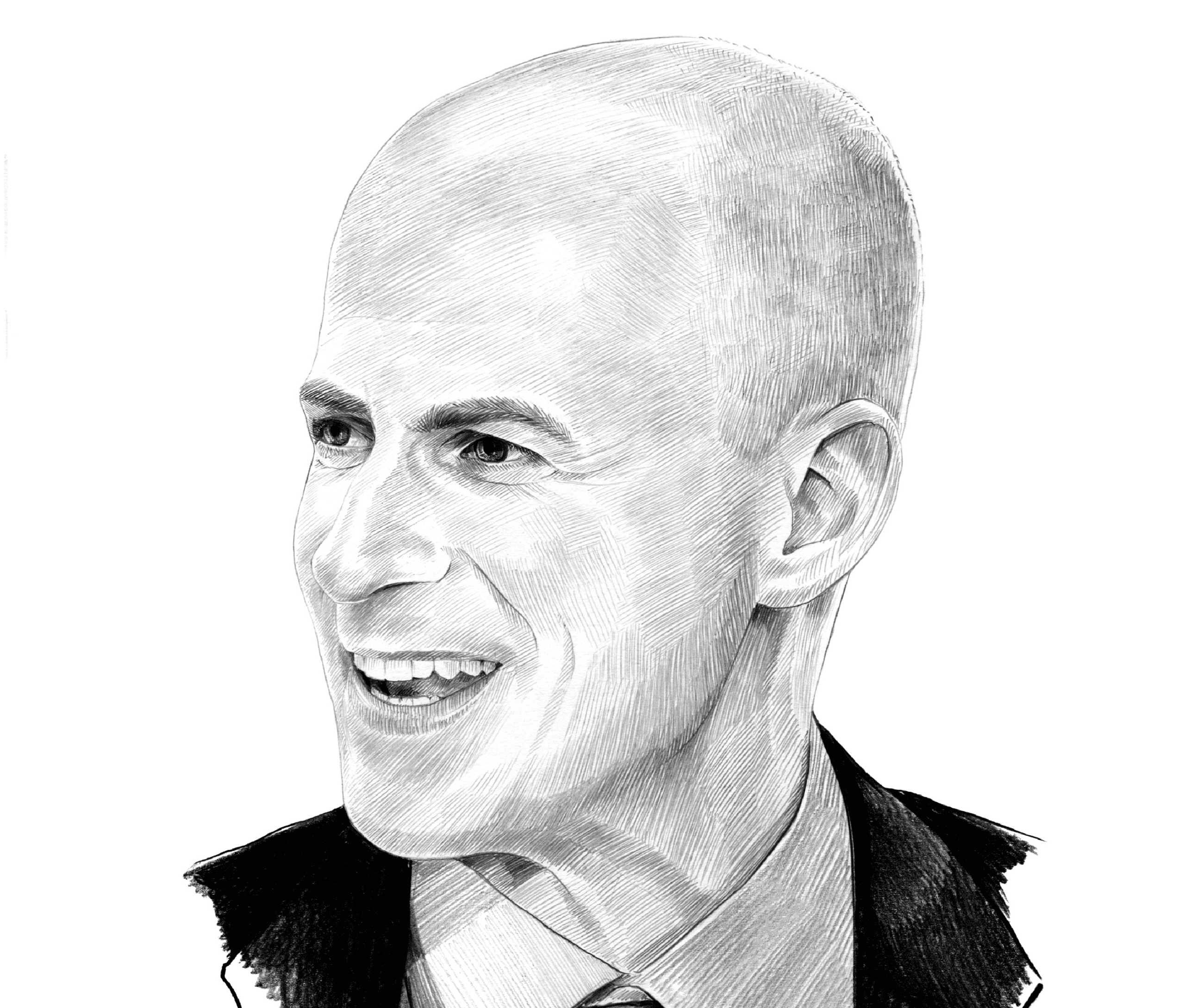
Illustration by Lauren Crow
Q: Could you start by explaining for our readers what the book is about, explain its title, and why you decided to publish now?
A: It’s a collection of some of my favorite essays I’ve written over the years. There was something appealing about picking the ones that still felt important. I tried to reflect not only on my campaigns against the predations of the Chinese Communist Party, but also my work as a teacher of Chinese and my studies in literature and the academic world. I’m mostly known as a scholar of modern Chinese literature.
The name of the book is the title of one of the essays — ‘The Anaconda in the Chandelier’ — a metaphor I came up with maybe 20 years ago, trying to capture what it feels like to live under a threatening presence that induces self-censorship. This kind of vaguely expressed, overhead fear affects not only Chinese people, but even foreigners who deal with China.
My first idea for the title was Captive China. I love China’s language, humor, and literature. My wife is Chinese and my children are half Chinese. But this big, wide conception of China has been taken captive by the Communist Party. It’s better to think of the Party as the head of a government that, in my view, is a very effective mafia that has captured a great, rich civilization. My publisher, Paul Dry, thought Anaconda in the Chandelier would attract more eyeballs.

How does the CCP capture public opinion? What has public opinion effectively become?
I wouldn’t say they control public opinion. They control public expression. There’s a big difference between that and opinion, which can be kept private or spoken among friends or colleagues or families, but not spoken in public. If you do it in public, you get in trouble. Everybody [in China] knows this; it is how self censorship works. One gets used to an atmosphere in which punishment is possible if you mispeak or misbehave, and therefore you train yourself not to. But that’s not the same as controlling public opinion. People have their own thoughts.
In your 2013 essay, ‘Capitulate or Things Will Get Worse,’ you discuss how Chinese author Han Han defends the younger generation of Chinese for their political apathy. Does this trend persist today? Why? And can it change?
Different kinds of people will have different experiences. Lately, there’s been a tide of disillusionment among urban youth. It’s become very expensive to live in urban China, and opportunities for making money have narrowed compared to five or ten years ago. You now have a lot of well-educated, well-meaning young people who do well in school but can’t afford to start families. One of the phrases young people use is tang ping — “lying flat” — which means giving up on the outside world, or at least pretending to give up, as a form of protest. It’s too hard to get anywhere: buying a house or even renting an apartment is so expensive that it takes everything you earn. So the protest becomes, “I’m going to lie flat. I’m out. I’m not even going to try.”
| BIO AT A GLANCE | |
|---|---|
| AGE | 81 |
| BIRTHPLACE | Gaffney, South Carolina |
| CURRENT POSITIONS | Emeritus professor of East Asian Studies at Princeton University and of Comparative Literature at the University of California, Riverside |
But the moment that kind of opinion starts to organize — if people form a group, a club, an NGO, or a religious community — the Party steps in. The CCP is relatively tolerant of individual opinion, as long as it’s ad hoc and not coordinated. But they’re deeply afraid of anything that suggests organization. If we’re talking about discontent or complaint, there’s plenty of that. But organizing it into a real dissent movement is extremely dangerous, which people know.
Could you give an example of indirect protest via sarcasm or humor online, which you refer to in the book as shunkouliu?
Shunkouliu — oral jokes, ditties, and so on — circulated especially in the 1990s. With the advent of the internet in the 2000s and right up until now, the clever wisecracking is mostly online. It’s very pervasive, and I don’t know how many hundreds of thousands of examples one could give.

For example, if you write “Xi Jinping” online, an automatic filter will grab it and flag it for a human censor, and you could get in trouble. So there’s a lot of clever game-playing about how to refer to top leaders or the state in code. Take Xi Jinping: jin means “near” and ping means “even.” But there’s an exact homonym, with the same tones: jin as in “prohibit” (jinzhi), and ping as in “comment” (pinglun). So it becomes “Mr. Xi who prohibits speech.” It sounds exactly like his name. Of course, the censors catch on to this too, and they set up filters for those versions. Then the clever netizens come up with something else. That is how some people express discontent.
Language can be just as important on the China-watching side. As you state in your 2021 essay ‘Beijing Protests a Lab Leak Too Much,’ what is reading ‘upside down’?
Reading ‘upside down’ is a phrase I borrowed from a Chinese author I love: Wu Zuxiang. In an interview with me, he grinned and said, “There’s truth in Chinese newspapers. You just have to know how to read it.” I asked, “What do you mean?” He said, “You read upside down.”

For example, if you read in the official press that the People’s Liberation Army has heroically rescued 17 people from a mine collapse somewhere in China, you can reasonably guess that several hundred people actually died in a mine disaster.
Any expression by official Communist Party writers tends to contain a grain of truth, but not in the Aristotelian sense of true or false. Rather, it’s true in the sense that there is a reason that sentence was written. That reason has to do with someone’s perception of what serves the interests of the Party-state. That’s the job of writers in the official press. If you can figure out what that reason is, then you have a firm kernel of truth to work with.
How might you suggest Western non-Chinese speakers — particularly business leaders, analysts, or government officials — read ‘upside down’ to make better decisions?
It’s not easy. The first step would be to learn Chinese. That gets you closer to the actual expression. But I won’t say it’s impossible to read ‘upside down’ in English translation. You just have to keep in mind that principle: ask why is this sentence being written, not whether it’s true or false in the empirical sense, meaning whether it matches up with external facts or not. That’s secondary. It might match up, it might not. The key point is how the sentence advocates the power interests of the state.

What would you look for when trying to read ‘upside down’ in the upcoming Five-Year Plan due in 2026?
I gave up reading Five-Year Plans a long time ago. They’re part of a political ritual where the current leader puts out a rosy projection of what’s desired. I don’t think people in China take the verbiage of the Five-Year Plans very seriously either. It’s like the “China Dream” in five-year form. It’s not something you can count on to actually be carried out.
The Chinese dissident astrophysicist Fang Lizhi, whom I got to know fairly well, put it perfectly in his autobiography. He wrote: “The Communist Party plans everything. It plans the economy, it plans publications. It has a five-year plan, a ten-year plan…it can plan everything except itself.” It can’t plan itself because it doesn’t know its own future. That future depends on the power struggles constantly going on inside the Party. No one can predict that, not even the Party.
| MISCELLANEA | |
|---|---|
| BOOK REC | The Framer’s Coup: The Making of the United States Constitution by Michael Klarman |
| FAVORITE MUSIC | Beethoven’s Symphony No. 9 |
| FAVORITE IDIOM | 死猪不怕开水烫 (sǐ zhū bùpà kāishuǐ tàng) — a person who has nothing more to lose will go to any lengths, regardless of the consequences. |
How might opposition to the Party from below shape or respond to China’s upcoming succession situation?
Pressure from below is there, but it’s ineffective unless there is a split at the top, so that one leader can attract support from below and the other one can’t. That briefly happened during the 1989 Democracy Movement, which was then crushed by the massacre. The reason that split could get out into the streets so dramatically — not only in Beijing, but in virtually all of the big cities in China — was because people who felt discontent saw the opportunity to come out and demonstrate. But it’s not generated from below. It couldn’t have happened if there hadn’t been a split at the top among the so-called reformers or more liberal-minded people in the Communist Party like Zhao Ziyang and Hu Yaobang.
If there’s a chance to get out in the streets and root for someone, they’ll do it. The whole Tiananmen demonstration was sparked by the death of Hu Yaobang. So the people below took the opportunity to get out and honor him — which was an indirect way of saying, “We want a different kind of China. We want the kind of China he was turning toward,” not the one that Chen Yun, Bo Yibo, and the so-called conservatives wanted.
I’ve unwittingly become a tool of the CCP: a poster boy for “Don’t be bad, or you won’t be able to go to China.”
Pressure from below matters, but it can only get to the top if there is a fissure at the top that can be exploited. If there’s no fissure, then the system of police control kicks in: monitoring, following you, listening to your phone conversations, and intercepting your emails.
Could you expand upon the build-up of punishment?

It starts with very gentle repression. By gentle, I mean the police invite you to tea. He cha — “drink tea” — has become a shorthand for gentle police intimidation. They bring you in and say things like, “You do want your daughter to be able to go to that local public school, right? It’s a nice school, and it’s nearby. You wouldn’t want something to get in the way of that.” That’s a threat — a gentle threat — but it says, “Shape up, or we won’t let her go to that school.”
If you don’t agree, they increase the pressure. The threats get stronger. You can be monitored. Most of my friends who are explicit dissidents inside China have two or three plainclothes police regularly assigned to them. As soon as they leave their home, those police go along with them. It’s not antagonistic, but you are monitored.

And if that doesn’t work, you can be charged with something, brought to court, given no chance, and sentenced to prison. There’s a spectrum of punishments, from gentle all the way up to death, to locking you up, withholding medication, so you die in prison. Everyone knows about this.
And that’s where the ‘Anaconda in the Chandelier’ comes in. Everybody knows that spectrum of punishment is there. And you have two or three off-ramp alternatives or ways to get off the spectrum if you obey and shut up.
You have not been able to enter China for decades. What has that experience been like for you?
You’re referring to my trip to Beijing in 1996, when I was going to visit the Princeton in Beijing program, and the police intercepted me at the border and said I wasn’t allowed in the country.
The cost to me of being blacklisted since that July 1996 experience is that I can’t go to China. I used to love going to China. Some of my books are based on personal experiences on the street — listening to the slang and the new phrases that come up — and I can’t do that now. That’s a loss to me. And of course, being able to see my friends face to face and enjoy delicious snacks on the street; that’s a cost too.
But the more serious cost is that I’ve become a symbol of what happens to a foreigner if you criticize the Party too much. I taught at Princeton for 23 years and had some very good students, including ones who steered away from China topics or China activities because they saw what happened to me and didn’t want to get stuck the same way.
What is one instance?
There was a wonderful young woman I taught in first-year Chinese at Princeton. She came in one day beaming with enthusiasm because she got a summer internship with Human Rights Watch in Washington, D.C. I encouraged her. But she came back a few days later and said, “Lin laoshi, you’re on a blacklist. If I take this job, will I get on a blacklist?” And I said, “Something like a summer internship in Washington, D.C. is not nearly serious enough for you to get on a blacklist.” But after a few more days, she decided to turn the internship down.

That’s one of my big points in the essay about the ‘Anaconda in the Chandelier.’ When a threat is delivered but the red lines are unclear, you don’t know where the danger is. She came to me asking where the line was, and I didn’t know. Nobody knows. They don’t want you to know. They want the threat to be clear, but the boundaries to be vague, so you over-censor in response. That’s the main reason I don’t like it. I’ve unwittingly become a tool of the CCP: a poster boy for “Don’t be bad, or you won’t be able to go to China.”
On the other hand, there are a couple of reasons why it’s advantageous to be on a blacklist. One is that I get a lot of credit I don’t deserve. People think, “Oh, you’re heroic, you stood up to an authoritarian government.” I also get a very deserved freedom. Because if you analyze the power of the ‘Anaconda in the Chandelier,’ it’s not the blacklisting itself that controls people, it’s the fear of getting on the blacklist. People self-censor because they’re afraid of crossing that invisible line. But once you’re on the list, that fear disappears. So you can speak more freely, and I do.
I want to transition now to the United States. In your 2019 piece, ‘Why We Remember June 4th,’ you described Tiananmen as a ‘nation invading itself.’ Do you see any parallels with the United States in its current political situation?
First of all, let me say that “a nation invading itself” was not my phrase originally — that was from Fang Lizhi, the same dissident astrophysicist I mentioned before.
Do I see any parallels? Yeah, I do. And I see them from both the Left and the Right in the U.S.
Mr. Trump clearly admires dictators around the world. He likes to be friends, if he can, with Kim Jong Un, Viktor Orbán in Hungary, Xi Jinping. In his ruling habits, he also has this sort of one-man imperial style: “Here’s what I’m going to write for my executive orders.” And that system still works. It does present an almost Chinese authoritarian-like threat to our society — from the Right.

But I also think the Left has that problem, in a different way. The idea that there’s an elite that knows what’s best for everybody else, and we have to train those unwashed proletarians to be sufficiently ‘woke’ leads to an authoritarian arrogance that I think Democrats need to look hard at.
I think in China, that sense of normalizing the repression, and accepting it as part of life, is more entrenched now than it was 30 years ago when I first thought of the [‘Anaconda in the Chandelier’] metaphor.
“We have the right answer, and you don’t. You have to reflect on your thoughts and what brought you to this or that wrong conclusion.” That also resonates with the Chinese Communist Party.
But I believe American democracy is strong enough in our culture that I don’t think the antics of Donald Trump or the self-righteousness of woke people will really threaten it in the long run. That culture of fairness, I think, is strong.
It sounds like you’re describing the process of self-censorship.
I have Chinese friends who point this out all the time. They say, “Self-censorship? Yes, in China — ‘Anaconda in the Chandelier’ — but look at political correctness in your society.” There are certain things you just can’t say, or if you do, you’re very careful how you say them, or to whom you say them.
So that parallel is there. But one big difference is that the fear that drives self-censorship in China comes from the top — it comes from the ruling people at the top of the Communist Party. In our society, the pressure comes from around us, from society. You risk being socially ostracized if you say something politically incorrect. The effect is quite similar, but the source of the pressure is very different.

A sort of ‘Anaconda in the Weeds,’ you could say. Would you revise or expand your famous ‘Anaconda in the Chandelier’ metaphor today?
Yeah, I would. First of all, I’d stick with it. The function of issuing a fearsome but unclear threat — which causes people to self-censor, and to censor themselves beyond what’s actually required — is still very much in place. And that’s continuous to today.
The main difference I see now is that this exists more inside China than outside. Inside China, the presence of the ‘Anaconda in the Chandelier’ has become so normalized that it feels natural. This is just the way the world is.

If someone speaks out and risks punishment from the government, some of the first people to criticize them are their own family members: “You doofus, what are you doing? Don’t you know you can’t say that? You’re not just risking yourself. You’re risking all of us.”
So what I want to emphasize now is the acceptance of these conditions. This is just how it is. Don’t be stupid and step off the path.
You can think of it like a hiker walking up a mountain who comes across a huge boulder in the path. What do they do? They walk around it and keep going. They don’t try to blow up the boulder. The presence of the boulder becomes natural. You just live with it.
I think in China, that sense of normalizing the repression, and accepting it as part of life, is more entrenched now than it was 30 years ago when I first thought of the metaphor.
As you look back on your career, how do you feel about the way U.S.-China and global China relations have turned out?
My career has been in Chinese language and literature. I am a fierce critic of the CCP because of the ways they have treated the Chinese people, whose culture I love and with whom I deeply sympathize. The story has not “turned out” yet. Eventually the CCP will lose power, but I am not confident that I will live to see that.

Dean Minello was a summer staff writer for The Wire based in New York. He is a junior at Princeton University studying Public & International Affairs with a minor in East Asian Studies, and does research at Princeton’s Center for Contemporary China. Proficient in Mandarin, Dean is interested in authoritarian politics, human rights, and U.S.-China relations.