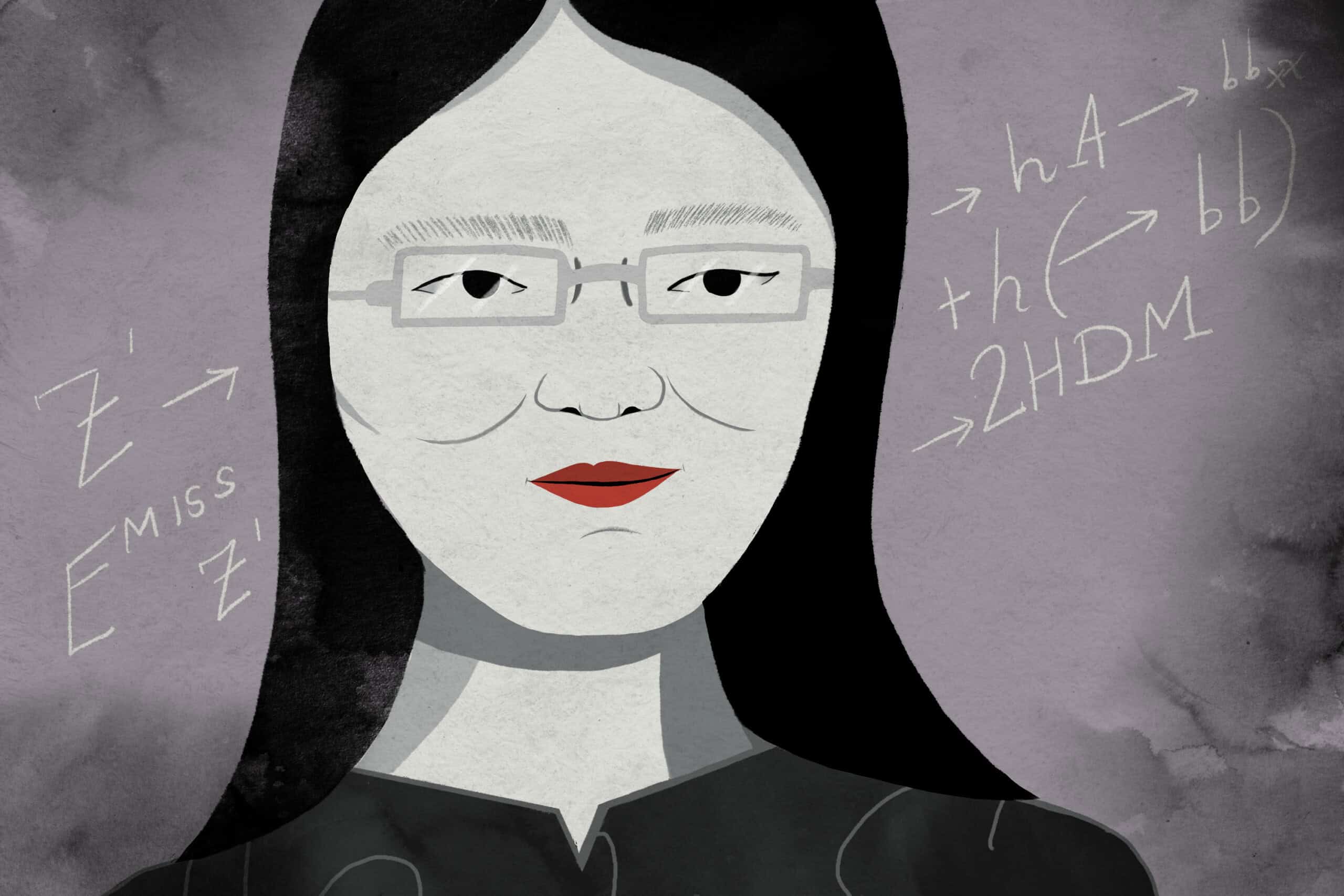
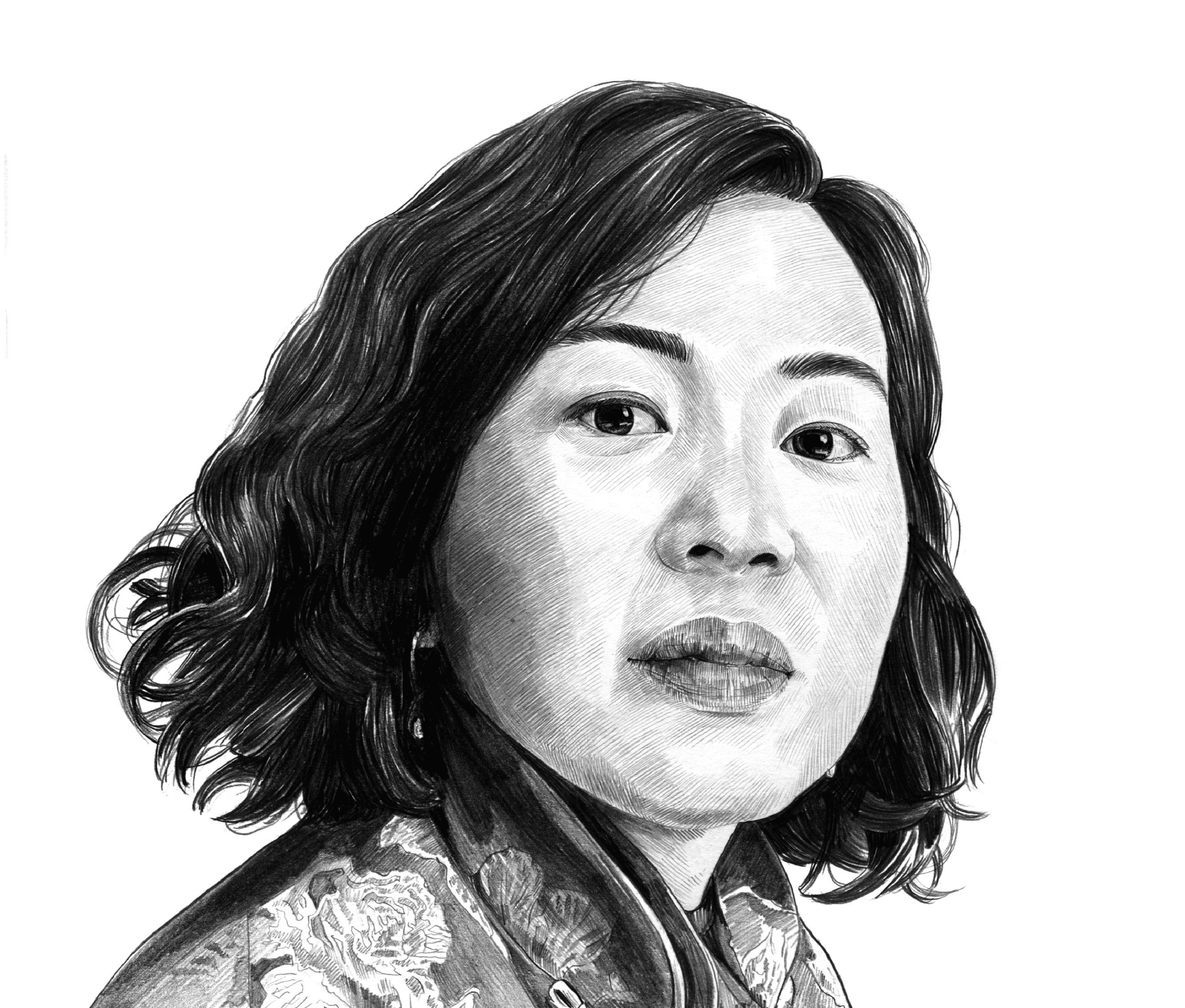
Yangyang Cheng wrote her first story just after she turned five. It was winter break, and she had been watching “Romance of the Three Kingdoms,” a television series based on the Chinese epic about the turbulent Han dynasty. It was a rare occasion for Cheng — her mother usually did not allow her to watch TV — and she immediately took a liking to one of the characters: Zhuge Liang, a military strategist with magical powers.
She liked the way Zhuge was portrayed on screen as a gentleman scholar. Not only did he help win battles against fierce warlords, but he was an engineer, politician and inventor as well. Legend goes that he even invented a special crossbow that could shoot multiple arrows simultaneously.

“There was a certain gentleness and a certain wisdom [to him],” she told The Wire China, “and then there was a certain tragic factor in that story, in the sense that he served, in the end, a failing and fallen kingdom.”
In a small red notebook, she wrote a kind of fan fiction, bringing Zhuge to life in modern day Hefei, the inland city in eastern China where she then lived. But it was a short-lived pastime. Cheng’s mother thought that extracurricular writing was a frivolous waste of time. On more than one occasion, she even tore up her daughter’s diaries.
Cheng turned her focus to a more accepted passion in the family: science. Her father had been a mechanical engineering professor at the University of Science and Technology (USTC), one of China’s premier science institutions, and Cheng followed in his footsteps when she enrolled at USTC and studied physics. She then moved to the U.S. for a PhD in experimental particle physics, and she spent years studying dark matter, one of the biggest remaining mysteries of the universe.

But Cheng never fully left behind her childhood interest in writing, and in recent years, the 34-year-old has become a ubiquitous voice in the American press. In fact, she has emerged as a public intellectual at the center of one of today’s most pressing geopolitical issues: the U.S.-China scientific relationship.
Not unlike her one-time inspiration, Zhuge Liang, Cheng draws upon a diverse range of disciplines — physics, politics, history, and personal experience — to explore the evolution of Sino-American scientific exchange and the responsibility of scientists in both an authoritarian China and an America that is increasingly suspicious of China’s technological rise. Her writing has developed a fan following of its own, partly because it has become rare for someone like her — a Chinese scientist in America — to be so unapologetically outspoken and to insist, as she does, that “science is an inherently political endeavor.”
Reading Cheng’s writing is like “seeing a giraffe on the subway,” says Susan Jakes, the editor-in-chief of ChinaFile who has edited several of Cheng’s pieces.
Of course, Chinese scientists in America are nothing new: Chinese students have come to U.S. universities for training for over a century. But in 2018, the Trump administration launched the “China Initiative” to investigate scientists, particularly of Chinese heritage, in an effort to counter the Chinese government’s theft of emerging technology and scientific secrets. The U.S. government brought more than 70 cases under the initiative, and ruined many more careers and lives in the process. Most tragically, the Stanford physicist Zhang Shoucheng took his own life after the FBI began questioning his ties to China.
The Biden administration dismantled the China Initiative in 2022, but still a chill lingers, with any kind of scientific collaboration with China seen as a minefield for researchers, scientists and professors. The deep psychological impact on scientists has also endured: A recent study by researchers at Princeton University found that nearly three quarters of survey respondents, who were all scientists of Chinese descent, did not feel safe in the United States.

So fraught is the terrain that one of the oldest bilateral agreements between the two countries, the U.S.-China Science and Technology Agreement, is now hanging on by a thread. The agreement enables very basic research collaboration, such as cooperation on influenza vaccine research, and was first signed in 1979; it has been renewed every five years since but faces expiration this summer.
Meanwhile, U.S. policymakers have leveled a bevy of sanctions on China’s high-tech firms in areas like quantum computing and advanced biotechnology for involvement in the Chinese military or human rights abuses. In early May, Cheng’s alma mater, USTC, was even placed on the Commerce Department’s entity list, for involvement in China’s nuclear program and quantum computing work.
“Science and technology have played a big part in both pulling the U.S. and China together and also, paradoxically, driving them apart,” says Zuoyue Wang, who studies the history of the U.S.-China scientific relationship at California State Polytechnic University, Pomona. “For some Chinese and Chinese American scientists, they need to make a choice, whether to stay in the U.S. or whether to return to China.”

Cheng, however, opted out of that choice. In 2021, she left science altogether and now works as a research scholar at the Yale Law School’s Paul Tsai China Center, where she is working on a book about the history of the relationship between science and the Chinese state. Her writing, she says simply, is about “science at the border,” but at a time when the U.S. border is such a fraught place for scientists, her dispatches have become must-reads for understanding both the benefits and challenges of U.S.-China scientific exchange.
In a way, it is the role she has always wanted to play. “Had I grown up in a free society I would never become a physicist,” she explains. “But I could not be the type of journalist I would like to be in a country without freedom; I could not be a lawyer or a judge in a country without the actual rule of law; and I don’t want to be a diplomat or politician in a country with an authoritarian system… So the natural sciences were the only disciplines I could pursue without compromise.”
She is one of the rare Chinese intellectuals since Fang [Lizhi] who uses scientific reason to look at topics like what it means to be human.
Orville Schell, the director of Asia Society’s Center on U.S.-China Relations
Her transformation is not entirely unique. Although Cheng doesn’t call herself a dissident, she is the latest in a long line of Chinese physicists-turned-political thinkers, including Fang Lizhi, one of the most famous activists of the Tiananmen Square era, who was the vice president of USTC before escaping to the U.S. with a dramatic plea for asylum. Cheng, like Fang before her, uses her training as a scientist to examine the often irrational turns in Chinese politics and the human cost of the crumbling relationship between the world’s two superpowers.
“She is one of the rare Chinese intellectuals since Fang who uses scientific reason to look at topics like what it means to be human,” says Orville Schell, the director of Asia Society’s Center on U.S.-China Relations who was friends with Fang. But Fang, Schell adds, was able to live in China and exist within the Chinese scientific and political system for much of his life. “That was a very different time when the middle ground offered people a reasonably solid place to stand.”
Cheng, by contrast, never saw a place for herself in China. And as the middle ground increasingly melts away in the U.S. as well, it’s not entirely clear where someone like her is supposed to go. What is the role of a physicist who refuses to be a tool of the state?
‘CRADLE OF SCIENTISTS’
Cheng likes to stand out. Slender and 6-feet tall, she has a penchant for fitted, patterned dresses and red lipstick, and she moves around Yale’s campus with the comfort of someone who has lived in college towns her whole life. In conversation, she switches fluidly between deep ruminations on the laws of the universe, analysis of U.S.-China relations, and irreverent digs at herself.
But as she delicately ate her eggs at a popular Yale cafe, a different campus was on her mind: USTC, a place she hasn’t been back to since she was a teenager and yet often finds its way into her writing and thinking.

USTC is not only intertwined with Cheng’s family lineage, but also with China’s scientific development, Chinese politics, and even the twists of U.S.-China relations. It was established in 1958 in Beijing to be the “cradle of scientists” for the new Chinese nation, and one of its founding scientists was Qian Xuesen, an aerospace engineer who spent much of his early career in the United States. Qian had helped found the Jet Propulsion Laboratory (now part of NASA) and served on the U.S. government’s Science Advisory Board during World War II. During the McCarthy era, Qian was accused of being a secret communist and put under house arrest for five years. In 1955, he was deported back to China, where he started China’s space and missile program and was tasked with running USTC’s modern mechanics department.
Another early faculty member at USTC was the brilliant young physicist Fang Lizhi. A graduate of Peking University, Fang had a spotty political track record — he was expelled from the Communist Party during Mao Zedong’s anti-rightist campaign after writing a letter warning against political interference in scientific research — but his physics prowess was too valuable for Beijing to sacrifice. He was dispatched to USTC in the late 1950s to work in the university’s new physics department. (Fang was very critical of Qian, his new colleague, for writing a physics paper defending the Great Leap Forward. “Even setting aside the question of whether Qian was using ‘science’ to flatter political power, the science itself was plain wrong,” Fang wrote in his memoir.)
USTC didn’t last long in Beijing. Amid the chaos of the Cultural Revolution, the university was banished from the capital. According to Fang’s memoir, the city of Nanyang offered to put up the university in Zhuge Liang’s old home, but the university eventually settled in Hefei. Fang, who was labeled a reactionary during the Cultural Revolution, was also “sent down” to Anhui province to work in a coal mine. When USTC classes eventually resumed in 1970, Fang was allowed to continue teaching at the university and eventually became an internationally recognized physicist, particularly in the realm of cosmology, which studies the origin of the universe. (In one controversial paper, he introduced the idea of the Big Bang Theory to the Chinese physics world, which contradicted the Friedrich Engels theory that the universe is limitless.)

Fang was promoted to vice president of USTC in 1984, but soon became an outspoken critic of the Communist system. In the mid-1980s, he traveled around China giving speeches and interviews that argued for the country’s democratization and modernization. Eventually, he was fired from his job at USTC and forced to return to Beijing, where he penned an open letter to then-President Deng Xiaoping that helped galvanize the Tiananmen protests. In the aftermath, Fang fled to the U.S. embassy, where he hid for over a year until the U.S. government negotiated his dramatic exit. He worked as a physics professor at the University of Arizona until his death in 2012.
Cheng was born just a few months after the Tiananmen massacre. Her parents met in Hefei when her mother was working as an elementary school teacher and her father was still a graduate student at USTC, and Cheng grew up in a small apartment on campus. Although her maternal grandfather had been an economics professor at the university — and a contemporary of Fang’s — she was mostly oblivious to the tumult of Fang’s tenure. She had a vague admiration for him and remembers using the pseudonym “the old vice president” to discuss him, but despite growing up surrounded by USTC, the school’s political history remained a mystery to her.

Cheng did, however, have a fair amount of exposure to the world beyond China. In her early childhood, her father had two stints abroad working as a visiting scholar. When Cheng was nine, she and her mother joined him for nine months at the University of California San Diego, which she says cemented her role as an observer, since she wasn’t able to communicate well with many of her classmates. When the family returned to Hefei in the summer of 1999, her father tried to improve her English by using a tape collection of famous speeches. She remembers reciting John F. Kennedy’s “ask not what your country can do for you, but what you can do for your country” again and again, attempting to commit it to memory.

But when Cheng was ten, her father’s heart gave out in his sleep. His sudden death ushered in a difficult period in Cheng’s life — her relationship with her mother had never been easy, but after her father passed away, Cheng says the emotional and physical abuse worsened. She sought refuge in her studies and graduated high school early to enroll in a gifted student’s program at USTC. She was 15 years old.
Cheng says she was drawn to experimental particle physics in part because it studies the most fundamental questions about the composition and history of the universe. But its international aspect was also attractive. At that time, the Large Hadron Collider (LHC), the world’s largest particle accelerator, had just been completed near Geneva, Switzerland. When her professors explained that the project drew scientists from many different countries, she was sold.

“I was always trying to debate between sciences and governance,” she says. “But now in this field, I can get a front seat to both.”
After she graduated from USTC in 2009, at the age of 19, Cheng packed her bags and left China for what would be the last time. She worked for the summer at LHC in Geneva, where she got to know scientists from all over the world and spent long days analyzing data and doing unglamorous maintenance work on the equipment.
In August, she traveled from Geneva to the University of Chicago, where she had been admitted as a PhD student. She was a few years younger than most of her classmates, but even her PhD advisor, Melvyn Shochet, says he had no idea she was so young. “She certainly matured early on,” he says. “She developed a great deal of confidence in her abilities and what she wanted to do and how she wanted to do it.”

She also saw her role as linked to the broader geopolitical environment — even then. On the first morning after she arrived, she went to see the large bronze statue near the physics department entitled “Nuclear Energy,” which commemorates the world’s first nuclear reactor. The reactor had been built at the university and was one of the first achievements of the Manhattan Project. Cheng asked a friend to snap a picture of her in front of the sculpture.
“That was really a question that was always on my mind,” Cheng says. “What is the scientist’s relationship with the state and responsibility to society? When are scientists carried away by the technical curiosity or even arrogance and do things that cause harm?”
THE TRENCHES
Cheng experienced a political awakening after arriving in Chicago.
Though she spent her days in the lab researching dark matter, she was eager to understand more about American politics. She volunteered to phone bank at one of Barack Obama’s field offices during his 2012 re-election campaign, and she became very involved in the university’s Institute of Politics, which was founded in 2013 by David Axelrod, a senior advisor to Obama. When the institute first opened, Cheng was such a constant presence at events and asked so many questions, that many of the fellows and staff who worked there, including Axelrod, nicknamed her “Y Squared.”
By focusing on people, including herself, [Cheng] resists simple us-versus-them narratives in Sino-U.S. relations and occupies a position along the borders of both nations…
Victor Seow, a historian of science at Harvard University
(Axelrod even became something of a mentor to Cheng during this time; she thanks him in her dissertation acknowledgements.)

Cheng was also hungry to learn more about Chinese politics now that she had access to the uncensored internet. After a classmate told her about Tank Man, she learned what had happened in Tiananmen Square the year she was born, and about the pivotal role that Fang Lizhi played in that era. She dreamed of one day meeting him at a physics conference and was heartbroken when he died.
“I’m always trying to reconstruct his story as a way to find some answers to questions I have,” she says. “I think in some ways, I’m also projecting a lot on Fang Lizhi out of a very, very specific personal condition because my father died when I was very little…. [It is a] personal and private quest to try to construct a father I never got to know.”

This initial foray into politics, during the height of the idealistic Obama era, led her to draw a clear line between the U.S. and China. But the same year Cheng moved on to a postdoctoral position at Cornell University, which is located in the rural New York town of Ithaca, Donald Trump was elected president.
“It was not just that I left Chicago, but also I felt the version of America I had learned and believed in from Obama’s Chicago was completely being overturned,” she says. “When both my world and my world view were shattered, I was thinking: What are the social responsibilities of scientists and how should scientists respond to this moment of global crisis in politics?”
The unsettling changes were compounded as Cheng watched Xi Jinping consolidate power and eliminate dissent in her country of birth. She felt compelled to write. “In Chinese there is a saying: ‘Those who have no knowledge have no fear,’ and so I did not know how to write at all, but I had the unwavering belief that I have things to say. I just need to figure out how to say it,” she says.
In the fall of 2017, Cheng spent several late nights in her office in Ithaca weighing the risks of publicly writing about China — including for her mother and for her ability to go back home — but in the end, decided she had too much to say. At the time, there was growing momentum behind a proposal to build a supercollider, akin to the Large Hadron Collider, in China, and Cheng believed an international scientific experiment on Chinese soil deserved more scrutiny.

“Questions about the Chinese proposal should be raised,” Cheng wrote in a piece published in Foreign Policy, “questions about politics that scientists are not accustomed to posing and that many physicists have been worryingly dismissive about. Collider experiments epitomize the international cooperation, transnational spirit, and camaraderie of science. But are those values compatible with an authoritarian state that’s increasingly hostile to foreign ideas at home and which sees science as a tool for national greatness?”
The piece set off a debate in the physics community. Brian Shuve, a close friend of Cheng’s who is also a physicist, says, “a lot of physicists were really mad about that — she was forcing a reckoning about the totality of that project,” he says. “It was contentious, bringing politics into science.” (The proposal, which is called the Circular Electron Positron Collider, is still pending.)
Attorney General Jeff Sessions announces the “China Initiative”, November 1, 2018. Credit: Department of Justice
Ironically, just a year later, Cheng’s reasoning about the Chinese government’s co-optation of science became key to the disintegration of scientific ties between the U.S. and China. In 2018, Trump’s Attorney General Jeff Sessions announced the China Initiative, a program that aimed to prosecute academics who were aiding China’s theft of technology and which put a damper on scientific collaboration.
Many scientists in Cheng’s position kept their heads down, eschewing politics of any sort. But Cheng leaned into her writing — insisting that scientists envision the broader political context and see themselves within it. Starting in 2019, she wrote a monthly column called “Science and China” at The China Project. In a piece about He Jiankui, the Chinese biophysicist and USTC alum who produced genetically altered babies, she simultaneously questioned the Chinese and outside world’s response to the scandal. In another column, she wrote about the Chinese government’s attempts to claim credit from the first two scientists of Chinese ethnicity to win the Nobel Prize (the scientists had been educated at the University of Chicago). She also wrote in the New York Times about the difficult process of communicating with her patriotic and deeply religious mother, and in MIT Technology Review about USTC and her family’s history at the university.

“Initially, I thought [she was] asking too much of scientists,” says Yu He, a Chinese physicist who now works at Yale and has been a friend of Cheng’s since high school. “I do basic research. I find how electrons move in a solid. How can I envision this being used in dual-purpose electronics?” As Cheng kept writing, however, Yu says he started seeing in her the same motivation as Albert Einstein’s public disapproval of the atomic bomb. “I saw Yangyang’s higher level of thinking or caring for humanity.”

As the China Initiative and its aftermath unfolded, Cheng urged her readers to resist broad characterizations about Chinese scientists and instead foreground the individual. “When I left China for the U.S., the decision was personal. It was not Beijing’s loss or Washington’s gain,” she wrote in a Wired piece. “I refuse to yield my worth this way.”
Although Cheng fiercely guards some aspects of her personal life (her scientist husband, for example, is off limits), she is disarmingly honest about most others. In fact, her nearly 20,000 Twitter followers seem to relish her posts about over-eating dumplings or accidentally buying a dress with a marijuana leaf pattern.
Victor Seow, a historian of science at Harvard University, says such silliness serves a purpose: “By focusing on people, including herself, she resists simple us-versus-them narratives in Sino-U.S. relations and occupies a position along the borders of both nations—a deeply humanistic in-betweenness.”
Given her success in this space, Cheng left science altogether in 2021 to pursue writing full time — work that she says is both more intellectually engaging as well as more precarious. Though her days are now taken up with research and writing from her home in New Haven, she says her physics background is still key to her work. Particle physicists are historians of the universe, she says, and through experiments, they are trying to pick up and decipher signals that the universe has left behind over time.
Her writing, she says, is similar. “[I am] trying to inject a little light, a little heat into the vastness with no expectation but always the hope that maybe after time and space, someone else, somewhere else, will be able to capture it and decipher its meaning.”
THE PHYSICIST WORLDVIEW
There is a surprisingly long tradition of physicist dissidents. Most famously, Andrei Sakharov, the Russian nuclear physicist, became a Nobel Peace Prize laureate and human rights advocate in the 1960s and 70s, when he campaigned against nuclear proliferation and called for the expansion of civil liberties in the Soviet Union.

“To do research in physics basically enables you to see the world in a very beautiful, principled way, which may not be evident on the surface,” says Zhou Fengsuo, a famous Tiananmen activist who was trained as a physicist and now lives in the United States. Zhou says he approaches his human rights activism similarly: “People try to see this world as dark and chaotic, but I also try to see it in a very unified way. I try to connect myself with people on the other side of the world or with people ages ago, because I think there’s something inherently similar that connects all of us.”
Xiao Qiang, a USTC-trained physicist who studied under Fang before becoming a human rights advocate, also notes that scientists in China get special treatment, including the ability to speak out more, because of Beijing’s reverence for science. But, he adds, the government’s view of science as merely a tool is antithetical to the core values of science that Fang vigorously defended. “Science is not just some hardware you need to master or possess,” he says. “Science is a fundamental spirit of respecting truth — how to acquire truth, and how to respect it.”

Xiao, who now runs the China Digital Times in California, sees Cheng’s work fitting into this “intellectual lineage,” though he worries that a life in exile can warp that fundamental respect for truth over time. “Many people [who are living in exile] are broken in many, many different ways,” he says.
This warping effect was front and center in a recent podcast that Cheng co-hosted. “Dissident at the Doorstep” tells the story of Chen Guangcheng, a blind human rights lawyer who escaped house arrest, fled to the U.S. embassy in Beijing, and was allowed to come to the U.S., where he turned into a very vocal Trump supporter. Weaving in reflections on her own life, Cheng helps unravel a central question in Chen’s story: How does the work of a principled advocate in China take on divergent meanings in another political context?
Colin Jones, one of Cheng’s co-hosts, says that part of the reason Cheng was an attractive choice to narrate the podcast is that she takes such a different approach to exile than Chen. “We were looking for someone who would be able to have a critical standpoint that didn’t play into either U.S. or Chinese nationalism straightforwardly,” he says. “So someone who isn’t quite like Guangcheng in that their criticisms of China don’t necessarily throw them into backing the U.S. or beaconism.”
I have a professional duty … to first of all try to understand the world, to interrogate it, to unsettle the norm, to take nothing for granted.
Yangyang Cheng
Indeed, especially over the past year, Cheng has critiqued the U.S. and what she sees as American hypocrisy with the same ferocity as she has China and its political system. To mark the Tiananmen anniversary earlier this month, for instance, Cheng published a piece in The Nation that questioned the American focus on the 1989 massacre even as U.S. law enforcement shut down Israel-related protests on American campuses. “A protest tent from an adversarial state is preserved as a symbol of courage at a U.S. museum; a similar object is criminalized when it challenges establishment power in this country,” she wrote. “The contradiction exposes the bounds of American freedom.”

Some of Cheng’s critics call this kind of argument “whataboutism” — the rhetorical strategy of responding to an accusation about China, for example, with another accusation about the U.S., without addressing the original point. Yaqiu Wang, research director for China at Freedom House, tweeted, “To the right: don’t compare US campus protests with the Cultural Revolution. To the left: don’t compare crackdown on US campus protests with crackdown on Tiananmen protests. You can make your point about stuff you don’t like in the US without resorting to false equivalence.”
On a phone call in June, Cheng considered the criticism. “It is a really interesting reaction, and to an extent, I can empathize with that because I think what took place during Tiananmen was so horrific,” she responds. “But I think what is important here is: Is the scale of the violence the only thing that defines Tiananmen? … That is effectively only remembering the spectacle — then there are not many lessons to be drawn from it because it just becomes this mass brutality.” She adds that this is particularly true for an American audience, who were not impacted by the tragedy. “If the takeaway for an American audience was still also to be shocked into speechlessness of the brutality,” she says, “it became this spectacle that happened to a foreign people on a foreign land three and a half decades ago. And that, I think, is a disservice to the memory of the dead.”

It is tempting to assume that Cheng’s focus on the U.S. is a response to the increasingly hawkish rhetoric about China — an attempt to “balance out” the conversation. But she resists such a simple or reactive interpretation, saying that it would be “a very limiting way to write.”
Instead, it seems Cheng is determined to not go the way of her childhood hero, Zhuge Liang, and serve an unworthy kingdom — in either the U.S. or China. “If I just accept the world as it is and try to maneuver [within] it, that is not the job of an academic,” she says. “I have a professional duty … to first of all try to understand the world, to interrogate it, to unsettle the norm, to take nothing for granted.”
In this way, she herself is like a particle accelerator, bouncing ideas around at high speeds in an effort to resolve the mysteries of U.S.-China relations. It can be dizzying to try to keep up or even sometimes to make sense of her unique brand of dissidence.
But it is also alluring to be caught up in her whirl, not least because of her almost obstinate sense of hope that scientists have an active role to play in repairing geopolitical schisms. It is the kind of hope that perhaps can only be honed by years of probing the vast universe for invisible forms of matter.
“The future is contingent, and there are different possibilities, and [I need] to be eternally optimistic in that,” she says. “I don’t think that I can allow myself to be pessimistic.”

Katrina Northrop is a former staff writer at The Wire China, and joined The Washington Post in August 2024. Her work has been published in The New York Times, The Atlantic, The Providence Journal, and SupChina. In 2023, Katrina won the SOPA Award for Young Journalists for a “standout and impactful body of investigative work on China’s economic influence.” @NorthropKatrina