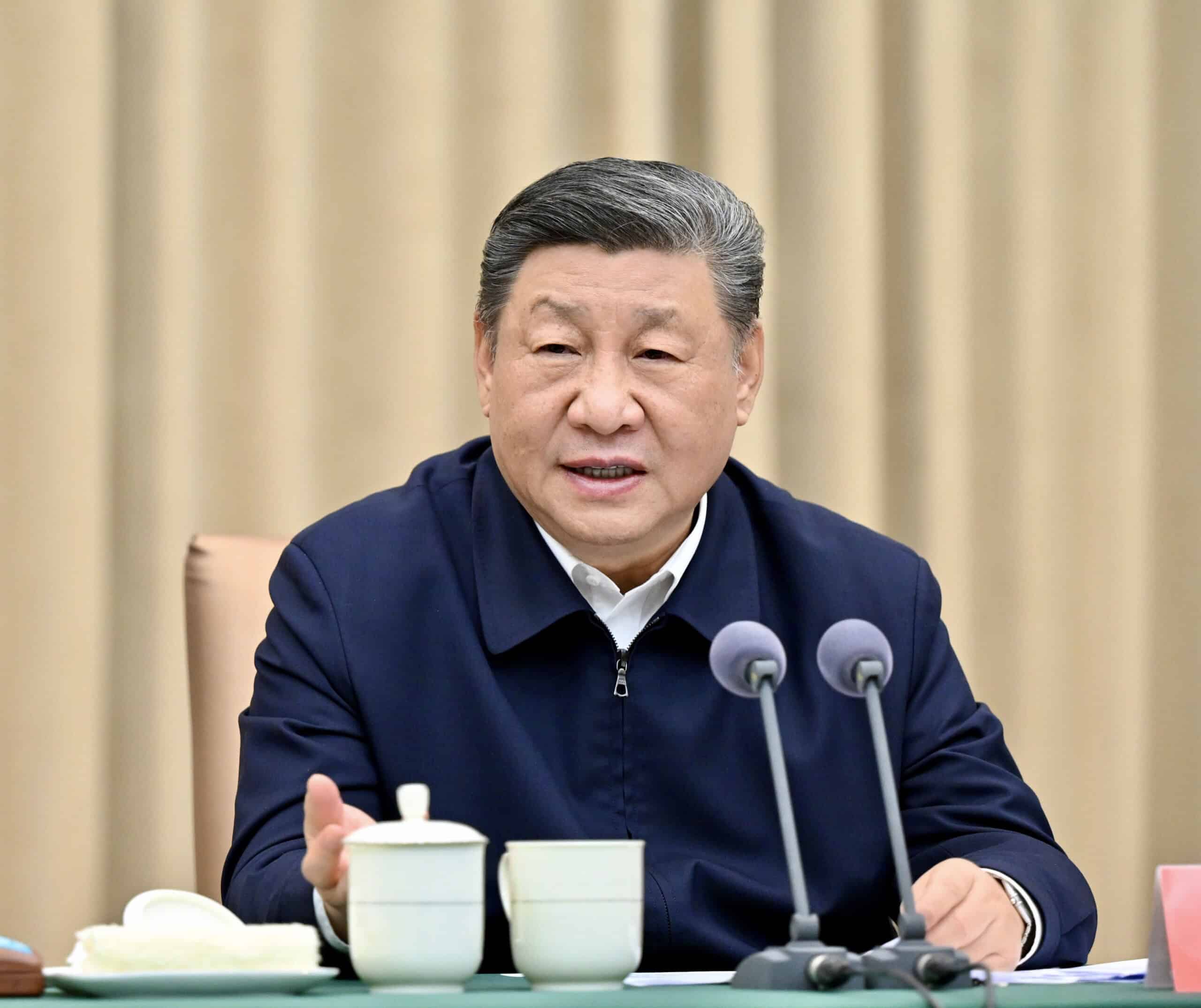
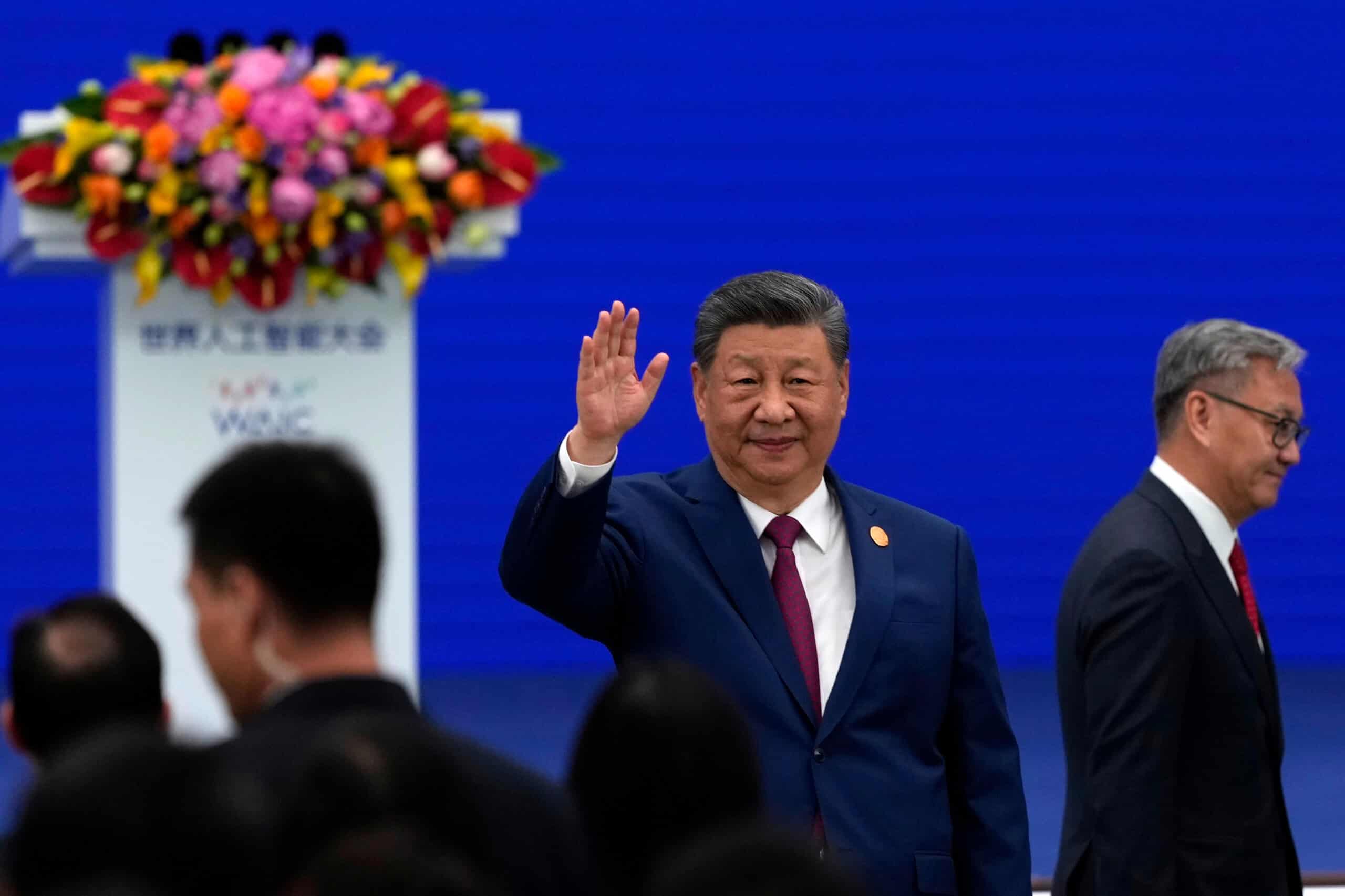
When Chinese leader Xi Jinping sat down with Chinese entrepreneurs on Monday, many observers cast the meeting as Beijing’s attempt to reset its relationship with the business sector. The gathering of private sector leaders is only the second of its kind: The previous one took place in 2018, during China’s trade war with the first Trump administration, when Xi stressed that the country would “unswervingly encourage” the development of the private sector.


Left: Xi Jinping shakes Jack Ma’s hand following the meeting with Chinese entrepreneurs, February 17, 2025. Right: Attendees applaud following the February 17 meeting. Credit: CCTV
Now, with another potential trade war brewing, China’s economy is in an even worse spot, having experienced a collapse in foreign investment and a slowdown in consumer spending. The decision to hold such a gathering comes as business sentiment in the country has faltered to such an extent that, for many observers, the biggest news of the day was that Xi was filmed shaking hands with Jack Ma, the previously disgraced founder of tech giant Alibaba.

But a closer look at the individuals invited this week suggests Xi plans to stick with his top-down control of China’s economy. The companies invited reflect many of the strategic industries the Chinese government has promoted in recent years, while the absences of several Chinese titans are just as telling.
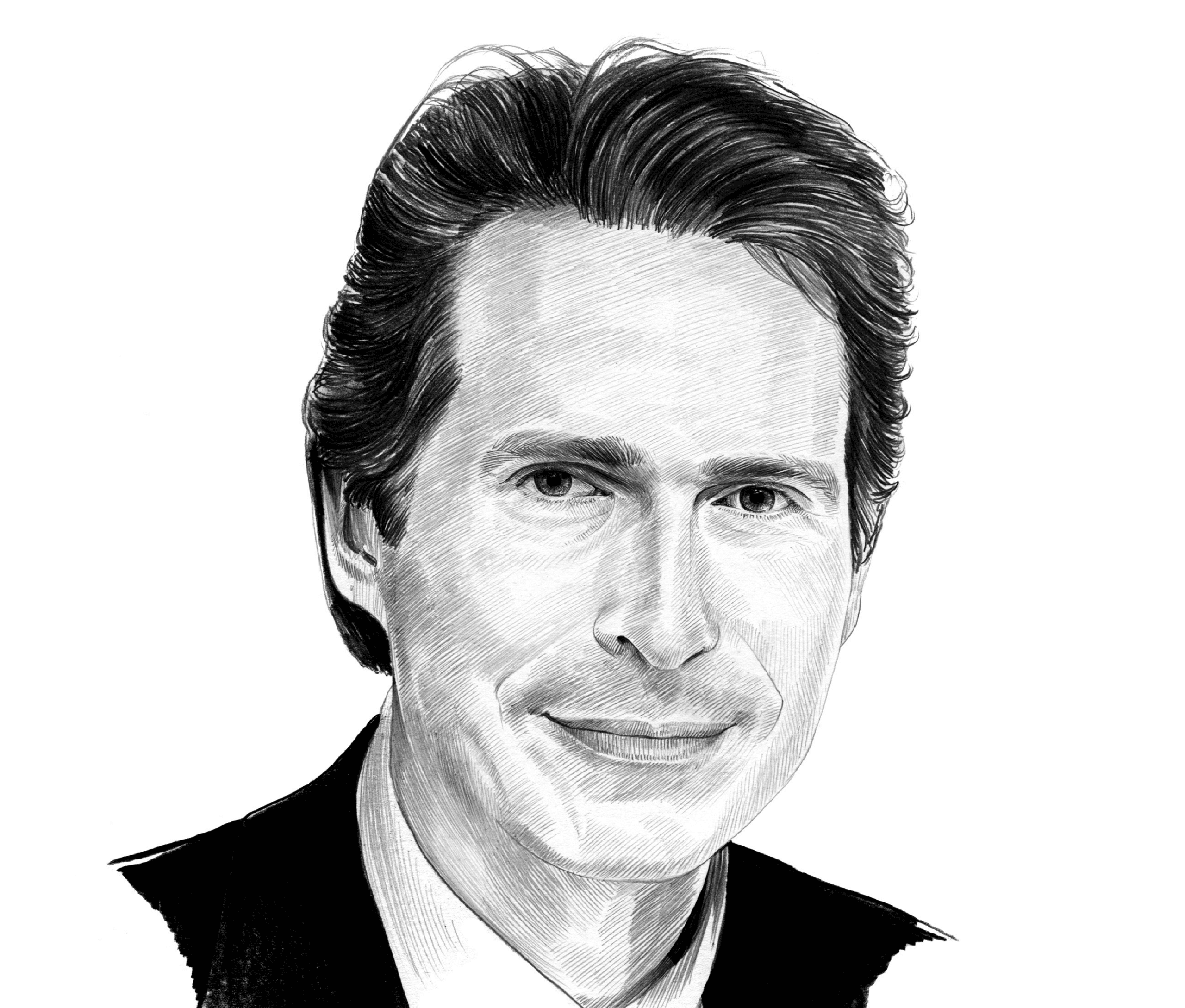
“If you’re a semiconductor, AI or robotics company, or an electric vehicle battery maker — one of those areas that is seen as high-tech that Xi Jinping and the party have blessed — then benefits will come your way,” says Dexter Roberts, a nonresident senior fellow at the Atlantic Council’s Global China Hub. “But does that mean there’s been a 180-degree turn and [these companies] don’t have to worry? I would say absolutely not.”
Based on footage of the meeting broadcast on Xinwen Lianbo, China’s premiere nightly news program, The Wire China has compiled and broken down the guest list at Xi’s big meeting.
FACE TO FACE
Xi and other members of the Politburo Standing Committee sat at a long green table in the Great Hall of the People in Beijing. At least 31 business leaders were organized around them in two rows1Additional rows of tables behind the entrepreneurs were occupied by government officials and Party cadres., and observers can tell a lot from the seating chart. Front and center, for instance, was Ren Zhengfei, founder of telecoms firm Huawei, and Wang Chuanfu, founder of carmaker BYD. The two companies represent China’s all-out push to cultivate homegrown technology in chips and electric vehicles and together raked in a reported $150 billion in global revenue in the first three quarters of last year — even despite far-ranging sanctions and tariffs by several western countries.
Chinese entrepreneurs listen to Xi Jinping during the February 17, 2025, meeting. Credit: CCTV
Also seated prominently were Wang Xingxing of Unitree Robotics, a leading humanoid robot manufacturer that competes with companies like the U.S.’s Boston Dynamics, and Yu Renrong, founder of Will Semiconductor, a chipmaker. (More on Will Semiconductor below.)
Jack Ma and Pony Ma, founders of Alibaba and Tencent respectively, sat in the wings, alongside Liang Wenfeng, CEO of DeepSeek, the dark horse AI company that made global headlines earlier this month. Only two women were present: Gao Yuejing of Sunresin, a chemicals company, and Zhang Ronghua of Rockcheck, a steel company.

The sectors represented underscore which industries Beijing currently prioritizes. Notably, a majority of the companies came from sectors in China’s ‘new economy,’ which includes high-tech sectors from AI to batteries and semiconductors. Since 2023, Xi has called on the country to mobilize what he calls ‘new productive forces’ to power China’s future economic growth, as traditional drivers such as the property sector and infrastructure stall. The high-tech sector is expected to account for 19 percent of GDP by 2026, according to Bloomberg Economics.
The meeting was carefully curated to ensure balance — across industries, generations, and regions… The exclusions weren’t necessarily a snub — but inclusion was a clear signal of relevance and alignment with Beijing’s vision for the future.
Lizzi Lee, a fellow on Chinese economy at the Asia Society Policy Institute
Still, several companies from the ‘old’ economy were also represented, especially in areas that Xi has prioritized, such as food security. Several large agricultural producers were present at the meeting as was China Feihe, a baby formula maker.
Six businessmen spoke at the gathering: Lei Jun of Xiaomi, Ren Zhengfei of Huawei, Wang Chuanfu of BYD, Yu Renhong of Will Semiconductor, Wang Xingxing of Unitree Robotics, and Liu Yonghao of New Hope Group (more on New Hope below). Most spoke at length about how optimistic they were about the country’s future, and emphasized what their respective companies were doing to contribute.
“I firmly believe that a greater China is rising at an accelerated pace,” said Ren, founder of Huawei, according to People’s Daily.
| Publicly Listed ‘New Economy’ Companies | Market Cap (billion) USD | Industry |
|---|---|---|
| Tencent | 575.64 | Cloud, Gaming, Social Media |
| Alibaba | 314.1 | E-Commerce, AI, Logistics, Cloud |
| Xiaomi | 169.42 | Electronics |
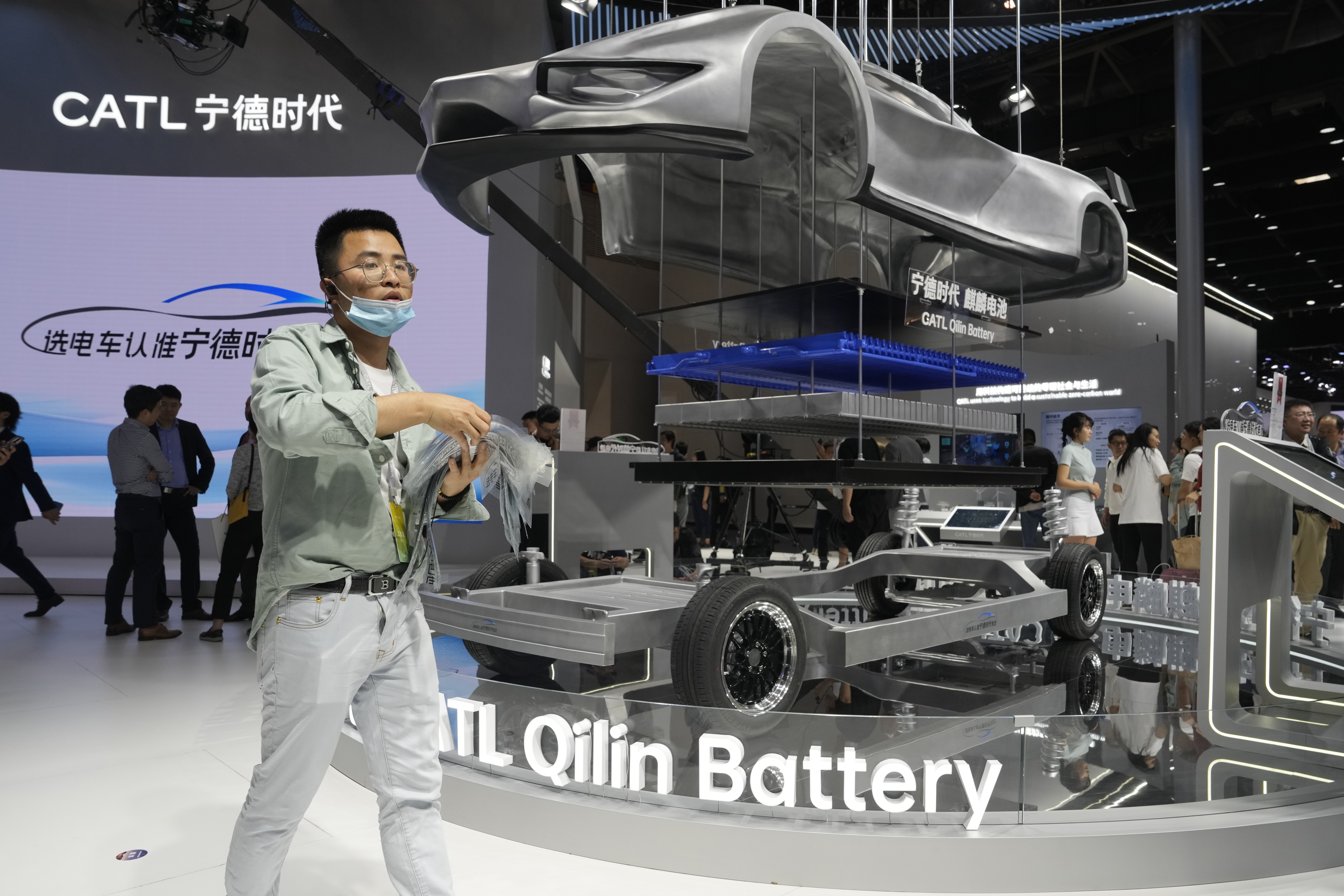
| CATL | 155.65 | Battery |
| BYD | 106.98 | Electric Vehicle |
| Cambricon | 32.89 | Semiconductor |
| Will Semiconductor | 17.67 | Semiconductor |
| iFlytek | 16.14 | AI |
| CHINT Group | 6.55 | Smart Energy Solutions |
| Jointown Pharmaceutical Group | 3.47 | Healthcare/Medicine |
| Shiyuan Electronic | 3.36 | LCD mainboards |
| Qi An Xin Technology | 2.36 | Cybersecurity |
| Transfar Group | 1.65 | Chemistry, biotech |
| Tellhow Group | 0.55 | Power products/Energy |
Source: Google Finance
| Publicly Listed ‘Traditional Economy’ Companies | Market Cap (billion) USD | Industry |
|---|---|---|
| Meituan | 121.65 | Food Delivery, Retail |
| Muyuan Foodstuff | 28 | Agriculture |
| China Feihe | 6.41 | Baby Formula |
| Sunresin | 3.44 | Chemicals, New Materials/Industrials |
| Shandong Denghai Seeds | 1.29 | Agriculture |
Source: Google Finance
OUT OF FAVOR?
Just as interesting, of course, were the companies that were left out of Xi’s meeting. For instance, Robin Li, CEO of Baidu, a leading force in China’s AI efforts, was conspicuously absent: the company’s shares dropped 7 percent on Monday as investors interpreted the absence as a sign that Baidu has lost political favor.
If you’re a semiconductor, AI or robotics company, or an electric vehicle battery maker… then benefits will come your way. But does that mean there’s been a 180-degree turn and [these companies] don’t have to worry? I would say absolutely not.
Dexter Roberts, a nonresident senior fellow at the Atlantic Council’s Global China Hub
Bosses from the troubled property sector were also nowhere to be seen, although this is not the first time they have been shunned — no developers were present at the 2018 meeting, either. Chinese officials continue to tighten the screws on the real estate sector: Last month, the CEO of China Vanke, one of China’s more reputable developers, was reportedly temporarily detained.
Also missing: representatives of TikTok parent ByteDance, as well as e-commerce firms Shein and Pinduoduo, parent company of Temu. ByteDance, Shein and Pinduoduo are some of China’s most valuable companies: the latter briefly overtook Alibaba to become China’s most valuable e-commerce company in December 2023. (Alibaba has since regained that position.) ByteDance and Shein are valued at about $300 and $30 billion, respectively. They are also some of the most recognizable Chinese brands overseas.
But the consumer internet and e-commerce sectors have become less of a priority for Beijing in recent years. Shein and Temu have also moved to distance themselves from China by redomiciling overseas in part to shield themselves from Western scrutiny of Chinese firms.
Lizzi Lee, a fellow on Chinese economy at the Asia Society Policy Institute, says Pinduoduo’s omission “indicates Beijing might not view the platform’s aggressive discount model as exemplary of the country’s economic future.” Others absences may be more strategic, she says, such as ByteDance, which “may have opted to stay away to avoid drawing further scrutiny from Washington.”

“That said, the guest list was never meant to be a definitive ranking of China’s top businesses,” Lee adds. “The meeting was carefully curated to ensure balance — across industries, generations, and regions… The exclusions weren’t necessarily a snub — but inclusion was a clear signal of relevance and alignment with Beijing’s vision for the future.”
SURPRISE APPEARANCES
The seating chart for Monday’s meeting also elevated the profile of companies that are little known outside of China. Here are two firms you may not have heard of:
Will Semiconductor
The Shanghai-based firm, which was established in 2007, is a fabless chip company, meaning it designs but does not make chips (à la Nvidia). It rose to prominence by acquiring other businesses, including the U.S. company OmniVision in 2018 and the Beijing-based SuperPix in 2019. Today it designs CMOS image sensor chips, which are widely used in security cameras and smartphone cameras. The company stands as an example of China’s progress in achieving self-sufficiency: It is the only Chinese company among the world’s top ten integrated circuit design firms by revenue.

New Hope Group
At its core, New Hope is an agriculture company and is among the largest suppliers of eggs, meat and dairy in the country. But its empire has also grown to encompass commercial real estate, such as hotels and office buildings, and chemical manufacturing. Its founder, Liu Yonghao, exemplifies the type of self-made entrepreneurs modern China is known for: Originally a quail farmer, he started the business in 1982 selling animal feed. New Hope remains a private company, however, which makes it difficult to gauge the scale of its operations. One of six entrepreneurs that spoke at the event, Liu said the company has closely followed the country’s strategic goals by focusing on food security and self-sufficiency in seeds, and pledged to help rural households prosper.

UNDER THE RADAR
Monday’s meeting offered an opportunity for firms to bask in Beijing’s spotlight, but those same companies are now also likely to face increased scrutiny from Washington. The U.S. government has been increasingly aggressive in recent years in targeting private Chinese companies, adding more than 1,200 entities to sanctions and red flag lists since 2017. Firms like Tellhow Group, which supplies vehicle-mounted electronic systems to the Chinese military and was present at the meeting, could attract more attention as Washington sets its sights on Chinese companies involved in civil-military fusion.
Of the 31 companies represented at Monday’s meeting, just five have been directly caught in Washington’s dragnet, according to data from WireScreen.
| Company | Entity List | 1260H List | DOD Procurement Plan |
|---|---|---|---|
| Huawei | X | X | X |
| iFlyTek | X | ||
| CATL | X | X | |
| Tencent | X | ||
| BYD | X |
Source: WireScreen

Eliot Chen is a Toronto-based staff writer at The Wire. Previously, he was a researcher at the Center for Strategic and International Studies’ Human Rights Initiative and MacroPolo. @eliotcxchen

Rachel Cheung is a staff writer for The Wire China based in Hong Kong. She previously worked at VICE World News and South China Morning Post, where she won a SOPA Award for Excellence in Arts and Culture Reporting. Her work has appeared in The Washington Post, Los Angeles Times, Columbia Journalism Review and The Atlantic, among other outlets.