The United States-China relationship has become a fight over chokepoints. That has become more apparent than ever over the last month, as new restrictions imposed by Beijing on rare earths shipments forced Washington to delay a major export control expansion — part of a one-year trade truce.

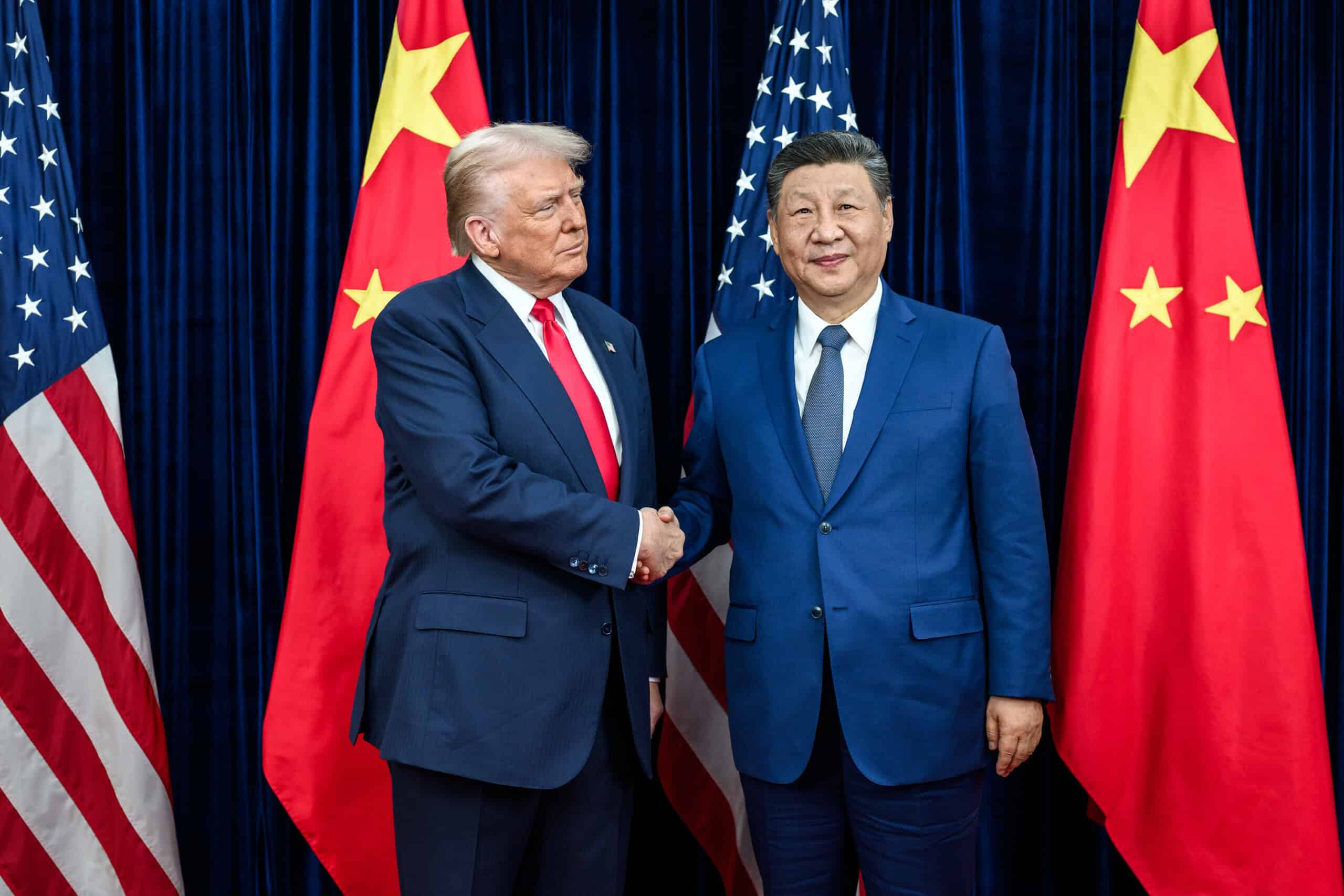
The deal, agreed by Xi Jinping and Donald Trump at their meeting in South Korea, has bought both countries a brief reprieve from losing access to vital resources that only the other produces.
Now, their focus has turned to winning the race to break the bottlenecks that keep them co-dependent.
Beijing has made indigenization a central economic objective for at least a decade, investing hundreds of billions into developing its own advanced semiconductors and jet engines supply chains. But self-sufficiency in those technologies remains years — if not a decade — away. That leaves China needing to spend the next 12 months bolstering its defenses against harsh American export controls.
Xi’s rare earth export controls have proven even more impactful than China could imagine. There’s an imperative over the next year [for the U.S.] to diversify away. It’s this sword of damocles hanging over the administration and the only way to get rid of it is to find enough alternative suppliers.
Eddie Fishman, author of Chokepoints: American Power in the Age of Economic Warfare
Meanwhile, the U.S. has pledged to use the pause in hostilities for an all-out effort to break China’s near-total control over rare earths. Treasury Secretary Scott Bessent has said that the U.S. is “going to do the equivalent of Operation Warp Speed to tackle [rare earth] processing,” referring to the pandemic-era partnership between the federal government and vaccine makers, and this month asserted that Beijing’s leverage in this area would last no more than 12 to 24 months.

Experts say that timeline is a tall order — but add that meeting it is essential if the U.S. wants to end Beijing’s effective veto over tougher trade policies.
“Xi’s rare earth export controls have proven even more impactful than China could imagine,” says Eddie Fishman, author of Chokepoints: American Power in the Age of Economic Warfare. “There’s an imperative over the next year [for the U.S.] to diversify away. It’s this sword of damocles hanging over the administration and the only way to get rid of it is to find enough alternative suppliers.”
Twice this year, Beijing has used rare earth controls to undercut the U.S.’s efforts to dial up pressure on China: once in April, in response to Trump’s ‘Liberation Day’ tariffs, and again in October, in response to the Commerce Department’s ‘50 percent rule’ — a rule change that added more than 18,000 Chinese companies to the U.S. export control list, according to Wirescreen estimates.
Both measures were deferred for a year as part of the trade truce, which includes other concessions and trading agreements. Experts say that if it lasts, the current truce will give China valuable time for further work on countering the U.S.’s efforts to stop Chinese companies buying vital American products.
“One year provides plenty of time for Chinese companies to do all kinds of creative corporate restructuring to avoid the controls,” says Saif Khan, a fellow at the Institute for Progress, a Washington think tank, who worked on export controls in the Trump and Biden administrations.
Ways that companies could restructure to get around the rules, he suggests, could include spinning an entity out of a company’s existing ownership structure, or adjusting its ownership to avoid the 50 percent rule when and if it is reintroduced.

“Entity-based export controls have their strongest effect in the near term, as Chinese companies can eventually find unrestricted pathways in China to acquire otherwise-controlled technology,” Khan says. “As a result, much of the effect of the rule is probably neutered by deferring it for a year.”

While China’s export control challenge is largely legal in nature, the question facing the United States is more industrial — specifically, whether it can break China’s stranglehold over the elements that are key to making the permanent magnets used in everything from cars to AI data centers.
At home and abroad, the Trump administration is spending heavily to do so. In July, the War Department bought a $400 million stake in MP Materials, an American company that owns the only operational domestic rare earth mine. This month, the War and Commerce departments participated in a $1.4 billion deal to fund Vulcan Elements and ReElement Technologies, two U.S. rare earth companies involved in permanent magnet manufacturing and recycling, respectively.
Overseas, Washington has extended a $465 million loan to a Brazilian rare earths mine through the Development Finance Corporation. The Trump administration also struck a partnership with Australia on rare earths in October, which includes $1 billion to be invested by the two countries in projects at home over the next six months. And Trump himself met with the leaders of five Central Asia countries earlier this month to discuss deals to cooperate on uranium, copper, gold and rare earths.
The MP Materials deal deployed a very robust toolkit. [The U.S. government] recognizes the problem and has been very creative in addressing it. Can we eliminate this chokepoint in a year? Absolutely not. But this is a good place to start.
Arnab Datta, managing director at Employ America, a Washington think tank
Asked whether Bessent’s 24 month timeline is feasible, John Maslin, chief executive of Vulcan Elements, told The Wire China: “I think it’s plausible.”
“The goal is to get as close to that as we possibly can. This is about accelerating and meeting an Operation Warp Speed-like timeline, while also making sure that… we’re producing high quality magnets that meet customer spec,” he adds.

The numbers still look challenging. Vulcan plans to build a facility able to produce 10,000 metric tons of magnets per year in the U.S. by 2027, sourcing many of its inputs from recycled end-of-life magnets and electronic waste. Another U.S. company, Noveon Magnetics, is already producing magnets, and has supply agreements with General Motors and the Swiss-Swedish industrial toolmaker ABB. This week, it announced a deal to source rare earths from Solvay, a European rare earths processor. It’s currently working to up production at its Texas-based plant to a maximum capacity of 2,000 metric tons per year.

For comparison, the Energy Department estimated annual demand in the U.S. for the type of magnet Vulcan and Noveon produce at about 16,000 tons in 2020, with projected annual demand of up to 37,000 tons by 2030.
Some analysts are relatively optimistic: If everything goes to plan, the wave of upstart U.S. magnet producers could eventually manufacture enough to offset imports, but only by 2028, Adamas Intelligence, a supply chain consultancy, said at a recent conference.
Others argue that overcoming China’s control over rare earths is not just about fast-tracking production.

“We don’t suffer from a lack of resources, we suffer from a lack of competitive, fair markets that can offer risk intermediation and capital for these very volatile markets,” says Arnab Datta, managing director at Employ America, a Washington think tank.
A recent report Datta co-authored argues that control over the market infrastructure for critical minerals, including exchanges like the Shanghai Metals Market and Baotou Rare Earths Products Exchange, has helped China increase its rare earths pricing power.
Those findings were echoed in a report by the House China Select Committee published on Thursday, which alleges that China “has established a legal framework governing mineral price reporting, giving Beijing the ability to raise and lower prices to favor its national security interests.”
“If U.S. and western allies are going to be able to succeed in a sustainable manner they need market infrastructure where prices aren’t beholden to China,” Datta says.

There are signs that the U.S. government is considering this approach. Its rare earths agreement with Australia includes language about accelerating the “development of diversified, liquid, fair markets for critical minerals and rare earths.” And in the MP Materials deal, the U.S. government agreed to provide a price floor to stabilize returns and attract private investors, as well as to protect the company against a potential price crash triggered by Chinese overproduction.
The Select Committee report recommends that the government go further, including by setting “temporary minimum price levels” for critical minerals until “true market conditions emerge outside the CCP’s influence.”
“The MP Materials deal deployed a very robust toolkit,” says Datta. “[The U.S. government] recognizes the problem and has been very creative in addressing it.”
“Can we eliminate this chokepoint in a year? Absolutely not. But this is a good place to start.”

Eliot Chen is a Toronto-based staff writer at The Wire. Previously, he was a researcher at the Center for Strategic and International Studies’ Human Rights Initiative and MacroPolo. @eliotcxchen