China has a new growth model, albeit one that’s poorly understood. If the new model delivers everything Beijing wants it to, the result will be a far more affluent and equitable China. But even if it falls short, it threatens to upend global trade — for better and worse.
When China’s property market collapsed earlier this decade, economists widely assumed that consumption-led growth was the only viable economic model that could replace one based on investment in housing. Beijing, however, has chosen a different path.

That’s partly because consumption-led growth would require large scale wealth redistribution, mostly from Chinese firms to households. The only viable way to do that at scale and relatively quickly is by expanding the welfare system, something the Party is reluctant to do.
That’s not because Xi Jinping has a deeply felt aversion to welfarism, as is often assumed. Quite the contrary — Xi and the Party routinely say how much they’d like to spend more on health and pensions. However, they’re unwilling to fund that spending with debt. Consequently, welfare expansion is contingent on the tax-base being able to support it — which it currently can’t.
But there’s another reason: China’s economy is facing challenges that a consumption-led growth model won’t fix, at least in Beijing’s eyes.
The first of those is the middle income trap, the phenomenon whereby “middle income” economies hit a developmental ceiling and stop converging with advanced economies like the U.S. and EU. While economists globally are divided on whether the middle income trap actually exists, in Beijing there is no doubt. And the Party is convinced the only way for China to avoid it is by pushing industrial production further up the value-added chain.
As a population ages, the burden on the state increases as healthcare costs and other benefits rise. Meanwhile, as the size of the workforce shrinks, so does the pool of taxpayers, making it harder for the state to cover its expanding expenses.
Second, Beijing wants an economic model that can deliver ‘Common Prosperity’, Xi’s vision of a more affluent and equitable China. Xi hopes to realize that vision not by redistributing existing wealth —although welfare plays a role once the state can afford it — but rather by creating new wealth that’s more equitably distributed than previously.

The challenge is achieving both of these goals at a time that the population is shrinking and aging. China’s old-age dependency ratio — that is the number of retirees as a percentage of the working-age population — is still quite low, according to United Nations data, but it will pull even with the U.S. in 2035, the EU in 2046, and then continue deteriorating until there are more retirees than workers by the 2080s.
That has major consequences for the economy. As a population ages, the burden on the state increases as healthcare costs and other benefits rise. Meanwhile, as the size of the workforce shrinks, so does the pool of taxpayers, making it harder for the state to cover its expanding expenses. Beijing needs a growth model that sufficiently increases tax revenue while delivering real income gains to the workforce.
SELECTED ECONOMIC INDICATORS: CHINA
| 2024 | 2025 | 2026 | 2027 | 2028 | 2029 | |
|---|---|---|---|---|---|---|
| Real GDP Growth (%) | 5 | 4.5 | 4.1 | 3.6 | 3.4 | 3.3 |
| Output Gap (%) | -1.2 | -0.5 | 0 | 0 | 0 | 0 |
| Inflation (% average) | 0.7 | 1.9 | 2 | 2 | 2 | 2 |
| Core Inflation (% average) | 0.9 | 1.5 | 1.8 | 2 | 2 | 2 |
| Current Account (% of GDP) | 1.5 | 1.5 | 1.4 | 1.4 | 1.3 | 1.2 |
| Augmented Debt (% of GDP)* | 124 | 128.9 | 133.7 | 138.7 | 143.6 | 148.2 |
*Augmented Debt includes local government financing vehicles’ debt and other off-budget government funds. Source: International Monetary Fund
The model also needs be debt light. The sheer scale of China’s demographic challenges are such that at some point, the welfare demands of an aging public will exceed the state’s ability to pay for them, and so the state will have to borrow. However, China’s debt-to-GDP ratio is currently around 290 percent, higher than most countries, including the United States. Moreover, the International Monetary Fund estimates that China’s government debt-to-GDP ratio — including central, local, and hidden government debts — was 124 percent at the end of 2024, well above healthy levels.
In the near-term, Beijing would like its debt-to-GDP ratio to decline so that it has space to expand borrowing when it’s no longer avoidable. For that to happen, it needs a model in which the economy expands faster than the stock of debt.
Beijing is, then, asking a lot from its new growth model.
- To avoid the middle income trap, China needs to produce higher value goods that can’t be cheaply replicated by lower income developing economies. That requires innovation and technically advanced manufacturing.
- Achieving ‘Common Prosperity’ requires the creation of a bigger middle class to generate the resources the state needs to increase spending on welfare. That requires higher paying jobs, a robust stock market to drive household wealth generation, and more profitable firms that can boost government revenue.
- Doing this in the face of demographic decline requires boosting tax revenue sufficiently to cover the expanding needs of retirees, but in a way that doesn’t bleed the shrinking workforce dry.
- And finally, growth can’t be built on rising leverage. The new model needs to use debt productively.
Beijing thinks it’s found a way to achieve all of these things. Xi Jinping calls it “New quality productive forces.” What that means in real terms is productivity-led growth, enabled by innovation and industrial upgrading.

China has had productivity-led growth before. During an earlier era, China’s productivity gains were fueled by the mass migration of workers from the fields to factory jobs. This time it’s hoping that innovation and advanced manufacturing will allow it to fuel a new wave of wealth creation.
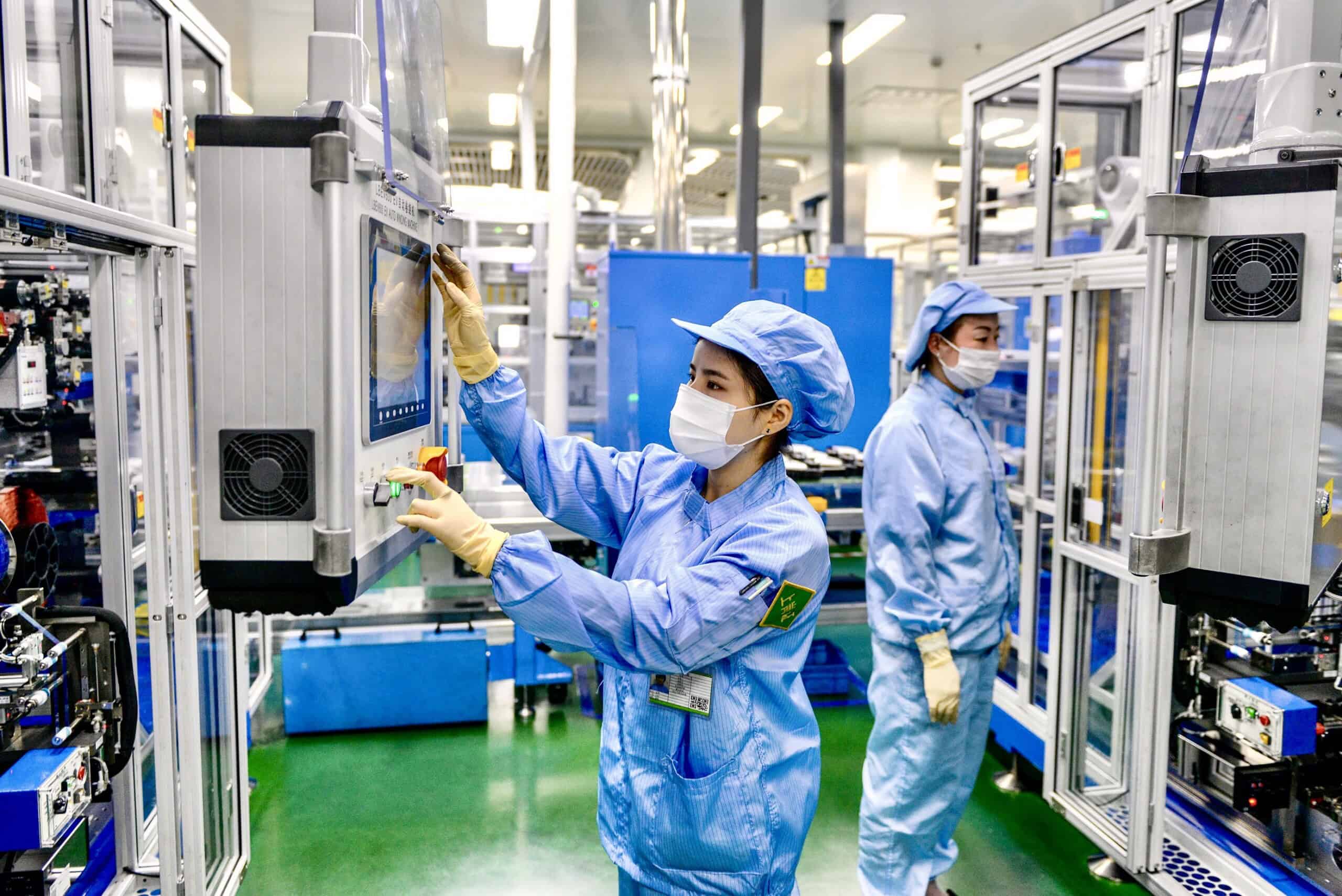
That’s on show most clearly with the success of China’s electric vehicle and battery companies. It’s hard to say what will come next, but the Chinese press writes enthusiastically about the imminent breakout of flying cars and humanoid robots. Beyond that, the state is supporting efforts in a long list of industries, including nano-manufacturing, quantum computing, nuclear fusion, hydrogen energy, deep-sea mining, genetic engineering, and pharmaceuticals.
Beijing is striving to build a research, business, and financial ecosystem capable of constantly producing and commercializing new innovations. The hope is that by developing their own proprietary technology, Chinese firms will be able to establish leadership in new, emerging industries, allowing them to generate higher profits margins than was possible when they were merely producing low-cost iterations of existing technologies.

Meanwhile, Beijing wants to hold on to all its old industries but use technology to make them more efficient. Traditionally, labor-intensive industries like textiles and toy-manufacturing have moved from country to country in search of ever-cheaper labor. But Beijing intends to keep those industries in China by deploying robots, industrial software, and eventually AI to reduce production costs and raise profit margins.
This process will inevitably result in fewer blue collar jobs, as purple-collar technicians and engineers replace production-line workers. To take up the slack, the hope is more profitable firms will generate new white-collar roles in advertising, sales, marketing, R&D, legal, and finance, as well as demand for a wide range of other business services, much as is the case in developed economies.

Of course, that assumes this model works, At the moment, it doesn’t.
The irony is, as exports soar and Chinese firms assume global leadership in emerging industries, China’s economy looks incredibly strong. But inside China, the economy feels weak. Corporate profits aren’t growing, and in some new industries they are non-existent. Consumer confidence hasn’t recovered since the pandemic as people continue to worry about job security. Tax revenue has been falling for most of this year, which typically occurs during a recession, not when real GDP is growing faster than 5 percent annually. And the debt-to-GDP ratio continues to rise as the government expands borrowing to support demand.
That’s why Beijing’s current “anti-involution” campaign is so important. Companies struggling with overcapacity can boost sales by cutting prices, but that erodes profits. And without profits — and the consequent corporate tax revenue — the country can’t reap the benefits of the new model.
For decades, economists have warned that China’s demographic profile meant that it ran the risk of growing old before it grew rich. The new growth model is a last ditch sprint to prevent that happening.
But there are other challenges that also stand in the way, not least the collapse in land sales which has resulted in a nationwide shortfall in local government revenue. Provincial authorities have responded with austerity policies, further dampening business and household sentiment, which was already weak following the erosion of wealth brought about by the decline in home prices. The new growth model will struggle to get traction until Beijing can ensure adequate government funding and restore household confidence.
Regardless of whether the new growth model is successful, it will have huge consequences for the rest of the world. The frenetic drive by Beijing to create a future of flying cars, robots, and cheap renewable power could bring global benefits. But it will come at a cost as China strives to become the dominant force in both high-end and low-end manufacturing, taking market share away from advanced economy firms.
Either way, Beijing is committed to this course of action as the only way China’s living standards can continue converging with those in the U.S. and EU, even as its population shrinks and ages. For decades, economists have warned that China’s demographic profile meant that it ran the risk of growing old before it grew rich. The new growth model is a last ditch sprint to prevent that happening.

Head of Markets Research at Trivium China and co-author of “China’s Economic Transition: Debt, Demography, Deglobalization, and Scenarios for 2035”, published by CSIS in September 2025. @DinnyMcMahon