For almost 18 minutes in the dead of winter, scientists in Hefei, Anhui province, heated a 3.5 tonne donut-shaped device filled with plasma to more than 100 million degrees Celsius — more than six times the temperature of the sun’s core.
The January experiment was a triumphant moment for scientists at the Institute of Plasma Physics. Inside the Experimental Advanced Superconducting Tokamak (EAST), a hulking silver structure capable of withstanding enormous heat and pressure, Chinese researchers had broken the world record for the longest containment of plasma under extreme conditions, a milestone in humanity’s decades-long quest to realize the ultimate energy source: nuclear fusion.

For decades, nuclear fusion has been an energy pipe dream. Observers have long joked that it is a technology that is “perpetually 30 years away.” Yet its irresistible promise of cheap, safe and emission-free electricity has made it a holy grail for energy scientists ever since it was first theorized 110 years ago.
Nuclear energy today is harnessed through fission: the process by which a heavy atom such as uranium is split in two, creating a burst of energy that can be harnessed as electricity.
Fusion, by contrast, is the opposite process. Rather than splitting an atom, fusion occurs when two light atoms — typically hydrogen — merge to produce a single heavier one, and in doing so produce a massive amount of energy. It is the same process by which the sun produces energy. Hence the common comparison of fusion being equivalent to the creation of “stars” on earth.
For decades, however, scientists were thwarted by the challenge of achieving ‘ignition’: the moment when a fusion reaction generates more energy than is needed to spark the reaction, achieving a net energy gain. Ignition is then followed by a second daunting challenge: sustaining an incredible level of heat — at least 150 million degrees Celsius — and pressure needed to keep the reaction going.

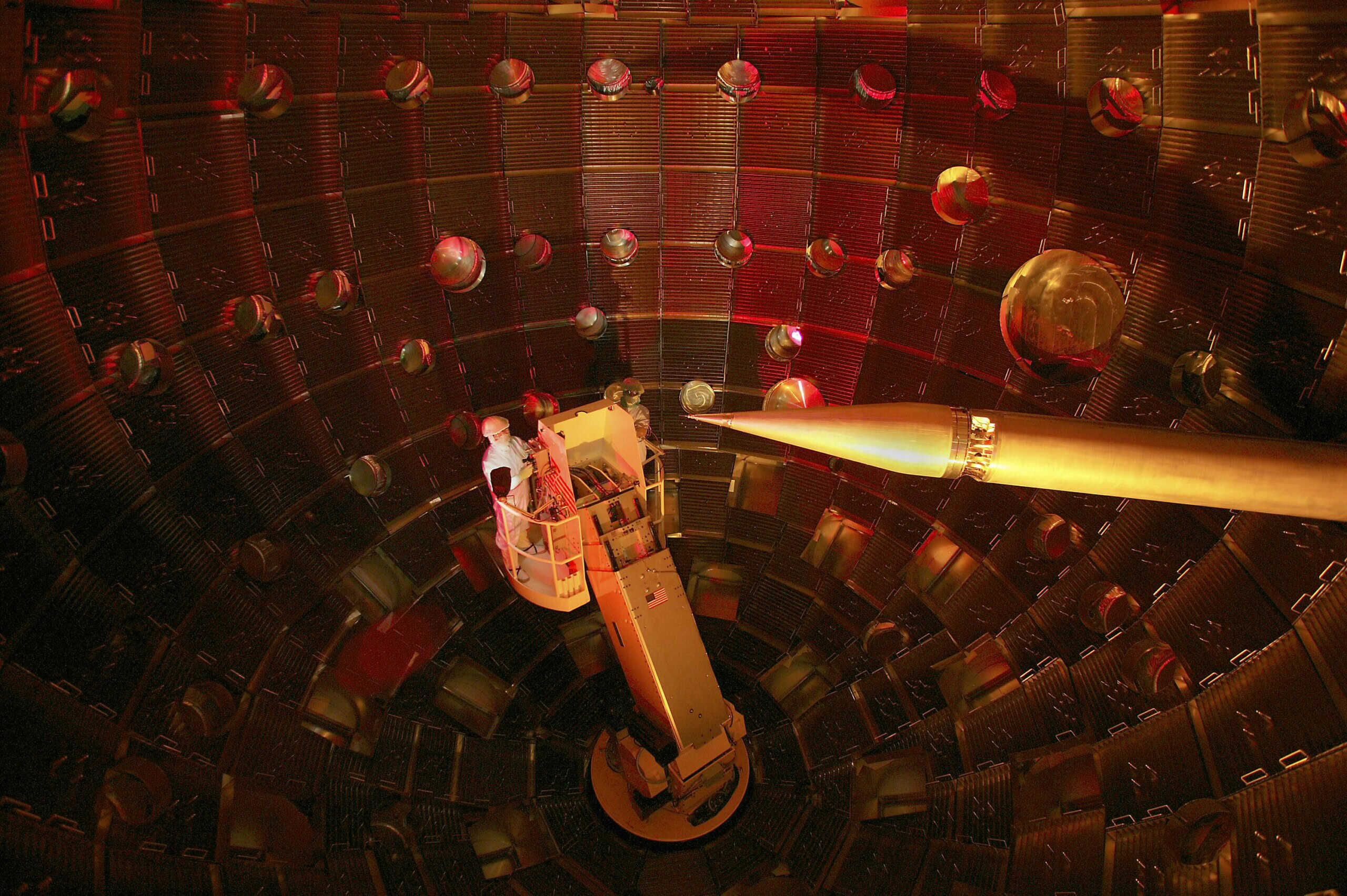
U.S. scientists won the first race when, in 2022, researchers at the National Ignition Facility (NIF) at the Lawrence Livermore National Laboratory in California achieved ignition for the first time.
“That was an epochal achievement,” says Sam Wurzel, a former official at the Department of Energy and founder of Fusion Energy Base, a website that tracks fusion developers and the fusion supply chain. “It’s truly a discovery on the level of controlled fire. It’s just amazing.”
MORE THAN A SCIENCE PROJECT
Ignition at the NIF and several other milestones, such as the 100 million degrees Celsius sustained in Hefei in January, have convinced a growing number of investors that a fusion reactor may not only be possible, but commercially viable, within the next decade. A 2024 survey by the Fusion Industry Association, a U.S. industry group, found that more than half of respondents predict that a fusion plant will be commercially viable by 2035.
Suddenly, the perpetually 30-year-away technology seems tantalizingly within reach.
But which country will win arguably the most important technological race of the 21st century? A cluster of companies in China, the U.S. and Europe are racing to be the first to commercialize fusion.
Last year, more than $2.5 billion in investment was announced globally. U.S. companies have raised more than $5.6 billion to date. Germany’s Proxima Fusion secured a record €130 million in funding in June, the largest investment to date in Europe’s fusion sector. That same month, the U.K. government announced a £2.5 billion investment into a prototype fusion energy plant.
But no country is channeling as much money towards realizing commercial fusion as China. Chinese investors have poured almost $3 billion into private fusion start-ups, while the state is injecting far more into its national fusion initiatives.
Beijing has recognized fusion as a core part of China’s energy plans since 1980. China’s most recent Five Year Plan set 2040 as its target for achieving power generation from its first experimental fusion reactor.

“Fusion is not just a physics and science challenge, but a more systematic one, demanding improvements in supply chain [and] infrastructure,” says Amy Ouyang, a researcher who has studied China’s fusion energy development. “China has an advantage in that it doesn’t just treat fusion as a science project, but has the ability to pull resources from different sectors.”
Fusion’s promise of cheap, virtually limitless energy would be transformative for nations’ efforts to secure their domestic energy supply, particularly as the global scramble to build data centers for artificial intelligence (AI) drives up demand for electricity and water.
Other technologies deemed unachievable due to their enormous energy demands, such as water desalination, could suddenly become viable, a transformative development for parts of the world where water is scarce. Fusion offers countries nothing less than a path towards energy independence, decoupling them at last from fossil fuels and the geopolitically fraught regions that produce them or through which they must be transported, such as the Red Sea, the Straits of Malacca and the South and East China Seas.
Fusion is not just a physics and science challenge, but a more systematic one, demanding improvements in supply chain [and] infrastructure.
Amy Ouyang, a researcher who has studied China’s fusion energy development
In Washington, the Special Competitive Studies Project, a nonprofit backed by former Google chief executive Eric Schmidt, has established a “Commission on the Scaling of Fusion Energy,” including Senators Maria Cantwell (D-WA) and Jim Risch (R-ID), alongside the heads of leading fusion labs and CEOs of fusion startups.

The commission is modeled in part on the National Security Commission on Artificial Intelligence (NSCAI), a Congressionally-mandated commission chaired by Schmidt that was tasked with figuring out how to advance the development of AI to address the U.S.’s national security and defense needs. Its final report, published in 2021, focused on the need to defend against China’s AI capabilities, and recommended using export controls to slow China’s efforts to indigenize sensitive technologies.
At a conference hosted by SCSP in Washington last month, energy secretary Chris Wright described the state of fusion as “thrilling.”
“Forty years ago I went to college specifically to work on fusion energy… and I loved the problem,” he said. “It’s a very tricky problem, and we’ve made continual, but not super rapid progress for 50 plus years. But fusion has hit that tipping point where things can happen fast.”
How fast things can happen will hinge in large part on the patience of fusion’s main supporters. A decade remains a long time in the politics of science funding, and fickle investors and partisan feuding in Washington could make it hard to sustain the level of support that is needed if fusion is to be brought to fruition.
“An economic downturn or a bust in the AI market could see fusion [funding] shrink in the U.S,” says Jimmy Goodrich, a nonresident fellow at the UC Institute on Global Conflict and Cooperation who has studied the U.S. and China’s progress towards fusion. “Over the course of a decade, a downturn is inevitable. And in a downturn, China, motivated by a desire to reduce its reliance on imported energy, may well jump ahead.”

Recent wrangling over the federal budget underscores just how fragile the current promising environment for fusion is. After House Republican lawmakers attempted to cancel direct tax incentives for renewable energy sources, Wright, who opposes subsidies, publicly defended the credits for nuclear, geothermal and fusion. Tax credits for the three were ultimately preserved in the final version of the ‘One, Big, Beautiful Bill’ that was signed into law this month. Nonetheless, scientists have separately warned that the Trump administration’s cuts to research funding will have cascading effects on the many auxiliary fields of science needed to make commercial fusion possible.
Given the stakes, proponents say that this race is too important to lose.
“The technology is advancing to the point where we can harness and create stars on earth,” says Abigail Kukura, director of the Future Technology Platforms program at SCSP. ”No matter what, there will be a demand for that. And because of AI, we have the opportunity and imperative to get this right.”
GOING NUCLEAR
Andrew Holland, president of the Fusion Industry Association, is used to skeptical receptions when he pitches policymakers on the promise of fusion. In the early 2010s, while working for a think tank in Washington, he wrote a paper calling for $30 billion in federal funding for fusion over the next 10 years.
“We basically got laughed out of the room,” he told The Wire. “People would tell us, of course we’re not going to invest into fusion, that’s so long-term.”
“But the nature of exponential growth is that if you’re not watching closely, [progress] can look very close to a flat curve before it takes off,” he adds. “I would pin the [2022] NIF ignition as the first time the curve came above the horizon for most people. But the fact of the matter is, things had been doubling and moving really fast for those who were watching closely for probably five years before that.”

That quiet acceleration came from advancements in several enabling technologies including AI, which has been transformative for researchers pursuing two different paths to fusion.
One approach takes inspiration from the fusion reactor that everyone knows — the sun. There, the mass of its core is so large that gravity pulls together plasma to the point where it triggers a fusion reaction, a phenomenon known as gravitational confinement.
Scientists have devised a system using ultra-strong magnetic fields to replicate the kind of heat and pressure observed in the sun’s core. This involves a machine called a tokamak, which heats up plasma inside a magnetic field contained in a doughnut-shaped reactor until it gets hot enough to fuse.

But replicating the physics that govern the sun, it turns out, is extremely hard, part of why magnetic confinement fusion has stymied researchers for years.
“Using magnetic fields to contain plasma is like using rubber bands to confine jelly,” explains Caleb Barnes, a nuclear engineer by training and SCSP’s associate director for fusion. “We don’t really have a great physics model for how plasma behaves. But now we have AI, which can control plasmas in tokamaks way faster than a human operator could. And as a result we’ve seen records for confinement times for plasma broken again and again.”
Other researchers are pursuing a different fusion method. This approach, known as inertial confinement, involves using lasers to heat a small pellet of fuel extremely quickly in order to ignite a fusion reaction. This is the approach pursued by researchers at the NIF at Lawrence Livermore National Laboratory, where, again, their recent progress has been aided by AI.
Other breakthroughs have enabled small start-ups to take on the larger national labs. Modern lasers designed for extreme ultraviolet (EUV) lithography machines — the ultra-complex equipment used to make advanced semiconductors — allow newer companies to build more efficient systems than the NIF’s. A proprietary magnet that generates a significantly stronger magnetic field, meanwhile, has allowed Commonwealth Fusion Systems (CFS), a Massachusetts-based fusion startup, to design a much smaller tokamak than other researchers have built in the past.
In 2021, CFS raised $1.8 billion from investors including Google, Bill Gates, and Eni, the Italian energy conglomerate. As a result of CFS’s record-breaking funding round, annual private investment into fusion outstripped public investment for the first time that year.
“It was a signal that the market wants fusion energy, and that investors think now is the time to make that commitment to it,” says Wurzel. Commonwealth’s funding round “was three times the U.S. fusion energy budget, and that got a lot of people’s attention — certainly attention in China — but also got investors interested in other approaches besides the tokamak.”

WHAT CHINA IS DOING
In 2020, the U.S. Department of Energy published a 10-year road map to deliver fusion energy. Endorsed by almost two dozen leading academics and fusion company executives, it spelled out in exacting detail the type of facilities and collaborations between government and industry needed to realize fusion in the next decade. Many of the report’s recommendations were wholeheartedly embraced — by China.
“We created the roadmap, but China is building it,” SCSP’s Kukura says. “China is building the facilities that have the most promising chances of fusion… All the shots on goal the U.S. is taking, China is trying to replicate.”
The foundation of China’s fusion strategy was established decades earlier. In 1983, China’s main economic planning agency, then referred to as the State Planning Commission, formulated its “three step” development strategy for nuclear energy: the development of a hot (steam) reactor, then a fast (fission) reactor and, finally, a fusion reactor. The country completed work on its first tokamak a year later.

Hefei, capital of Anhui province, is the hub for China’s fusion research efforts. It is home to EAST, the 19 year-old experimental tokamak that broke the record at the start of this year for sustaining plasma at 100 million degrees Celsius. Hefei will also soon play host to a new facility for testing underlying technologies for future fusion systems as well as the China Fusion Engineering Test Reactor, which is envisioned as a stepping stone to commercializing fusion power.
Seven hundred miles to the west of Hefei, in Mianyang, Sichuan province, China is building an enormous X-shaped building — each “stroke” of the X, containing laser bays, is almost 400 yards long. Analysts who have watched the building rise via satellite photos say that it is akin to a larger, upgraded version of the NIF in California.
Barnes, the nuclear engineer, says that the Mianyang facility will likely be able to fire a laser with an energy yield of three megajoules or more, enough to achieve ignition relatively easily.
China’s efforts extend beyond building state-of-the-art facilities and other necessary hardware. Last year, it established China Fusion Energy Inc., a consortium of 25 entities, in order to pool resources and form an integrated supply chain. The consortium involves top research facilities, mining and metals giants, steelmakers, and utility companies.
“The focus is not just on the science portion,” says Ouyang. “The Chinese government is trying to think a step ahead about what [China] needs when this technology is commercialized.”

The consortium members include State Grid and China Southern Power Grid Corporation, a sign that officials are thinking ahead to how to integrate fusion systems with the grid when the time comes. American energy executives say that connecting to the grid could be a major obstacle.
Kieran Furlong, chief executive of Realta Fusion, a Madison, Wisconsin-based fusion startup, refers to the term “on the grid” as “those awful words”. The process of connecting a commercial fusion reactor to the grid, he said at a conference last month, “adds on 10 years.”
“You’re also seeing aerospace companies [on China’s consortium list],” says Ouyang. “There is knowledge crossover [between the consortium members]. High temperature superconducting materials [essential to building tokamaks] are also used in China’s aerospace exploration.”
Provincial governments are also wading into the fray. Unlike in the U.S. where venture capital has put up most of the funding for commercial fusion ventures, fusion startups in China often have backing from their local governments. Shanghai-based Energy Singularity’s shareholders include the Shanghai and Shenzhen municipal governments. Shaanxi-based StarTorus Fusion has received investment from the Shaanxi, Xi’an and Tianjin governments.
We created the roadmap, but China is building it… All the shots on goal the U.S. is taking, China is trying to replicate.
Abigail Kukura, director of the Future Technology Platforms program at the Special Competitive Studies Project
All told, the Chinese government is investing as much as $1.5 billion in fusion every year, according to the DOE’s Office of Fusion Energy Sciences, compared to $790 million in U.S. public funding. It is a formidable advantage that, observers say, could help Chinese companies overtake the U.S. and secure a dominant lead.
“The concern is that we’ll repeat our national failure as seen in other clean energy technologies, where we invent the technology but, because of overregulation and underinvestment, we become non-competitive,” says Goodrich. “Meanwhile, China brings down the cost massively because of their scale advantage. The risk here in fusion is that the same story repeats itself.”
STAYING IN THE RACE
Step one to winning the fusion race, U.S. proponents say, is getting regulators out of the way. An early victory came in 2023, when the fusion industry convinced Washington’s top nuclear regulator to treat fusion systems separately from fission reactors, which are subject to cripplingly long licensing and permitting timelines of up to 20 years. The distinction was subsequently codified into law in the 2024 ADVANCE Act.
“Fission is easy to start and hard to stop; fusion is easy to stop and hard to start. It’s really important that they not be treated the same,” says Holland.
It is impossible for fusion to trigger the type of chain reaction that makes fission reactors so potentially dangerous. “If the Nuclear Regulatory Commission defined fusion the same way it defined fission, it would have killed the industry,” he adds.
Step two involves beefing up a public incentive program that would reward commercial fusion companies for achieving key technical milestones. The ‘Milestone-Based Fusion Development Program’ was first authorized by the 2020 Energy Act, and is modeled closely after NASA’s Commercial Orbital Transportation Services program, which was instrumental to building the U.S. commercial space industry and the creation of Elon Musk’s SpaceX.

“SpaceX would not exist today without NASA’s COTS program. That’s not my opinion, it’s what they [SpaceX] say publicly,” says Fusion Energy Base’s Wurzel. “The Milestone-Based Fusion Development Program… has the potential to be really transformative.”
But the initial $46 million allocated to the program, supplemented by an additional $415 million under the 2022 CHIPS Act through to 2027, pales in comparison to what China is spending annually.
Proponents at SCSP’s Fusion Commission say $10 billion should be allocated “as a down payment” on cultivating a domestic fusion ecosystem — with a portion of that money going towards the milestone program.
State governments could also chip in. “There’s really almost no history of states putting money into fusion, but that’s starting to change,” says FIA’s Holland.
Tennessee has a $50 million “nuclear energy supply chain investment fund,” while several state senators in California have introduced bills supporting fusion. But Holland emphasizes the “scale of funding from U.S. states is nowhere near the scale from [Chinese] provinces.”
If the Nuclear Regulatory Commission defined fusion the same way it defined fission, it would have killed the industry.
Andrew Holland, president of the Fusion Industry Association, an industry group
A longer term challenge for the U.S. may be the competition for scientific talent.
“Fusion crosses over so many fields. It’s not just about plasma physics but material science and chemical engineering,” says Wurzel. “The national laboratory system in the U.S. is the crown jewel of this country. You have a scientific cadre that is just amazing … I do think it is in the U.S.’s interest to be funding scientific research.”
But, Kukura notes, “[China is] graduating ten times more fusion science PhDs than the United States is. As this [technology] gets to a commercial level, it will become a real talent game.”
The Trump administration’s recent cuts to scientific funding and attacks on higher education could help China by convincing scientists to leave the U.S.. One example is Liu Chang, a research scientist at the Princeton Plasma Physics Laboratory who pioneered a way to mitigate the damage that can be done by runaway electrons in tokamaks. Earlier this year, he announced he would return to China to teach at Peking University.
Others who opt to stay warn of far reaching consequences, that, in a race as closely fought as fusion, the U.S. can scarcely afford.
“If you look at the [federal] budget request, it says we’ll make cuts except for AI, fusion and quantum,” Egemen Koleman, a professor at Princeton University, said at a conference last month. “Okay, I work on AI for fusion and we just had a paper out on quantum and all of my budget has been cut.
“When you have these types of budgetary issues, I’m not going to change my job,” he adds. “But it stops the new generation from coming in, by putting question marks in people’s minds.”

Eliot Chen is a Toronto-based staff writer at The Wire. Previously, he was a researcher at the Center for Strategic and International Studies’ Human Rights Initiative and MacroPolo. @eliotcxchen