Chipwi is a small town in northeastern Myanmar’s Kachin State, perched on a bend of the meandering N’Mai River. For decades its people subsisted on the sale of walnuts, apricots, sour cherries and other produce to China’s Yunnan province, some 40 miles to the east via treacherous mountain roads and the Burmese border town of Pang War.

But from 2010, the area’s economy began to change dramatically, transforming Beijing’s interests — and eventually its diplomacy — in the area. Chinese rare earth miners, fleeing tighter environmental regulations at home, ventured into this frontier area of Myanmar.
Chipwi lies within a roughly 500-mile-long belt in the country’s northeast, encompassing Kachin and the neighboring state of Shan to its south. Both states are rich in rare earths — particularly terbium and dysprosium, elements used in the production of magnets in televisions, electric vehicles, wind turbines and fighter jets. Chipwi alone hosted around 350 rare earth mining sites, and more than 2,500 pits.
The Chinese miners stripped swaths of Chipwi’s topsoil and dug dozens of circular leaching pits, whose acrid chemicals leaked into the earth. Produce sales plummeted and landslides, some deadly, became commonplace. So many pits littered the landscape that much of Chipwi appeared from above to resemble the cratered surface of the moon.
Chipwi is part of a territory designated by Myanmar’s ruling military junta, the Tatmadaw, as “Kachin Special Region 1” and was the fief of a warlord named Zahkung Ting Ying. His militia, the New Democratic Army, allied itself with the generals. The junta seized power in a 2021 coup d’etat and arrested Aung San Suu Kyi, the Nobel Peace Prize winner whose National League for Democracy had been in power since 2016.

Zahkung Ting Ying’s alliance with the Tatmadaw was convenient for the Chinese government, which didn’t have to worry about Myanmar’s generals in the capital, Naypyidaw, trying to disrupt shipments from the rare earth mines in his jurisdiction.
The Tatmadaw, however, soon faced widespread civil protests that fanned into a nationwide conflict pitting the junta against a pro-democracy militia and a loose confederation of regional ethnic armed organizations, or EAOs.
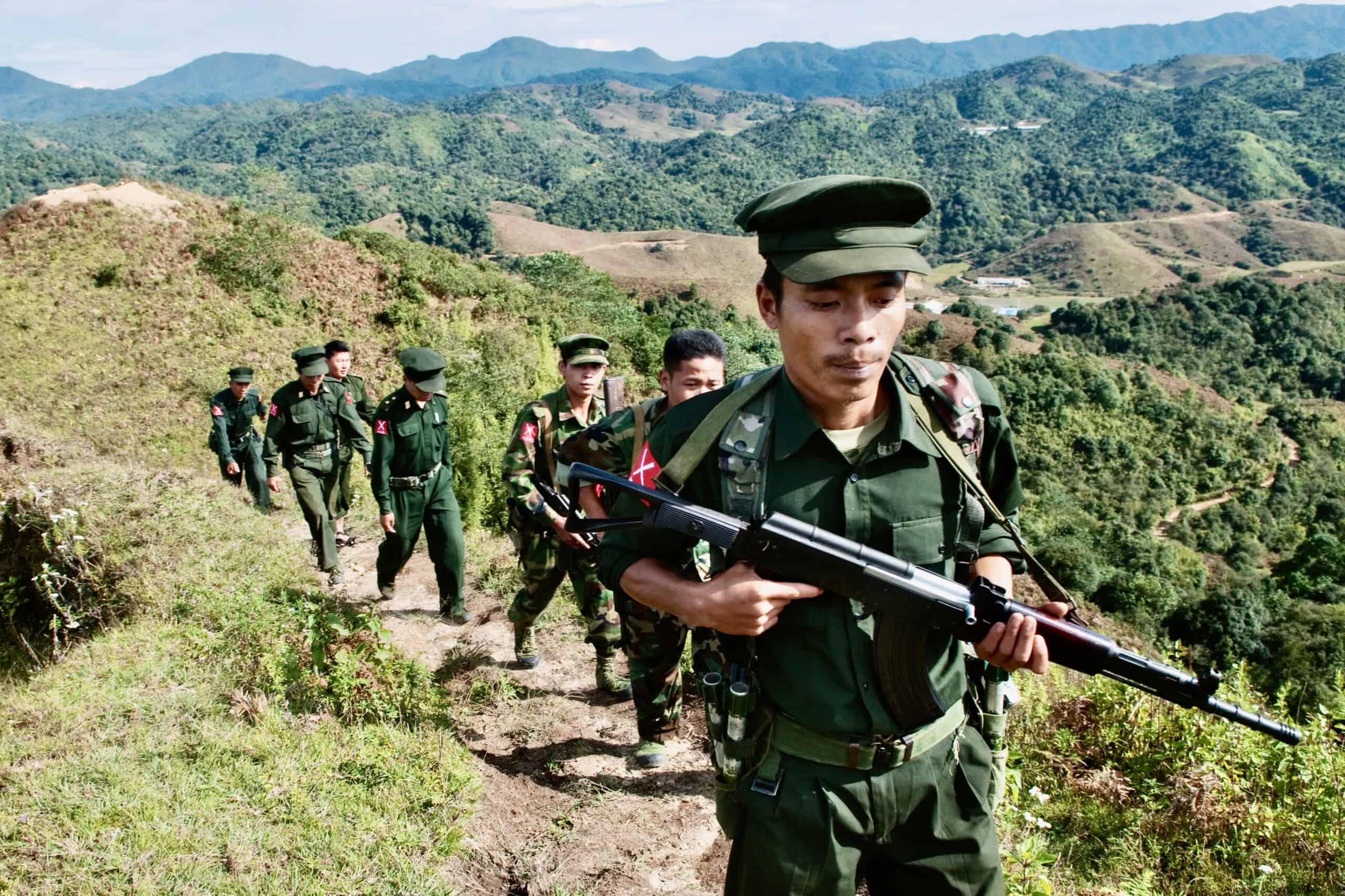
The Kachin Independence Army or KIA, a separatist group, was one of them. Its battles with the Tatmadaw and Zakhung Ting Ying were of huge strategic importance to China, and not just because of Kachin’s rare earths and other natural resource industries. Kachin is also Myanmar’s northernmost territory, jutting like a jagged spear tip into China’s underbelly, where it borders Yunnan province and Tibet as well as the Indian states of Arunachal Pradesh and Nagaland to its west.
China has now assessed that it has to step in more directly, that the Tatmadaw is [the] horse to back, and it’s willing to use what leverage points it has to essentially prevent the resistance from overcoming the regime.
Lucas Myers, a Southeast Asia expert at the Wilson Center
Initially, China hedged its bets after the 2021 coup. It refused to host a visit by Tatmadaw leader Min Aung Hlaing, who coveted the legitimacy a trip to China would bestow on his regime.

But neither did China savor the prospect of a western leaning, democratic Myanmar, which could jeapordize its access to natural resources and hamper infrastructure projects designed to funnel them its way. China has spent $9bn on a road-and-rail corridor; $7.3bn on a deepsea port in Myanmar’s westernmost state of Rakhine and $20bn on a network of seven hydroelectric dams, one of which is located at Chipwi. Of $52bn in planned or part-completed Chinese projects in Myanmar, $28bn falls either fully or partially within territory controlled by one of the country’s 17 EAOs.
Then, in October of last year, KIA guerrillas seized Chipwi and Pang War, sealed off Zakhung Ting Ying’s border home, and assumed control of an area now producing almost half the world’s heavy rare earths. Some believed the Tatmadaw itself to be on the brink of defeat.
At first China dealt with the KIA, negotiating solely to ensure that only its miners would continue operating the pits. But by month’s end their tactics changed.
Chinese officials closed the crossing at Pang War — throttling the KIA’s chief source of income and thus threatening its dreams of statehood. “The strategy was consistent with China’s broader playbook in dealing with EAOs,” says Ye Myo Hein, an independent analyst affiliated with the Taguang Institute of Political Studies in Yangon and the Wilson Center in Washington, DC. “First, establish influence by offering material support, economic incentives, or diplomatic engagement; then incrementally apply leverage to bring them more fully into China’s orbit and ensure they ultimately play to Beijing’s tune.”
In November the Chinese government increased the pressure on the KIA by allowing Min Aung Hlaing to visit Kunming, Yunnan’s capital, where he met with Chinese Premier Li Qiang. That fell far short of his desired meeting with President Xi Jinping in Beijing. But Chinese mercenary groups also began working alongside the Tatmadaw, protecting Chinese-funded infrastructure projects and freeing up junta soldiers to fight the war.
“China has now assessed that it has to step in more directly, that the Tatmadaw is [the] horse to back, and it’s willing to use what leverage points it has to essentially prevent the resistance from overcoming the regime,” says Lucas Myers, a Southeast Asia expert at the Wilson Center. “It basically wants to freeze the conflict in a way that’s beneficial to the junta.
“That’s a pretty recent development,” Myers adds, “but a big one.”
Sean Turnell, of the Southeast Asia Peace Institute in Washington DC, adds that “keeping the West out” has always been a strong motivator for Beijing. In 2021 the Biden administration’s Burma Act promised to impose more sanctions on the junta, as well as State Department and USAID assistance to “democracy activists”. The act also tabled sanctions on Myanma Oil and Gas Enterprise, the country’s most lucrative state-owned venture with estimated annual revenues of $1.5bn, in an effort to reduce the Tatmadaw’s “ability to undermine democracy.”

No such scruples preoccupy China. Its priorities, says Turnell, are “keeping the place stable as a potential market, and as a potential source of energy and raw materials”.
“China’s Myanmar policy has consistently focused on [the] security of its borders and of its economic and investment interests.” adds Dr Moe Thuzar, of Singapore’s ISEAS-Yusof Ishak Institute. “Beijing thus pragmatically deals with Naypyidaw.”
FROM JUNTA TO NOBEL HEROINE TO JUNTA
Myanmar is best imagined not as a single, coherent nation, but as a collection of ethnic kingdoms. The Tatmadaw, a paranoid and cultlike organization, did little for years but siphon off Myanmar’s wealth. Its troops routinely committed atrocities against civilians, and its leadership bivouacked themselves within Naypyidaw, the vast new city that supplanted Yangon as Myanmar’s capital in 2005.

China’s default foreign-affairs strategy is to get along with whomever holds power in a given foreign country, provided they respect its multifarious “red-line” core interests ranging from sovereign claims over Taiwan and the South China Sea to the origins of the Covid-19 pandemic. In keeping with this, in the first decade of the new century China armed the Tatmadaw as it bombarded various EAOs — with scant regard for civilian life.
It suited Beijing to have an anti-West ally in charge of its southeastern neighbor. But the Tatmadaw’s constant fighting with EAOs to its west, north and east imperiled Chinese financial interests — not least a China-Myanmar Economic Corridor that would connect Yunnan via Myanmar to the Indian Ocean, bypassing the strategic chokepoint that is the Malacca Strait.

In Rakhine China signed a $2.4bn loan deal in 2008 to construct a 660-mile oil pipeline from the fishing town of Kyaukphyu to Yunnan. China poured billions more into oilfields, and nickel and copper mines, in Myanmar’s interior, particularly in the area around its second-largest city Mandalay, a traditional entrepôt of Chinese and Burmese traders.
In 2012 a senior editor at the Global Times , the tabloid arm of the Chinese Communist Party’s flagship newspaper, the People’s Daily, declared Beijing’s operations in Rakhine to be “no less important than the [South China Sea] sovereignty disputes between China and the Philippines.”
China’s Myanmar policy has consistently focused on [the] security of its borders and of its economic and investment interests. Beijing thus pragmatically deals with Naypyidaw.
Dr Moe Thuzar from Singapore’s ISEAS-Yusof Ishak Institute
The war between the Tatmadaw and Rakhine’s powerful Arakan Army intensified, threatening China’s interests in the region. But the Tatmadaw and Arakan Army had at least one thing in common — they were both predominantly Buddhist organisations with a penchant for regular mass slaughters and wholescale displacements of Rakhine’s Muslim Rohingya ethnic group.
KEY TERMS
| KIA | Kachin Independence Army |
| UWSA | United Wa State Army |
| SAC | State Administration Council |
| MNDAA | Myanmar National Democratic Alliance Army |
| TNLA | T’ang National Liberation Army |
| NLD | National League for Democracy |
| EAO | Ethnic Armed Organization |
| People’s Defense Force |
Also in 2012, across the country in Kachin, a 17-year ceasefire between the Tatmadaw and the KIA ended. Zakhung Ting Ying, wo had controlled the greater Chipwi and Pang War area since 2008, clashed with the KIA, jeapordising the export of rare earths to China. In one battle KIA troops overran a Tatmadaw-allied milita at Chipwi, where a joint venture between China Power Investment Corporation and Asia World — run by a Burmese heroin kingpin — was building the Myitsone Dam, a $3.6bn hydropower plant.
Hundreds of Chinese workers fled to Yunnan, and the project was postponed indefinitely. As the Tatmadaw weakened other EAOs — mostly in the eastern states of Shan and Kayin (previously known as Karen) — built vast criminal empires based on narcotics and online fraud that stole billions of dollars from Chinese victims.
With its headaches multiplying across the border regions, China embraced Aung San Suu Kyi when she emerged from 21 years of house arrest to win an election in November 2015 and unite Myanmar under her party, the National League for Democracy (NLD).

Aung San Suu Kyi had visited Washington DC in 2012 and welcomed President Barack Obama’s softened policy of “principled engagement” with her country’s military rulers. But after she assumed power, her ministers were also regular visitors to China and her refusal to condemn the persecution of the Rohingya tarnished her saint-like reputation in the west.
Xi Jinping visited Naypyidaw for talks with Aung San Suu Kyi in January 2020. His administration was encouraged that the Rohingya crisis had quietened (although it did not end), that drug gangs targeting China were being reined in, and that mineral extraction across Kachin and Shan was flourishing. Chinese cash was pledged for a 31-square-mile city, dubbed “Myanmar’s Shenzhen”, on the edge of Yangon.

“[China was] getting on famously with Aung San Suu Kyi; they thought everything was going great,” says Richard Horsey, a senior Myanmar advisor to the International Crisis Group. “The West was sort of neutered a bit. For the first time, China had good relations with the government and improved relationships with the people [of Myanmar] because it was Aung San Suu Kyi they were supporting, rather than an odious military regime.”
Aung San Suu Kyi, however, also tried to blunt the influence of the United Wa State Army, or UWSA, a China-allied EAO that operated from two enclaves within Shan State.

The UWSA had grown wildly rich in the 1990s from the manufacturing of so-called yaba or “crazy” pills, a combination of meth and caffeine which by 2019 had grown into an illicit industry worth tens of billions of dollars a year. The Wa also mined some of the world’s largest tin reserves, almost all of which they exported to Yunnan.

Aung San Suu Kyi won a landslide second election in November 2020, beating her Tatmadaw-backed opponent by 396 parliamentary seats to 33. The humiliation was too much. On February 1 2021, Tatmadaw leaders declared the vote a fraud, placed lawmakers including Aung San Suu Kyi under arrest, and established its own State Administration Council, or SAC, under Min Aung Hlaing.
BETTING AGAINST THE TATMADAW
Protests erupted across the country, particularly in Yangon and Mandalay. Anti-junta Burmese quickly formed a democratic government-in-exile backed inside the country by a “People’s Defence Force”, or PDF, whose numbers swelled from a few thousand in mid-2021 to 65,000 by the end of 2022.
The 50-year-old KIA and other EAOs initially steered clear of the Buddhist-on-Buddhist civil war in central Myanmar. (More than 90 percent of Kachin’s population is Christian, while Shan Buddhism is heavily infused with local animist practices.) Their path to independence, they reckoned, was better served by brokering deals with the Tatmadaw to retain control over extractive industries — a strategy dubbed “ceasefire capitalism.” The United Wa, for example, shared profits from its tin exports to China with the regime.
If you talk about stopping fighting and talking, you’re risking your political life.
A member of the KIO, the political wing of the Kachin Independence Army
But the Tatmadaw’s regular bombardments of civilian areas and battlefield atrocities outraged younger members of EAOs, who pressured their elders to fight, rather than negotiate with, Naypyidaw. “If you talk about stopping fighting and talking, you’re risking your political life,” a member of the KIO, the political wing of the KIA, told the Wire China.

China supplied planes, drones, bombs and arms to the Tatmadaw. In revenge, anti-junta Burmese occasionally targeted Chinese businesses. Factories were ransacked in Yangon and Mandalay, while fighting intensified around the China-backed $1bn Letpaudaung copper mine, and Kyaukpyu.
But China abstained on a 2022 UN Security Council resolution urging military restraint and the release of Aung San Suu Kyi. It also persuaded Russia, a close Tatmadaw ally, to do the same. And it has never challenged the credentials of Kyaw Moe Tun, Myanmar’s permanent representative to the UN, who has remained fiercely loyal to the ousted civilian government.
Beijing also either quietly sanctioned, or at least turned a blind eye to, the purchase of Chinese-made commercial drones by rebel groups, which were fitted with weapons. “And,” says Horsey, “they refused to give Min Aung Hlaing what he really, really wanted — their blessing, which is an official invitation to Beijing.”

Xi’s administration came to disdain Myanmar’s usurper-in-chief. It viewed him as an incompetent and corrupt leader who allowed drug and scam cartels to proliferate.
In 2023, China moved decisively against the junta. It supported a “Three Brotherhood Alliance” consisting of the Arakan Army and two Shan EAOs: the Myanmar National Democratic Alliance Army (MNDAA) and the T’ang National Liberation Army (TNLA).
That October the KIA joined the Brotherhood and launched Operation 1027 (named for its calendar start date) against scam cartels in three Burmese states, Tatmadaw proxies such as Zakhung Ting Ying in Chipwi and Pang War and, in some cases, against the junta itself. The Wa, with China’s consent, provided the now four brother organizations with arms and munitions.

The operation was a stunning success. Guerrillas overran criminal redoubts, routed junta positions near the border and took the fight to several other states.
For Beijing, however, the Brotherhood offensive was too successful. Fearing chaos on its border if the Tatmadaw collapsed, in January 2024 the Chinese government summoned Myanmar’s belligerents to Kunming and brokered a peace deal.
The truce lasted only until June, when the Brotherhood resumed its offensive. By August the MNDAA and several allies captured Lashio, Shan’s largest city. In Rakhine, the Arakan Army was on the march, threatening Kyaukphyu.
After the summer 2024 offensive, the KIA was in command of 60 percent of China’s entire rare earth supply. Only the Wa, arguably the country’s most powerful EAO with up to 35,000 soldiers, did as China instructed, restricting its arms sales to anti-junta forces. When the TNLA pondered an assault on Mandalay, businesses in the city shuttered and western and Chinese analysts speculated the Tatmadaw could soon be finished.
BETTING ON THE TATMADAW
China had fueled a juggernaut that, if left unchecked, would mow down the junta and, at least for a while, fragment Myanmar. So it intervened again — not by convening another round of cease-fire talks, but taking decisive action in Min Aung Hlaing’s favor.

Five hundred rebels had died taking Lashio. In late 2024, China demanded they hand it back to the Tatmadaw. To force the rebels’ hand the Chinese government blocked border trade and cut off cross-border power supplies. When Peng Daxun, the ethnic-Chinese head of the MNDAA, traveled to Yunnan for medical treatment, Radio Free Asia reported that Chinese forces detained him “to negotiate withdrawal of his troops from Lashio”.
China also stepped up the supply of drones to the junta, and in August 2024 arranged a meeting between Min Aung Hlaing and foreign minister Wang Yi in Naypyidaw. They proposed the formation of a joint Chinese-Tatmadaw security force to protect Belt and Road assets — particularly the Rakhine-Yunnan oil and gas pipeline — which freed up junta resources to fight the war. Three months later, Min Aung Hlaing had his meeting with Li Qiang in Kunming.
In May of this year, as Chinese officials looked on, the rebels departed Lashio and a 200-vehicle Tatmadaw convoy took their place. “It represents one of the most assertive and muscular examples of Chinese diplomatic and security engagement beyond its borders in recent years,” says Ye Myo Hein. “While Beijing did not deploy troops, the combination of intense pressure, direct mediation, and its leverage over armed groups constitutes a high level of external intervention.”
Tha Eh Soe, a representative of the Kayah State-based Karenni Nationalities Defence Force, a pro-democracy EAO, says “it is obvious that [China] … has backed the SAC economically, politically, and also militarily.”
While Beijing did not deploy troops, the combination of intense pressure, direct mediation, and its leverage over armed groups constitutes a high level of external intervention.
Ye Myo Hein, an independent analyst affiliated with the Taguang Institute of Political Studies in Yangon and the Wilson Center in Washington, DC
The rebels had no choice; they didn’t have any other potential allies. India has sent officials to discuss rare earth exports with the KIA, but only China is capable of refining the ores. And New Delhi is loathe to risk losing its own Myanmar megaproject, a sea-and-land corridor connecting Rakhine’s capital, Sittwe, with Kolkata. The corridor is scheduled to open in 2027. “The Indian government is more linked to Naypyidaw,” says the KIO member. “So nothing [has] improved much yet.”

Even the U.S., for decades a champion of Aung San Suu Kyi and Burmese democracy, has stood down since the Biden administration’s sanctions. According to Human Rights Myanmar, an NGO, the Trump administration’s foreign aid cutbacks will cost Myanmar $1.1bn in lost support through 2028.
The three USAID workers who remained in Myanmar after the cuts were fired on the same day a 7.7-magnitude earthquake struck central Myanmar in March, killing over 5,000 people. China, meanwhile, contributed over 600 rescue personnel.
The gutting of USAID, meanwhile, has weakened Radio Free Asia, Voice of America and Benar News, all of which have exhaustively chronicled Tatmadaw abuses and the ongoing civil war.

In July Min Aung Hlaing cherished a tariff letter from Trump, who threatened Myanmar with punitive duties of 40 per cent, as Washington’s first public recognition of his rule. In response, the junta’s leader sought to establish a bond with the U.S. president. “Similar to the challenges you encountered during the 2020 election of the United States, we also experienced major electoral fraud and significant irregularities,” he wrote, in a factually incorrect reference to its embarrassing electoral defeat to Aung San Suu Kyi’s NLD the same year Trump lost the presidency to Joe Biden.
For its part, the EU has attempted to block European companies from purchasing metals mined in Myanmar conflict zones. Siemens and Volkswagen are among the biggest buyers of magnets containing terbium and dysprosium from KIO-administered mines, which have also wrought widespread environmental destruction downstream in both Myanmar and Thailand.

Firms buying these magnets “must engage with the KIO as a legitimate authority as the international community does already in relation to humanitarian aid,” says Ben Hardman of Earth Rights, an environmental and human-rights watchdog. “Under the OECD Guidelines, if they instead decide that the KIO is a non-state armed actor, they must stop buying these magnets immediately.”
Kachin separatists have continued to take territory this year and are now contesting the strategically important town of Bhamo. The Arakan Army has increased its territory and power since the coup. It should be able to consolidate its position with China’s support, perhaps by agreeing not to attack Kyaukphyu and the pipeline’s terminus there. Karenni groups have grown richer, largely from scam centers, illegal casinos and drug money. Only the MNDAA’s power has waned since Lashio was surrendered to the Tatmadaw.
THE UNITED WA

But even as these groups grow in strength and accrue more economic leverage over China, Beijing has a trump card: the United Wa State Army. The UWSA supplies most other EAOs with almost all of their small arms and is set to resume shipping tin after a two-year hiatus. In June, experts have observed the opening of new rare earth mines in a UWSA enclave that borders Shan and the Thai provinces of Chiang Mai and Chiang Rai.
An official from the enclave, who asked not to be identified, said that two mountains have been blown up near the village of Mong Ton to make way for pits.
[The UWSA’s] ability to play a pretty critical role in influencing the trajectory of the conflict in northern Burma [is] something that a lot of Myanmar analysts don’t really have a full grasp of.
Jason Tower, a senior expert at the Global Initiative against Transnational Organized Crime
“Last year these mines did not exist, [now] there are new processing pits and infrastructure,” adds Neha Muckerjee, raw materials research manager at London-based Benchmark Minerals. “This is being funded by China.” Nor has the USWA stopped producing meth; in April, Laotian authorities seized 20 million yaba pills believed to have come from Wa.

“We’ve not really seen anything like that in a long time,” Jason Tower, a senior expert at the Global Initiative against Transnational Organized Crime, said of the yaba seizure. “It just shows you the extent to which the production in that area, which is largely under the Wa’s influence at this point, has just surged dramatically. [The UWSA’s] ability to play a pretty critical role in influencing the trajectory of the conflict in northern Burma [is] something that a lot of Myanmar analysts don’t really have a full grasp of.”
So long as China can rely on the United Wa to keep other powerful EAOs in check, a resistance victory seems unlikely. But so too does a united Myanmar effectively led by Min Aung Hlaing.

As part of his renewed friendship with China, the Tatmadaw has pledged to hold a general election in December or January. Elections imply a return to the constitution, which mandates a power-sharing arrangement between elected civilian, and unelected military, authorities. That would dilute Min Aung Hlaing’s power and potentially nudge Myanmar back towards some kind of rules-based system with which China can work.
“There’ll be minimal pretence that this is anything meaningful, in terms of any sort of democratic outcome,” says Turnell at the Southeast Asia Peace Institute. “But if it’s a regime that [Myanmar’s other neighbors] grudgingly accept, then it’s probably good enough for China. And it probably means that Min Aung Hlaing personally will be shoved aside in some way.”

The KIA, Arakan Army and other EAOs may also settle for a return to ceasefire capitalism, carving out more official autonomy in their border territories in return for economic cooperation with China. But in the country’s central heartland, the broader population will not accept rule by a military that has killed 10,000 civilians since its 2021 coup and then displaced 3.5 million people. A likelier scenario is more civil conflict.
“China will continue using its influence to prevent the regime’s collapse while containing the advance of rebel coalitions that could generate prolonged instability along the border,” says Ye Myo Hein, the DC-based analyst. “This balancing act enables Beijing to consolidate its influence, protect its investments, secure critical resources, and preserve a degree of control over Myanmar’s political trajectory.”
“China can’t solve Myanmar,” adds Richard Horsey at the International Crisis Group. All they can hope to do, he says, “is manage the mess”.

Sean Williams is a British reporter and photographer based in New Zealand. His work has been published by The New Yorker, Harper’s Magazine, GQ, The Daily Beast, The New Republic, Wired, The Economist and more. @swilliamsjourno