In 2017, the Chinese economist Chenggang Xu met Jack Ma inside his palatial home in Hangzhou. The Alibaba founder had recently funded an academy of social sciences of which Xu was a founding member. During a group meeting at Ma’s mansion, Xu tried to politely warn the outspoken billionaire that the explosive growth of Ant Group, Alibaba’s fintech arm, was a colossal political liability.

“I was saying that the Communists would not allow any non-Communist institution to be a major financial player,” he recalls. “I said, ‘You’re going to run into deep trouble.’”
Ma shrugged off Xu’s warning. Three years later, the Chinese Communist Party dropped its red hammer: in late 2020, Ant Group’s $37 billion IPO was cancelled; an anti-trust investigation then compelled a $2.8 billion fine and a financial restructuring of Ant Group; and Ma was forced to recede from public life.
If Xu’s warning was eerily prescient it was also, in his mind, glaringly obvious.
“My prediction was simply based on the principles of the Communist regime,” he explains. “As long as you understand their principles, you know what is allowed and what is not allowed.”
Xu on “regionally administered totalitarianism” during a CSIS Q&A, March 26, 2024. Credit: CSIS
One thing not allowed in the People’s Republic is the exact sort of critical scholarship and commentary which Xu has become famous for. As a political economist, Xu, 74, has worked at his alma mater Tsinghua University, the University of Hong Kong, Seoul National University and the London School of Economics. He has consulted for the World Bank and the International Monetary Fund.
He is now a senior research scholar at the Stanford Center on China’s Economy and Institutions in Palo Alto, California. In the Xi Jinping era, defined by a sharp curtailing of political speech and a restrained private sector, Xu is one of the only major Chinese economists in the world to regularly criticize the Chinese Communist Party.
Having come of age in pre and post-reform China, Xu’s academic rigor and his political outspokenness have earned him the kind of credibility and public prominence not typically enjoyed by economists, especially among overseas Chinese. He is a regular commentator in the Chinese-language arm of the Voice of America and other overseas Chinese media outlets. One hour-long VOA interview with him, on China’s economic turmoil, has logged over five million views. His X account, which he has had for less than two years, boasts over 40,000 followers.
“A lot of [overseas Chinese] from mainland China criticize the [Party] but it’s often very emotional and at times doesn’t make any sense,” says Victor Shih, director of the 21st Century China Center at the University of California, San Diego. “Chenggang is one of the few who can systematically dissect a problem and criticize it.”
Xu is no starry-eyed conspiracy theorist. He comes out of the system himself, was educated at Harvard, and offers sober analyses.
Perry Link, Professor Emeritus of East Asian Studies at Princeton University
“Even with the great firewall, his writings and interviews are still widely shared in China, especially among intellectuals and people who care about China’s future,” adds Zhou Fengsuo, a Chinese democracy activist based in California.

THE MAGNUM OPUS
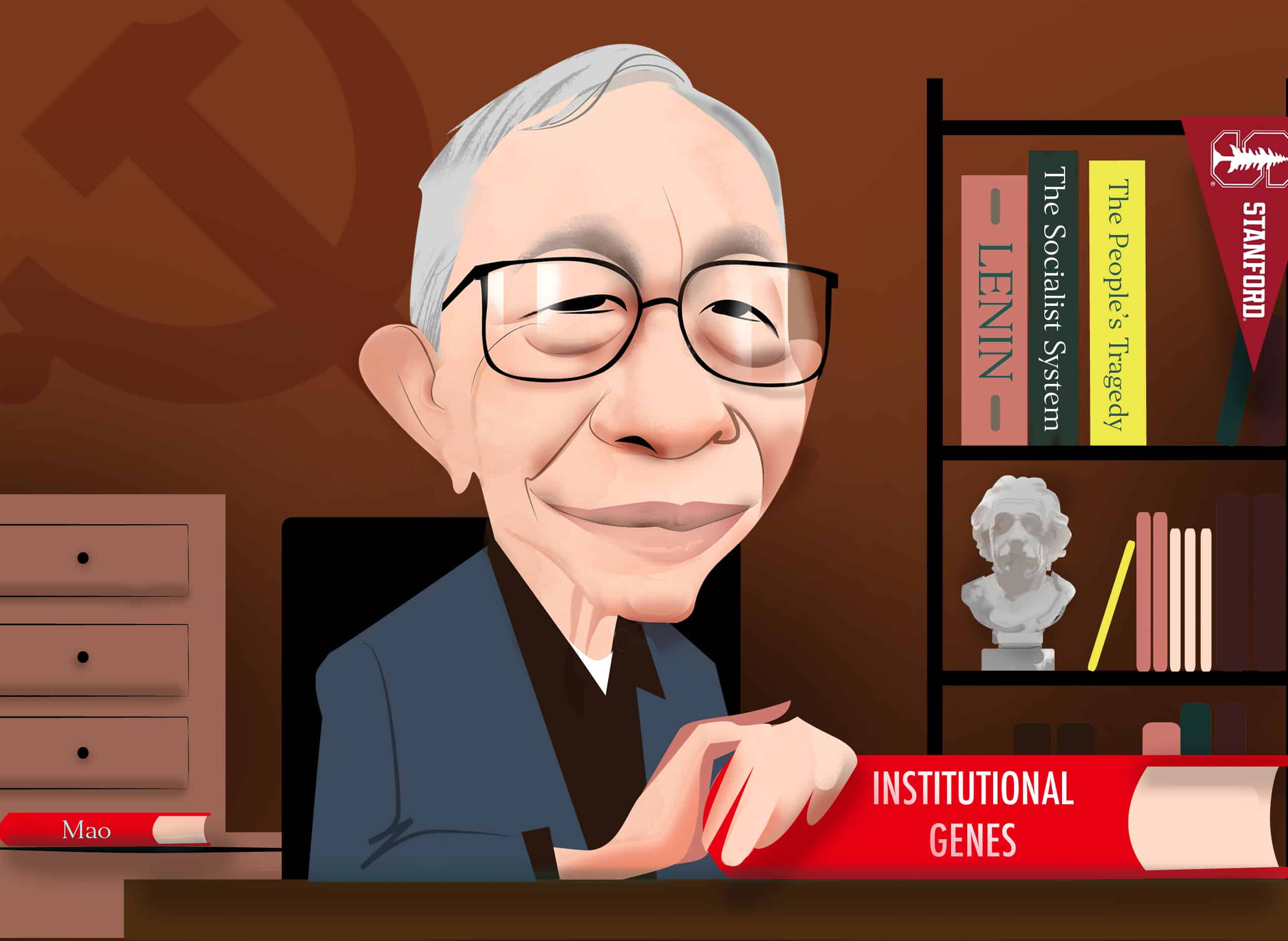
Xu’s new book, Institutional Genes: Origins of China’s Institutions and Totalitarianism, is a long, history-dense meditation on the political economy of the PRC. In it he coins the term institutional genes, referring to deeply embedded cultural and political practices. Much of the nearly 800-page book explores how the Marxist-Lennist institutional genes of the Soviet Union merged with those of the Chinese imperial system, resulting in “socialism with Chinese characteristics”. Though only his first book, he considers the tome his magnum opus, the agglomeration of all of his life experience and academic research. For free-market liberals like Xu, it offers a grim diagnosis.
“The CCP’s intention is to preserve the totalitarian system and it is unwilling to tolerate further growth of the private sector, even if that growth is vital to the economy,” he writes. “The very survival of the totalitarian system takes precedence over economic considerations, a stance that has profound implications for China’s future economic trajectory.”

In Xu’s telling, most observers’ characterizations of China’s political system do not capture it correctly. It is not merely an authoritarian system, he argues, but a totalitarian one led by committed Marxist-Leninists — with all of the rigid zealotry that label implies. He stresses that China’s communism is not just a superficial gloss used to bind the country together, as many western policymakers and businesspeople have long assumed, but the dominant animating force of its rulers and institutions.
“Everything in mainland China is controlled by the communists, no matter what something is nominally called — all the entrepreneurs, everyone is controlled by the Party,” says Xu, speaking with The Wire China at his Stanford office. “Not understanding this is to misunderstand China.”

He depicts China’s economic “miracle” over recent decades as merely a temporary tool for party empowerment during a moment of crisis. Following the economic devastation wrought by Mao Zedong’s chaotic despotism, the party cunningly used markets as a means to rescue itself from potential collapse. Now that China boasts the world’s second largest economy, Xu writes, “the incentives of the party-state bureaucracy have shifted.”
These incentives have shifted away from promoting economic growth towards ensuring “party loyalty” and stamping out ideological threats, Xu writes. He points to the mandating of party cells in private companies and increased ideological indoctrination for citizens and party members alike as evidence of this shift. Xu also cites the party’s recent assault on the e-commerce industry and Jack Ma in particular, as an example of Beijing “controlling big private businesses at the expense of the economy.”

Xu’s book, published in English this month, has been well-received in the west. Perry Link, the Princeton China historian, called it “startling and important.”
“Xu is no starry-eyed conspiracy theorist,” Link added. “He comes out of the system himself, was educated at Harvard, and offers sober analyses.” Desmond Shum, the exiled Chinese businessman and author of Red Roulette, a revealing expose of his business dealings with powerful political families, called it “the most damning indictment of the CCP I’ve ever read. He has given up [the ability] to ever [return to] China for publishing this book.”
Xu has a long face with large, bespectacled eyes which widen when he gets excited. He laughs often. Only a few books line the shelves behind him in his office: The Socialist System by one of his mentors, János Kornai, Orlando Figes’ A People’s Tragedy, Lenin by Victor Sebestyen. He doesn’t teach at Stanford and typically conducts research from his home, which he shares with his wife, the economist Di Guo.

HIDE AND BIDE
He has not always been so outspoken. In China, he avoided expounding too explicitly on contemporary politics in his academic output, and his career prospered.
After a decade at the London School of Economics as a lecturer, Xu worked as a professor of economics at the University of Hong Kong from 2009 to 2016. For four years after that, he held the same position at Cheung Kong Graduate School of Business in Beijing, an institution funded by the Li Ka Shing Foundation. He also regularly visited Tsinghua University as a special-term professor.
In 2013, Xu won the Sun Yefang Economics Prize, considered China’s Nobel for economics, for his paper “The Fundamental Institutions of China’s Reforms and Development”; in 2016, he became the first-ever winner of the China Economics Prize, a now sought-after honor awarded by the China Economics Society, a non-governmental group. Grants and public speaking events came in droves.
Though Xu didn’t fully express his political critiques, he did push the envelope more than others. A colleague recalled that during a 2007 talk show panel on China Central Television, a state broadcaster, Xu remarked that the failure to politically liberalize was going to be a handicap for China.
Under Xi Jinping’s increasingly repressive rule, constraints tightened to the point where he felt he could no longer write as openly as he wished. In 2019, he and his wife left Hong Kong following the government crackdown on the pro-democracy demonstrations that erupted in the territory that year.
“We knew clearly that [Hong Kong was] not a place with freedom of speech anymore,” he recalls. “Without freedom of speech, there was no point in staying.” Institutional Genes will not be published in the China and he does not plan to ever return, for fear of government reprisals.
Economists who are still in China don’t say everything they think about the government, but Xu does. That gives him a very critical voice.
Xiao Qiang, a Chinese internet expert at the University of California, Berkeley
Freeing himself from China made Xu even more famous in his field. He joined a vaunted list of liberal intellectuals who found western acclaim after fleeing totalitarian homelands. These include Albert Einstein, who fled Nazi Germany; Aleksandr Solzhenitsyn, a novelist expelled from the Soviet Union; and Fang Lizhi, an astrophysicist forced to leave China following the pro-democracy protests of 1989. The latter was close to his father, Xu Liangying, a physicist, scientific historian and democracy activist who died under house arrest in Beijing in 2013.

Like these predecessors, Xu is faced with the same trade-off of freedom versus influence. Outside of China, Xu’s visions of a liberal China might find plenty of readers and champions. But what impact can he have on the country itself? For an intellectual hoping to change China, what is more effective: tweaking what you can on the margins from the inside or moving abroad and shouting into the wind?
Some see Xu’s value differently — what matters is the quality of his scholarship and his ability to publish it, regardless of its impact or lack thereof back home. “He helps us think about China’s potential future,” says Zhou, the democracy activist. “He helps us think about what China might become.”

“Economists who are still in China don’t say everything they think about the government, but Xu does,” adds Xiao Qiang, a Chinese internet expert at the University of California, Berkeley. “That gives him a very critical voice.”
A NARROW ESCAPE
Xu was born in Hangzhou in 1950, one year after the founding of the People’s Republic. Both of his parents had been members of the Communist Party during the Chinese civil war. His father, a physics teacher at Zhejiang University, had headed the underground party’s operations in Hangzhou. Then the family moved to Beijing, where Xu was raised.
In 1957, Xu’s father was banished to the countryside for denouncing Mao Zedong’s purge of intellectuals. This set his father on a course of abandoning his communist convictions; in 1962, he began translating the writings of Albert Einstein. “I gave up Marxism totally and returned to Einstein,” Xu’s father told the New York Times in 2006.

As an adolescent, Xu absorbed Einstein’s scientific writings through his father, which led him to pursue science and engineering. On his own, he devoured mathematics and physics textbooks and assembled radios and other electronics. Through secretly channelled VOA broadcasts, he taught himself English. Only much later in his late twenties, while being persecuted himself, did Xu, like his father, also absorb Einstein’s liberal politics.
Like his father and despite the persecution of his father, Xu began life as a committed Marxist. While at Tsinghua High School at the outset of the Cultural Revolution, he joined a “revolutionary rebel organization” that was opposed to the Red Guards, the radical student groups which Mao had unleashed in 1966 to squash former figures of authority. Xu’s splinter group felt the Red Guards weren’t Maoist enough.

During the politically charged summer of 1967, he traveled from Beijing to Jiangxi province to support a group of students and workers who were trying to seize power from local authorities. When local security forces cracked down on Xu’s group, they were pursued through the Luoxiao mountains with orders to kill on sight. For a week, Xu traveled only by night, subsisting on foraged food and the assistance of sympathetic villagers.
“This period is especially significant to me, as it stimulated my intellectual interest in exploring problems of socialist systems — particularly the emergence and role of ‘new classes’ within such systems,” says Xu.

In 1970 Xu, like his father, was deemed a “counter-revolutionary.” On an agricultural commune in Heilongjiang province, he received a temporary sentence of “supervised hard labor” and awaited a final charge. During this time, he continued self-studying physics, mathematics, electrical engineering and English.
He also maintained his scholarly focus on trying to understand China’s socialist system and matters of political economics. Finally, in 1974, he was charged by authorities with “leading a nationwide counter-revolutionary organization.” Though the charges were “completely fabricated”, he says, capital punishment was a real possibility.
While imprisoned, Xu became terribly depressed. He contemplated suicide. Eventually, he roused himself and mounted a defense. “Since there was no real legal system, the only way to fight against it was to find connections within their system,” he says.

Through correspondence with his parents, Xu was able to get two high-ranking officials in the People’s Liberation Army to intervene. Though he was not released from confinement, his supervision was loosened on the commune and, in 1976, he saw an opportunity to escape. By tractor, boat and train, he made it to Beijing not long before Mao died.
“A REMARKABLE TIME AT HARVARD”
As China’s political landscape slowly stabilized, Xu returned to university. In 1982, he earned a master’s in mechanical engineering from Tsinghua as “there were no avenues at the time to pursue my interests in political economy or socialist theory.” After graduating, he joined the Chinese Academy of Social Sciences as a researcher where he was offered “a valuable opportunity to return to my research interests in socialist systems.”
Two years later, he was accepted into Harvard, first as a visiting scholar then a PhD student. It was a heady time. Under Deng Xiaoping’s reform-and-opening period, the black box of China was finally beginning to open up its economy to not only private enterprise but the prying eye of academics.
What made [Xu] stick out was the combination of his deep understanding of what was going on in the Chinese economy with his ability to put that in rigorous economic terms so that it could be analyzed carefully and systematically.
Eric Maskin, a Harvard economist and Nobel laureate
“It was a remarkable time at Harvard as we were getting the first infusion of Chinese economists who had grown up in the PRC,” recalls Eric Maskin, a Harvard economist and Nobel laureate who became Xu’s dissertation advisor. “They were very, very eager to understand what was going on in their own country. Chenggang’s most obvious characteristic was how dedicated he was to getting to the bottom of the mystery of China.”

Economists wondered how Chinese communism could achieve such impressive economic growth while other communist countries had failed. Xu, the disillusioned Marxist, went about solving that mystery with a near-obsessive intensity. Working under Maskin and the late Hungarian economist János Kornai, Xu completed his dissertation in 1991. It was a collection of papers looking at China from a theoretical lens entitled “Innovation, productivity and labor mobility in socialist economies.”
For Xu, living in democratic America was a revelation and a challenge. It was hard to imagine a country more alien to Maoist China. Xu recalls one of his first moments of culture shock as watching a politician on a streetcorner deliver impassioned critiques of the U.S. government.

“Culturally, he’s very Chinese,” says Debin Ma, a friend and economic historian now based in China. “His generation had very little exposure to western lifestyles and culture when they were young. He really had to overcome a lot to get to where he was.”
After Harvard, the first paper to put Xu on the map was “Why China’s Economic Reforms Differ”, which contrasted Soviet economic failures with the PRC’s successes. Co-written with the Chinese economist Yingyi Qian, it was published in the Economics of Transition in 1993 and reported on in the Financial Times and elsewhere. At the time Xu had taken a position as a lecturer at the London School of Economics.
The paper argued that China’s success was mainly due to the fact that economic authority there was dispersed across provinces and localities, with a wide range of autonomy granted to local governments. This diffusion encouraged economic competition. It is a concept which Xu now calls “regionally administered totalitarianism”.
This paper was a “big hit,” says Maskin, and made Xu’s reputation among developing world economists.

“What made him stick out was the combination of his deep understanding of what was going on in the Chinese economy with his ability to put that in rigorous economic terms so that it could be analyzed carefully and systematically,” says Maskin. “One thing it contributed was our understanding of why China succeeded whereas the Soviet Union’s economy did not.”

GREAT LEAP BACKWARD
In 2022, Xu and his wife co-authored an essay entitled “Is Today’s China Yesterday’s Soviet Union?” They warned that the “same problems that sank the Soviet economy are now threatening to sink China’s. With each passing day, that outcome appears more certain.”
For the past few years, China says it has hit its short-term GDP growth targets of around 5 percent. But long gone are the days of China’s world-beating double-digit growth. Today, the economy is marooned in a deflationary spiral, with stagnant incomes, low consumer spending and high unemployment, particularly among college graduates. The party, meanwhile, seems to be leaning into deflationary policies, such as government subsidies for unproductive industries, which economists believe will prolong these problems.
Xu maintains that none of this is merely cyclical, but structural and institutional. And he predicts that it will worsen. The foremost issue is “the state’s dominance over the banking system, China’s most fundamental institutional feature,” he says. “The crisis is still ongoing and the near future, at best, is stagnation, like what the Soviet Union experienced in the late eighties.”

Ding Gang, a pro-CCP columnist in the Global Times Chinese state newspaper, has characterized Xu’s Soviet Union comparisons as a “typical Western economic study that only looks at the system but not the cultural and mindset changes of the [Chinese] people … Russia’s economic system can no longer be used as a reference to China.”
But most academics agree with Xu that economic management under Xi has fundamentally shifted leftward, away from free markets. There is less of a consensus about the staying power of this shift and what it might mean for conducting business in China. Might the Chinese economy one day return to its more freewheeling ways? Or is China on a permanent descent into late Soviet-style malaise?
“If you listen to what Chinese leaders are saying, they understand the importance and the power of markets and the private sector,” says Nicholas Borst, an investment advisor and author of The Bird and the Cage: China’s Economic Contradictions. “What is always tricky is the question of the boundaries of what the private sector can do in China. How big can the bird grow within the cage?”
“Xi has placed much more emphasis on the visible hand of the government in guiding the economy and there is a greater degree of uncertainty [for companies],” adds Ya-Wen Lei, a Harvard sociologist and author of The Gilded Cage: Technology, Development, and State Capitalism in China. “But I would say that control is not a binary concept; it exists in degrees. It’s important to distinguish between the Communist Party’s intention to control and the actual level of control on the ground.”
[The foremost issue is] the state’s dominance over the banking system, China’s most fundamental institutional feature. The crisis is still ongoing and the near future, at best, is stagnation, like what the Soviet Union experienced in the late eighties.
Chenggang Xu
Lei points to the much-ballyhooed social credit system, which the party tried to implement some years ago but has largely stalled after facing resistance from local officials.

It is this question of intent versus capability that perhaps most complicates Xu’s ideas about China’s solidifying totalitarianism. The party may aim for perfect control over the private sector, but can it actually achieve it? (Xu notes that his research “has consistently focused on details, including how the party exercises control in reality — an issue that I have never treated as binary.”)
When it comes to cowing individual industries or companies, the party is clearly well-equipped. Chinese regulators have successfully brought to heel several industries in recent years seen as detrimental to party interests, including video gaming, private education, fintech and real estate. The country’s nascent artificial intelligence sector could face a similar reckoning.
“You have to understand that if the party has a political campaign going on or makes a statement, you better take notice,” advises Joerg Wuttke, a partner at Albright Stonebridge Group and former president of the European Union Chamber of Commerce in Beijing. “Know that, at the end of the day, the party always wins.”

Brent Crane is a journalist based in San Diego. His work has been featured in The New Yorker, The New York Times, The Economist and elsewhere. @bcamcrane