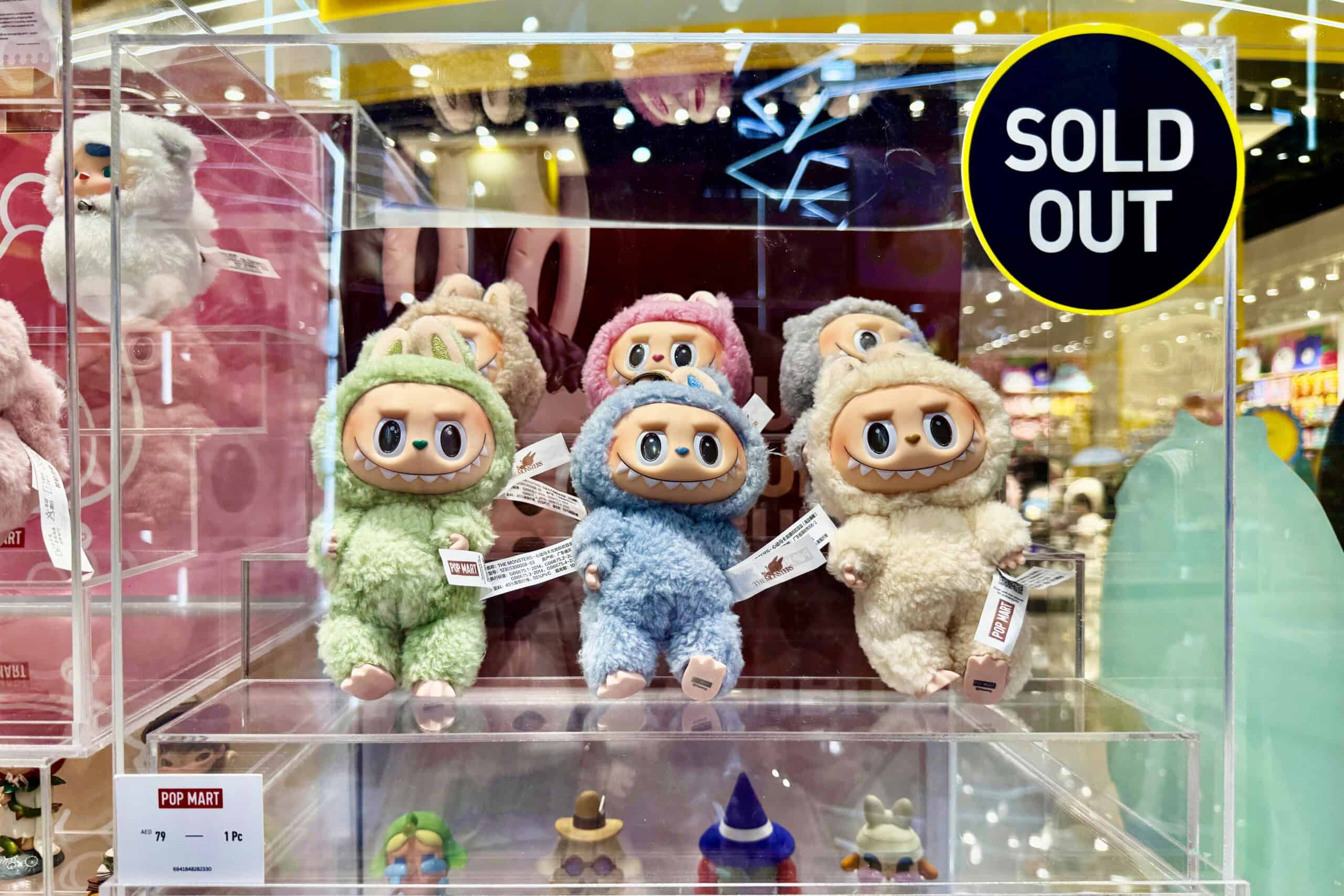
The global rise of designer toy Labubu began as a typical case of the celebrity effect.
In April last year, a singer with the hugely popular K-pop group Blackpink posted a photo of herself on Instagram hugging the little monster with its trademark toothy grin. The furry toys were soon after spotted dangling from the bags of stars like Dua Lipa and Rihanna.

Before long, Labubu became one of the world’s most coveted toys. In Australia, fans have queued overnight to get their hands on the bag charms. In Korea and the UK, fights have broken out among overzealous buyers, forcing the company to halt in-store sales. And at an auction in Beijing this month, a rare, first-generation Labubu figure sold for an eyewatering 1.08 million yuan ($150,000).
What’s even rarer about Labubu, however, is its Chinese origins — the quirky elf is the creation of a Hong Kong-born designer Kasing Lung, and is sold worldwide by Beijing-based company Pop Mart.
China is not new to the toy industry. The country produces most of the world’s toys, including three-quarters of those imported by the U.S. last year, according to data from the International Trade Commission. Some Chinese companies, such as the Guangzhou-based Miniso, have previously sought to sell products directly to international consumers.
This is a Chinese company, but it is not relying on Chinese motifs or design or heritage. It is more just connecting with people on an emotionally driven level. That traditionally has been harder for Chinese brands to do.
Olivia Plotnick, founder of the marketing agency Wai Social
But Pop Mart, which is listed in Hong Kong, has achieved what hardly any Chinese company has done before — creating a character that resonates on a global scale. The amount of money Labubu fans are willing to pay for the toys has allowed the company to thrive in the U.S. at a time when many American toysellers are struggling due to the Trump administration’s tariffs.

From the marketing and the design of Labubu to the way the toys are sold in blind boxes (which keep their exact contents secret until opened), “Pop Mart really got the formula right,” says Olivia Plotnick, founder of the marketing agency Wai Social. “The experience of getting the product these days is almost as important as the product itself.”

Thanks to the Labubu frenzy, Pop Mart’s revenue more than doubled to 13 billion yuan ($1.82 billion) last year. The company is now worth $45.7 billion, nearly seven times as much as Mattel, the American company behind Barbie. With a net worth of $22 billion, Pop Mart’s 38-year-old founder and chief executive officer Wang Ning became the tenth richest person in China this month.
Pop Mart’s success represents a breakthrough for Chinese brands. Though China has risen as an export powerhouse in recent decades and exporters have refined their product offerings, Chinese companies have struggled to nail branding and marketing outside the country.
But, as the emergence of Labubu underscores, that is starting to shift. Its wide appeal has in part derived from the fact that there is little about the toy that is recognizably Chinese.

“This is a Chinese company, but it is not relying on Chinese motifs or design or heritage. It is more just connecting with people on an emotionally driven level,” says Plotnick. “That traditionally has been harder for Chinese brands to do.”

Despite what seems to be its overnight success, Pop Mart’s surge has been a long time in the making. Wang, who hails from Henan province, had dabbled in different small ventures as a university student, before founding Pop Mart in 2010, as a variety store for trendy merchandise.
The company had its first break several years later, when it obtained the license for Sonny Angel, a popular Japanese figurine that drove up to half of its stores’ revenue. “We are studying why people go crazy over it,” Wang said on a Chinese TV show similar to Shark Tank in 2016.
The use of blind boxes was one reason behind Sonny Angel’s success. Buyers enjoy a burst of dopamine when they land on the toy they want; the sense of loss when they don’t keeps them coming back for more.
Pop Mart founder Wang Ning discusses the company’s plans during an interview from 2016. Video via bilibili
But Wang and his team had bigger ambitions.
“We wanted to go from selling what’s already out there to creating something that didn’t exist yet,” said Si De, executive director of Pop Mart, at a talk at Peking University last month. “Our dream is not merely to become China’s Disney…It’s to leave our own unique mark on the world.”
Instead of fixating on processes and technicalities, the Pop Mart team explored concepts that are often more foreign to Chinese companies, such as storytelling, design aesthetics and creative visions that can generate emotional rapport between customers and products. “Cultural products are fragile. They don’t survive translation unless you care deeply about the language — both literal and emotional,” said Si.


‘Mega Space Molly’ dolls on display in California (left) and Japan (right).Credit: Pop Mart, Depositphotos
To that end, Pop Mart started working with artists across Asia to develop its own intellectual property, debuting its Molly doll collection in 2016, a character designed by Hong Kong artist Kenny Wong. By 2020, when the company raised $616 million in an initial public offering in Hong Kong, 84 percent of the toys it sold were under its own brand, up from 30 percent in 2017, according to its prospectus.
A line outside a Pop Mart in California, April 26, 2025. Credit: @mycuteattacks
“At the time it went public, the biggest question was whether it had any valuable intellectual property other than Molly,” says Stephen Wong, an analyst with Maven Securities. “But now it has proven its ability to keep creating new IP.”
As growth in the domestic Chinese toy market slowed following the pandemic, Pop Mart has accelerated its global expansion, opening 130 brick-and-mortar stores outside of the country by the end of last year.
This includes North America, which accounted for only 14 percent of its international revenue last year, but is quickly emerging as a key market. Revenue in America jumped ninefold in the first quarter compared to the same period last year, surpassing growth in other regions. The company now plans to double its store count in the U.S. to over forty by the end of the year.

This stands in contrast to the gloom that swept over the toy sector as Trump imposed tariffs on toys from China that were as high as 145 percent earlier this year. That tariff has been lowered to 30 percent amid trade negotiations between China and the U.S., but it has still dealt a major blow to U.S. toysellers which rely heavily on Chinese manufacturers.
Trends are dangerous. But if you can stay on top of it, then you could do really well.
John Parker, a toy industry veteran and chief executive of Patencio Development
“Some are going out of business. Some are frozen because they don’t know what to do. Others are just trying to navigate the storm,” says John Parker, a toy industry veteran and chief executive of Patencio Development, which advises pop culture brands. “It’s not sustainable to put a 30 percent premium on the price or the cost and expect consumers to pay that.”
One thing Pop Mart and other toysellers share in common is the challenge of avoiding tariffs by diversifying their supply chain away from China, where the ecosystem for toy manufacturing is far more mature than elsewhere.
“The advantage in countries such as Vietnam and Cambodia might be lower labour costs,” says Tony Chen, founder of TonySourcing, which links foreign toysellers with Chinese suppliers. But in China, he adds, toymakers can find everything they need within manufacturing hubs such as Shantou in Guangdong and Yiwu in Zhejiang, from design services and raw materials to plastic molds and accessories.
Such factors explain why Pop Mart has made little progress in sourcing toys from elsewhere so far, despite its march into the U.S. market. According to data from Import Yeti, a firm that tracks bills of lading, Pop Mart Americas’ shipments are still predominantly from China.
Pop Mart’s continued success is not without challenges at home. On Friday, the People’s Daily, the Chinese Communist Party mouthpiece, criticized the frenzy over blind boxes and pressed for greater oversight. While the piece stopped short of naming Pop Mart, the company’s shares fell by 3.6 percent by the end of the day.

Still, Pop Mart’s success has inspired other Chinese companies to follow in its path, although replicating its model is easier said than done.
Miniso, for one, has given up on developing its own IP given the huge investments and risks it involves. “We lost money in a way that was just ugly,” founder Sun Yuanwen told 36kr in April.
QuantaSing, a U.S.-listed Chinese company that runs several online learning platforms, jumped on the bandwagon in March by acquiring a stake in the Shenzhen-based Letsvan, which has mimicked some of Pop Mart’s marketing strategies with its Wakuku toy, which is gaining traction in the domestic market.
As for Pop Mart, the big question is whether it can sustain the momentum and ensure its products stay relevant. “Trends are dangerous,” says Parker. “But if you can stay on top of it, then you could do really well.”

Rachel Cheung is a staff writer for The Wire China based in Hong Kong. She previously worked at VICE World News and South China Morning Post, where she won a SOPA Award for Excellence in Arts and Culture Reporting. Her work has appeared in The Washington Post, Los Angeles Times, Columbia Journalism Review and The Atlantic, among other outlets.