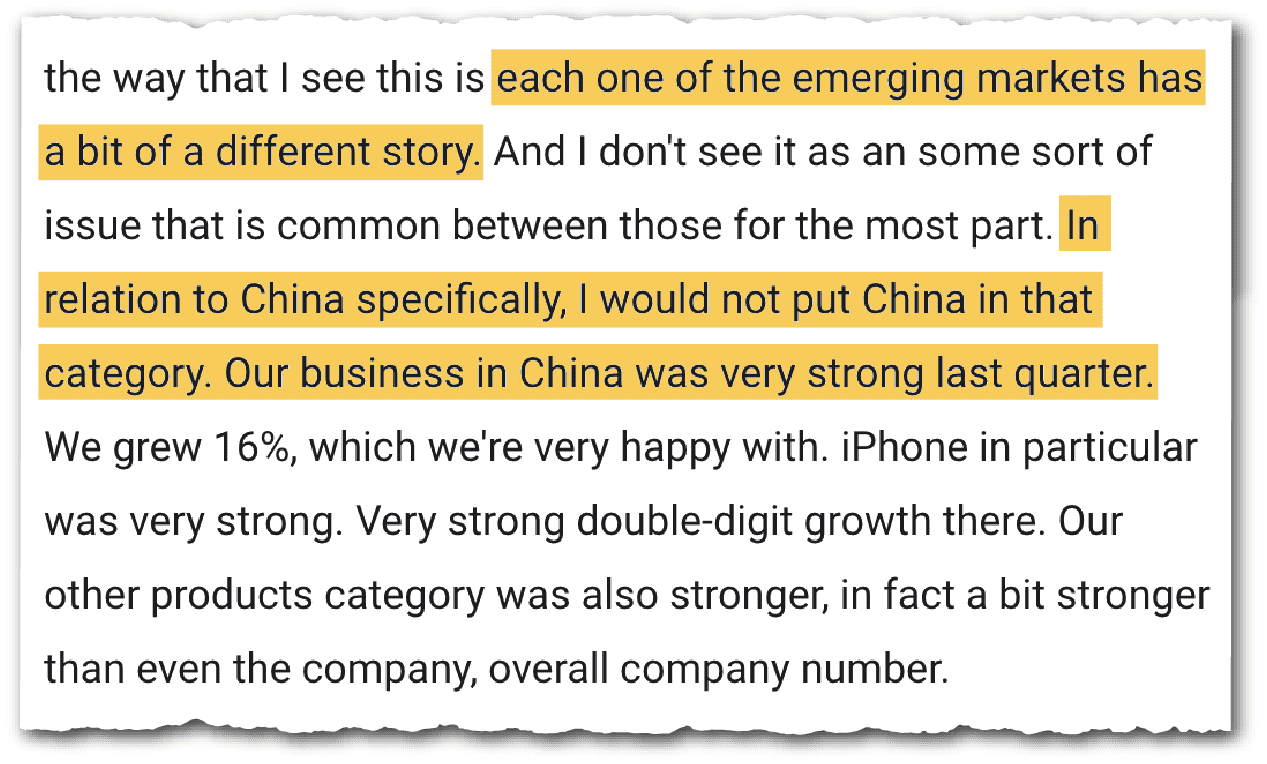
First the Apple executives were stunned; a few months later they panicked; then, as iPhone sales in China missed Apple’s targets, Tim Cook reassured investors and analysts that everything was fine.
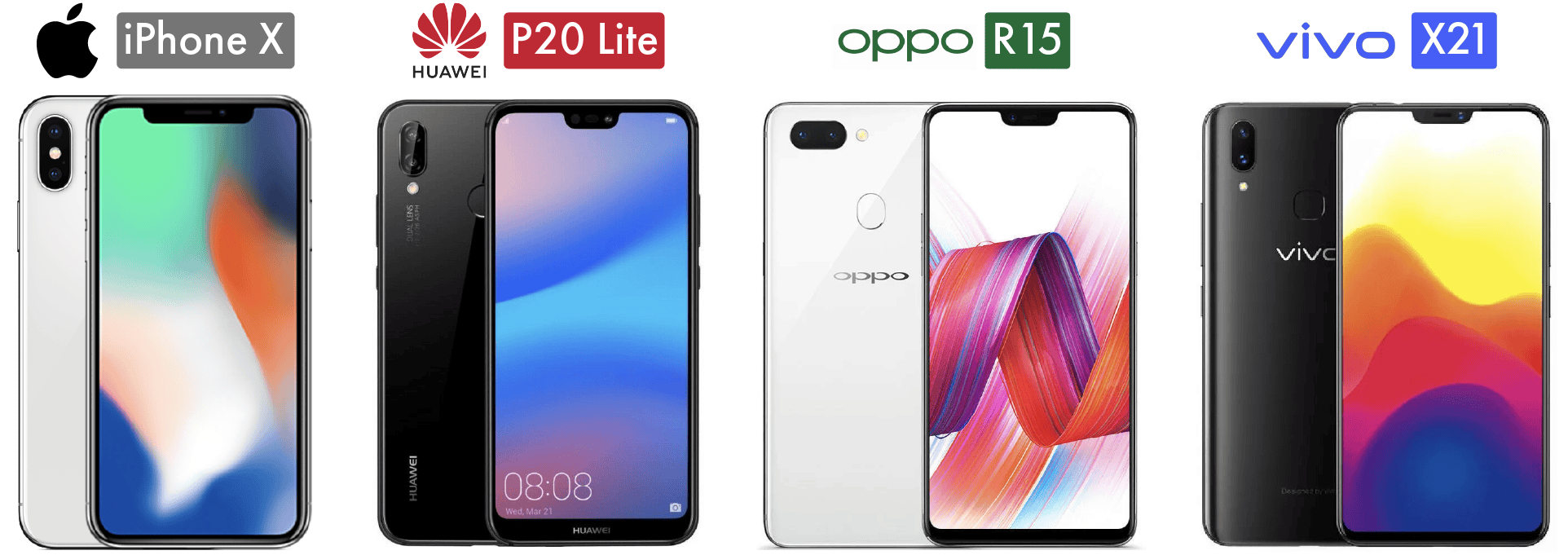
The drama began in early 2018, a time when Apple executives thought they’d be basking in the halo of the iPhone X. The “tenth anniversary” iPhone was a big hit when it went on sale the prior November, owing to an Infinity Pool-like design that let the user unlock it with a face scan instead of their thumbprint. It was arguably the biggest change to the iPhone since Steve Jobs announced “the one device” in January 2007. In a sea of similar-looking smartphones, the new flagship was a stark demonstration of Apple’s innovative edge.
But only for five months. As early as April 12, 2018, Apple’s China sales team issued a dour update back to headquarters in Cupertino, California. New phones from “all of our Chinese competition” — namely Huawei, Oppo, and Vivo — had managed to match Apple’s breakthrough. “Incredibly,” the team wrote to Kevan Parekh, a finance VP, “they all look similar (to varying degrees) to iPhone X, right down to the wallpaper, portrait lighting UI [user interface], and even the marketing how-to-videos. I expect Q3 to be challenging for us.”
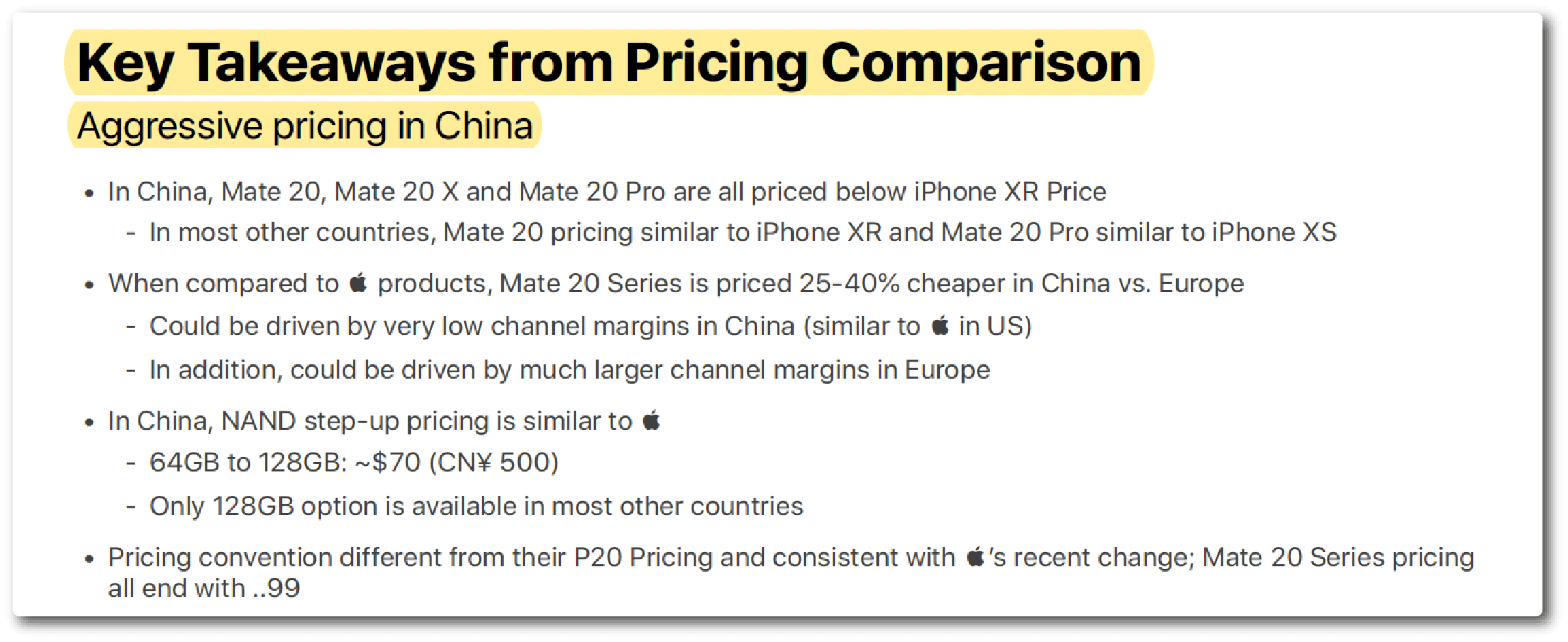
When Parekh, who has since been promoted to chief financial officer, forwarded the note to worldwide sales head Mike Fenger, he added that Huawei prices were “really aggressive.” Fenger immediately grasped the implications: “Thanks,” he replied. “Tough times ahead for us in China.”
The executives’ concern was prescient, as made clear in a trove of internal documents, emails, and depositions of senior Apple executives made public in court discovery but not previously reported.
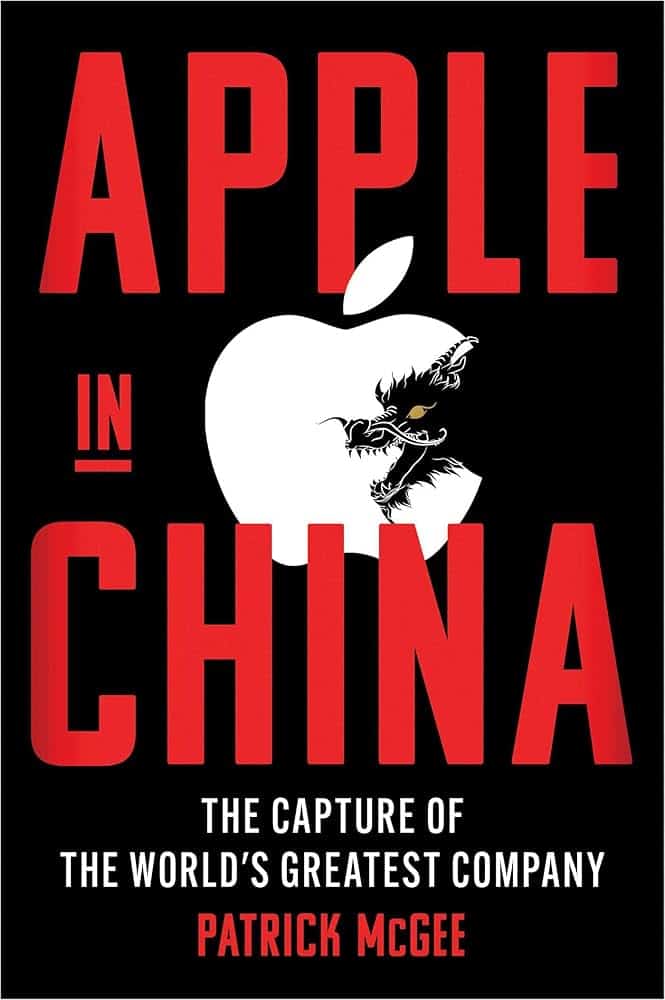
The documents were part of a 2019 class-action lawsuit that concluded last year, when Apple agreed to pay $490 million to settle allegations that it concealed tepid demand in China from investors. Apple denied liability. The episode is part of a wider narrative in my book Apple in China: The Capture of the World’s Greatest Company, published by Scribner Books this month.
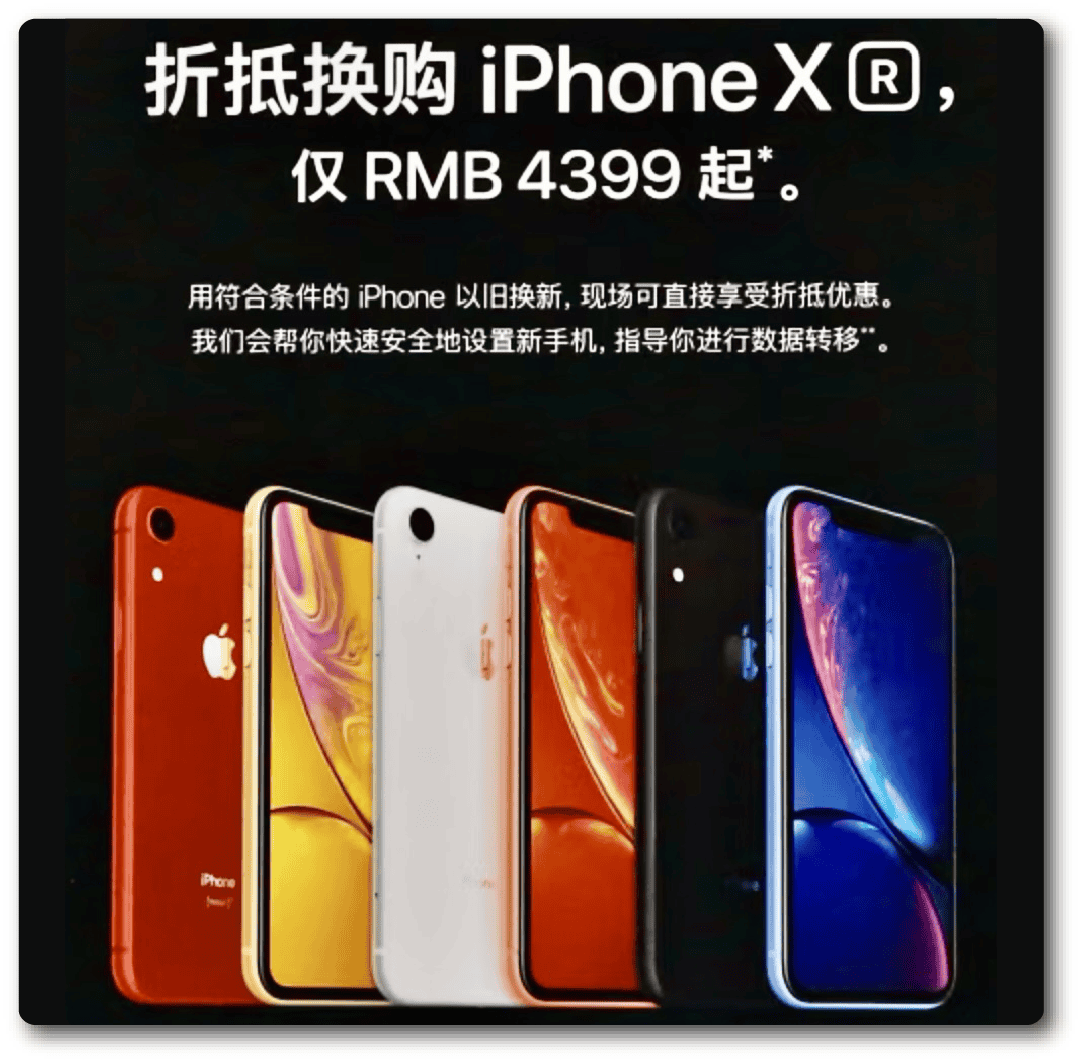
In the autumn of 2018 Apple released three new iPhone models, and at first executives were so optimistic they wondered if holiday quarter revenues (October–December) might surpass $100 billion for the first time. Instead, it became clear almost immediately that the iPhone XR — a budget-friendly handset aimed at the Chinese consumer — was shaping up to be a major disappointment as Chinese customers turned to local brands instead.
China prelaunch for the iPhone XR began on October 8, 2018. By October 19, Apple’s Worldwide Reseller Operations team was reporting internally that demand was 79 percent less than for the iPhone 8 and 8+ a year earlier and “softer than expectations across all reporting partners”.
Tough times ahead for us in China.
Mike Fenger, Apple’s vice president of Worldwide Sales
When the phone officially launched in China on October 26, a VP of financial planning, Saori Casey, sent new projections to Tim Cook indicating that total iPhone sales in the holiday quarter would be up to 7.1 million units short of the prior estimate. The finance team characterized the new guidance as “an extreme problem”. Tim Cook was in Europe when he received the news. “This is obviously a disaster,” he typed back to his team. “We need all hands on deck now.”
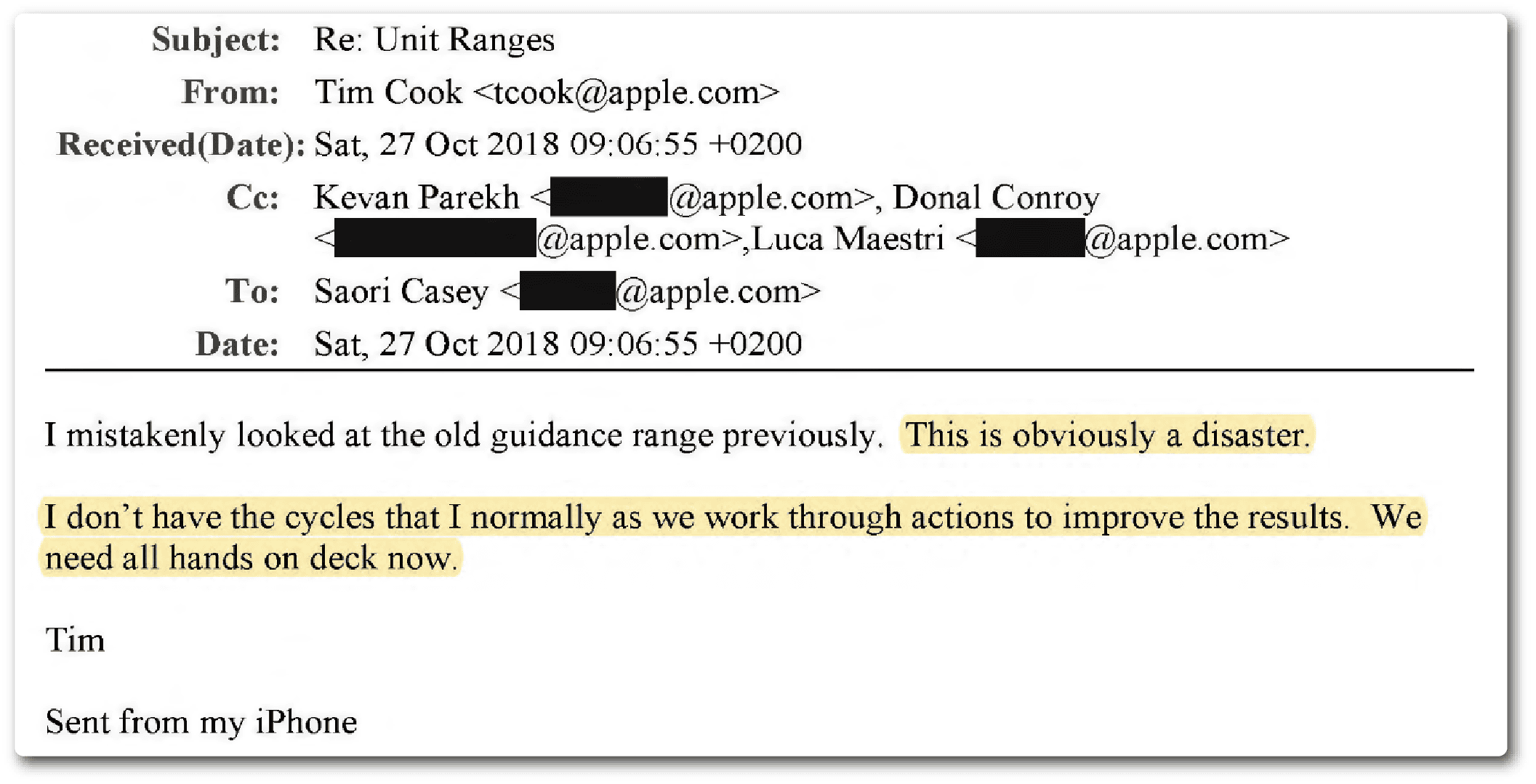
In a deposition, cited here for the first time, Cook explained that the new estimates suggested “a huge drop of $3.5 billion” for the quarter — “in, literally, a 24, 48-hour kind of window.” Another VP, Donal Conroy, later commented: “We definitely had some concerns based on preorders . . . but the wheels fell off on Friday [October] 26th.”
Into the Dragon’s Den
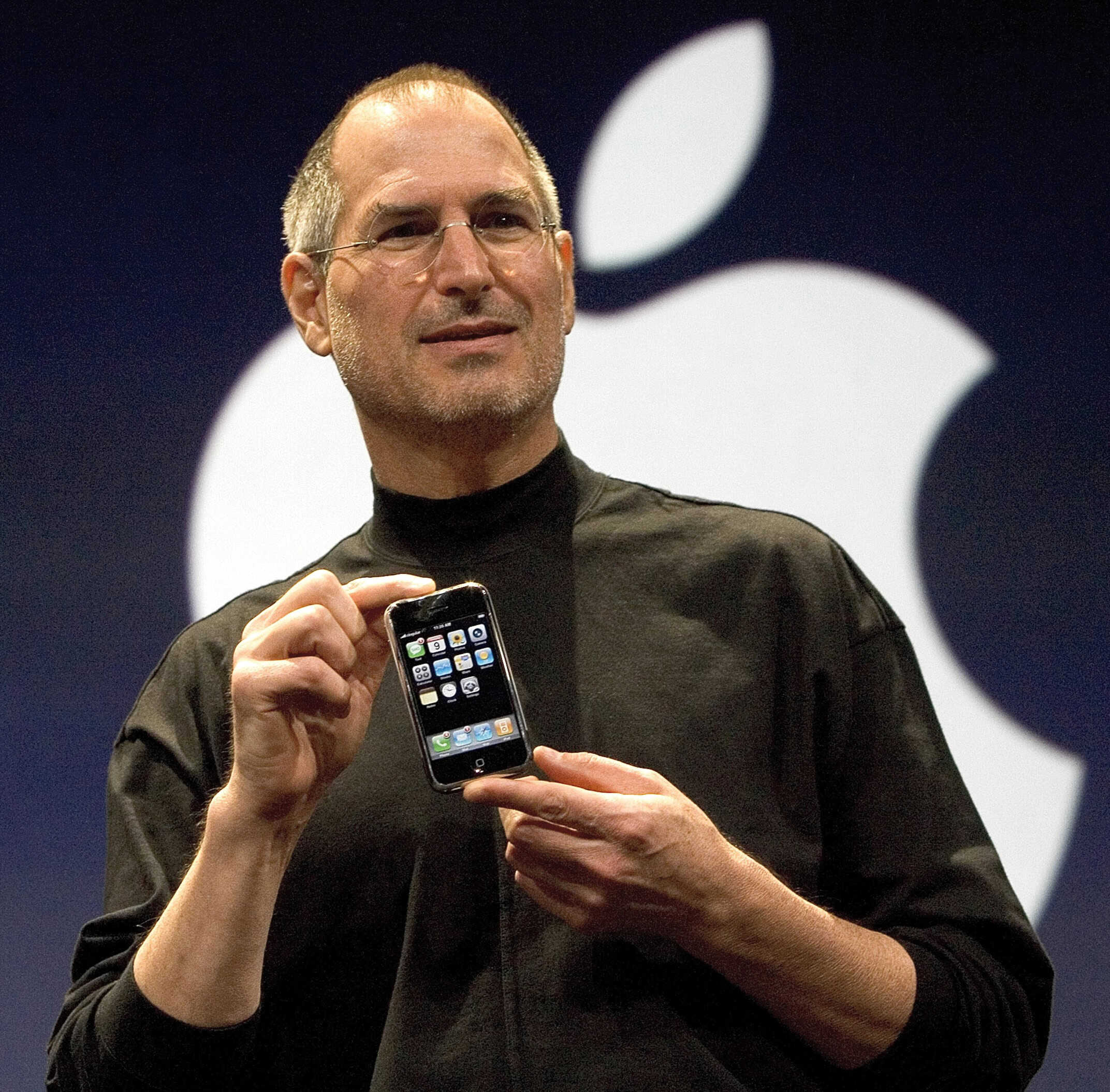
That rivals would imitate the latest iPhone features was not surprising. When Apple first accused Samsung of copying the iPhone, Steve Jobs declared “thermonuclear war” and sued his South Korean challenger. As Chinese brands emerged on the smartphone scene, Apple’s chief designer, Jony Ive, similarly railed against the likeness of phones made by Xiaomi, saying, in 2014: “It really is theft and it’s lazy and I don’t think it’s okay at all.”
But such public criticism of Chinese mimicry by Apple executives ceased as Xi Jinping consolidated power in his first term, which began in November 2012. By then Apple had too much at stake. Over the previous decade it had moved nearly all of its production to China and was selling tens of billions of dollars worth of its products in the country.

Apple had also been shaken in March 2013 by a coordinated, multi-week attack from Chinese state-media outlets for alleged customer service failings. For a while executives feared Apple products might be blacklisted in China.
Under Xi, the Chinese government made clear that it wanted Western multinationals to embrace “in China, for China” policies. Brands such as IBM and Cisco suffered as their Chinese clients were incentivized to buy from local rivals, and the state launched multiple antitrust investigations into big technology groups.
Qualcomm was the subject of a three-year antitrust probe that led to a $975 million fine. Subsequently, the company agreed to start a semiconductor joint venture with Chinese partners Huawei and Semiconductor Manufacturing International Corp. “They held us hostage for a billion dollars and stole our intellectual property,” says a former Qualcomm executive.
As Beijing made it clear that it was unhappy with Apple, Apple responded with a charm offensive.The strategy culminated in May 2016, when a trio of top executives led by chief executive Tim Cook visited Zhongnanhai, the Chinese Communist Party headquarters.
The three Apple executives stood near Zhongnanhai’s main entrance, where two banners read “Long Live the Great Communist Party of China” and “Long Live Invincible Mao Zedong Thought.”
The scene underscored just how much had changed since 2000, when the first China-made iMacs rolled off assembly lines. Back then, Washington was encouraging China to join the World Trade Organization. Many officials believed that trade would empower China’s middle class and perhaps ultimately inspire a more liberal political environment; instead, foreign investment strengthened the Party’s grip on power. No corporation was a bigger investor than Apple, and that was the message the executives were there to convey.
The meeting reflected a years-long strategy to fit Apple’s business narrative into language Party officials would appreciate. For decades, the Chinese government had wanted foreign companies to operate joint ventures in China — partnerships in which local partners could learn the ins and outs of the business and eventually thrive on their own. This idea was anathema to Cupertino, but Cook’s executives in China had come up with a better argument.
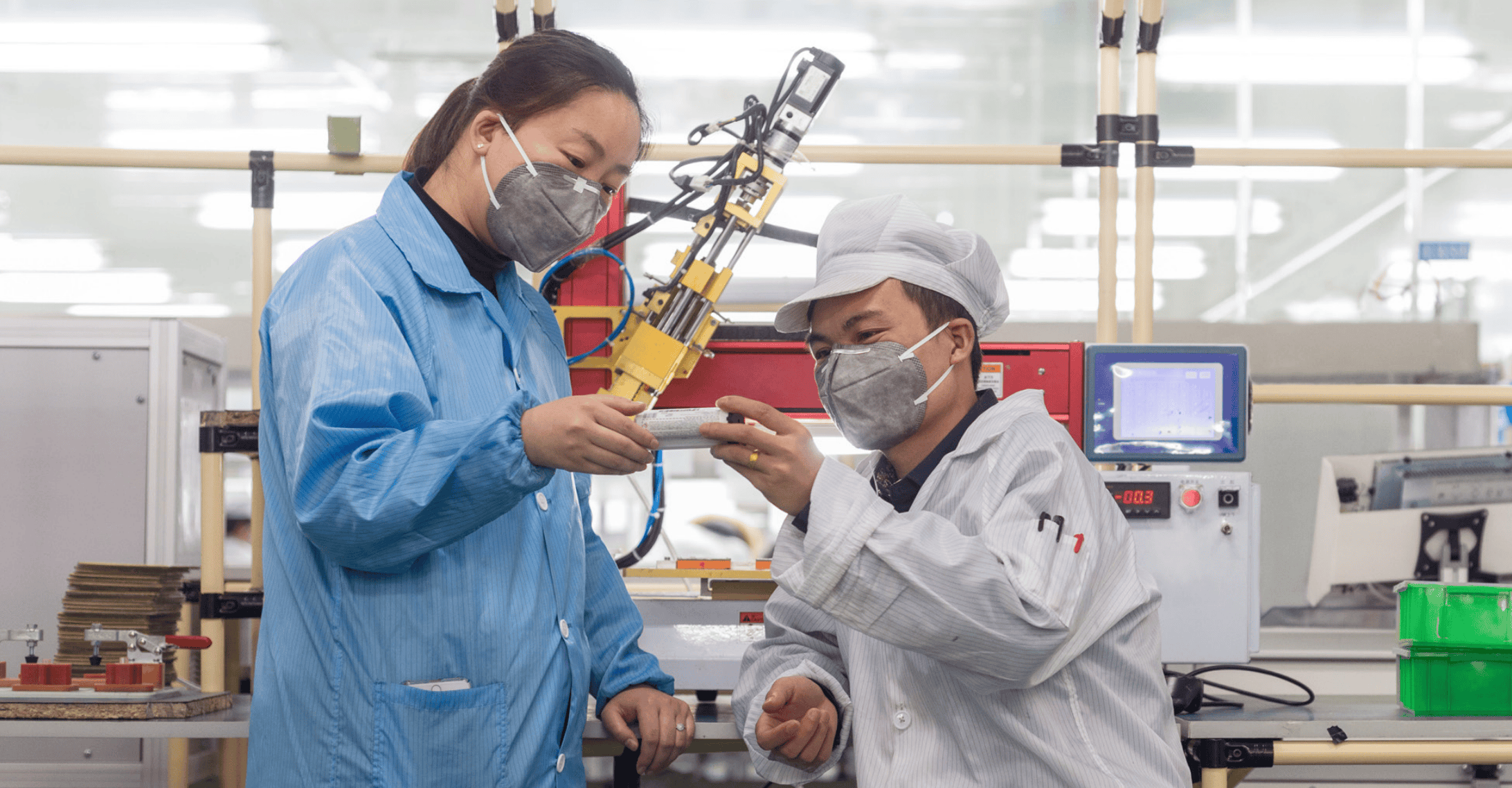
Apple wasn’t just ordering components for the latest iPhones, assembling them in China and then shipping them around the world. Instead, Apple’s top engineers were constantly parachuting into the country and embedding themselves into hundreds of factories where they’d co-invent new components and manufacturing processes. As they did so, they trained and mentored millions of Chinese managers and workers.
China did not have the talent or expertise to build the products conceived by Jony Ive’s design studio. “There is no supplier out there where we could just send a package of drawings and a pack of specs and get what we wanted without lots of work on our side,” says a former Apple manufacturing design engineer. “It just didn’t exist.”
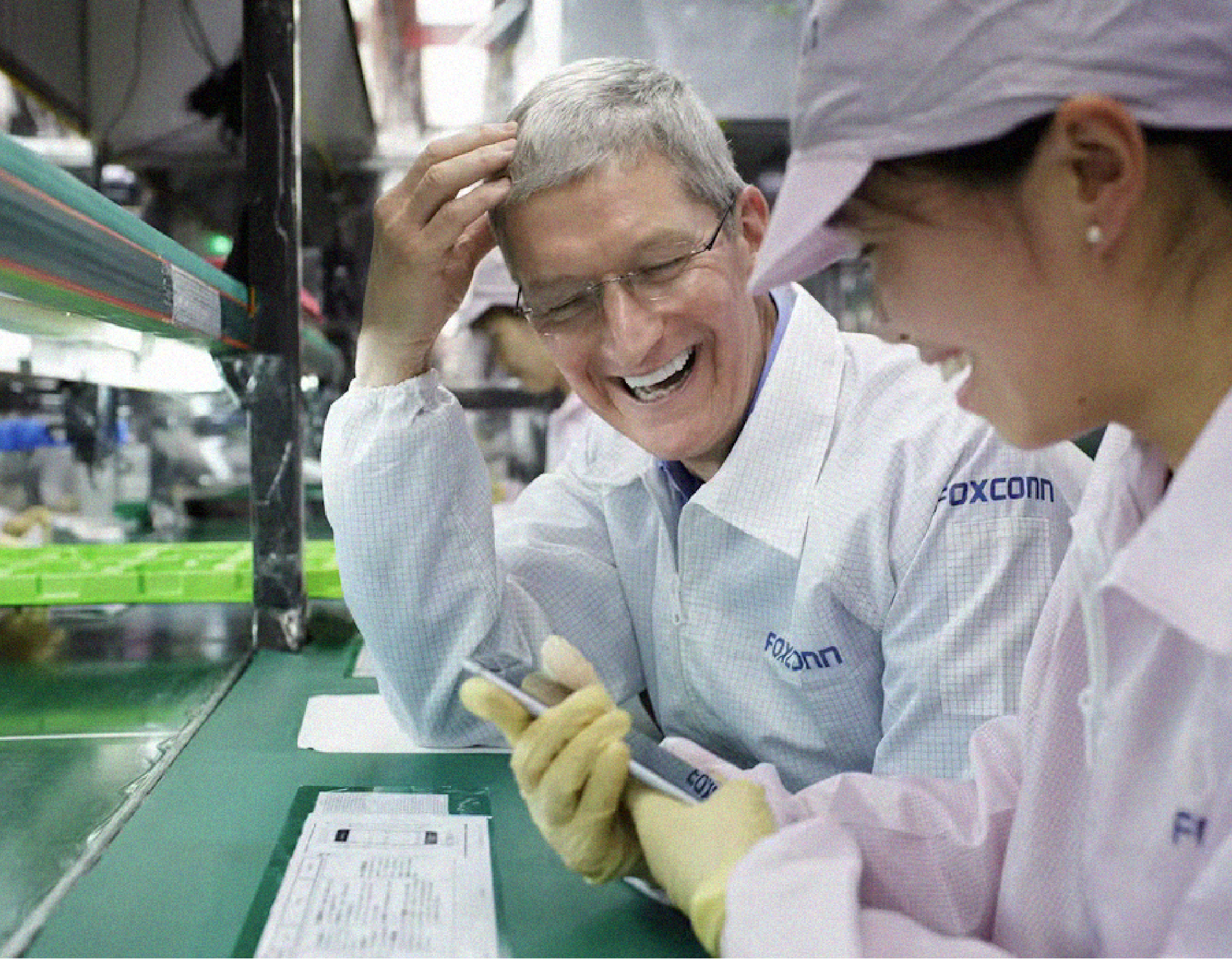
But through extensive training, Apple could change that. One engineer who spent more than two decades with Apple estimates he trained workers in 1,000 factories; another says he worked in 500 factories over a decade; a third has two shoeboxes at home filled to the brims with the business cards of Chinese factories he visited.
According to internal company documents, the number of workers employed in Apple’s China supply chain fluctuates from around 900,000 in March, when factories emerge from their annual Chinese New Year breaks, to more than 1.8 million ahead of an annual iPhone launch.
Apple’s China suppliers eke out razor-thin margins; at times they even lose money. That suggests to some that they add little value to Apple’s products. But working for Apple is enormously beneficial to them in other ways. Apple, for example, often purchases machinery for suppliers to help them meet quality standards — a lot of machinery. iPhone shipments grew from less than 5 million units in 2007 to nearly 250 million annually by 2015.

In Apple’s view, the training and experience suppliers reaped from it more than compensated for their tiny margins. As another former Apple engineer puts it, “There was an attitude of, ‘working with Apple was a reward, not a business.’”
Apple’s rigorous training of, and investment in, its network of China suppliers had come full circle. Suppliers were using their skill sets to supply Apple competitors such as Huawei, which became a source of national pride as it penetrated the premium market with slick new phones.
The result of this strategy was an enormous transfer of technological know-how. And this tech transfer wasn’t only coming from America — it was global. Apple had a specific team of “subject matter experts” whose job was to research new processes, materials, tools and machines in Europe and Japan to discover the next great innovations.
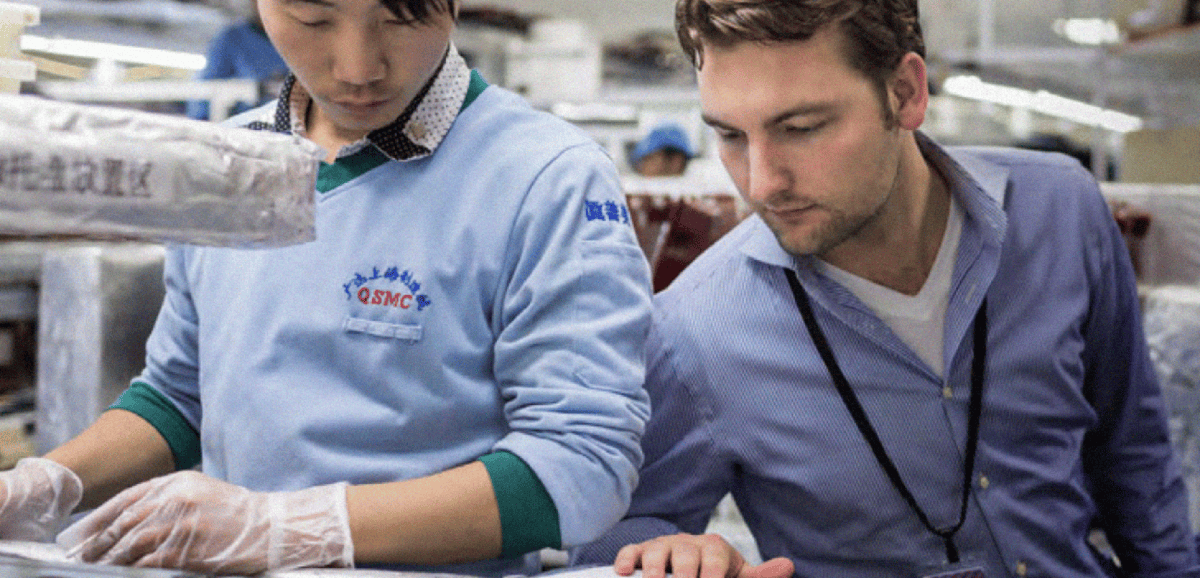
“They’d try to transfer that to China and make in China what we couldn’t do with the current technology,” another former manufacturing design engineer says. “This happened every year when we had to launch a new product, because every year we were pushing the envelope and we’d need something new.”
The full details of what Cook told Party officials at Zhongnanhai in May 2016 isn’t known, but it was there that he pledged to invest $275 billion in China over the next five years. The investment agreement stemming from that closed-door meeting, first reported by The Information in 2021 and independently corroborated by the author, was part of a wider campaign to show Beijing just how seminal Apple’s influence was on the country’s tech sector. New R&D labs and public investments would follow.
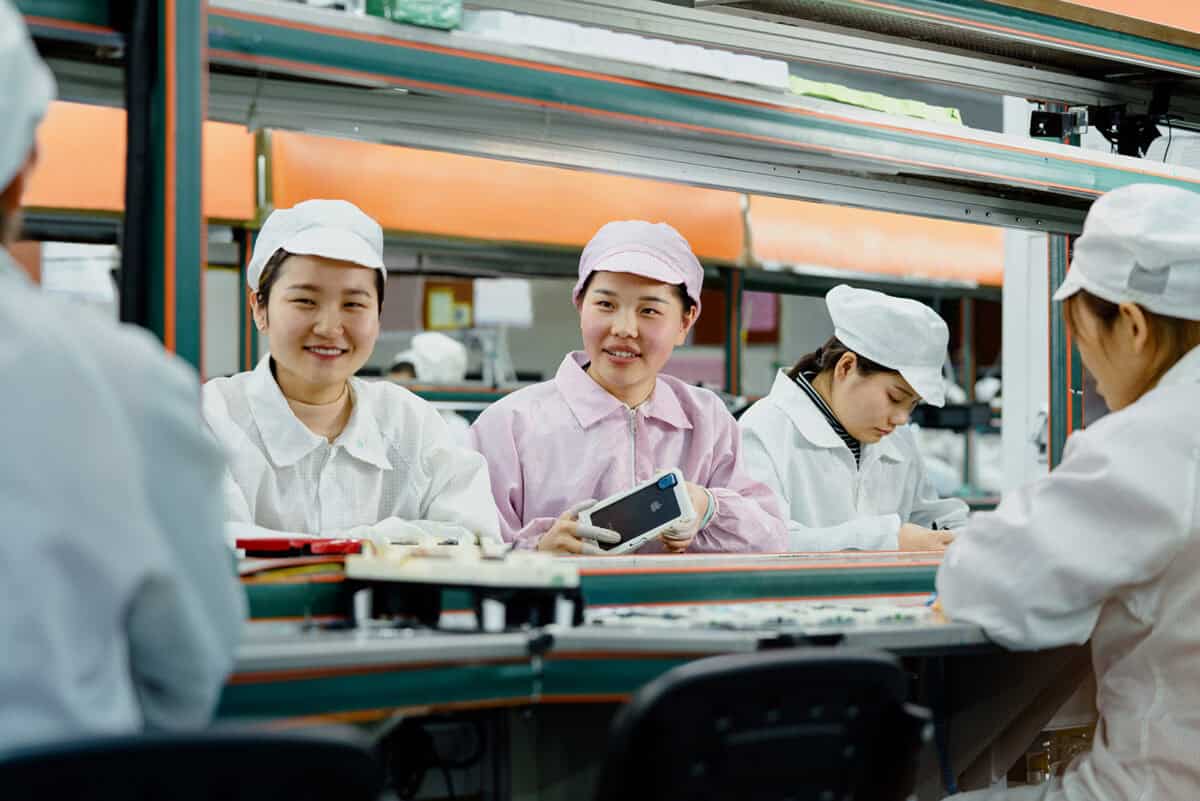
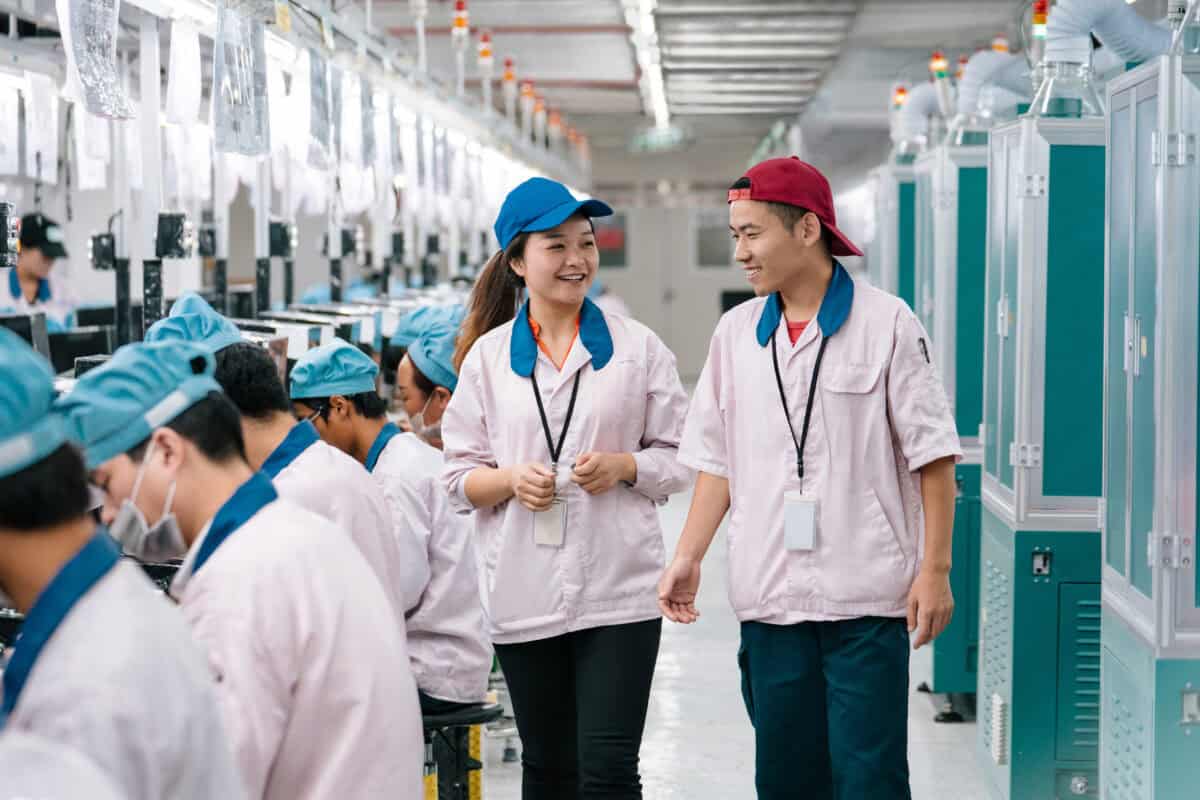
Left: Line operators at an iPhone production facility in China. Right: iPhone production line managers in China. Credit: Apple
The Red Supply Chain
As word of Apple’s investment deal circulated among Chinese officials, something unexpected happened: it spurred competition.
For years, Chinese suppliers had been frustrated by Apple’s overbearing controls. They often viewed Apple as the “prom queen” — beautiful to look at but unwise to date because of all the drama, says a former Apple vice president. “At the end of the day, she’ll leave you hanging, your heart will be in your hand, and then you’ll be out — that’s Apple’s business,” this person says.
But Terry Gou, founder of the Taiwanese assembly giant Foxconn, had an important epiphany. In the late 1990s he figured out that the value of working with Apple was never in the profits; it was in the learning.
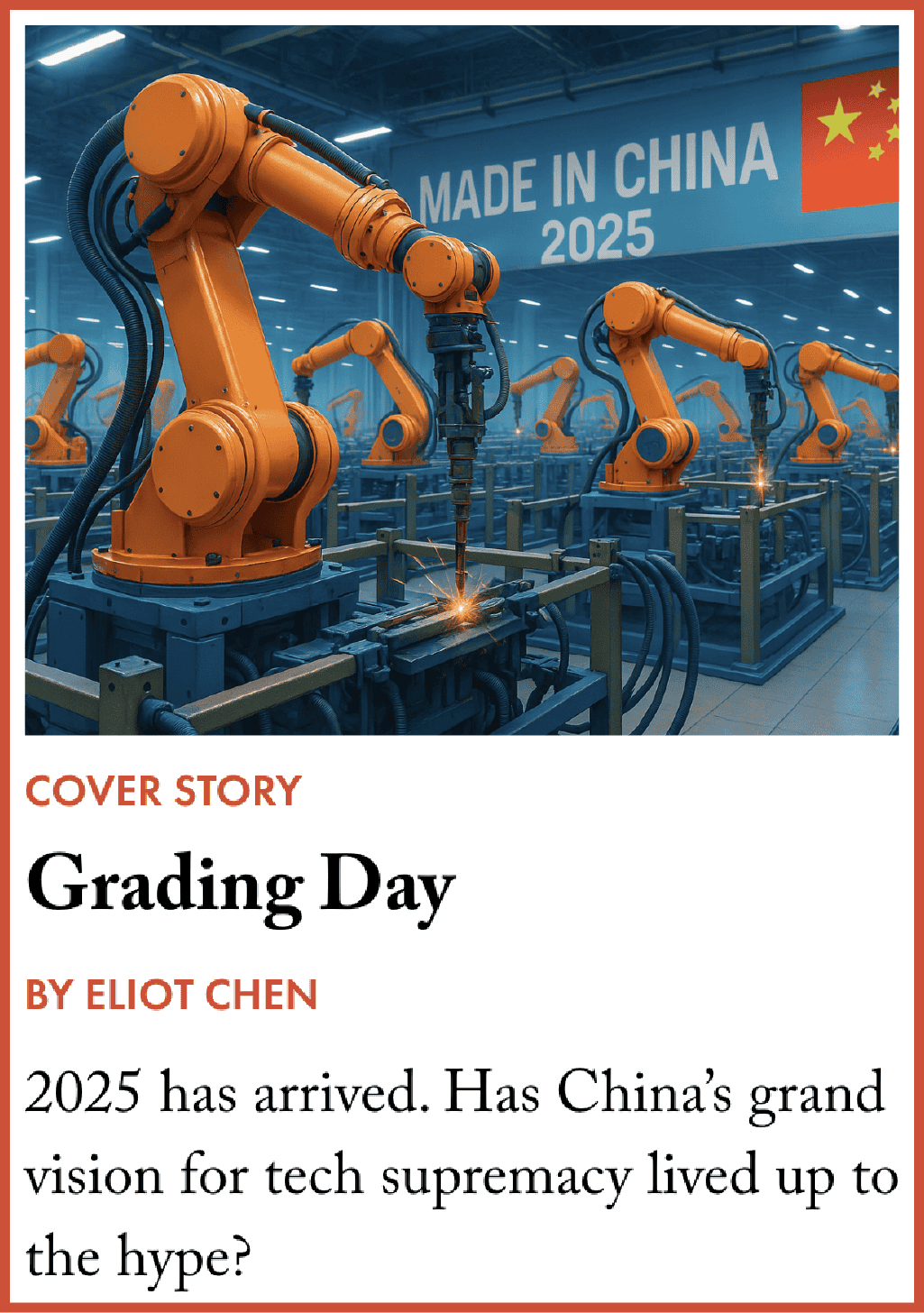
Xi Jinping’s Made in China 2025 plan, published in 2015, had asked Chinese companies to “master core technologies, perfect the industrial supply chain, and form our own development capabilities”. It was a blueprint for China to wean itself from dependence on the West and become self-sufficient in advanced technologies. What became clearer to Chinese companies after Cook’s 2016 visit to Zhongnanhai was that the best way to support these goals was to work more closely with Apple.
The tech giant, for its part, didn’t necessarily want to have even more Chinese companies in its supply chain. But it was Chinese suppliers who could most readily access cheap capital, government subsidies and land, while also enjoying access to a vast labor pool.
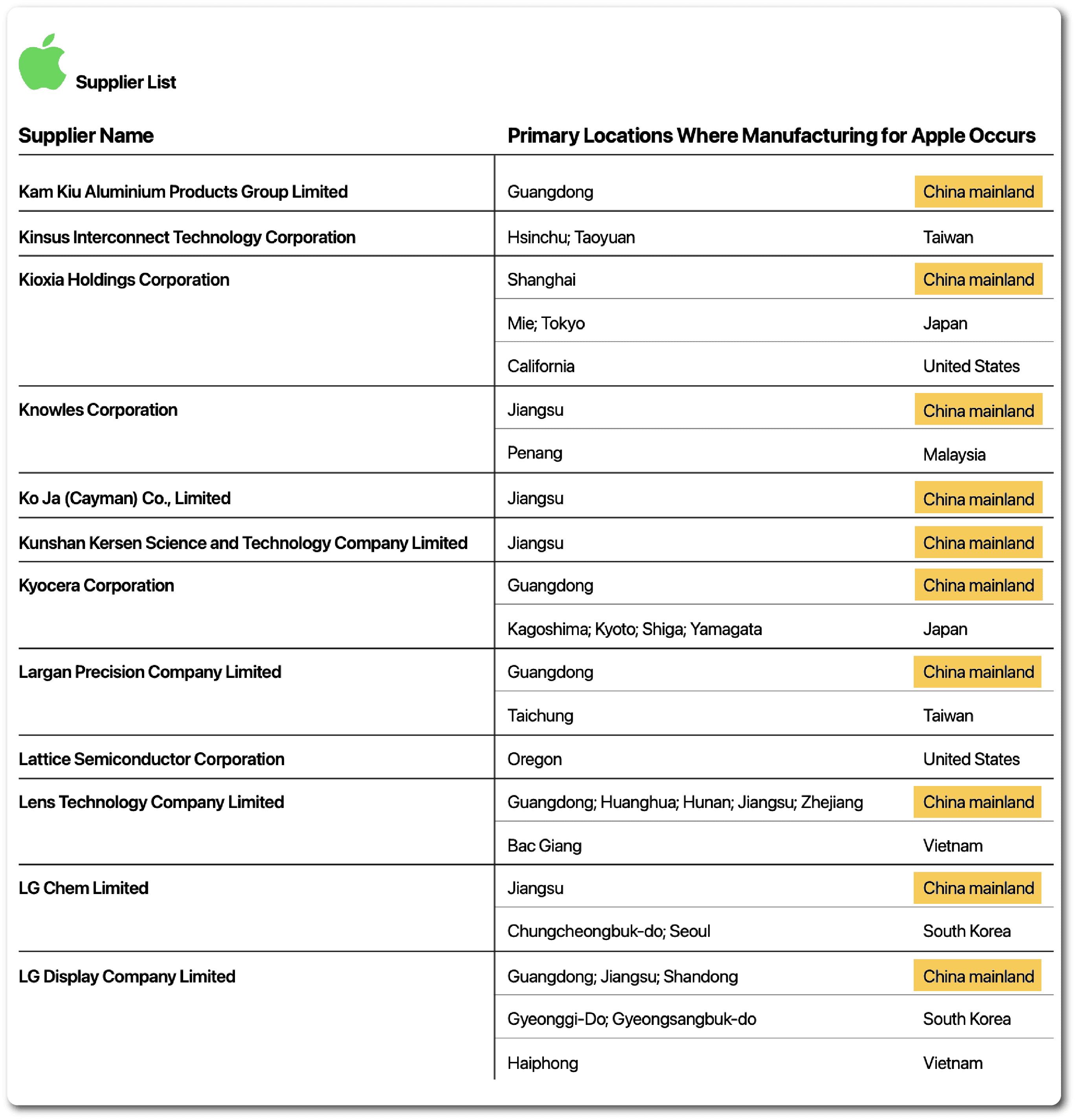
As a former Foxconn executive puts it: “The faucet was being turned off” for Taiwan firms that had also previously reaped such benefits and largely built China’s manufacturing sector over four decades. Instead they were flowing freely to an emerging class of domestic suppliers known as the Red Supply Chain.
Apple’s own annual lists of its top suppliers document the transformation. The number of Chinese companies in Apple’s list of its top two hundred suppliers climbed from 16 in 2012 to 41 in 2019, when they overtook the number of American suppliers. By 2021, the number of top Chinese suppliers hit 51, overtaking Taiwanese suppliers for the No.1 spot.
Significant as those numbers are, they understate China’s dominance by treating the suppliers as equals, when in fact the scale of the Chinese factories dwarfs those in other countries. Internal presentations from 2018 document how total “labor demand” at Apple’s fourteen suppliers in Vietnam totaled 45,000 workers, far less than the 72,000 people needed at a single Chinese glass supplier, Biel Crystal.
Panic in Cupertino
Just why China sales of the iPhone XR were coming in so low, in October 2018, wasn’t immediately understood, but it became clear soon enough. Apple’s rigorous training of, and investment in, its network of China suppliers had come full circle. Suppliers were using their skill sets to supply Apple competitors such as Huawei, which became a source of national pride as it penetrated the premium market with slick new phones.
Working with more Chinese suppliers and assembly groups made Apple hugely popular in government circles. It also helped Apple increase its margins — a critical development after unit sales of the iPhone peaked in 2015. But when sales of the iPhone XR stagnated, another less desirable consequence was revealed.
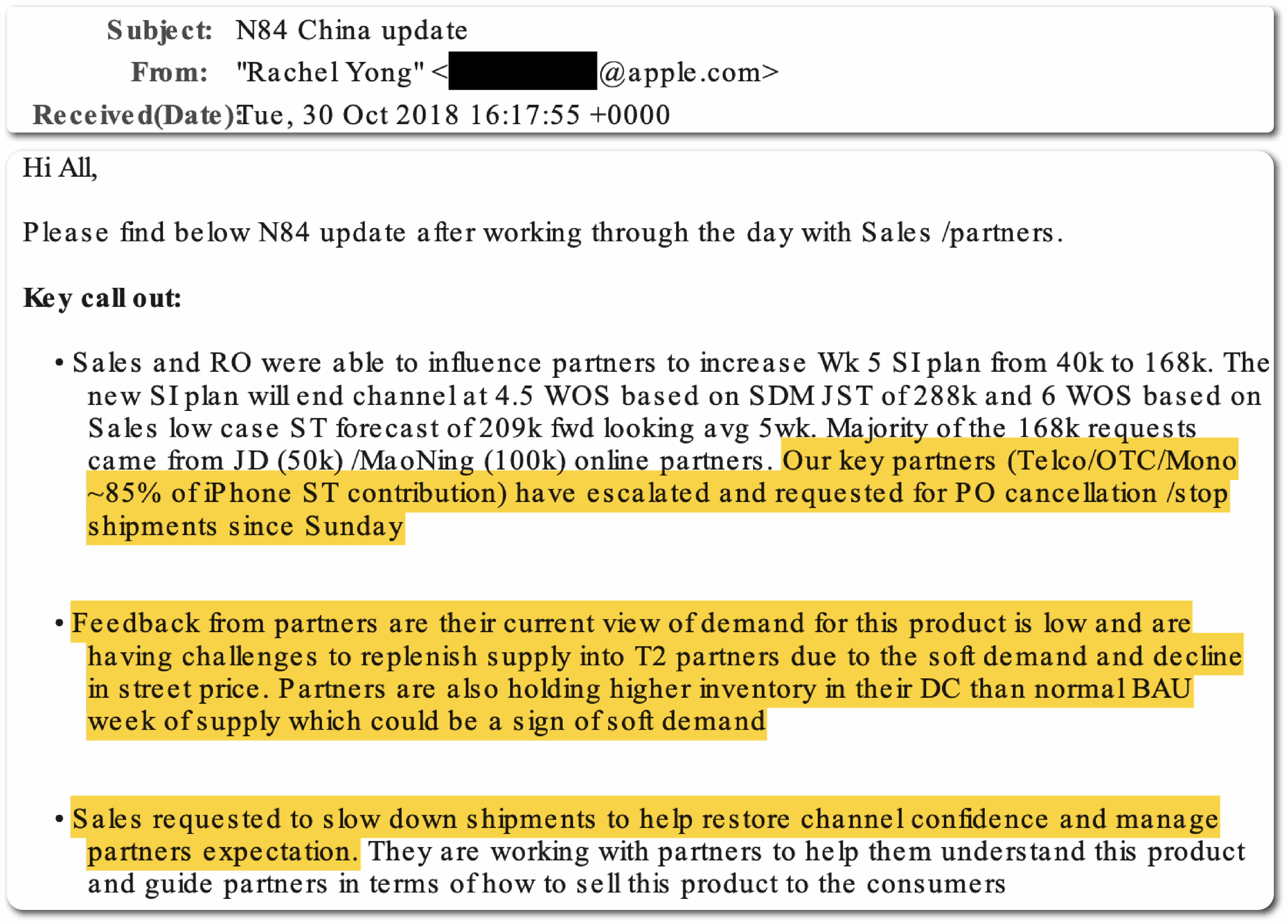
Mark Anderson, a senior manager for iPhone sales finance, characterized the sales challenge as “a 5 alarm fire”. On October 30, staffer Rachel Yong updated more than a dozen colleagues with news that “key partners” accounting for 85 percent of retail channels in China had requested that Apple stop shipments of the XR. She cited a new demand prediction later characterized by a VP of sales as “massively muted” and “nothing like an iPhone NPI” — the acronym for new product introduction.
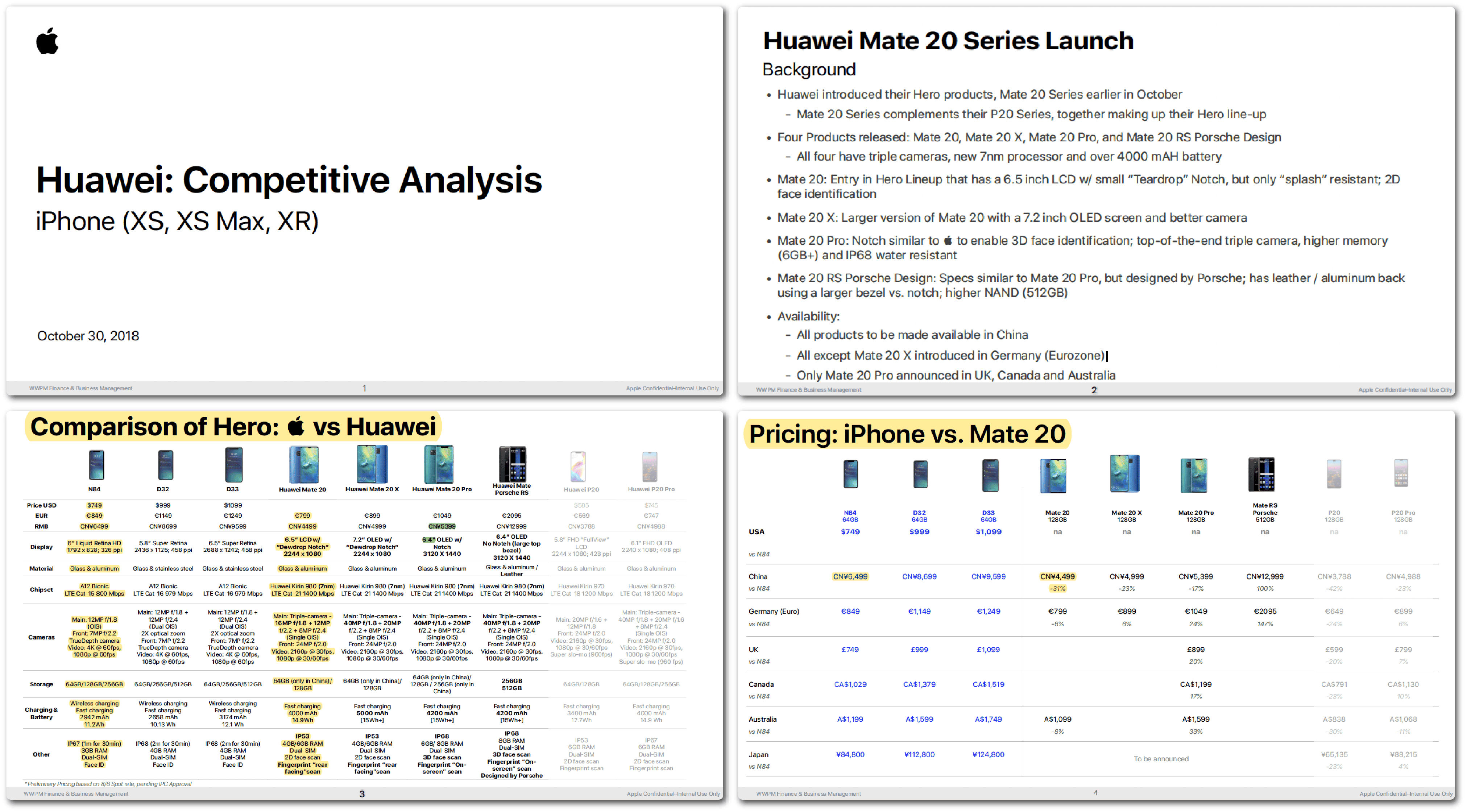
Apple’s sales team in China quickly put together a six-page note titled “Huawei: Competitive Analysis,” which compared Apple’s newest iPhone models with Huawei’s Mate series. It found that the flagship Mate 20 Pro’s features easily rivaled those of the higher-end iPhone XS, but Huawei had surprised Apple by positioning its pro model against the lower-end XR, even undercutting it on price by 17 percent. The Mate 20 Pro featured a larger screen with better resolution, three back cameras instead of one, double the memory, a bigger battery, and a faster recharging time.
On October 31, 2018, a day before Apple reported earnings and holiday-quarter forecasts to Wall Street, the company cut its internal revenue outlook in China from +4 percent to -1 percent. Revenues weren’t just growing slowly in its most important overseas market; they were shrinking. On November 1, Apple’s Operations team held its weekly meeting and discussed whether to slash production.
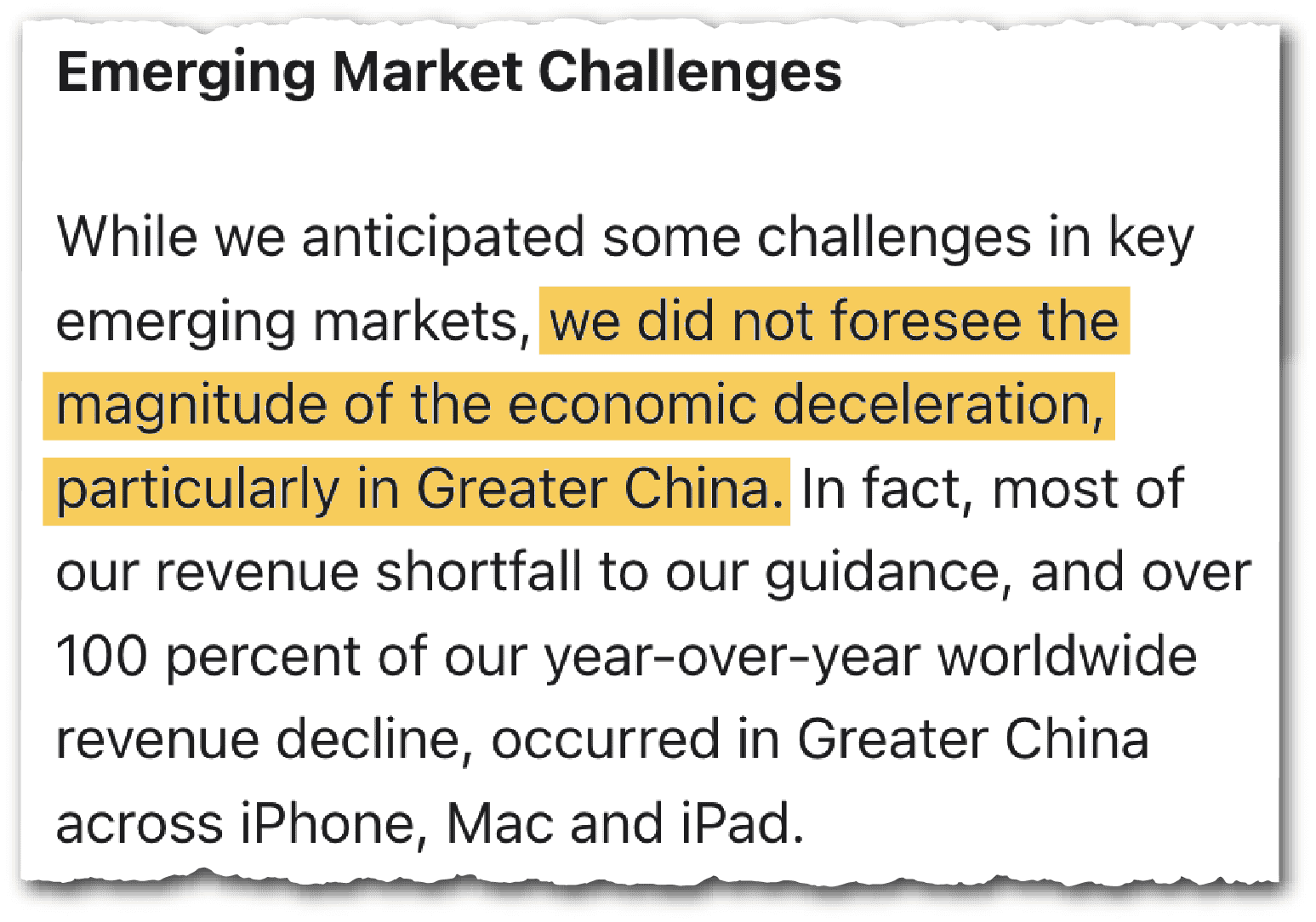
But when Apple published earnings that same day. Tim Cook sounded upbeat — even when he was specifically asked about China. His tone calmed the nerves of Wall Street analysts who’d been worried about weakening macroeconomic conditions in the country. But over the following eight weeks, sales in China continued to underwhelm. Cook, realizing that global sales that quarter would sink 5 percent to around $84 billion, shocked Wall Street with the company’s first revenue warning in sixteen years.
If Huawei’s success had been confined to China, the damage would have been limited. But in 2019 sales of Huawei phones overtook the iPhone globally. Huawei shipped 238.5 million phones — more phones than Apple had shipped even in its peak year of 2015.
The Decline and Reascension of Huawei
Apple got out of this mess with unexpected help — from Donald Trump. Trump had ascended to the US presidency in 2016 threatening the company; on one occasion he even urged his supporters to “boycott Apple”. Instead, he saved it.
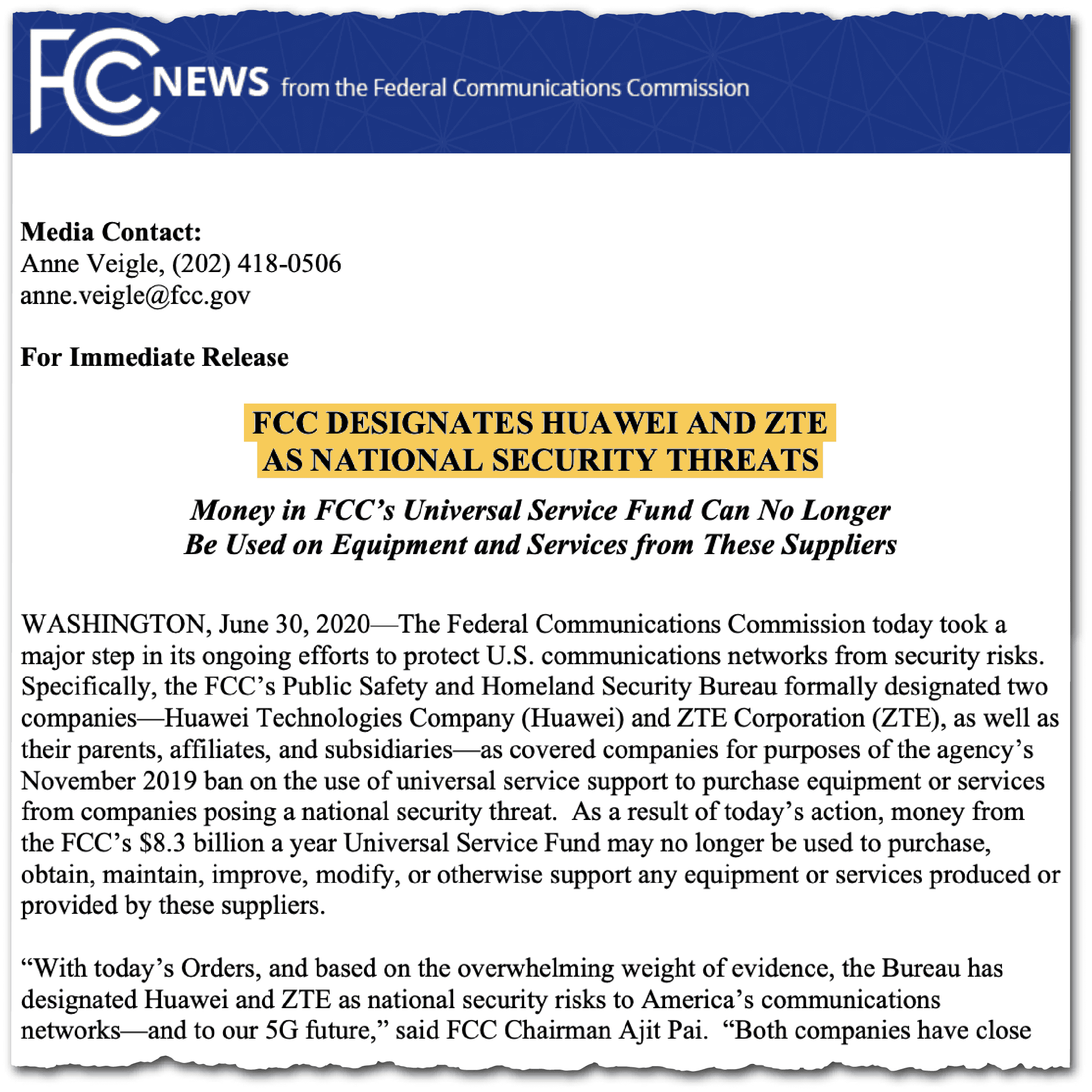
In May 2019 the Trump administration alleged Huawei was a security threat, citing ties with the Chinese government and the potential for its communications equipment to be used for espionage. It soon imposed unprecedented sanctions, depriving Huawei of US-made software and 5G cellular technology.
Huawei’s smartphone business was pushed to the brink of collapse. Apple was suddenly the only game in town for premium 5G phones, enabling its share of the China market to nearly double to 17 percent. In a matter of months, Trump’s first-term trade war with China had unexpectedly morphed from threat to boon.
When Covid hit in early 2020, the work-from-home trend spurred Apple sales. In that year’s holiday quarter, Apple revenue jumped 21 percent to $111.4 billion. Buoyed by the sanctions-induced collapse of Huawei, China sales soared 57 percent. The following year was even better and, by the start of 2022, Apple’s market value surpassed $3 trillion — a first for any company.
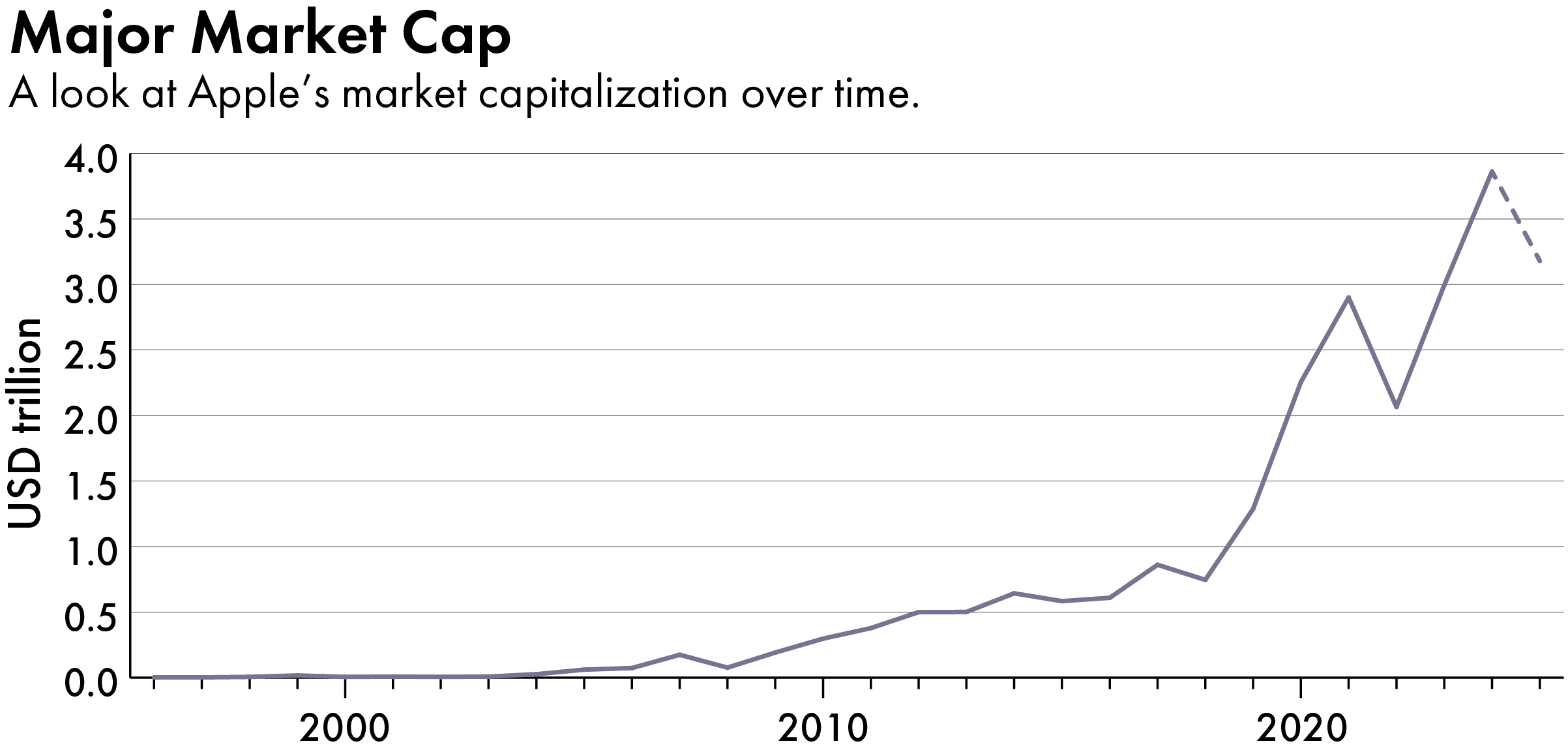
Yet this rebound may prove short-lived. In late 2023, Huawei re-emerged with a vengeance, shipping phones with chipsets so fast that the Biden White House sought to investigate how it was even possible. Its phones now run HarmonyOS, a novel operating system that, in early 2024, overtook iOS in Chinese market share. The latest version for Chinese users is completely divorced from Android and might, within a few years, become the preferred OS for multiple Chinese brands at home and abroad.
Even more pressing than falling sales, though, is the U.S.-China tariff war that Trump began in April. The battle threatens Apple’s over-reliance on China and, as it attempts to navigate the turbulence, it could be hit by a political backlash from both superpowers.
When Apple released its latest flagship product, the iPhone 16 in September 2024, Huawei upstaged it just hours later with the world’s first trifold smartphone, the Mate XT, a marvel of industrial engineering. Unfolded, its 10.2-inch screen is equivalent to a standard iPad, yet it’s more svelte than the iPad Pro, “the thinnest Apple product ever.”
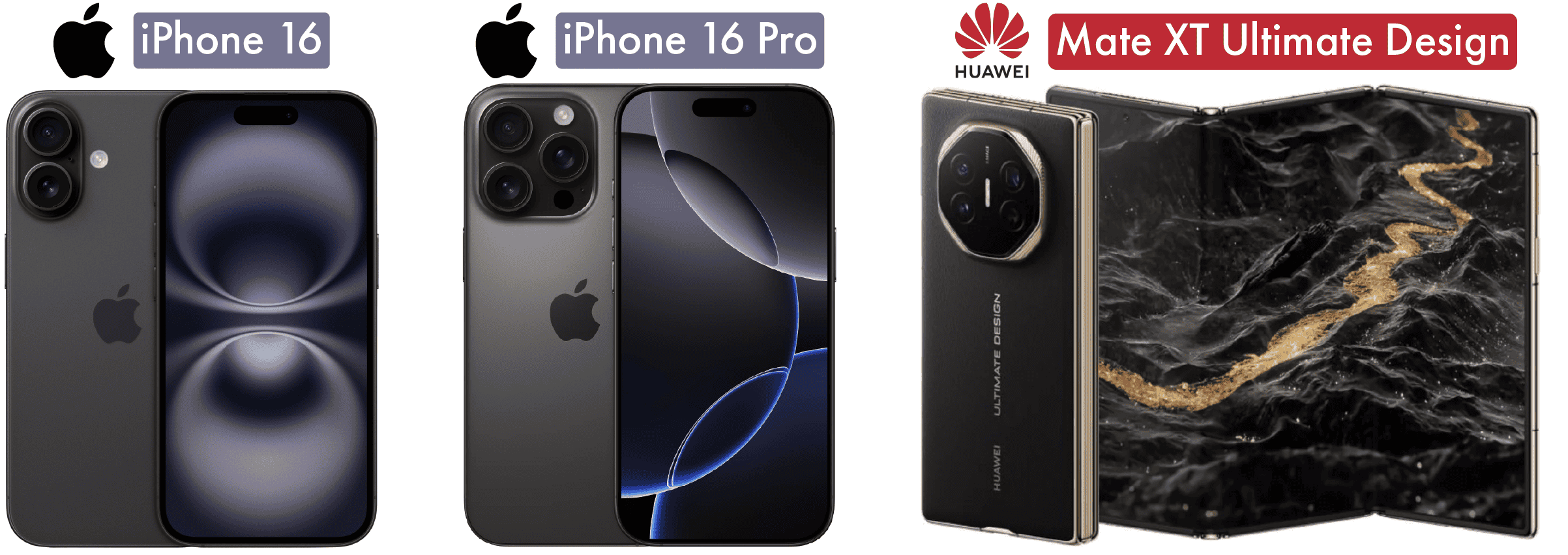
In the Western press, critics have derided the new Huawei trifold for its $2,800 price tag. But they have missed the wider point. It was only in 2014 that Jony Ive complained of brazen “theft” of his designs; it was 2018 when Cupertino expressed shock at Chinese brands’ ability to match its newest features; now, here was a Chinese brand designing, manufacturing, and shipping more expensive phones with alluring features that industry analysts don’t expect Apple to match until 2027.
Oppo’s Find N5 mobile phone. Credit: Oppo
Both Xiaomi and Huawei outsold Apple in China in 2024; in the all-important holiday quarter Apple’s China revenues fell 11 percent. In the months since, Oppo has released an ultra-thin foldable phone made possible by energy-dense Silicon Carbide battery technology not yet found in Apple devices.
In the January–March quarter of 2025, Apple beat Wall Street’s expectations, but revenues in Greater China declined and are now on track for a third straight annual fall. Even more pressing than falling sales, though, is the U.S.-China tariff war that Trump began in April. The battle threatens Apple’s over-reliance on China and, as it attempts to navigate the turbulence, it could be hit by a political backlash from both superpowers.
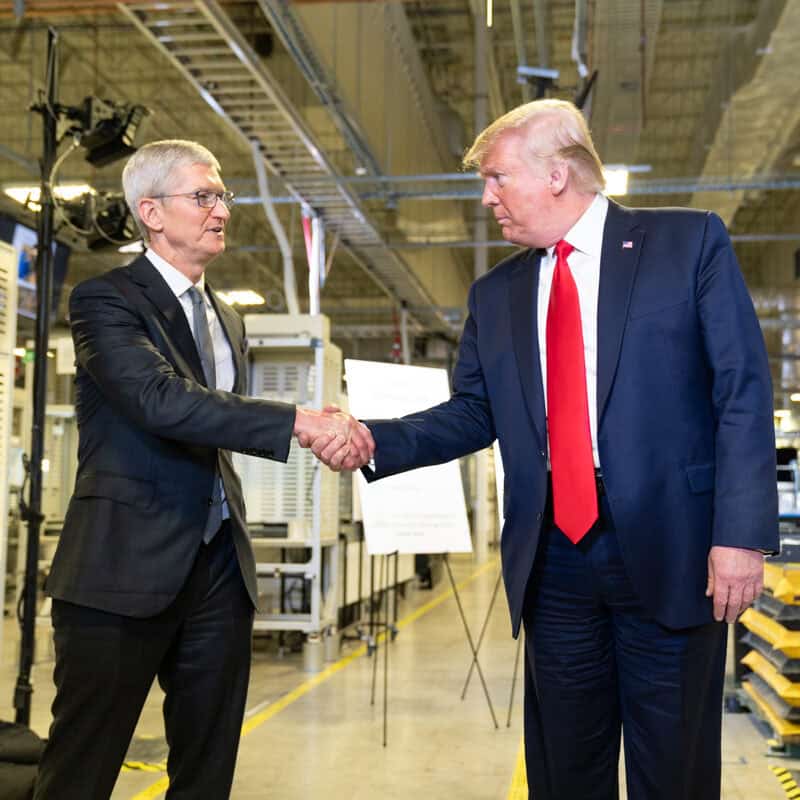
The Trump administration wants Apple to shift much of its production, preferably to the U.S.. On May 15 President Trump said he “had a little problem with Tim Cook” and criticised Apple’s plans to move much of its production to India. “We put up with all the plants you built in China for years,” the President said. “We are not interested in you building in India, India can take care of themselves … We want you to build here.” This of course risks re-sparking the ire of Xi Jinping and the Chinese Communist Party, which can exert far more pressure on Apple’s daily operations than Trump can. Nor can Apple risk being seen by Chinese consumers, who purchase $70 billion worth of its products a year, as an exemplar of Western companies’ attempts to reduce their China exposure.
This puts the world’s greatest company in a tight geopolitical bind. There’s no easy way out. And Apple is still led by the very CEO who oversaw the strategy that led to its current predicament.
Adapted from APPLE IN CHINA: The Capture of the World’s Greatest Company by Patrick McGee. Copyright © 2025 by Patrick McGee. Excerpted with permission of Scribner, a division of Simon & Schuster, Inc.

Patrick McGee was the Financial Times’s principal Apple reporter from 2019 to 2023, during which time he won a San Francisco Press Club Award for his coverage. He joined the newspaper in 2013, in Hong Kong, before reporting from Germany and California. Previously, he was a bond reporter at The Wall Street Journal. He has a master’s degree in global diplomacy from SOAS, University of London, and a degree in religious studies from the University of Toronto. He and his family make their home in the Bay Area.