On Thanksgiving day in 2016, an autistic nine-year-old went missing in the Houston suburb of Pearland. The local police initiated a massive search and rescue effort, roping in bloodhounds and neighboring police departments. But no one could find the child before the worst came to pass and the boy was found drowned in a pond. A subsequent Pearland police report noted that having a drone involved in the search could have saved him.
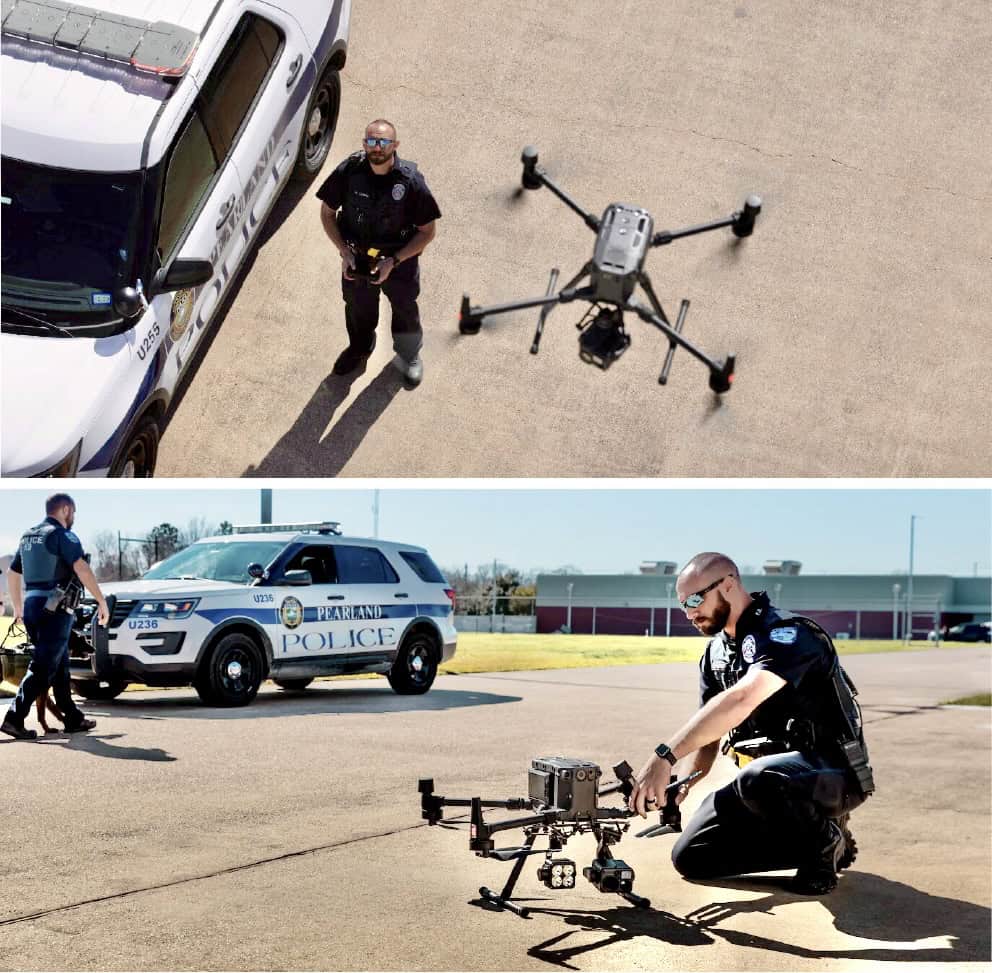
Upon learning this, one officer, a certified airplane pilot named Brandon Karr, decided to take action. In June 2017, he set up a drone unit within the department using off-the-shelf units built by DJI, a Chinese brand. At the time, fans and foes alike were beginning to call the company “the Apple of drones.”
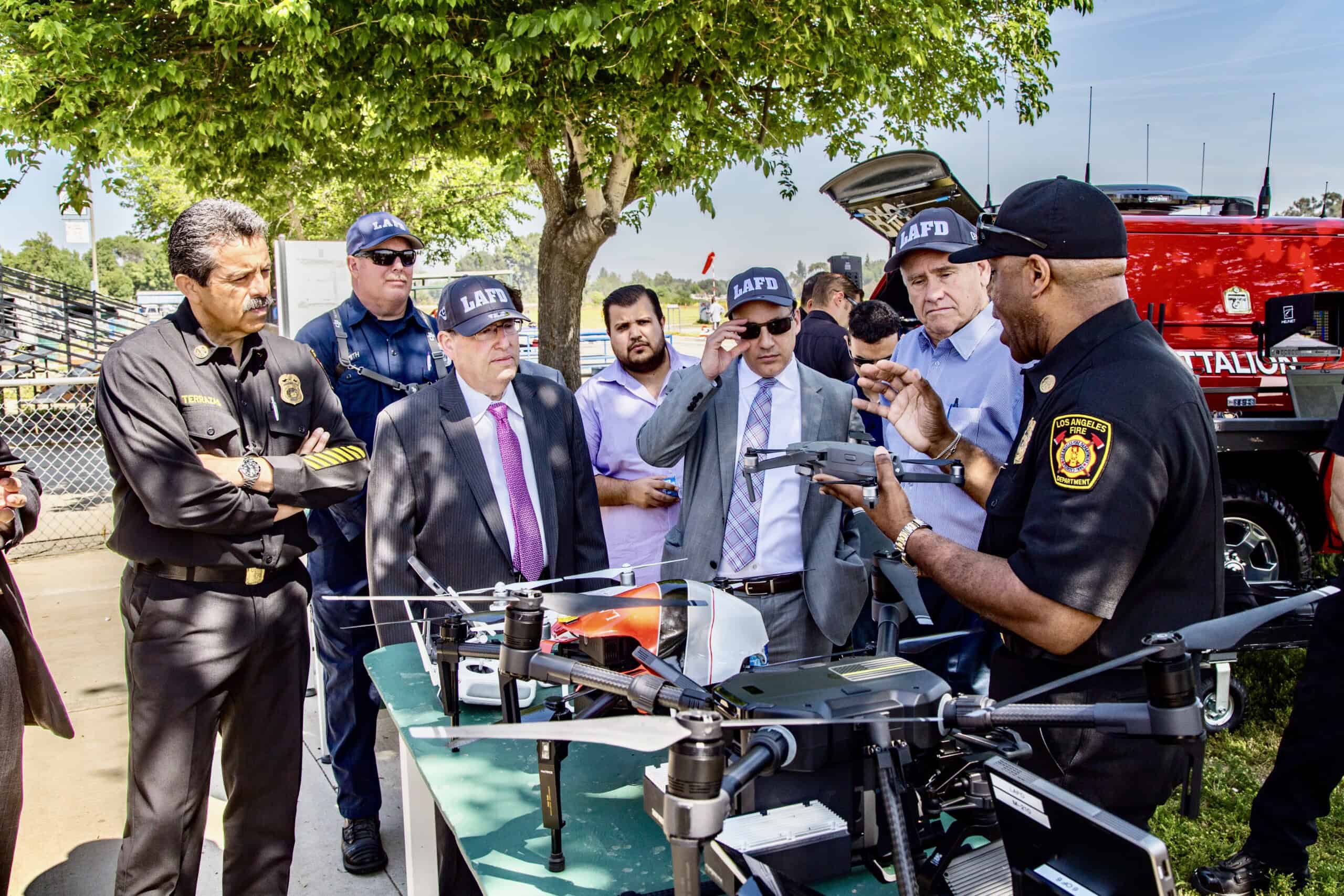
DJI supercharged Pearland’s police force, which came to boast one of the largest police drone fleets in America. As they did for first-responders across the country, the cheap, easy-to-use, eyes-in-the-sky proved pivotal in locating criminal suspects, stolen vehicles and missing people.
“For affordability, accessibility and reliability, DJI is a no-brainer,” says Karr, who now represents the Law Enforcement Drone Association, a national advocacy group.
While in Pearland, Karr tested drones from other companies like Skydio, an American firm, and Parrot, a French one. But DJI always came out on top, with longer battery life, nimbler controls and better handling in inclement weather. A Bard College study from 2020 estimated that DJI makes up 90 percent of all drones used by American law enforcement.
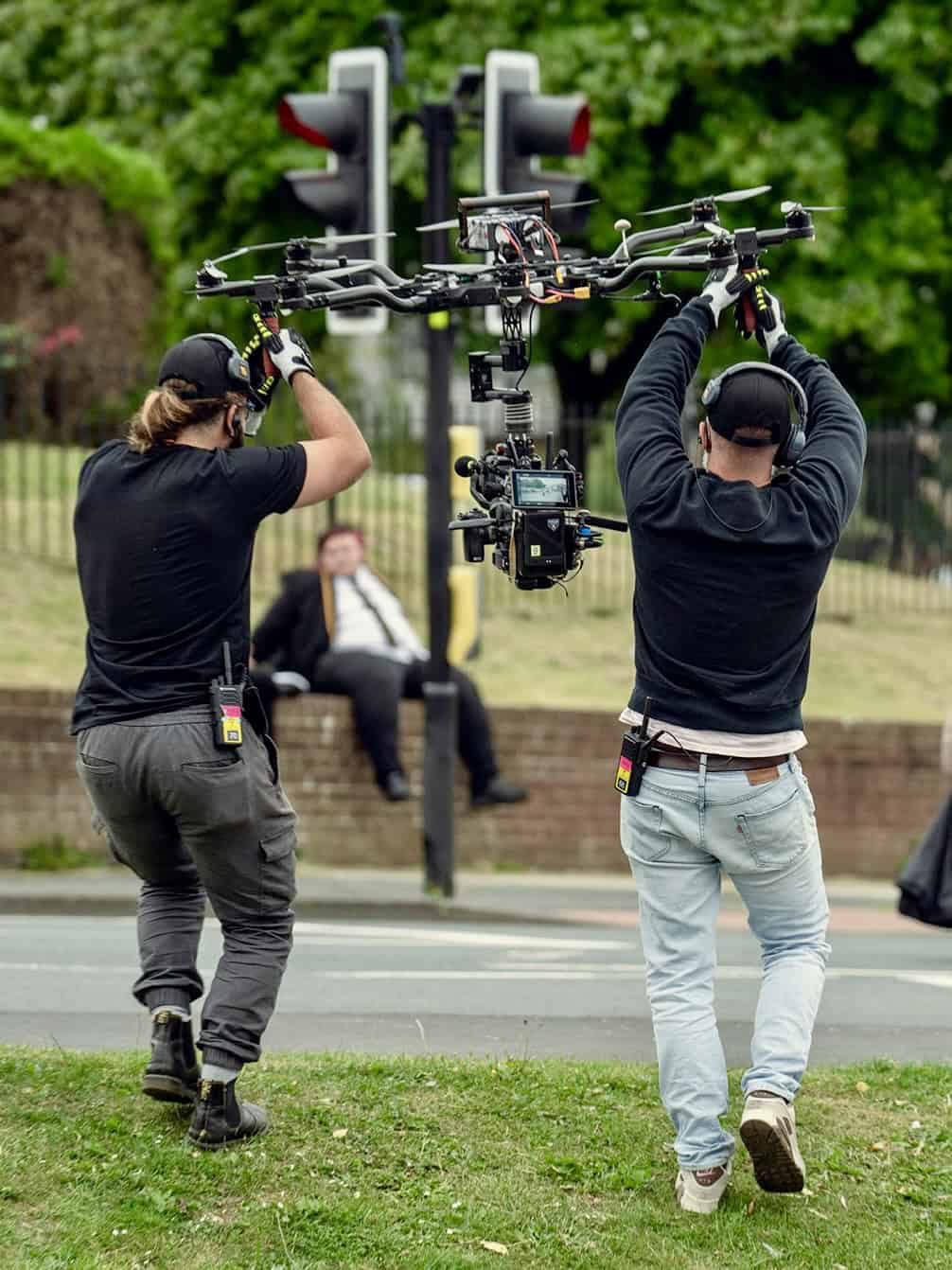
Today, the company’s drones are also beloved by farmers as well as filmmakers; most recently, DJI drones have been praised for their use in Hollywood blockbusters like Civil War and Netflix’s Adolescence. Indeed, most drone experts agree that DJI, which manufactures an estimated 76 percent of all commercial drones globally, has no equal.
“They’re the only company that we think about,” says Trent Emeneker, an aviation consultant working to strengthen the U.S. drone industry for the Pentagon’s Defense Innovation Unit. “They have a phenomenal user ecosystem.”
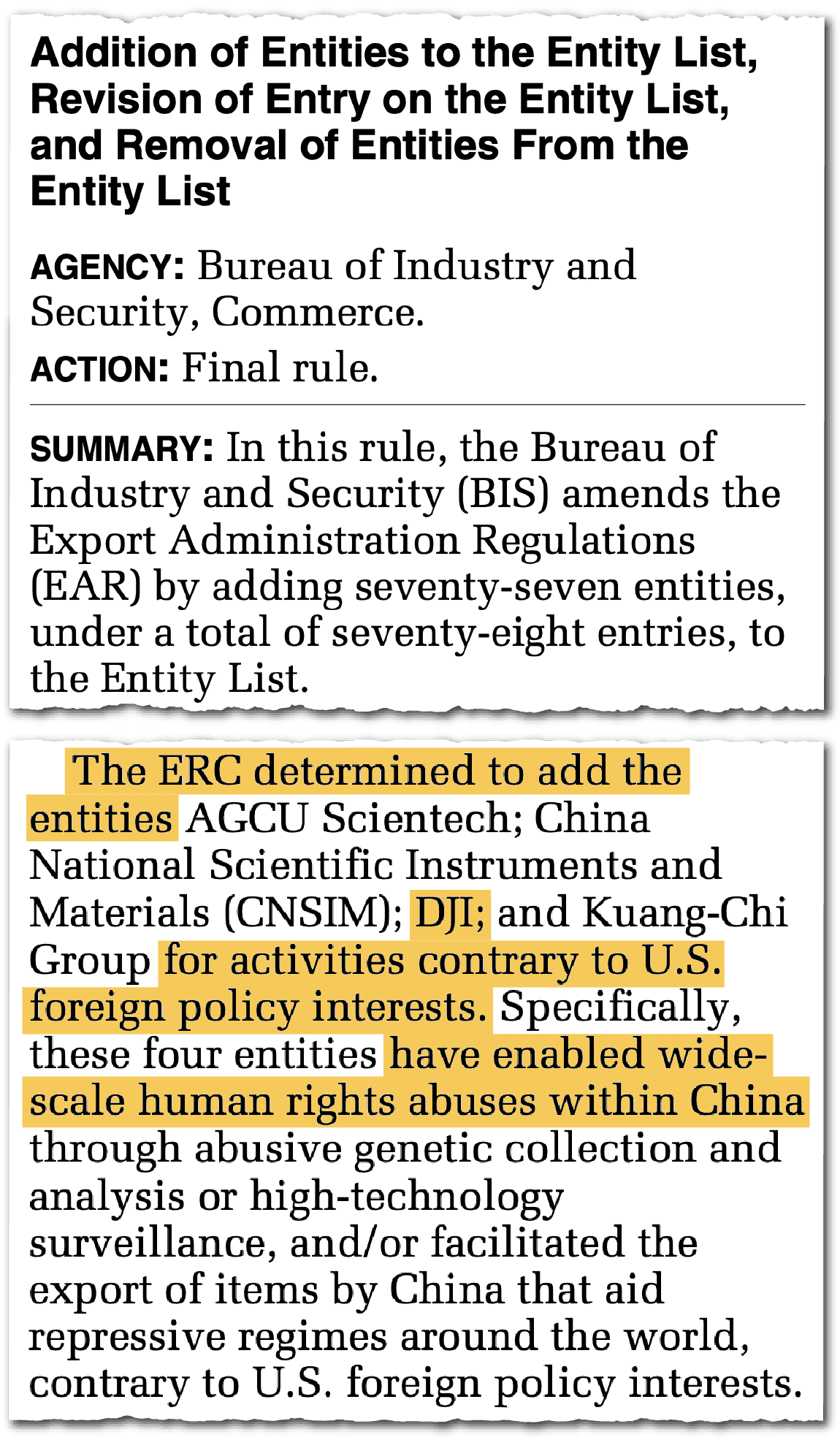
Yet despite DJI’s overwhelming popularity — or precisely because of it — the Chinese company faces an uncertain future in the United States. In recent years, Democratic and Republican lawmakers, defense officials and federal agencies have portrayed the drone powerhouse as a Trojan horse for the Chinese Communist Party (CCP). As early as 2017, a leaked draft memo from the U.S. Immigration and Customs Enforcement speculated without evidence but “with moderate confidence that [DJI] is providing U.S. critical infrastructure and law enforcement data to the Chinese government.” Three years later, the Commerce Department added DJI to its Entity List, barring its access to U.S. technology, because the company sold drones to the Xinjiang Public Security Bureau, a government body responsible for Uyghur human rights abuses. The next year, the Treasury Department followed suit, placing DJI on its Chinese Military-Industrial Complex Companies List, also citing Xinjiang. And in late 2022, the Department of Defense classified DJI as a “Chinese military company,” citing alleged ties to the People’s Liberation Army.
“The backdrop to all of this is this broader conversation about whether or not we can use or trust Chinese technologies,” says Elsa Kania, an expert on Chinese civil-military fusion. “Companies like DJI are really becoming flashpoints.”
The company has yet to face a full ban in the U.S., largely, its supporters say, because no one in Washington has proven the company is actually dangerous. It should be, they say, a simple question: Have Chinese engineers implanted DJI drones with the ability to surreptitiously relay data back to Beijing? According to publicly available U.S. government assessments, such 007-esque capabilities appear to be more of an educated guess than proven fact.
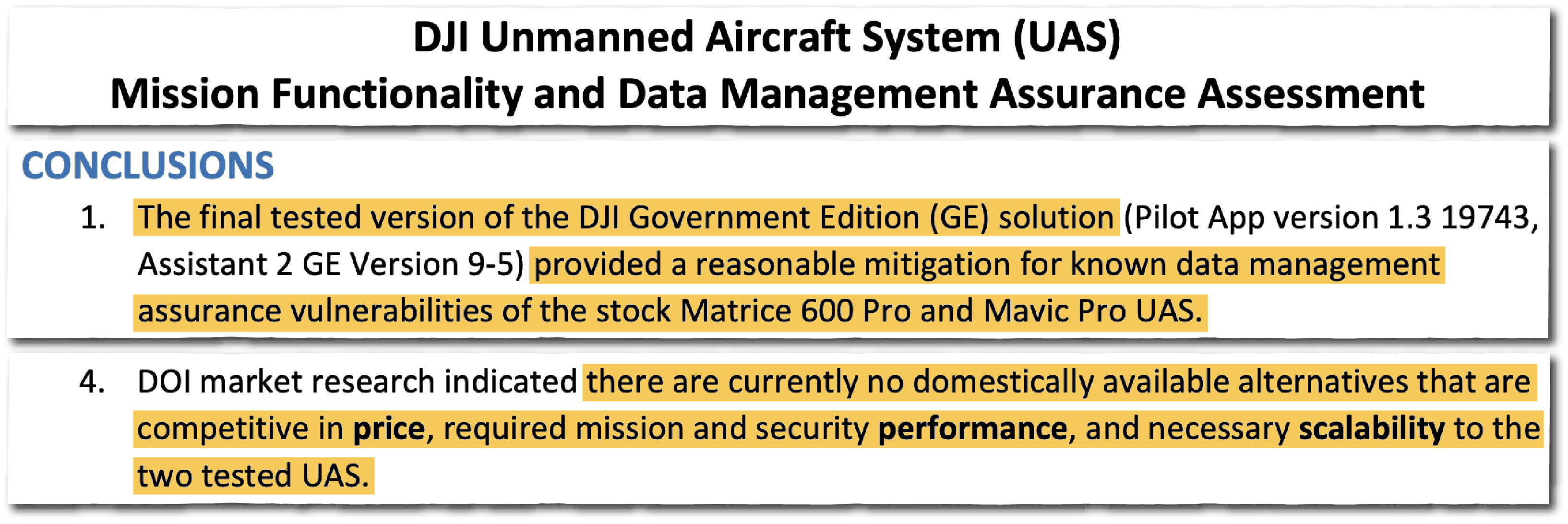
In response to the crescendo of espionage accusations, DJI even participated in several third-party audits of its drones. These were conducted using units bought off-the-shelf by federal agencies like Idaho National Laboratory, the U.S. Department of Interior 1“We did not find examples of the DJI software transmitting data back to China in normal operations,” says Carrick Detweiler, who conducted the audit for the Department of Interior. “This does not ensure that there could not have been special cases where that could occur, just that it didn’t happen in normal use.” and the Department of Defense; as well as private firms like FTI Cybersecurity and Booz Allen Hamilton. None found any evidence that bolstered the technical claims made by DJI’s critics. (The Defense Department officially disavowed its audit after news of it leaked, calling the report “inaccurate and uncoordinated.”)
“The other side has never put anything on the table even approaching a smoking gun,” says Adam Welsh, a Briton who has headed global policy for DJI since 2018. “It’s been proven over and over again that local data mode [something similar to the iPhone’s Airplane Mode] works the way we say it does and that the drones are not pinging back to any Chinese servers.”
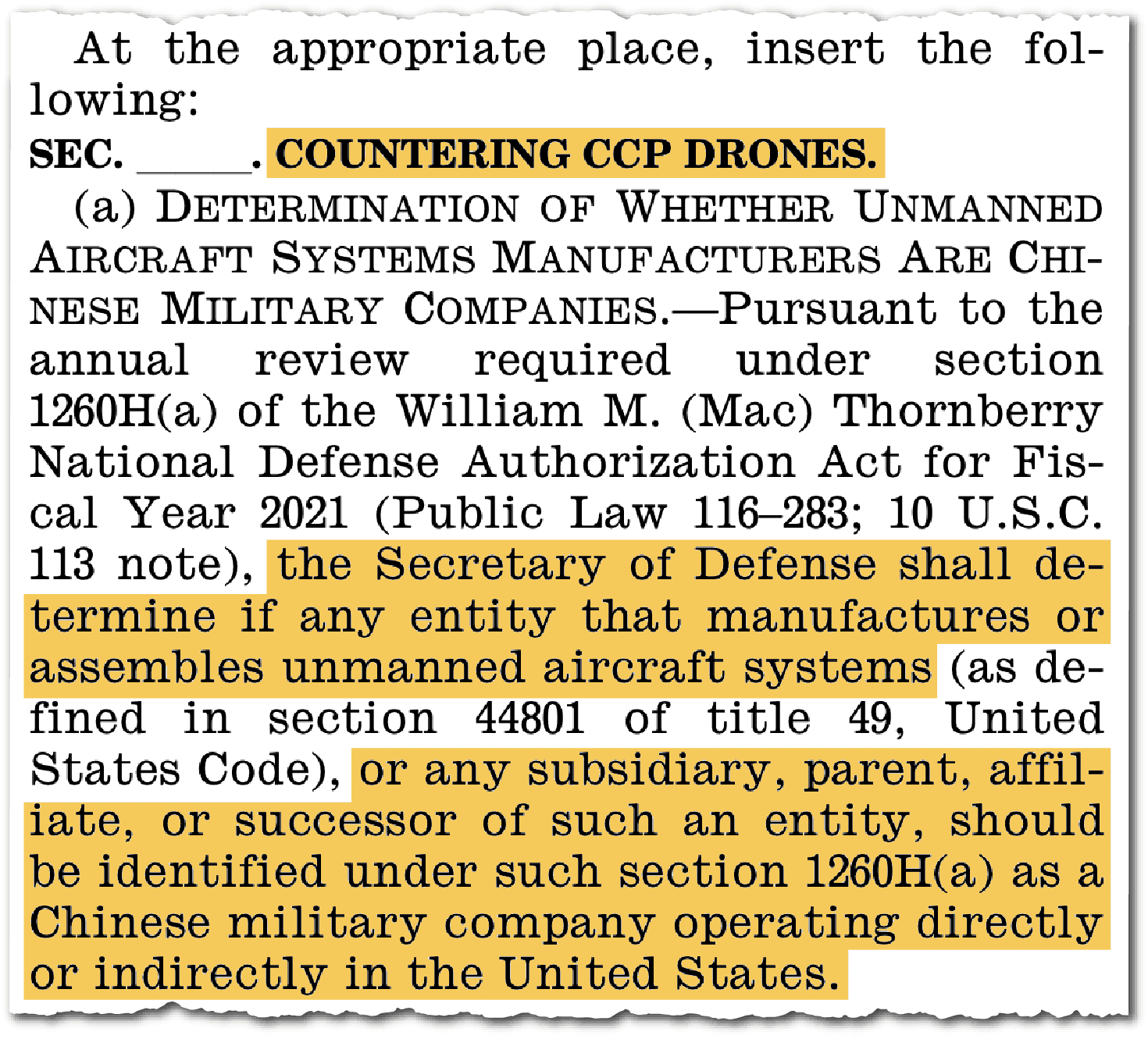
It’s an issue that the most recent National Defense Authorization Act hopes to get to the bottom of. Thanks to an amendment from Sen. Rick Scott (R-FL), America’s five national security agencies have been tasked with conducting a risk review of Chinese drones this year. If none of the agencies declares DJI products safe to use, the company will be placed on the Federal Communications Commission’s Covered List — a list of “communications equipment and services that are deemed to pose an unacceptable risk to the national security of the United States.” A listing would prohibit new DJI drones from operating on U.S. communications infrastructure, effectively shutting them out of the U.S. market for good.
Even more damning, this listing automatically occurs even if a risk assessment does not take place. DJI is in the process of contesting this potentially fatal provision, which it calls “unfair.”
Imagine a scenario where China really needed cheap drones on a mass scale for some sort of military operation and the CEO of DJI said, ‘We refuse to do that.’ He’d just be fired or imprisoned. You can’t refuse the Party when they really ask for something in that way.
Bill Drexel, a Chinese tech-focused fellow at the Center for a New American Security
“We’re doing as many meetings as we can to try and ensure that one of the agencies does the work and does it in a fair and objective way that actually has some due process established,” says Welsh. “We’re pretty optimistic that our products will pass muster as they have in the past.”
If history is any guide, however, the company has struggled to formulate a successful D.C. strategy.
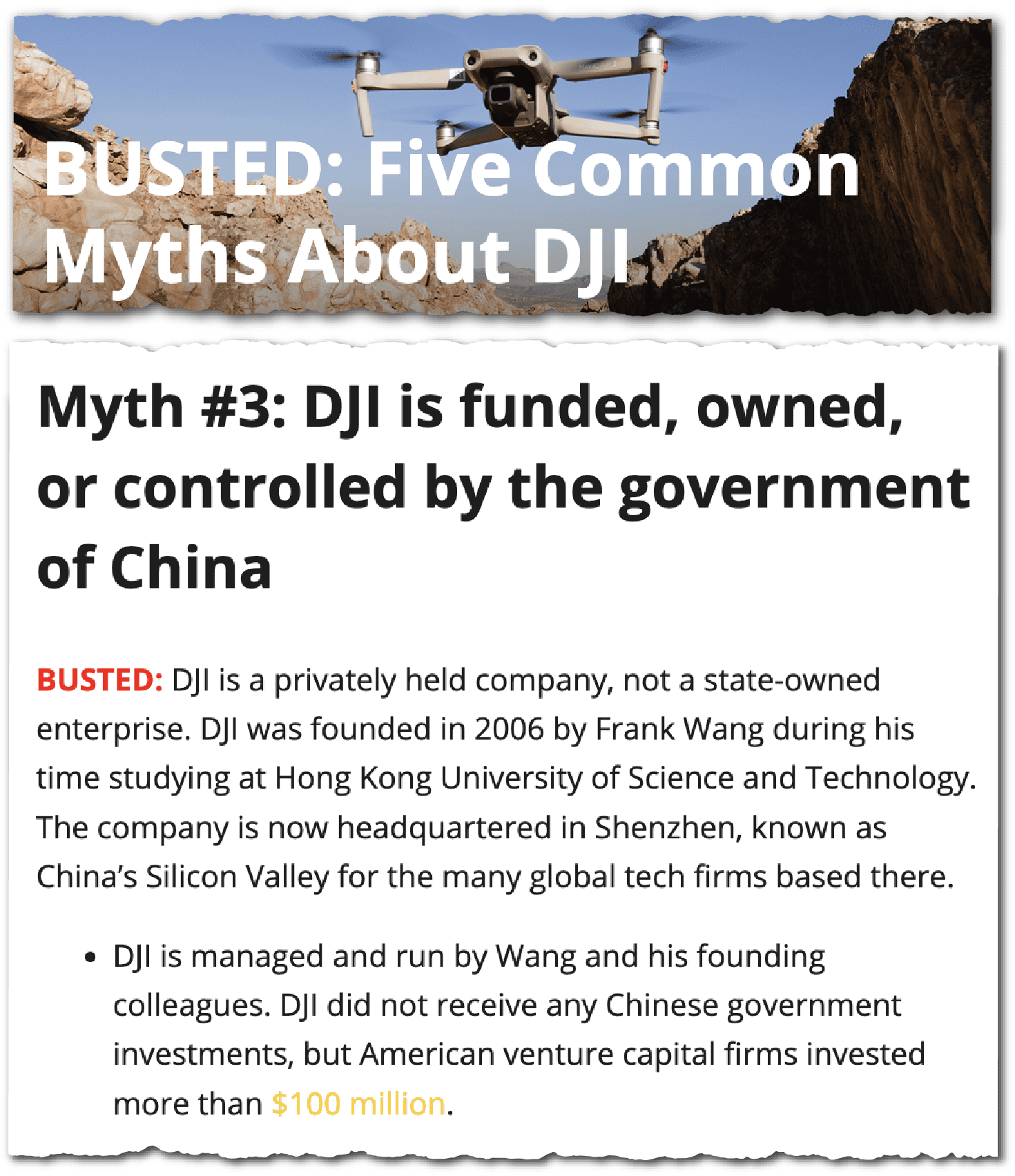
In October 2020, DJI posted a “myth busting” blog on its English-language website, stating firmly that the firm, which remains private, received no Chinese government funding. But a 2022 investigation by IPVM, a trade publication, in partnership with the Washington Post, disproved this assertion outright. They found that DJI had received funds from at least four state-backed entities. One of them, China Chengtong Holdings Group, is directly administered by Beijing’s State-owned Assets Supervision and Administration Commission. An article posted on China Chengtong’s website confirmed the investment, the reporters found. “DJI adheres to the guidance of Xi Jinping thought on socialism with Chinese characteristics for a new era,” the article read.
DJI responded to this discovery by denying that the Chinese government has any control over its operations. “Shareholders other than the founders do not participate in the company’s management and operation,” a DJI spokesman told IPVM/Washington Post.
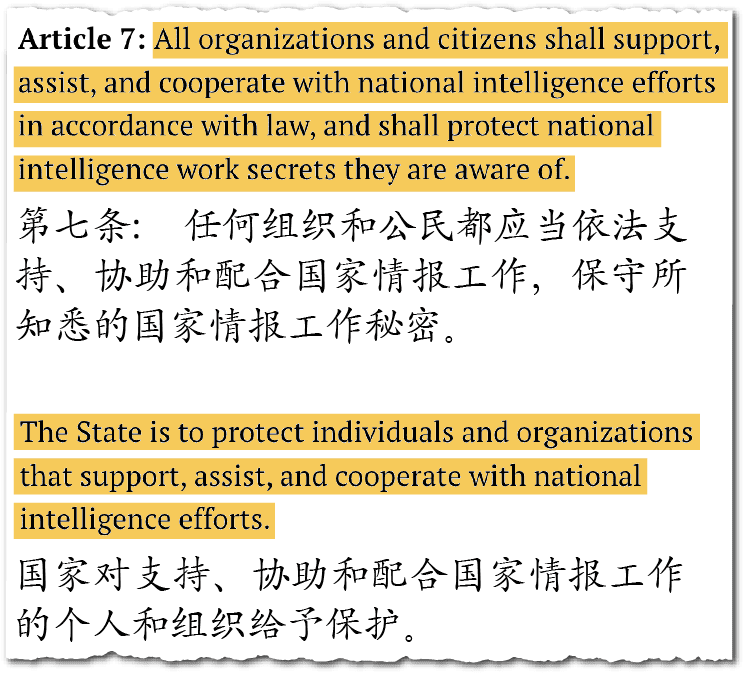
Such assurances mean little, however, in today’s climate. After the Huawei “back-door” saga, China’s 2017 National Intelligence Law (which mandates that every company in China aid intelligence operations if asked to do so), and revelations about Beijing’s high-tech espionage programs (such as Volt Typhoon), even privately-owned Chinese companies carry the scarlet letter of the CCP. Many DJI critics, for instance, bring up the company’s failure to hire a chief information security officer, which would signal its seriousness in distancing itself from Beijing; instead the company leans on government affairs and public relations teams to speak about highly technical issues. Some critics even bring up the possibility that Chinese intelligence could somehow commandeer DJI’s drones for spying without DJI’s knowledge.
Facing existential stakes in the U.S. market, DJI began a concerted defense of itself this October. They sued the Defense Department for the Chinese military designation, stressing that it “is neither owned nor controlled by the Chinese military.” Because of that “unlawful and misguided decision,” DJI’s lawsuit argues, it has “lost business deals, been stigmatized as a national security threat, and been banned from contracting with multiple federal government agencies.”
But analysts don’t expect DJI to gain much traction in the case, not least because, from the Defense Department’s perspective, the threat from DJI is as much about its market monopoly as it is its espionage potential.
Speaking in 2019, then-Undersecretary of Defense for Acquisition and Sustainment Ellen Lord said “essentially we don’t have much of a small UAS [unmanned aerial systems] industrial base because DJI dumped so many low-price quadcopters on the market.”
In September, when introducing her bill, the Countering CCP Drones Act, Congresswoman Elise Stefanik (R-NY) also lamented DJI’s market dominance, saying it is “strategically irresponsible to allow Communist China to be our drone factory.”2Her bill passed in the House, but remains buried in the Senate.
Lurking behind both women’s statements was the possibility of war.
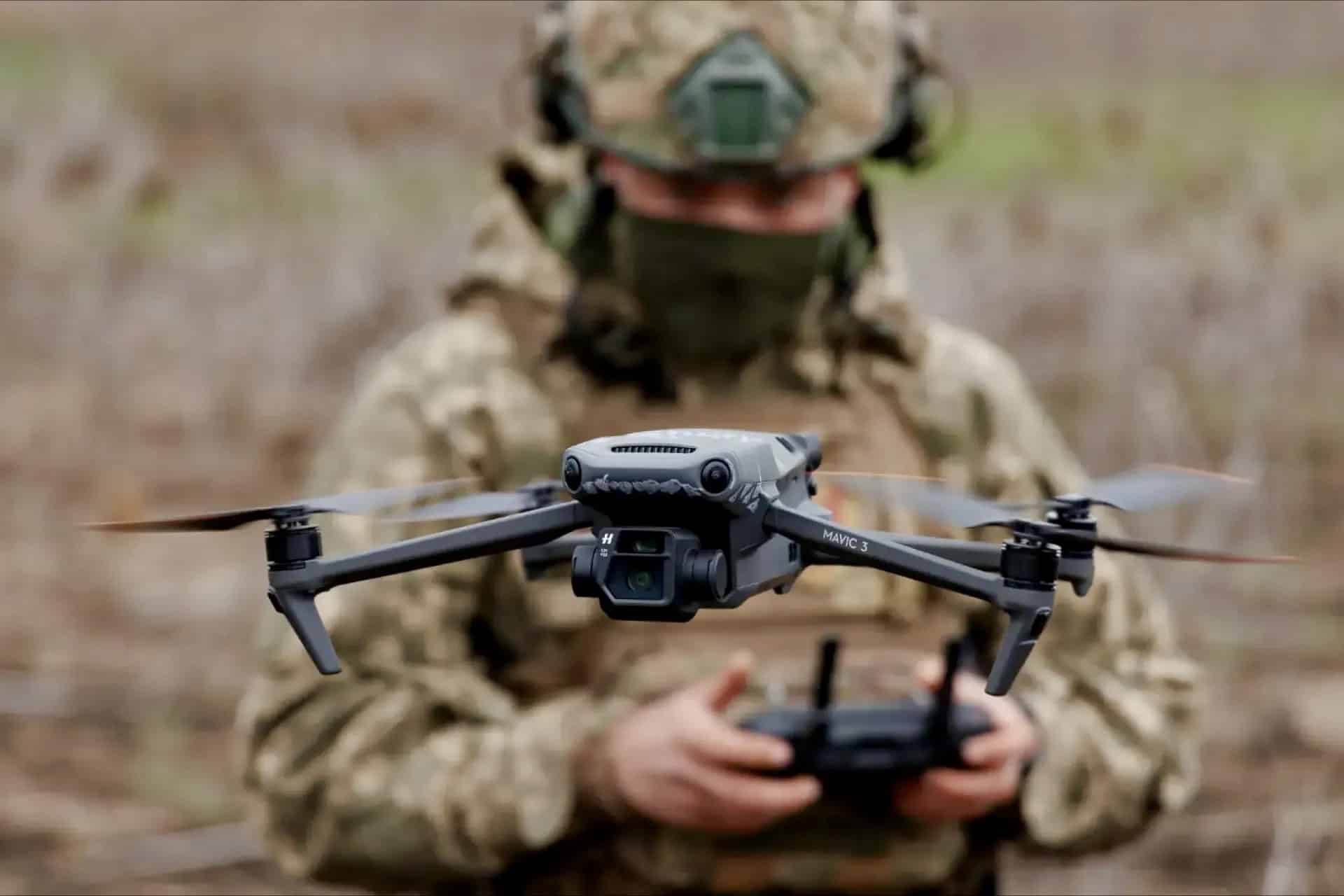
Indeed, as exhibited in Ukraine where retrofitted DJI drones are deployed on the battlefield for various uses, small, easy-to-manufacture drones have become a major weapon in modern warfare.3DJI says that it does not condone its drones being used in warfare and says that it bans vendors who sell them for this purpose. In this case, what DJI’s success has definitively shown is the alarming lack of an industrial base for commercial drone manufacturing in America itself.
“Imagine a scenario where China really needed cheap drones on a mass scale for some sort of military operation and the CEO of DJI said, ‘We refuse to do that,’” says Bill Drexel, a Chinese tech-focused fellow at the Center for a New American Security. “He’d just be fired or imprisoned. You can’t refuse the Party when they really ask for something in that way. And the fact is that scalable, attritable drones are unequivocally a key technology for military advantage.”
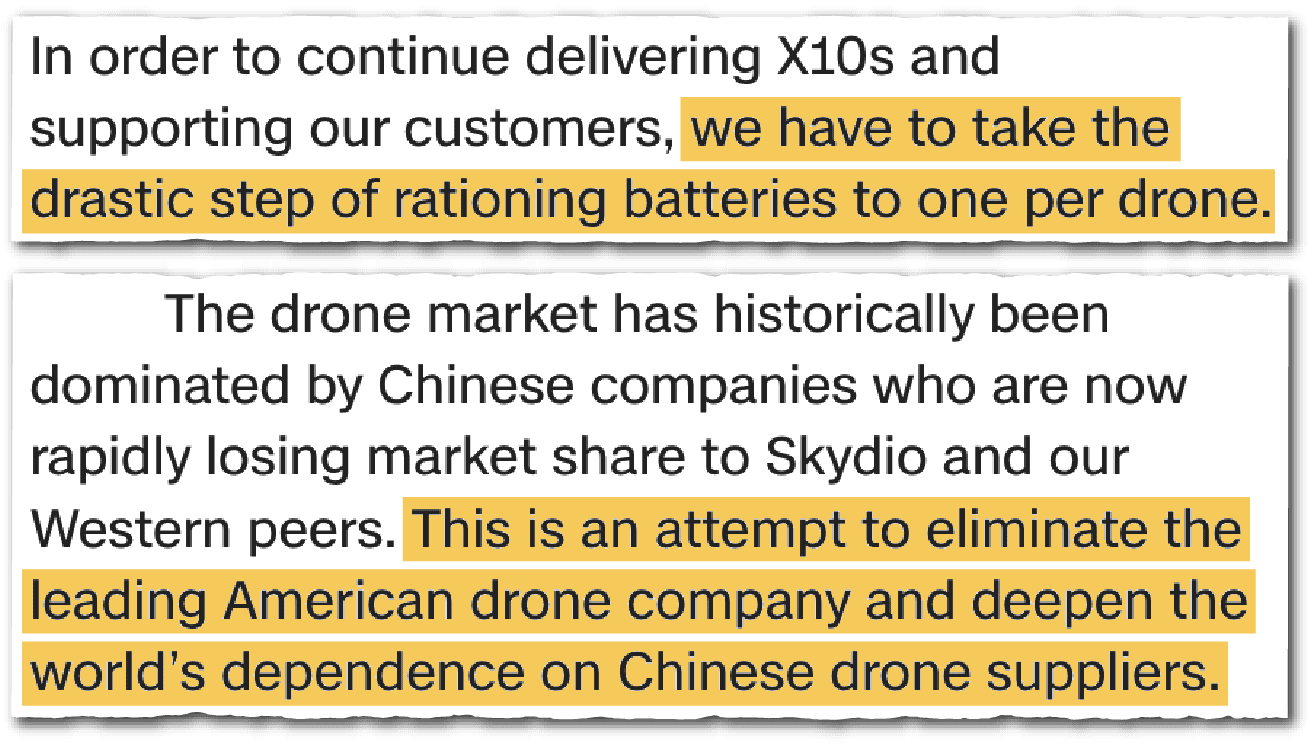
Not only does China boast the world’s biggest drone manufacturer in DJI, but it has strangleholds over several of the critical raw materials that go into drones, like rare earth minerals and batteries. That vulnerability was underscored in October when Beijing sanctioned the U.S. drone maker Skydio over its sales to Taiwan, forcing it to ration its Chinese-made batteries.
According to Emeneker, the Pentagon consultant, if the U.S. were to go to war today and begin losing drones at the same rate that Ukrainian forces lose them to Russia, “we would exhaust our inventory of platforms in about four days.”
The Neros Archer drone is featured on the Blue List, meaning it is approved for use by the Department of Defense and other government agencies. Credit: Neros
Various Department of Defense initiatives, like the Replicator program and the Office of Strategic Capital, are working to address these industrial and technical shortcomings through partnerships with American drone firms like Skydio, BRINC and Neros. But creating a reliable drone supply chain free of China will take years to get off the ground, experts say — if it is even possible at all. The question is, in the meantime, does America’s reliance on DJI drones do more harm than good?
Flight Path
When Wang Tao was a child, in 1980s Hangzhou, he dreamed of having his own “fairy,” an aerial companion always watching over him. The son of an engineer and a teacher-turned-entrepreneur, Wang became entranced by model airplanes. One day as a teen, after doing well on an exam, he was rewarded with a remote-controlled model helicopter. But mostly Wang did poorly at school, which kept him out of his American dream colleges of M.I.T. and Stanford. At Hong Kong University of Science & Technology, he majored in electronic engineering.
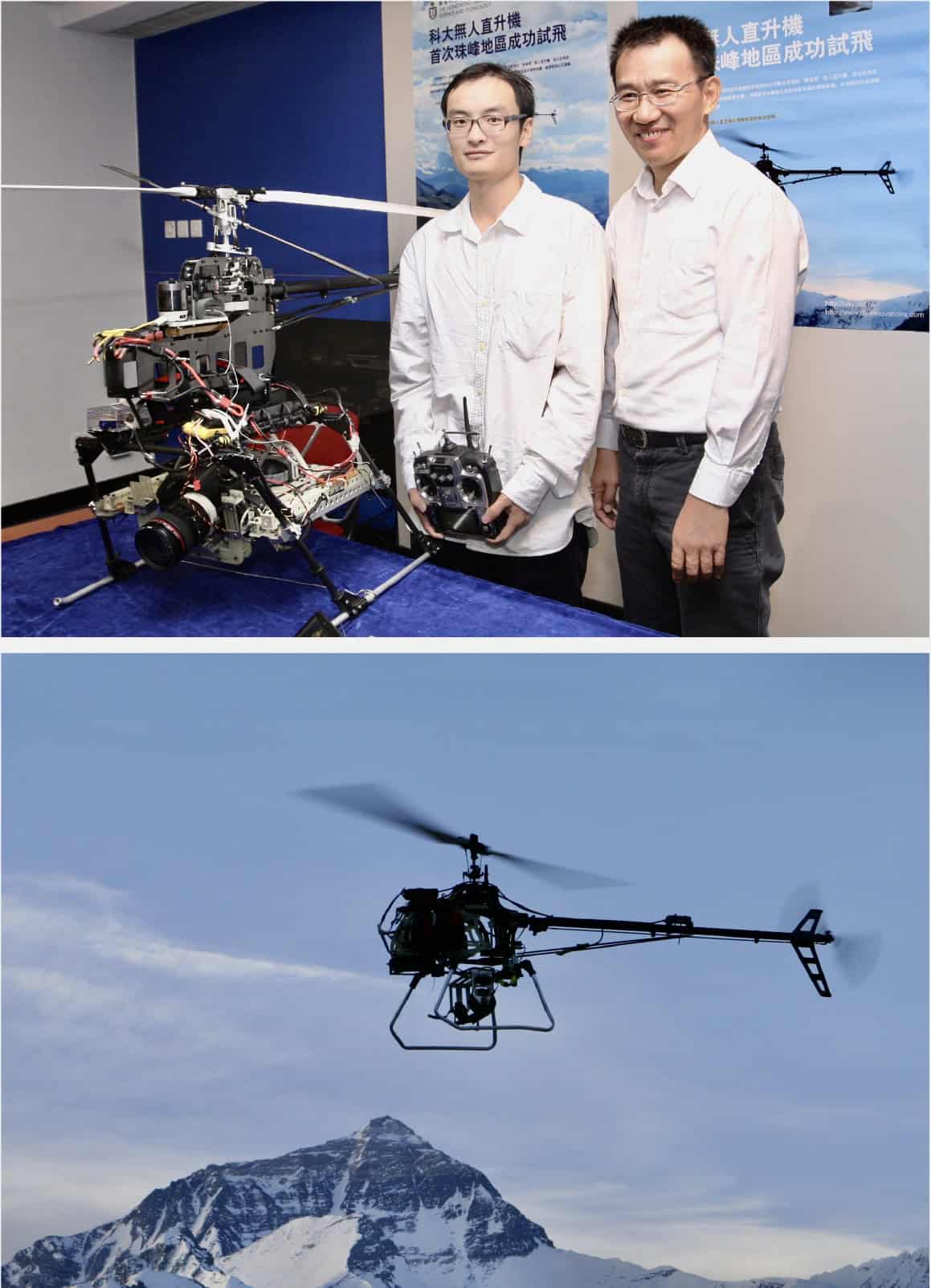
Reserved but stubborn, Wang adopted the English name Frank, and he remained an unremarkable student until his senior year, when he was tasked in a class project with building a model helicopter flight-control system, according to an interview he gave to HKUST in 2013. The project consumed him, and his robotics professor, Li Zexiang, took notice of his passion and encouraged him. Wang went on to build drone prototypes in his dorm room. He twice led teams in a prestigious robotics competition, winning the championship on his second entry.
In 2006, Wang moved across the border to Shenzhen, China’s tech manufacturing hub, with a small team of former classmates. With $90,000 in funding from a family friend named Lu Di — and, later, investments from Professor Li — they launched Da-Jiang Innovations. (Da-jiang means “great frontier” in Mandarin.)
At the time, drones were cumbersome to use. They arrived in parts that users had to painstakingly assemble, and flying them correctly was another matter altogether. DJI began by selling parts to a niche group of enthusiasts around the world.
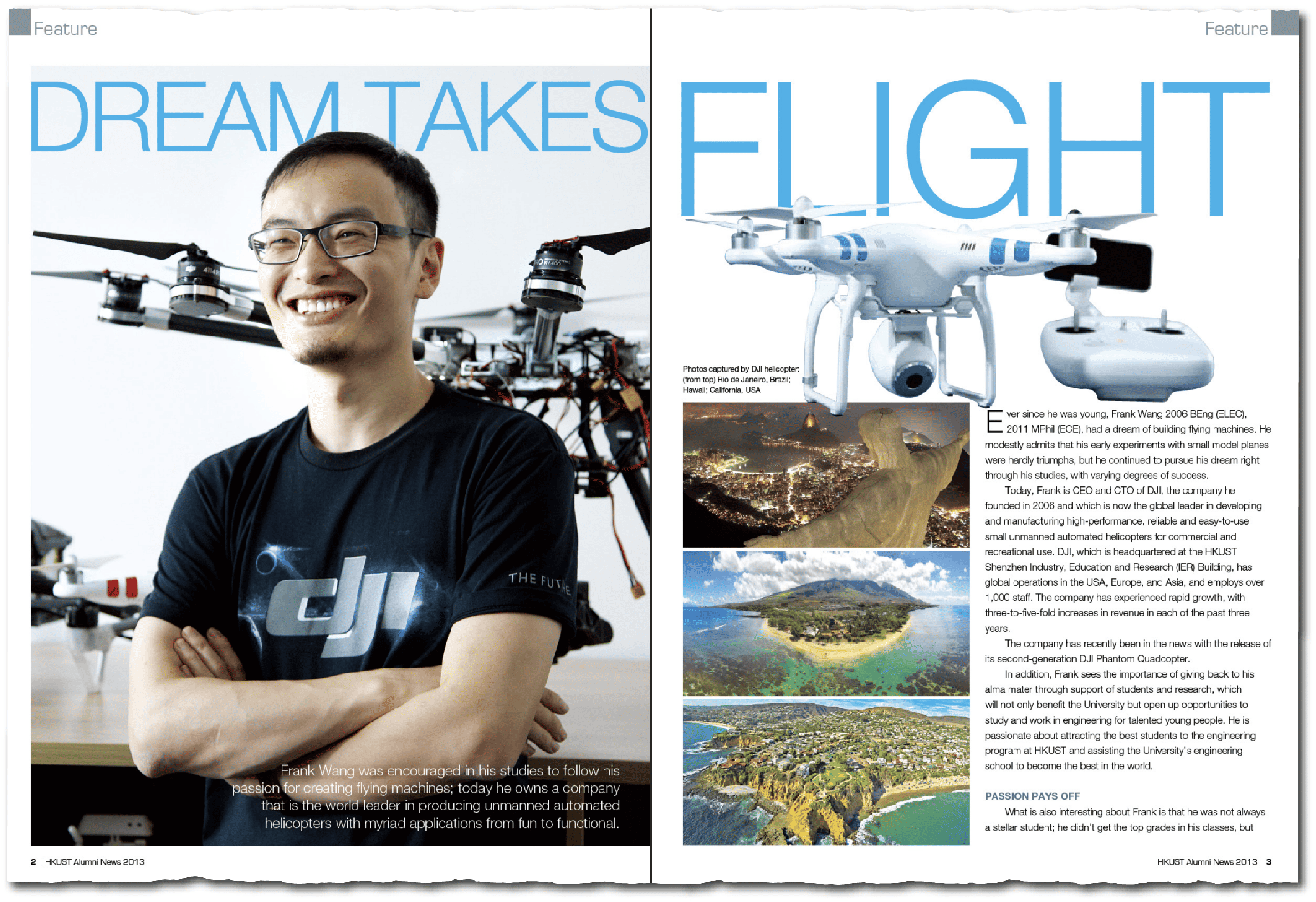
While his co-founders handled marketing, finances and the other intricacies of running a multinational start-up, Wang focused on one singular task: building a truly flawless drone. Even today, insiders say, Wang rarely deviates from his engineering obsession. A self-described “abrasive perfectionist,” he would often pit two teams against one another on the same task, firing whichever team fared the worst.
“Frank was always focused on the product side of the house,” says David Benowitz, an American who worked at DJI in Shenzhen from 2015 to 2020. “Engineering felt very rooted to the core of the company.”
At the same time, Wang paid shrewd attention to the nascent market for drones. He frequented online forums, where hobbyists discussed the kinds of technical features they pined for in their flying machines, according to an interview he gave to Forbes in 2015. Manufacturing costs, meanwhile, were falling: from 2006 to 2011, the cost to make a flight controller, or the “brain” of the drone, plummeted from around $2,000 to $400.
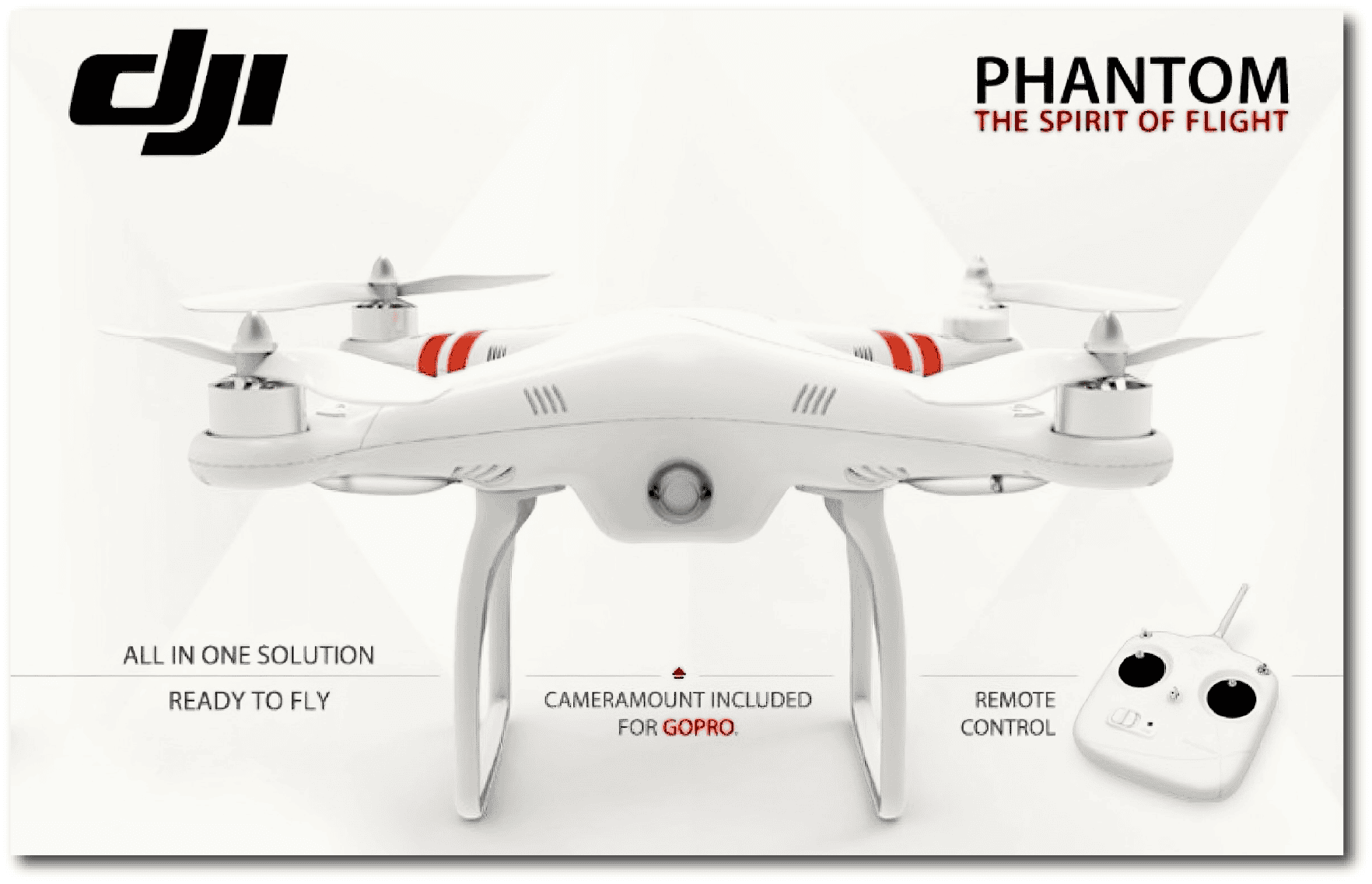
In 2013, DJI released the Phantom 1, the first fully assembled consumer drone in the world. The quadcopter drone, with its easy-to-use controls and $679 price tag, was an instant hit, propelling the company to new heights.
If we lived in a world where this huge competitor was from Canada or Australia, that would be a very different conversation. But we know that China is actively seeking to infiltrate our critical infrastructure…
Michael Robbins, president of the Association for Uncrewed Vehicle Systems International (AUVSI), an advocacy body
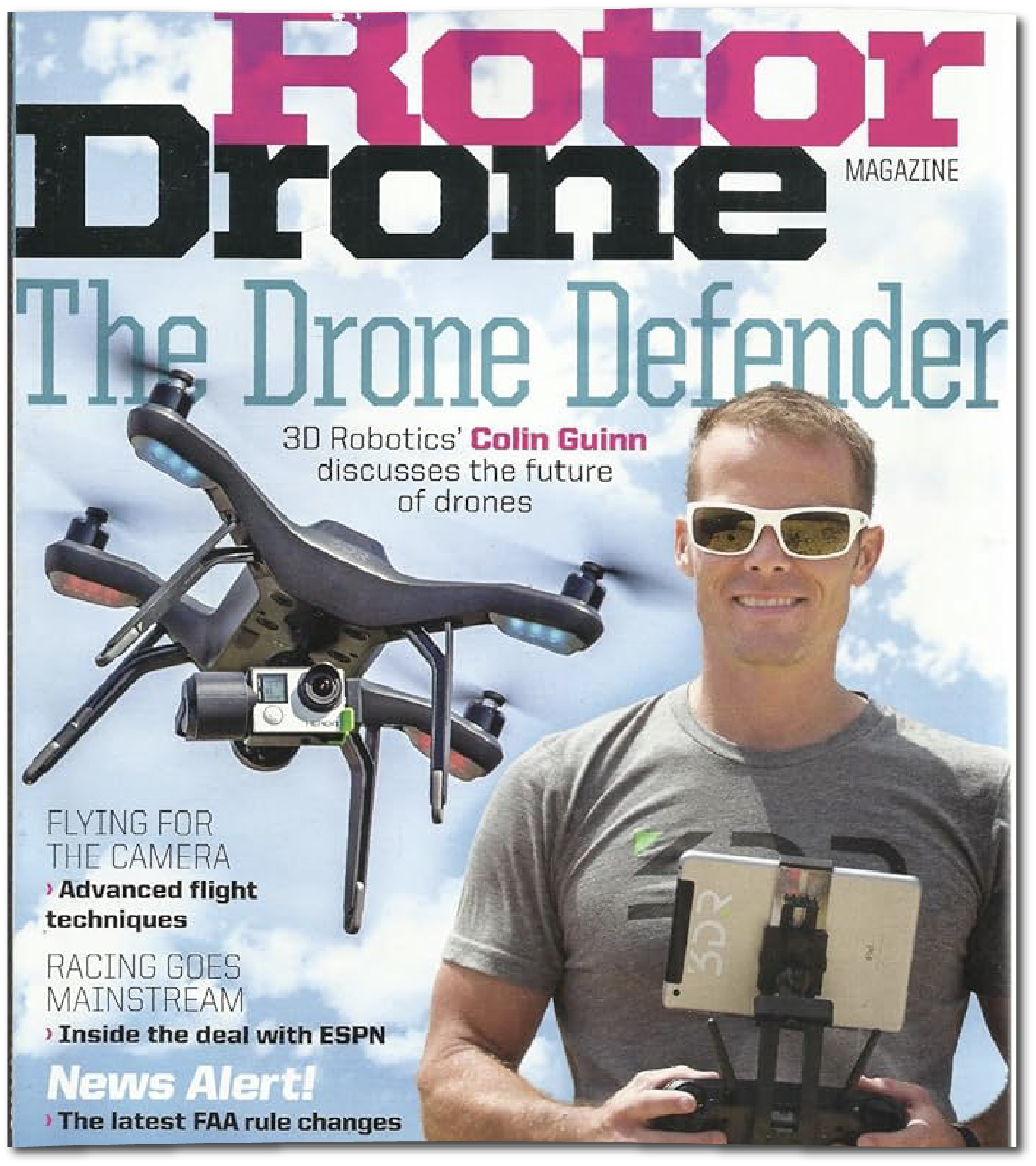
From the beginning, Wang believed the vast American market was key to realizing global success. At a 2011 trade show in Indiana, Wang had met a Texan named Colin Guinn who ran a videography start-up. Before the trade show, Guinn had emailed Wang asking for advice on how to stabilize a drone-mounted camera. Soon after meeting in person, the pair formed DJI North America to sell Wang’s drones in the New World. Guinn was awarded 48 percent of the venture, which he based in Austin.
Colin Guinn, then at DJI, discusses troubleshooting the Phantom drone, November, 2013. Credit: MicBergsma via YouTube
Personality-wise, Guinn is far from Wang’s reserved nerdiness: In 2004 and 2019, he even competed in The Amazing Race, a prime-time American reality show, placing second the first time around and winning the second time. A prototypical sales guy, he sported flashy leather jackets and drove a Tesla while marketing DJI, targeting both professional filmmakers and amateur photographers and videographers — people that wanted to record epic shots from their Hawaii vacations, say. Guinn even coined a motto for the firm: “The Future of Possible.”
His strategy worked: From 2011 to 2014, the firm’s sales tripled or quadrupled every year, ballooning from $4.2 million to $400 million.
“Colin was raking it in,” says an early American DJI employee. “A huge part of the profit was going to him.”
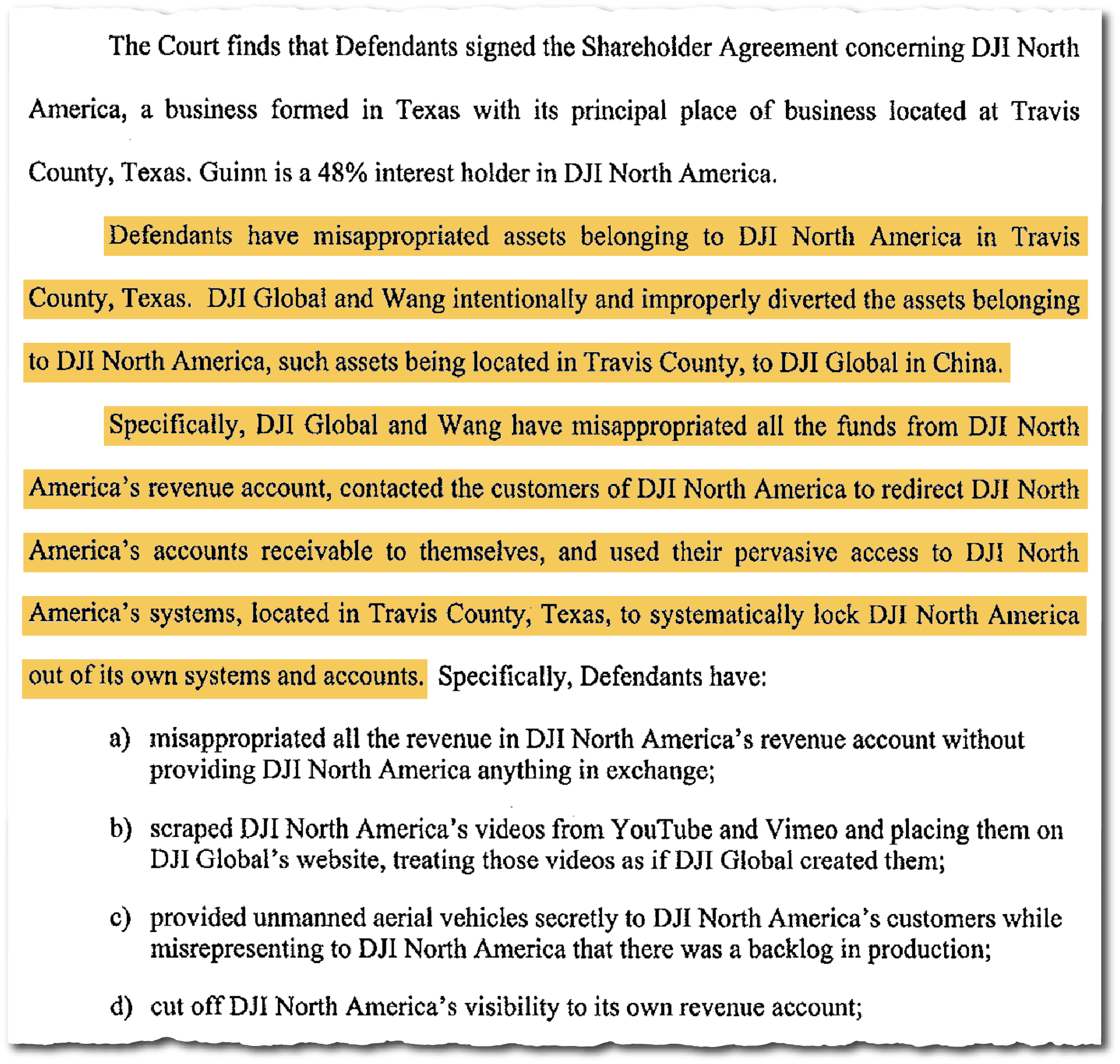
In May 2013, Wang proposed that Guinn sell his 48 percent share in DJI North America in exchange for a 0.3 percent share in DJI Global. (Because DJI Global is currently valued at $15 billion, this would be worth around $45 million today — a fraction of Guinn’s stake in the North America operation.) But before the proposal was even put into writing, according to court records, Wang commandeered DJI North America’s social media accounts, instructed customers to not engage with the subsidiary and blocked Guinn from company email accounts. Aggrieved, Guinn sued. In July 2014, a settlement was reached out of court for an undisclosed sum. (Guinn did not respond to requests for comment.)
But by then, DJI hardly needed Guinn; it had reached escape velocity. Starting that year, Sequoia Capital China invested $36 million (they exited in 2021), and the next year, Accel Partners, a California private equity firm, led a $75 million Series B, valuing the company at $8 billion. With a 45 percent stake, Wang had become a billionaire nearly four times over. (Wang has since bought out Accel’s shares in the firm, according to a former employee with knowledge of investment matters. The firm did not respond to requests for comment.)
Since DJI remains private, it does not regularly disclose revenue, but it last claimed $2.7 billion in sales in 2017.
Inevitably, competitors arose, in China and beyond. DJI’s biggest competitor at the time was an American firm called 3D Robotics. Their drone, the Solo, closely resembled the Phantom, and they had even hired Colin Guinn. But Wang was unbothered. “They have money, but I have even more money and am bigger and have more people,” he told Forbes in 2015. “When the market was small, they were small and I was small, too, and I beat them.” The following year, 3D Robotics stopped making drones.
DJI, of course, also benefited from state assistance. In 2015, Beijing launched Made in China 2025, a 10-year industrial policy plan focused on seeding high-tech industries in China, including unmanned platforms. It allowed Chinese drone firms like DJI (and later its local competitor, Autel Robotics Co.) to access low-interest loans, research partnerships, grants and state bank investments.4Since DJI is a private company, it does not publish specific numbers on investment matters.

According to former employees, Wang is bored by and indifferent to anything beyond designing drones, including government relationships and its corporate image. In Shenzhen, for instance, he was known to skip meetings with visiting Chinese officials or foreign dignitaries, such as the Prime Minister of Belgium. And Benowitz points out that the company headquarters, which consists of two towers, underscore Wang’s priorities: one tower houses engineers and the other houses all other employees; only the engineers are granted access to both buildings.
But Wang’s investors, of course, cared about more than just engineering. By 2016, Kleiner Perkins, another California private equity firm, had invested in DJI and convinced the company to hire a team of American lobbyists, according to a former communications hire. One early hire, an attorney named Brendan Schulman, had run the only drone-focused law firm in America. Others were similarly well practiced in transportation and aviation matters. At the time, the U.S. Federal Aviation Administration was reluctant to allow commercial drones to zip across American skies unheeded. Regulations were inevitable so DJI’s savvy team helped shape them. For instance, when the FAA was considering requiring commercial drone pilots to obtain a full pilot’s license, DJI and other stakeholders successfully lobbied for a less restrictive certification, according to two former communications staffers. From 2016 to 2024, according to OpenSecrets, DJI’s annual lobbying expenditure swelled from $390,000 to $1.4 million.
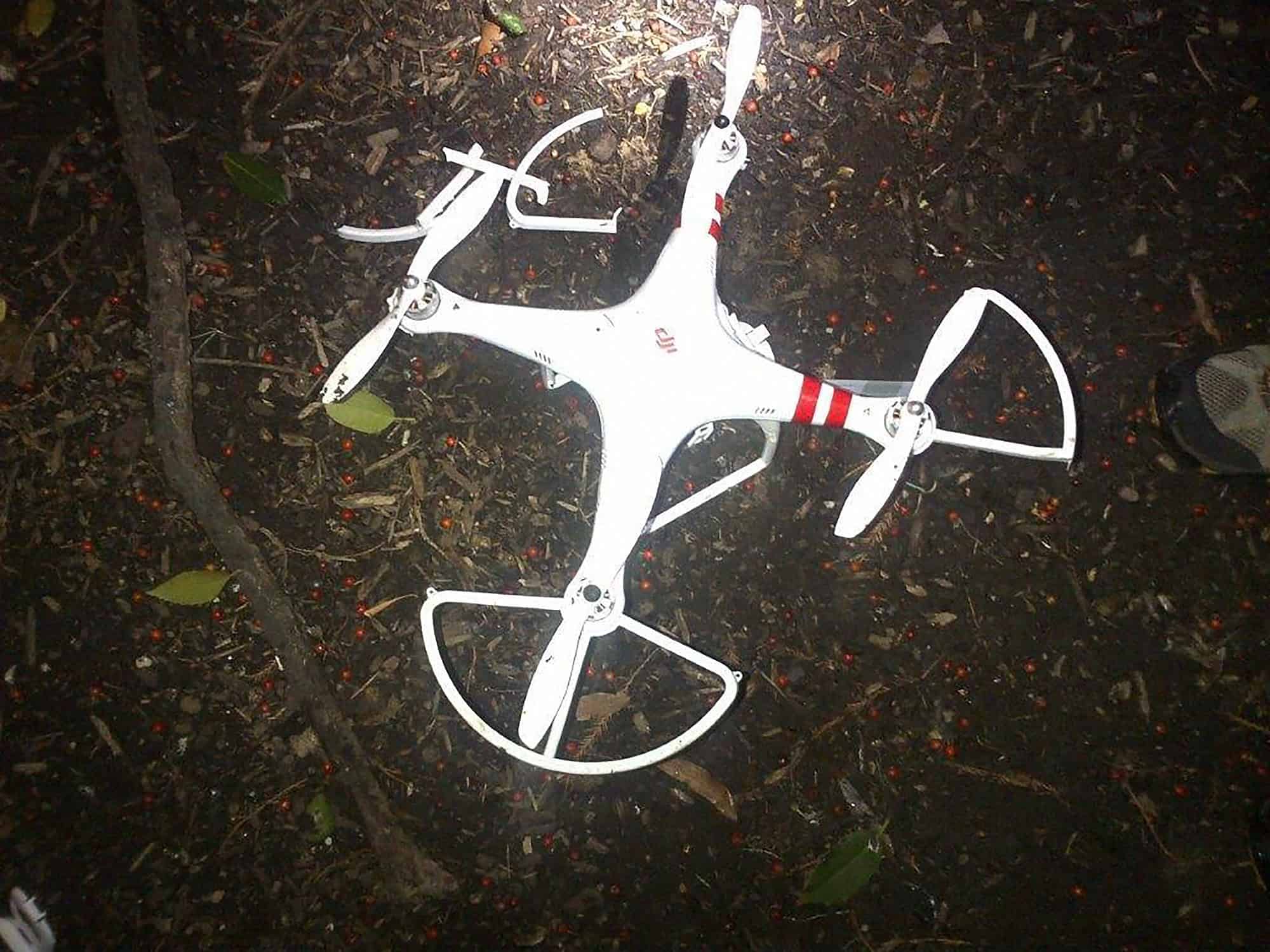
When it could, DJI responded to concerns from government bodies with technical fixes. In 2013, for instance, the company created “geo-fencing,” a software update that was supposed to keep drones from flying over specifically designated areas like military bases or government buildings; two years later, a new version of the software was released after a DJI drone, flown by a local scientist and amateur drone pilot, accidentally landed on the White House lawn. To address data security concerns, the company built something called “local data mode,” where the drone shuts off all data transmission between the controller and the internet.
But as U.S.-China relations have unravelled, the company seems to be out of technical fixes to appease critics. The company, says Welsh, DJI’s head of global policy, is now “constantly in a position of trying to prove a negative. [Critics] will say, ‘Prove that you’re not stealing data.’ Well, we’re not stealing data, so what proof do you need to see? We’ve done audit report after audit report.”
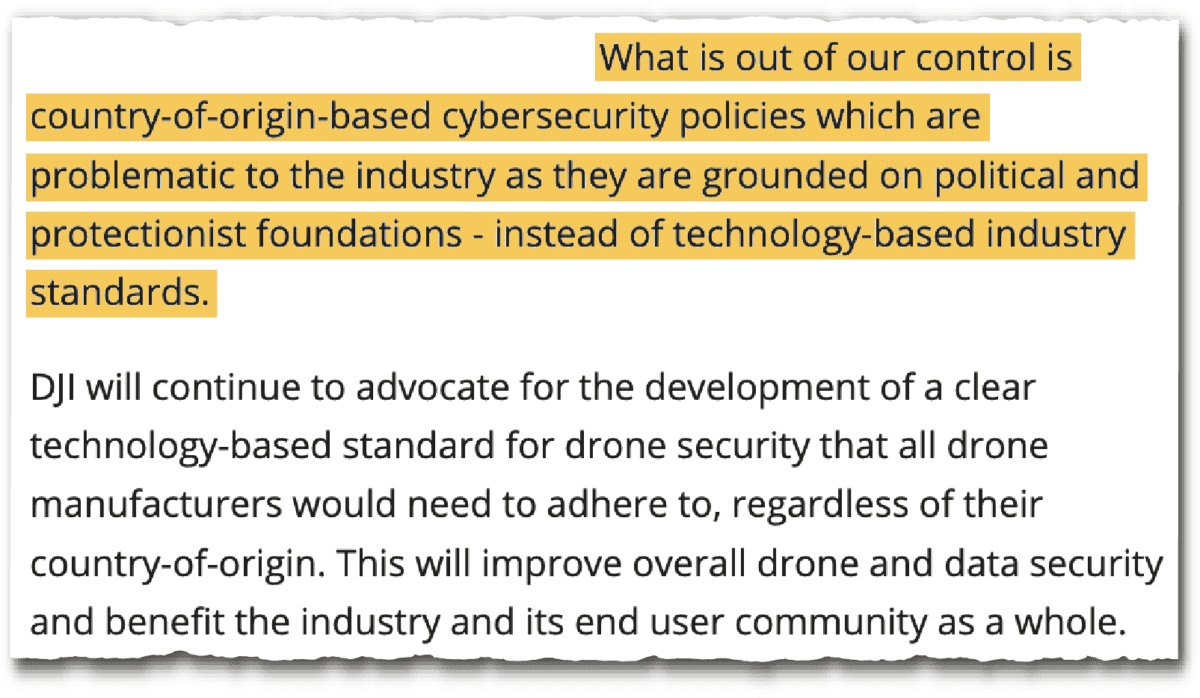
“We were diligently trying to explain on a technical level how we were addressing people’s concerns,” says a former DJI communications employee who spoke on the condition of anonymity because they were not authorized to speak about internal company matters. “But it didn’t matter a damn bit to the anti-China folks.”
Off Switch
Last summer, a mysterious list began circulating among lawmakers that named registered lobbyists for Chinese firms like DJI, Huawei, ByteDance and others. American lobbyists on the list suddenly found themselves shut out of offices on Capitol Hill. As a result, many terminated their relationships with Chinese clients. These included the Vogel Group and Avoq LLC, according to Politico, companies which DJI had on retainer. (A third group, CLS Strategies, continues to represent DJI.)5Vogel Group, Avoq and CLS Strategies did not respond to requests for comment.
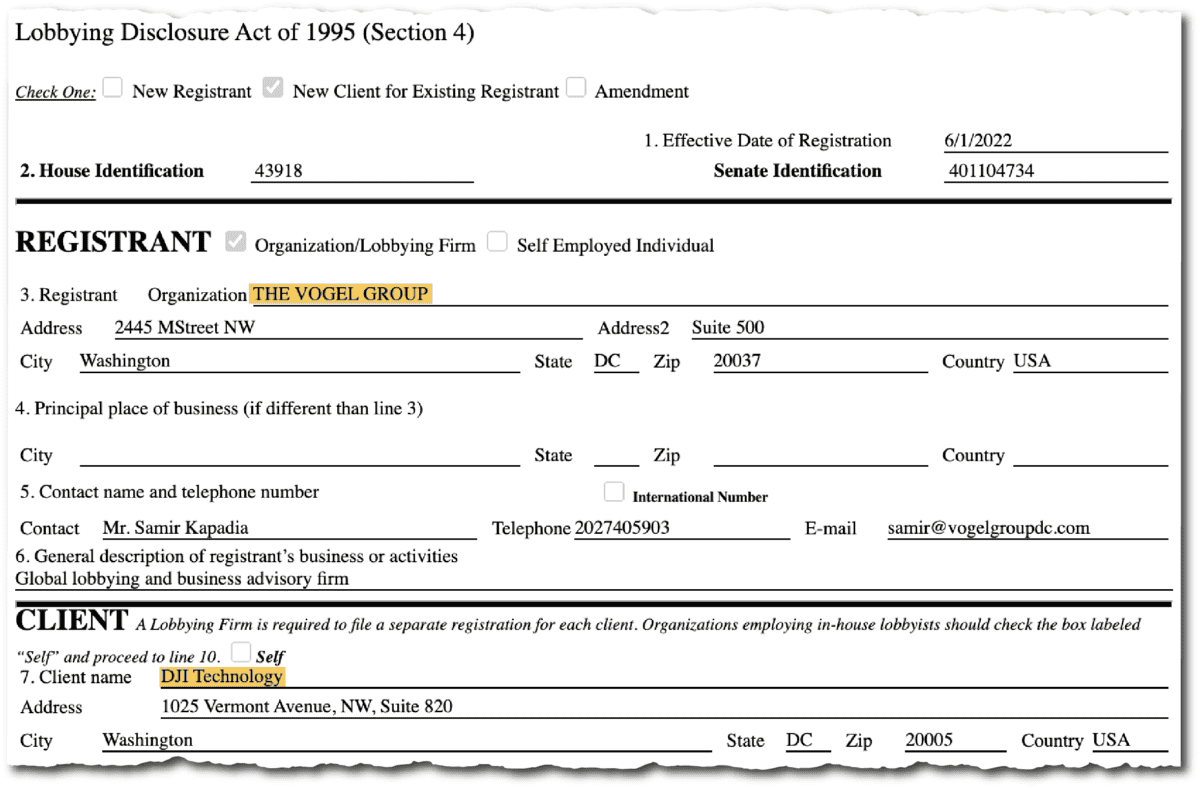
Suddenly, DJI, like so many Chinese technology firms, had become a Beltway pariah.
“It’s demonstrated how radioactive Chinese interests are in congress these days,” says Tom Spulak, a partner at King & Spalding who advises clients on lobbying compliance, referring to the lobbyist list, the origin of which remains unknown. “In Washington, it’s all about how people view you. If you take on a radioactive client, you become radioactive yourself.”
A case in point: In January, a former DJI lobbyist named Mark Aitken was fired from a new position on the House Foreign Affairs Committee after media reports highlighted his history with the company.
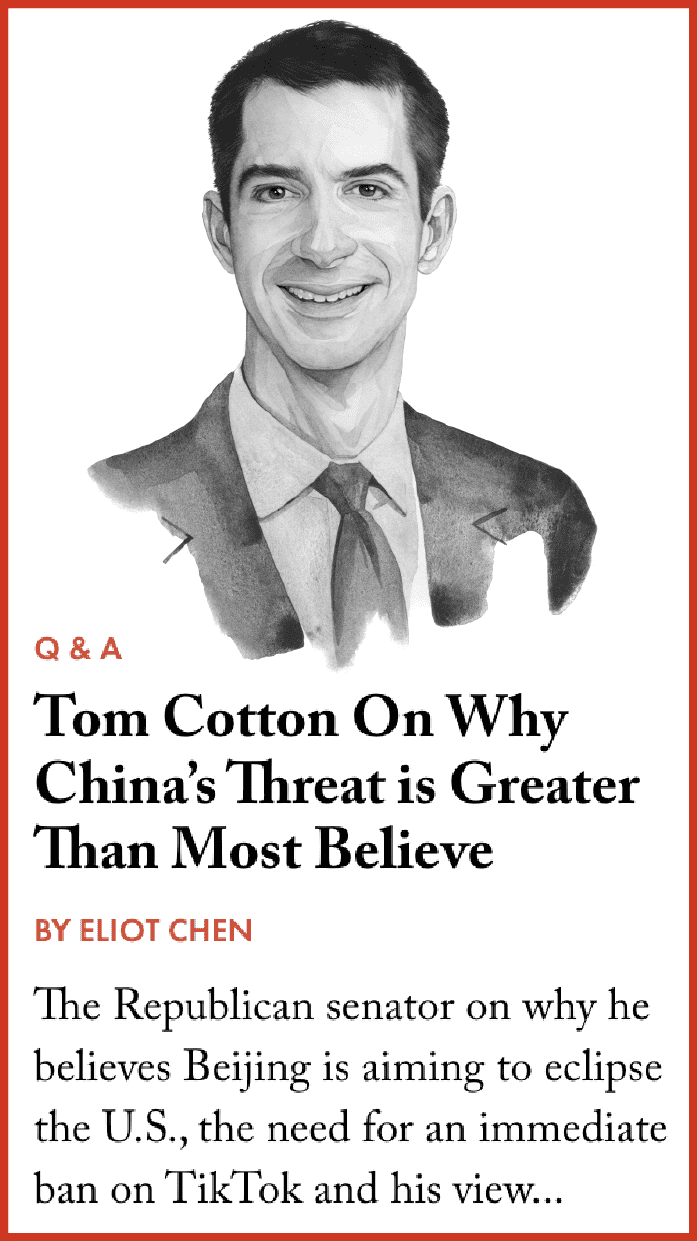
And in a recent Q&A with The Wire, Sen. Tom Cotton (R-AK) expressed an interest in banning any lobbying on behalf of Chinese companies like DJI. “We never would have allowed communist Russia to have such an economically interdependent relationship with America, or to hire lobbyists to come in and advocate on behalf of Russian companies,” he said. “We shouldn’t allow Chinese Communists to do it either.”
With the National Defense Authorization Act’s risk assessment on the horizon, DJI now finds itself fighting for its survival in America with one hand tied behind its back. Although Welsh, the DJI head of global policy, says the U.S. is not DJI’s largest market (he declined to disclose what is), losing the American market would surely constitute a calamity.
DJI, however, claims that far from just bruising the company, a ban would “implode” the entire American drone industry. “Each of our competitors represents 5 percent of the market or less so there’s nobody that can actually fulfill the need [for drones in America],” says Welsh.
DJI’s very central role in the commercial drone market accelerated the democratization of the technology and also normalized it for people around the world. That then made its transition into the military realm feel natural.
Michael Horowitz, a University of Pennsylvania professor and former Defense Department official
Indeed, there’s reason to take him at his word. Since October 2019, the Department of Interior, which boasts the largest federal drone fleet in America, has been barred from buying new DJI drones — despite its fleets being in need of replacement. A recent Government Accountability Office report that reviewed Interior’s efforts to replace DJI found that suitable non-Chinese drones typically cost over five times as much per unit and could take up to six months for delivery. As a result, Interior has been able to conduct less operations, the report noted, such as collecting data on wildlife and natural resources. In some cases, Interior has resorted to costlier options like piloting helicopters.
The DJI Zenmuse H30T is used to aid public safety in Hardin County, Kentucky. Credit: DJI
Jon Beal, president of the Law Enforcement Drone Association, recently wrote a fiery op-ed about American drone companies not being ready for primetime should DJI drones be banned. “In my 10 years of operating drones in the public safety sector and literally seeing them side-by-side,” he wrote, “I have yet to see an American drone outperform a Chinese one. Until that day comes, banning the perfectly capable drones our teams across the country have is not only reckless, it’s negligent.”
If DJI drones are not available to first responders, says Karr, the former police officer, “this could potentially cost American lives. There are a lot of ways that these systems are saving lives every single day.”
Western drone companies, whose own lobbyists have been pushing hard for a ban on their largest competitor, see the risk-reward calculus of DJI drones differently.6Last year, Skydio spent $680,000 on federal lobbying, according to OpenSecrets; BRINC spent $180,000.
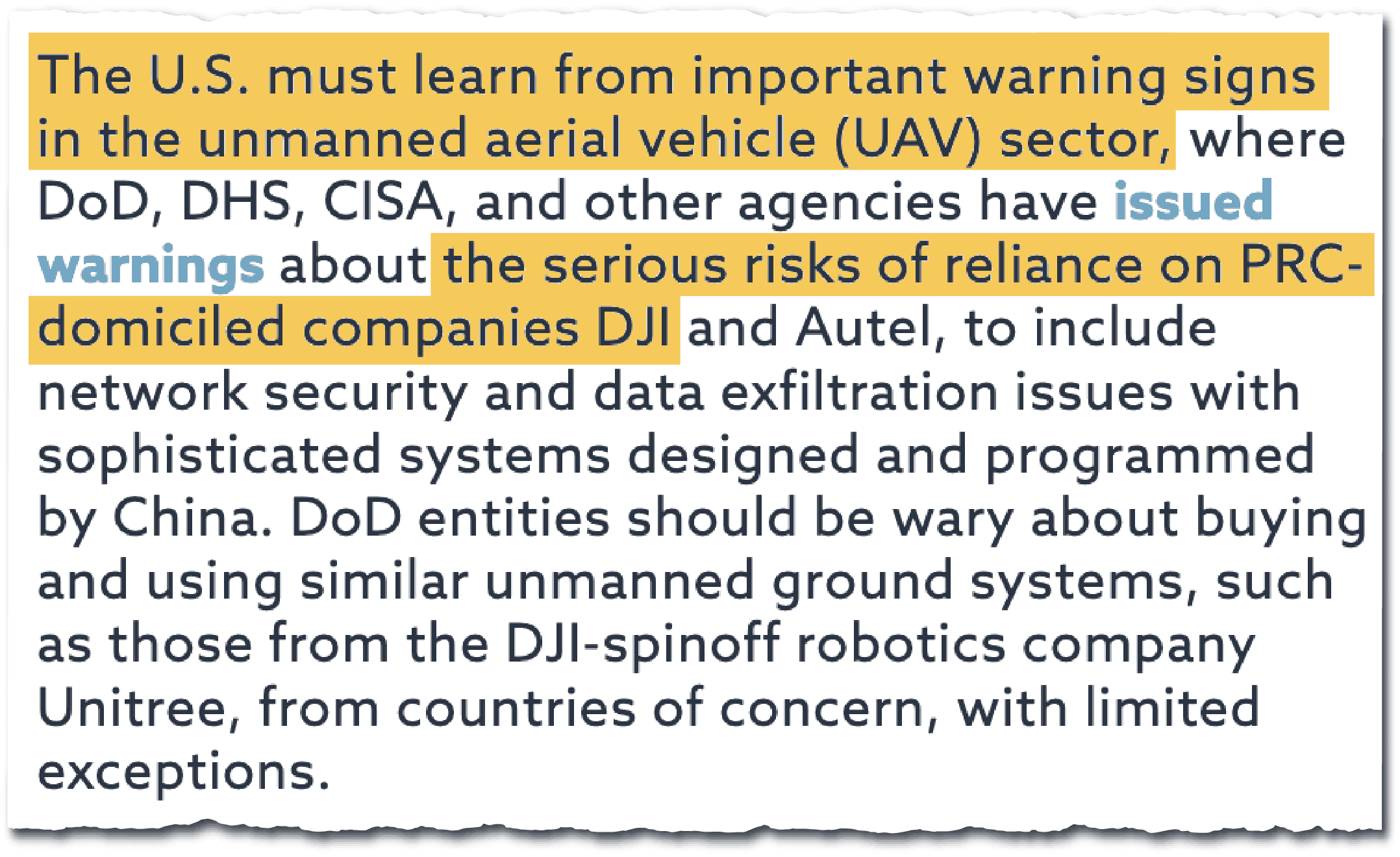
“If we lived in a world where this huge competitor was from Canada or Australia, that would be a very different conversation,” says Michael Robbins, president of the Association for Uncrewed Vehicle Systems International (AUVSI), an advocacy body. “But we know that China is actively seeking to infiltrate our critical infrastructure, infiltrate our communication networks, infiltrate our telecommunications and are actively spying on Americans.”
Moreover, DJI’s competitors may not be as lackluster as some claim. “These products are becoming on par [with DJI] when it comes down to certain features,” says Benowitz, the former DJI employee who now works for BRINC. “Maybe they don’t meet all the same specs, but they hit other specs that are more valuable for certain users.” For instance, BRINC’s drones for law enforcement have a glass-breaking function for forcing entry and can carry medical payloads like Narcan.
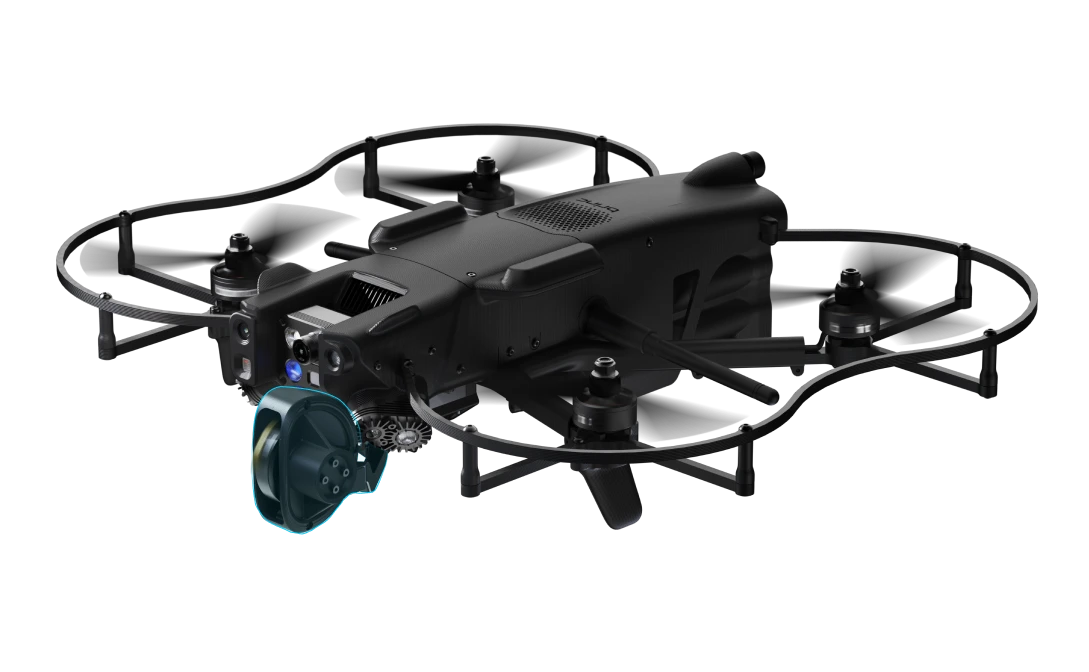
Left: A video from the St. Johns County Sheriff’s Office demonstrating BRINC’s Lemur 2 drone. Right: BRINC’s Lemur 2 drone equipped with a glass-breaking attachment. Credit: SJSO, BRINC
In the immediate future, however, both opponents and supporters agree that filling a DJI-shaped void would require government intervention. In 2023, for instance, after Florida became the first state to ban DJI drone use by state authorities, first-responders and police departments made a stink. The state then enacted a replacement program for agencies to acquire non-Chinese drones, to the tune of $25 million. Other states, like Texas and Mississippi, are also considering a ban.
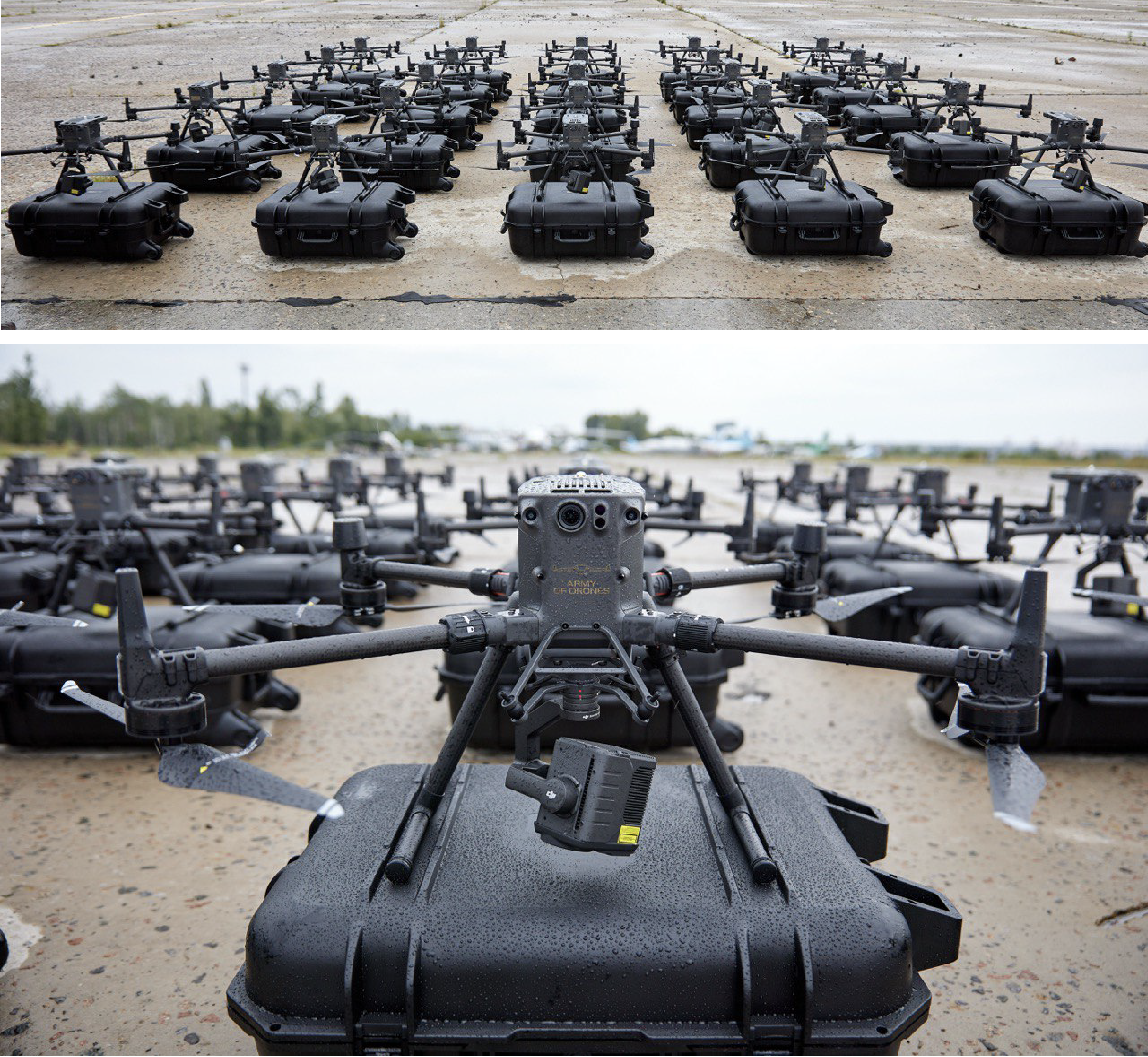
The possibility of great power war — and the critical role that small drones would play in one — adds further incentive and urgency for the U.S. government to help get Western-made drones up in the sky. Michael Horowitz, a University of Pennsylvania professor and former Defense Department official, has coined the term “precise mass” to refer to the tactical benefit that commercial drones are bringing to the modern battlefield. This term refers to how small drones fuse overwhelming quantity with precision targeting. Typically, military strategists have thought of mass and precision as distinct qualities in warfare. But drones are collapsing the difference.
DJI has been pivotal in this.
“DJI’s very central role in the commercial drone market accelerated the democratization of the technology and also normalized it for people around the world,” says Horowitz. “That then made its transition into the military realm feel natural.”
In other words, it may not matter what DJI drones can or can’t do — or whether its American customers are performing life-saving missions or filming vacation sunsets. For many in Washington, the company’s greatest legacy is the fact that, in only two decades, it has spawned the future of warfare. It may be headed for a crash landing as a result.

Brent Crane is a journalist based in San Diego. His work has been featured in The New Yorker, The New York Times, The Economist and elsewhere. @bcamcrane