Xinjiang may be China’s most controversial region, the place where the Communist Party’s human rights abuses of the Uyghur population have drawn condemnation from foreign governments and international human rights groups.
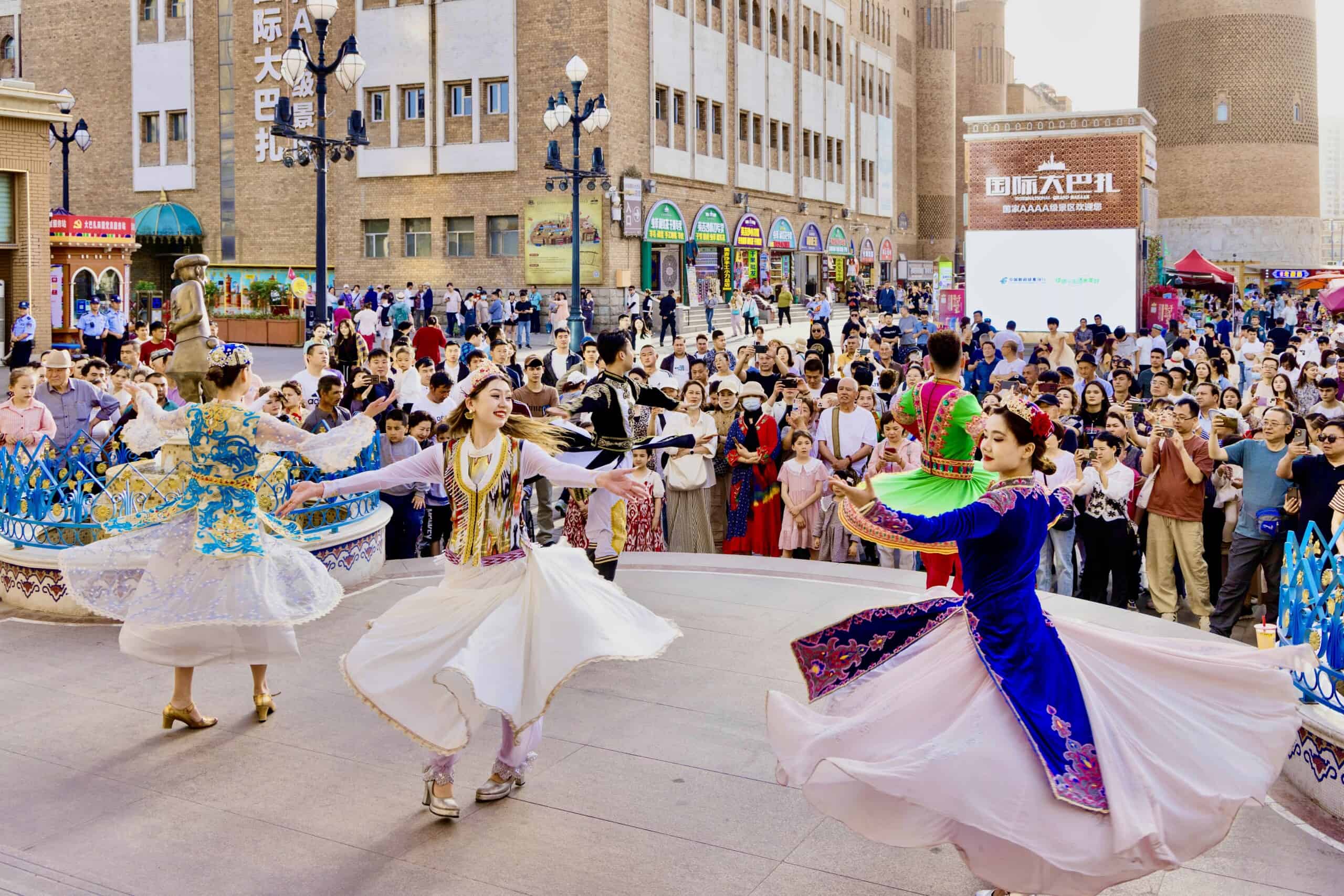
It’s also now one of the country’s fastest-growing tourist destinations.

Last year Xinjiang recorded some 300 million arrivals, nearly equivalent to the population of the United States and up 14 percent from 2023, according to the regional culture and tourism department. Revenue from tourism jumped by one-fifth to nearly $50 billion over the same period.
While the vast majority of visitors come from within China, the number of international tourists heading to Xinjiang is growing faster, with almost 5 million inbound visitors traveling there in 2024, a 50 percent increase over the year before. They contributed some $4 billion to the $50 billion tourism revenue total, according to provincial figures.
China’s broader tourism industry has meanwhile yet to fully recover following the Covid pandemic. Although the country reported 5.6 billion domestic trips in 2024, a 15 percent increase from the year prior, that still fell short of the 6 billion trips China reported in 2019.

The Xinjiang boom suggests that China’s efforts to recast the region’s international image are beginning to bear fruit — and raises questions about whether governments seeking to hold China accountable for abuses in the region should turn their gaze to the tourism industry.
“The Chinese government is able to, on one hand, destroy a culture and a language and a religious practice, and on the other hand benefit from tourist ventures,” says Thea Lee, who until last month served as Deputy Undersecretary for International Labor Affairs in the Biden administration. “This is something that requires a higher level of public scrutiny.”
The fact that the CCP has actively promoted tourism to Xinjiang, at the explicit direction of Xi Jinping, has aroused suspicion over the strong visitor data. But monthly flights to Kashgar, a city in southern Xinjiang, are also up by more than a third since 2021, according to analytics site FlightConnections. Bookings with tour agency Xinjiang China International Travel more than doubled last year, with most visitors coming from Southeast Asia, says Lesley Lee, the company’s director.

The rise in visitors has come at a time of increasing international pressure on businesses to stop operating in Xinjiang or sourcing products from there, and after the first Donald Trump administration declared China’s repression in the region a “genocide” in 2021 — a designation maintained by President Joe Biden.
However, most U.S. trade laws, like the Uyghur Forced Labor Protection Act, focus on goods rather than services. The UFLPA mandates that American importers must prove any products made in Xinjiang were created without forced labor, but does not impose restrictions on investment in the region or service providers there.

Indeed, American firms, including in the tourism industry, are still largely free to operate in Xinjiang, where they contribute to a local economy that counts on tourism for 16 percent of its GDP, according to statistics reported by state media.
Several U.S. travel companies maintain operations in Xinjiang, including major hospitality brands like Hilton and Marriott, which respectively operate six and two hotels in Urumqi, the regional capital; Hilton operates more hotels in other cities in the region, including in Kashgar and Turpan, and is currently expanding. Travel platforms like Expedia and TripAdvisor connect users with third-party tours in Xinjiang meanwhile.
“Huge American hotels promoting tourism in Xinjiang sends the wrong message by putting a happy face on China’s horrific record of genocide and slave labor in the region,” Senator Jeff Merkley (D-OR) said in a statement to The Wire. “Americans shouldn’t be complicit in China’s surveillance, imprisonment, torture, and forced ‘re-education’ of Uyghurs and other Muslim minority groups in Xinjiang.”
Hilton, Marriott, Expedia, and TripAdvisor did not respond to requests for comment.

European hospitality companies also have business in Xinjiang. French firm Accor has 12 hotels in the region, and IHG Group, a British firm that owns brands such as Holiday Inn, has at least five. GetYourGuide, a German travel platform, offers third-party tours, including one that advertises “lunch at a local Uyghur’s house.”
A spokesperson for Accor said that it adheres to standards for how employees are treated in all the countries in which it operates.
A spokesperson for GetYourGuide said forced labor violates the company’s guidelines and that tour operators who violate their guidelines “may have their partnership with us terminated.”
Neither company explained how they enforce these policies in Xinjiang, where the U.S. and rights groups say due diligence is effectively impossible. IHG did not respond to requests for comment.

Until recently the EU had no forced labor law, but legislation passed in December will set out due diligence requirements for the bloc’s companies when it goes into effect in 2027.
Multinational hotels likely see it as important to maintain a presence in Xinjiang to stay in Beijing’s good graces, industry experts say. Companies in other sectors, including Calvin Klein-owner PVH Corp, have recently faced blacklisting for taking steps to eliminate Xinjiang products from their supply chains.
“China overall is such a massive market and one that any hotel company would want to break into, attracting Chinese consumers who spend tons of money on travel,” says Carroll Rheem, chief executive of travel advisory firm Iolite group. Chinese domestic tourists spent some $787 billion on travel last year, according to official statistics. “You can’t separate Xinjiang from just the relationship with China overall,” Rheem says.

That could put companies in a bind between their big China businesses and their own corporate responsibility statements, many of which decry forced labor. Independent analyses estimate that China has detained at least hundreds of thousands of Uyghurs and members of other Muslim minority groups since 2017. The United Nations and the U.S. government have said this number exceeds 1 million.
For some Uyghur escapees from the region, seeing tourists visit Xinjiang is a reminder of the battle they face in achieving recognition of what they say are ongoing atrocities perpetrated by the Chinese government.
[Recasting Xinjiang as a tourism hub] does a lot of heavy lifting for the state narrative of shifting from a region that is unstable, wracked with extremism, and now is ready for visiting and investment.
Henryk Szadsiewski, director of research at the advocacy group Uyghur Human Rights Project
“To see tourists freely visiting my homeland, where we had memories, where we have lost loved ones to the genocide and suffered so deeply, feels deeply unsettling and offensive,” says Rizwangul NurMuhammad, who was born and raised in Xinjiang before leaving for a masters degree in New Zealand in 2010. She says her brother Mewlan has been imprisoned on arbitrary charges since 2017, when Xi renewed China’s crackdown on the Uyghur region.

China denies allegations of human rights abuses in Xinjiang. State media says the country is subject to a “ferocious disinformation campaign,” but that tourism allows visitors to “experience the real Xinjiang.”
This recasting of Xinjiang as a tourism hub “does a lot of heavy lifting for the state narrative of shifting from a region that is unstable, wracked with extremism, and now is ready for visiting and investment,” says Henryk Szadsiewski, director of research at the advocacy group Uyghur Human Rights Project.

For a rising tide of Western travel vloggers, the Chinese “state narrative” about Xinjiang is already proving convincing. While some influencers take trips sponsored by state media, raising concerns of official disinformation campaigns, others go on their own. Some stay at Hilton hotels. In dozens of such videos from last year reviewed by The Wire, not one vlogger expressed concern about maltreatment of Uyghurs and other Muslim minorities.
Within China, these vloggers have attracted the attention of top propagandists. State tabloid Global Times called them the “Marco Polos in the New Era.”
Ryan Palmer, a New Zealand expat, visited Xinjiang for eight days last November and posted videos of his trip on YouTube. In one, he pushes back against the idea that a genocide of Uyghurs is taking place. “I just filmed what’s in front of me,” he told The Wire. “I’m not a political guy. I had no agenda.”
Palmer, 35, says he did not show his footage to anyone before posting — YouTube is blocked in China — and did not encounter an abnormal security presence in Xinjiang. He said his only source of profit from his videos is $50 a month in YouTube ad revenue, which supports his job as a kindergarten teacher in Beijing, where he has lived for the past year.
Gabriel Calabuig Lloyd, 29, and Dennís Marín Juan, 31, vloggers from Spain, visited Xinjiang in November 2023 as they drove from Europe to Southeast Asia.
“We found a totally different reality than what is reflected in the Western media,” they told The Wire. The region’s “unique culture seems to be extolled as the tourist attraction of the region.” They say their decision to not accept YouTube sponsors allows them to present what they see without outside influence.
Bolstered by its recent success in attracting visitors, the Xinjiang regional government has set even higher targets for the coming years. It has a goal of attracting 350 million tourists in 2026 — and it has created a $27,000 bonus for the travel agency that attracts the most foreign visitors. Local authorities have concentrated investment in the region’s mountainous north, where more ethnic Han Chinese live; that area now has almost four times as many ski resorts as Colorado.

Noah Berman is a staff writer for The Wire based in New York. He previously wrote about economics and technology at the Council on Foreign Relations. His work has appeared in the Boston Globe and PBS News. He graduated from Georgetown University.