Last month, the U.S. Federal Reserve initiated its first monetary-easing cycle in more than four years. With a 50-basis-point cut, the Fed brought the federal funds rate down from its 20-year high of 5.3% to a range of 4.75-5%. This is good news for China, which now has much more room to maneuver in its quest to reflate its economy.
Prior to last month’s rate cut, monetary policy in the United States and China were on sharply diverging paths. The Fed had raised its benchmark interest rate ten times since mid-2022, while the People’s Bank of China lowered its key policy rate — the seven-day reverse repo rate — from 2.1% to 1.7%.
Pan Gongsheng, governor of the People’s Bank of China, delivers a statement on lowering the reverse repurchase rate, September 23, 2024. Credit: CGTN
The PBOC would have eased monetary policy further, were it not for the interest-rate gap with the U.S., which was causing the renminbi to depreciate against the U.S. dollar and depressing Chinese asset prices. That, together with a broader deflationary trend, rising geopolitical tensions, and declining population growth, fueled capital outflows, which totaled a whopping $787.8 billion over the last three years.
This compounded the stress on China’s troubled real-estate sector, which comprises around 70% of household wealth and accounts for about 30% of GDP, compared with 14% of GDP in the U.S.. This past July, new home prices recorded their largest drop in nine years, bringing average prices to a level 30% below their 2021 peak. The impact of such a large decline should not be underestimated: Bloomberg estimates that every 5% decline in home prices in China wipes out about CN¥19 trillion ($2.7 trillion) in wealth.
The negative income and wealth effects of declining real-estate prices were compounded by falling stock prices. The Shanghai Composite Index fell by about 30% from its 2021 peak to mid-September 2024. None of this has been good for domestic consumption.
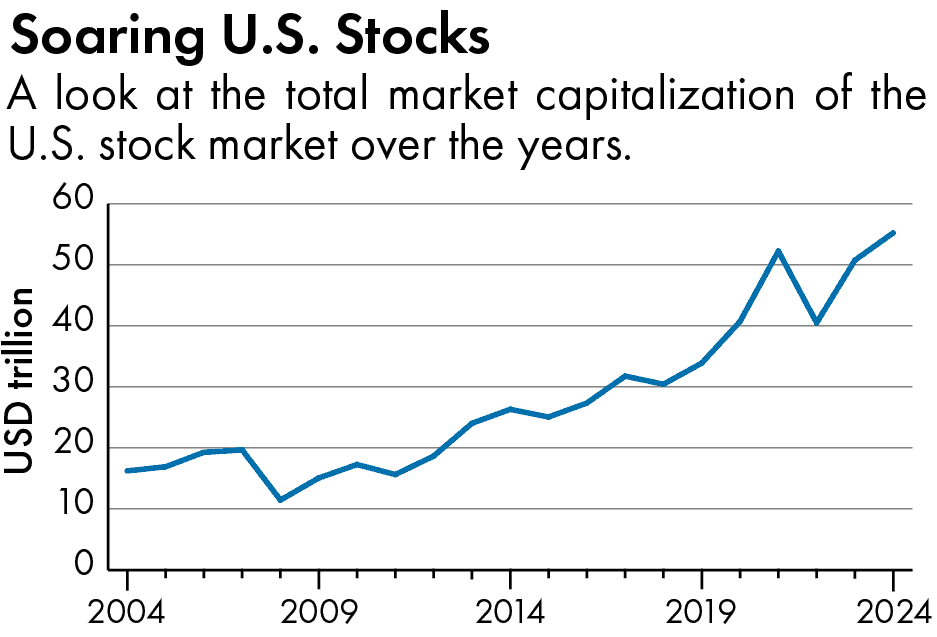
To be sure, high U.S. interest rates also hurt the American real-estate market. But the impact on household wealth was offset by a soaring stock market. From the end of 2022 to June 2024, U.S. stock market’s value surged from $40.5 trillion to $55.3 trillion, with the “Magnificent 7” tech stocks alone contributing nearly $9 trillion to U.S. household wealth.
With the U.S. stock-market boom not only supporting household consumption and employment, but also fueling inflation, the Fed continued to postpone rate cuts. But the Fed could not keep interest rates high forever, not least because they translate into higher payments on the U.S. government’s $35.32 trillion debt.
…the Fed’s easing cycle creates an opportunity to address deflation and revive domestic market confidence, thereby buying more time for structural reform…
Of course, this problem is not limited to the U.S. government. Many countries hold large volumes of U.S. dollar-denominated debt, to the point that higher U.S. interest rates have traditionally been contractionary for the entire global economy. Over the last two years, many emerging-market economies have allowed their currencies to depreciate, rather than risk slower growth by raising domestic interest rates. As a result, deflationary pressures have intensified.
The Fed’s newly initiated easing cycle implies lower debt-repayment burdens and higher liquidity, which means that these countries can now cut rates without worrying about excessive capital outflows. As for China, it introduced a bold monetary stimulus just two days after the Fed’s decision.
The PBOC has reduced banks’ mandatory reserve ratio by 50 basis points, cut its key policy rates and standing lending-facility rates by 20 basis points, and lowered existing mortgage rates and minimum down payments. Moreover, China has introduced new tools to support the stock market. A swap facility will give qualified securities, funds, and insurers access to at least CN¥500 billion to buy shares. And up to CN¥300 billion in cheap PBOC loans will be provided to commercial banks to help them fund share purchases and buybacks by other entities.
China has also expanded its pilot program for increasing equity investment by asset-management firms, and called on medium- and long-term investment funds, such as the social-security fund, to enter the market to boost stock prices. Last month’s meeting of the Communist Party of China’s politburo underscored the government’s determination to restore private-sector confidence and stabilize the macroeconomy.
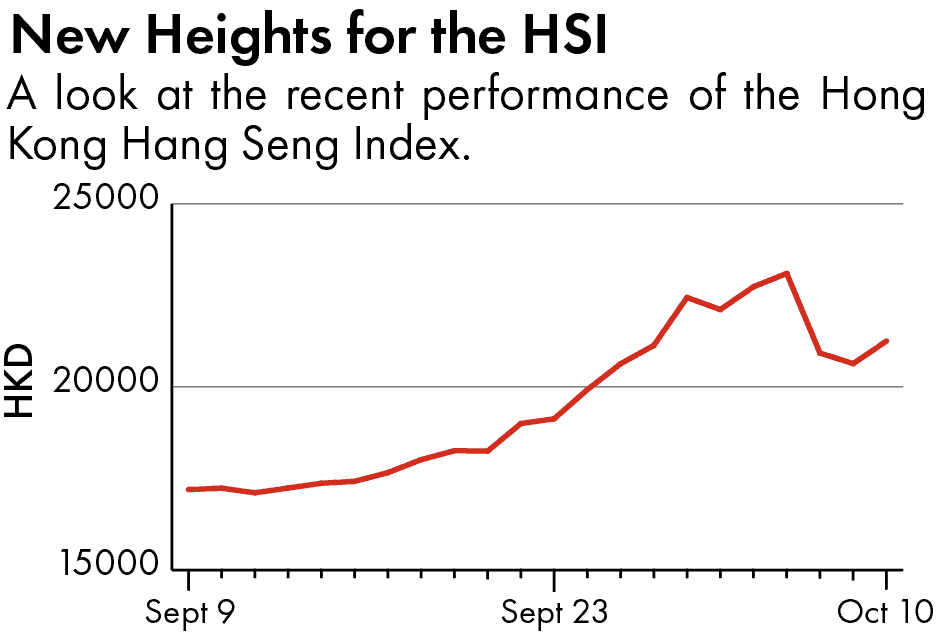
Following the introduction of the government’s ambitious policy package, China’s main stock indices surged, with the Shenzhen Stock Exchange Composite Index rising 29.2%, the Shanghai Composite Index by 20.4%, and the Hong Kong Hang Seng Index by 13.8% — its largest increase since 2008. This bodes well for China’s shift to a growth model based on domestic consumption, rather than exports.
Though China has been grappling with deflation for a while, its leaders have hesitated to pursue any significant stimulus measures. They have not forgotten the lessons of the 2009 stimulus, not least that excessive credit expansion can raise serious risks of non-performing loans and over-construction. But the Fed’s easing cycle — and the more favorable external environment that it provides — creates an opportunity to address deflation and revive domestic market confidence, thereby buying more time for structural reform, especially in the real-estate market. Fortunately, China’s leaders are committed to seizing it.
Copyright: Project Syndicate, 2024.

Andrew Sheng is Distinguished Fellow at the Asia Global Institute at the University of Hong Kong and a member of the UNEP Advisory Council on Sustainable Finance.

Xiao Geng, Chairman of the Hong Kong Institution for International Finance, is a professor and Director of the Institute of Policy and Practice at the Shenzhen Finance Institute at The Chinese University of Hong Kong, Shenzhen.