The average minor league baseball game uses between 60-70 baseballs. Some use more than 100, and each ends up in a different part of the stands. But they all came from the same place: China.

For companies that produce the goods needed to take part in ‘America’s Pastime,’ tariffs are now top of mind. Sellers of baseball gear across the United States are reporting pressure to raise prices due to minimum 30 percent tariffs on China, which manufactures more of the sport’s equipment than any other country.
The tactics baseball equipment firms have used to restrict the impact mirror those used by other American importers from China, from cutting costs to accepting lower profit margins, as they run down inventories built up before tariffs snapped into place.

How these companies handle the longer-term pressure to raise prices will affect the cost of playing baseball, particularly for kids and amateur players.
“The only question is whether the tariffs are a one time increase to inflation or whether this will persist and snowball,” says Victor Matheson, a sports economist at the College of the Holy Cross. “Where it really hits is Little League.”
As in many industries, U.S. imports of baseball equipment from China have surged over the past several decades. The United States bought just $63,000 worth of baseball gear from China in 1989; by last year, that figure had ballooned to $239 million, according to the U.S. International Trade Commission, a government agency. (Balls are treated separately in trade data.)

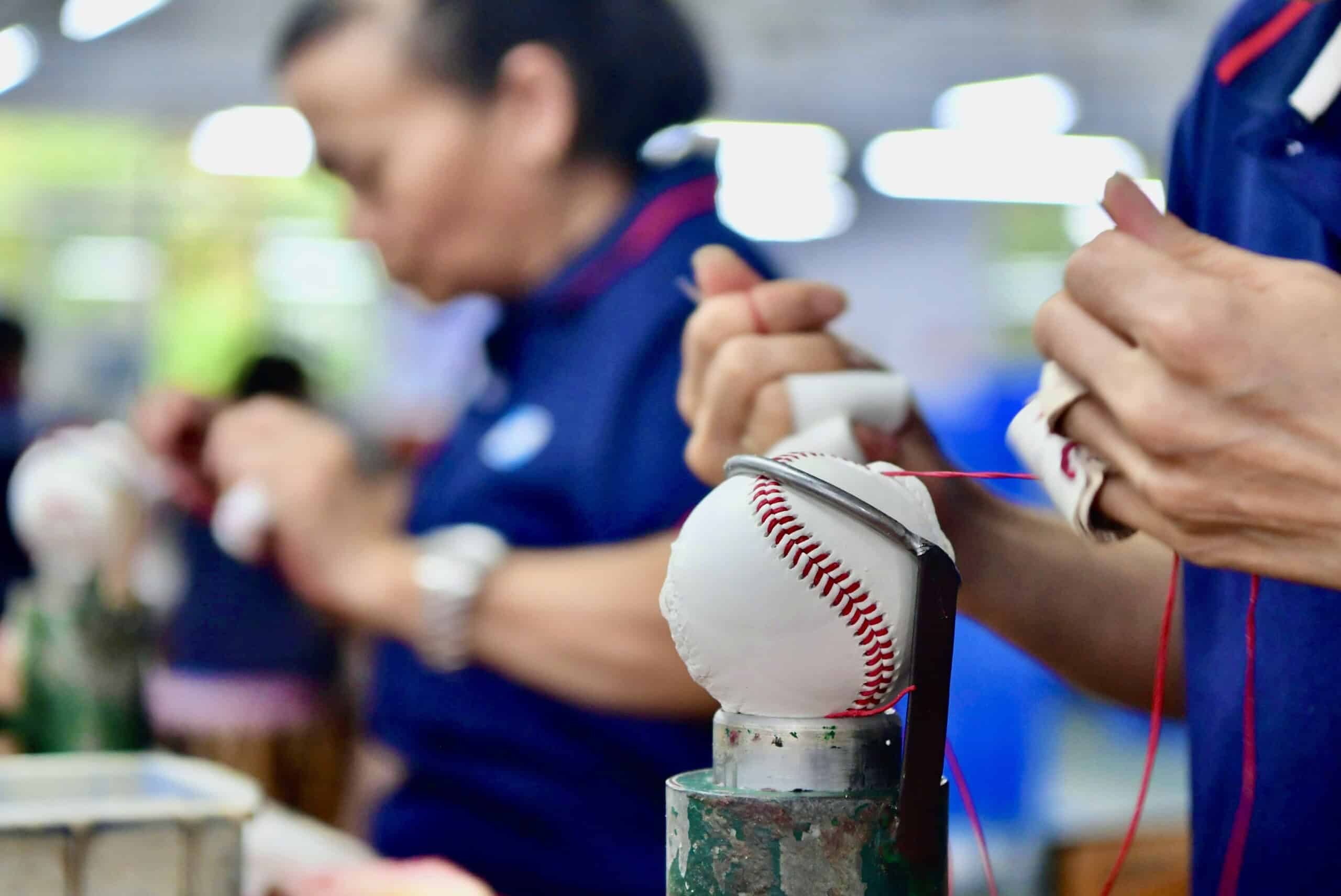
Again as with other areas of manufacturing, from socks to buttons, a particular Chinese region has become synonymous with baseball. Production is concentrated in Liancheng County, a mountainous area in Fujian Province — the closest in China to Taiwan, where baseball is the national sport — that has come to be known as “baseball town.”

Many equipment firms there are led by Taiwanese executives. Liao Fangzhou was the first of this cohort to set up shop in 2006: His company Hongguo (Longyan) Sporting Goods, which specializes in baseball gloves and goes by Hilltop Sports in English, generates $60 million in revenue a year selling its products to the U.S., Canada, Japan, and South Korea, according to a business portal managed by Taiwan’s Mainland Affairs Council. The firm’s business has been “significantly impacted” by the trade war, says Mickey Liaw, Hilltop’s president.
“We were asked to bear some of the tariff cost but ultimately it is still our customers that [are] shouldering [the] majority of the tariff,” he says. “Doing business in China is becoming unsustainable in the long run,” he adds, but given the expansive nature of Trump’s tariff agenda, “moving to other countries is not a solution either.”


Workers produce baseball gloves at a baseball equipment manufacturer in Fujian. Credit: CCTV
American firms that have become reliant on Chinese suppliers are now having to figure out how to handle higher prices charged by the likes of Hilltop. Many are slowing down purchases. U.S. importers bought half as many baseballs and softballs from China in June — after tariffs slid into place — as they did the same month last year, U.S. International Trade Commission data shows.
With the uncertainty here of an ever-shifting trade policy, there is no environment for long term investment, no environment for [capital expenditure] spending or new hiring. I think you’re seeing companies at the end of their rope.
Alex Jacquez, a former economic advisor to President Joe Biden
Big sporting goods firms, Nike and Adidas among them, have broadly said they will raise their prices in response to tariffs. The Chinese-owned parent firm of Wilson, a maker of baseballs, gloves and other kit, said in an earnings call this week that the brand has raised its prices by approximately 10 percent due to tariffs. Several smaller baseball equipment companies are meanwhile scrambling to avoid doing the same.

Force3 Pro Gear, which sells catcher’s equipment from its base in Connecticut, has thus far been able to put off price increases because the firm more than doubled its standard order from its Chinese suppliers after last November’s election, according to chief executive Steven Goldsmith. His suppliers have agreed to reduce costs by approximately 10 percent, and the company is determining how much of the remaining levy it can afford before passing costs to its customers.
Domestic production is an “extreme” option, Goldsmith says, because the machinery and foams necessary to make Force3 equipment are not available. “I’m not aware of catcher’s gear being made in the United States,” he adds.

Guardian Baseball, an equipment seller headquartered in Kentucky, has also kept its China-based supply chain, but tariffs have led it to cut staff hours and scale down a program that donated gear to teams in developing countries, co-founder Matt Kubancik says. “It hurts the entrepreneurial spirit,” he adds.
Guardian has explored making sliding mitts in the U.S., but has run into red tape. “There’s just not the capabilities, or the cost is so astronomical, or the lead time is a year or two out,” Kubancik says. “You don’t have the seamstresses.”

Georgia-based glove company Shadow Ball Glove is meanwhile absorbing tariffs in its profit margins while looking to diversify its supply chain from China to elsewhere in Asia, according to its founder Carson Snave. He says tariffs have pushed the firm to reduce sourcing from China to between 60 and 70 percent of goods, down from 80 to 85 percent before Trump’s inauguration. “We’re paying almost double what we did before,” Snave says. “The push is now a shove.”
The equipment costs of playing baseball are relatively fixed — it takes a similar amount of gear to play the game no matter the level — so tariffs will fall harder on youth sports, says Matheson, the sports economist. “If you’re talking about equipment as a percentage of operating costs for an MLB team, it’s pretty tiny…With Little League, a ton of your costs are equipment,” he says. “It doesn’t affect the Boston Red Sox, but to the Springfield Junior Red Sox, that money is more significant.”

The MLB and Little League International, which runs the Little League World Series, did not respond to requests for comment on how tariffs are impacting their business.
Some families spend thousands of dollars annually on equipment and travel-league costs, says Ryan Ruddy, an economist at Ohio State University who has taught a class called ‘Baseball Economics.’ “Baseball has had an accessibility problem that is getting worse and worse,” he says. “There is a lot of money spent on equipment.”
There are signs tariff-caused price increases have already landed on home plate. Mori Ninomiya, the president of Downtown Little League in New York, says it paid around $10,000 for baseball and softballs this year, about a third more than usual. He worries tariffs will force the non-profit league to raise the $200 fee it charges each of the 1,200 kids on its 86 teams for the first time in a decade.
“I would hate to have to charge more,” he says. “It would be a shame. I don’t even know what else we could do.”

The travails facing American baseball companies and their clients highlight the bluntness of Trump’s tariffs, which blanket nearly all goods from China regardless of the prospects for reshoring domestic manufacturing. Alex Jacquez, a former economic advisor to President Joe Biden, says tariffs on baseball equipment will raise the cost of America’s Pastime without delivering a boost to employment or productivity.
“With the uncertainty here of an ever-shifting trade policy, there is no environment for long term investment, no environment for CapEx [capital expenditure] spending or new hiring. I think you’re seeing companies at the end of their rope,” he says. “What you are definitely not going to see is an explosion of new baseball and bat factories in the United States.”

Noah Berman is a staff writer for The Wire based in New York. He previously wrote about economics and technology at the Council on Foreign Relations. His work has appeared in the Boston Globe and PBS News. He graduated from Georgetown University.