In early December, days before the People’s Liberation Army conducted large-scale exercises around Taiwan, a seemingly ordinary cargo ship arrived in the central Taiwanese port of Taichung, the country’s second most-populous city.
The Hong Kong-flagged SCSC Fortune was, however, no ordinary civilian cargo vessel. Two years earlier it had participated in amphibious infiltration exercises with PLA special forces.
Video footage released in 2022 by China Central Television’s military affairs channel showed what it called a “seaborne infiltration exercise”, with the SCSC Fortune playing a central role. The ship was met at a rendezvous point by multiple light assault boats capable of transporting more than 10 PLA special forces soldiers each. Its two cranes loaded at least six attack craft into its cargo hold, which it then covered with large metal panels.
The video later cuts to another location, where the SCSC Fortune’s cranes unload its heavily armed cargo into the water. Each assault boat, powered by two Mercury outboard motors, leaves the mothership. Dozens of soldiers then land on a coastline, run through forests and practice shooting.
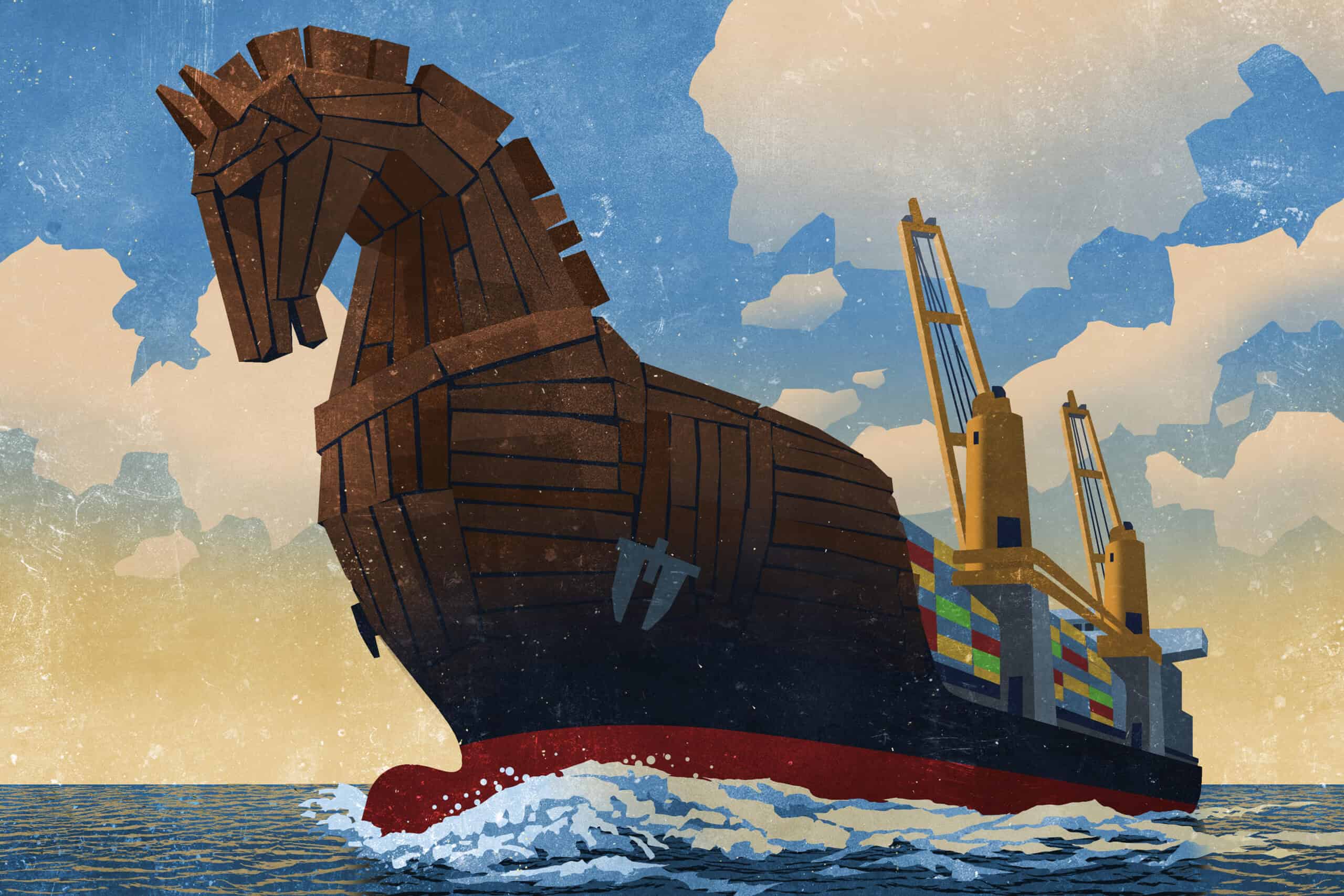
It’s a kind of Trojan horse situation — during peacetime, they can do surveillance, but they can also help China’s military during wartime.
Legislator Wang Ting-yu, a DPP lawmaker and co-chair of the Taiwan legislature’s Foreign Affairs and National Defense Committee
The drills highlight some of the ways in which China is planning to get troops and military equipment in place at the outset of an invasion attempt, utilizing all of the tools available to the Chinese Communist Party. These include ostensibly commercial assets managed by Beijing’s vast network of state-owned enterprises.

SCSC Fortune, built in Shanghai’s Wusong Shipyard, is owned by Cosco Shipping, the Chinese shipping behemoth with the world’s fourth-largest commercial fleet. Cosco-owned ships are a major component of cross-strait trade, regularly visiting all of Taiwan’s largest ports.
“It’s a kind of Trojan horse situation — during peacetime, they can do surveillance, but they can also help China’s military during wartime,” Taiwanese legislator Wang Ting-yu, co-chair of the legislature’s foreign affairs and national defense committee, told The Wire China in an interview.
The Chinese Communist Party claims Taiwan as its territory despite having never ruled it. The threat that its military buildup poses to its smaller democratic neighbor has grown quickly in the past two decades, especially over the past two years.

While in Taichung Port in December, the SCSC Fortune did not disgorge special operations forces but rather commercial cargo, stopping at two berths in the course of three days. But its presence at one of Taiwan’s largest ports days before major exercises in which 12 PLA Navy warships and nine Chinese government-owned vessels surrounded Taiwan generated concern.
Taichung Port is only five miles from the Ching Chuan Kang Air Base at the city’s international airport. Satellite data provided to The Wire China by ingeniSPACE, a geospatial analysis company, shows that the SCSC Fortune also made stops last year at the ports of Anping and Kaohsiung.
On May 28 of this year, Wan Min, Cosco Shipping’s chairman and party secretary, chaired a meeting of the company’s party committee, during which he said that the “patrolling and inspection” done by the company’s fleet was a “sharpened weapon” serving both Party and Country.

The office of Taiwanese President Lai Ching-te told The Wire China tougher regulations that would affect Cosco Shipping are needed. “For vessels that evoke major national security concerns, including ships that have participated in Chinese military exercises, relevant management agencies will prohibit the entrance of such vessels into Taiwanese ports,” presidential office spokesperson Wen Lii told The Wire China.
EMBEDDED IN KAOHSIUNG
Taiwanese officials are not alone in viewing Cosco as a national security risk. In January, the U.S. Department of Defense under the Biden administration added Cosco Shipping and two subsidiaries to its list of “Chinese Military Companies Operating in the United States”. Cosco has denied the allegations, and did not reply to multiple requests to comment for this article.
Through one of its subsidiaries, Hong Kong-based shipping company Orient Overseas Container Line (OOCL), Cosco already has an indirect presence at Taiwan’s largest and most important port in Kaohsiung, which is adjacent to its largest naval base, Tsoying.

During the presidency of Ma Ying-jeou, whose Chinese Nationalist Party, or Kuomintang, has sought closer relations with Taiwan’s giant neighbor in the past two decades, OOCL was allowed to sign a contract giving it control of berths 65 and 66 in Kaohsiung Port. OOCL was founded by the father of Tung Chee-hwa, the tycoon hand-picked by Beijing to be Hong Kong’s first chief executive after the UK handed the territory to China in 1997.
In 2018, by which time Taiwan’s presidency was held by Tsai Ing-wen of the Taiwan-centric Democratic Progressive Party, Cosco Shipping purchased OOCL’s parent company Orient Overseas (International) Limited and, with it, control over the two berths in Kaohsiung.

Tsai’s administration did not block the acquisition in part because, at the time, it wanted to reassure Taiwanese voters — as well as the U.S. government — that it could keep relations with China relatively stable. The presidency of Taiwan’s first DPP president, Chen Shui-bian, from 2000 to 2008 had left many domestic voters and observers in the Beltway wary of the DPP’s ability to handle cross-strait ties. Tsai’s successor Lai Ching-te, also from the DPP, has been more willing to take stronger measures to address potential national security risks.
With their towering red-and-white cranes, OOCL’s berths are located at a strategic site within Taiwan’s largest port facility. They sit just one mile from Kaohsiung International Airport, Taiwan’s second-largest airport. Seizing the airport would likely be a major initial goal in any Chinese invasion.
OOCL’s facility is also the southern terminus of the Sun Yat-sen Freeway that runs along Taiwan’s densely populated and industrialized west coast, where more than 90 percent of Taiwan’s 23 million citizens live.

Finally, the northern entrance to Kaohsiung Port that OOCL and Cosco ships use to access the facility is only five miles down the coast from Tsoying. Taiwan’s largest and most important naval base, Tsoying was originally built by the Japanese Empire when it controlled Taiwan in the first half of the 20th century. It only has one access point, a major vulnerability. Construction of a second access point is currently underway, with completion projected for 2027, according to Taiwanese media reports. Until then, the naval base’s lone entrance remains its Achilles’ heel.
The DPP lawmaker Wang Ting-yu said he is concerned about the proximity of the Cosco-controlled berths to Tsoying.
There’s risk that [Cosco’s] operations could be used in peacetime to bolster, pre-position, or otherwise prepare for any number of Chinese actions against Taiwan — including a blockade or invasion.
Lauren Dickey, a Defense Department official during the Biden administration and senior associate at the Center for Strategic and International Studies
“If they sink a large vessel in the entrance to Tsoying Naval Base at the beginning of a conflict, then all our destroyers there will be unable to get out,” Wang said. “They’ll be sitting ducks.”
“We shouldn’t regard Cosco’s operations in Kaohsiung Port as [a] civilian business,“ added Wang, who is a Kaohsiung native. “We should show more concern with regard to this case.”

Wang said he has pressed the executive branch on the risk of OOCL’s terminal in Kaohsiung, noting that “they say they monitor to make sure it’s only civilian use, but sometimes it’s quite difficult to separate civilian use and military use.” He added that Cosco’s familiarity with the layout and operations of Taiwan’s ports and logistics networks during peacetime has obvious intelligence value during wartime.
NO ORDINARY SHIPPING COMPANY
Cosco’s close relationship with the PLA is well documented, and effectively required by Chinese law. In 2016, the same year that Cosco Shipping was formed by the merger of state-owned Cosco Group and China Shipping, Beijing passed a national defense transport law that strengthened the existing relationship between China’s transport sector and military.
A national intelligence law promulgated the following year put Chinese companies such as Cosco even more firmly under central government control, by mandating that they assist in intelligence collection when ordered to do so.
“[Cosco] is a prime example of the assertion of political control over the maritime transport industry,” Conor Kennedy, at the U.S. Naval War College’s China Maritime Studies Institute, wrote in an August 2024 report.
The crew on many, if not most of the company’s oceangoing vessels, include enough party members to form a party committee, headed by a party secretary. The same structures have also been more firmly embedded in state, private and foreign companies across China since Xi Jinping became head of the Party in 2012.
Party members, says Kennedy, are “not hired for their seamanship, but rather their loyalty to the Party, adherence to Party rules and discipline, ability to conduct political work, and ability to lead personnel and groups.” In most instances the ship’s captain is not also head of his vessel’s party committee, raising questions about who wields ultimate authority onboard.

Party secretaries on board Chinese ships are typically former PLA officers, Kennedy notes, and Cosco has for decades been a major recruiter of former regimental and battalion-grade political officers.
“Cosco is not just a commercial shipping company — it’s a state-owned enterprise embedded within China’s military-civil fusion framework,” said Nathan Attrill, a China analyst with the Australian Strategic Policy Institute’s Cyber, Technology and Security Program. “Under PRC law it’s legally and politically obliged to support national defense objectives, including those of the PLA.”
“With CCP committees embedded in its leadership and a sizeable portion of employees [also] party members, Cosco functions as a commercial extension of China’s military apparatus when required,” he added. “The relationship is therefore structurally close and strategically significant.”
THE CASE OF THE HONG TAI 58

There have been many examples of Cosco working with the PLA, including drills in which company vessels
resupplied Chinese naval ships or, like the SCSC Fortune, participated in amphibious infiltration exercises.
In 2019, the Fuzhou, a Hong Kong-flagged cargo ship then owned by Cosco, completed the first replenishment at sea of a PLA Navy ship from a Chinese civilian vessel. “Civilian vessels cover a wide range of routes, thus have large potential for replenishment at sea, which implies remarkable military economic benefits,” reported China Military Online, an official news website.Lauren Dickey, a Defense Department official during the Biden administration and senior associate at the Center for Strategic and International Studies, calls Cosco Shipping “the logistics company of choice for the PLA.”
“Cosco not only has documented ties to the military, but it is a Chinese state-owned conglomerate that dominates the global shipping and marine transportation market more broadly,” she said. “There’s risk that the company’s operations could be used in peacetime to bolster, pre-position, or otherwise prepare for any number of Chinese actions against Taiwan — including a blockade or invasion.”
Cosco operates more than 1,300 vessels across multiple subsidiaries. While its largest cargo ships and ferries receive the most attention, smaller Cosco-owned vessels are also valuable potential military assets.
In February a submarine cable connecting Taiwan with the small island county of Penghu in the Taiwan Strait was cut by the anchor of a Cosco-owned vessel. Penghu is home to Taiwan’s second-largest naval base.
Taiwanese coast guards board the Hong Tai 58, February 25, 2025. Credit: Taiwan Coast Guard
The Hong Tai 58, a Togo-flagged freighter, spent more than a day lingering in the vicinity of the Taiwan-Penghu Number 3 submarine fiber optic cable, which is used for telephone and broadband communication. According to court documents from the subsequent prosecution of the freighter’s captain, it was five nautical miles off of the coast of the southern city of Tainan.
In an area where ships are forbidden to drop anchor, the Hong Tai 58 sailed back and forth, dragging its anchor along the sea floor and severing the cable. In June a Taiwanese court sentenced the captain, a Chinese national, to three years in prison.
Cosco’s operations provide the Chinese state with embedded access to Taiwan’s ports under the guise of commercial activity. This is precisely what military-civil fusion is designed to achieve: leveraging civilian platforms to enhance military readiness.
Nathan Attrill, a China analyst with the Australian Strategic Policy Institute’s Cyber, Technology and Security Program
Taiwanese media referred to the Hong Tai 58 as “the thousand-faced boat” because of attempts by its Chinese crew to hide its identity. When apprehended, crew members said the ship was the Hong Tai 168 while its Automatic Identification System (AIS) transponder identified it as the Hong Tai 58. The vessel’s Maritime Mobile Service Identities ID number was also linked to the China-flagged Jin Long 389 and the Tanzania-flagged Hong Da 8, which are all believed to be the same ship.

In March Taiwan’s Liberty Times newspaper, citing government sources, reported the Hong Tai 58 was owned by Cosco Shipping and operated by Jinlong Shipping, a company based in Dongguan, Guangdong province. A spokesman for Taiwan’s Mainland Affairs Council told The Wire China the report was correct.
“Taiwan depends heavily on undersea cables — both for 99 percent of its international internet and communications traffic, and for electrical power to outlying islands such as Penghu and Kinmen,” Athena Tong, a researcher at the University of Tokyo and the China Strategic Risks Institute said. “Cutting these cables would severely degrade Taiwan’s military command and control, impede coordination with American and Japanese allies, blind international intelligence efforts tracking [Chinese] military movements, and weaken Taiwan’s energy security.”
Such incidents are consistent with China’s doctrine of “system destruction warfare,” which seeks to paralyze an opponent’s critical infrastructure at the outset of a conflict. The frequency of recent cable incidents — with four confirmed in the first two months of 2025 — indicates that China is actively rehearsing these tactics, Tong said.

Taiwan’s Coast Guard Administration told reporters that the Hong Tai 58 had docked at three ports — Keelung, Anping port in Tainan and Kaohsiung — for three months prior to the severing of the Taiwan-Penghu cable. Keelung, Anping, and Kaohsiung are all home to Taiwan naval bases. Tong said it was “highly likely” that the civilian cargo vessel was collecting intelligence at the ports.
The Hong Tai 58 “displayed behavior consistent with pre-invasion intelligence preparation,” added Tong. “Over the course of three months, it called at several of Taiwan’s most strategically important ports: Kaohsiung, Keelung, and Anping, which are not only commercial hubs, but also host naval facilities and landing points for Taiwan’s critical undersea data and power cables.”

At Kaohsiung port, the area around OOCL’s terminal is crammed with towering stacks of OOCL and Cosco containers. Large vessels from both companies regularly berth at the facility to unload cargo.
Cosco Shipping has an office inside OOCL’s Kaohsiung facility. Both companies also use the same office addresses in Taipei and Taichung.
The executive directors of OOCL’s parent company, OOIL, are all top Cosco executives.
Wan, the Cosco chairman and party secretary, is OOIL’s executive chairman. He is also one of 133 members of the Party’s Central Commission of Discipline Inspection, which he was appointed to at the 20th Party Congress in October 2022.

“Cosco’s operations provide the Chinese state with embedded access to Taiwan’s ports under the guise of commercial activity,” ASPI’s Attrill said. “This is precisely what military-civil fusion is designed to achieve: leveraging civilian platforms to enhance military readiness. In practical terms, Cosco vessels and personnel could be tasked with reconnaissance, sabotage, or logistical support — all without displaying PLA insignia. It’s a latent, low-visibility form of presence that could be activated when needed.
“These terminals could be used for covert intelligence collection, logistical disruption, or even to facilitate grey-zone operations,” he added. “In a military scenario, Beijing might leverage OOCL’s footprint to complicate Taiwan’s port security or delay military and commercial mobilization.”
BEWARE THE RO-ROs

Cosco also controls, through Cosco Shipping Ferry, a fleet of 12 “roll on, roll off” vessels, or ro-ros, that can transport motorized vehicles.
According to Kennedy at the U.S. Naval War College, Cosco Shipping Ferry’s organizational structure includes a People’s Armed Forces Department, “which would be responsible for working with the PLA in managing mobilization of the vessels and militia crewmembers.”
Several of Cosco’s ro-ro ferries have participated in amphibious military exercises with PLA Navy vessels. At least one ferry, the Bang Chui Dao, was retrofitted with purpose-built ramps to be able to unload and load amphibious tanks and other military vehicles directly into the water.
In the event of a surprise attack, one could imagine [them] unloading a large number of vehicles directly into one or more of Taiwan’s crucial ports, potentially facilitating its seizure intact…
Tom Shugart, a defense analyst and fellow at the Center for a New American Security
Chinese military planners have been busy working on other ways to utilize the amphibious lift capacity of the country’s megaferries. China has been building landing platform utility barges, or LPUs, that can deploy long bridges from ship to shoreline, allowing personnel, vehicles and other cargo to disembark.
The Zhong Hua Fu Xing “cruise type” ro-ro passenger ship being used to transport PLA vehicles. Credit: CCTV
Tom Shugart, a defense analyst and fellow at the Center for a New American Security, has used open-source intelligence to ferret out the capabilities of the ro-ro ferries and barges that could be used during an invasion of Taiwan.
Shugart has urged the Taiwan government to ban Cosco’s ro-ro vessels from Taiwan’s ports.
“In the event of a surprise attack, one could imagine [them] unloading a large number of vehicles directly into one or more of Taiwan’s crucial ports, potentially facilitating its seizure intact,” he said. “The seizure of such a port would be a grave blow to Taiwan’s ability to survive an invasion.”

To address the potential threats posed by China’s Trojan Horse fleet, Taipei could increase oversight and regulatory requirements for Chinese vessels calling at Taiwan’s ports, as well as more ad hoc inspections by the island’s maritime authorities.
“This could be adopted as a global policy — one that applies to all ships, no matter from which countries they are flagged — or, if the legislature and public support it, more narrowly scoped just to Chinese-flagged or Chinese-manufactured ships,” says Dickey, the former Defense Department official.
“If scoped to focus on [Chinese operated] vessels only,” Dickey noted. “Taiwan will likely need to give consideration to any number of trade or economic retaliatory actions that China could take in response.”

Wang Ting-yu argues that allowing the Chinese state and military to maintain a de facto presence within Taiwan’s waters and ports is not an option.
The legislator is calling on Lai’s government to find a way to legally end OOCL’s operations in Kaohsiung. In the meantime, he adds, the government should increase scrutiny of all OOCL and Cosco operations in Taiwanese territory, regardless of likely counter-measures by China.
“Of course there will be damage to some of Taiwan’s commercial interests,” Wang says. “But national security and survival are much more important.”

Chris Horton is a Taipei-based journalist and author of the book Ghost Nation: The Story of Taiwan and its Struggle for Survival (Macmillan, 2025). His writing has appeared in Bloomberg News, The New York Times, The Atlantic, Nikkei Asian Review and elsewhere. Prior to arriving in Taiwan in 2015, Chris lived and worked in China for 15 years, in Shanghai, Kunming, and Hong Kong. @heguisen