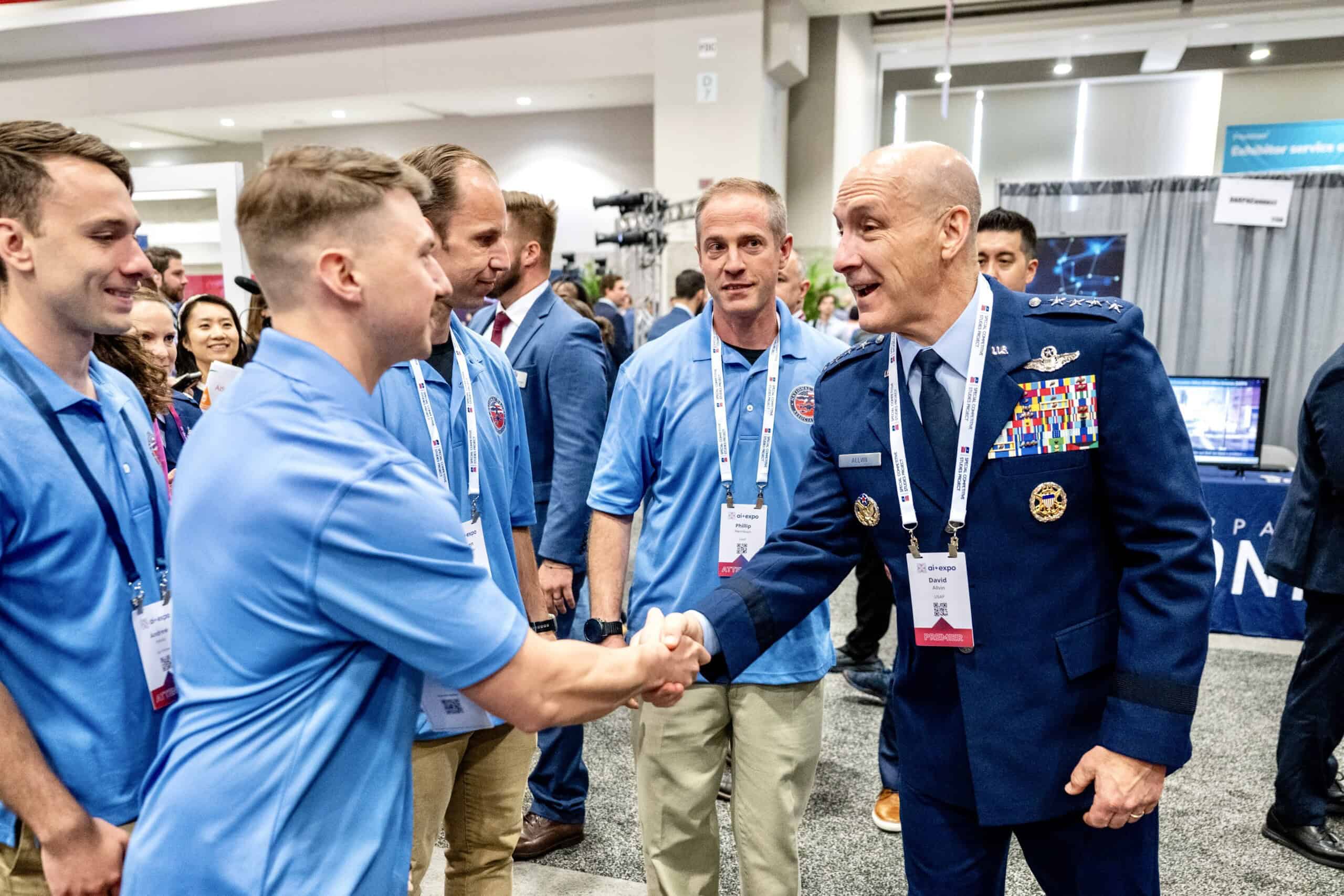
America’s ‘own military-civil fusion fair’ is back: bigger, burlier and buzzier. The AI+ Expo, one of the country’s largest confabs of artificial intelligence and defense companies, took place in Washington D.C. this week, once again drawing thousands of attendees including top U.S. officials and industry leaders.

Just like twelve months ago, competition with China was the common theme hanging over almost every discussion. But while attendees at last year’s inaugural event were still relatively sanguine about the U.S.’s lead over China across the tech and defense spectrum, the mood at this year’s expo — hosted by the Special Competitive Studies Project, a brainchild of former Google chief executive Eric Schmidt — had shifted.
A year ago, for example, speakers continued to predict that China’s AI industry was up to three years behind America’s. Alex Karp, the chief executive of data analytics firm Palantir, even confidently declared “there is no tech scene in China.”

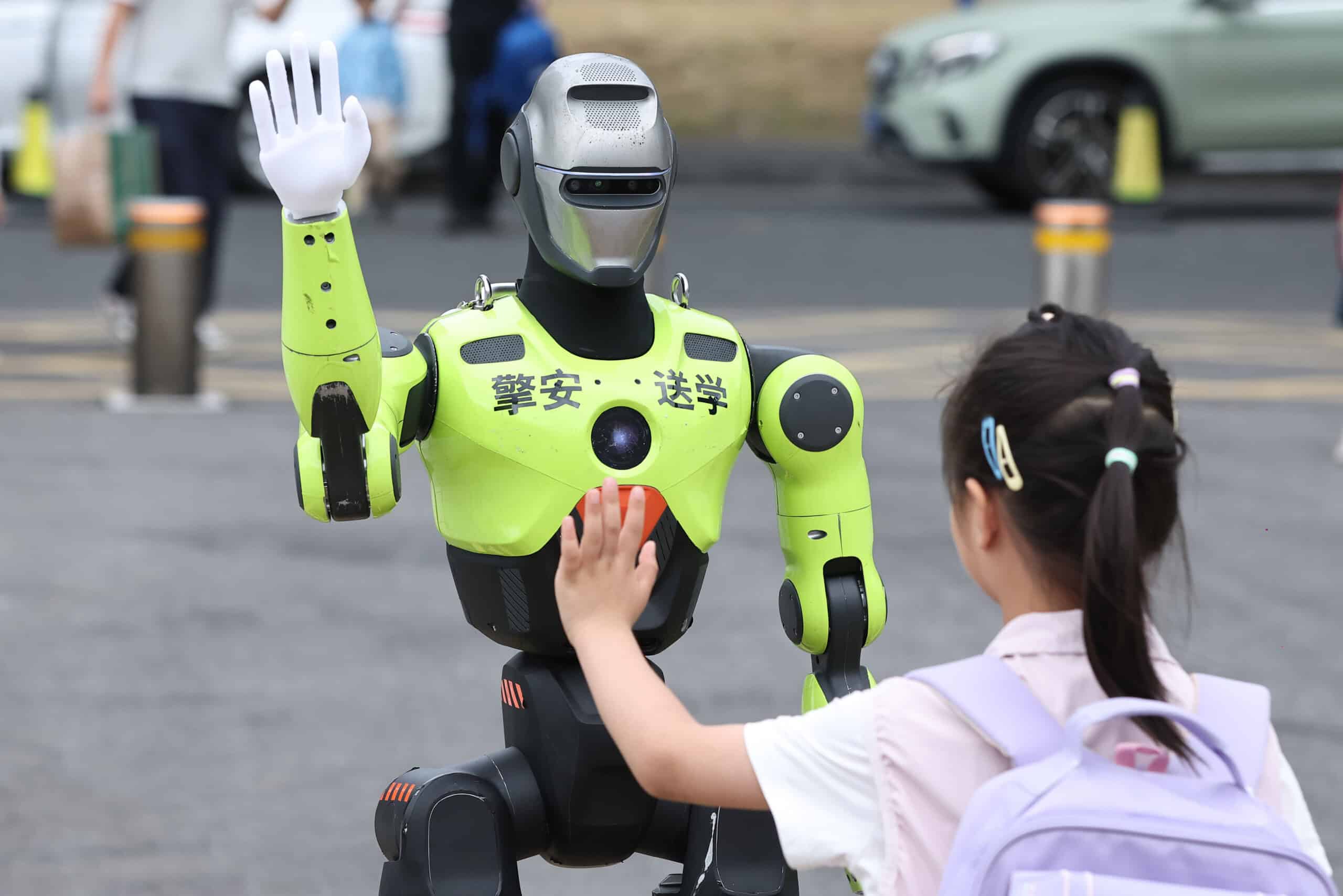
You would be hard pressed to find anyone repeating such claims now. On panels and across the exhibition floor, participants acknowledged China’s rise in sectors from open-source AI to semiconductors, drones and robotics — and the need for the U.S. to run faster to stay in the race.
“China is winning in terms of the quantity of innovation being generated,” said Dan Rosen, co-founder of consultancy Rhodium Group. “The U.S. still has an edge on quality, but that is in terrible peril right now of being squandered.”
(The Wire China’s sister company, WireScreen, was a conference sponsor. The Wire is editorially independent from WireScreen.)
I don’t think the U.S. is behind, but we’re playing one game. China is playing another. The U.S. has to get its act together on being able to manufacture efficiently and at scale.
Damion Shelton, chairman of humanoid robot maker Agility Robotics
The affinity between the defense industry and America’s most innovative sectors isn’t new: technologies such as the Internet and GPS were born from secret U.S. military research projects. But rarely have top military officials, defense contractors and tech and AI firms schmoozed so overtly in a public forum like the AI+ Expo — a sign of how great power competition with China has emboldened Silicon Valley to rally around the flag.

The sense that the U.S. needs to sharpen its competitive instincts to ‘outrun China’ — alongside uncertainty about whether and how that aim can be achieved given mixed political imperatives — extended both to the expo’s panels and its demonstration events.
In one venue, a row of servicemen from the various branches of the U.S. military donned virtual reality headsets to race custom-made drones around an aerial obstacle course set up by the U.S. National Drone Association (USNDA) — a new “competition and advocacy” group which aims to enhance the military’s ability to “compete and win in the modern drone defense era.” A representative said the association hoped eventually to expand such events into a countrywide drone “Superbowl.”
Yet these racing drones’ background illustrates the challenge the U.S. faces in developing its homegrown industry, given China’s supply chain dominance.

Their manufacturer, Virginia-based Building Momentum, boasts that its aircraft complies with recent legislation prohibiting the federal government from procuring drones with sensitive parts made in China, and that it sources some features from U.S. NATO ally Croatia. But with a $1,500 price tag, the drone costs three times as much as if the company had procured parts from China, Building Momentum’s chief strategy officer Cheyanne Dwyer told The Wire; had it used all-American parts, the drone would be priced another four times higher, she added.
Indeed, while the Pentagon’s sense of urgency towards supply chain reshoring has grown, there remains little idea of how to achieve that while bringing down industry costs, according to a USNDA representative who declined to be named.
In other areas, concerns about Chinese-made products are still protecting Western manufacturers — at least, for now.
Roaming the exhibition hall were two robotic dogs: One, a yellow steel and aluminum pooch called Spot, was made by the U.S.’s Boston Dynamics, and costs up to $250,000, according to Brendan Schulman, the company’s vice president of policy and government relations. The other — a red hound called the ANYmal from Zurich-based Swiss firm Anybotics — would set buyers back 300,000 euros (over $340,000), said company representative Paul Bingaman.
Equivalent products made in China, such as Hangzhou-based Unitree’s robodogs, are far cheaper, thanks in part to heavy state support for the robotics industry. Last October, the city police department in Pullman, Washington, announced it had purchased a Unitree Go2 robodog, which costs around $3,000.

Even so, Western robotics firms reckon their market shares are still relatively safe. “Our customers don’t consider anything that’s Chinese,” Anybotics’ Bingaman told The Wire. That is due both to quality and safety concerns, but also to the political risk involved in buying Chinese: Last month, the House Select Committee on the Chinese Communist Party urged three federal agencies to investigate Unitree for “advancing PRC military objectives.” Unitree has said its products are for civilian use and that it does not have relationships with military parties.
Most, though, acknowledge the mounting competition. “I don’t think the U.S. is behind, but we’re playing one game. China is playing another,” says Damion Shelton, chairman of humanoid robot maker Agility Robotics. “The U.S. has to get its act together on being able to manufacture efficiently and at scale.”

On stage, speakers often invoked “outrunning China” as a rallying cry, while the details of their speeches pointed to several unresolved policy and legal tensions.
U.S. energy secretary Chris Wright, for example, cited the need to outrun China to advocate for preserving energy tax credits for nuclear and geothermal power. Congressional Republicans are currently looking at repealing some of those tax credits, which were first enacted under the Biden administration’s 2022 Inflation Reduction Act.
Matt Pottinger, who served as U.S. deputy national security advisor in the first Trump administration, also used the ‘outrunning’ trope to argue against copyright holders who are suing AI firms like OpenAI and Meta for allegedly stealing their intellectual property.
If it’s scale we need, it’s scale of human resources and talent. It’s about knowing how to involve foreign nationals including Chinese nationals in deepening innovation, rather than fecklessly pulling the plug on it all and saying we should do this ourselves.
Dan Rosen, co-founder of consultancy Rhodium Group
“Let’s not make the disadvantage [against China] worse by not letting our AI models train on all that data,” he said.

Less discussed at the conference — at least publicly — was how the federal government’s cuts to scientific funding and crackdown on foreign students could undermine the U.S.’s efforts to compete. Secretary Wright, for example, extolled the value of America’s national research laboratories, saying “basic science is critical to what the labs are and what government-funded science should be doing.”
Meanwhile, the White House’s budget request for the 2026 fiscal year would more than halve the budget of the National Science Foundation and cut key research programs overseen by the Department of Energy. Others have warned that Trump’s immigration crackdown could choke America’s pipeline of inventors.
At a panel on nuclear fusion, Egemen Koleman, an associate professor at Princeton University, provided a reminder of what happens when ambitions to compete on cutting-edge technologies run up against political realities. “If you look at the budget request, it says we’ll make cuts except for AI, fusion and quantum. Okay, I work on AI for fusion and we just had a paper out on quantum. And all of my budget has been cut. So things fall through the cracks.”
Rhodium’s Rosen, meanwhile, was more open in acknowledging the issues.
“Let’s not needlessly and frivolously fritter away our [science lead]. If it’s scale we need, it’s scale of human resources and talent,” he said. “It’s about knowing how to involve foreign nationals including Chinese nationals in deepening innovation, rather than fecklessly pulling the plug on it all and saying we should do this ourselves.”

Eliot Chen is a Toronto-based staff writer at The Wire. Previously, he was a researcher at the Center for Strategic and International Studies’ Human Rights Initiative and MacroPolo. @eliotcxchen

Noah Berman is a staff writer for The Wire based in New York. He previously wrote about economics and technology at the Council on Foreign Relations. His work has appeared in the Boston Globe and PBS News. He graduated from Georgetown University.