Lawrence H. Summers has played a leading role in Democratic Party policy making since the 1980s. A wunderkind economist, Summers, at age 28, became the youngest tenured professor in Harvard University’s history in 1983. He joined the Clinton administration in 1993 as Treasury’s undersecretary for international affairs. During his time as deputy Treasury secretary, Time magazine lionized him, Treasury Secretary Robert Rubin and Federal Reserve Chairman Alan Greenspan as “The Committee to Save the World” for their work on the Asian and Russian financial crisis in 1997. As Treasury Secretary in 1999, Summers played an important role in finishing negotiations with China for its entry into the World Trade Organization. In 2009, he was named director of President Obama’s National Economic Council as it dealt with the Global Financial Crisis. After a controversial stint as the president of Harvard University, where he had run-ins with progressive faculty, he has returned to his academic roots, and is now the Charles W. Eliot University professor. Recently he urged the Biden administration and the Fed to focus on inflation before either gave it much attention. This interview is part of Rules of Engagement, a new series by Bob Davis, who covered the U.S.-China relationship at The Wall Street Journal starting in the 1990s. In these interviews, Davis asks current and former U.S. officials and policymakers what went right, what went wrong and what comes next.

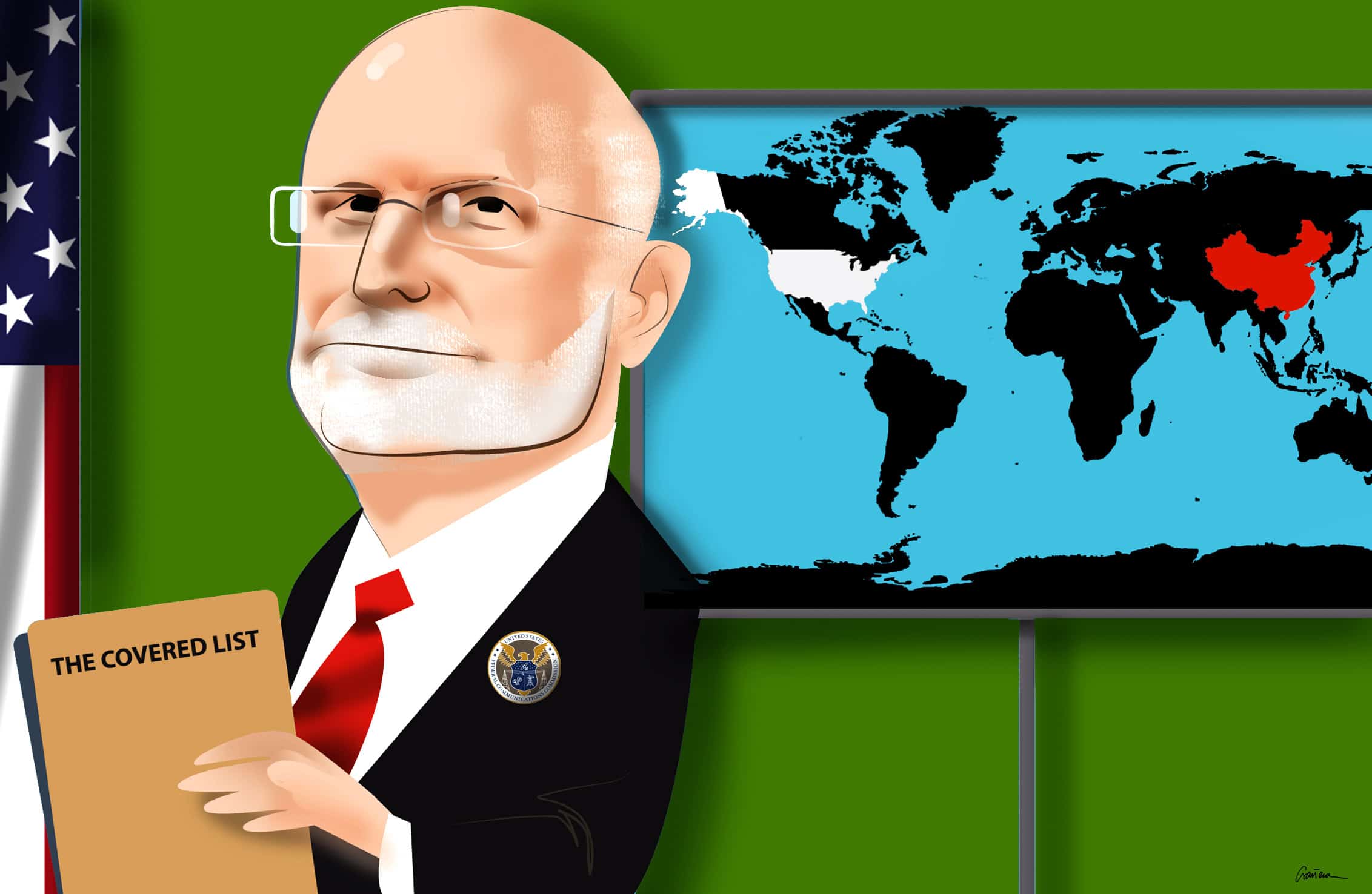
Illustrated by Lauren Crow
Q: It used to be said regularly that an economically strong China is in the U.S.’s interests. Do you think that’s still true?
A: I think a policy where our objective would be to cause them to be poor would be a grave error for the United States. Our interests are more complex. China is both our competitor and our customer. It’s good when your customer gets richer. It’s bad when your competitor gets more effective.
It is probably still the case that there is sufficiently little overlap between what we make and sell, and what China makes and sells that their greater prosperity is a larger positive for us. But there is more than the narrow economic point of view here; there’s obviously a geopolitical dimension. And depending upon how much one regards China as having imperial aspirations around the world, the more one would be concerned about their economic success.
Going back to the Clinton administration, Japan was clearly the target of aggressive U.S. economic policy. Is there something you learned from that period that informs how we should deal with China?
I’m going to answer that in a slightly broader context. There are things to learn from the post-Sputnik period, and there are things to learn from Japan, and they’re actually quite similar. When we terrify ourselves about a potential economic adversary — whose economy is in fact mean reverting and struggling quite substantially — there can be serious effects.
![]() |
|
| Illustration by Sam Ward. | |
| More in this series: | |
| Charlene Barshefsky on Why Engagement with China is More Important Than Ever |
![]() |
| Matthew Pottinger on Flipping the U.S.-China Paradigm on its Head |
![]() |
Part of what drove the Cuban Missile Crisis was Khrushchev’s concern that the Soviet Union couldn’t keep up. The United States had declared a missile gap and rallied itself around Sputnik [The Soviet Union had launched the first man-made satellite, Sputnik, in 1957, prompting the U.S. to invest more in defense]. Khrushchev had to do something in the window of opportunity he had. That was probably the most dangerous moment in the history of humanity.
In retrospect, nothing in all our truculence towards Japan looks to have been particularly productive or constructive. The emblematic example for me is George Fisher [the CEO of Kodak Corp. from 1993-2000]. Kodak made an enormous fuss and had many officials in Washington consumed with Kodak’s concern about Fuji [Corp.’s] unfair trade practices in restricting the Japanese market for [photographic] film. If the Kodak Corporation had stayed away from Washington and focused on the patents on digital photography that were in their laboratories, but which did not receive nearly as much executive attention as this trade dispute, it’s hard not to believe that Kodak would be a viable and strong operating entity today.
| BIO AT A GLANCE | |
|---|---|
| AGE | 67 |
| BIRTHPLACE | New Haven, CT, USA |
| CURRENT POSITIONS | President Emeritus and Charles W. Eliot University Professor at Harvard University. |
| MARITAL STATUS | Married to Elisa F. New. |
The lesson to learn from both the Japanese experience and the Russian experience is to be very careful about exaggerating threats and generating truculence in response. That could lead insecure powers to a high level of threat, aggressiveness, and truculence vis-a-vis the United States.
But isn’t there another way of looking at this? The United States does seem to work itself into a frenzy over threats, but sometimes that has positive side-effects. Sputnik generated a huge amount of effort in technology. One could argue that Reagan’s obsession with the Strategic Defense Initiative contributed to the end of the Cold War. [The Strategic Defense Initiative, popularly called Star Wars, was President Reagan’s effort to create a space-based missile defense system.]
The Sputnik example is more relevant. In the case of Reagan, that was a strategy of seeing economic weakness and pressing forward in an area where the Soviets were going to have great difficulty competing by enunciating a visionary project involving information technology.
Sputnik and the Japanese examples are relevant and clearly there is energy to be derived [from a foreign challenge]. Absolutely, we should be strengthening our capacity to innovate. We should be strengthening our investments in engineering and infrastructure by an order of magnitude in order to compete.
But the art of policy is to balance drawing energy from national security and competitiveness concerns. That is clearly the right thing to do. But that has to be balanced against setting off cycles of hostility and insecurity that can have potentially catastrophic consequences.
| MISCELLANEA | |
|---|---|
| FAVORITE BOOK | The General Theory of Employment, Interest and Money by John Maynard Keynes |
| FAVORITE MUSIC | Beethoven |
| FAVORITE FILM | Rocky |
| PERSONAL HEROES | My parents, who were both economists. |
After the Cuban Missile Crisis [in 1962], there was a very substantial evolution in President Kennedy’s approach away from missile-gap rhetoric towards emphasis on a Nuclear Test Ban Treaty. There were also a variety of other ways of trying to increase communication channels with the Soviet Union.
The nature of our current problem is obviously one of balance. I am more concerned that on a bipartisan basis, the balance is tilting away from constructive [efforts to deal with adversaries] and the maintenance of contact towards vilification and provocation.
One of the early decisions the Clinton administration made was to delink human rights from trade with China. When you think back to that decision, do you think one of the takeaways, from the Chinese point of view, was that human rights issues will always be trumped by commercial interests in Washington?
It’s always a mistake to make threats and then not keep them. And there were a set of threats [to cut off trade with China unless it eased repression] that were made during the Clinton campaign that were then reconsidered in the first two years of the administration.
Carrying out those threats would have had catastrophic consequences for Hong Kong, which was still at that point a British colony, and for all our allies in Asia. I suspect ultimately [the threats] would not have been successful in generating any improvement in Chinese human rights, which, while deplorable, were substantially better than they had been at the time when Nixon opened to China.
I don’t think there was any viable alternative to the approach that was pursued. There was a desire in the Clinton administration which ultimately didn’t prove very successful, to use a bit of leverage to get as much as we could. But we couldn’t get much because it was fundamentally not a very credible threat, given our own interests. If we delinked completely, then we’d have no leverage at all, because then there would have been no economic interaction to hold hostage.

I remember being visited by freedom-fighting Hong Kong people who hated the Chinese, who had been jailed by the Chinese. They told me there was no choice but to grant China MFN [Most Favored Nation status means imports face the lowest tariffs the U.S. offers any nation].
It’s not like when the threat was made [to cut off MFN if China didn’t improve human rights], that there was any careful strategic calculation. The policy and the threat were conceived thoughtlessly.
The difference between then and now, is that even among the people who didn’t like the Clinton MFN policy, there was still some feeling back then that economic liberalization was going to lead to political and human rights liberalization. It just does not seem to have worked out. So the question is, what else could have been done?
I’m influenced by when we architected our policy to isolate Castro in 1959. If you had told the people who designed that policy that the Soviet Union was going to collapse, that there were going to be McDonald’s all over Red China, that there were going to be 300,000 Chinese students in the United States, and Castro would still be there violating human rights, I don’t think they would have thought they were embarking on such a smart policy.
The most prominent cases where we’ve been focused on isolation — Cuba, North Korea, Iran — have all been complete disasters on human rights. Maybe there would have been a better way. But you have to consider the fact that when we really went all in and had more leverage on human rights, it turned out to be terrible for human rights.
One of the big initiatives in the Clinton administration was negotiating with China to join the World Trade Organization. You and Treasury Secretary Bob Rubin, and others who dealt with Chinese Premier Zhu Rongji were quite impressed with him. What were your impressions?
Of the people who have been the No. 1 or No. 2 person in China, he is the one who I knew by far the best. He was extraordinarily impressive in his understanding of economic modes of reasoning, and in his command of detail around the specific provisions that go into negotiation, and he obviously had a deep political perspective from which he was approaching reform. From his point of view, a significant benefit of the WTO accession was the reform it was going to necessitate in China. He was using what the Japanese call gaiatsu [foreign pressure] to drive a domestic agenda.
After the U.S. mistakenly bombed the Chinese embassy in Yugoslavia in May 1999 and the WTO deal looked like it was going to fall apart, you were the first cabinet official to go to China to try to smooth things over in Oct. 1999. You were then Treasury Secretary and met with Zhu. What happened?
After the Belgrade bombing, there was an APEC [Asia-Pacific Economic Cooperation] meeting in Auckland [in Sept. 1999], that was attended by trade ministers from the U.S., China, and other nations. That went nowhere on the WTO issue.
We had an ongoing financial dialogue with the Chinese, so I had a reason to go to China. The decision was made to send me with a letter from President Clinton. I can’t remember whether the letter was addressed to Zhu Rongji or [Chinese President] Jiang Zemin, but my dialogue was with Zhu. At the time of my trip, he was taking a tour of the depressed regions of China. The Chinese arranged the Chinese military plane to take me and our delegation, which was probably 20 to 25 people, to Lanzhou [in Western China], where he happened to be.

Lanzhou was probably the Amarillo, Texas of China at that time. It was quite an implausible place for an American to be visiting. But my delegation and I met for three-and-a-half hours and then two more hours over lunch with Zhu Rongji. The discussions began with my talking about the letter that President Clinton had sent. Then we discussed a range of the specific issues. We discussed Chinese frustrations with the process as it had played out in April during Zhu Rongji’s visit to Washington. [Editor note: Clinton told Zhu he wasn’t ready to sign a WTO deal and sent him home empty handed].
The lunch was a more broad-ranging conversation about how we saw the world and larger issues between the United States and China. While there certainly wasn’t any agreement — and the ultimate diplomacy that concluded the agreement was done by [U.S. Trade Representative] Charlene Barshefsky — it’s fair to say that after that meeting, because of the President’s letter, it looked like the talks were back on track at a high political level. The question was whether the details could be worked through, which fortunately they ultimately were.
[Editor’s Note: After the interview, Charlene Barshefsky said about the Lanzhou letter Summers was carrying: “I am almost positive that the letter was to Jiang. A number of us had a hand in crafting it. I recall that it preceded a call between Clinton and Jiang, which then was used to restart talks.” Summers agreed that was correct.]
There is a view that China cheated its way to prosperity by ripping off American intellectual property, through subsidies, and by all sorts of improper ways. Do you think our engagement with China has worked for U.S. interests?
This may be the most important thing I’m going to say in this interview. You have to consider alternatives and counterfactuals. The United States had granted China MFN. It had become routine. There was no prospect in anybody’s mind that MFN was going to be interfered with.
I believe the concessions that China made to join the WTO led to more exports from the United States, more fair competition between American companies and Chinese companies, and more discipline over a range of Chinese subsidy activities than would have taken place if China had not made any commitments, and if there had been no multilateral mechanism for engaging with China.
The question isn’t, ‘Would it somehow have been better if China had not had access to the U.S. market in the context of China’s WTO accession?’ All the privileges associated with being a WTO member had already been granted to China. I believe the concessions that China made to join the WTO led to more exports from the United States, more fair competition between American companies and Chinese companies, and more discipline over a range of Chinese subsidy activities than would have taken place if China had not made any commitments, and if there had been no multilateral mechanism for engaging with China.
Of course the Chinese stole intellectual property. Of course there was damage done to the United States, and to particular areas in the United States, by exports from China. Of course there was less-than-perfect compliance with a range of commitments that had been made. But that’s not the question. The question is whether our interests were better served by having made that deal [compared to whether] our interests would have been served better in a regime where they had MFN access to our market, but we would have extracted no commitments from them; would have had no multilateral mechanism for continued engagement; and where we would have projected an active desire to hold them down. That would have been an extremely serious error, which would have led to less favorable American economic interests and a more vexed security relationship over the last 20 years.

The case for this agreement does not rest on the Chinese being our friends. It does not rest on the Chinese being entirely faithful in carrying out agreements. It rests on a comparison of the alternative of reaching the agreement and not reaching the agreement.
Let’s move on to the Obama administration and its dealing with the global financial crisis. A Group-of-20 meeting in London in April 2009 was enormously important in terms of getting commitments about spurring economic growth. As head of the National Economic Council, were you talking directly with Chinese officials? What role do you think China played in dealing with a crisis that was clearly made in the U.S.?
I had some conversations with Chinese officials. Many more conversations were held by Mike Froman, who was the president’s Sherpa [The U.S. official responsible for arranging international economic conferences.] Froman was reporting to me at the NEC and Jim Jones, at the National Security Council. And of course, the senior financial communications were of course had by [Treasury Secretary] Tim Geithner.

Our strategy of seeking to engage China in being a source of demand-led growth around the world and encouraging China to undertake fiscal stimulus in its own interests and in the interests of the global economy was a successful strategy. [China launched a near-$600 billion fiscal stimulus in late 2008]. The recovery globally was accelerated relative to what would have happened if China had not engaged in that fiscal stimulus, both because the Chinese market grew more rapidly and because more of Chinese production fell on domestic demand rather than being sold abroad in ways that would have reduced demand in the rest of the world.
Given the poor relations between the U.S. and China today, and given that China is perhaps less capable of economic stimulus than it was, are you concerned that if there was another global financial crisis that China wouldn’t be helpful in the same way?
It’s hard to imagine a circumstance like 2009 arising again. For one thing, this time around China is much more likely to be part of the problem rather than central to any solution. For another, the whole relationship has become much more adversarial than it was previously. That’s why I emphasized that our interaction with China should be focused towards mutual respect. Too often, the U.S. way of strategy is to develop a wish list and call it a strategy without considering what concessions we’re prepared to make, and without considering what leverage we do or do not have. So I’m concerned about our capacity for joint action with the Chinese in situations where that’s very much in our interest.
If we engage in rhetoric that is easy to hear as reflecting a desire to see them fail, we run the risk of undermining the possibility of cooperation.
You just said if there was a global problem, China might be one of the contributors to it. Why?
There are risks to financial stability emanating from China. There are substantial Chinese exposures in a significant number of emerging markets. Whereas China as a creditor was not an important factor in previous waves of debt default, if [the world] were to encounter a wave of debt default going forward, Chinese creditors and their cooperation or non-cooperation with other creditors in the kinds of restructurings that were used in the Asian financial crisis [in 1997] would be a very important issue.
What would you advise China to do to reduce the chance of defaults becoming a problem?
The quality of the Chinese track record [of handling economic problems], my ignorance of the Chinese language and the fact I haven’t been able to be in China for several years because of Covid, makes me timid in offering advice. But it seems to me that China is making some of the mistakes that Japan made in the early years of its challenges after the bubble burst in 1989. It is focusing on preserving economic activity rather than operating market-oriented systems that select ruthlessly for the strongest, best and most efficient economic activity. It seems to me, as an outsider, that’s something that needs to be very carefully considered by the Chinese as they go forward.
Even as we compete brutally in information technology and other areas, I would hope that on issues like the restructuring of sovereign debt, the financing of climate change investments across the developing world, the provision of screening tests and vaccines for the next pandemic when it comes, that we are able to maintain cooperation with the Chinese. Even though our interests are hardly identical, there are significant positive-sum aspects. If we engage in rhetoric that is easy to hear as reflecting a desire to see them fail, we run the risk of undermining the possibility of cooperation.

Back in the Clinton administration, I remember you musing that the Chinese economy would probably fall back to a growth rate that is normal for big countries. But you also thought there was a chance that China might have come up with a super-charged way to grow. Where do you think we are now when it comes to China’s growth?
No one knows, and confident prediction is a mistake. In the 1990s, when there was a ton of reformist energy, a staggering work ethic, a big advantage [for China] from relatively low wages, and a world eager for an inexpensive workshop, it was reasonable to see a significant prospect of very rapid growth for quite some time to come, though it certainly was not assured.
Now, the likely probabilities are on the side of mean reversion [meaning that China’s growth will start to resemble the much slower growth of big, advanced economies. Summers explored this issue in a paper with Lant Pritchett].
China is much richer now. Their dependency ratio, [the average number of children and elderly supported by each worker], which was plummeting because of the one-child policy through the ‘90s and the decade of the naughts, is now rising incredibly rapidly. The consumption/GDP share, which was low in the ‘90s, is now even lower.

There are also limits to what the world is prepared to take in terms of exports from China. Wages have risen to the point where they’re much less competitive than they were. There are also very substantial diminishing returns to infrastructure investment. And when there’s a population the size of Germany full of empty apartment units, there is limited scope for further real estate investment.
There is also a set of problems in terms of maintaining state control over an increasingly sophisticated, information technology-based economy which has caused them to move back very substantially from the market-oriented reforms of the Zhu Rongji period. [Zhu was premier from 1998 to 2003.]
For all those reasons, there’s a substantial chance that historians will look back and say that the conventional wisdom that got Russia’s economic prospects egregiously wrong after Sputnik, and got Japan’s economic prospects egregiously wrong after the big run-up in asset prices when the land under the Imperial Palace was worth more than all the land in California, was also largely too optimistic about China’s economic prospects.
I don’t think it would be responsible for U.S. policy makers to assume that the Chinese economy is going to have a very difficult decade. But it would be an equally great error to assume that rapid Chinese growth, economic strength, and technological leadership will be the dominant problem regarding our relationship with China.
The U.S.’s long-term potential growth rate is seen as being roughly 2 percent per year. Do you think that China would be roughly in that ballpark?
It could come down into that range. It’s a bit more of a complicated calculation because they will have a shrinking labor force, whereas we still have a slowly expanding labor force.
We need to recognize that the 30 years of [strong] Soviet economic performance between 1960 and 1990 would have been regarded as inconceivable by Sovietologists in 1990 [as growth collapsed]. And the low-end scenarios for Japan in 1990 were for 3 percent annual growth, whereas they didn’t get 1 percent over the next several decades. So we need to be open to a very wide range of possibilities, which of course include the upside possibilities.
One of the decisions in front of the Biden administration is whether to eliminate tariffs that were imposed on China during the Trump years. Do you think they should remove those tariffs; and if they are eliminated, do you think that would have a significant effect on inflation?

I was very involved in encouraging and reviewing the Peterson Institute [for International Economics] study that found that a well-designed tariff reduction program that was short of removing all the Trump tariffs could take 1.3 percent off the CPI [Consumer Price Index] over time. That’s not breaking the back of inflation and it’s only a one-time gain. But in the context of what we’re going through with respect to inflation, that’s something that’s significant and meaningful.
I don’t think the tariffs are strategic. What you want to do, as strategy, is find measures that are painful to your adversary but not so painful to yourself. Many of these tariffs are actually much more painful to us than they are to the Chinese because they hurt our exporters and make them less competitive, because they have access only to higher cost inputs.
I would favor a reform to make the tariffs much more strategic by making clear the areas in which Chinese behavior is unacceptable and where we’re prepared to retaliate. And we should be looking with particular importance at possible leakages to China of information that is sensitive for national security, through whatever kinds of means, involving both Chinese investments here and our investment there. We can maintain pressure on China in ways that are much less burdensome for us economically, and much more directed at our fundamental economic interests.
You have talked publicly about how Xi Jinping and Vladimir Putin have met something like 38 times in the past decade while no U.S. president has met any foreign leader to that extent in a 10-year period. What is the significance?
The first principle of any multipolar system, whether it’s between countries or between companies, is that you want to unify your friends and divide your adversary. The master stroke of the Nixon-Kissinger opening to China in 1970 was not any kind of deep affinity between Mao Zedong’s China, running up to the Cultural Revolution, and the United States. It was a moment when there was a very fundamental nuclear triangle involving the United States, Russia, and China. It shortened the axis between the United States and China and lengthened the axis between China and Russia. In that sense, it isolated our adversary and empowered us.
There are risks to financial stability emanating from China… it seems to me that China is making some of the mistakes that Japan made.

Now it’s a very different world. Russia and China are very differently configured than they were at that time. But the concern about the strategies we have pursued in recent years, and the paradigm of framing matters in terms of a conflict between democracy and autocracy rather than a conflict between allies and adversaries, is that it unifies our adversaries relative to ourselves. We need to think about that very, very carefully.
I like to call this the post-post Cold War world. We’ve been living in the post-Cold War world, and we haven’t really quite defined that period. For a time, it looked like it was going to be a hegemonic U.S. But it certainly stopped looking like that some years ago. It’s very, very likely we’re headed into something quite different.
It has to be of concern if major countries that don’t consistently wish us well are getting closer to each other than they are to us. The Russia-China axis is the most important part of that. But the fact that a majority of the world’s people in the U.N. General Assembly were not prepared to support us in our efforts, vis-a-vis Putin’s aggression in Ukraine, is a further manifestation of this kind of challenge.
It sounds like your basic message to the Biden administration is that when it comes to China, turn down the heat, at least rhetorically.
It’s to do what they want to do — be as genuinely strategic as possible. That means calculating what our most fundamental interests are, what our leverage is, and what concessions we’re prepared to make. Simply enunciating all the things that we want is a first step in formulating a strategy. But no strategy in any sphere is simply a wish list.

Bob Davis, a former correspondent at The Wall Street Journal, covered U.S.-China relations beginning in the 1990s. He co-authored “Superpower Showdown,” with Lingling Wei, which chronicles the two nations’ economic and trade rivalry.