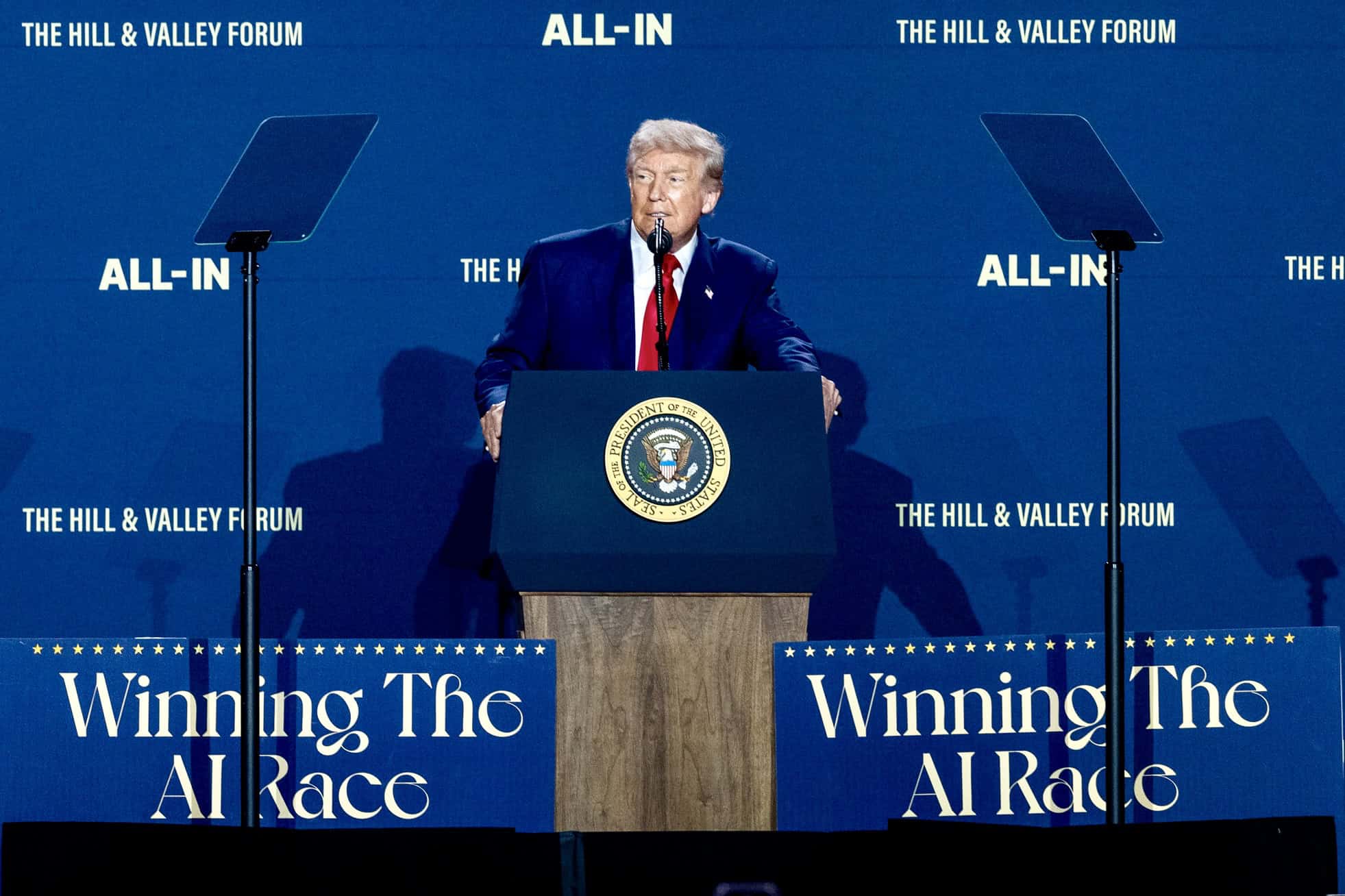
As the global AI race heats up, so has the scramble to secure AI sovereignty. Even before the dust had settled on SpaceX’s IPO, the Trump administration was reportedly holding discussions with OpenAI and other major AI labs about potentially acquiring an equity stake before they, too, go public. Similarly, China’s state-backed National Artificial Intelligence Industry Investment Fund is reportedly finalizing talks to invest in DeepSeek’s first outside funding round.

At first glance, these parallel moves suggest a convergence between the world’s two leading AI powers. But a closer look reveals stark differences in their underlying strategies for securing AI sovereignty.
In the United States, there appears to be an emerging coalition comprising politicians from both the left and the right — including Donald Trump and the left-leaning Senator Bernie Sanders — around the idea that a public or sovereign wealth fund could help ordinary citizens share in the potentially massive wealth generated by AI.
Radical as such a proposal may sound, it could happen, especially considering that both OpenAI and Anthropic have endorsed similar ideas. But once the government takes a stake in an AI lab, it creates a conflict of interest. It may think twice before intervening aggressively against the company, whether on safety, antitrust, content regulation, or other grounds.

Moreover, such an arrangement might create AI firms that are “too big to fail.” OpenAI’s chief financial officer, Sarah Friar, already caused controversy last year when she suggested that a federal “backstop” could help finance the computing infrastructure to power the firm’s AI development. Critics in the U.S. thus have begun to point to the Chinese experience, highlighting the inefficiencies of state investment and the widespread corruption and financial waste that plagued the state-backed semiconductor funds that preceded the national AI fund.
But this argument overlooks the recent pivot in China’s innovation strategy, which is best described as “platform state capitalism.” As S. Alex Yang of the London Business School and I have argued, China’s government manages its massive innovation ecosystem much like a large digital platform. After using subsidies and other incentives to entice firms to join, the government applies regulation to govern interactions among platform participants, then imposes strict exit controls to maintain its competitive moat. The same logic applies to state investments.
It is therefore naive to view China’s recent move to invest in DeepSeek as a simple attempt to support a national champion. Instead, China is nurturing a broader AI ecosystem and coordinating DeepSeek’s product development more closely with the rest of the AI supply chain.
Before examining more closely how the platform state operates, it helps to look at the Chinese Big Tech companies’ common practices. Above all, these firms have invested billions of dollars not only to earn financial returns, but also to build and strengthen their own ecosystems. Alibaba, for example, has reportedly invested in most of China’s leading AI labs, including Moonshot AI, MiniMax, and Zhipu. Some of these investments have been delivered partly in the form of cloud computing credits, thus locking startups into Alibaba’s own cloud infrastructure. Notably, one finds a similar phenomenon in the U.S., where Nvidia, Google, and Microsoft have each invested heavily in leading AI labs.
China’s national AI fund is adopting a similar strategy. The fund was launched in early 2025 with initial capital of CN¥60 billion ($8.2 billion), which came from the third phase of the government’s massive semiconductor fund (Big Fund III). This origin story sheds light on the new fund’s mission. Like Big Fund III, whose objective was to reduce reliance on external chip suppliers and build a more resilient domestic ecosystem, the new fund is guided by the quest for self-sufficiency, with investments targeting companies across the entire AI ecosystem, from semiconductor design to AI applications.
Seen in this light, the national AI fund’s planned investment in DeepSeek can be understood as a form of platform governance. By giving financial support to a platform complementor, the state can ensure that the firm’s product development aligns with China’s broader strategic interests. The more DeepSeek’s models, which are open source and widely used around the world, are optimized for domestic chips, the more they can stimulate demand for domestic hardware and incentivize developers to build around China’s AI stack.

DeepSeek is already moving in this direction by collaborating closely with Huawei on its latest V4 models, which have reportedly been adapted to run on Huawei’s Ascend chips, China’s best homegrown alternative to Nvidia’s chips. It is therefore naive to view China’s recent move to invest in DeepSeek as a simple attempt to support a national champion. Instead, China is nurturing a broader AI ecosystem and coordinating DeepSeek’s product development more closely with the rest of the AI supply chain.
That means Chinese state investment should not be dismissed as another case of inefficient resource allocation. As America debates whether and how the government should invest in its leading AI firms, China’s systematic approach to capital investment deserves closer attention. Otherwise, the U.S. may end up embracing an old-fashioned version of state capitalism just as China moves toward a more sophisticated model.
Copyright: Project Syndicate, 2026.

Angela Huyue Zhang, Professor of Law at the University of Southern California, is the author of High Wire: How China Regulates Big Tech and Governs Its Economy (Oxford University Press, 2024) and Chinese Antitrust Exceptionalism: How the Rise of China Challenges Global Regulation (Oxford University Press, 2021).