
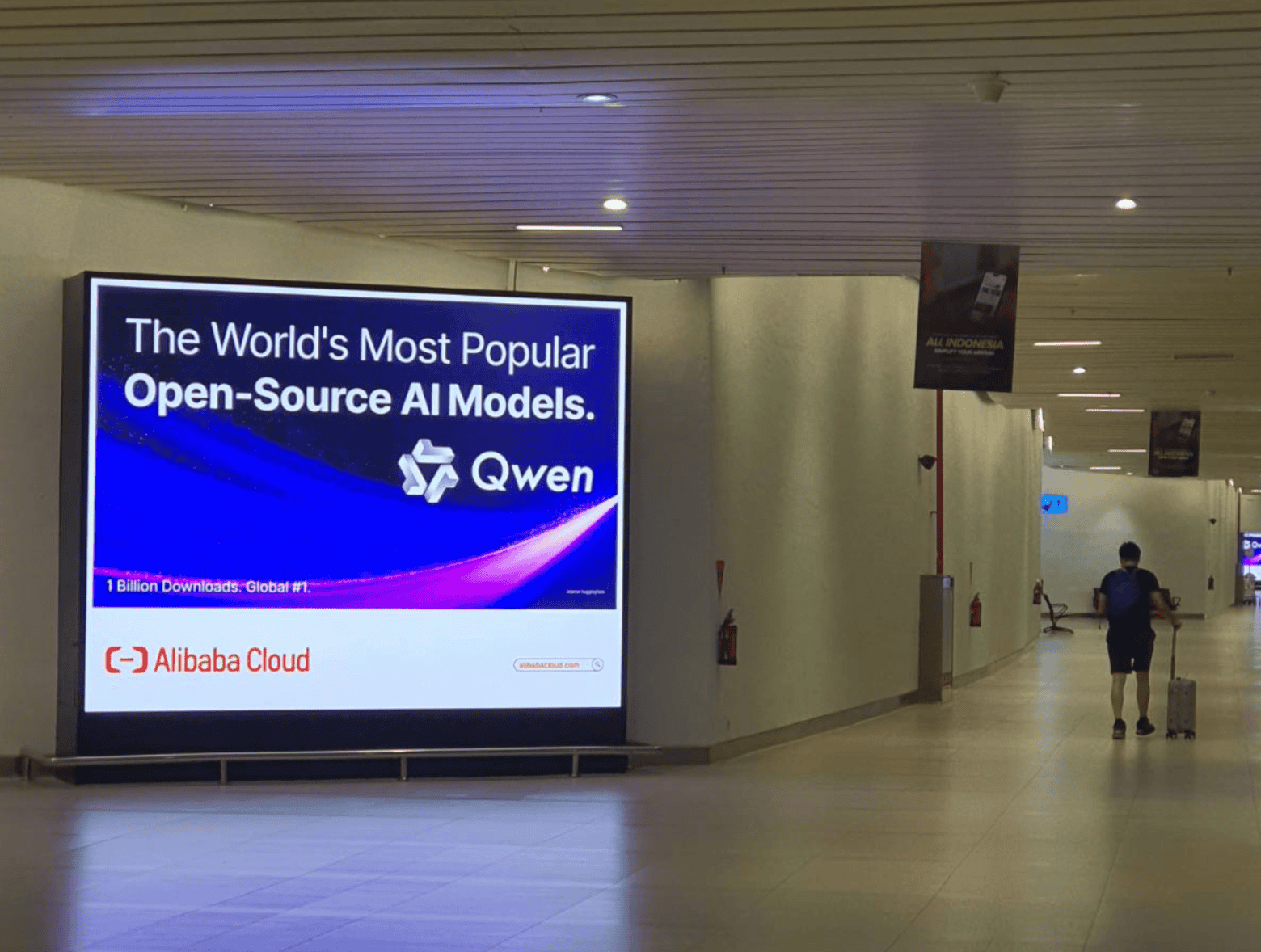
The long corridors in Jakarta’s Soekarno-Hatta International Airport display billboard after billboard from Chinese tech giants Huawei and Alibaba, advertising their AI models and partnerships with Indonesian companies.
Four years ago U.S. models accounted for 60 percent of downloads from platforms such as Hugging Face; now they account for just 16 percent. The reason for this Chinese surge is cost. While developers in Indonesia think Anthropic’s Claude is a better quality AI model, “they will always pick the cheapest one,” says Christian Guntur Lebang at Lab45, a Jakarta think tank.
Unlike “closed-source” U.S. offerings from Anthropic or OpenAI, open-source models from Alibaba or DeepSeek can be used and modified for free, or accessed by developers via an AI lab’s “application programming interface” (API) at a fraction of the cost of Western AI models.
“Open-source” is a loose term, generally referring to AI models that publicly release all of their training data, code and architecture.
U.S. companies tend to guard their ingredients more closely than Chinese ones; Chinese models usually have more permissive licenses allowing users to modify their parameters, also known as “weights”. But even though open-source or kai yuan has become the term commonly used in China, AI professionals refer to Chinese models as “open-weight” ones because their developers do not release core information such as training data.

Speaking at a Politburo meeting on AI in 2018, President Xi Jinping said AI leadership would give a “lead goose effect”, forcing other countries to follow its lead, the same way a goose flying at the head of a flock (tou yan in Chinese) controls its direction.
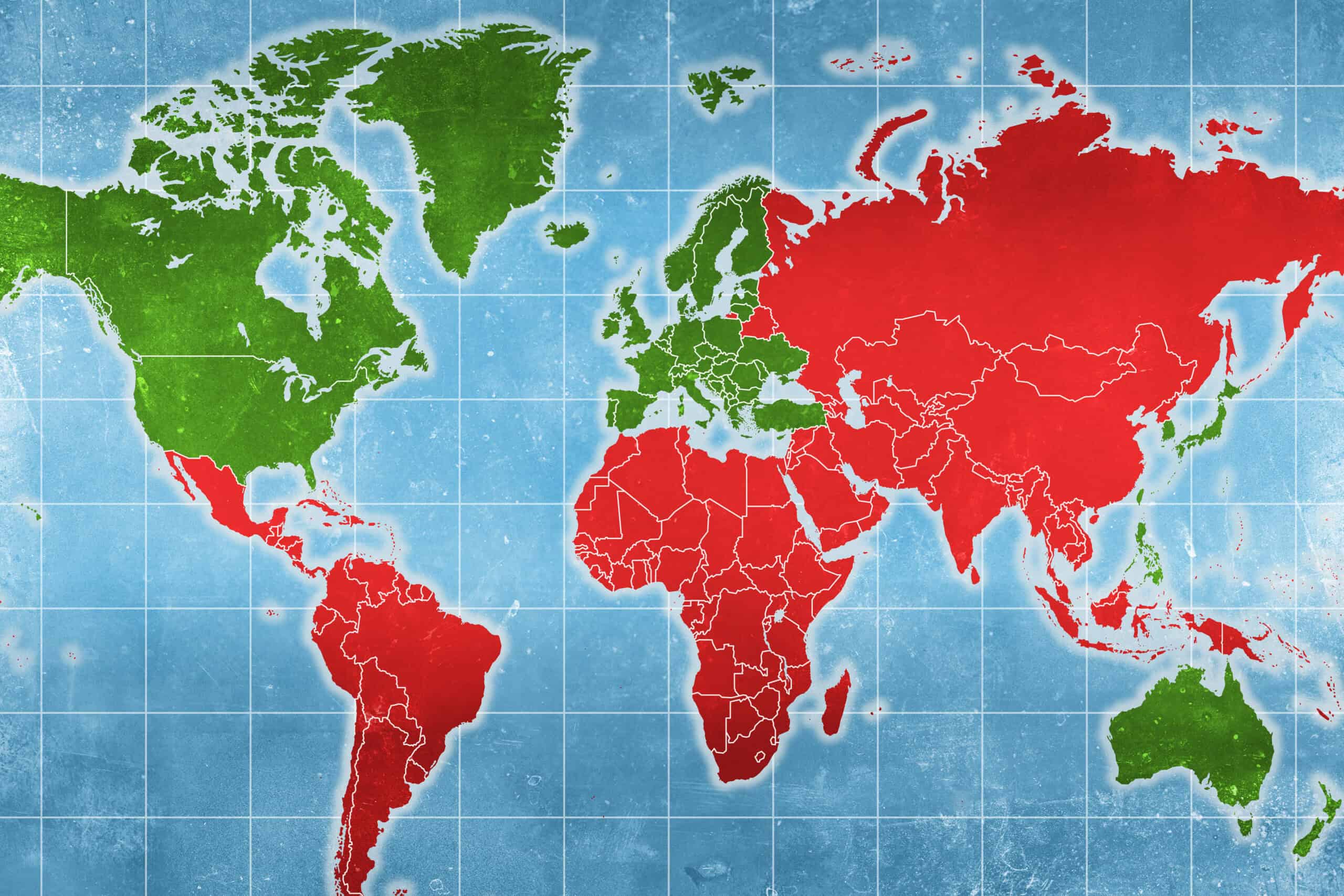
The so-called “Global South”, especially the large developing nations of Southeast Asia, Africa and South America, is key to the Chinese Communist Party’s AI ambitions. (The Philippines and Turkey are awkward exceptions for China given their strategic defense alliances with the U.S., and the former’s bitterness over Chinese encroachment in the South China Sea.)
Like Mao Zedong’s famous revolutionary strategy of “surrounding the cities from the countryside”, Beijing hopes that Chinese AI will similarly prevail against American AI. If so, it would be similar to how demand from the Global South allowed China to reap the world’s first trillion-dollar mercantile trade surpluses even as Donald Trump’s trade wars reduced China’s exports to the world’s richest economy.
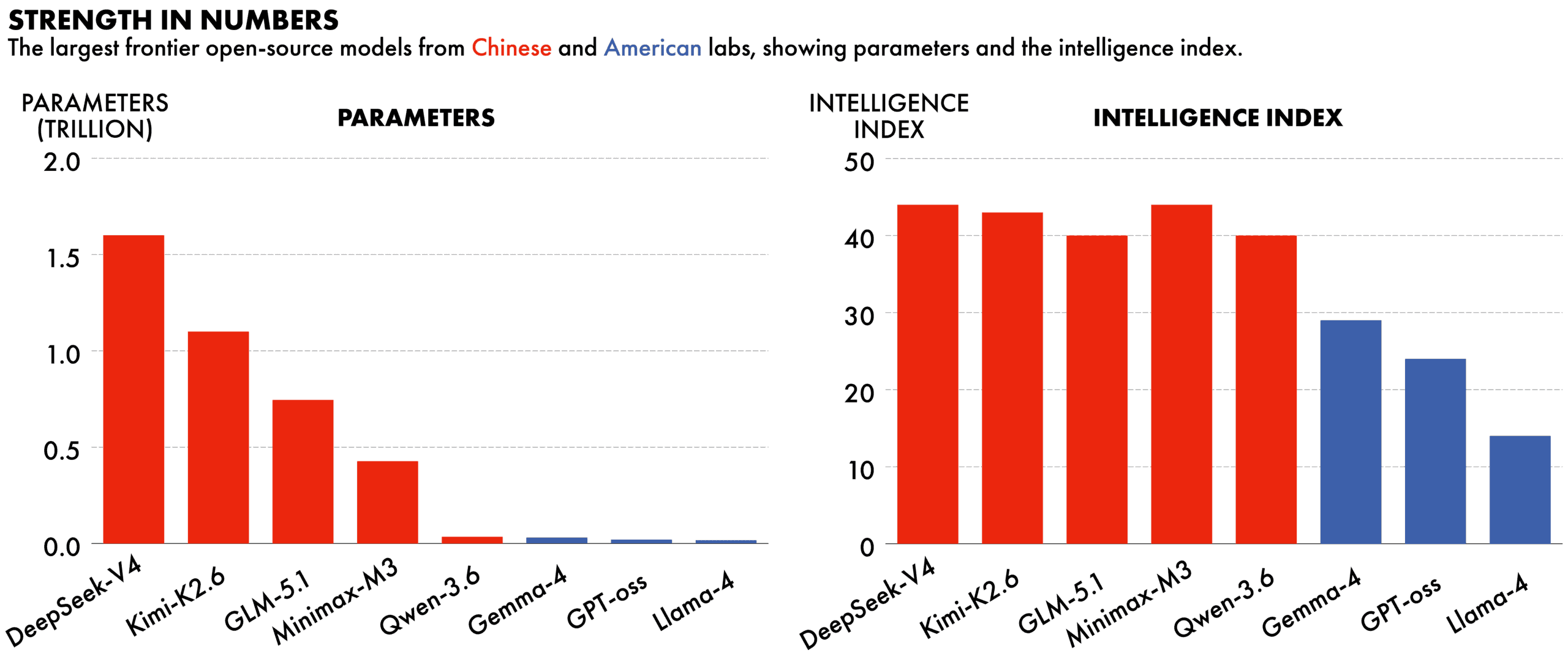
Chinese open-source models, such as those from DeepSeek and Moonshot AI, are far ahead of western open-source alternatives as measured by parameters. (Parameters are often compared to synapses, the connections between neurons in the brain.) The more parameters a model has, the “bigger” and, in theory, the “smarter” it is.
For their western critics, Chinese AI systems are compromised by censorship and alleged security flaws that can be exploited by their home country. There are fewer such qualms in Southeast Asia when it comes to Chinese AI. Some argue American AI is just as bad.
DeepSeek V4, for example, boasts 1.6 trillion parameters compared to 31 billion in Google’s Gemma 4 (see chart, Strength in Numbers). High-parameter Chinese models allow developers in populous developing nations such as Indonesia to access models capable of more complex tasks for little cost.
“We want the biggest model, and right now there’s no offering from Western open-source,” says Tze Jin Shee, a machine learning specialist at Entermind AI, a Malaysian consultancy firm that advises enterprises on AI.
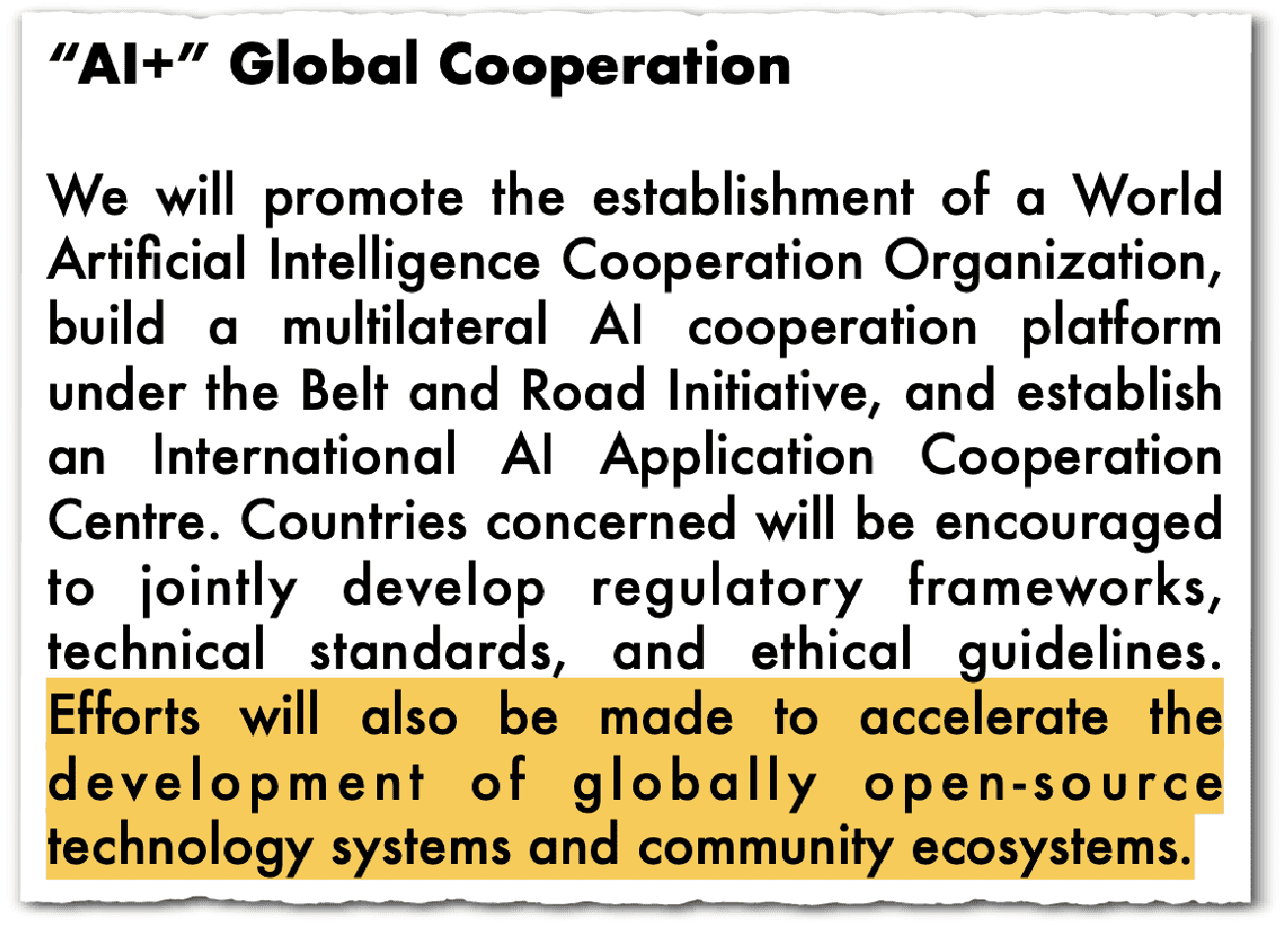
At last year’s APEC leaders summit, Xi said China would deepen open-source technology cooperation around the world. China’s new five-year plan also pledges to accelerate development of open-source ecosystems.
The State Council’s AI+ policy, which outlines its AI expansion plans, argues AI must not “become a game for rich countries and rich people.” State media have touted the ability of open-source AI to help developing countries in the Global South develop their own AI paths, rather than being dependent on “hegemonic” (that is, American) closed-source AI systems.
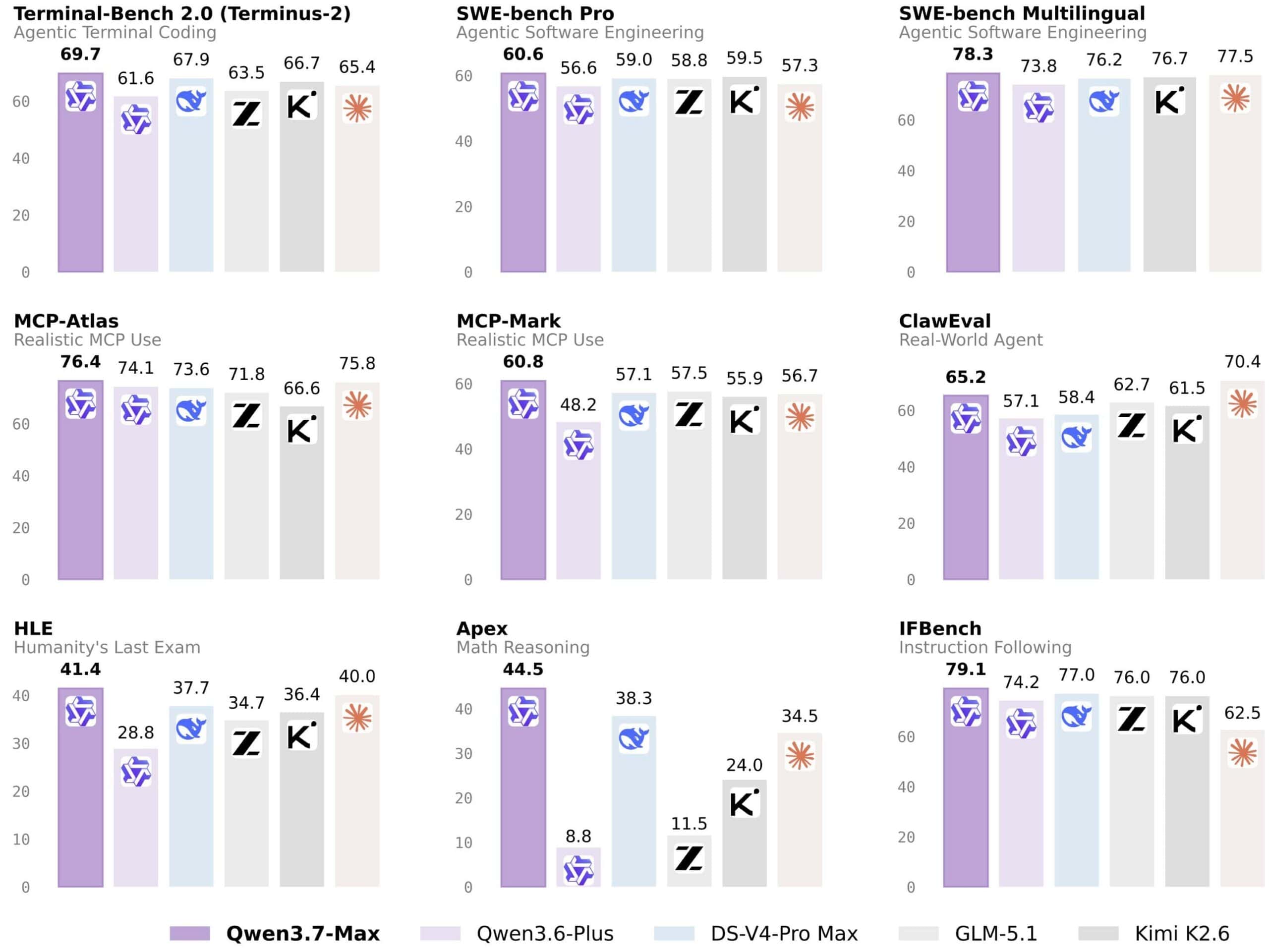
It is unclear, however, if Chinese firms can continue to put their money where Xi’s mouth is. The latest models from Alibaba’s Qwen family are now also closed-source and only accessible through a subscription. Another Chinese start-up, MiniMax, has released its latest open-source model, MiniMax-M3 with a new license designed to give the company a cut of any particularly profitable uses of their models. But for now, other Chinese AI labs like Z.ai, Moonshot AI and DeepSeek are sticking with their open-source business strategies.
Foong Chee Mun, CEO of YTL AI Labs in Malaysia, worries that closed-source AI systems will always be controlled by their creators. YTL AI Labs is a unit of YTL, a Malaysian infrastructure and utilities conglomerate. In 2023 it partnered with Nvidia to build out AI infrastructure in the country.
Malaysia and many other middle-income countries instead hope to foster “sovereign AI”, adapted to their social and political conditions. From these governments’ standpoint, Foong says, “open-source is something that you can control.”
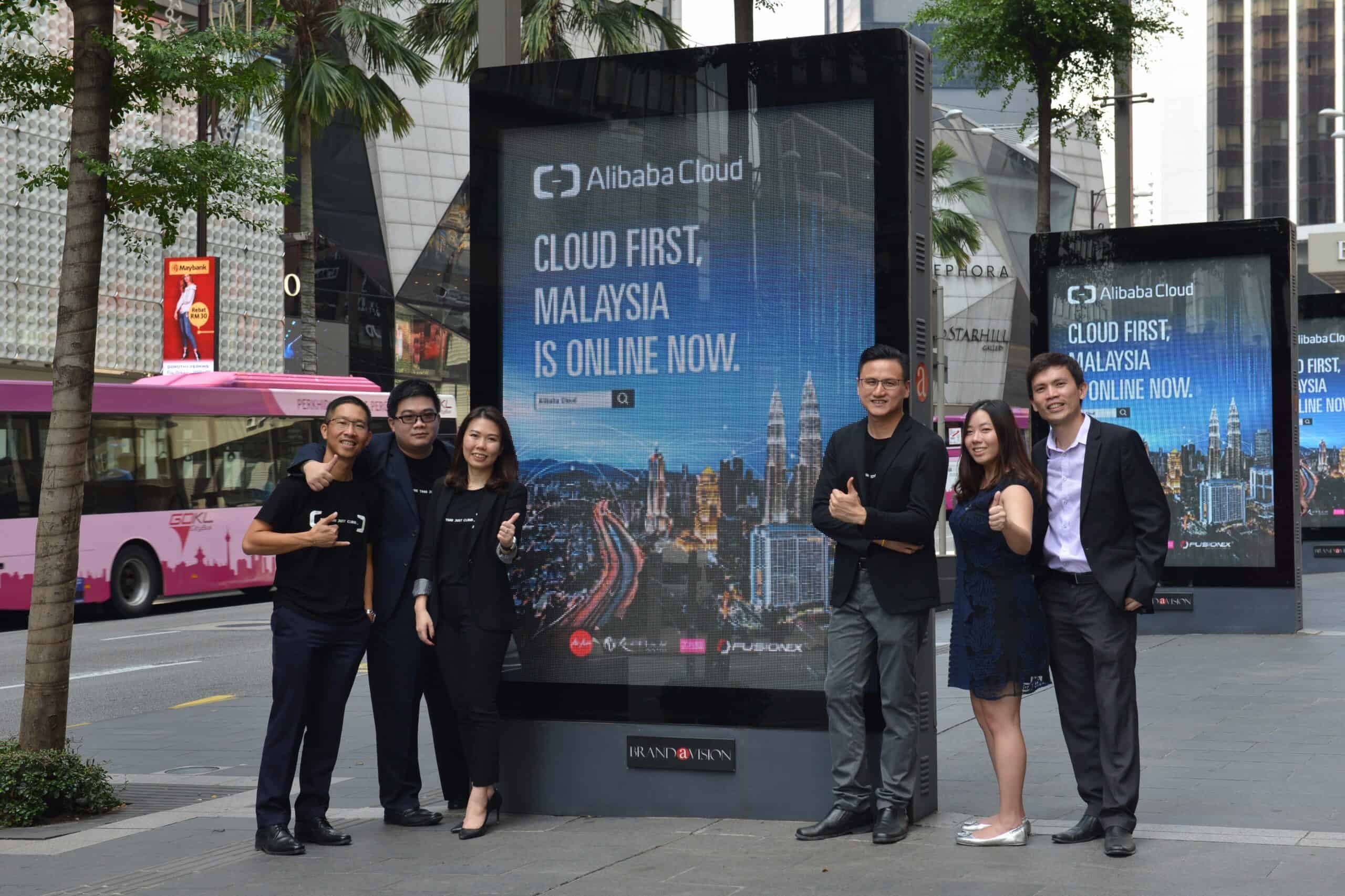
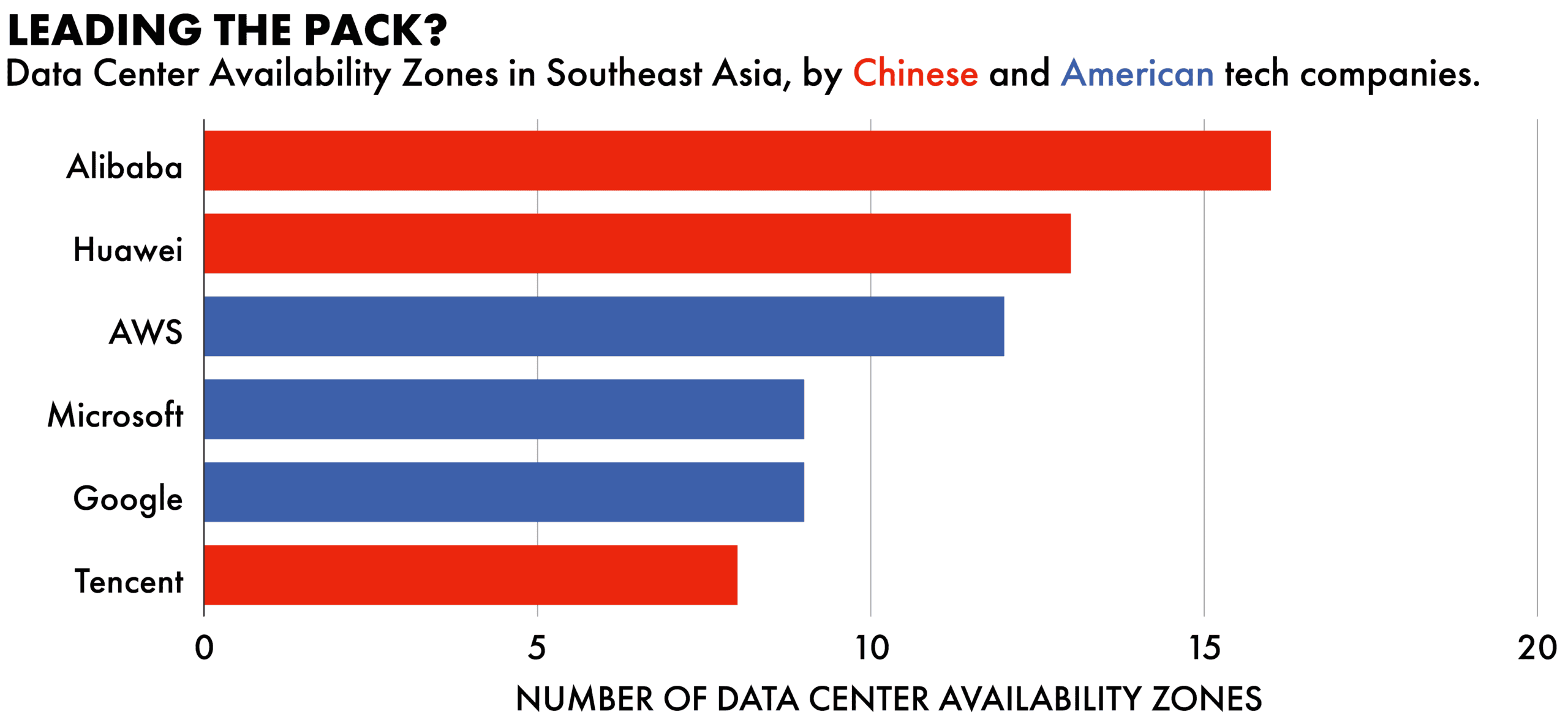
This preference is just one reason that Southeast Asia is a promising region for Chinese AI. Another is that Chinese tech giants have built out a large cloud computing infrastructures across the region.
Alibaba, Huawei and Tencent say they have built out 37 “Availability Zones” for their cloud infrastructure across six regions in Southeast Asia, compared to the 30 AZs across four regions reported by Google, AWS and Microsoft.
While not all of the Chinese services in these zones have AI processing capabilities, a wider array of AZs within a certain region allow Chinese cloud companies to cater to a larger number of users. Last year Alibaba Cloud announced the expansion of its services in Malaysia, Thailand and the Philippines. More AZs within a certain region mean greater performance and higher availability for any future customers.
Last year Chinese AI start-up Z.ai highlighted Southeast Asia as a focal area for deployment of its AI models. In the first half of 2025, the company earned more revenues from the region than any other outside China.
For their western critics, Chinese AI systems are compromised by censorship and alleged security flaws that can be exploited by their home country. There are fewer such qualms in Southeast Asia when it comes to Chinese AI. Some argue American AI is just as bad.
SINGAPORE AND INDONESIA, OCEANS APART
As they work to boost the popularity of their AI models, Chinese officials and companies must take into account radically different conditions across the region. Singapore and Indonesia represent the opposite poles of this divide between Southeast Asia’s AI haves and have-nots.
Google’s Singapore data center. Credit: Google
Singapore’s emerging AI industry enjoys robust government support and a deep reserve of technical talent. The city-state is also home to a dense concentration of data centers with low-latency, allowing users to run AI applications smoothly with few if any disruptions.
AI Singapore (AISG), a government-backed initiative established to coordinate research and industry to help develop the country’s AI capabilities, has fine-tuned a variety of open-source models from Alibaba, Google and Meta to improve their understanding of Southeast Asian languages, societies and cultures.
Alteredverse, a Singapore start-up that uses AI to create virtual worlds and AI characters, estimates that its use of Alibaba Cloud servers has reduced company costs by 70-80 percent.
“We have no choice but to look for a cheaper way to maintain those products,” says Alvin Yap, Alteredverse’s CEO and co-founder. Alteredverse now also uses open Qwen models in parts of their set-up, hosted on their own servers while testing their products. Once the product goes public, Yap says they may move these models to Alibaba Cloud software. In this scenario, open-source means that beyond cloud subscriptions, Alteredverse doesn’t have to pay Alibaba for using their AI models, even when they are hosted on Alibaba’s own infrastructure.
Yap estimates that about half of all Singapore AI developers are testing both Chinese and Western AI models, and half are only using Western models.
While Alteredverse’s engineers prefer to use Claude Code when writing software, they turn to Qwen models when developing AI-generated charactersthat users can interact with in virtual worlds, believing they bring more personality to the characters than Meta’s open-source offerings.
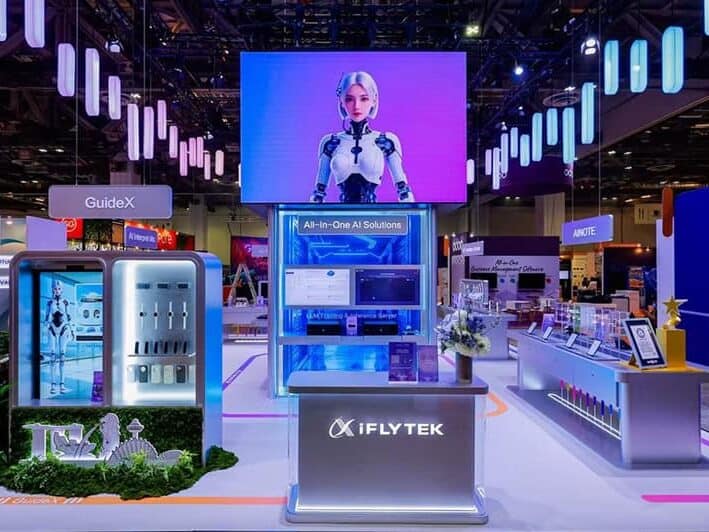
Other Chinese companies, such as AI software developer iFlytek, are flocking to Singapore to sell their AI applications. At the GITEX AI ASIA expo, held at Singapore’s Marina Bay Sands resort in April, iFlytek had a large display of AI glasses. The company says it has corporate customers that use them to scan financial and other documents.
Elsewhere robot dogs made by Hangzhou-based DEEP Robotics marched through the expo halls. DEEP has sold its robodogs to Certis, a Singaporean security company.
From the 56th-floor observation deck at the top of the Marina Bay Sands, Indonesia is easily visible. But though separated by only about 18 miles of water, in terms of AI infrastructure Singapore and Indonesia are oceans apart.
In Indonesia, there is an AI policy and funding vacuum that should, in theory, provide opportunities for Chinese AI companies.
The Indonesian government has outsourced the creation of “a framework and direction” for the country’s national AI strategy to a non-governmental organization, Korika. Korika’s tasks include updating AI strategies and promoting inter-ministerial cooperation on the industry’s development.

However, Indonesia remains without a set of clear, enforceable regulations on AI development. Several government departments have announced their own plans for AI governance, leading to a general fragmentation on plans for development. A centralized roadmap for AI development has been repeatedly delayed, meaning the country’s tech giants, who lead the way in the country’s digitalization, have faced difficulties in creating their own AI strategies.
In a 2023 report, advisory firm Access Partnership estimated that widespread AI usage in Indonesia could provide a $244 billion boost to the economy, or 16 percent of GDP. An Ipsos poll from 2024 also found strong consumer enthusiasm for and usage of AI.
That usage is not yet very sophisticated, says Damar Juniarto, founder of PIKAT Demokrasi, an independent AI research institute and a former university lecturer.
…the future of AI lies in multi-agent systems that combine AI products from different companies, with each working on a discrete part of a larger project. Chinese and U.S. AI models, in other words, can be harnessed to work together.
Juniarto is a member of the Indonesia AI Society, a non-profit aiming to advance AI expertise in Indonesia. Alibaba representatives contacted him through the society, and offered him free training — and tokens, a unit of compute used by AI companies to measure how much a user should be paying for their services — in the company’s Qwen AI model. Juniarto was told by the Alibaba representatives that these sessions were only available to university staff and researchers. In his experience working with students at ten Indonesian universities, he found that none of them were using Qwen or DeepSeek on a daily basis, and instead relying mainly on ChatGPT for relatively simple tasks.
Andi Widjajanto, a senior adviser at Lab45, adds that the country lacks the professional talent — and government money — needed to develop homegrown Indonesian AI models, especially when faced with so many advanced international alternatives.
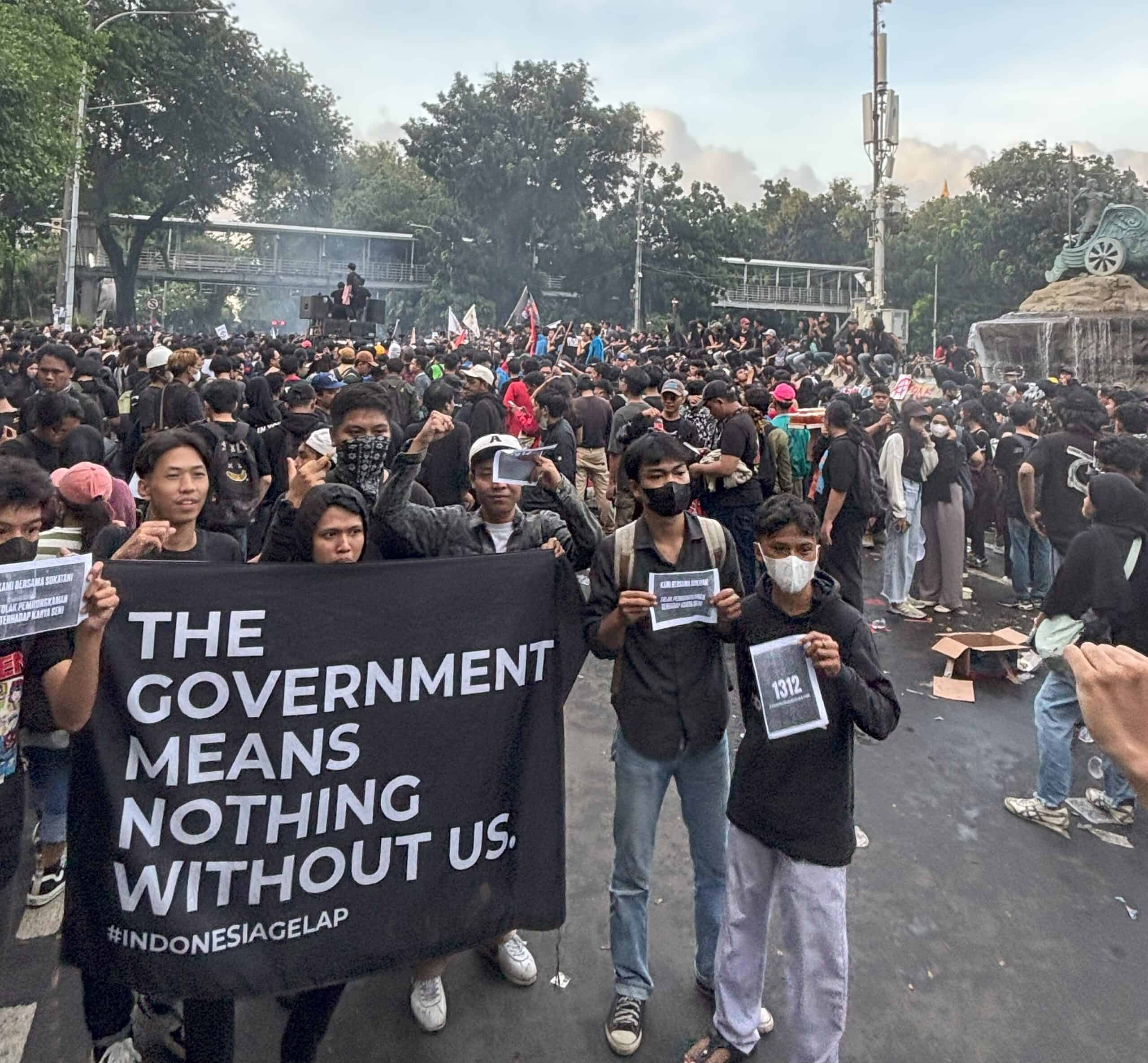
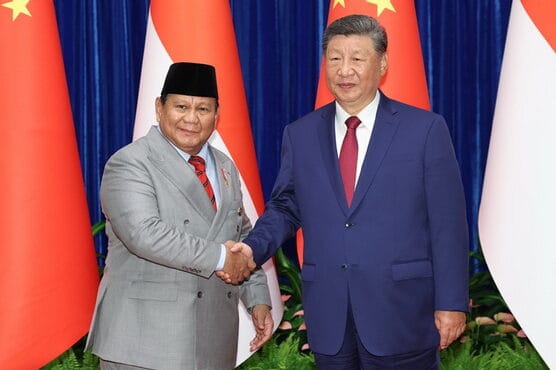
The government funding problem is particularly acute in the world’s fourth most populous country. Last year President Prabowo Subianto’s young administration was rocked by violent protests fueled by rising living costs and unemployment.
In this fraught political context one of Prabowo’s top policy priorities, understandably, is a free school meals program that could cost as much as 1.2 trillion rupiah ($69 million) per day. By comparison the annual budget of Indonesia’s national science and technology research agency, which oversees critical AI infrastructure programs such as the construction of a National AI Supercomputer Center, is about 12 trillion rupiah.
The controversial prosecution of Nadiem Makarim, a progressive and former education minister, for his role in an allegedly corrupt government procurement contract has also cast a pall over the country’s technology sector.
Lebang, Widjajanto’s colleague at Lab45, estimates that less than 10 percent of Indonesian technology companies are using AI.
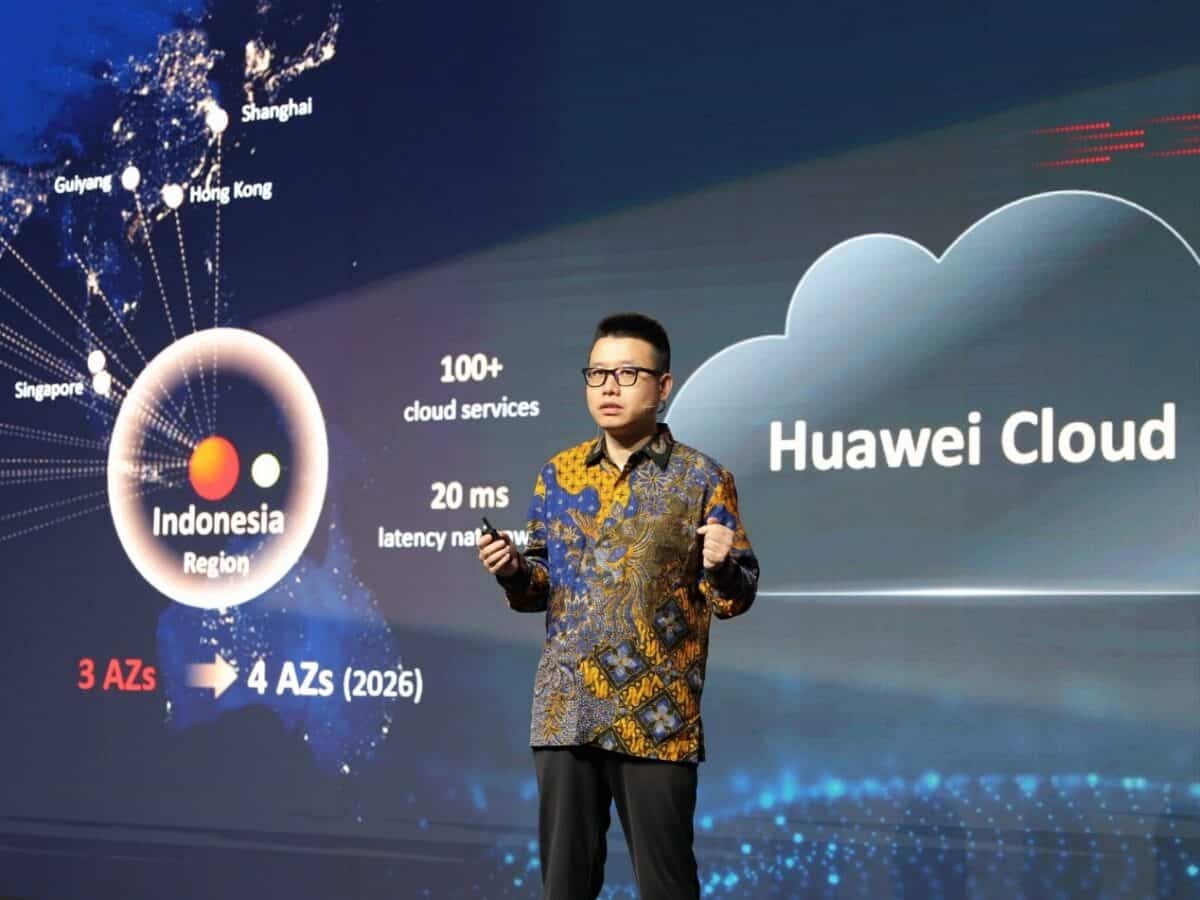
One Huawei Cloud partner in Indonesia, Paratekno, has signed up “about 60 to 80” clients for the Chinese tech giant’s cloud computing services, says Paratekno’s Managing Director Bambang Santoso. But of these only ten have expressed an interest in using AI models.
One representative from a major Chinese technology conglomerate, who asked not to be named, said he does not believe his company will be able to make much headway in Indonesia, owing to poor regulation and lack of consumer demand. The representative believed his company’s current attempts to push ahead with its AI projects in the country were about as useless as “dropping an ice cube in a hotpot”.
MALAYSIA IN THE MIDDLE
Compared to Indonesia, Malaysia has proven to be much more fertile ground for Chinese AI. Last year the Guangxi provincial government invested 10 billion yuan ($1.4 billion) in the China-Malaysia AI Application Cooperation Center, a joint venture situated in Kuala Lumpur’s western suburbs. Guangxi’s Malaysian partner is Zetrix, a company that sells blockchain technology, a form of digital record-keeping.
Zetrix declined requests for an interview.
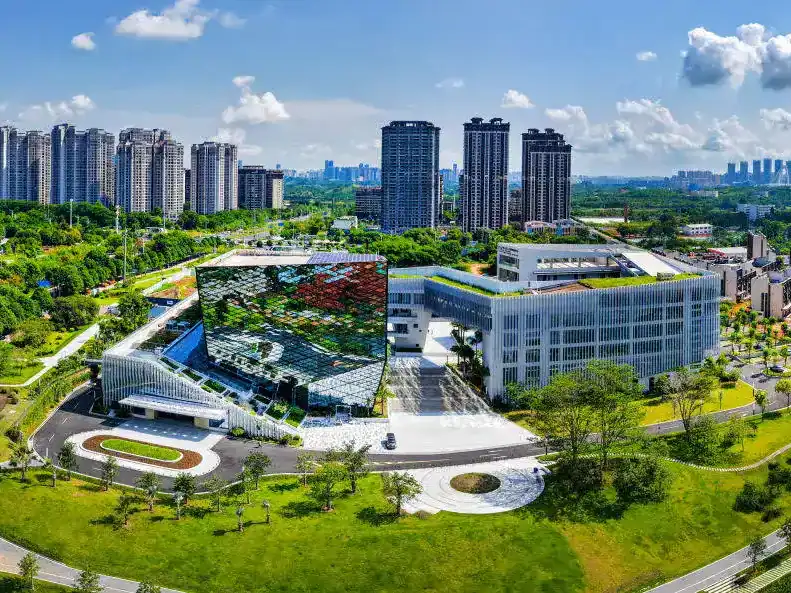
The center is one of several China is launching around the world in order to create AI products tailored to local needs.
During a visit to Guangxi in 2023, Xi Jinping said the province, which borders Vietnam, should play a pivotal role in using AI to more closely integrate China with Southeast Asia. The Guangxi government sums up this process, with some condescension, as “R&D in Beijing, Shanghai and Guangzhou; integration in Guangxi; and application in ASEAN.”
The center’s showroom highlights AI products from Chinese companies including Alibaba, DeepSeek and Huawei. One LLM touted there, NurAI, is described as a DeepSeek-Zetrix collaboration and “the world’s first shariah-aligned AI” — a reference to the Islamic legal system used in parallel with Malaysia’s Common Law courts.
In promotional videos, Zetrix says the LLM is distinct from “mainstream AI systems built on secular Western-centric data,” with input from Islamic scholars from Malaysia, Indonesia and Egypt. It was launched in August by Malaysia’s deputy prime minister, Ahmad Zahid Hamidi. According to Zetrix, one of its target markets is “government agencies pursuing digital Shariah compliance.”
An example of NurAI responding to a question about Uyghurs. Screencapture provided by author.
When asked about the rights of LGBTQ people in Malaysia, NurAI responds that those in the community must “draw closer to Allah and find a way back to the original nature of human creation.” NurAI also answers questions about the Chinese government’s controversial policies towards Muslim Uyghurs in Xinjiang in ways that accord with Chinese government justifications for its policies.
Zetrix also works with Malaysia Blockchain Infrastructure (MBI), a federal agency, to create blockchain-based solutions for the country, including age verification systems used to enforce laws that ban kids aged 16 and under from using social media.
In May of last year Teo Nie Ching, Malaysia’s deputy communications minister, announced that Malaysia would adopt Huawei’s Ascend GPU chips and use DeepSeek as an “open-sourced sovereign LLM” for Malaysia.
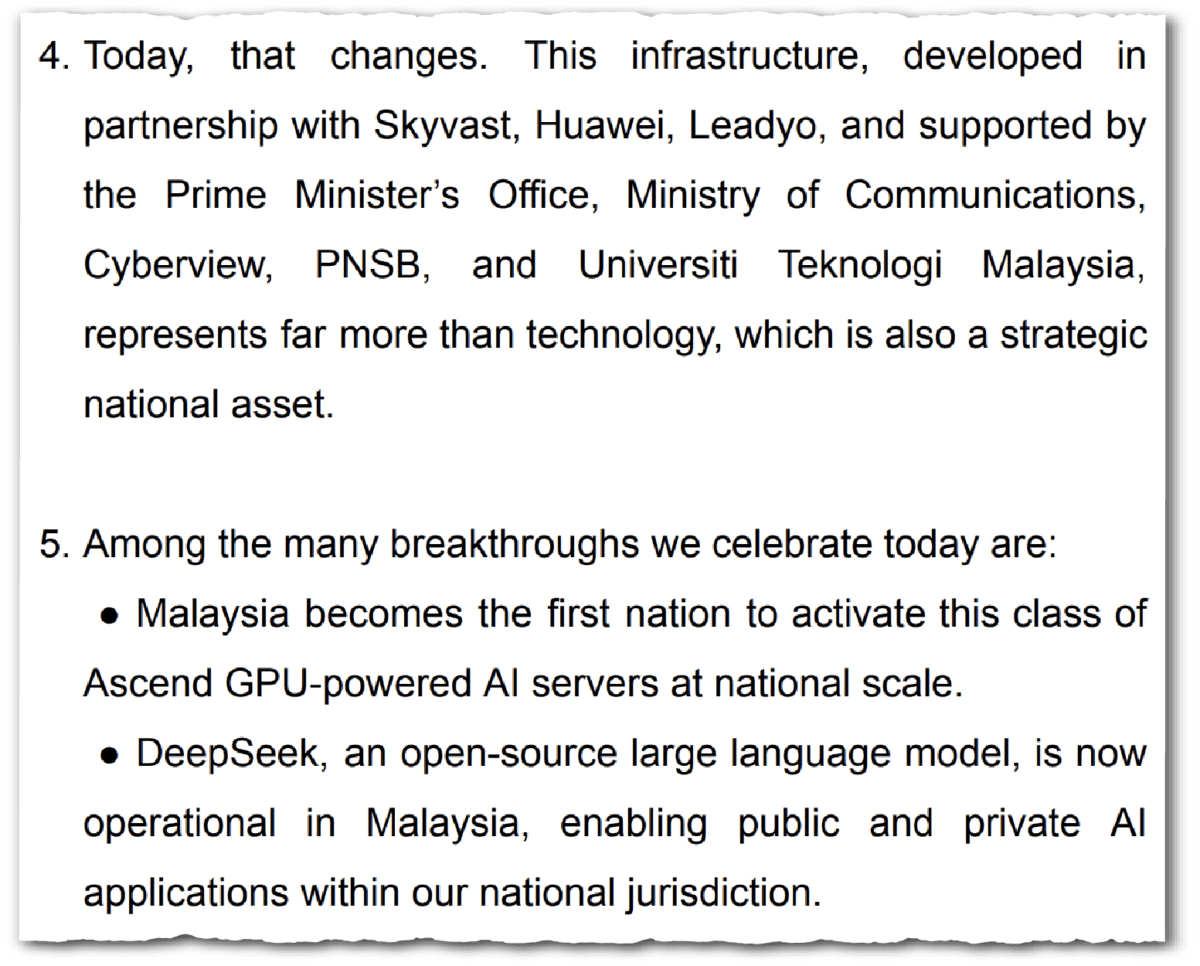
Two days later the ministry of investment, trade and industry said the project had not been endorsed or reviewed by the government.
Lee Chee Leong, a lecturer in international relations at the University of Malaya’s Institute of China Studies, believes government departments sometimes conflict with each other over policy, partially due to a lack of communication. “We have some ministries trying to promote AI, then we have some other ministries trying to regulate it. I’m not sure why they are not in the same WhatsApp group,” he says.
The communications ministry declined interview requests.
CHOOSING NOT TO CHOOSE
Dr Lee adds that the Malaysian government wants to build two separate AI ecosystems, one US-led, the other Chinese-led, from semiconductors through to AI infrastructure, so as to “reap the industrial and wider economic benefits from both ecosystems.”
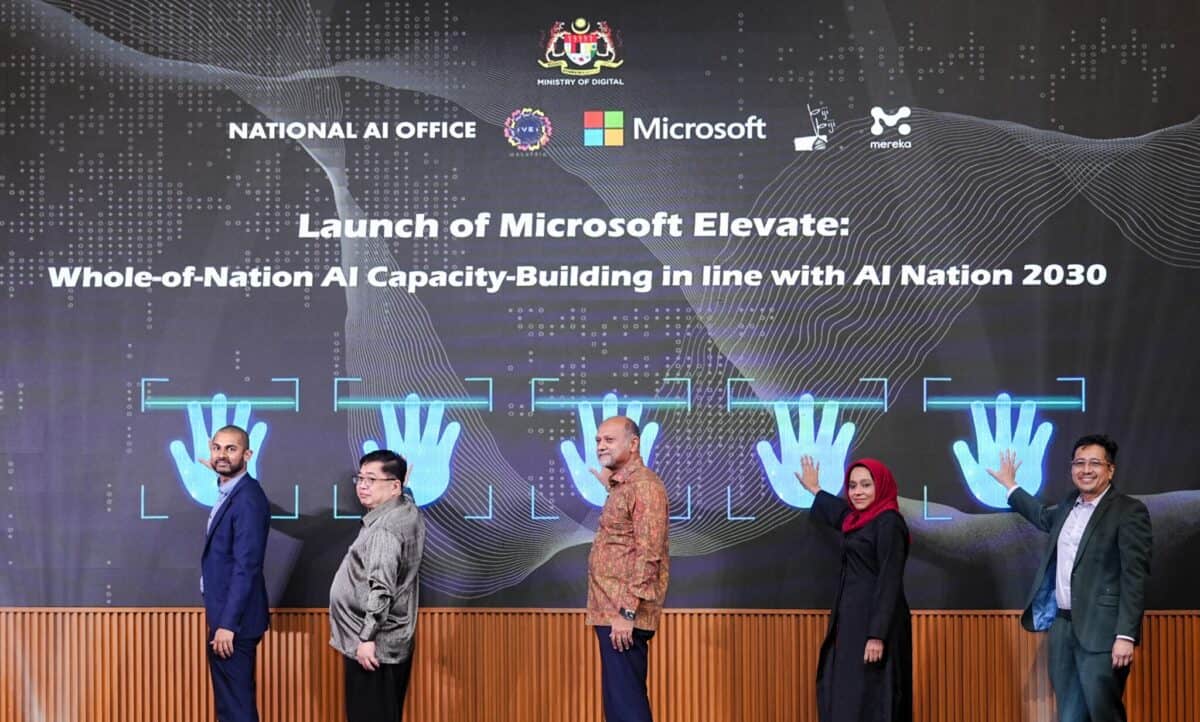
In Malaysia’s 2026 National Budget, Google, Microsoft and Amazon Web Services are listed as the main companies involved in building out AI infrastructure and education programs. The budget does not refer to any Chinese companies.
Malaysia’s AI ministry (formally called the “Ministry for Digital”) is expanding a suite of Google AI products for government workers. It also has AI training partnerships with Microsoft and Oracle.
Ong Kian Ming, Former Deputy Minister of International Trade and Industry, says that “if Malaysia says that we have some sort of MOU or cooperation signed together with Alibaba and Huawei, I think that would capture the attention of the American authorities in a not-so-positive way.”
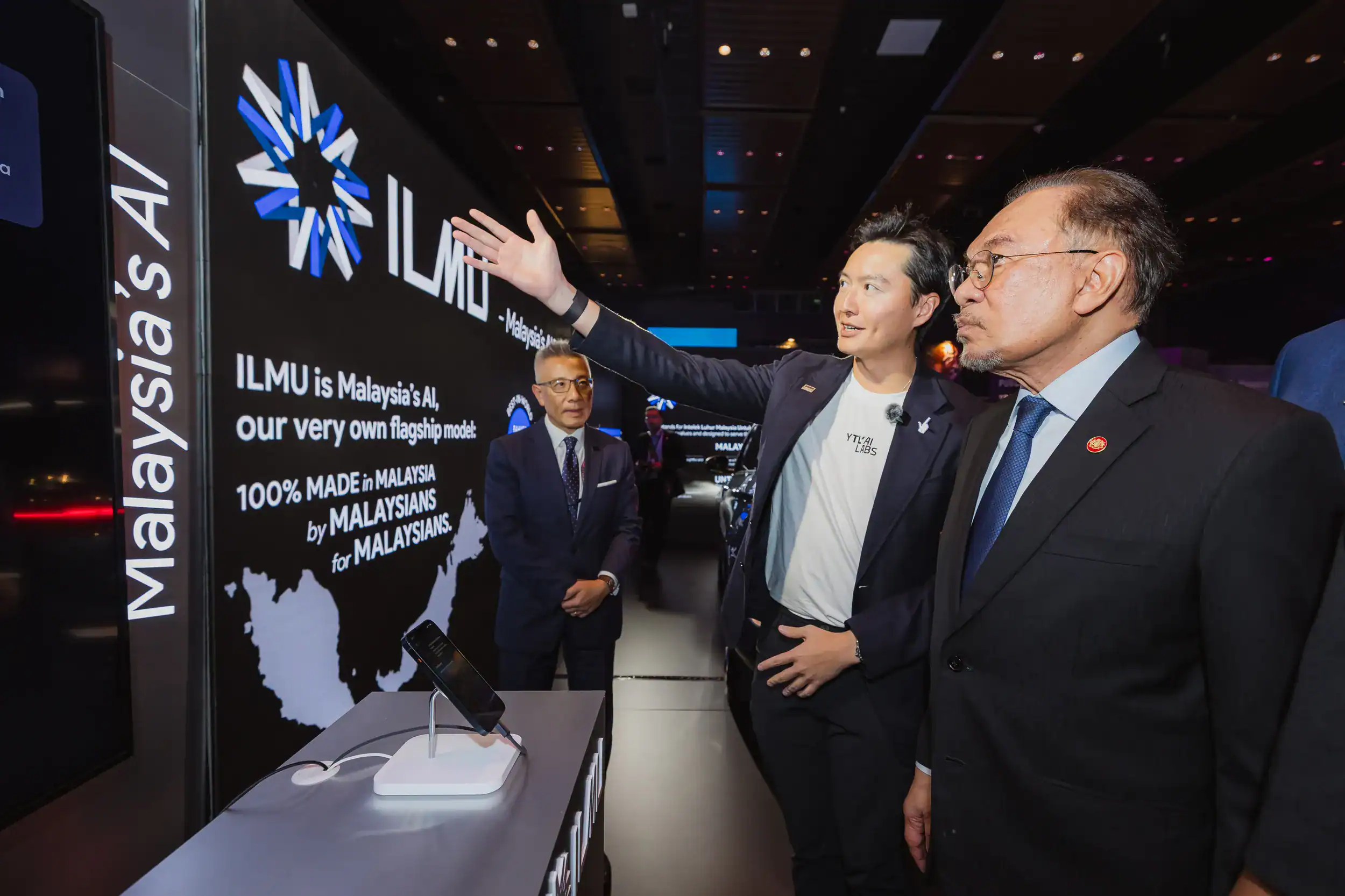
Companies such as YTL AI Labs are also trying to use the best of both worlds.
YTL CEO Foong says the company has the largest cluster of Nvidia’s GB200 chips outside of America, which it used to train its own AI model family called Ilmu. He also notes YTL has benefited from cooperation with a variety of Chinese AI labs that share their research as part of the country’s open-source strategy.
Foong argues that the future of AI lies in multi-agent systems that combine AI products from different companies, with each working on a discrete part of a larger project. Chinese and U.S. AI models, in other words, can be harnessed to work together.
“YTL AI Labs is frankly benefiting from both sides — the Americans and the Chinese,” he says.

Alex Colville is a Taiwan-based analyst for the Australian Strategic Policy Institute, focusing on the Chinese AI industry. He previously worked for the China Media Project and has written for The Economist and The Financial Times. His reporting was supported by a grant from the Tarbell Center for AI Journalism.

.jpg)