China’s AI firms aren’t horsing around in 2026. The country’s leading AI developers rang in this month’s Chinese new year celebrations by launching new products and trying to entice new users.

The huge marketing campaigns carried out by tech giants like Alibaba and Tencent confront a stark reality, however: for all the hype around China’s advances in AI, the country still has significantly lower adoption rates compared to the United States and other major markets.
As a result, China’s AI models still have a long way to go to meet government aspirations. In October, the Central Committee of the CCP called for the increased application of AI into industry, culture, public health, and social governance in its recommendations for the upcoming 15th Five Year Plan, due to be finalized and approved in March.
ONLINE BUT AI-LESS
Even though China is highly online, with over 90 percent of the population internet users, the country’s top AI models have fewer regular users compared to leading U.S. models.
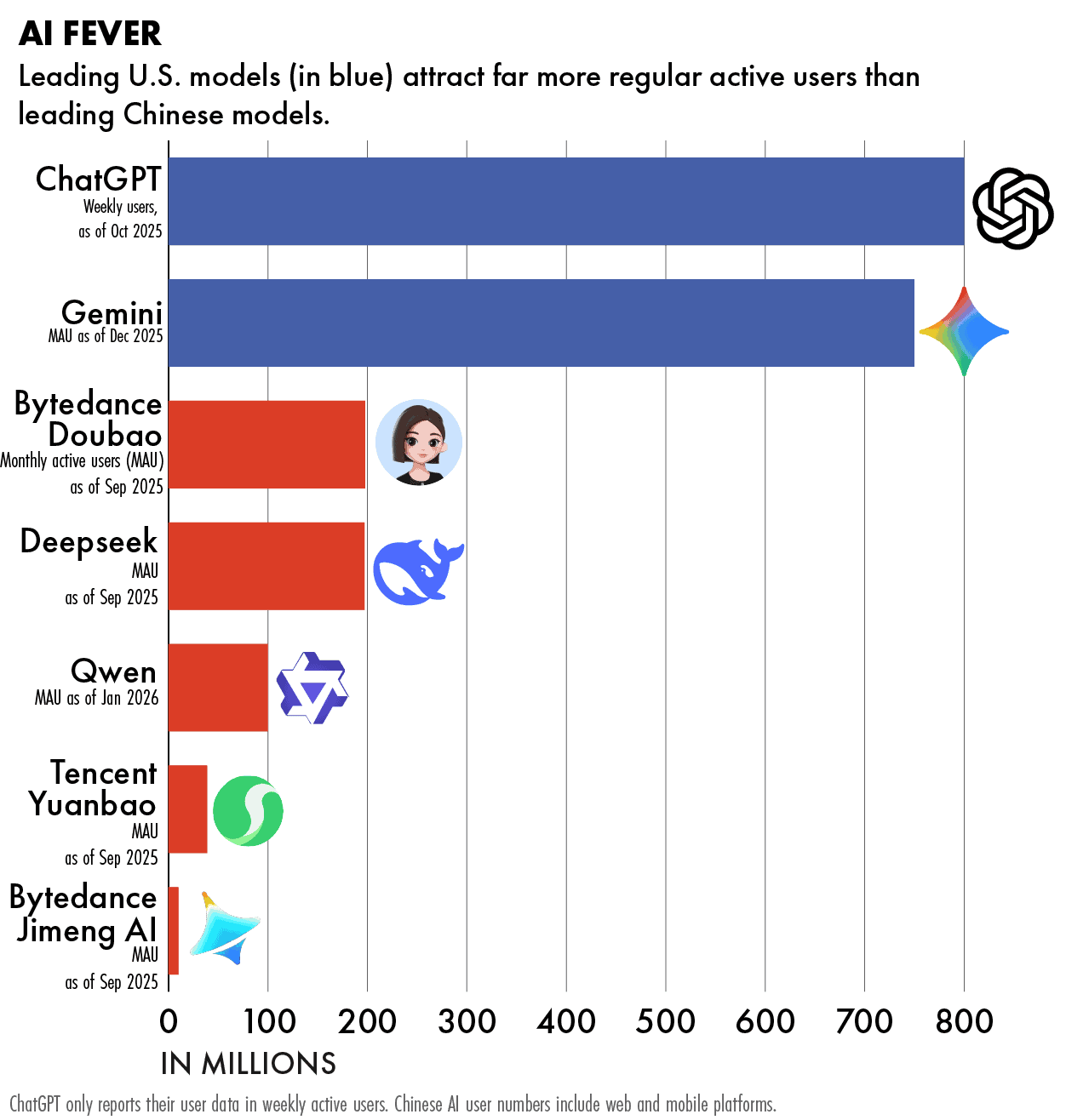
Measuring the real-world reach of AI, or diffusion, is difficult. Because some leading Chinese AI models including Qwen and DeepSeek are open source, and users can download and adapt them for independent purposes, it’s hard to capture the number of people who use adapted models.
Much as Google has deployed Gemini across its suite of products, China’s internet firms are integrating their own AI tools into their platforms. This presents another challenge for measurement: it’s hard to determine if users are seeking out AI intentionally, or if active user numbers are mistakenly inflated.
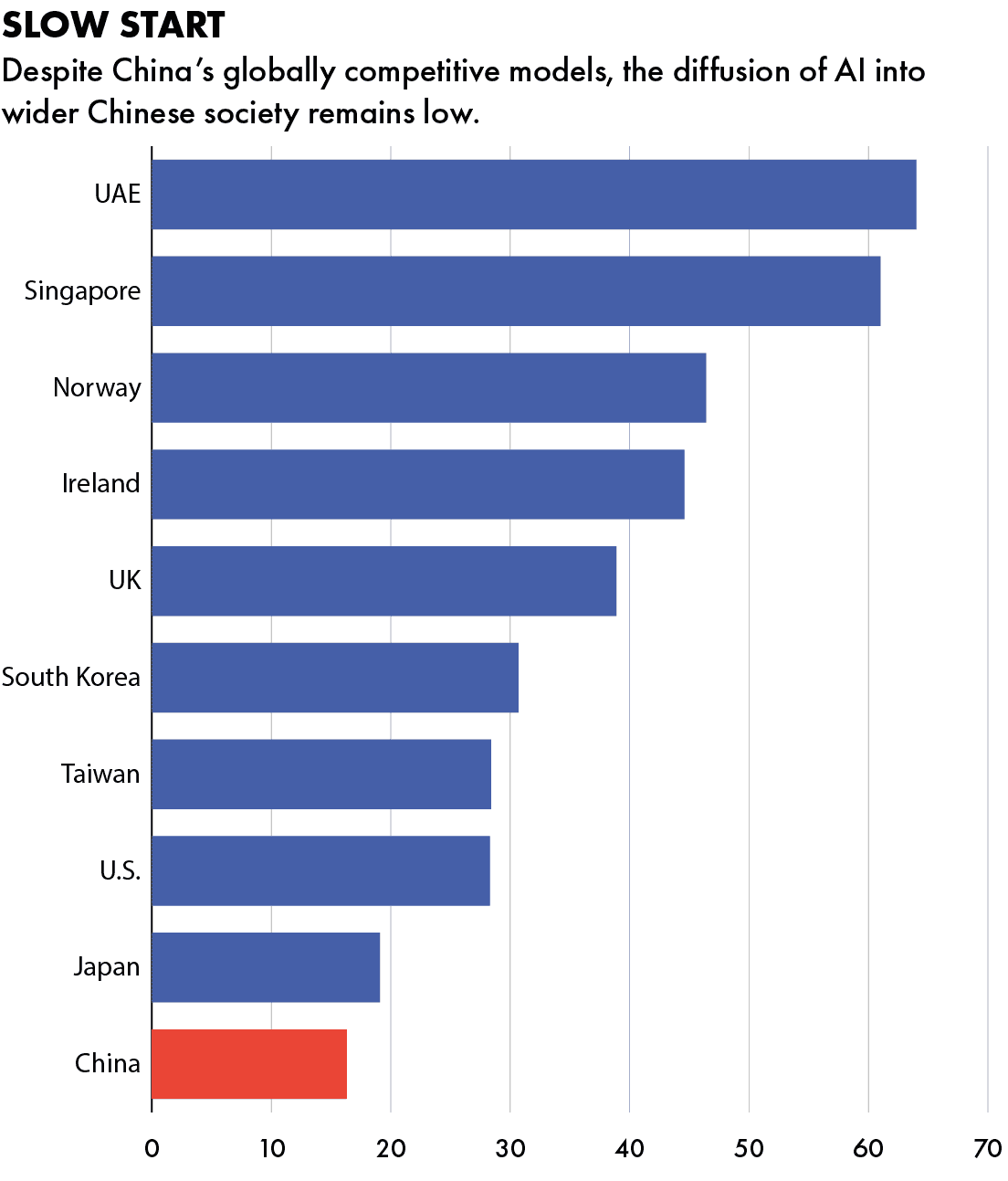
However, various metrics point to China having lower AI diffusion rates compared to other developed markets. Microsoft measures China’s AI diffusion rate, calculated by the share of people in each country who used a generative AI product in 2025, at just 16.3 percent.
With plenty of globally competitive AI tools to choose from, created by Chinese companies and localized to Chinese audiences, the diffusion problem has less to do with supply than demand. The fact is, Chinese AI has not yet penetrated into the real world for many users.
Despite China’s low rate of AI adoption, models produced by Chinese companies are among the most popular globally. By mid-2025, China-developed models were the most downloaded of any country on developer platform Hugging Face, according to research published on paper repository arXiv.
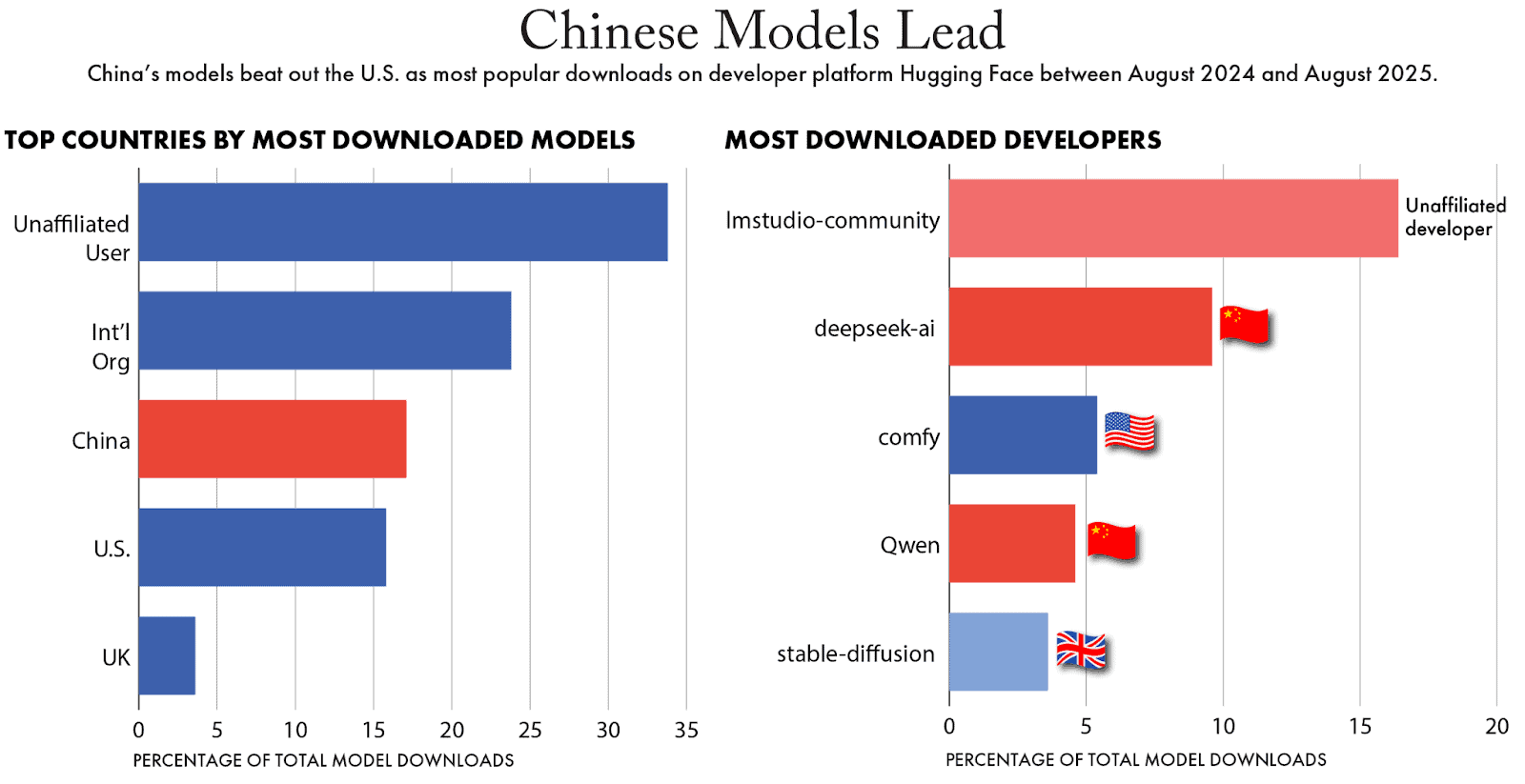
As a platform for sharing code, models, and datasets, Hugging Face is inherently an international and collaborative environment. Even so, models released by Chinese organizations stand out. DeepSeek and Alibaba’s Qwen, both open-source models, are the two most downloaded Chinese models, beating out UK-based Stability AI’s Stable Diffusion text-to-image model, and U.S.-based generative AI model Comfy. LM Studio, an app for running AI models locally on personal devices, allows users to run Qwen and DeepSeek anyway.
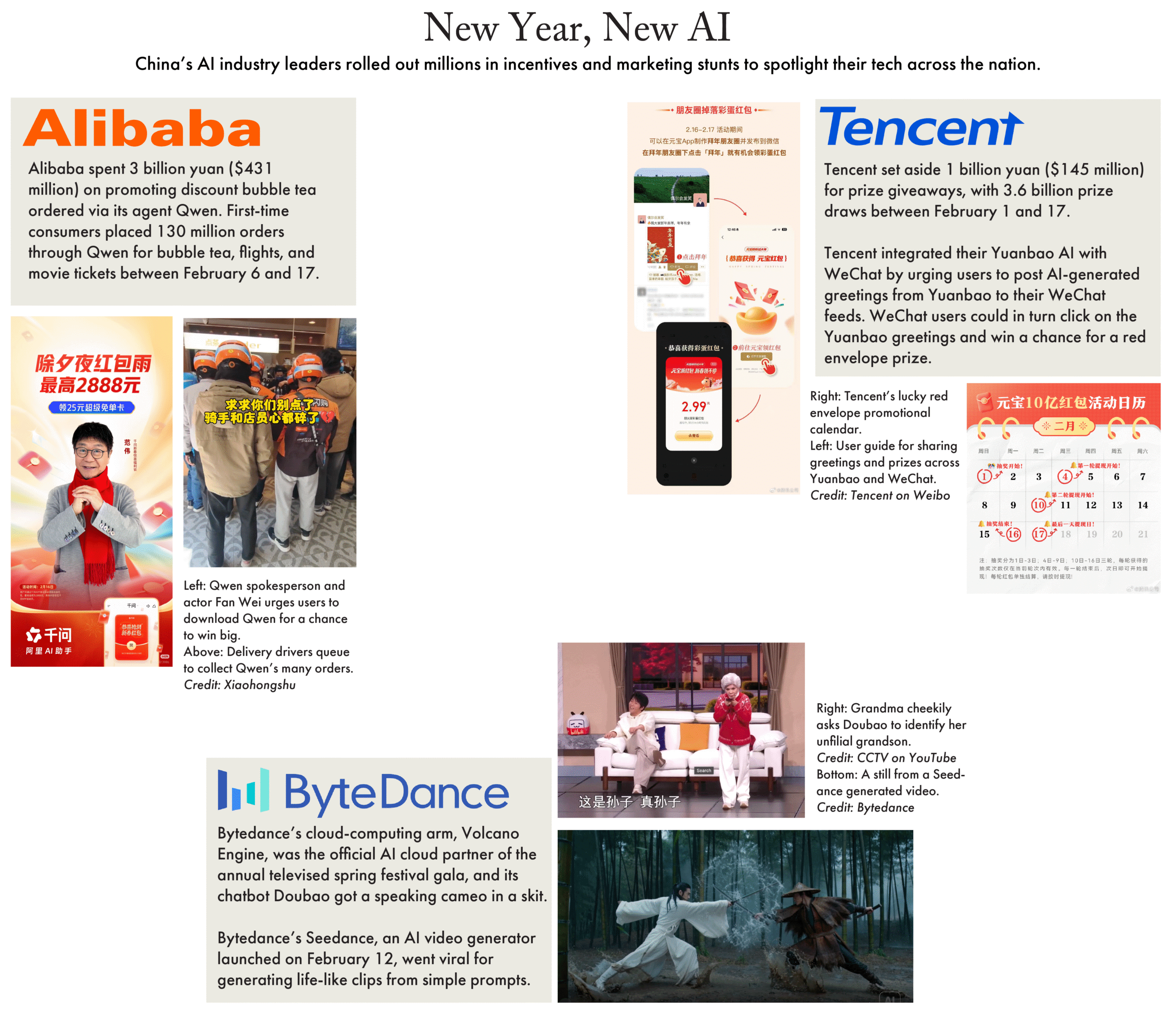
It’s clear that Chinese AI models have the chops to stand out in the global tech industry a year after the so-called “DeepSeek moment” catapulted the domestic AI race into overdrive. But ordinary Chinese consumers need a push — in the form of red envelope cash incentives.
COMPUTE CONSTRAINT
“The big story is already here,” said Kyle Chan, a fellow at the Brookings Institution. “I’m scratching my head around this because, wow, this is all squeezing out more efficiency out of much less compute and yet still able to keep pace.”
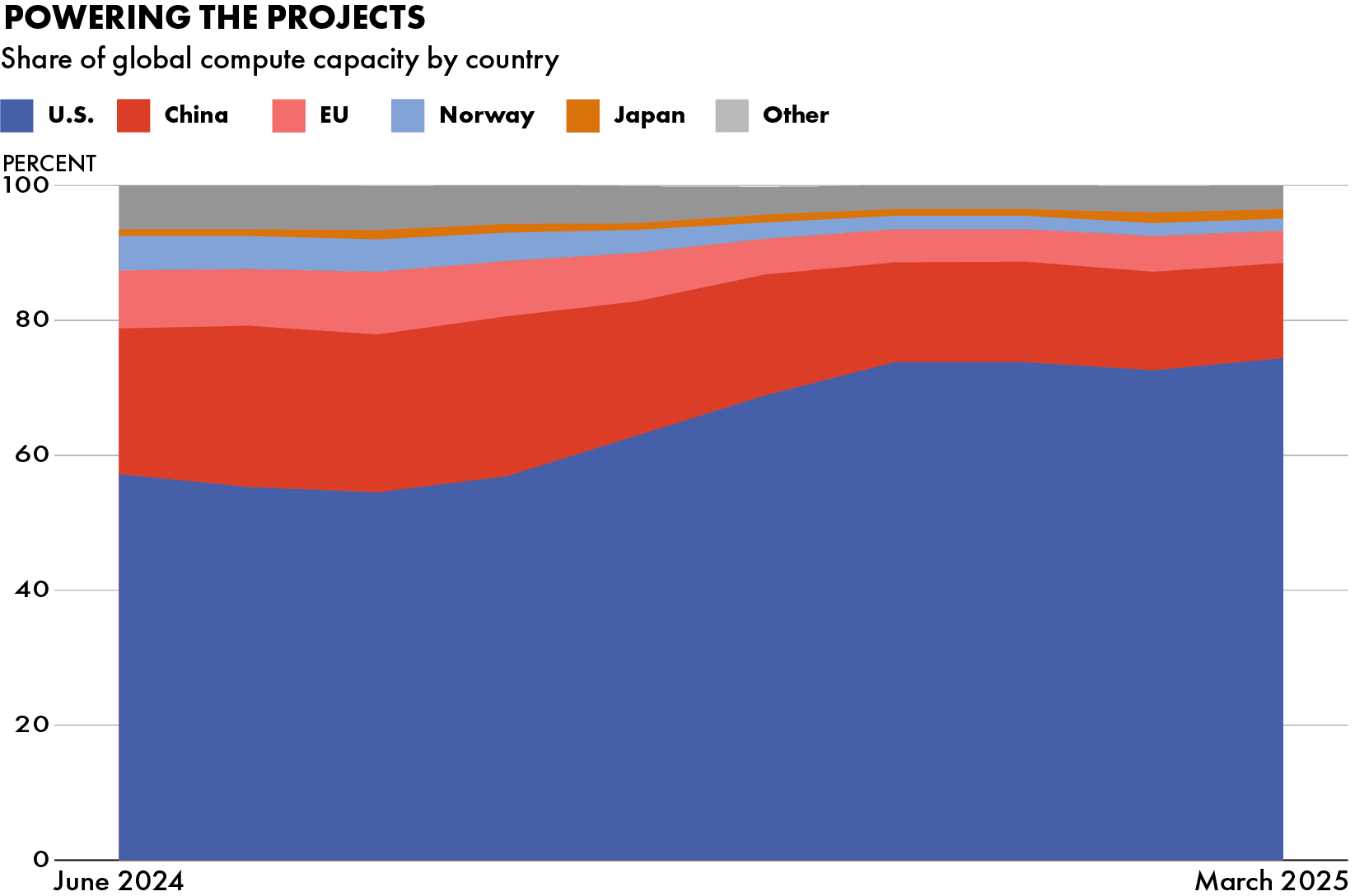
The relative lack of ‘compute’ Chan highlights refers to a major challenge to Chinese AI growth in the new year: its dearth of the hardware — processors, memory, and storage — needed to sustain highly complex models. The U.S. holds the undisputed lead in this area, containing three quarters of global compute capacity.
The new year advertising blitz also brought fresh examples of the regulatory and practical hurdles to rolling out AI products at a rapid pace in China.
Video compilation of bubble tea baristas filling a crush of New Year’s beverage orders. Credit: Xiaohongshu
Alibaba’s Qwen caused chaos on the ground for delivery drivers and bubble tea baristas tasked with filling orders from the AI agent.
China’s market regulator also flagged the rash of expensive giveaways as a concern given its ongoing fight against so-called ‘involution’. It is concerned AI could become another area of the Chinese economy where intense price competition between deep-pocketed players could lead to low and falling prices. On February 13, the State Administration for Market Regulation demanded Alibaba, Baidu, Douyin, Tencent, and other internet firms regulate their promotional activities.
Chan says China’s AI market remains “tough”, and warns that it will be important for companies to become profitable enough to sustain themselves.
“They’re going to have to really start to make revenue to pay for all these costs,” he says. “Will there be a point where they start to slow down and can’t keep up?”

Savannah Billman is a Staff Writer for The Wire China based in NYC. She previously worked at the National Committee on U.S.-China Relations.