From drone deliveries to aerial sightseeing tours, China is looking to the sky for a new engine of economic growth. But a recent accident has cast a cloud over its low-altitude aviation ambitions.
XPeng air modules rehearse for a stunt at Changchun’s Air Show, September 16, 2025. Footage via Douyin
Last Tuesday two flying cars produced by Chinese automaker Xpeng crashed into each other while rehearsing a stunt for an air show in the northeastern city of Changchun. One vehicle touched down normally, but “the other sustained damage and caught fire upon landing,” Xpeng AeroHT said in a statement to The Wire China, adding that the cause of the crash is still under investigation.
The accident — one of the first of its kind in China — has drawn attention to the safety and regulation of so-called eVTOL (electric vertical take-off and landing) vehicles. But behind the collision lies a larger uncertainty about China’s drive to turn the sci-fi dream of flying cars into reality, including questions about their technical and commercial viability.
From cost and battery constraints to the lack of regulatory framework, air traffic control solutions, and supporting infrastructure, “we are seeing many challenges in terms of commercialization for eVTOL at this stage,” says Koh Weng Siang, co-founder of Volar Air Mobility, a company in Hong Kong that is building an air taxi platform. “I don’t see a massive rollout of eVTOL operations in at least the next five years.”
The concept of eVTOL vehicles powered by electricity first emerged in the U.S. in the 2010s. Proponents could imagine flying vehicles whisking passengers from building to building, revolutionizing how people and goods travel through urban space in a more versatile, cost-efficient and quiet way than traditional aircraft such as helicopters.
It’s a brand new industry in which China can become one of the dominant players in the world. There is not this existing, multi-decade long headstart that the West has in other parts of aerospace.
Sergio Cecutta, founder of SMG Consulting, an aerospace consultancy in Arizona
Yet regulatory concerns and technological limitations have to date clipped the wings of eVTOL startups globally. At least three Western companies have gone bankrupt in recent years: one of them, Germany’s Volocopter, was acquired in March by Chinese automotive firm Zhejiang Wanfeng. European jetmaker Airbus and Korean automaker Hyundai have hit the brakes on their eVTOL projects this year.
China, by contrast, is going all in. The creation of a low-altitude economy, which encompasses all devices buzzing around airspace below 3,000 metres, was included in the CCP’s 14th five year plan in 2021. The government established a new department to oversee the sector last year.
“It’s a brand new industry in which China can become one of the dominant players in the world,” says Sergio Cecutta, founder of SMG Consulting, an aerospace consultancy in Arizona. “There is not this existing, multi-decade long headstart that the West has in other parts of aerospace.”
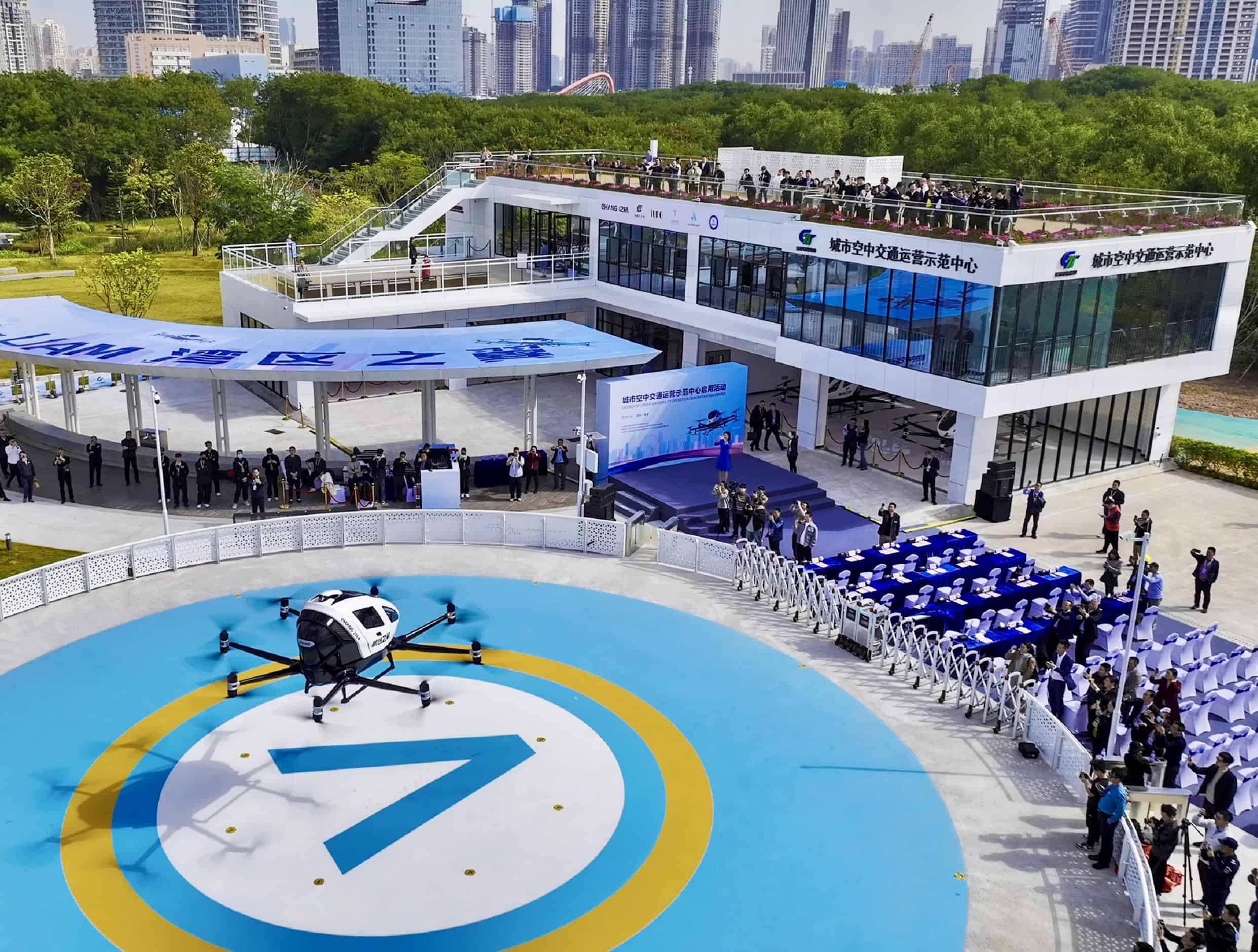
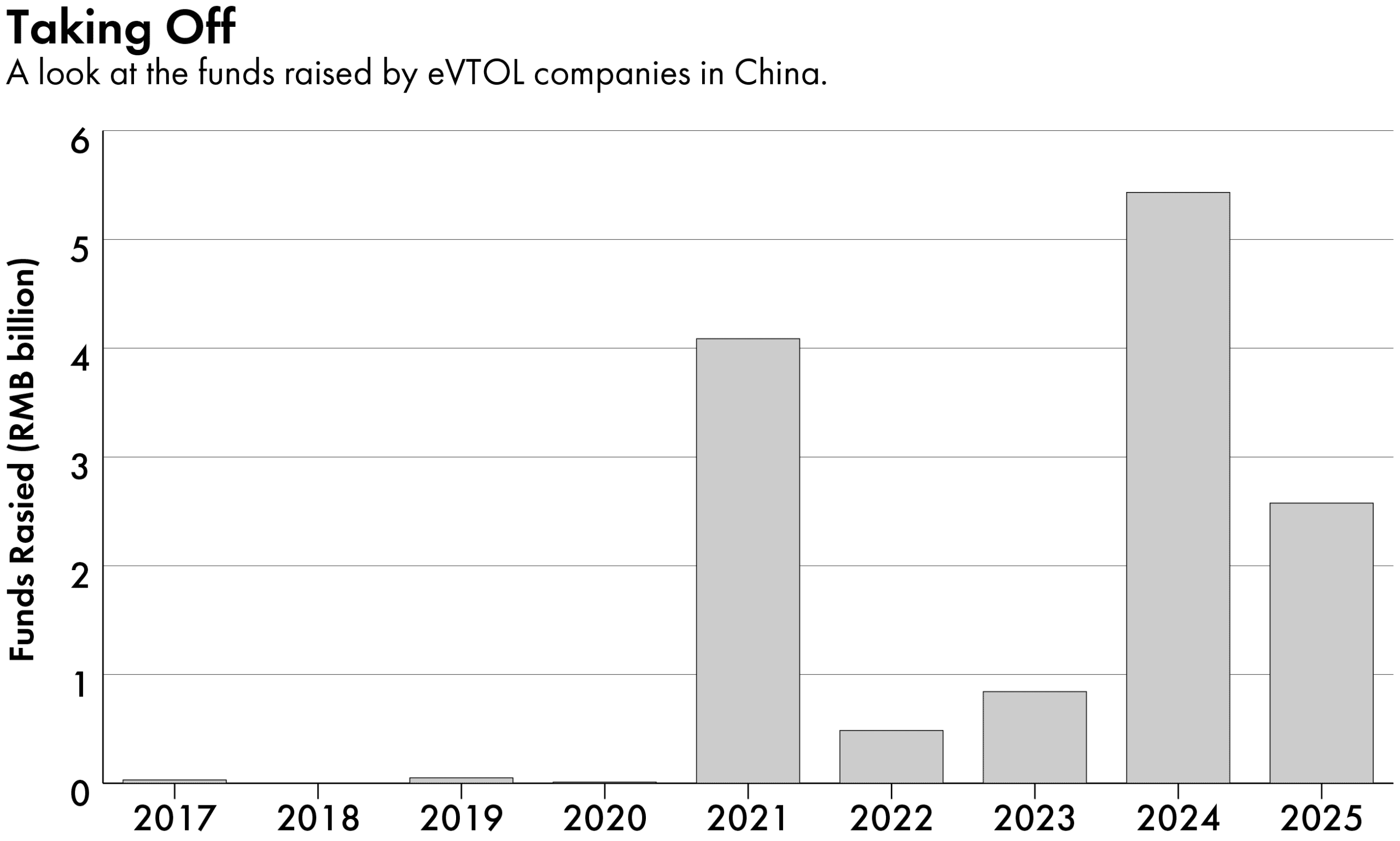
By Cecutta’s estimates, the Chinese government has already committed $16.5 billion in funding and other indirect support to boost the eVTOL sector since 2021. Leading cities are on board: both Shanghai and Shenzhen are offering 15 million yuan ($2 million) to reward eVTOL companies that have their aircraft certified by aviation authorities. In July, Shenzhen unveiled plans to build nearly 300 vertiports across the city for the takeoff and landing of eVTOL aircrafts by 2026.
The Boston Consulting Group recently estimated that China’s eVTOL market could be worth 6 billion yuan ($843 million) by 2030 with an annual sales of 190,000 passenger vehicles.
“In the West, the burden is largely on the eVTOL companies to push through everything, such as certifying the aircraft, making sure the infrastructure is there and the business is profitable,” says John Lou, an aerospace engineer and an independent eVTOL researcher based in Germany.
“In China, where the effort is more state-led, it’s going to be easier to kickstart adoption. That’s the biggest differentiator.”
Government support has enabled the rapid growth of Chinese eVTOL companies. In 2022, there was only one Chinese company among the top twenty of SMG Consulting’s Advanced Air Mobility Reality Index, which evaluates companies’ progress towards mass production based on factors such as their funding, talent, and technological maturity. In the latest edition, there are eight.
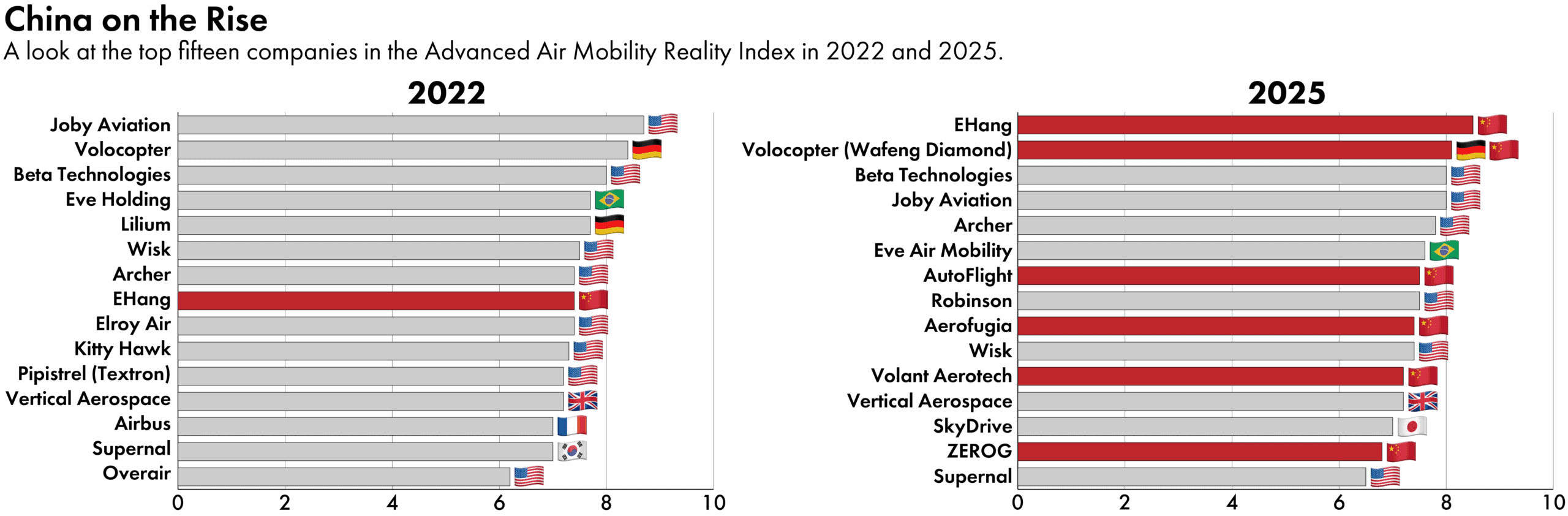
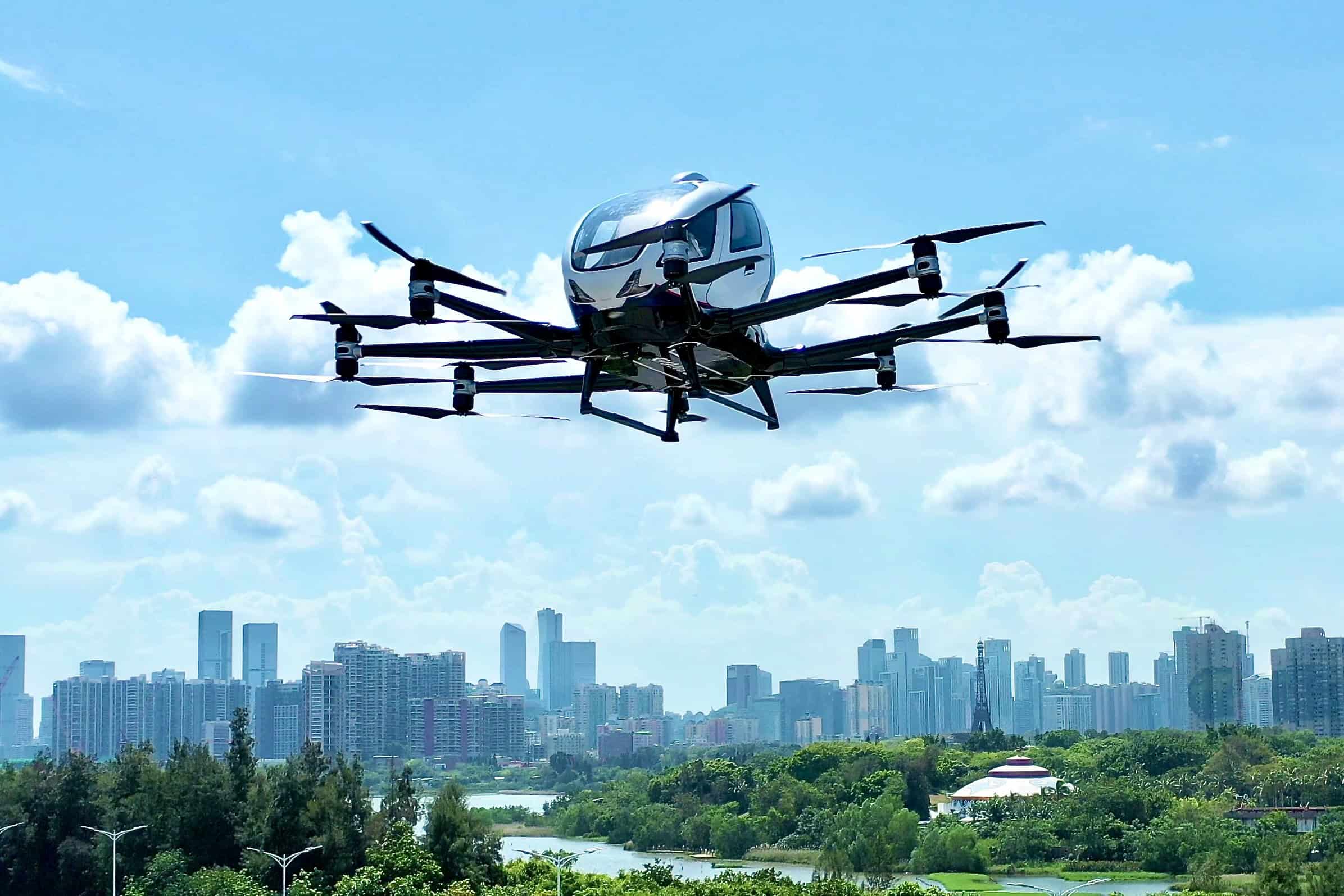
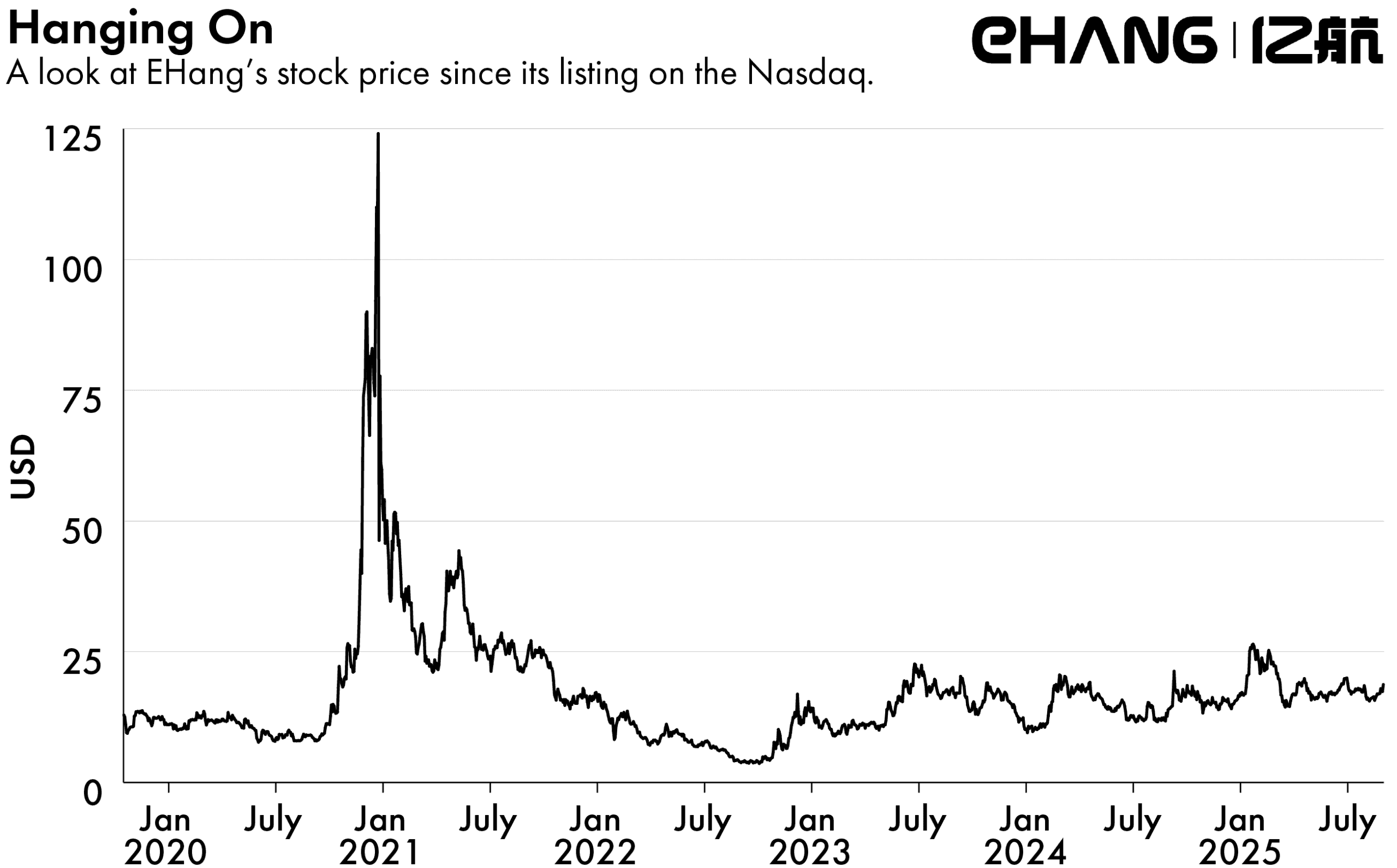
Topping the index now is EHang, a Guangzhou-based company that listed on Nasdaq in 2019. Its flagship vehicle, an autonomous two-seater, is the first of its kind to gain approval from the Civil Aviation Administration of China to take to the air and operate commercially, albeit in very stringent conditions.
A demonstration of EHang’s EH216-S vehicle in Hangzhou, at the 2024 Smart Transport Expo. Credit: EHang
As EHang’s clientele shows, local governments are driving market demand for eVTOL vehicles. A state-owned tourism operator in the southwest province of Guizhou ordered 50 EHang vehicles in June with the hope of flying visitors over its famous waterfalls. Hefei’s provincial government has committed 500 million yuan ($70 million) to support the company, including orders for aircrafts and other investments. Its joint venture with EHang may offer aerial sightseeing tours to the public by the end of the year.
AutoFlight, another leading player based in Shanghai, last year demonstrated its sleek-looking air vehicles’ ability to fly from Shenzhen to the neighboring city of Zhuhai, across the Pearl River Delta. The vehicles completed the journey, which usually takes three hours by car, in 20 minutes: along with the local authorities AutoFlight envisions the route becoming one of hundreds connecting the southern China region in future.
The company also expects certification for crewed flights in another year and unmanned ones eventually.
Besides robust state support, Chinese startups have clear advantages in cost and manufacturing know-how, thanks to the strength of the country’s electric vehicle supply chain.
When it comes to development costs, “$1 in China goes as far as $7 in the U.S.,” says Cecutta. As a result, Chinese model eVTOL prices are typically around 30 percent of their foreign counterparts. EHang’s flagship vehicle, for instance, sells for 2.39 million yuan ($336,000) in China, while the prices for eVTOL aircraft in the U.S. range from $1.2 million to $4 million.

Chinese eVTOL companies are actively seeking new markets. Some, such as AutoFlight and Aerofugia, owned by the Chinese automaker Geely, have already set up research centers or offices in the U.S. and Europe.
Others are turning to the global South. Autocraft, an air mobility company based in Abu Dhabi, pledged to buy 350 eVTOL aircrafts from the Shanghai-based TCab Tech in July. The same month, a Thai property giant signed a $1.75 billion intent deal for 500 eVTOL aircrafts from Volant Aerotech, a Shanghai-based company.
Even so, eVTOL vehicles still face several bottlenecks before they can take off both inside China and overseas.

For starters, flying cars still have a very limited flight range and time due to battery constraints. “The typical model in mass production can only fly for around 20 to 30 minutes,” says Alan Lau, an analyst with the investment bank Jefferies.
Companies in the sector are working with domestic batterymakers such as CATL and Gotion to develop more powerful cells that employ solid-state electrolyte technology, but there’s no clear timeframe around when this will happen.
The next big step for the industry is to develop eVTOL vehicles that are reliably autonomous: “Clearly it’s not sustainable, if you need a human pilot for every two to three passengers,” says Lou. He adds that the first mover in this area will also be taking the greatest risk.
These technologies are still under development. All these hardware, software, policy and talents are not well positioned right now, so the passenger scenario may take a longer time.
Zhanfu Yu, an independent aerospace and aviation consultant
The Chinese authorities are also figuring out how to govern a shared airspace. Certifying eVTOL vehicles, whose designs vary wildly, is a challenging task for the Chinese aviation regulator given the industry’s minimal track record. As more eVTOL vehicles take flight, the country will potentially have to set up invisible corridors in the air and systems to monitor the aircrafts.
“These technologies are still under development,” says Zhanfu Yu, an independent aviation and aerospace consultant. “All these hardware, software, policy and talents are not well positioned right now, so the passenger scenario may take a longer time.”
While early applications of eVTOL include aerial tourism, cargo delivery and airport shuttles, the most anticipated use case is air taxis, which could prove easier to scale up eventually. Even so, to build a sustainable business in this area, operators will need to be able to maintain a commercial fleet and a network of vertiports, while attracting regular passengers. The cost of eVTOLs will also have to come down dramatically, says Koh, of Volar Air Mobility.
Safety remains the biggest issue for the nascent industry. Concerns include whether there is the infrastructure in place to allow emergency landing or whether batteries might explode upon impact. Such considerations suggest mass adoption may still be a long way off, despite the ambitious timelines set out by some companies and local Chinese governments.
“If there’s an accident in the first five years, that can really kill public confidence in this type of vehicle,” says Lou. “It makes more sense to be really cautious.”

Rachel Cheung is a staff writer for The Wire China based in Hong Kong. She previously worked at VICE World News and South China Morning Post, where she won a SOPA Award for Excellence in Arts and Culture Reporting. Her work has appeared in The Washington Post, Los Angeles Times, Columbia Journalism Review and The Atlantic, among other outlets.