Every year, millions of Chinese workers leave their homes in the countryside to work in cities and factories in more developed parts of China. The sweat of their brows has fueled the country’s economic rise in the last few decades, but now they are growing older and facing a more precarious future.
There are nearly 300 million migrant workers in China — labourers with rural hukou under the household registration system who work outside the agricultural sector — according to official data recently released by the National Bureau of Statistics. That’s up by 9 percent since a decade ago, with migrants now accounting for 41 percent of the country’s total workforce.

Migrant workers are getting older with nearly a third of them now over the age of 50. With younger generations turning away from factory jobs and the general population also aging rapidly, the average age of migrant workers hit 43 last year, up from 34 in 2008, when the Chinese government first began tracking data on migrant workers. And the majority of them have only received lower secondary education or less.

Even though the age profile of migrant workers is rising, it has become harder and harder for many middle-aged and older workers to find jobs, according to Jenny Chan, a sociologist at the Hong Kong Polytechnic University, who has been doing field research among migrant workers in Beijing, Shenzhen and other Chinese cities.
If Chinese workers in the EV industry, electronic or other factories have to work 13 to 14 hours a day and 20 days without rest to make a living, that is not common prosperity.
Han Dongfang, founder of China Labour Bulletin, a labour rights group based in Hong Kong
Older workers, especially if they have reached the cut-off age of 45, are often deemed unsuitable for assembly lines, which require speed and precision, and are often physically taxing. “What is left for them is basically the more informal work, where they are not even recognized as employees,” says Chan. “They become what we call gig workers, who are more vulnerable because they do not have accident insurance, proper social security, pensions or other benefits.”

The industries where they work reflect this shift. The construction sector employed 10 million fewer migrant workers last year compared to a decade ago, following Beijing’s crackdown on the real estate industry in recent years. The share of workers in manufacturing has also decreased, despite the breakneck expansion of Chinese companies in areas like electric vehicles and clean energy. The platform economy has meanwhile seen an influx of couriers, food deliverymen, and drivers.


There has also been a shift in migration patterns with six out of ten migrant workers now staying within their home provinces.
“In the past half decade, there has been a strategy led by Guangdong province and extended to other wealthy coastal areas to push away labour-intensive jobs and replace them with high-tech jobs that add value to their gross domestic product,” says Han Dongfang, founder of China Labour Bulletin, a labour rights group based in Hong Kong. As a result, many labour-intensive factories have moved to inland provinces, such as Hubei and Sichuan, allowing workers to stay closer to home.
Chinese robot manufacturer UBTECH’s Walker S1 humanoid robots at work in Zeekr’s Smart Factory. Credit: UBTECH Robotics
Still, the question remains as to whether there would be enough jobs for ordinary workers across China as the country embraces technological innovation over construction and real estate as its new engine of growth.
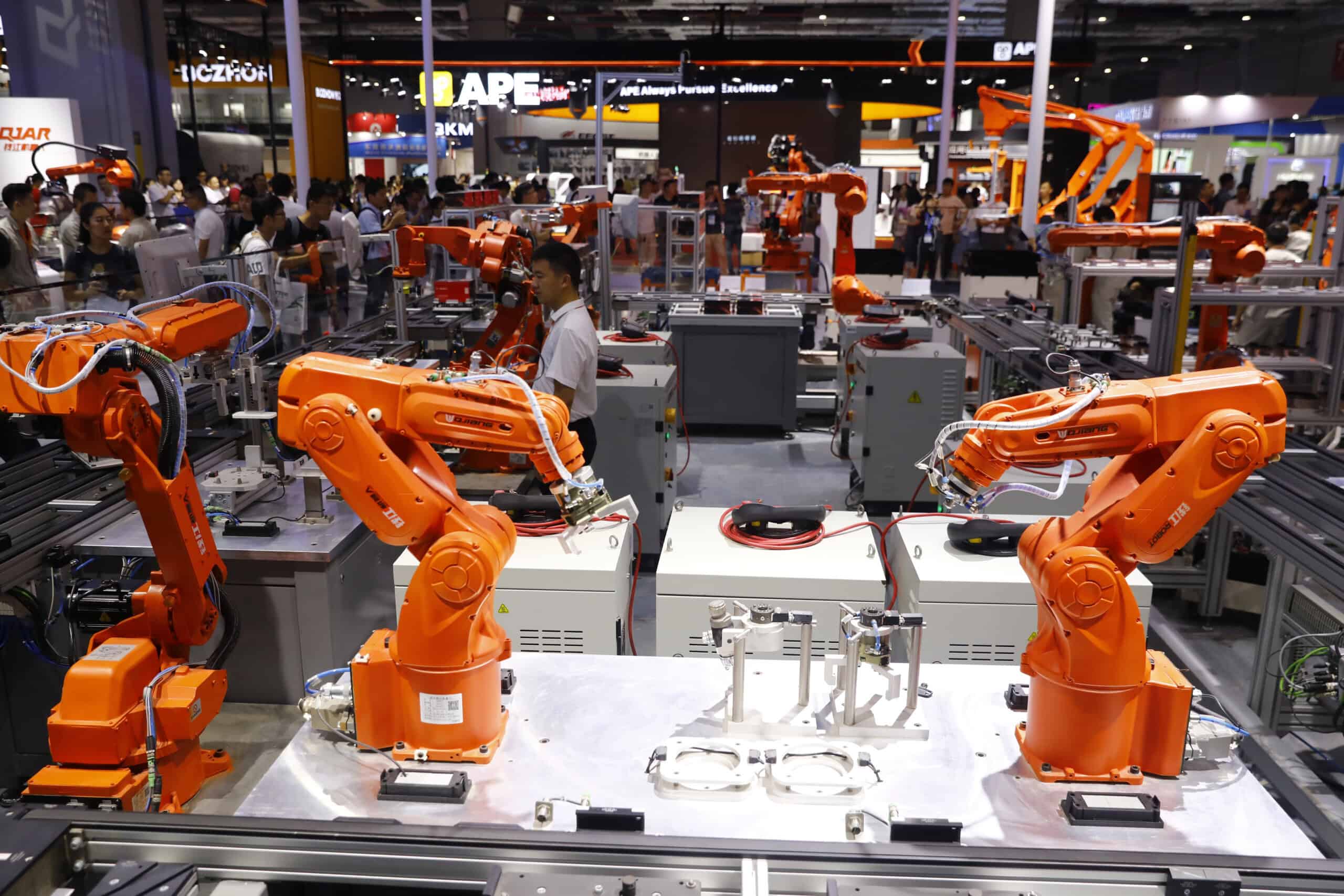
There are fears that the struggle for jobs will only become more acute as factories replace workers with robots and more manufacturing activities move from China to other countries with lower labour costs and geopolitical risks. “The overall number of jobs in China is shrinking,” Chan says.
The French bank Natixis estimates a loss of at least 1.5 million jobs even in the most optimistic outcome of the China-U.S. trade negotiations — and up to 9 million if the truce falls apart.
By some metrics, migrant workers’ lives have improved. The average monthly wage reached nearly 5,000 yuan ($694) last year. They have more living space and more of their children are entering schools and receiving basic education. Earlier this year, food delivery platforms, such as Meituan and Alibaba’s Ele.me, also pledged to offer more social welfare benefits for their army of courier workers.
But a reform of the hukou system, which prevents migrant workers from gaining residency in cities and accessing public services, has been painfully slow. In the meantime, the growing gap between the disposable incomes of urban and rural households underscores the persistent inequality in Chinese society and why it is so difficult for Chinese leader Xi Jinping to achieve his dream of eliminating poverty.
“If Chinese workers in the EV industry, electronic or other factories have to work 13 to 14 hours a day and 20 days without rest to make a living,” says Han. “That is not common prosperity.”


Rachel Cheung is a staff writer for The Wire China based in Hong Kong. She previously worked at VICE World News and South China Morning Post, where she won a SOPA Award for Excellence in Arts and Culture Reporting. Her work has appeared in The Washington Post, Los Angeles Times, Columbia Journalism Review and The Atlantic, among other outlets.