In normal years, the spring tree-planting event for China’s top military brass is an unremarkable affair. But last month all eyes were on the carefully choreographed demonstration for clues to the whereabouts of one man: General He Weidong.

China’s second highest ranking military officer has not been seen in more than 60 days. General He’s last appearance was at the close of China’s National People’s Congress on March 11. Since then he has missed Politburo meetings, including a recent televised collective study session, and authorities have offered no explanation for his absences.
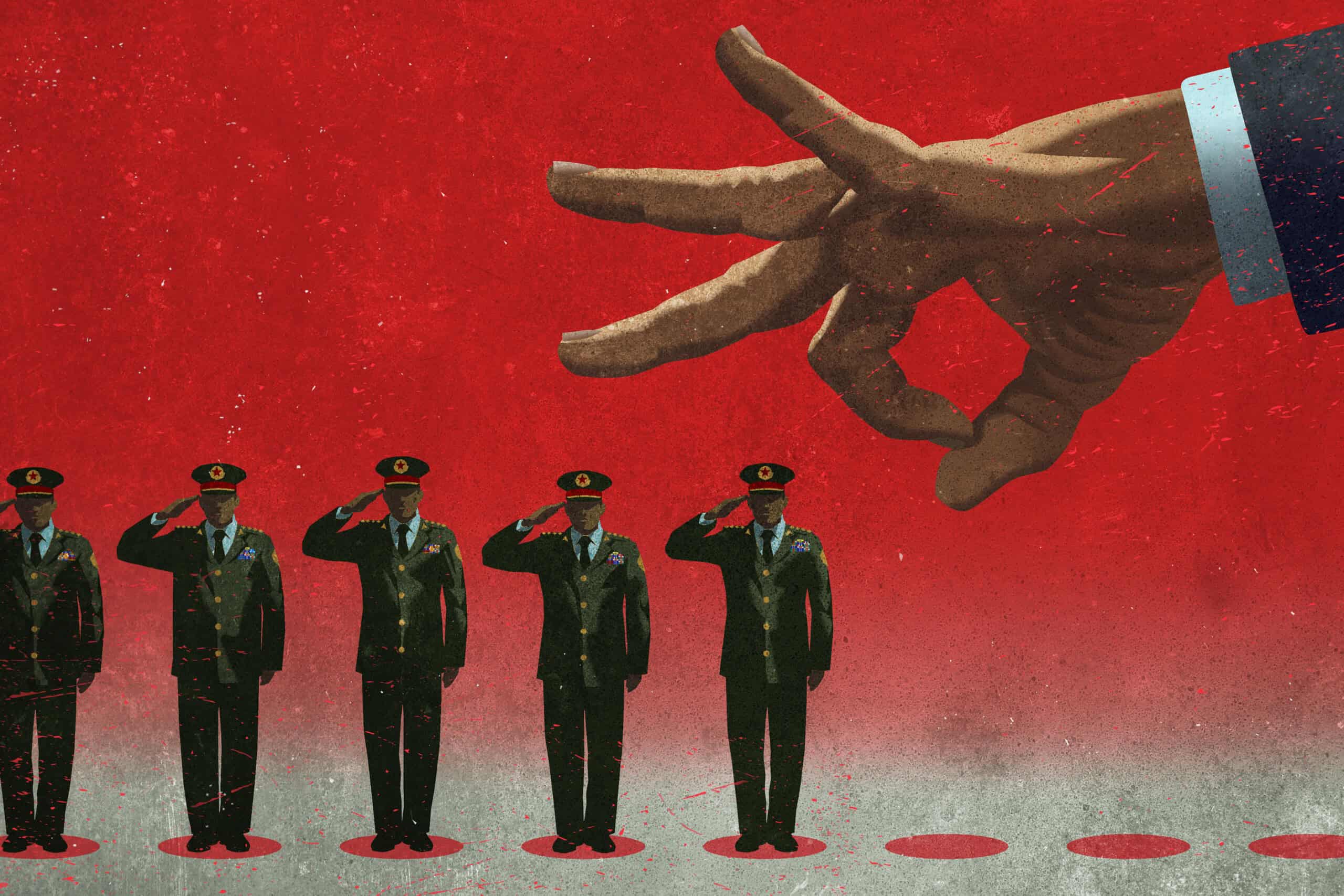
Every no-show has amplified suspicion that He, one of six generals appointed to the Chinese Communist party’s powerful Central Military Commission headed by President Xi Jinping, may be the latest and most senior officer to fall in a remarkable purge of China’s military that has transfixed watchers of Chinese elite politics.
The two-year campaign has netted at least 20 senior officers from the People’s Liberation Army. Almost all of them are the President’s men, having been promoted to their lofty heights over the first 14 years of Xi’s rule. It suggests that corruption is so embedded in the Chinese military that not even Xi, whose anti-corruption campaigns have been a hallmark of his administration, can find enough untainted generals to fill the PLA’s top military posts.
It’s the opposite of the old approach to ‘kill the chicken to scare the monkeys’. [Now, Xi is] killing the monkeys.
Jonathan Czin, a fellow at Brookings’ China Center and former CIA China analyst
If it is confirmed that General He is under investigation he will be the third CMC member to fall since the beginning of Xi’s third term in 2022. The others, whose downfalls have been confirmed by government announcements, are Miao Hua, head of the PLA’s Political Work Department, which oversees ideological discipline, and Li Shangfu, a former defense minister.

Since 2012, Xi has made high-level anti-corruption drives a priority task for his administration. After taking office, he made waves by investigating powerful retired officials, including two former CMC vice-chairs and a feared former security chief, Zhou Yongkang. Nonetheless, for one-third, and possibly half, of the CMC to fall in less than three years is astonishing.

(General He may yet reappear. China’s current defense minister, Dong Jun, who does not sit on the CMC, was reported to be in trouble last November but eventually resumed his public duties.)
“It’s arguably the largest purge of the PLA in modern Chinese history — at least two dozen three- or two-star officials and above arrested, detained or disappeared,” says Lyle Morris, a former Pentagon China expert now at the Asia Society Policy Institute’s Center for China Analysis.
Taking Taiwan
After Xi assumed power in 2012, the PLA felt the wrath of his initial anti-corruption campaigns. China’s ambitious new president orchestrated a dramatic restructuring of the PLA, ousting military leaders who had been appointed by his predecessors, Hu Jintao and Jiang Zemin, and unlocking enormous sums of investment aimed at overhauling an organization riddled with inefficiency and corruption into a state-of-the-art fighting force.

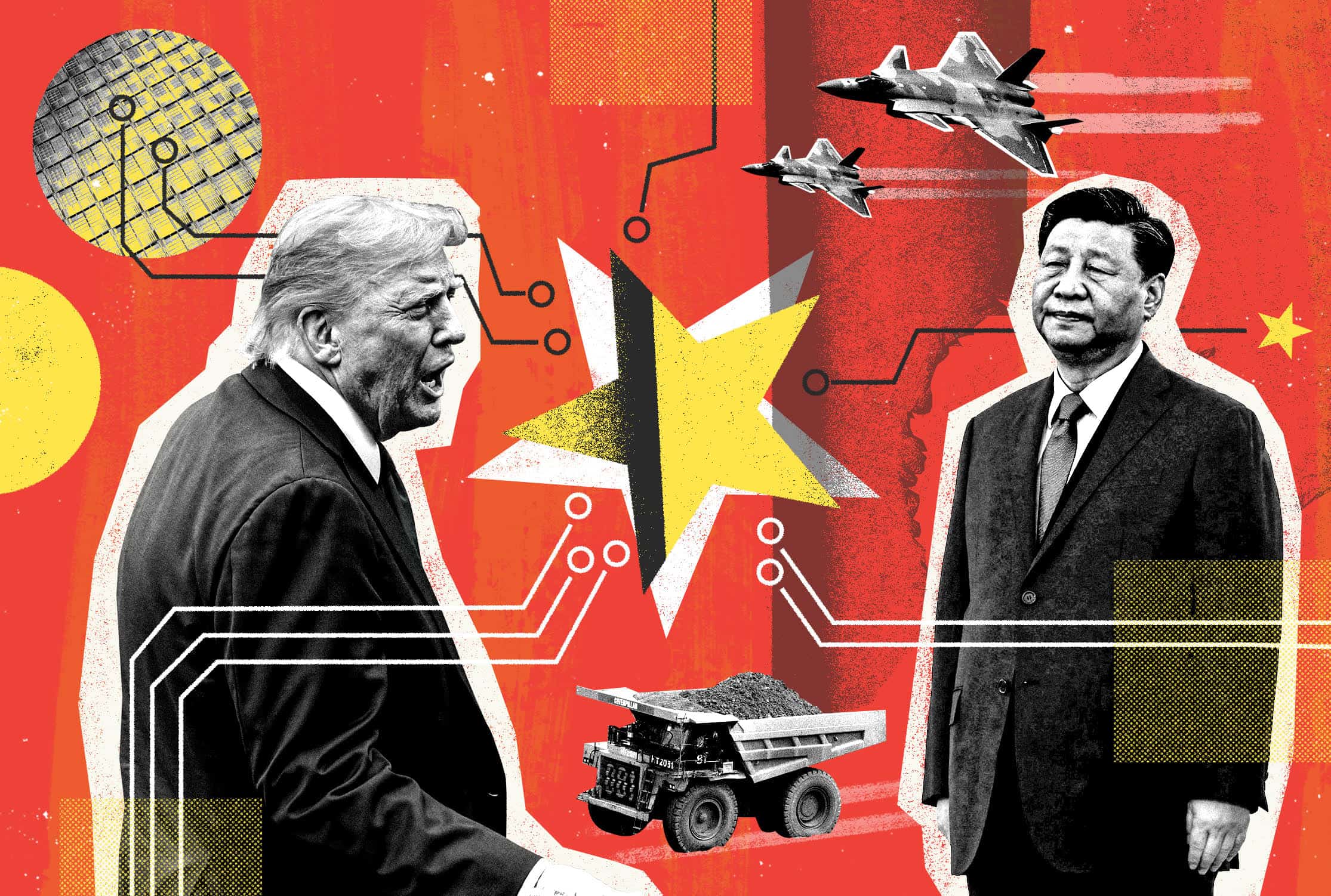
Under Xi, the military’s official budget has doubled since 2012, to $232 billion in 2024. Other estimates put the real figure almost twice as high, at $471 billion.

That influx of money has allowed the PLA to greatly expand its navy — which now includes two indigenously built aircraft carriers and a fleet of stealth destroyers. China’s military has also made significant gains in hypersonic missiles, making them faster and harder to intercept. And it is transitioning its army from a bloated, moribund body to a smaller and nimbler high-tech fighting force.
The modernization efforts should allow the PLA to project power far beyond China’s territorial waters and — more crucially — build up the capabilities needed if Xi decides Taiwan can only be retaken by force. As he has threatened, the Taiwan issue cannot continue to be “passed on from generation to generation”.

But Xi’s latest anti-corruption sweep could put a wrench in Beijing’s war plans. Many PLA watchers believe that the recent resurgence of corruption investigations targeting senior generals means that China’s military is not yet fit for the purposes Xi envisages for it. But this may not be the case. Sunny Cheung, a fellow for China studies at The Jamestown Foundation, says that experts are divided over whether corruption “has a meaningful impact on the PLA’s readiness or if it’s just a distraction”.
“The PLA has essentially been defined as the pacing challenger for DoD,” says Joel Wuthnow, a China expert at National Defense University. “This is a country with a rapidly modernizing military and yet whose intentions remain cloaked in uncertainty. This lends itself to questions about what are the actual capabilities of the PLA? Are they capable of performing complex military tasks?”

“There are questions about how [China’s] capabilities will translate to combat power,” adds Jennifer Kavanagh, director of military analysis at Defense Priorities, a think tank. “We just don’t know if the implications [of corruption] are surface-level or if they extend deep enough to create challenges on the battlefield.”
Washington’s interest in the state of China’s military capabilities stretches back decades — it is the only country whose military capabilities Congress mandates the Defense Department produce an annual report on, dating back to a period when the PLA’s commercial activities and corruption were so rife that they challenged the Party’s control. Interest in the PLA’s capabilities and its weaknesses has only magnified since Russia’s invasion of Ukraine. But even for close observers of the PLA, the issue of corruption and its influence on military readiness remains a question mark.
Dennis Wilder, a former senior U.S. intelligence officer, describes corruption as “the X factor” in evaluating China’s capabilities. “The difficulty is how do you know? When the Russian army went into Ukraine, the first thing those soldiers did was they looted the grocery stores. Why? Because the meals they had been given in their tanks were rotten. You don’t know these things until you go into the battlefield.”
While it may not be possible for outsiders, or even Xi, to assess the true depth of the PLA’s corruption problem, analysts agree that the removal of so many senior officers in such a relatively short period of time suggests that something has gone badly wrong.
In December, Ely Ratner, then-assistant secretary of defense for Indo-Pacific security affairs, described the purges at an event on the Pentagon’s 2024 report on Chinese military capabilities as “reflective of a serious concern that this is having serious problems”.
“I don’t think this is just … some guys … taking some money and putting it in their pocket, or maybe at their banquets they’re buying too expensive whiskey, as was the problem in the past,” Ratner said. “We’ve seen some reporting on particular modernization programs that have faced challenges.”
If nothing else, the purge is likely taking a toll on military morale. “It’s the opposite of the old approach to ‘kill the chicken to scare the monkeys’,” says Jonathan Czin, a fellow at Brookings’ China Center and former CIA China analyst. Now, he adds, Xi is “killing the monkeys”.
But the campaign poses risks for Xi too, as Washington looks to capitalize on the reign of fear that the anti-corruption campaign has created. In a particularly overt example, last week the CIA put out two videos on social media seeking to attract new Chinese spies.
In one scene, the narrator makes a not-so-subtle allusion to the tumult at the PLA: “As I climbed the party ladder, I watched people with higher positions than me being thrown aside like worn shoes … Now I realize my fate is as precarious as theirs.”
PLA Inc.
Historians point to one pivotal date in late October 1984, to explain when the PLA’s corruption problem exploded.
Six years after Deng Xiaoping formally introduced the Four Modernizations, his signature policy to rejuvenate China’s collapsed economy, China’s top leaders were looking to cut the cost of its four million man army.

That October, Deng’s Central Military Commission made the decision to slash the PLA’s budget and demobilized one quarter of its force, amounting to one million soldiers.
At the same time, Deng encouraged units to expand into the business sector as a way to shore up their finances. “Since the development of all our armed services is tied to national development, they should devise ways to assist and actively participate in it,” he said in a speech that year.
Within years, what came to be known as PLA Inc. boomed. At its peak in 1993, an estimated 20,000 companies were under PLA control. Army units opened every kind of business, ranging from pig farms to hotels and nightclubs, often leveraging the military’s privileges for commercial gain.

The most lucrative operations were run by politically connected officers. One such company was Poly Technologies, which specialized in foreign arms sales. Run out of the Equipment Department of the PLA’s General Staff Department, Poly’s president was He Ping, Deng’s son-in-law. Other executives included Wang Jun and He Pengfei, the sons of two generals who had fought in the revolutionary war alongside Mao Zedong.
“Poly Technologies’ specialty was that they didn’t sell things that were newly manufactured, they sold out of PLA inventory. In other words, pure profit,” says Wilder.

Profit, Poly Technologies did. U.S. officials suspected that Poly was behind the $3 billion sale of medium-range ballistic missiles to Saudi Arabia in 1987, around the time that the country was looking to develop its own nuclear program. On other occasions, Poly’s commercial operations worked in Washington’s favor: in the 1980s, it sold guns to the Central Intelligence Agency, which the agency then supplied to the Afghan mujahideen, according to a recent memoir and two people familiar with the purchases.
But the freewheeling antics by the PLA were quickly spiralling out of control. In 1996, U.S. federal agents arrested representatives from Poly and Norinco, another Chinese state-owned defense firm, on charges of smuggling thousands of AK-47 into the U.S., in a scandal that almost became a major international incident.
A PLA display conducted for visiting foreign delegates, March 7, 1997. Credit: AP Archive
By the late-1990s, “everything beyond weapons acquisitions, training and some facilities was being paid for by the PLA itself”, says John Culver, a former PLA specialist at the CIA. “Not being financially subordinate to the Party is very politically dangerous. The CCP realized that it had lost the power of the purse.”
“The net assessment was that the negative impact of going into business outweighed the commercial benefits,” says Tai-Ming Cheung, a Chinese military expert at the University of California, San Diego, who wrote a book on the PLA’s business interests during this period. “The PLA’s warfighting and organizational and normative cohesion was so seriously undermined that they had to pull out.”

The solution, outlined by then-President, Party General Secretary and CMC Chairman Jiang Zemin in a speech in July 1998, was a grand bargain with the military: cease all commercial activities and be rewarded with a dramatic boost in military spending. Jiang delivered: for the next decade, the PLA’s budget rose, on average, 13.4 percent every year, amounting to a more than three-fold increase up to 2009. Soldiers’ wages rose and their living conditions dramatically improved.
The PLA, meanwhile, was less acquiescent in holding up its end of the bargain. While many businesses were closed, “[parts of] PLA Incorporated went underground”, says Wilder. “It continued, but much more clandestinely.”

Poly Technologies’ parent company, Poly Group, for example, was moved under the oversight of the State Council’s State-owned Assets Supervision and Administration Commission (SASAC). Today, the Group is a sprawling conglomerate whose business interests range from real estate to theater and film. Poly Auction, a subsidiary, is the world’s third largest auction house after Sotheby’s and Christie’s.
“The people in charge of Poly Group today are very different in terms of composition,” says Cheung. Gone are the days where the company was run as a princelings’ fiefdom. But, he adds, “Poly Technologies remains a very important part of the military import-export business.”

Since Russia’s invasion of Ukraine, Poly Technologies has been accused of supporting Putin’s war by shipping gunpowder, navigation equipment and helicopter parts to Russian state-backed firms. The company, which was sanctioned once in 2013 for violating U.S. restrictions on sending weapons to Iran, Syria and North Korea, was again sanctioned by the Treasury Department last year.
Trust deficit

By the time Xi Jinping came into office in 2012, the PLA’s budgetary woes had largely been rectified. Its corruption problem, however, had not. From his first days in office, Xi Jinping made clear his intent to target corrupt officials, be they high-ranking “tigers” or lowly “flies”. An anti-graft campaign initiated by his predecessor, Hu Jintao, allowed him to hit the ground running.
Earlier that year, the CCP’s central anti-graft agency had quietly overruled the PLA’s own investigators to dismiss a lieutenant-general named Gu Junshan. Gu, a portly man with heavy set eyes, was a protege of General Xu Caihou, who served as vice-chair of the Central Military Commission from 2005 to 2013. Under Xu’s patronage, Gu had enjoyed a meteoric rise through the PLA’s General Logistics Department, which oversaw general procurement for the entire military, rising to the rank of deputy director in 2009.
When investigators raided Gu’s house in January 2013, they were stunned by the scale of his profligacy. The ex-officer was obsessed with gold, reported Phoenix Magazine, a Hong Kong-based outlet that often dared to tackle subjects that other Chinese-language media were reluctant to examine. According to Phoenix, Gu’s trophies included gold statues of the Buddha and hundreds of kilograms of gold bars, which he would gift to patrons by the trunk-load. All told, his ill gotten gains, which also included vast property holdings, were estimated to be worth some $5 billion.
Gu’s prosecution was just the start. The following year, investigators turned him against his protege, General Xu, a close ally of Jiang. By this point Xu had retired and was deeply ill. Xi’s investigators were not sympathetic. Armed police officers reportedly hauled Xu out of his sick bed and into custody. They also detained General Guo Boxiong, another CMC vice-chair under President Hu Jintao. Guo was eventually sentenced to life in prison for bribery in 2016. Xu died before his trial.

Analysts say that Xi’s move to go after his predecessors’ top military allies was motivated as much by politics as it was by any wrongdoing. “At a certain level anyone who rises in the system has some corruption or untoward part of their record. So the fact that you go after some people versus others is always going to be somewhat political,” says Neil Thomas at the Asia Society Policy Institute’s Center for China Analysis. Xu and Guo’s prosecutions were “pretty clearly a factional move to remove Jiang Zemin’s influence from the PLA”.
Xu and Guo’s arrests, which implicated more than 100 other senior PLA officers, cleared house inside two longstanding hotbeds of military corruption. The first, the General Logistics Department (GLD), oversaw sprawling areas of non-weapon related procurement including food, shelter, uniforms and fuel. The second, the political commissariat, oversaw promotions, and had been thoroughly compromised by a widespread cash-for-promotions racket.
Investigators took away two retired generals that had overseen the logistics and political departments. At the same time, Xi rammed through reforms that centralized control of the GLD. To break up patronage networks established by political commissars, he rotated them around the country.
But there were limits to what Xi could achieve in his initial anti-corruption drive within the PLA.
“When anti-corruption officials gave speeches in 2012 to 2013, they identified several areas where corruption was the heaviest: the political commissar system, the logistics system and the procurement and acquisition system,” says UCSD’s Cheung. While Xi quickly went after the commissars and logistics, Cheung adds that “the weapons acquisition system was always off limits … They had an opportunity at the beginning of Xi’s term to deal with this, [but] they put it off.”
Part of the reason for Xi’s deferral may have had to do with his appointment of a loyal confidant, General Zhang Youxia, to oversee weapons procurement.

Zhang, a son of a revolutionary general and childhood friend of Xi’s, led the General Armaments Department and its successor, the Equipment Development Department, from 2012 to 2017, when he was promoted to vice-chair of the Central Military Commission.
“Zhang and Xi have a much deeper bond,” says Czin at Brookings’ China Center. In a departure from party norms, Zhang secured another term as vice-chair of the CMC in 2022 despite having reached the usual retirement age. “It underscores how few people in the system Xi truly trusts,” Czin adds.
Under Zhang’s watch, the PLA invested deeply in cutting edge technologies, modernizing its nuclear arsenal and accelerating military-civil fusion efforts. But the military’s spending sprees also made the department ripe for graft.

When the CMC announced an anti-corruption probe into the department in 2023, several of Zhang’s proteges were the first to fall. By year’s end, several generals, including defense minister Li Shangfu, who had succeeded Zhang at the EDD, were ousted from their posts.
At the same time, top leaders of the PLA’s Rocket Force, the arm of the military in charge of China’s nuclear arsenal, were also removed in a purge that was never explained by the military or the party. A subsequent article in Bloomberg, citing U.S. intelligence, claimed widespread graft and mismanagement at the unit, including missiles filled with water instead of fuel and defective silo covers.
Crackdowns have also spread across China’s military industrial complex. At the same time that rocket force personnel were being removed, three senior executives at state owned enterprises responsible for key military modernization efforts programs were abruptly stripped of their posts.

They included Liu Shiquan, party secretary and chair of Norinco; Wang Changqing, deputy manager of China Aerospace Science and Industry Corp, China’s satellite operator; and Wu Yansheng, chairman of China Aerospace Science and Technology Corporation, China’s main builder of rockets and missiles. In January, Xue Jianguo, a former executive involved in China’s satellite navigation program at Harbin First Machinery Group, a Norinco subsidiary, was also placed under investigation.
Experts say that, almost 15 years into Xi’s rule, the corruption that continues to fester within the PLA and its suppliers is structural in nature.
At a certain level anyone who rises in the system has some corruption or untoward part of their record. So the fact that you go after some people versus others is always going to be somewhat political.
Neil Thomas at the Asia Society Policy Institute’s Center for China Analysis
“In the U.S., we have the ‘iron triangle’ problems, with close relationships between defense firms and military officials and the government,” says Christian Curriden, a defense analyst at RAND. “In China an SOE in many ways pulls all of those functions into a single organization. A lot of the oversight for the companies has to come from the PLA, but a lot of the individual people responsible for oversight have traditionally had close relationships with the companies they’re supposed to be overseeing.”

Since 2023, many state-owned defense companies have pledged to step up efforts to probe corruption internally. Beijing this year also enacted higher standards for quality control in weapons research and development.
But those measures are unlikely to resolve a more fundamental problem for Xi.
“Xi has been in power for 10 plus years, but that’s not forever,” says Helena Lagarda, a lead analyst at the Mercator Institute for China Studies, a European China think tank. “There was a long period where ranks and promotions were up for sale, and a lot of those people who likely got their rank and promotion with money on the side haven’t retired.”
“To me, it’s about [Xi’s] confidence in the people that would be commanding troops in battle,” says Wuthnow at National Defense University. “We’re not talking about minor people on the fringes, we’re talking about the most central people in the PLA who are not reliable interlocutors. [General He] was Mr. Taiwan Contingency. So if you have someone like that who you’ve lost confidence [in] … then who can you trust?”

Eliot Chen is a Toronto-based staff writer at The Wire. Previously, he was a researcher at the Center for Strategic and International Studies’ Human Rights Initiative and MacroPolo. @eliotcxchen