President Trump’s mercurial trade announcements, up to and including last week’s ‘Liberation Day’ tariffs on over 100 countries, have upended the global economic order and thrown a spanner into the workings of the international commercial system. Bigger recession risks now loom over the U.S. economy, and hard times lie ahead for many other nations. Businesses, adept at using risk management and hedging models, have been cast adrift and are having to cope with elevated uncertainty. Multinational firms, long resigned to the increasingly awkward idiosyncrasies of doing business in Xi Jinping’s China, will from now on have to configure how to manage similar issues arising in Trump’s America.

This unexpected convergence of politics and trade policy between the U.S. and China is particularly perverse, given that not so long ago it was thought that openness and engagement would cause China to become more like the U.S. over time. In a recent Foreign Affairs essay, Michael Froman, president of the Council for Foreign Relations and former U.S. Trade Representative, describes how precisely the opposite has occurred.
In pursuing industrial policy, self-reliance, and restrictions on foreign investment and market access — and now in embracing protectionism on a huge scale — America has joined, as Froman quips, Beijing’s world. For global firms, this new, seemingly dystopian ‘level’ playing field has come as a shock. How might it change their perceptions and behavior?
The Chinese government’s portrayal of itself as a champion of globalization and free trade is certainly not credible. But it is clear it wants to exploit both Trump’s flawed economic strategies, and the U.S.’s newfound hostility towards its allies.
The U.S. has, until now at least, been the stand-out destination for foreign investment, along with Europe. In the case of the U.S., the reasons include economic outperformance, flexible and transparent product markets, deep and open capital markets, predictability, robust regulatory and legal systems, and a vibrant consumer market that is as big globally as Chinese manufacturing.

The market value of the stock of foreign direct investment in the U.S., according to the Department of Commerce, was over $13 trillion in 2024, over three times as high as it was in China. Annual flows into the U.S., moreover, have been running at about $200-300 billion in the last couple of years, boosted by strong inflows related to the Biden-era tilt towards industrial policy legislation in 2020-21. In China, by contrast, the State Administration for Foreign Exchange has reported that annual flows of inward investment have fallen from $250-350 billion in 2020-21 to less than $5 billion in 2024, the lowest since 1991.
China’s failure to sustain higher levels of inward investment has been evident for a while in regular surveys conducted by, for example, the American and EU Chambers of Commerce in China, whose members have reported a rising tendency to relocate future investment outside China. According to the most recent American Chamber of Commerce report, a record 30 percent of member firms in China are considering moving or have already moved some operations outside the mainland.
The shift of firms away from China is mostly due to trade and tariff tensions, U.S. export controls, the perceived need to recalibrate supply chains, and unreasonable market access difficulties there. It is also true that although China has some world-renowned firms in key sectors, its own faltering economy, especially in real estate and infrastructure, along with its low demand, deflation and repressive governance structure, have all weighed on corporate attitudes and expectations.
Even if there might yet be a U.S.-China deal involving a reduction in tariffs, more bilateral goods purchases, and other possible other ‘fixes’, the underlying friction in the bilateral relationship is bound to persist. The current controversy over the proposed sale of ports, including in Panama, by CK Hutchison to Blackrock, as well as over other national security-related corporate transactions involving Chinese acquisitions in recent years, reveal a fundamental separation of national interests.

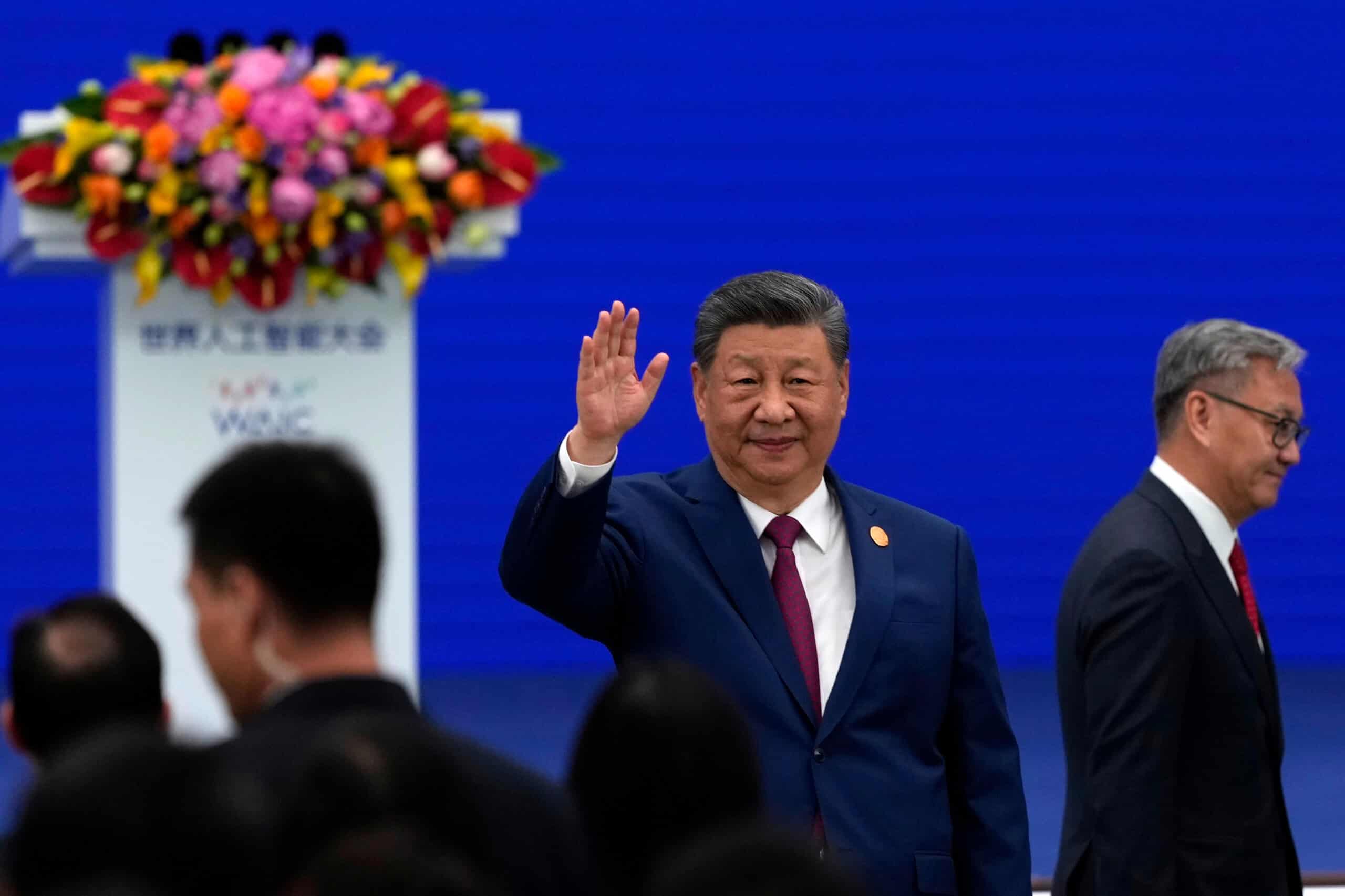
It is no surprise, therefore, that China has been trying to appear more amenable to foreign firms. In recent weeks, Ministry of Commerce officials have met with several foreign chief executives. Premier Li Qiang tried to reassure executives at the China Development Forum in March about the government’s handling of the economy, and told them that foreign firms could be confident that China would ‘resist unilateralism and protectionism’. Xi, himself, met with executives at the Great Hall of the People just afterwards to assure them they would receive equal treatment with domestic firms and lower market access barriers, and to praise their valued contribution to China’s modernisation drive.
Much of this is not new, or even correct. The Chinese government’s portrayal of itself as a champion of globalization and free trade is certainly not credible. But it is clear it wants to exploit both Trump’s flawed economic strategies, and the U.S.’s newfound hostility towards its allies.

Accordingly, China’s Foreign Minister, Wang Yi struck a contrasting tone to Vice President JD Vance at the Munich Security Conference in February, asserting that China had always regarded Europe as a key part of the multipolar world, and that Europe and China were partners not rivals. Although these were opportunistic and unfounded compliments, his political purpose — to encourage countries like Germany, the UK, Italy and Spain to sustain high levels of commercial engagement despite China’s unequivocal support for President Putin’s war in Ukraine — was clear.
In the wake of ‘Liberation Day’, some states may make common cause with China as ‘victims’ of Trump’s tariffs. But for multinational firms, China is not the answer, as Beijing isn’t going to change its political character or the basic thrust of its economic and financial policies. The main question for global firms, then, is what to make of the U.S.?
While the U.S. retains important advantages over China as a destination for multinational firms, one of the main consequences of Trump’s tariffs will be to make multinationals look more closely at local markets, including those where the U.S. tariffs are lower…
The short-term, tariff- and trade-driven cyclical outlook is poor. Business confidence in U.S. manufacturing has cracked, as suggested by recent surveys published by the Federal Reserve Banks of New York and Philadelphia. The widely followed Michigan indices of consumer sentiment and expectations have dropped sharply. These readings presage a sharp slowdown in growth, maybe even a recession this summer, and a rise in inflation back to 4-5 per cent. Yet, cyclical performance alone won’t rob the U.S. of its foreign investment credentials and business attractions. Multinationals need to focus on longer-term factors.

They need to know if Trump’s tariffs are temporary or permanent. If temporary, there might not be much reason for their investment strategy to change. If permanent, they would be perceived as an enduring campaign to break up supply chains, especially in China and Asia. Trump wants multinationals to relocate production and investment to America. Whether this happens in a meaningful way in years to come is a moot point, and is closely linked to the consequences of tariff strategy for Trump himself, and the Republican government.
While the U.S. retains important advantages over China as a destination for multinational firms, including many that are alien or undesirable to the China’s Communist Party, one of the main consequences of Trump’s tariffs will be to make multinationals look more closely at local markets, including those where the U.S. tariffs are lower — for example in Singapore, the UK, Turkey and much of Latin America and the Gulf, even India.
There is certainly little commercial, political and regulatory equivalence between the U.S. and China for these firms despite casual commentary to the contrary. Yet, the uncertainty and consequences surrounding Trump’s tariffs are liable to intensify the trend among firms towards ‘silo-ing’. In other words, they will want to boost their operational resilience and earnings by changing their supply chain geography — even if that means having to adapt a myriad of corporate functions to become locally compliant. It will also mean companies concentrating on regional goals: being in China for the Chinese market, in the U.S. for the Americas, and in Europe for most everywhere else.
President Trump may want his tariffs to make America great again. What is more certain is that they will exacerbate the divisions within the global economy.

George Magnus is a research associate at Oxford University’s China Center and at SOAS, and the author of Red Flags: Why Xi’s China is in Jeopardy. He is the former Chief Economist of UBS.