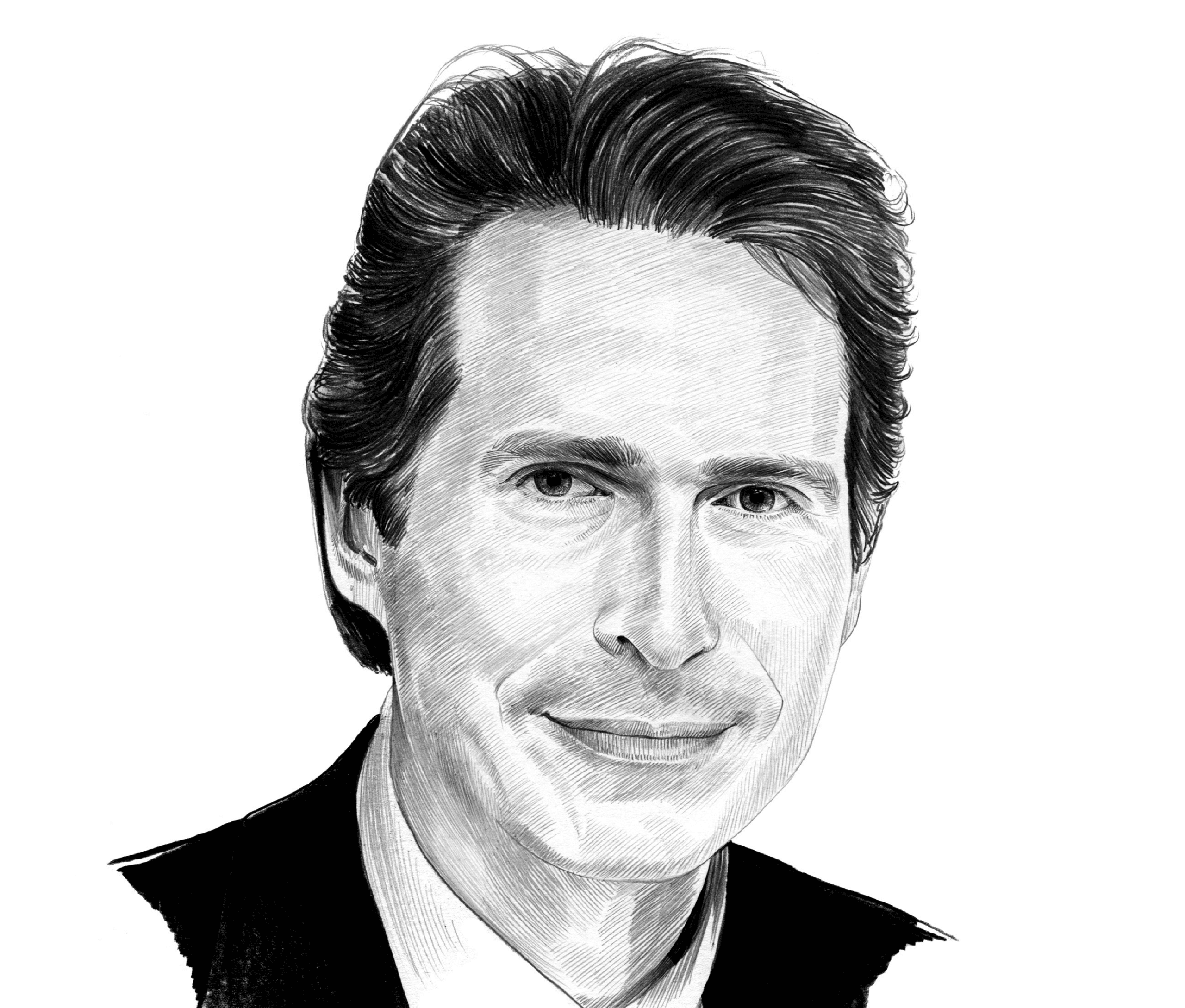
Before joining the Biden administration in 2021 for a two-year stint as senior China advisor to Commerce Secretary Gina Raimondo, Elizabeth Economy had a long and distinguished career as a China watcher and writer. Her 2018 book, The Third Revolution: Xi Jinping and the New Chinese State, details how Xi accumulated power in his quest to compete, if not surpass, the United States. In June 2018, Economy was named one of the “10 Names That Matter on China Policy” by Politico Magazine. At Commerce, she helped Raimondo develop parts of the administration’s main economic outreach to Asian nations, the Indo-Pacific Economic Framework. She also worked to ease tensions with Beijing in the economic sphere by preparing meetings with Chinese economic leaders. She is now Senior Fellow and co-chair of the Program on the US, China, and the World at the Hoover Institution.

Illustration by Kate Copeland
Q: Before you came into office, you had written influentially about Xi Jinping as the leader of a country looking to catch up to, if not surpass, the United States. That view is generally accepted now. Why do you think it took so long [for U.S. policy makers] to accept that and work that into their views?
A: For several decades, we had this sensibility about China that a policy of engagement, and bringing China into the international system of regimes and institutions, would make it, as [George W. Bush’s Deputy Secretary of State] Bob Zoellick put it, ‘a responsible stakeholder.’ We believed that over time, China’s political and economic system would begin to resemble that of the United States and that it would become a partner, if not an ally, at some point in the future.
Xi Jinping however transformed our understanding of what China was seeking for itself and for its role on the global stage. His vision emerged almost immediately.
| BIO AT A GLANCE | |
|---|---|
| AGE | 62 |
| BIRTHPLACE | Buffalo, New York, USA |
| FORMER POSITION | Biden Commerce Department’s former senior advisor on China |
| CURRENT POSITION | Hargrove Senior Fellow and Co-Director, US, China, and the World Program, Hoover Institution, Stanford University |
He talked about the “Great Rejuvenation of the Chinese Nation,” which had at its core both the domestic rejuvenation of China and China reclaiming centrality on the global stage. Within his first two years in office, he was also calling for China to lead in the reform of the global governance system and proposed the Belt-and-Road Initiative and the Asian Infrastructure Investment Bank. He also ramped up military activity in the South China Sea and began the construction of seven artificial features there. All the signs were there of a major change in Chinese outlook and ambition.
It’s not puzzling to me that it took us a little bit of time to adjust our policies. It’s righting a ship that had been moving in one direction for decades.
You have written about how the competition between the U.S. and China is one of values, not simply hardware. Do you think of it as essentially a soft power competition?

No. I think it’s a competition across the board, across all dimensions of the relationship. Xi Jinping’s vision of the international system is one in which the system reflects much more Chinese values, Chinese interests, and Chinese priorities. That’s whether we’re talking about state-directed human rights, or the dissolution of the U.S.-led alliance system, or China as the number one technology and innovation superpower, or the de-dollarization of the global economy. Those are all part of Xi Jinping’s ambition.
Many people argue that Xi just wants to make the world safe for China, and safe for autocracy. But when you do that, you make it unsafe for democracy. Some people are missing all of this.
You have written about the need to ‘seize the mantle of change that China has claimed’ and for a ‘transformed international system.’ Do you think Biden moved in that direction?
There were elements of the Biden administration’s strategy that were taking us in that direction, for example, efforts around global digital transformation and the clean tech revolution. But what we were missing, and what we have been missing for a long time, is a president who can articulate a vision of the international system that is attractive not only to people in the United States, but to a large portion of the rest of the world.

It’s very difficult for a president, who only has a four-year term, to focus on that kind of global vision. What should be the U.S. role in the international system 10 or 20 or 50 years from now? What should we be providing in terms of global goods? Are there areas where we need to take a step back, to share our power, to share our influence in different kinds of ways? I think there has to be an element of system reform. We need to bring many more voices into the decision-making part of the international discussions.
President Trump seems to think that this alliance system doesn’t benefit U.S. security very directly. But in pulling out of all these multilateral arrangements, we are simply picking up our marbles and going home. You can’t win in a game if you’re not there to play.
These are difficult things for the superpower to do, and we haven’t done it to date. President Trump may be in the process of changing the U.S. position in the international system — albeit not in a direction that I like — but he hasn’t articulated a clear vision or explained all the potential ramifications for the United States and the rest of the world.

Trump is certainly talking about transforming the international system. Is that in a way you think is helpful or unhelpful?
As an internationalist, as somebody who believes that the leadership role that we’ve played for 70 years serves American security and American economic interests, I see what’s coming out of the Trump administration as a retrenchment of the U.S. leadership position on the international stage.
Withdrawing us from a number of international institutions and organizations, and even potentially pulling out of NATO, and focusing on the western hemisphere seems to reflect the idea that we would go back to a system of spheres of influence, which would allow China to do what it wants in the Asia-Pacific region.

Xi Jinping’s vision of an international system that is predicated on Chinese values is enabled when we pull out of the UN Human Rights Council, the World Health Organization, and a range of other organizations. Frankly speaking, when I look at President Trump’s actions, joining with Xi Jinping and Vladimir Putin, it’s as though he is spurring on changes that will help realize Xi’s ambitions. For example, Xi has called for the dissolution of the U.S.-led alliance system, and President Trump has several times raised the possibility of withdrawing from NATO. President Trump seems to think that this alliance system doesn’t benefit U.S. security very directly. But in pulling out of all these multilateral arrangements, we are simply picking up our marbles and going home. You can’t win in a game if you’re not there to play.
I think the one place where Trump and Xi diverge is in Xi’s call for the de-dollarization of the global economy. I think that President Trump will push back there. But the President has to understand that as we alienate every ally that we’re not going to get much support. You can’t expect other countries to come to your defense and do things that promote your leadership if you, in turn, are not supporting, or even considering their interests.
[The interview was conducted before Trump announced his wide-ranging tariffs on April 2, 2025. In an email afterwards, Economy added an additional comment.
The reciprocal tariffs may, in fact, be the final nail in the coffin of U.S. global leadership. Had the administration made a legitimate argument for targeted tariffs based on actual evidence of unfair trade policies or a national security imperative, I think there would have been significant support for such action within the United States and some acceptance globally. But there was no real analysis presented.

What is the objective in levying a 47-percent tariff on goods from Madagascar, whose per-capita GDP is $500 and whose largest export to the United States is vanilla? And there is certainly no foundational principle involved if, as President Trump has suggested, he is ready to offer China tariff relief in exchange for a deal on TikTok. Our only hope now is that Xi Jinping scores enough own goals to stave off a permanent shift in the world’s political and economic center of gravity.]
There has been a lot written about how the destruction of USAID will allow China to move in and substitute for the U.S.. Given the way China operates, do you think that’s correct?

I don’t think that China will move in and substitute for the U.S. because I don’t think it wants to spend the kind of money that the United States has traditionally devoted to overseas aid. China’s overseas assistance comes primarily through the Belt-and-Road Initiative and the Global Development Initiative. In some respects, those programs directly serve the interests of the host country, but in almost every circumstance they also serve the political and economic interests of China. China’s overseas development assistance almost always benefits Chinese companies. USAID is about aid. China is not a huge provider of aid on the global stage.
One area where China will benefit from the Trump administration’s destruction of USAID, however, is in digital infrastructure. USAID was a critical player in mobilizing funding for digital infrastructure and providing technical assistance. China was already very competitive there and now is going to have much less competition. Where the intersection of economics and assistance was most direct, China was already playing [an important role]. Now they will simply dominate.

In economic diplomacy, the Biden administration’s big effort was the Indo-Pacific Economic Framework. Honestly, that seemed like pretty weak tea and will probably be ended with Trump. What’s your view on the significance of the effort, and presumably the end of it?
The Commerce Department was responsible for three of the four pillars of the Indo-Pacific Economic Framework. Those were the three pillars that came to fruition, where agreements were negotiated and signed. Enormous credit goes to Secretary [Gina] Raimondo and Sharon Yuan who was the chief negotiator.
There was skepticism among our IPEF partners at the outset. But I think as the process went on, there was greater and greater buy-in and enthusiasm.

With the recognition that we weren’t going to join the CPTPP, at least for the time being, [Asian governments] wanted us there in some form. And we made some real progress, for instance, in the supply chain and clean tech pillars. For someone like me who would like to see us get back in the trade game and find a way to align with the CPTPP, IPEF was a good first step. It was a platform from which we could move forward.
[On the first working day of the first Trump administration, President Trump pulled the U.S. out of negotiations for the Trans-Pacific Partnership, or TPP, a proposed trade deal between a dozen Asia-Pacific nations. The remaining nations put together a trade deal without the U.S.. called the Comprehensive and Progressive Agreement for Trans-Pacific Partnership. The U.S. has so far rebuffed calls to join CPTPP while China has asked to join.]

IPEF was also one of the first projects that I worked on in government. The Secretary held a brainstorming session where she discussed ideas about how we could demonstrate to the partner countries our commitment and enthusiasm for the framework. We landed on the idea of digital skilling for women and girls in the emerging and middle-income economies of IPEF. She then told me to go do it.
I said, ‘ What do you mean, do it? I’m an academic.’
But it was a great introduction to government because it involved the full arc of coming up with an idea, identifying the objective, and figuring out how to realize that objective. Working with the Secretary and a small team, we pursued a number of U.S. companies, basically asking each of them to support this endeavor by providing 500,000 digital-skilling opportunities over ten years in countries like Fiji, Vietnam, and Malaysia.
Fourteen companies signed on, everyone from Edelman to Google to Apple, IBM, Cisco — many of the big tech companies.
Each company provided something different — one supported a bus in rural India that went around training young girls on computer skills, another helped women entrepreneurs understand how to do social media and get their products into the global market and others did cybersecurity training or offered certificates for mastering specific computer skills. Every company could choose its own activity.
We announced it and launched it at the very first IPEF summit in Los Angeles [in Sept. 2022]. I will never forget the Minister of Trade for Fiji stood up and was so excited because he had four companies coming in to do this kind of work. When would that otherwise have happened?
I don’t disagree that compared to a big, high-standard trade agreement IPEF can seem a little bit anemic. But if you’re thinking of the United States demonstrating a commitment to economic development and prosperity in the region, it was a first step that became quite meaningful.
[Economy added afterwards: As an aside, our target of 7,000,000 digital skilling opportunities in total over ten years was surpassed in just two years.]
What happens if Trump cancels IPEF?

It would be just another signal of U.S. capriciousness, and the inability of the international community to rely on the United States to live up to its commitments.
During much of your time at Commerce, relations with China were awful, with the balloon incident, the Pelosi visit to Taiwan and so on. You were involved in the Raimondo meeting with Chinese Commerce Minister Wang Wentao in trying to stabilize things. How did that go?
I think the Biden administration’s tenure with China is best encapsulated in the term ‘managed competition.’ I started nine months into the first year. The first two and one-half years were really about the competition part and trying to ensure that the United States had the capabilities to compete with China. So, putting in place stuff like the CHIPS Act, the Inflation Reduction Act; and also defensive tools, like modernizing CFIUS, outbound investment restrictions and export controls; and then reestablishing relations with our allies and partners, which had frayed under the Trump administration. [The Committee on Foreign Investment in the U.S. is an interagency group that reviews foreign investment in the U.S.]
Then Secretary of State Antony Blinken delivers a speech on “A Foreign Policy for the American People,” March 3, 2021. Credit: State Department
[Secretary of State Antony] Blinken made statements that we’re going to negotiate from a position of strength. Once we had put in place the policies to enable us to compete effectively, we could negotiate — that became the ‘managed’ part of managed competition. We recognized that not having a set of ongoing discussions and engagements didn’t serve the U.S.’s purpose. At the base level, it was about stabilizing the relationship, and anything else above that would be sort of icing on the cake.
While Commerce was at the forefront of the U.S.’s competitiveness strategy, through initiatives such as CHIPS and Science, and led the way on export controls, we were also early in thinking about how to engage with Chinese counterparts to keep the relationship stable. For example, Secretary Raimondo met with the Minister of Environmental Protection [Huang Runqiu in July 2022]. NOAA is part of the Commerce Department, so there was a natural fit, and I knew this minister was serious from my previous work on China and the environment. He was also the only non-Communist Party member of the government.

She had a good meeting with him. Raimondo had been the governor of Rhode Island and knew wind power, so they had a lot to talk about. They shared interests in the problems of marine plastic pollution and wind power. It’s not that this meeting led to a major new expansion in our relationship, but it was one connector point between the two countries — the first bilateral meeting of a Chinese minister in the United States.
Then Commerce Minister Wang Wentao came [in May 2023]. He came across as constructive and pragmatic. Also, he had been party secretary of a province. [Wang had been deputy party secretary of Shandong province and party secretary of the city of Jinan.]

They shared a desire to get things done. He also came across as constructive and pragmatic. He had been governor of a province, so he and Secretary Raimondo shared a desire to get things done. One of the most interesting moments was when Secretary Raimondo talked about de-risking and Wang said, ‘Isn’t de-risking decoupling? And she said, ‘No, let me explain to you my experience as a governor with Covid and what it was like having to call around to try to get access to PPE [personal protective equipment.] I was calling countries. I was calling South Korea. I was calling other places.’
At the end, he said, ‘Oh, I understand. That makes a lot of sense.’ Again, a small moment, but an important one for improving understanding. I think they developed a pretty good working relationship at a time when relations continued to be extremely fraught.

Let’s talk about export controls. There are lots of reports about how the Chinese have managed to get around the controls either by stockpiling chips, or coming up with their own chips. How do you assess the success of the administration’s efforts to keep the Chinese behind when it comes to advanced technology?
Coming from a more academic background, I like to understand clearly what the objective is. What’s our strategy? So, fairly early on, I was thinking about the efficacy of export controls. How do we measure success? I think it’s difficult to assess. Some people have said we did better with controls on chip-making equipment than the chips themselves.
As you say, China can develop workarounds. There have been some chips that have gone to other countries and found their way to China. Our enforcement capacity is not that strong. We have two people inside mainland China and one person inside Hong Kong responsible for inspecting companies and checking to make sure that when a license is granted it’s being used in the way that it’s supposed to be used. That’s not many people.
That’s not playing with the United States or with other countries in a way that reflects the state of their domestic economy. China is playing as if its domestic economy is working and robust. They are on pace to try to realize their global vision.
And the people inside BIS work non-stop. [Commerce’s Bureau of Industry and Security is responsible for export controls.] It’s a very high pressure job with a constant drumbeat for more export controls.

It’s worth taking a beat and saying that for every new control there should be a framework for understanding the costs and benefits. What are the tradeoffs of this particular new control? Are there alternative sources? How do we get our allies and partners on board?
And what is the objective? I don’t think we want to completely conflate national security with economic competitiveness. Although export controls can be used for foreign policy, not just national security, when it comes to competition, I’d rather think about other tools than export controls.
On the competitiveness front, I don’t think our mission is to, ‘slow China down broadly economically.’ I think what we want is a level playing field.
| BOOK RECOMMENDATIONS |
|---|
| At War with Ourselves by H.R. McMaster, The Handmaid’s Tale by Margaret Atwood, 1984 by George Orwell. For understanding the human condition — anything by Dostoevsky or Gogol. For understanding China today — Xi Jinping’s collection The Governance of China, The Art of War by Sun Tzu. For fun — Stieg Larsson’s The Girl with the Dragon Tattoo and anything by Harlan Coben, David Baldacci, or Lee Child. |
I know people in the Biden administration don’t like to talk about it this way, but if the U.S. is ahead then China is behind. It seems pretty clear that the U.S. goal is to keep China a couple of generations behind on very important technologies.
I did not understand the export controls that way. I understood the export controls to be targeted against technologies that either can be used to undermine our national security or are tied to things like the surveillance technology and human rights abuses inside China, with the potential for China to export those capabilities.
I didn’t think of export controls in terms of us wanting to be the leader in biotech, in EVs, in every technology. That would be an endless list; you’d have export controls across everything. But you’re probably right that there are people who do think of them that way.
Chip-making equipment is a huge Western advantage so long as you can keep ASML, the Dutch company, on board. The U.S. can use the so-called foreign direct product rule [which limits the use of U.S.-developed technology] to force the Dutch and others to comply. What happens if the U.S. acts not by cajoling them, but by smacking them?
That’s possible. But to be honest, it’s not inconceivable that some countries might like the U.S. to use the foreign direct product rule if they have similar concerns about China. Many European countries have become much more concerned about China, especially given its role in supporting Russia in its war against Ukraine. They have their own reasons for not wanting to advance Chinese military capabilities.
Using the foreign direct product rule gives them cover. That’s a different way to look at it.
In 2018, during the first Trump administration, you wrote in Foreign Affairs about the need for U.S. policy toward China to be based on reciprocity. Trump now says he will use reciprocity as the cornerstone of his policy on tariffs, not just with China but with everyone. Is that the direction you had in mind?

No. My idea for reciprocity was related to China’s use of non-tariff barriers and local content rules — and how we could ensure a level playing field by preventing China from having access to U.S. markets where we didn’t have access to Chinese markets. Frankly, the U.S. displayed a little bit of reciprocity in what it did with the IRA. [The Inflation Reduction Act provides hundreds of billions of dollars in incentives for U.S.-based manufacturing of environmental goods.]
China’s too big now. We can’t think of it as an emerging economy and allow it to have all the benefits of an emerging economy. I want to treat China the way it treats us. That was my thinking. It wasn’t about tariff reciprocity or using tariffs to eliminate bilateral trade deficits.
China’s economy is in a weak position now. How do you think that affects the way in which they will try to deal with the U.S. and Trump?

I don’t think that the weakness of the Chinese economy is having much of an impact in the way they’re approaching the U.S. or China’s role on the global stage. China is playing to what it considers to be its strengths. It’s all-systems-go in terms of its investments in technology domestically. It has bounced back in terms of its Belt-and-Road funding. It hasn’t agreed to a meeting with President Trump. It has matched our tariffs on them with their own mix from their retaliatory toolkit.
That’s not playing with the United States or with other countries in a way that reflects the state of their domestic economy. China is playing as if its domestic economy is working and robust. They are on pace to try to realize their global vision.
What about dealing with Trump?
They’re sitting back and thinking, ‘We will manage through these tariffs, and we will watch as the president of the United States blows up the U.S. position in the international system. And we will be there to pick up the remains and look to see what we can exploit in terms of the relations with the Europeans. We will take advantage of any withdrawal there might be in terms of U.S. military presence.’
You have to imagine President Trump’s non-committal response to whether the United States would come to the defense of Taiwan was music to Xi Jinping’s ears. So, I think they see this period of time as maybe having some short-term pain, but with enormous potential for long-term gain.
President Trump has a reputation of being very tough on China. What’s your assessment?

There are so many mixed messages coming out of this administration right now. It’s really difficult to see where the China strategy is going to land. We have discussions of spheres of influence: The idea that three big powers are going to carve up the world and treat each other with respect because President Trump admires authoritarian leaders or strong leaders. But there’s also discussion of moving troops from Europe to Asia to be able to compete more effectively with China.
He has talked about welcoming Chinese investment into the United States during the campaign, as long as they provided U.S. jobs. But we’ve also seen moves to toughen up restrictions on Chinese investment in the U.S. and outbound investments that’s targeted against China.

Then there’s big talk about President Trump’s desire for a large, comprehensive deal with China. At the same time, I’ve heard from people who work for him that he has no faith that Chinese will adhere to any deal we strike. At this point, it’s not clear what the administration’s strategy on China is.
| FAVOURITE MUSIC |
|---|
| Opera — I grew up singing opera with my father at the piano. I had no semblance of an operatic voice, but I had a lot of enthusiasm. I can still sing bits from La Traviata, Don Giovanni, and the Magic Flute. My favorite of all time is probably Vesti La Guibba sung by Pavarotti. |
This is a totally different administration [from the first Trump one] in a couple of respects. Number one you have Elon Musk; and number two, Secretary of State Marco Rubio, National Security Advisor Mike Waltz, and certainly Secretary of Defense Pete Hegseth thus far are not Defense Secretary Mattis, are not National Security Advisor McMaster, and are not Secretary of State Tillerson or Pompeo, in the sense that those officials were strong in their own right and served as constraints on President Trump — oftentimes in ways that he didn’t like.
As one of them put it to me, he saw his job as being that the president will say things that sound crazy: Your job is to understand the intent. What is it strategically that he wants? Then you have to offer him policy options that are rational to get at what he really wants.

I’m not seeing that ability from this set of cabinet officials to take the crazy — like we’re going to annex Greenland or Canada — realize the intent, and provide him with policy options that are rational and that he can accept.
Maybe they’re finding their footing. But again, you have other elements in there, like Elon Musk, that are really amplifying all the President’s worst impulses.

What do you make of Musk? Clearly, there was no one like him the first time. He has the President’s ear, he’s pouring money into the Republican Party, and he’s obviously got huge interests in China.
I don’t know. I’ve seen his statements where he has said Taiwan is part of mainland China, that it’s like Hawaii is to the United States. I don’t think he has a deep understanding of geopolitics. He’s prone to make statements off-the-cuff.
Other than Xi Jinping, who in the Chinese leadership should the U.S. be paying particular attention to?
The people who have mattered, like Cai Qi and Wang Huning, are the people that are most difficult for the U.S. to access. [Cai and Wang are members of the ruling seven-member Politburo standing committee. Cai is a longtime confidante of Xi. Wang is the party’s main ideological thinker and, rare among the Chinese leadership, has served in top Party positions with Xi’s predecessors, Jiang Zemin and Hu Jintao.]

It’s easy to engage with Wang Yi [China’s top diplomat] and [Chinese Premier] Li Qiang and [Vice Premier] He Lifang.

When we went to China, we met with all the economic officials from Li Qiang down, but we weren’t meeting with the Ministry of State Security or the Ministry of Public Security — not that they would have been meaningful engagements in any case — but we knew they had enormous influence on opportunities and situations that American companies were facing in China. It’s hardest to meet with those who hold the most power in the Chinese administration.
What’s your view of the prospect for a so-called ‘reverse Kissinger’, to try to wean Russia away from China?
I think it is improbable at best and most likely impossible. Russia and China have been working together for a few decades now. It’s not just a function of Xi Jinping and Vladimir Putin. There is a close personal relationship.

Vladimir Putin has asked Xi Jinping for an alliance. Xi Jinping has said that Vladimir Putin is his best friend in the international system and that they share similar characters. They have ‘opened their souls to each other.’ They are aligned on efforts to de-dollarize the global economy, on human rights, and on getting rid of the U.S.-led alliance system. On human rights, spheres of influence, getting rid of the U.S.-led alliance system, they share a global vision. There’s little that the United States could offer Russia, aside from lifting sanctions that would lead Russia to forsake China.
The calculation that Xi Jinping made when he decided to support Russia instead of siding with the west in Russia’s war against Ukraine is that Russia is the better bet as a long term strategic partner for China. And I think Vladimir Putin sees China very much in the same way.
| MOST ADMIRED |
|---|
| All Americans who refuse to be cowed by tyrants and use their voice to stand up for what is right. As Einstein said, “The world will not be destroyed by those who do evil, but by those who watch them without doing anything.” |
With the changes in the trading system Trump wants, will the U.S. become more like a fortress while the rest of the world trades in a relatively open fashion? Or do you think the global system will mimic the U.S. under Trump and become more like the 1930s?
I don’t know the answer to that. What President Trump is trying to do in some respects is a lot like what Xi Jinping is trying to do with his ‘dual circulation’ strategy. He is looking to make China much more self-sufficient in technology, in energy, and in food security. He wants the international system to depend on China while China remains insulated from the international system. It’s all advantage to China, all the time.
I’m not seeing that ability from this set of cabinet officials to take the crazy — like we’re going to annex Greenland or Canada — realize the intent, and provide [Trump] with policy options that are rational and that he can accept.
It’s not a one-for-one, but I think of Trump in a similar way. Xi Jinping will say dual circulation is China being able to innovate, manufacture and consume largely within itself because it’s such a big economy. There’s some similarity in terms of a fortress economy. That is what the Chinese are trying to develop, and I think Trump is trying to develop it too.

I think the global system will reorient around the United States. I don’t think it collapses. There are many trading agreements now that don’t include the U.S.. If the United States wants to take itself out in some significant way, industries will reorient around the U.S..
Last question, a question I never used to ask. What do you think are the chances of war between the U.S. and China are in the next decade or so?
I think the greatest likelihood is over Taiwan. Direct military engagement with China? Confrontation with China? I probably put it at 50 percent.

Bob Davis, a former correspondent at The Wall Street Journal, covered U.S.-China relations beginning in the 1990s. He is the author of Broken Engagement, a collection of The Wire China interviews. Earlier, he co-authored Superpower Showdown, with Lingling Wei, which chronicles the two nations’ economic and trade rivalry. He can be reached via bobdavisreports.com.