This page was last updated May 1, 2025.
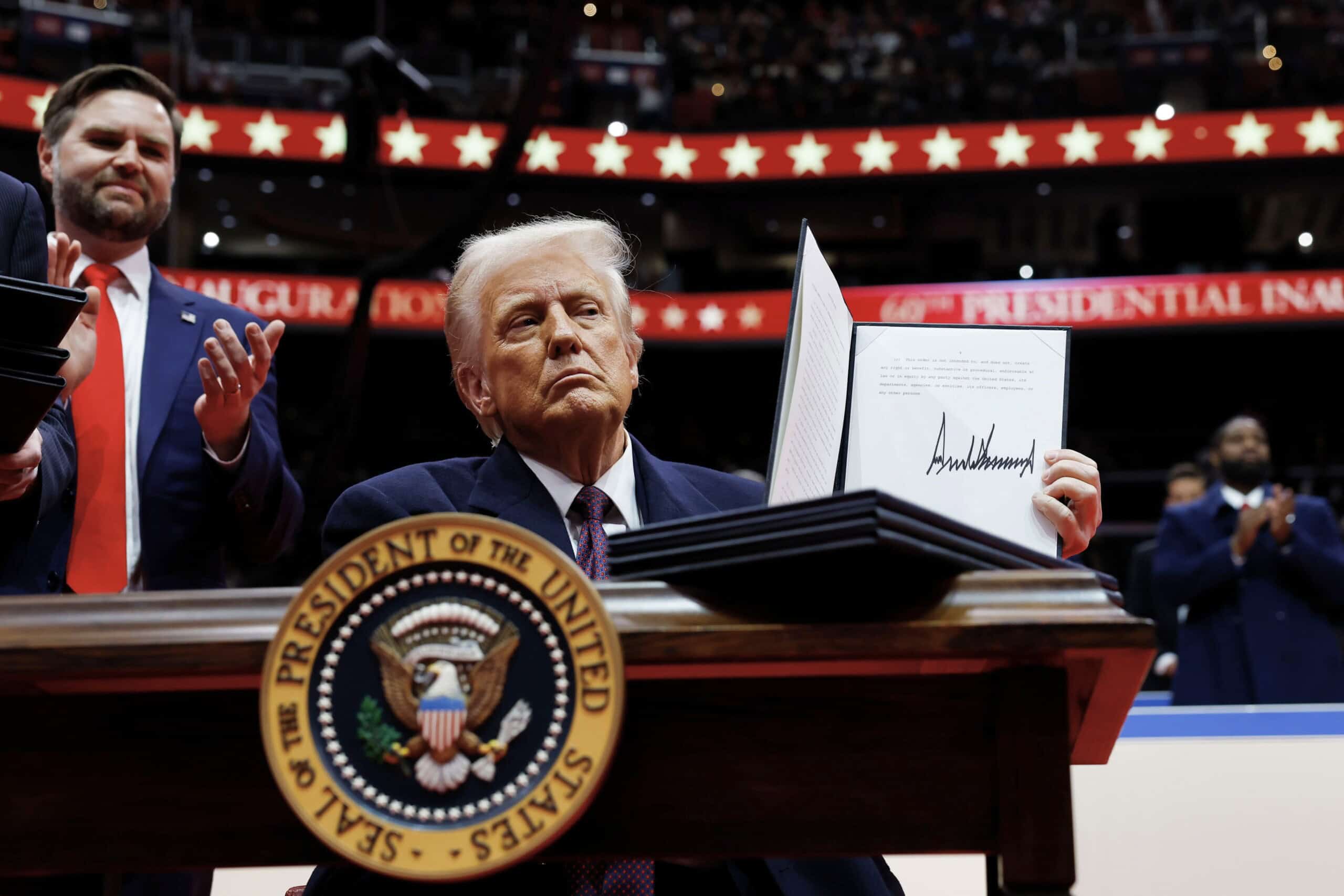
President Donald Trump took office on Monday, with a full stack of appointees for top posts ready to begin confronting what many of them have described as the most important challenge facing the United States: the rise of China.
His appointees come in three broad flavors:
- Establishment hawks, such as Secretary of State Marco Rubio;
- Pro-business executives from the private sector, including Commerce Secretary Howard Lutnick and Treasury Secretary Scott Bessent;
- and wild cards, like Tulsi Gabbard, Director of National Intelligence, or Elon Musk, the Tesla, Twitter, and SpaceX owner now tasked with running the Department of Government Efficiency.
How the differences between these three camps play out will have a huge influence on China policy under Trump 2.0, from tariffs to Taiwan. So too could intra-camp divisions between institutionalists like Rubio and hardcore loyalists like Peter Navarro, who served four months in jail for not complying with a congressional probe into the January 6 U.S. Capitol attack.
The Wire has put together a resource highlighting the presumptive members of the Trump administration likely to contribute to this debate. Around half of the officials listed below served in the previous Trump administration, and one-fifth served in the military.
Asterisks appear next to the picks that require and have not yet received Senate confirmation, with hearings now underway. Daggers appear next to staff positions that have been widely reported but not yet publicly confirmed. This list will be updated as additional appointments are made.
Please allow a moment for the image to fully load.
Office of the Vice President
JD Vance, Vice President
Vance criticized China heavily on the campaign trail, calling it the “greatest threat” to the United States. As the junior Senator in Ohio from January 2023 to now, his China focus was on economic issues. Last year, he introduced a bill to restrict China’s access to U.S. capital markets if it does not comply with international financial norms. A lawyer, Vance rose to prominence in 2016 after writing a book about his upbringing in the white working class.
State Department
Marco Rubio, Secretary of State
Rubio was a 14-year senator from Florida and longtime China hawk who was confirmed as secretary of state on January 20. He has spearheaded several tough-on-China congressional efforts, having told The Wire in 2020 that “the twenty-first century is going to be defined by the relationship between the U.S. and China” — a comment he repeated in his confirmation hearing. Rubio has introduced bills to reduce dependence on imports of Chinese pharmaceutical products, publicly reaffirmed U.S. commitments to Taiwan, and cosponsored legislation opposing human rights abuses against the minority Uyghur population in Xinjiang. China sanctioned Rubio twice in 2020.
David Perdue, Ambassador to China
Perdue represented Georgia in the Senate for six years, leaving office in 2021. He previously worked as a corporate executive and management consultant, including as the chief executive of apparel firm Reebok and discount chain Dollar General. While in the private sector, he lived in Hong Kong and Singapore and defended outsourcing jobs to China as a sound business practice. He has called for investing more in the Navy to keep up with China’s growing fleet, but has also said that disengaging with China “would be a tremendous mistake.” The U.S.-China Business Council has applauded his nomination, calling him a “thoughtful advocate for trade with China.”
Michael Needham, Counselor
Needham is a former chief of staff to Secretary of State Rubio and a long-time executive at conservative think tanks. He is a harsh critic of China, which he has accused of “using slave labor to make products.” Needham, who has called TikTok “China’s addictive propaganda and espionage app,” most recently served as chairman of American Compass and worked at the Heritage Foundation for more than a decade.
Jacob Helberg, Undersecretary Of State For Economic Growth, Energy And The Environment*
Helberg is an advisor to big data firm and military contractor Palantir Technologies, which was cofounded by Peter Thiel, and a former congressionally appointed commissioner on the U.S.-China Economic and Security Review Commission. Helberg has been among the most vocal proponents of banning TikTok if Chinese owner Bytedance does not sell it. He has sought to put together a group of Silicon Valley executives concerned about China’s threat to U.S. national security. If confirmed, he will oversee seven State Department offices, with responsibilities for areas such as managing scientific cooperation and foreign investment.
Michael Anton, Director of Policy Planning
During the first Trump administration, from 2017 to 2018, Anton was deputy assistant to the president for strategic communications as part of the National Security Council. He published an essay in 2021 called “Why It’s Clearly Not In America’s Interest To Go To War Over Taiwan,” in which he argued that defending the island is not worth risking a potential nuclear war. He previously worked as a spokesperson for high-profile Republicans, including at the National Security Council under Condoleeza Rice and for Rudy Giuliani when he was mayor of New York. He has also worked in communications at financial firms Citi and Blackrock.
Michael DeSombre, Assistant Secretary of State for East Asian and Pacific Affairs*
DeSombre has been a lawyer at Sullivan and Cromwell where he led the Asia mergers and acquisitions practice and advised companies on doing business in China. During his post as U.S. Ambassador to Thailand during the first Trump administration, he criticized China’s conduct in the South China Sea, writing that it reflects the country’s “complete disregard for the sovereign rights of other nations.” During the COVID-19 pandemic, he wrote that “the Chinese people know their government is to blame.”
Kevin Kim, Deputy Assistant Secretary of State, Bureau of East Asian and Pacific Affairs
Kim was most recently a professional staff member for the Senate Armed Forces Committee. He was previously a longtime analyst at the State Department, including in the Office of Analysis for East Asia and the Office of the Special Presidential Envoy for Arms Control.
Jonathan Ward, Senior Policy Advisory, Office of Policy Planning
Ward was most recently a senior fellow at the Hudson Institute, a conservative think tank. He is the author of a book, The Decisive Decade, about how the United States can outcompete China “economically, diplomatically, militarily, and ideologically.” He previously ran a China-focused geopolitical risk firm.
Jonathan Fritz, Principal Deputy Assistant Secretary of State, Bureau of East Asian and Pacific Affairs
Fritz is a longtime diplomat who served as chief of staff to the undersecretary for economic growth, energy and the environment and covered China, Taiwan and Mongolia as deputy assistant secretary of state in the Bureau of East Asian and Pacific Affairs during the Biden administration. In that capacity in 2021, Fritz said in congressional testimony that “strong U.S. support for Taiwan is paramount” due to China’s “coercive behavior.” He previously worked as the top foreign service officer at the U.S. embassy in Beijing and in several other China-focused roles at the State Department.
Department of Government Efficiency
Elon Musk, Department of Government Efficiency
Musk, the leader of at least three of the most influential companies in the United States, has taken on a new role as head of the newly created Department of Government Efficiency. He will be tasked with slashing government spending, though his broader remit is unclear. He has no previous government experience but his company Tesla has significant business in China, where it makes about half its cars.
Department of Commerce
Howard Lutnick, Secretary of Commerce
Lutnick is the chief executive of Wall Street investment bank Cantor Fitzgerald and brokerage firm BGC Group. He has long-standing business relationships with Chinese firms, having helped to take a smattering of them public while at the helm of Cantor Fitzgerald, including the biotech company Adlai Nortye in 2023. At BGC, Lutnick launched a brokerage joint venture with China Credit Trust Company, which is 75 percent owned by government entities, according to WireScreen. Lutnick co-chaired Trump’s transition and has no previous government experience. He has said he will divest from his businesses if he is confirmed.
Jeffrey Kessler, Undersecretary of Commerce for Industry and Security
Kessler, a trade lawyer, was the Commerce Department’s assistant secretary for enforcement and compliance during the first Trump administration. He oversaw enforcement of U.S. anti-dumping and countervailing tariff laws. In the private sector, he has advised American companies seeking to navigate China’s barriers to trade and investment.
Landon Heid, Assistant Secretary for Export Administration*
Heid most recently worked on technology policy for the House of Representatives’s Select Committee on China, during which time it announced support for an AI licensing regime before the Biden administration adopted a similar rule. Earlier in his tenure, Republican and Democratic leaders on the committee introduced legislation to restrict U.S. firms from doing business with Chinese biotech companies such as BGI and Wuxi Biologics. Heid previously advised on U.S.-China tech competition at the State Department, where he worked in the Office of China Coordination and at the American embassy in Beijing. If confirmed he will help set policy on U.S. export controls.
National Security Council
Ivan Kanapathy, Senior Director for Asia
Kanapathy is a former military and White House official. He was the NSC’s deputy senior director for Asian affairs and director for China, Taiwan, and Mongolia during the first Trump administration. Before that, he was a military attaché at the American Institute in Taiwan and a fighter pilot instructor. He has pushed Washington to “invest more in hard deterrence” to maintain the status quo between China and Taiwan, and urged U.S. officials to reconsider their messaging around “non-support” for Taiwan’s independence. In September, he told The Wire that the U.S. has been “too deferential” toward allies on China policy and that an incoming Trump administration would revisit China’s response to the outbreak of the COVID-19. He wrote two chapters in former Trump Deputy National Security Advisor Matt Pottinger’s book The Boiling Moat, on “Countering China’s Use of Force” and “Countering China’s Gray-Zone Activities.”
Office of the U.S. Trade Representative
Jamieson Greer, U.S. Trade Representative
Greer was the chief of staff to U.S. Trade Representative Robert Lighthizer during the first Trump administration, when he was involved in crafting the tariffs that came to serve as a hallmark of Trump’s China policy. Last May, he said in testimony before the U.S.-China Economic and Security Review Commission that he views China “as a generational challenge for the United States,” adding that the United States should revoke permanent normal trade relations with China and that Congress should pass legislation to screen outbound U.S. investment into China, among other recommendations. After leaving the U.S. Air Force’s Judge Advocate General’s Corps in 2012, he worked as an international trade lawyer.
National Economic Council
Kevin Hassett, Director of the National Economic Council
Hassett, a trained economist, filled the same role during the first Trump administration, after which he worked as a distinguished fellow at the Hoover Institution. He holds traditional views on economics, arguing that tariffs are harmful to U.S. businesses. But he says levies on China are necessary to provide leverage for a deal that will ultimately enhance free trade. He is a longtime economic advisor to Republican presidential candidates, including John McCain in 2000 and 2008, George W. Bush in 2004, and Mitt Romney in 2012.
Office of the Director of National Intelligence
Tulsi Gabbard, Director of National Intelligence
Gabbard served as a Democratic congresswoman from Hawaii from 2013–2021. She joined the Republican party this year and endorsed Trump. While running for the Democratic nomination for president in 2019, Gabbard decried the “destructive tariff war with China.” After being named by Trump, she has faced criticism from some China hawks, who see her as insufficiently tough on Beijing and questioned her views toward Russia and Syria. Gabbard served in the Hawaii Army National Guard and U.S. Army Reserves, including during her time in Congress.
Department of the Treasury
Scott Bessent, Secretary of the Treasury
Bessent is a financier who made his fortune at Soros Fund Management, the firm founded by George Soros. He advocates a “3-3-3” economic policy, based on Japan’s “Three Arrows” strategy under former Prime Minister Shinzo Abe. The proposal calls for increasing economic growth to 3 percent annually, decreasing the budget deficit to 3 percent of GDP, and raising oil production to 3 million barrels a day. During his confirmation hearing, he said the United States needs to take greater steps to reduce supply-chain reliance on China, which he described as “the most imbalanced, unbalanced economy in the history of the world.” He has no previous government experience, and donated to Hillary Clinton and Barack Obama; he gave more than $1 million to the Trump election campaign.
Department of Defense
Pete Hegseth, Secretary of Defense
Hegseth is a Fox News host and former officer in the Army National Guard. He faces a rocky road to confirmation after being accused of sexual assault and alcohol abuse, allegations he denies. During his confirmation hearing, he said that he would seek to ensure that the Department of Defense views the Chinese Communist Party as a “front and center” threat. Two days after Trump won the election, Hegseth said on a podcast that “China is building an army specifically dedicated to defeating the United States of America.” He has no previous government experience outside of his military service.
Elbridge Colby, Undersecretary of Defense for Policy
Colby is the director of the defense program at the Center for a New American Security, a Washington think tank. He called China “by far the biggest threat to the U.S.” in a post on X last May. He has said that the U.S. should “face the fact that we can’t do everything in the world” and reduce spending on aid to Ukraine in order to focus on Asia. In the event of a Chinese invasion of Taiwan, he says the U.S. should intervene to defend the island, including by blowing up the Taiwan Semiconductor Manufacturing Company. Colby previously served as an assistant secretary of defense during the first Trump administration, and then wrote a book entitled The Strategy of Denial: American Defense in an Age of Great Power Conflict.
John Noh, Deputy Assistant Secretary of Defense for East Asia
Noh will help lead the Department of Defense’s policymaking toward China, Taiwan and East Asia. A lawyer and U.S. Army veteran, he most recently served as deputy general counsel for the Republican majority in the U.S. House Select Committee on China. He previously served as an assistant U.S. attorney in Texas.
Department of Agriculture
Brooke Rollins, Secretary of Agriculture
Rollins is the president of the Trump-aligned think tank America First Policy Institute, which has called for increasing scrutiny on Chinese purchases of U.S. farmland near military bases. She served as the head of the White House Office of American Innovation during the first Trump administration, a post Trump created. She previously served as an advisor to former Texas Governor Rick Perry and as the longtime president of the Texas Public Policy Foundation, a conservative think tank.
Stephen Vaden, Deputy Secretary of Agriculture*
Vaden is a Trump-nominated judge on the U.S. Court of International Trade. Last June, he said that while U.S. trade policy has benefitted agriculture, its costs to other sectors have been too high. Vaden was principal deputy general counsel of the Department of Agriculture during the first Trump administration.
Luke Lindberg, Under Secretary of Agriculture for Trade and Foreign Agricultural Affairs*
Lindberg will oversee trade missions for the Department of Agriculture, seeking to promote the sale of American agricultural products abroad. More U.S. agricultural exports went to China than anywhere else in 2023, the most recent year with data available. During the first Trump administration, Lindberg served as chief of staff and chief strategy officer at the Export-Import Bank of the United States.
Department of Homeland Security
Sean Plankey, Director of Cybersecurity and Infrastructure Security Agency*
Plankey is a cybersecurity executive who served as an official on the National Security Council and in the Department of Energy during the first Trump administration. He said last June that “there is more work to be done” in restricting companies tied to the Chinese Communist Party from U.S. telecom supply chains.
Advisors
Peter Navarro, Senior Counselor for Trade and Manufacturing
Navarro advised Trump on several roles related to trade and economic policy during his first administration. Navarro supports high tariffs and has been particularly critical of China, which sanctioned him the day after President Joe Biden took office in 2021.
This is a preliminary and incomplete list of officials who might engage with China. It does not include, for the most part, civil servants. The color coding is based on public writings and statements about China. Also, the positioning of officials does not always show who a person reports to directly.

Noah Berman is a staff writer for The Wire based in New York. He previously wrote about economics and technology at the Council on Foreign Relations. His work has appeared in the Boston Globe and PBS News. He graduated from Georgetown University.