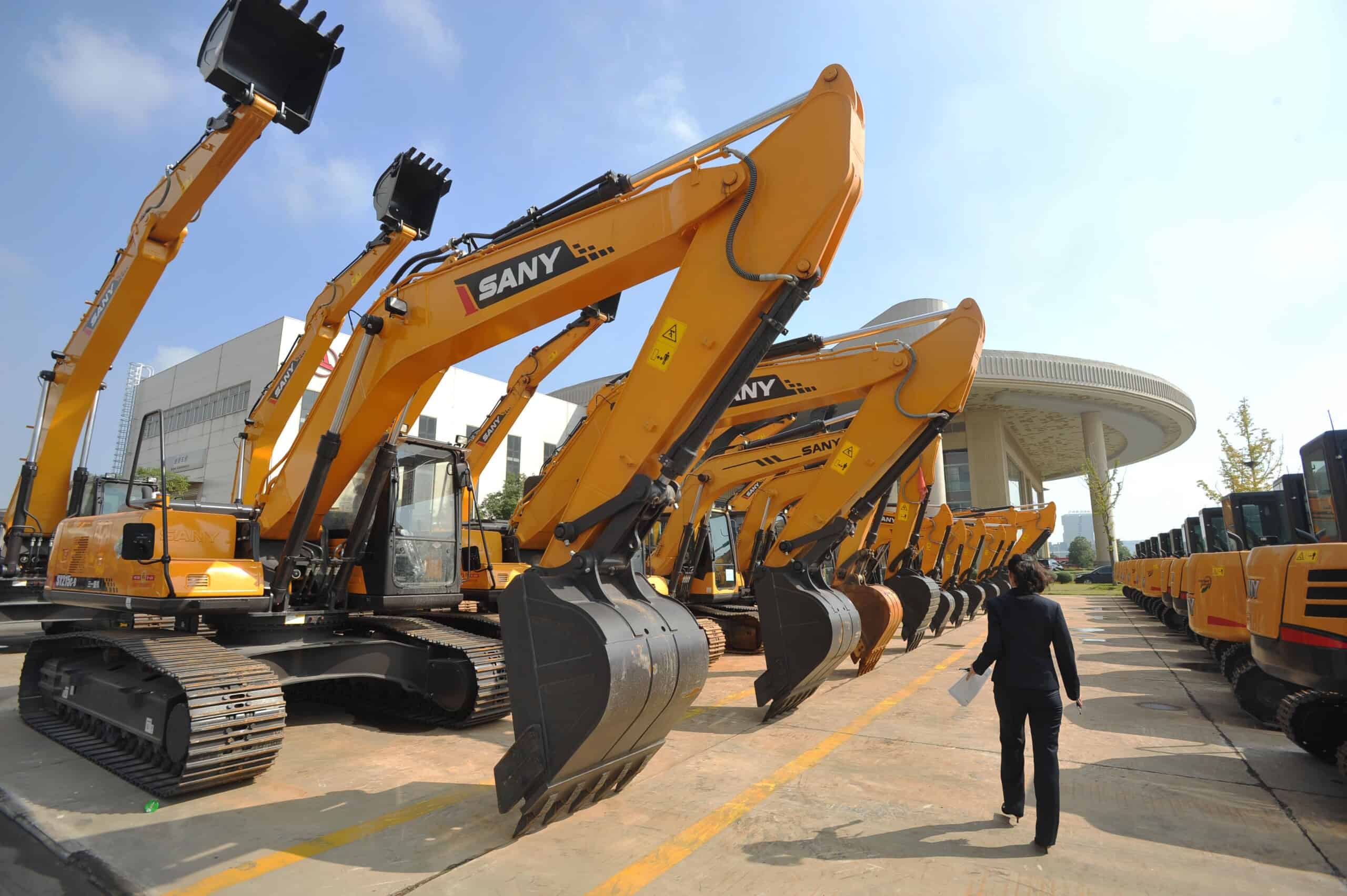
Companies have long paid top dollar to be the first brand that travelers see on arrival at Hong Kong International Airport. But the name they are likely to spot immediately these days isn’t HSBC or some high-end retailer. Thanks to the army of excavators working on the airport’s expansion, it’s Chinese company Sany.
Along with China’s other heavy equipment makers, Sany Group is enjoying a boom in international business. Despite inflationary pressures and high freight costs, global demand for excavators and diggers is strong, owing in part to the mining and oil boom in 2022 stemming from high commodity prices.
China’s real estate crisis and broader economic slowdown mean that its equipment providers are looking to international markets to drive sales, competing with industry leaders like the U.S.’s Caterpillar and Japan’s Komatsu. Top Chinese firms including Sany Heavy Industry (Sany’s listed subsidiary), Zoomlion and XCMG have experienced double-digit growth overseas since 2020.
This week, The Wire looks at China’s heavy machinery giants: who they are, what they’re building, and what it means for the industry’s longtime incumbents.
BIG YELLOW
China’s largest heavy machinery makers have been around for a while, driving China’s decades-long construction boom.
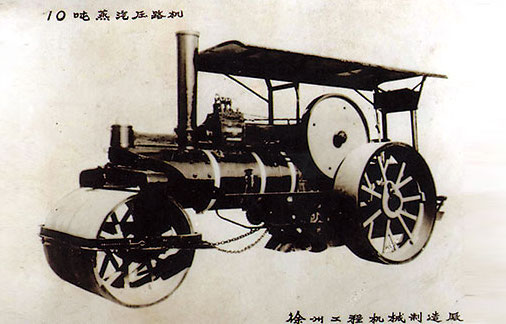
Take Xuzhou Construction Machinery Group (XCMG), China’s oldest heavy equipment manufacturer, which originated from a factory that supplied armaments for the Red Army during World War II. The firm, then named Huaxing Iron Works, built China’s first tower crane in 1957, and soon after, its first steamroller. Zoomlion was established later, in 1999, but similarly has roots in the state, growing out of an arm of the Ministry of Construction in the city of Changsha, in Hunan Province.
The largest Chinese player by market capitalization is now Sany Heavy Industry. Sany Group was founded in 1989 by its chairman, Liang Wengen, a former top manager at a munitions factory, along with three partners. Sany Heavy Industry has been the most successful at expanding abroad, selling $3.9 billion worth of construction equipment overseas in 2021, compared to XCMG’s $2 billion and Zoomlion’s $900 million. Forbes and the Hurun Rich List named Liang as China’s richest person in 2011, largely due to his controlling stake in Sany (now 57 percent).
In addition to heavy machinery, the conglomerate is involved in the production and operation of wind turbines. But its international push in the wind sector has encountered headwinds. In 2014, the Obama administration forced a Sany affiliate firm to sell its stake in a wind farm project in Oregon, due to its proximity to a U.S. naval training facility. The case marked the first time the Committee on Foreign Investment in the United States (CFIUS) forced a divestiture since 1990, preceding a sharp increase in CFIUS investigations into Chinese investments in recent years.
INFLECTION POINT
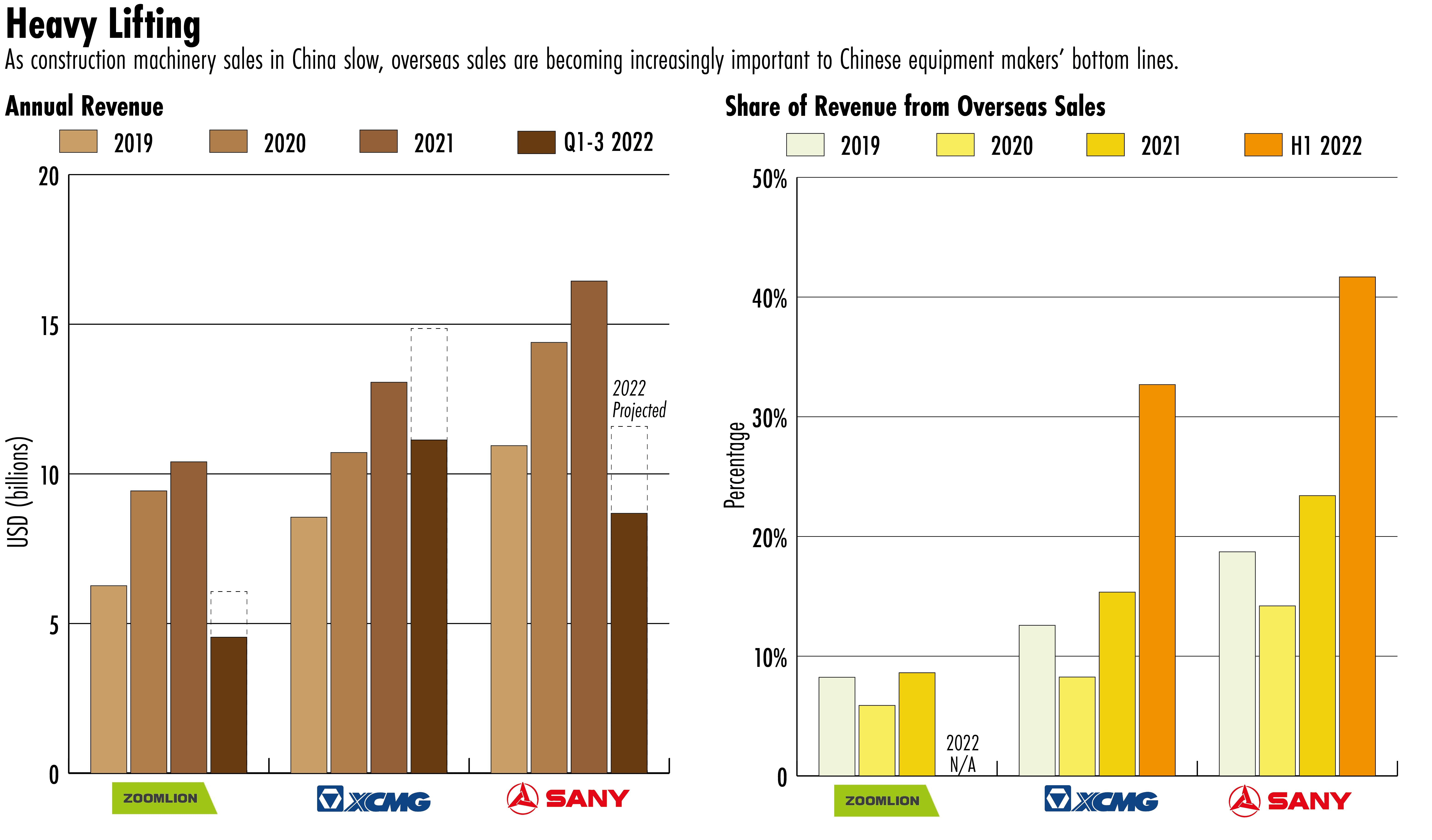
The global pandemic and China’s economic slowdown has marked an inflection point for heavy equipment makers. Between 2020 and 2021, XCMG, Zoomlion and Sany saw their overseas sales grow by between 60 and 130 percent. Chinese suppliers are also taking on more prominent projects: cranes from Zoomlion, for example, built the Lusail Stadium in Qatar, which hosted the World Cup final.
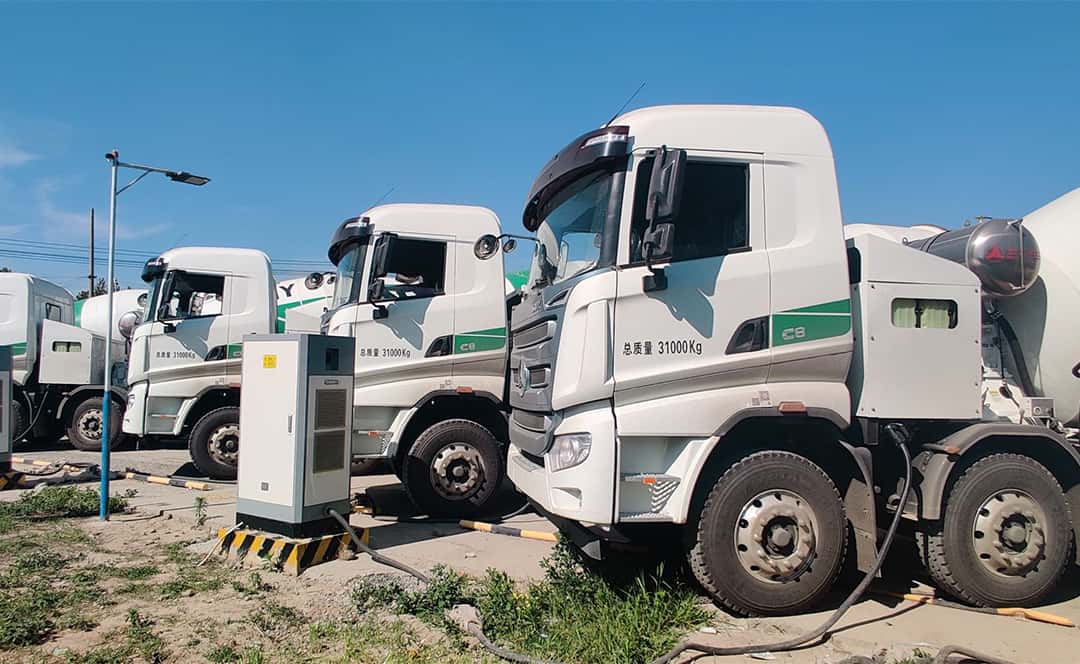
Broader changes in the industry mean that Chinese manufacturers may not be playing catch-up for long: They are already ahead of the curve when it comes to electrification. Sany, for example, has partnered with Chinese battery giant CATL to develop battery-powered construction vehicles. The two companies are also working together on battery-swapping technology, which can mitigate the problem of charging, a major headache for such enormous machines.
Sany’s full electric equipment lineup today includes at least 60 models, including cranes, concrete mixers, dump trucks, excavators and loaders, putting it well ahead of Western competitors that are investing in electrification: Caterpillar showed off its first battery-powered mining truck in November, but it remains a prototype.
Some analysts believe that electric heavy machinery is already competitive with international combustion engines on cost. Moreover, improvements in power efficiency and lower maintenance could mean that the total cost of operating a battery-powered heavy machine could already be over 20 percent cheaper than an internal combustion engine, according to McKinsey, a consultancy.

Eliot Chen is a Toronto-based staff writer at The Wire. Previously, he was a researcher at the Center for Strategic and International Studies’ Human Rights Initiative and MacroPolo. @eliotcxchen