In Washington DC, China’s premier robotics company is a growing cause for consternation on either side of the aisle. But outside the Beltway, Unitree’s products are more popular than ever.
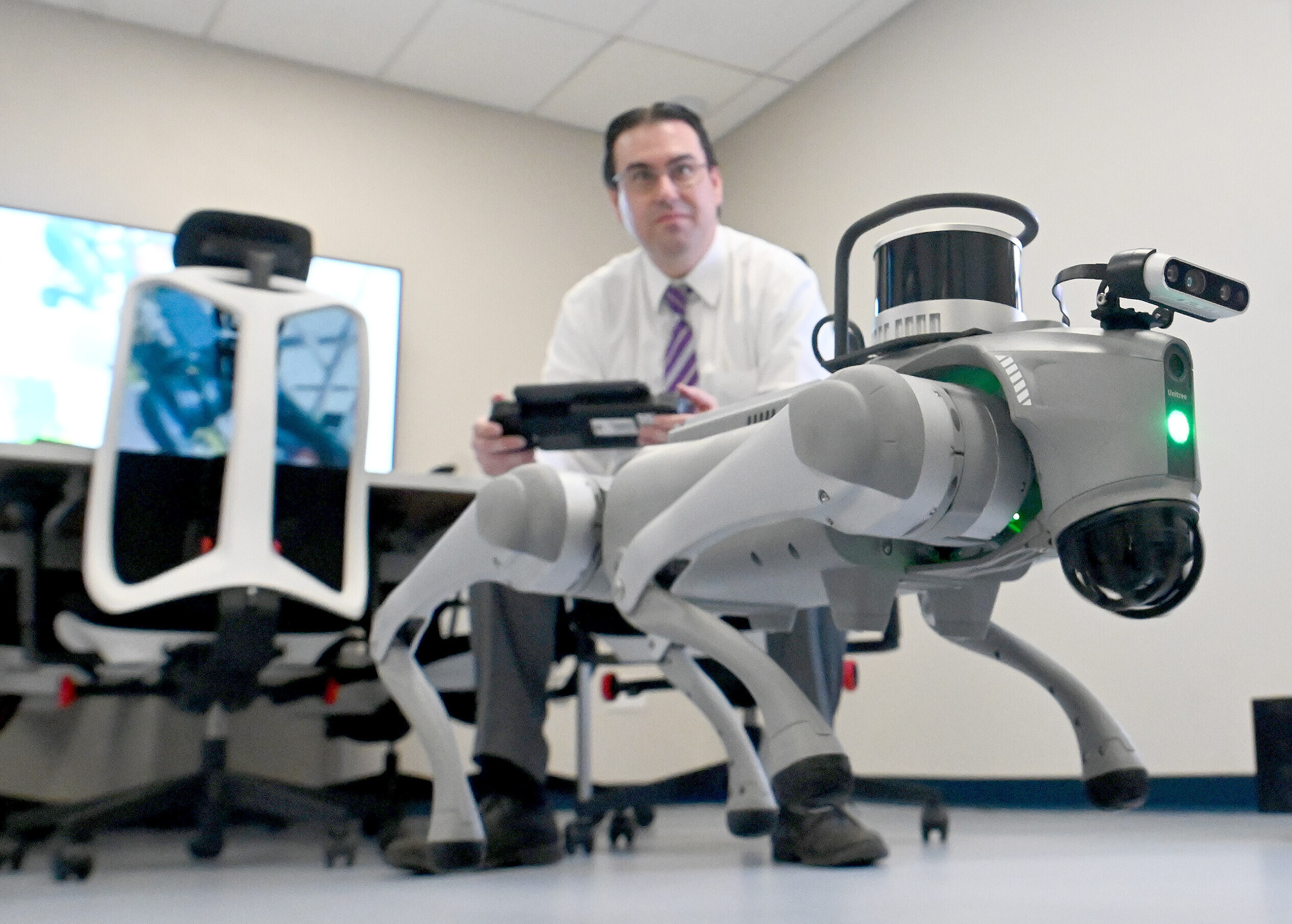
Universities, companies, local police stations, and even the U.S. army are looking to buy Unitree robotic dogs, which cost a fraction of those made by Western rivals.
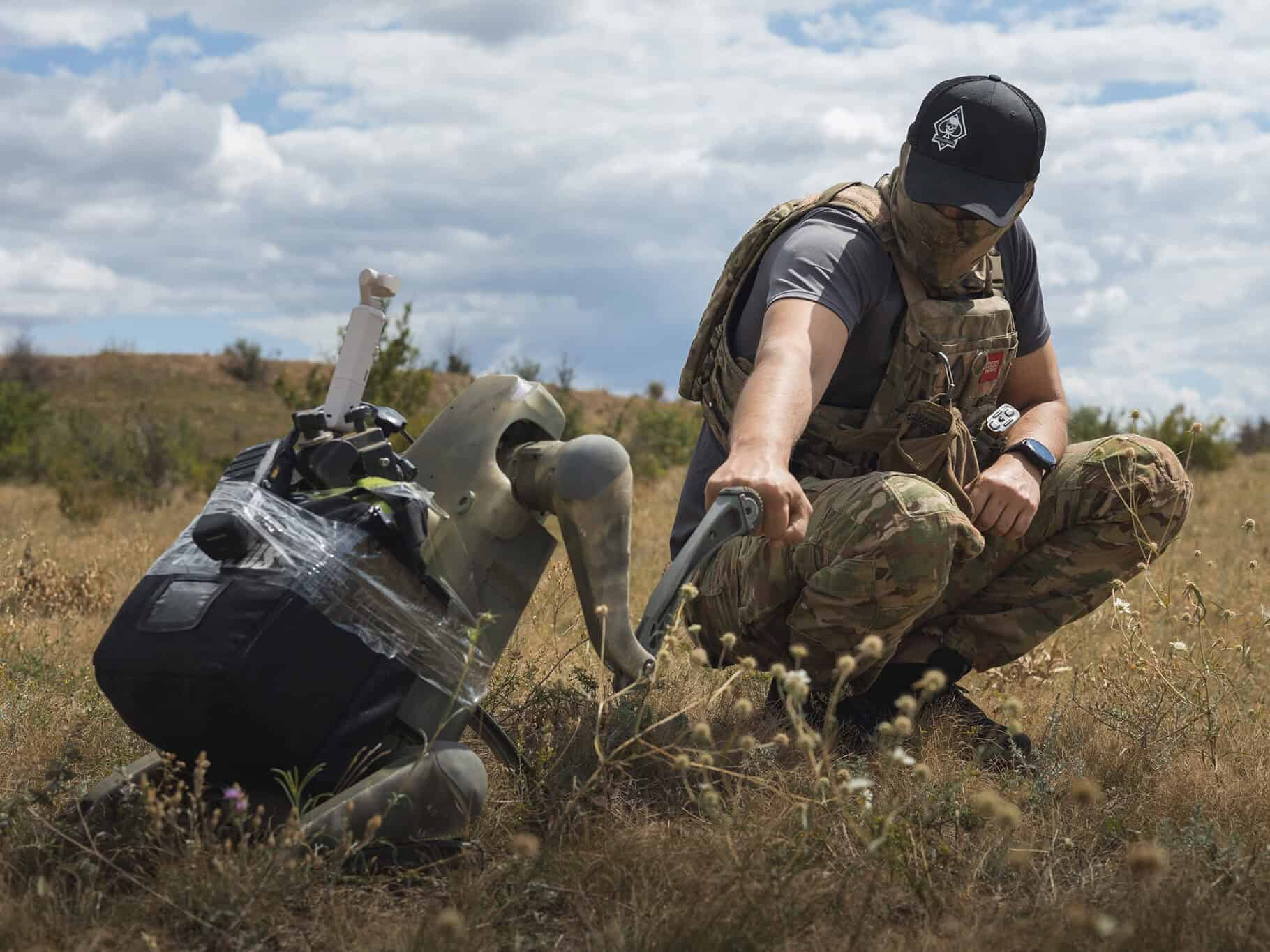
Companies around the world market metal canines — equipped with cameras, sensors, and sometimes weapons — for tasks deemed dangerous for humans, such as firefighting or inspection of power plants. In Ukraine, they’ve also begun to appear on the battlefield.
Unitree’s ability to capitalize on the U.S. market hinges on whether Washington continues to allow it to sell its robots in the country. Lawmakers have ratcheted up scrutiny on the company, alleging ties to the Chinese military and raising alarms about its data collection practices.
The growing adoption of Unitree products across the American economy raises the question of how Washington will balance national security concerns with the boon of low-cost robotics to areas like public safety and academic research.
“The success of China’s robotics industry, including its advances in the U.S. market, is an illustration that in yet another high-tech industry, the risk of China overtaking the United States is real,” says Michael Horowitz, a former defense official. “The United States has work to do.”
Wang Xingxing, an engineer born in 1990, founded Unitree in 2016, and it released its first product, a robotic dog, the next year. By 2023, a pack of them were dancing at the Super Bowl pre-game show.
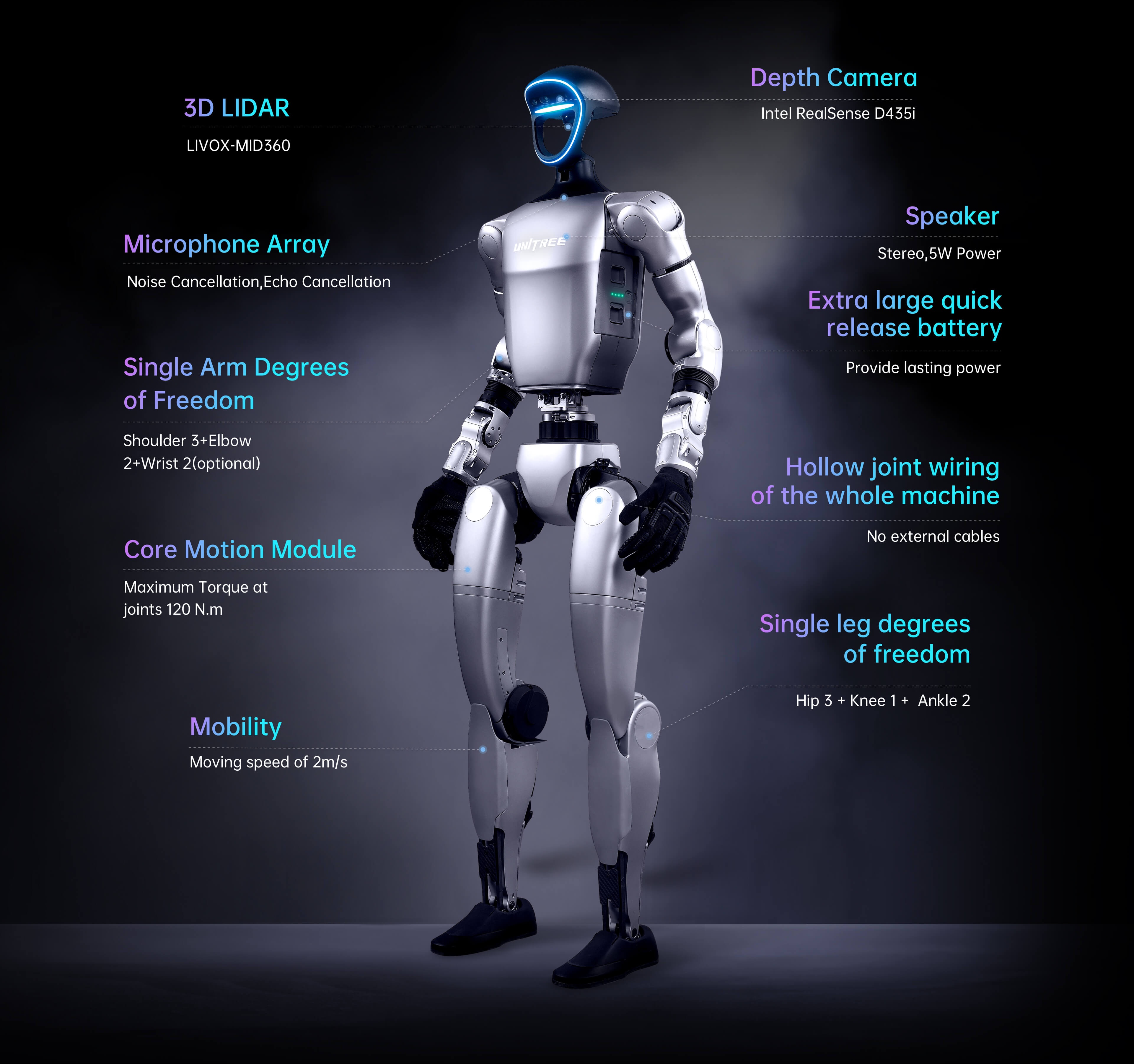
Unitree is now the international market leader for robotic dogs and their successor: humanoid robots. On its website, the company claims a 60 percent share of worldwide quadruped sales. It also controls an industry-leading 37 percent share of global humanoid sales, according to research firm Yole Group — a market that could be worth $5 trillion by 2050, Morgan Stanley forecasts. In an interview with state-run China Daily in August, Wang said that half of Unitree’s annual sales now come from overseas.
The company’s rise underscores how China’s strengths in advanced manufacturing allow it to rapidly scale and commercialize emerging technologies, including those with military applications.
Unitree’s success has partially been driven by the ease of buying components via China’s concentrated industrial supply chains, says Reyk Knuhtsen, an analyst at consultancy Semianalysis. For an input like motors, he notes, companies based in Shenzhen fiercely compete on price and speed of manufacturing.
“What’s really drastic is the comparison with the U.S.,” Knuhtsen says. “[Component] costs are multiples higher than they would be in the Pearl River Delta.”
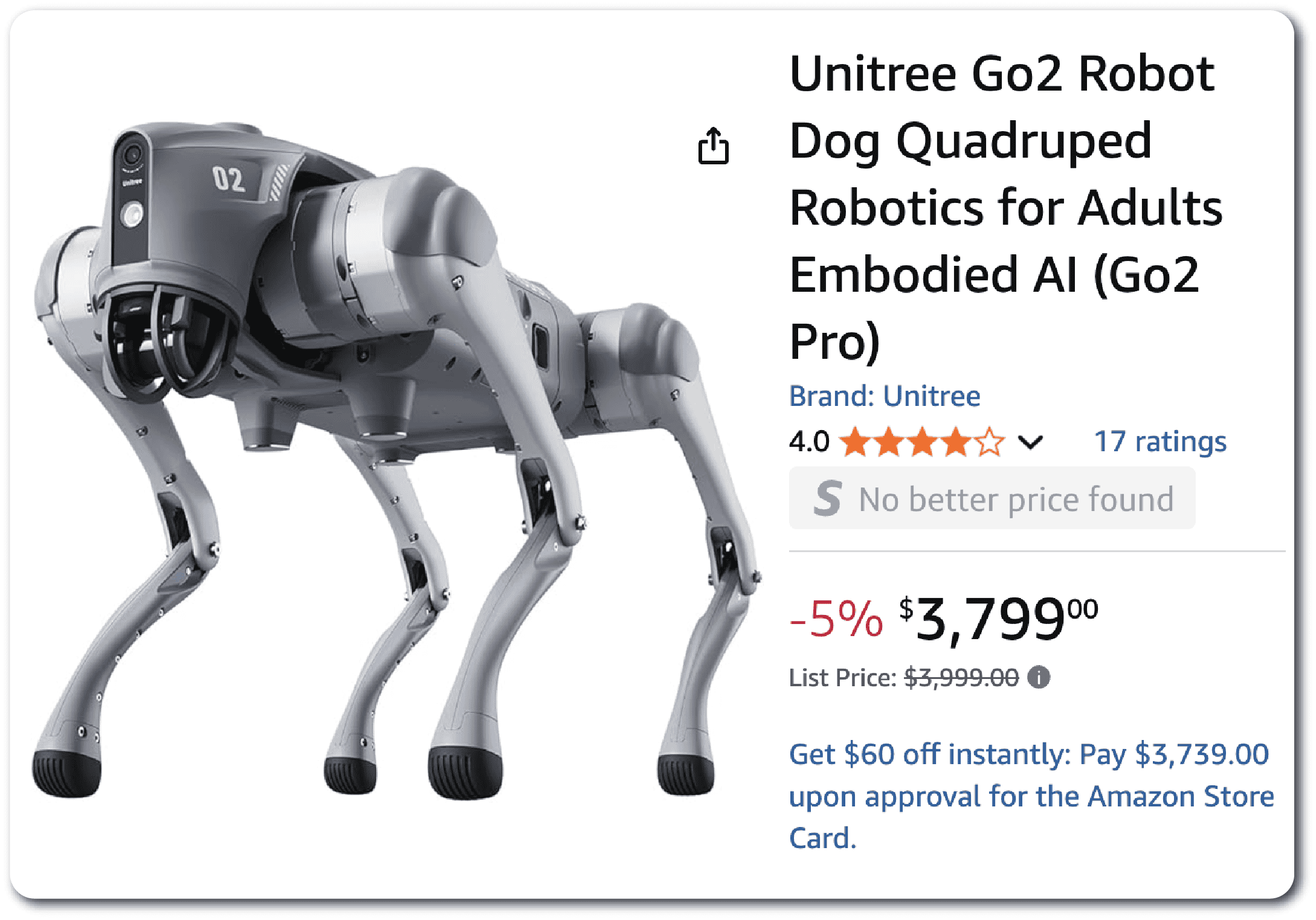
The result is a final product that is orders of magnitude cheaper than American machinery. Unitree sells the cheapest of its robodogs for just $1,600; the company even offers them on Amazon. A robodog made by U.S. market leader Boston Dynamics runs upwards of $100,000, though it is also bigger than many Unitree models.
Police departments across the United States have bought Unitree dogs, from Pullman, Washington to Port St. Lucie, Florida; and Topeka, Kansas. In Topeka, they enter dangerous situations — such as when a suspect has barricaded himself — before human officers, according to Lieutenant Andrew Beightel, a spokesman for the local police department.
The decision to buy from Unitree “came down to simple dollars and cents,” he says. “While other companies [such as Boston Dynamics] have a much better overall product we just could not afford them.”
The Topeka Police Department paid $5,360 for its first Unitree robotic dog over the summer — which it named Pepe — and bought two more last month for $4,625.50 each, Beightel says. By comparison, the Los Angeles Police Department acquired a Boston Dynamics robotic dog in 2023 with a $277,918 price tag, according to documents it filed with the city council.
Unitree does not have a direct presence in the United States but markets its products through licensed distributors. Texas-based RobotLab, for example, imports Unitree robots from China and tests them in Texas before selling them on to customers, according to Chief Executive Elad Inbar. He says most customers buy Unitree for research, because “there is no set use case.”
In one study published in January, researchers at the University of California Santa Cruz deployed a Unitree quadruped to a nearby forest and used the data it collected to create a 3D map of the area. Several other studies, backed by federal grants, have focused on making Unitree robots more autonomous and agile.
Every sale that Unitree makes into the United States will invariably improve China’s industrial and military might for a future of warfare that has fewer and fewer humans involved.
Ryan Fedasiuk, a fellow focused on U.S.-China tech competition at the American Enterprise Institute
“Unitree almost single-handedly has changed the way that a lot of people have been able to participate in robotics research,” says Alex Robey, a postdoctoral researcher at Carnegie Mellon University who has studied the integration of AI into robots. “It’s just so amazingly cheap…There just aren’t American options that an academic lab could reasonably afford.”
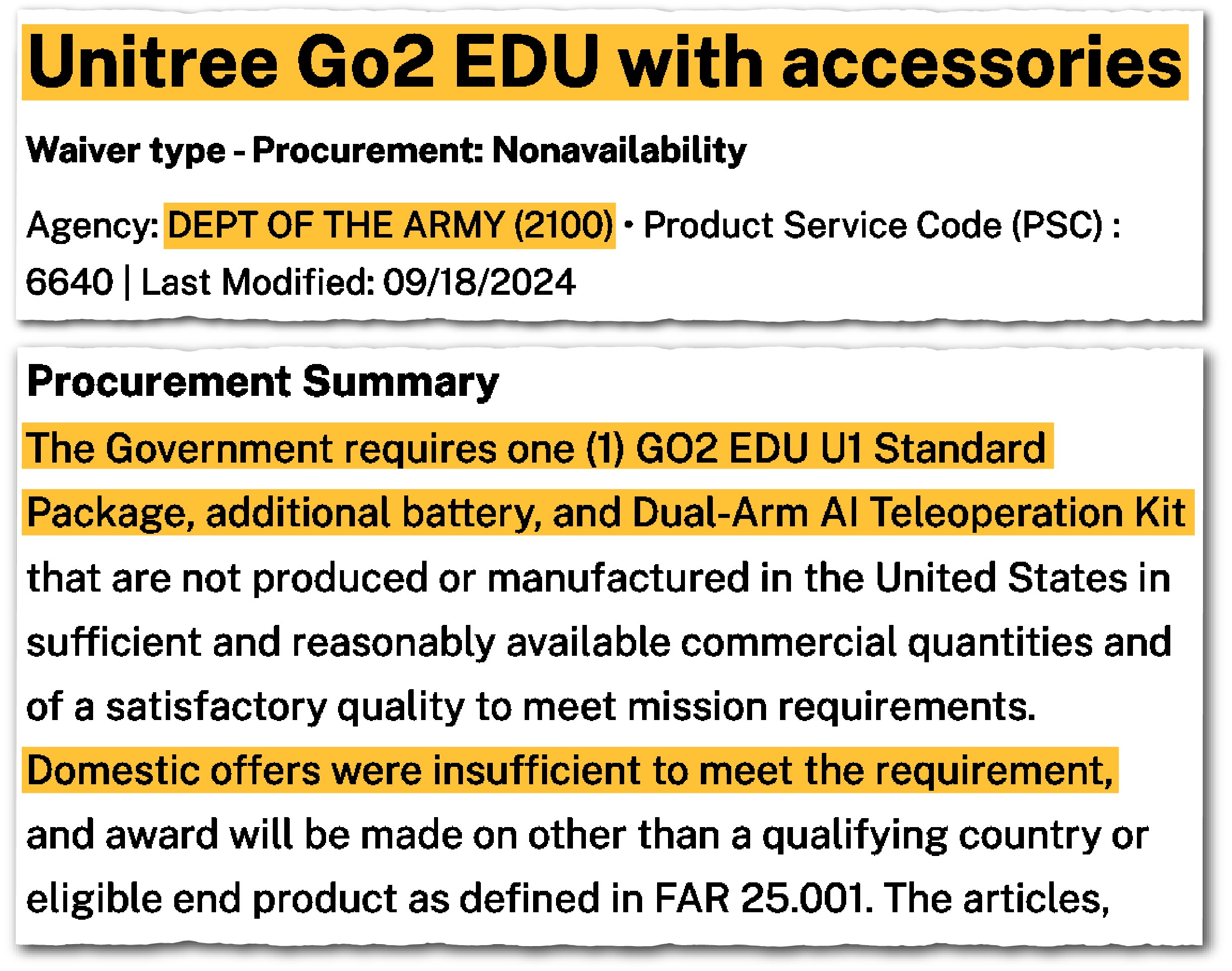
Procurement records show that the U.S. Army has also agreed to buy Unitree products from the company’s American distributors, earmarking more than $60,000 for four Unitree robotic dogs since 2023, according to government spending records. In a waiver the Army submitted for one such purchase last year, it said the Unitree robotic dog is “equipped with very different movement capabilities than other available robots,” making it “highly applicable and effective for [Army Research Laboratory] research.”
The U.S. Army directed The Wire’s inquiry to the Department of War, which did not comment on the Army’s purchases of Unitree robots. In a statement, a war department official said recipients of department grants must “comply with federal law and the terms of their grant agreements.”
Since 2020 U.S. law has prohibited the military and recipients of defense grants from buying telecoms equipment made by a list of Chinese companies, as well as unnamed others “owned or controlled by, or otherwise connected to” China.
But Unitree is not on the list, and the restriction has historically been applied only toward named firms. “We haven’t seen the [defense department] actually take enforcement against anyone who isn’t on the list,” says Cy Alba, a government contracts attorney at law firm Piliero Mazza.
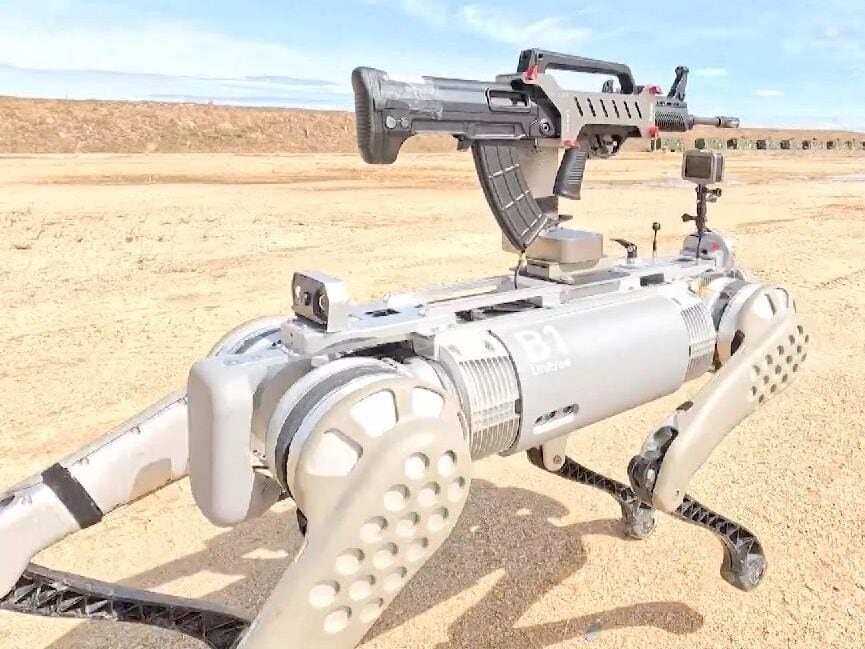
Still, some in Washington say the U.S. military shouldn’t fund purchases of robots that could become part of China’s own arsenal — if they are not already. In one widely publicized video published by China’s state broadcaster last May, a Unitree robotic dog fires a mounted rifle during a joint China-Cambodia military exercise.
“I don’t think Department of War money should be going to a company building robots that will inevitably be the backbone of the People’s Liberation Army,” says Ryan Fedasiuk, a fellow focused on U.S.-China tech competition at the American Enterprise Institute. “Every sale that Unitree makes into the United States will invariably improve China’s industrial and military might for a future of warfare that has fewer and fewer humans involved.”
Unitree said in a statement that its products are designed for civilian use and that it has no business with military-affiliated parties.

Another concern is data protection: Unitree robots are equipped with cameras, microphones, and sensors. In September, a team of cybersecurity researchers based in the U.S. and Europe published a report showing how a Unitree humanoid could be hacked through its bluetooth connectivity, and that the company sends audio and visual data back to servers in China.
One of the research team, Víctor Mayoral-Vilches, said he had offered to fly to China to work with the company to address the security risks, and that it rebuffed him.
Unitree did not respond to a request for comment on his offer. But in a statement to The Wire, the company said that “if customers directly provide us with clear vulnerability information, we will definitely fix them immediately,” adding that “without the user’s authorization” it does not obtain any “private or sensitive data.”

Last month the Republican chairmen of four committees in the U.S. House of Representatives urged the Department of Commerce to investigate products made by Unitree and several other Chinese firms, including dronemaker DJI, where Unitree’s founder Wang worked for two months before starting the robotics firm. The Department of Commerce did not respond to a request for comment on whether it will conduct the investigation.
American concerns have done little to slow Unitree down, which is currently preparing for an initial public offering in Shanghai that could value it at up to $7 billion, according to Reuters reporting.
Speed of innovation is at the core of Unitree’s advantages, says Knuhtsen, the analyst. It has already released four of its own humanoid models, while Tesla, which many observers consider the likely U.S. champion in the sector, has repeatedly delayed the release of its first.
“They’re not moving as fast as Unitree,” Knuhtsen says. “Nobody is.”

Noah Berman is a staff writer for The Wire based in New York. He previously wrote about economics and technology at the Council on Foreign Relations. His work has appeared in the Boston Globe and PBS News. He graduated from Georgetown University.