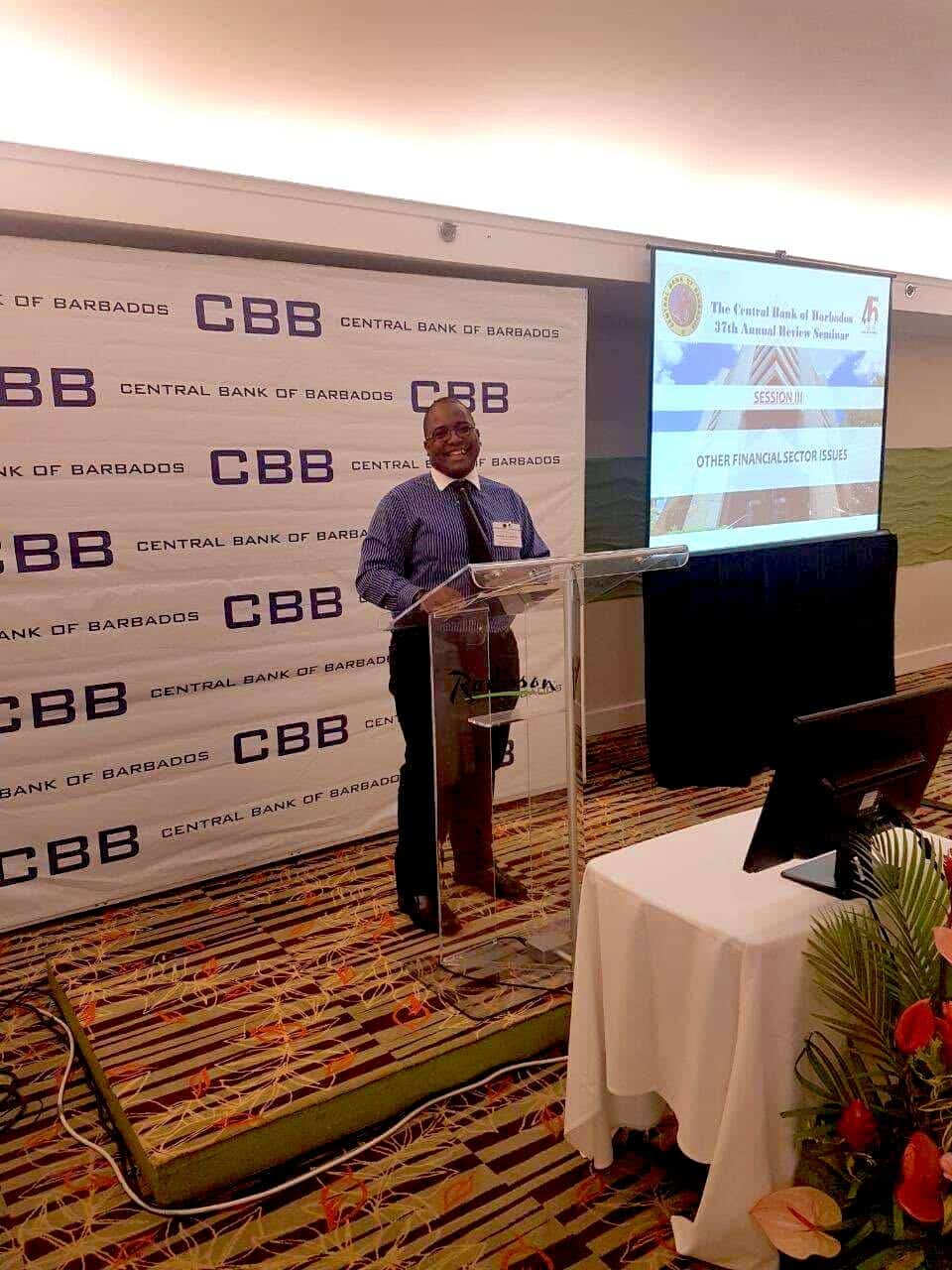
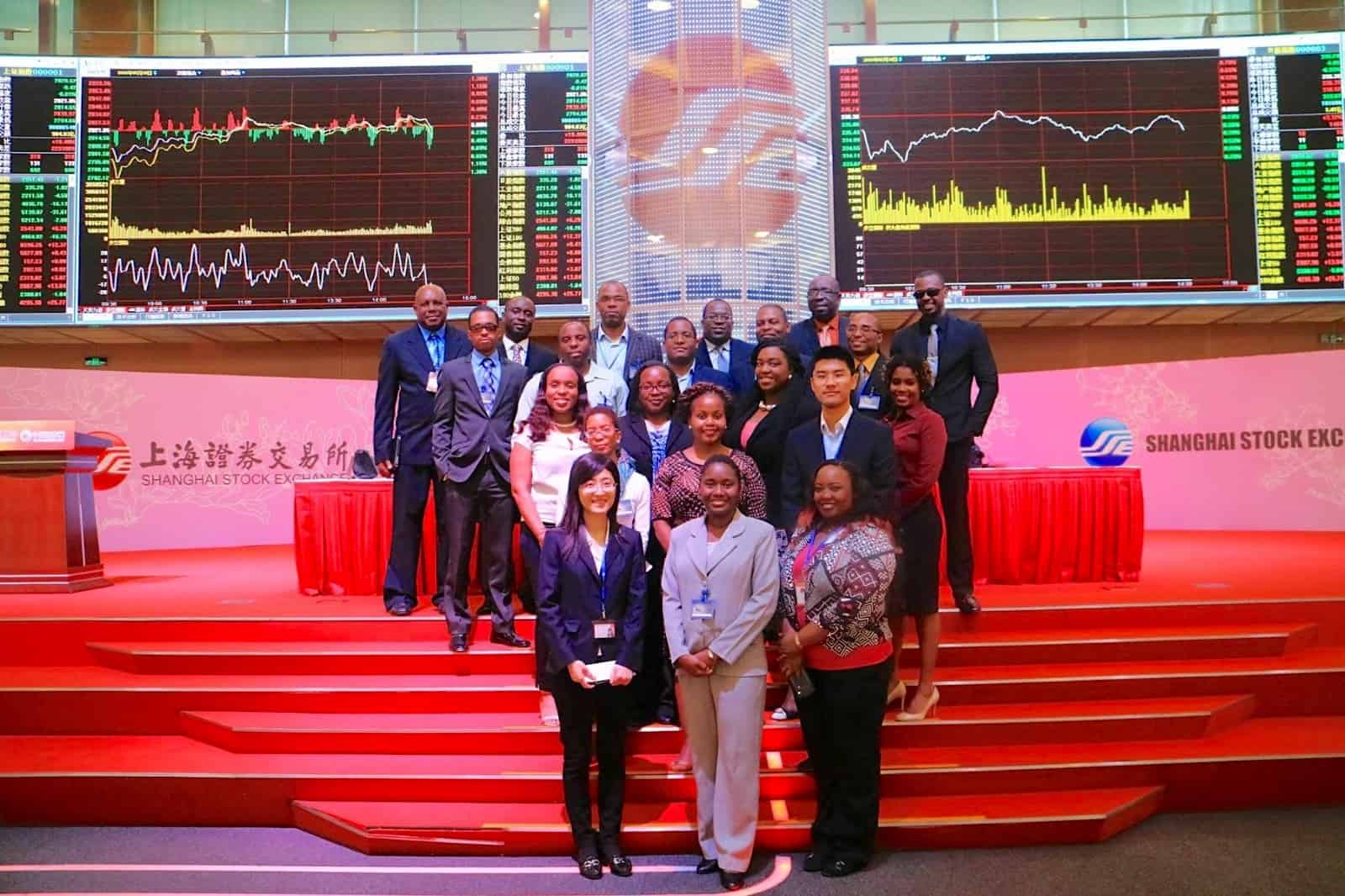
Rasheed Griffith, host of the China in the Caribbean podcast, is the head of operations at Tokamak Labs, a Canadian technology company that develops software for institutional crypto-assets trading. A graduate of the University of West Indies, he has previously worked in fintech in the Caribbean and Southeast Asia. Griffith first went to China as part of an economics policy delegation from the government of Barbados in 2016. He is also a Research Fellow at Future Forum and an Emergent Ventures Fellow at the Mercatus Center at George Mason University where he researches China’s economic activities in the Caribbean. What follows is a lightly edited interview.

Illustration by Lauren Crow
Q: Jamaica has been the most recent flashpoint for U.S.-China tensions in the Caribbean region. Can you walk us through what happened?
A: Jamaica, like all the other Caribbean countries, has quite a material deficit when it comes to infrastructure. And they’ve been trying to get that up to snuff for the last decades. Jamaica had a financial crisis in the late 1970s and again in the ’80s and again in the 2000s. So they’ve been under a consistent structural adjustment program from the International Monetary Fund for the last 40 years. Because of that, the way they think about debt is very unique. They want to take on a lot more productive debt, but they are constrained by the IMF program, which is European and U.S.-centered. The IMF does not differentiate between productive and non-productive debt. That is, if you borrow money to build a road, it is counted the same as borrowing money to pay public sector wages. So because of that, Jamaica wants to have deals where it can get some substance without adding more burden to the debt program, which in itself affects the IMF program.
China is the only country willing to do deals in this situation. China has the capital and is willing to do unconventional deals that do not require much interference in domestic affairs. That is the cliche they use, but it is accurate and useful in many situations. Whereas if the IMF loans money, they want to dictate how your fiscal and even monetary policy should be restructured. That’s why China did the massive North-South highway, which they’ve been trying to build since the 1990s. Initially, a European company had tried to do the project but ran into trouble in 1999, and it had remained unbuilt.
So, when the current government came to power back in 2008, they went on a mission to China and asked if there was something they could work out. And China, willing to do an alternative financing arrangement, said: Sure, we will build the road, but for payment, let’s do a land transfer.
Jamaica was like: Yeah, it’s useless land for us, we can’t do anything with it; if you build it up, you could actually help us get more money from it. So, as they would say, it was a ‘win-win situation.’ Now, when people see that, they think China is trying to do a land grab. But it’s still Jamaican land in Jamaica, run by the Jamaican government. Also, the concept of land exchange, it’s not that new; China actually does this in China. The policy banks in China, for example, will lend some money to some provincial government in exchange for a land grant. It’s not some new invented thing; they’re just exporting what they already do at home. You have to keep that in mind.
The U.S. doesn’t want more Chinese encroachment near the U.S. for obvious geostrategic interests. The problem is, the U.S. isn’t at the same time offering Caribbean countries alternatives in order to get these problems fixed. Instead of building roads, they’re having teacher training seminars. Instead of building hospitals, they’re training coast guards. Instead of, for example, building schools, they are giving $2 million to a hurricane relief fund. That’s nothing.
In the United States, some policymakers expressed alarm about the investment in Jamaica. Do you think it should be cause for concern?
It is paranoid, but it is not misguided. It is factual that for some of the investments, especially in the maritime areas, it is possible they could have military utility. But even if it’s technically possible, it’s not very practical. The only time it will make sense for China to actively engage in a military-infrastructure campaign in the Caribbean is during wartime with the United States.
The real interest is commercial. The Panama Canal is U.S. controlled. And China still needs to get goods into the coastal areas of South America, Central America and so on. And they have to rely upon the Panama Canal as it is currently. But, if you need to have a more diversified portfolio of entry points, marine shipment lanes and so on, any rational country would do the same thing. So I think the real thing is commercial interest, and it’s not necessarily the commercial interest of the government of China, but of the companies. People often don’t disentangle enough the actual commercial interest of the companies. The companies that need the infrastructure are a lot more engaged in the region than the actual government of China itself. And that is not necessarily a better thing. It makes it slightly more complicated, because the government doesn’t have a good way of supervising the companies. So the loans and debt and mismanagement of resources in the recipient country can be a lot worse when the Chinese government doesn’t have that oversight.
The biggest company that comes to mind is China Harbor Engineering, a big behemoth of Chinese construction globally (and subsidiary of China Communication Construction Company, one of China’s biggest state-owned enterprises). It has headquarters in Kingston, Jamaica, and they’re the main company behind the $400 million infrastructure plan in Jamaica, which was by far the biggest ever infrastructure plan in Jamaica’s history. That same company does some construction in Guyana, Barbados, and Trinidad and is one of the companies that built the port in Hambantota, Sri Lanka. There’s also Hutchison Port; they manage Freeport in the Bahamas.1Hutchison Port is a subsidiary of CK Hutchison Holdings, a Hong Kong-based company. But China Harbor is by far the biggest interest group.
But it’s very much a commercial interest. The Panama Canal has expanded and there are bigger ships that go through it. The problem is these bigger ships cause substantial strain on the port in New York, for example, and they have to go to Jamaica first, then do transshipment. So China has to have a port to furnish, for itself, a space for transshipment. They’re doing transshipment in Jamaica; they’re doing a similar thing in the Bahamas as well.
| BIO AT A GLANCE | |
|---|---|
| AGE | 27 |
| BIRTHPLACE | Barbados |
| CURRENT POSITION | Head of Operations at Tokamak Labs |
Can you give an overview of what Chinese investment in the Caribbean looks like today?
One important thing to keep in mind is that there is no one place called the Caribbean in reality. I think that throws people off, because the actual contours of the Caribbean are very, very nebulous. There’s the English speaking Caribbean: Trinidad, Barbados, Jamaica, and so on. There’s Dutch Caribbean: Curacao, Bonaire, Eustatius; and the French Caribbean: Martinique, Guadeloupe, St. Maarten. Then there’s also the British dependencies: Bermuda and the Cayman Islands are the big ones. And then there’s Cuba, Haiti, and the Dominican Republic. So the landscape is very, very heterogeneous.
But one of the focal points that you hear a lot about in the Caribbean involving China is infrastructure. It’s building a port, for example, in Kingston, Jamaica; in Paramaribo, Suriname; and in Venezuela and Brazil. However, when you look at the actual scale of things, there’s not that much Chinese money spent on infrastructure in the Caribbean, which is surprising, especially compared to the amount of money you get on the financial side.
Beyond infrastructure, there are things like aid and some loans, but actually not as much as people assume. I think people kind of find that surprising. You often see this statistic of how China gave $100 billion dollars to the Caribbean, but $62 billion of that was for Venezuela alone — one country. The actual Caribbean proper — the islands in the Caribbean ocean area — they haven’t gotten that much money. Jamaica had $2.1 billion in loans from China as part of the BRI. That’s a bit misleading, because when you compare that to Jamaica’s debt portfolio, it’s like less than 4 percent of government debt. It’s nothing. The question is: why hasn’t China given more money to Jamaica? It’s already being asked a lot here.
Let’s talk about the offshore world. The British Virgin Islands and Cayman Islands have become very important for Chinese companies. Why did they start going there?
In corporate structuring and finance, the Cayman Islands and BVI have always been at the forefront of innovation when it comes to legal vehicles. Innovation: that’s a competitive advantage they’ve had for a long, long time. They saw the writing on the wall — China had a very quickly growing middle class and a very quickly growing economic sector that needed beachhead markets to get into the bigger market. Bermuda itself or Cayman Islands itself isn’t the end of the game. It’s only the starting point of the game, which is in North America, the United States. So they tailored their vehicle planning to meet the growing demand.
Obviously, today, China is not a niche market. But back then, they saw a niche market and said: we have the ability to innovate our legal vehicles, what else can we do? This came at a time when there was pressure from the E.U. and North America [on their companies to stop going offshore]. So there was less business for corporate services, although there was still a big market for offshore assets. So the Caribbean financial centers said: let’s innovate some more, that’s what we’re good at. And they started attracting a lot more Chinese clients. That’s why every large Chinese tech company in the U.S. market has a vehicle in the Cayman Islands they pass through to go to the United States.
Why have Chinese companies become so reliant on these jurisdictions?
The expertise in the Cayman Islands is world class. Same with BVI. The expertise in understanding U.S. and Canadian law is just world class. They’re also very, very well regulated. It’s not just some pirate cove where you can just come and do what you want. Large Chinese firms are coming because of their ability to be compliant. It’s not simply about being offshore, because the connotation of being offshore is secretive. A better way to think about it, at least in terms of the Caymans and Bermuda, is that offshore means legal flexibility. These jurisdictions are in the middle for companies that exist in very contrasting legal systems, and nobody knows exactly how these systems will change over the next ten years. So you need to have the competitive flexibility to adjust your models, adjust your regulations, adjust your compliance laws to meet demand. And the Cayman Islands, Bermuda, and BVI — the Caribbean in general has been much better at that than any other ‘offshore center’ in the world.
When you say that Caribbean jurisdictions are well regulated, what do you mean?
The BVI, the Caymans and Bermuda are not independent countries, they are dependencies of the U.K. So, for example, the court systems in those jurisdictions are under the same supreme court as the U.K. The law in these jurisdictions is common law, which is dependent on the U.K. common law system.
You can’t really hide ownership of BVI entities. It’s easier to incorporate companies in, let’s say, Wyoming or Delaware than it is in BVI. There’s a lot of compliance, and you need to give ownership information. Because BVI is party to the Foreign Account Tax Compliance Act [a U.S. law that requires non-U.S. financial institutions to report on the assets of U.S. account holders], and yet people are still incorporating companies in the BVI, that shows it’s mostly legal and clean business that’s going to BVI relative to somewhere like Delaware or Panama
There’s a lot of confusion when it comes to Caribbean offshore, in particular BVI, the Caymans and Bermuda. People think it’s primarily a place to hide assets, when that’s actually never really been true. If you want to hide assets, you don’t go to those three U.K. territories, you go to other places. The BVI, Caymans and Bermuda, they act as global APIs [application programming interfaces], to use a tech term, where they connect people from one jurisdiction, say the U.S., to people in a place like China, because that’s the only way commerce happens across those two borders in any realistic and robust way. So the BVI has never tried to position itself as this privacy jurisdiction. In fact, the BVI doesn’t have any privacy laws, it only has the normal common law when it comes to confidentiality, which is identical to what is in the U.K.
Are you saying places like the Cayman Islands are crucial for China’s economic engagement with countries like the United States?
That is the key thing — the linchpin holding together these contrasting markets is these very, very well regulated centers that we call offshore. They actually help to coordinate capital flows across these massive global corridors. And that’s the thing that people really don’t understand when they speak about offshore in a negative light.
Do you think these centers are going to continue to play this role over the next decade, or do they face challenges?
These centers always face challenges. A lot of that actually comes from the European Union. Recently, the E.U.’s tendency to be hegemonic when it comes to regulation has damaged these centers.2Griffith adds: The E.U. uses its rule setting by implementing requirements of stringent anti-money laundering, combatting the finance of terrorism and tax compliance rules to force small countries to adjust their financial services policies. If the small countries do not make changes, then the E.U. places them on “blacklists.” This does not just impact the Cayman Islands, BVI, and Bermuda, but materially affects Barbados, Antigua etc. The way the E.U. tries to attack the offshore market is very problematic and perhaps even detrimental to the sustainability of these kinds of financial flow corridors. This is not good for anybody. It’s kind of ironic. I don’t like to play the race card, because it’s a very boring card to play. But you don’t see, for example, the E.U. taking this kind of action towards Delaware, or Wyoming, or London, or Singapore.3See The Wire’s piece on the trust industry in South Dakota. It’s always the Black countries in the Caribbean that have the problem.
The laws of the E.U. still think of the Caribbean with an inequality mentality, where these aren’t real countries, these are toys that will be controlled. And because of that, they don’t see the problem of having these extremely absurd, global regulatory regimes that the Caribbean has to comply with. It’s truly absurd.
That is the key thing — the linchpin holding together these contrasting markets together is these very, very well regulated centers that we call offshore. They actually help to coordinate capital flows across these massive global corridors. And that’s the thing that people really don’t understand when they speak about offshore in a negative light.
When you talk about regimes, do you mean the Common Reporting Standard? Or is there something else?
It’s not only that. There’s the Financial Action Task Force (FATF) as well, which really has a big impact. For example, Barbados was added to the FATF high risk jurisdiction list last year. You have to wonder: why is Barbados in the same category as Syria? It’s really absurd. The logic behind how they think about these things is hard to comprehend. From the Caribbean side, you can’t comprehend how these regulations make sense. I think it really comes down to that for the E.U. — we are just toys they can push around as they see fit regardless of what the actual effect, true or imaginary, is.
Courtesy of Rasheed Griffith
Is there any way journalists or governments or businesses can understand corporate structures in jurisdictions like the Cayman Islands or BVI?
There is no centralized database for that information in the BVI. So, usually, the short answer is no. There are some jurisdictions, for example, like St. Kitts and Nevis, which have particularly strong privacy laws when it comes to things like directors. Companies can have nominee directors and privacy for the actual directors themselves. That’s a brick wall; there’s no getting past that. Any accountant or international financial lawyer could easily hide you behind layers and layers and layers. For example, Alibaba has at least 30 layers of corporations. It has 10 alone in the Cayman Islands. Because of that, it’s nearly impossible. If a corporation wants to not be found in the Caribbean, it’s not going to be found.
A few Caribbean countries have citizenship-by-investment programs. Can you tell me about them?
There are five countries with these programs: Antigua and Barbuda, Dominica, St. Kitts and Nevis, St. Lucia and Grenada. St. Kitts and Nevis invented the citizenship-by-investment program in 1984. This is another example of an innovative Caribbean legal system. You can buy a passport starting at $100,000. You can do it in a few ways. One is real estate investment. A lot of people assume that it just inflates the real estate value and so poor St. Kitts — well, no. It’s more like a timeshare: you buy an approved lot or villa. That qualifies you to get a passport. Or, you can donate some money to an economic development fund, which is pretty much directly to the government.
Antigua and Barbuda has another option. There, you can also invest in education — you can donate money to the university in Antigua, and that would qualify you to get a passport. The average size of a family that buys passports in Antigua is 3 or 3.5. That means there are children involved. The children can go to school at the campus for free, because they invested the money.
In Dominica, they have another one. You can invest in real estate or make a direct contribution to a government fund, or you can invest $50,000 and live there for a year or so, then get naturalized after that. St. Lucia, it’s about $150,000, and then you can get a passport. There are many, many different routes to qualify for naturalization.
The largest proportion of people buying passports are Chinese. But that is not too odd — for the EB5 visa in the U.S., the biggest group is Chinese people as well. That tracks across the board.

Why would somebody want to participate in one of these programs? Is it generally for asset protection?
The asset protection aspect, to me, it’s not very compelling. You can get yourself out of China by buying a passport, but you can’t get your assets out of China very easily just because you have a new passport. So I think asset protection is not that big of a reason.
One big reason is international travel. These passports are actually a lot better than Chinese passports in terms of travel restrictions. The other thing is, for corporate people, when they have to go through things like know-your-customer processes, when you have a Chinese passport, it’s a much higher burden. And the other big thing is for children. Most of the groups applying for these passports are families. A lot of them do it so their children don’t have a Chinese passport. (Under Chinese law, you can’t have dual citizenship).
I think it’s more of a family planning thing. If you’re a billionaire, it’s very cheap. It’s like buying a bag.
So your sense is people aren’t buying second citizenships because they’re running away from something?
You don’t have to guess; none of this is a secret. To buy a passport, you have to go through an approved seller, and those people are normally a big international law firm that works with agencies in China. They go through a very, very long compliance process. There are some people who slip through the cracks, of course. But, the vast majority are normal people who have a lot of money, and have children who they want to have non-Chinese passports. Or, they want passports that in the case of political problems, they have the ability to access different countries.
There was a billionaire named Sun Xiang who was promoted to the provincial congress of Hebei, and in that process it was revealed on Weibo that he had a St. Kitts passport. Of course, that’s illegal, because you cannot have two passports in China. It was a big scandal.
But I think it’s more of a thing for personal security. If things go wrong, I need to be able to get to other places. You see it a lot more in that situation. Not necessarily to hide stuff. Sometimes it’s almost like a passport arbitrage system. I saw that Turkey has a golden visa program also, and 1 percent of the applicants are from St. Kitts. Those aren’t natural-born St. Kitts citizens of course.
| MISCELLANEA | |
|---|---|
| BOOK REC | Submission by Michel Houellebecq |
| FAVORITE MUSIC | Gustav Mahler’s Symphonies |
| FAVORITE FILM | Manila in the Claws of Light |
Xiao Jianhua, the billionaire founder of Tomorrow Group who was kidnapped from Hong Kong by the Chinese government, had an Antiguan diplomatic passport. How did that happen?
Antigua has done this many times. They had, and to some extent still do, a very expansive view on what a diplomat is. They saw a diplomat as someone who could represent and promote the interests of Antigua. That’s not what it actually is, of course, in most cases. They have a thing called Ambassador-at-Large; that’s what Xiao was. There are some other instances where citizens-by-investment in Antigua also have an Ambassador-at-Large title and a diplomatic passport. One that comes to mind is Fahad Sattar Dero from the United Arab Emirates. He bought a citizenship from Antigua, probably paid a lot more money because it’s not on the actual market, and the government said: you can represent our interests back in your home country, because you bought our passport and have a lot of influence and connections. Take a passport and do some more for the country.
I don’t necessarily find that problematic. It only becomes problematic because other definitions of diplomatic passports don’t work that way. The Antiguan ambassador to Turkey actually became an Antiguan citizen through investment. In some cases, it actually enables the country to have a much more expansive diplomatic reach than they could actually afford themselves. So, inherently it’s not a problem, but in practice, it does have issues.
Eight countries in the Caribbean recognize Taiwan.4Guatemala, Haiti, Honduras, Nicaragua, Belize, Saint Lucia, Saint Vincent and The Grenadines, and Saint Kitts and Nevis Why do they continue to do that?
Pride and arrogance, mostly. A lot of it comes down to clout. The treatment of, let’s say, a St. Kitts ambassador in Taipei has a lot more fanfare than the treatment a St. Kitts ambassador would get in Beijing. You see that play out across the board. There’s a paper by Tom Long and Francisco Urdinez where they analyze why Paraguay sticks with Taiwan. They made an econometric model that shows the cost of doing that is so great. In reality, it’s an elite politics thing. The elite politicians in these countries have favor with the elite politicians in Taiwan. That’s all it is. Because of that, they don’t have a need to switch sides.
You also have to couple that with: China doesn’t actually invest that much money in the Caribbean. The real benefit the Caribbean gets from China isn’t on the investment side, it isn’t on the export market side, it is on the import cost savings. In the Caribbean, we import almost everything. If you look at the trade data, it would appear that the U.S. is by far the biggest trade partner. And yet, if you come to Barbados or go to Trinidad and go to a store, everything says: Made in China. Of course. The stuff goes to America first, and then we buy it from America. The cost savings we get from China producing all these goods — it’s a lot cheaper than the U.S. and the E.U. and so on — the money we save on that kind of import is the real benefit. Jamaica gets the same benefit as St. Lucia because they all buy from the same place: China. You don’t see Made in Taiwan in St. Lucia, for example.
But the actual diplomatic tie is not very important when it comes to the benefit that the countries get. Barbados has tied to Beijing since 1980, it’s not that big a benefit. We have a gymnasium that China built. They’re building a new hotel. But it’s not that much. It’s definitely a matter of elite politicians having a very pompous view of themselves: we are the small holy league that supports Taiwan. Because of that, I don’t think it will change very easily. And if it changes, it’s not going to be because of dollar diplomacy. If it was that simple, it would have happened decades ago.

Eli Binder is a New York-based staff writer for The Wire. He previously worked at The Wall Street Journal, in Hong Kong and Singapore, as an Overseas Press Club Foundation fellow. @ebinder21