logo for print

Eyck Freymann

Columnist

eyck.freymann@gmail.com

Eyck Freymann is a Hoover Fellow at Stanford University, where he directs the Allied Coordination Working Group. He is also a Non-Resident Research Fellow at Columbia University’s Center on Global Energy Policy, the Institute of Geoeconomics in Tokyo, and the China Maritime Studies Institute at the U.S. Naval War College.

Dr. Freymann works on strategies to preserve peace and protect U.S….

Read More

Eyck Freymann is a Hoover Fellow at Stanford University, where he directs the Allied Coordination Working Group. He is also a Non-Resident Research Fellow at Columbia University’s Center on Global Energy Policy, the Institute of Geoeconomics in Tokyo, and the China Maritime Studies Institute at the U.S. Naval War College.

Dr. Freymann works on strategies to preserve peace and protect U.S. interests and values in an era of systemic competition with China. He is the author of several books, including the forthcoming Defending Taiwan: A Strategy to Prevent War with China (Oxford, 2026), The Arsenal of Democracy: Technology, Industry, and Deterrence in an Age of Hard Choices (Hoover, 2025), and One Belt One Road: Chinese Power Meets the World (Harvard, 2021). His scholarly work has appeared in The China Quarterly and is forthcoming in International Security.

Dr. Freymann comments on bipartisan national security issues in The Wall Street JournalThe New York TimesForeign AffairsThe EconomistWar on the RocksThe Wire China, and The Atlantic, among other venues.

Before Hoover, Dr. Freymann held postdoctoral fellowships at Harvard and Columbia. He holds a doctorate from Oxford, masters degrees from Cambridge and Harvard, and a bachelors from Harvard, all in history and China studies.

Read Less

Articles

Climate Changers

With climate diplomacy deadlocked, researchers and policy makers are grappling with extreme warming scenarios and sobering choices — including tinkering with the global climate. Despite the many risks, the U.S. and China are both barreling forward with geoengineering research, and many experts warn there aren't...

Climate Consensus

Increasingly, Democrats and Republicans believe that climate change and China pose a single interconnected challenge. As a result — and for the first time ever — a window is opening for bipartisan cooperation on climate policy. Historically progressive ideas like a 'carbon border adjustment mechanism'...

The Ocean Edge

With its plans for seabed mining and the "blue economy," China is implementing a strategy for the world's warming oceans. The U.S. is trying to keep up, but just as climate change is heating up geopolitical competition, the scramble for ocean resources has also become...

Pole Position

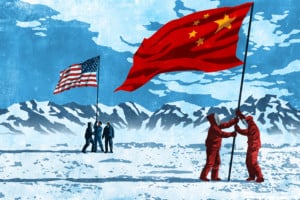
In public, Chinese diplomats and climate negotiators deny that they see any link between climate change and geopolitics. But there is a deeply cynical consensus within China’s academic and policy communities that climate change creates geopolitical opportunities that China can exploit — and must exploit...

The Adaptation Advantage

China is mobilizing to adapt and thrive in a rapidly warming world. Under Xi Jinping, the country has undertaken thousands of projects — across industries and in every part of the country — that are clearly designed to protect the country against extreme climate impacts....

The Diplomatic Deadlock

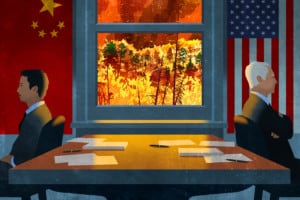
For decades, climate change has been framed as a crisis that the international community needs to solve — and which it could solve if world leaders would only muster the political will to cooperate and share the burden. But the bonhomie of climate conferences and...

The Sponge Revolution

By 2030, 70 percent of Chinese cities are scheduled to become “sponge cities” — a novel solution designed to prevent flooding while also “greening” China and making it more resilient to climate change. If it succeeds, it will be a major step forward in the...