Last October, scientists from around the world descended on Chengdu for the International Atomic Energy Agency’s 30th fusion energy conference. But one group was missing: the Americans.
The quiet boycott of the event, a biennial gathering of top minds in the field, came after the U.S. Department of Energy discouraged American scientists from attending, five people told The Wire China. Researchers were warned in the summer that participating in the conference could jeopardize their ability to obtain government funding.
The DOE’s move comes as Washington and Beijing are increasingly framing the development of fusion energy in strategic terms. Recent breakthroughs in the field have convinced many scientists that commercial fusion — and its promise of clean, limitless energy — could be as little as a decade away.
With the U.S. and China pouring resources into commercialization efforts, fusion research, once a haven for international collaboration, has become the latest battleground in the technology race between the world’s two leading economic powers.
“Fusion has been an open collaborative effort for a very long time, so people who work in the sector are still used to that type of thinking,” says Scott Hsu, Fusion Partner at Lowercarbon Capital and former DOE Lead Fusion Coordinator. “But the geopolitics are very dominant right now.”
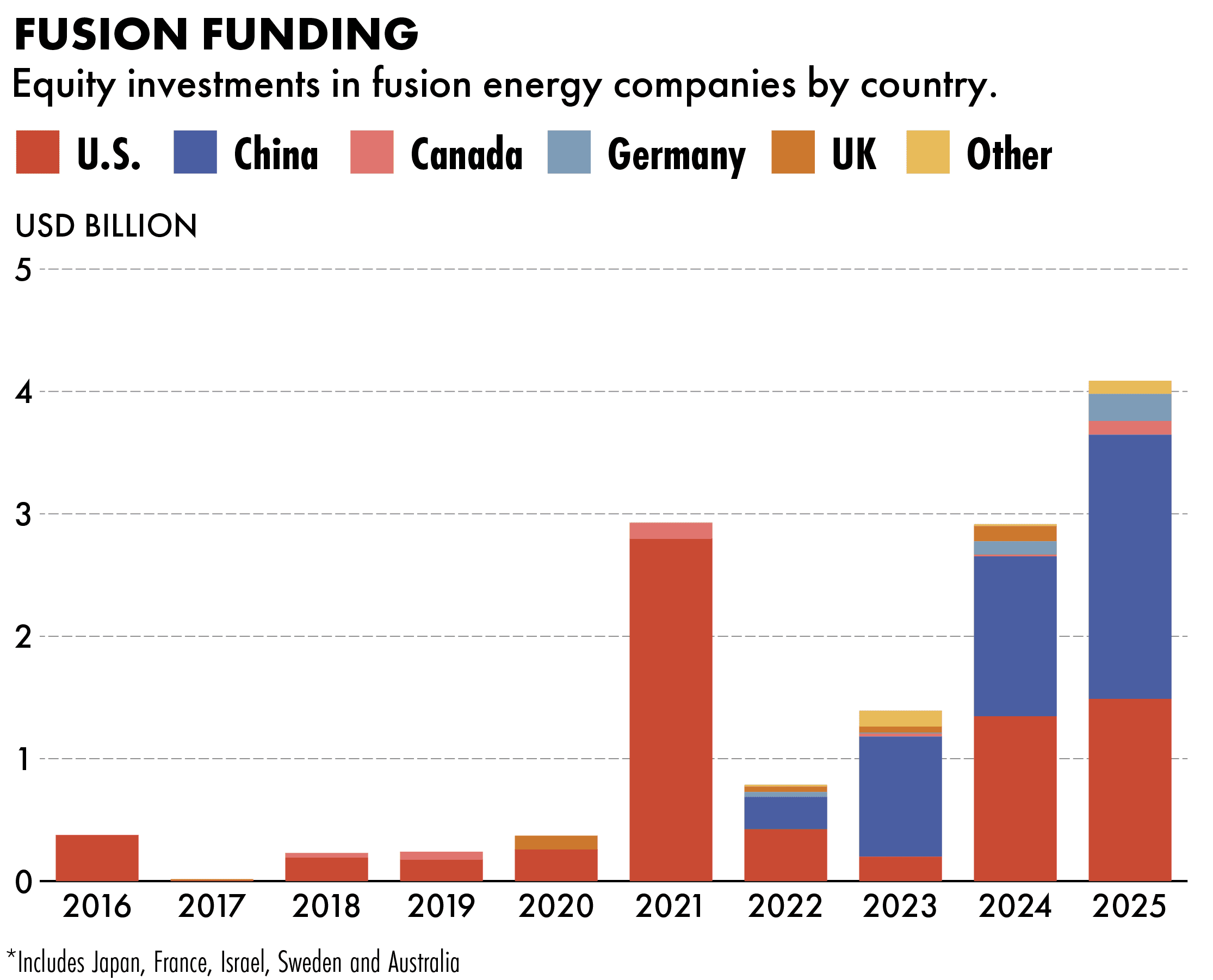
While the U.S. and China have scaled up their investments into fusion in recent years, the two countries are pursuing different paths to realize the technology. Federally-funded national labs in the U.S. have made major scientific breakthroughs, but most fusion industry growth is now coming from private funding: since 2021, annual private investment into fusion has outstripped public investment, data from Fusion Energy Base show.
The technology has even attracted the attention of people in Donald Trump’s circle: late last month, the president’s media company, Trump Media & Technology Group, announced a $6 billion merger with TAE Technologies, one of the world’s oldest private fusion ventures, previously backed by Alphabet, Chevron and Goldman Sachs.
China has been positioning itself to be a world leader in fusion science diplomacy and is at the ready to fill any vacuum left by the U.S. …it could very well become a top destination for international fusion scientists.
Abigail Remler, a former director at the Special Competitive Studies Project
Public funding is mostly fueling China’s fusion drive. Beijing announced a new $2 billion state-owned fusion company in the summer, and has invested more than $1 billion in an experimental facility in Hefei named BEST.
Many of China’s facilities, which have been years in the making, were built with American help during the 2010s, when both countries’ governments were more willing to encourage scientific collaboration. The U.S. and China have both contributed to the International Thermonuclear Experimental Reactor (ITER), a decades-old multilateral fusion research project headquartered in France, whose other members include the EU, India, Japan, Russia and South Korea. One of the project’s main testbeds, a facility known as EAST, is located in China.
“China has actively collaborated with international partners in the design and operation of their facilities,” says Hsu. “U.S. collaboration has provided many of the physics analysis tools that are being used to design BEST, and EAST was largely based on an earlier U.S. design that was never built. Until very recently we worked very closely together for mutual benefit. We sent scientists to work on EAST and had people on the board of BEST.”
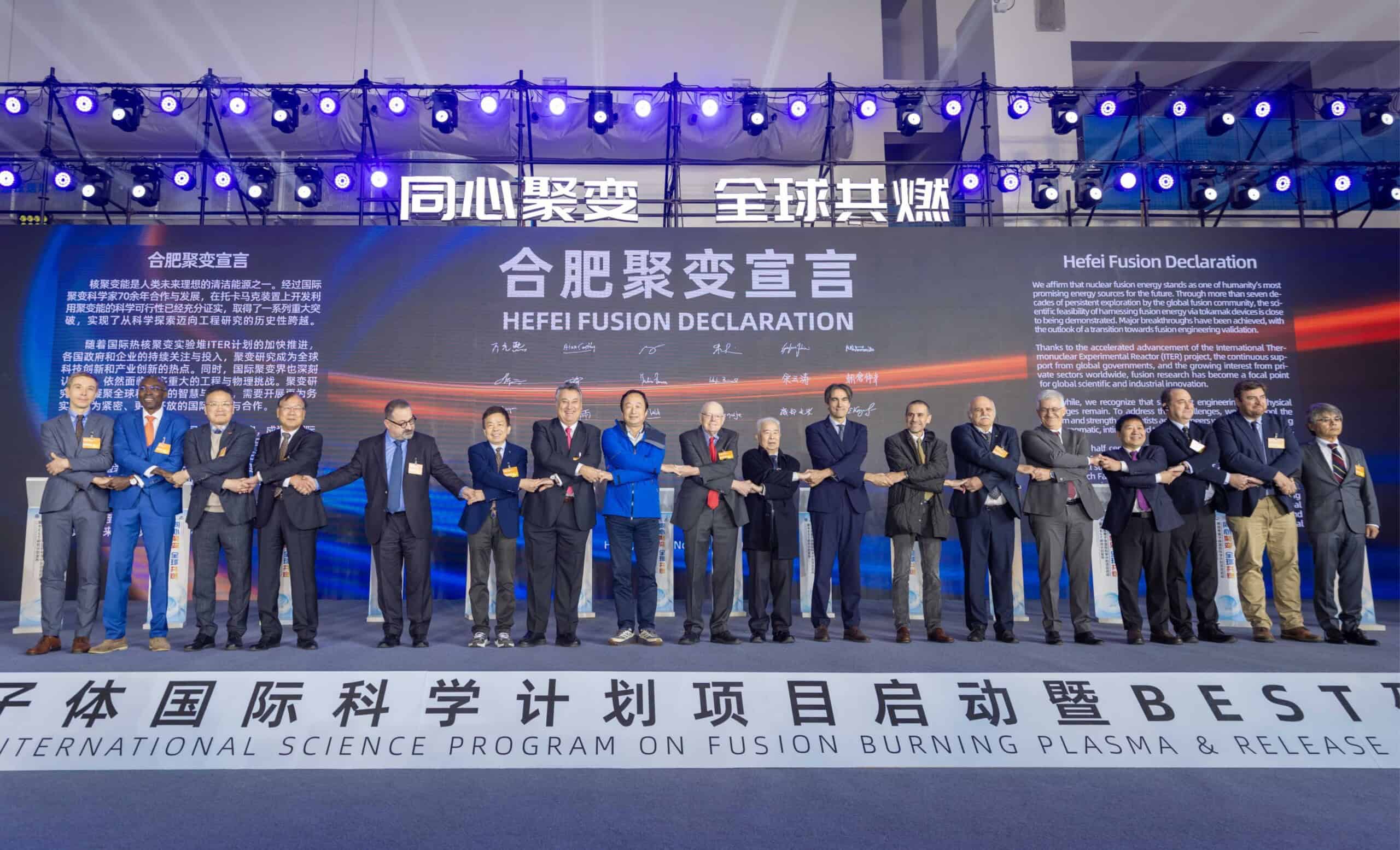
China’s bid to host the IAEA meeting in October, for only the second time in the conference’s history, was an opportunity to declare the country’s fusion ambitions, and to showcase its progress to foreign observers. It followed up the next month with a major win, when the Chinese Academy of Sciences unveiled the Hefei Fusion Declaration: a partnership with 10 countries including France, the U.K. and Germany, that would grant foreign scientists access to China’s fusion research facilities.
“China has been positioning itself to be a world leader in fusion science diplomacy and is at the ready to fill any vacuum left by the U.S.,” says Abigail Remler, a former director at the Special Competitive Studies Project, a Washington nonprofit. “Between the Hefei Declaration and its suite of research infrastructure under construction, it could very well become a top destination for international fusion scientists.”
China’s efforts to woo international scientists are coming at a time when U.S. public funding for scientific research is in retreat.
“There are many scientists who’d rather work for the public good rather than for private gain,” says Jimmy Goodrich, a senior fellow at the University of California Institute on Global Conflict and Cooperation. “Meanwhile, the government shutdown coupled with DOGE, research funding freezes and layoffs — none of that is good for long term U.S. technology leadership. International citizens have a choice of where they want to work and the U.S. is not necessarily making the best case.”
There’s been a recent perception of the U.S. versus China in fusion. What’s interesting about [the Hefei declaration] is there may be a degree now of not just U.S. versus China, but U.S. versus the world.
Scott Hsu, Fusion Partner at Lowercarbon Capital and former DOE Lead Fusion Coordinator
Washington has made some efforts to engage in fusion science diplomacy. The DOE, for example, worked with U.S. fusion groups to organize competing programming in Washington the same week that the IAEA conference took place in Chengdu. Scientists from Japan, South Korea, the U.K., Germany and Italy attended.

The DOE did not respond to a request for comment.
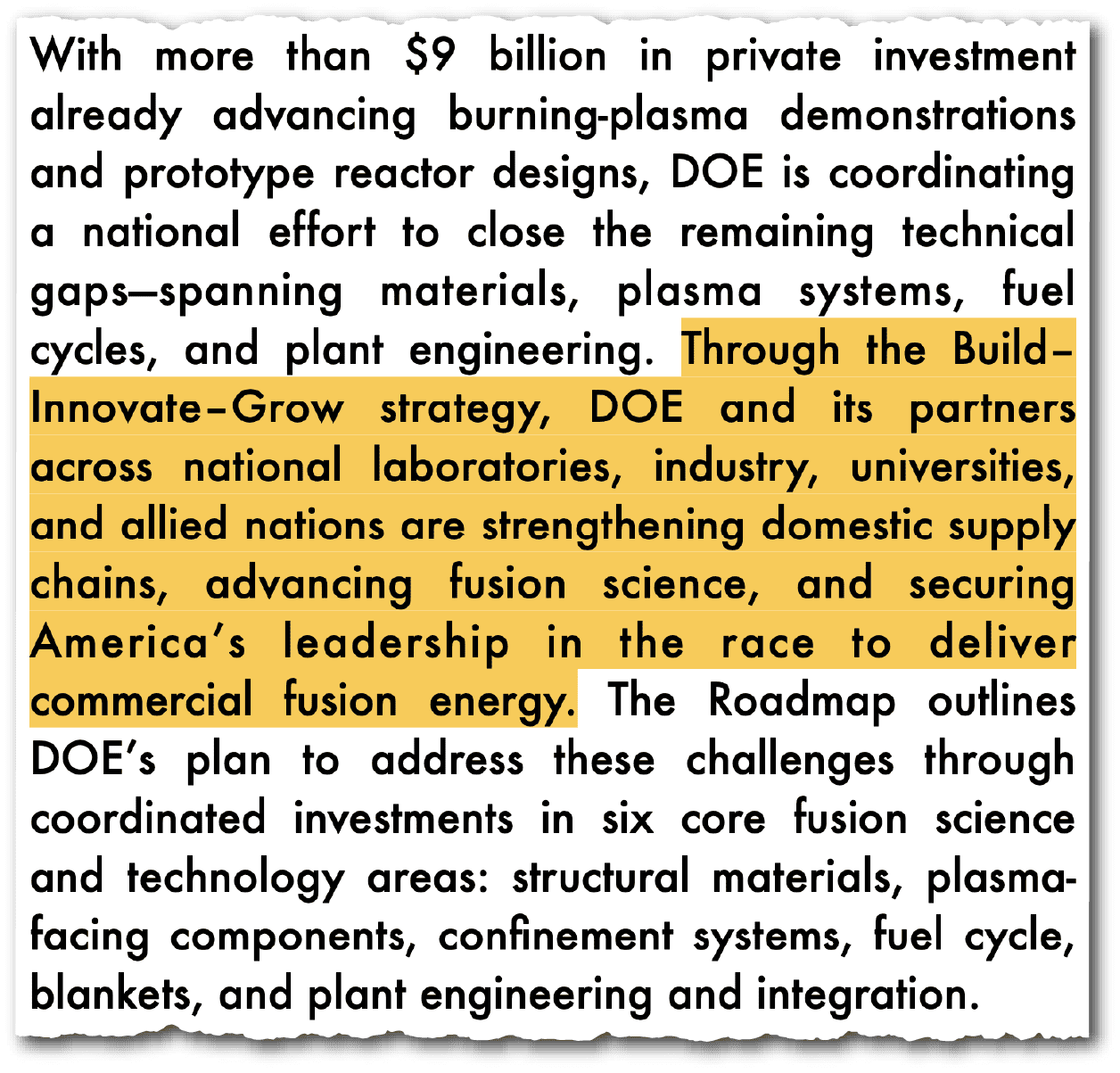
But the bulk of DOE’s recent efforts have been geared towards supporting the domestic fusion mission.
In November, DOE created a new fusion office outside its office of science as part of a major reorganization of the department. Hsu, the former DOE Lead Fusion Coordinator, says that the new fusion office is important because it signals that the government no longer regards fusion as exclusively a science program, and could make it easier for fusion to receive more money from Congress.
Fusion industry advocates have called on Congress to allocate more funding towards initiatives like the Milestone-Based Fusion Development Program, an incentive program that would reward U.S. commercial fusion companies for achieving key technical milestones. A similar program at NASA was successful in fostering the U.S. commercial space industry and the creation of Elon Musk’s SpaceX.
Experts are divided on the extent to which the recent developments in fusion diplomacy foreshadow a harder split for the global research community.
“There’s been a recent perception of the U.S. versus China in fusion,” says Hsu. “What’s interesting about [the Hefei declaration] is there may be a degree now of not just U.S. versus China, but U.S. versus the world,” he adds, while noting that several countries such as Korea and Japan did not sign on.
Others argue that it remains too soon to tell. Agreements like the Hefei Declaration “could make it harder for Americans to work with Europe if they go further down that pathway, but I don’t yet see [countries] hardening into blocs,” says Andrew Holland, president of the Fusion Industry Association, a U.S. industry group.

Eliot Chen is a Toronto-based staff writer at The Wire. Previously, he was a researcher at the Center for Strategic and International Studies’ Human Rights Initiative and MacroPolo. @eliotcxchen