Good evening. When a dam breaks like this, there is no un-breaking it.
On November 8, Nvidia founder Jensen Huang admitted that he lied about the nature of his relationship with a Chinese data-center executive and suspected chip smuggler, Alice Huang. Ms Huang is also suspected by U.S. officials of being an asset for China’s Ministry of State Security. (If she was not, someone at MSS should be sacked for dereliction of duty.)
On November 12, Jensen Huang was forced to leave the company he had spent his life building. Après Jensen, le déluge:
On November 16, the Commerce Department said it was getting serious about restricting Chinese companies’ ability to access cutting-edge U.S. chips in offshore data centers. See Noah Berman’s article in this week’s issue on the new rules, and also his interview with two Biden administration officials who drafted the “diffusion rule” in an attempt to prevent U.S. tech leakage to China. And in The Big Picture, Savannah Billman reviews long-stalled chip control initiatives that are suddenly gaining an awful lot of momentum on Capitol Hill.
On November 20, Representative Brian Mast, chair of the House Foreign Relations Committee, released a list of all the Chinese companies that Nvidia applied for permission to sell its H200 chip to. Noah looks at a Beijing-based company on this list, Intelliture Technology, that supplies a blacklisted Chinese university with computer servers.
The last of these developments is particularly significant. At the beginning of last week, journalists around the world were trying to beg, borrow or steal WireScreen logons and passwords to dig up whatever they could on any executive or company that had a connection to Alice Huang. By the end of the week they were scouring WireScreen and other databases to dig up whatever they could about the companies on Congressman Mast’s list.
Meanwhile, Jensen Huang hasn’t even testified to Congress yet. That date has been set for December 1.
In other articles this week:
Robert D. Kaplan asks Evan Medeiros, what do you do about a problem like Xi Jinping?
WireScreen and STAT News unveil a new index tracking China’s top-25 pharmaceutical companies, as measured by market capitalization and revenues.
And in this week’s Wire China podcast, reporters Noah Berman and Rachel Cheung follow Alice Huang’s paper trail, analyze the U.S. government’s most recent effort to close the loophole Huang’s data-center business exploited, and explain why China still needs Nvidia. Our podcasts are produced by Savannah.
Want this emailed directly to your inbox? Sign up to receive our free newsletter.
FOUR STORIES FOR WEEK FOUR OF THE NVIDIA AFFAIR:
Close Enough for Due Diligence Work
Beijing-based Intelliture Technology sells computer servers to a blacklisted Chinese University. Nvidia, Noah Berman writes, courted it as a client anyway.
OK, So What’s Your Next Move?
A new rule finalized by the Commerce Department on November 19 seeks to tighten control of U.S.-made chips in off-shore data centers that sell their services to Chinese companies. But while many industry experts are pleased that the Trump administration has finally moved to address this gap in existing rules, others see it as insufficient in itself. “It is a serious, credible first effort to address the major weaknesses in export controls,” Daniel Remler, who worked on AI policy at the State Department, tells Noah Berman. “[But] there are still real issues that even vicious enforcement of this rule won’t cover.”
Marco Rubio Steals the Ball!
Having trouble following the internal chip-control politics of Trump 2.0? It helps to think of it in terms of one of the greatest plays — and radio calls — in Boston Celtics history. You just have to substitute Marco Rubio and Scott Bessent for the Celtics’ Larry Bird and Dennis Johnson, and Jensen Huang and Howard Lutnick for the Detroit Pistons’ Isiah Thomas and Bill Laimbeer.
In this scenario Huang and Lutnick, star players for the Silicon Valley Doves, are playing against Rubio and Bessents’ Beltway Hawks team in a critical playoff game. The Doves have the ball and a one-point lead with five seconds left to play. All Huang has to do is make a routine inbound pass to Lutnick and it’s Game Over. So here goes, with apologies to legendary Celtics announcer, Johnny Most:
“Aaaa-nn-d now there’s a steal by Rubio! Underneath to Bessent. He lays it in! They have one second left. What a play by Rubio! Rubio stole the inbounding pass, laid it up to Bessent, and Bessent laid it up and in, and the Hawks have a one-point lead with one second left! Oh my the place is going crazy!”
In this week’s Big Picture, Savannah Billman tracks the recent revival of long stalled chip-control initiatives thanks to the superior play of Rubio and Bessent — with a big assist from Huang and Lutnick’s unforced errors.
A Q&A with the Diffusion Rule Guys
Ben Buchanan and Tantum Collins are former Biden administration officials who drafted the “diffusion rule” to stop chip and other technology leakage to China. Their recent book, The Bitter Struggle: Superintelligence, Superpowers and the Fate of the World, tells the story of their efforts and was recently excerpted by The Wire.
In a conversation with Noah Berman, Buchanan and Collins argue that the Trump administration was handed a useful and carefully crafted tool but threw it away. “The diffusion rule said there should be some significant scrutiny on which companies in places like Malaysia could get chips, and what they’re doing with those chips,” Buchanan said. “[Buyers in China] can’t just have a cutout company in Malaysia that buys the chips and either smuggles them to China or lets the Chinese companies or military access them remotely. The diffusion rule was meant to, and in fact did, respond to very real circumvention threats. We are definitely worse off given that it’s not enforced.”
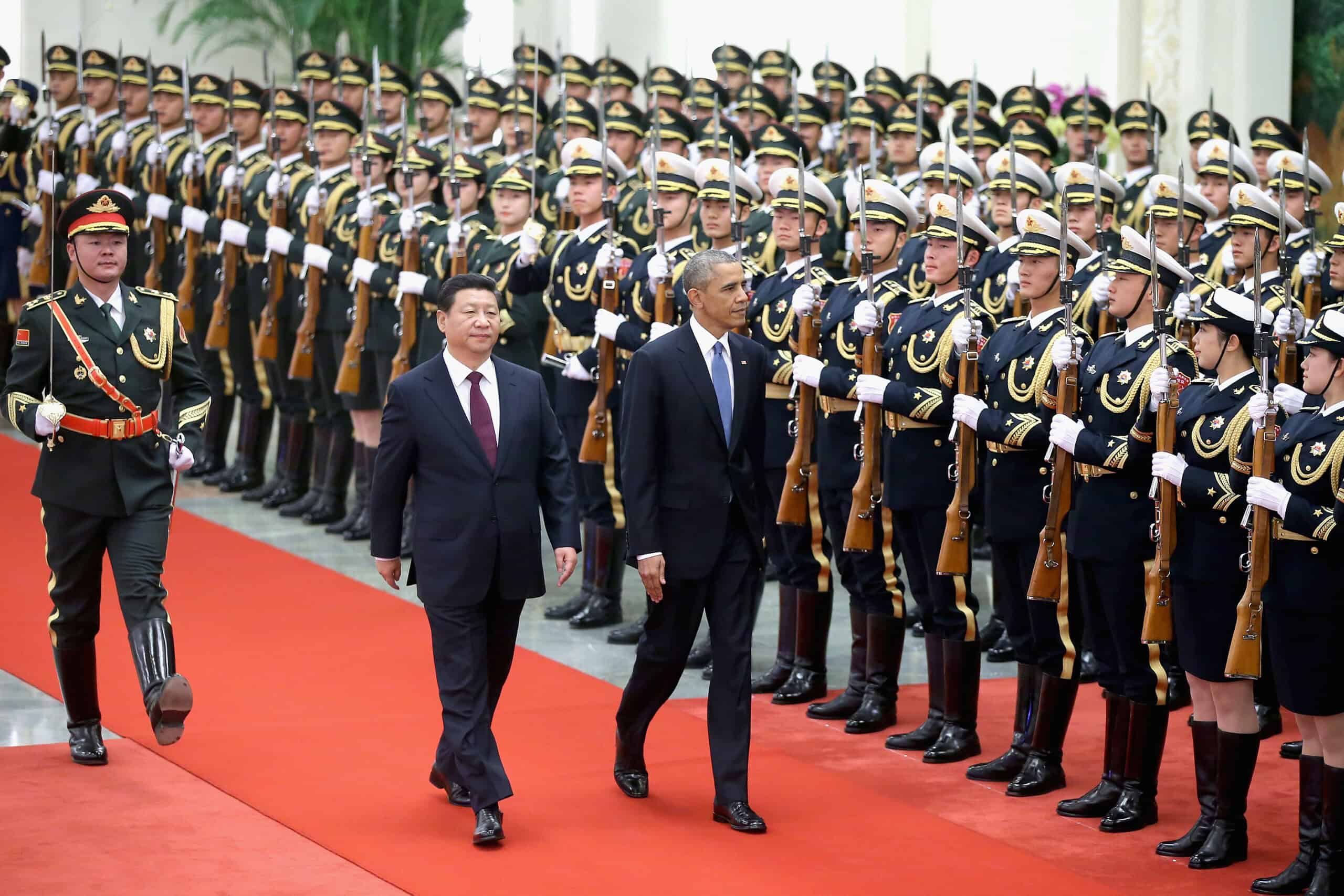
America’s “Gonna Need a Bigger Boat”
Evan Medeiros was the China Director on President Barack Obama’s National Security Council from 2009 to 2015. The difference between dealing with Hu Jintao’s China and Xi Jinping’s China, he tells Robert D. Kaplan in an excerpt from China Whisperers, was the difference between swimming with a big shark and swimming with a really, really big shark.
“Medeiros,” Kaplan writes, “said the big question at the time and even more pressing today is, ‘What risks was Washington willing to run and what costs is America willing to pay to compete with China?’ … Combined with recognizing just how aggressive and assertive Xi’s China could be, came the slow building but frightening realization that China was now a truly global power with unfair trading practices and an ability to pivotally influence not only North Korea and other countries in East Asia but Iran, the rest of the Middle East, European businesses and economies, climate change, and so forth. ‘Now there were, say, ten issues, not four. What is the line from ‘Jaws’, You’re gonna need a bigger boat.’”

The China Biotech Index
WireScreen, in partnership with STAT News, has produced a new index ranking China’s top 25 biotech companies based on their market cap and revenue. See who made it.
Subscribe today for unlimited access, starting at only $25 a month.
The Wire China, Issue No. 310