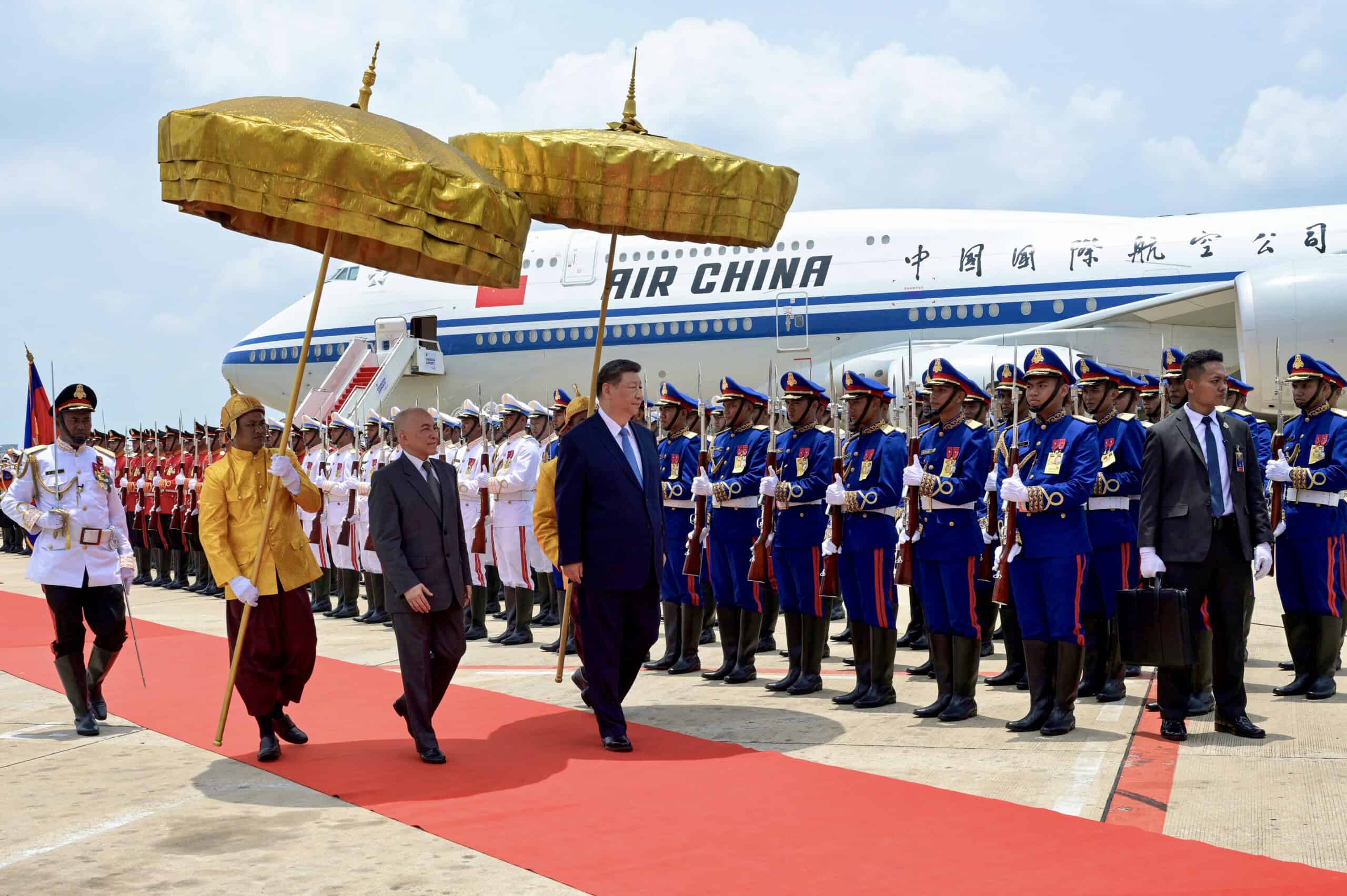
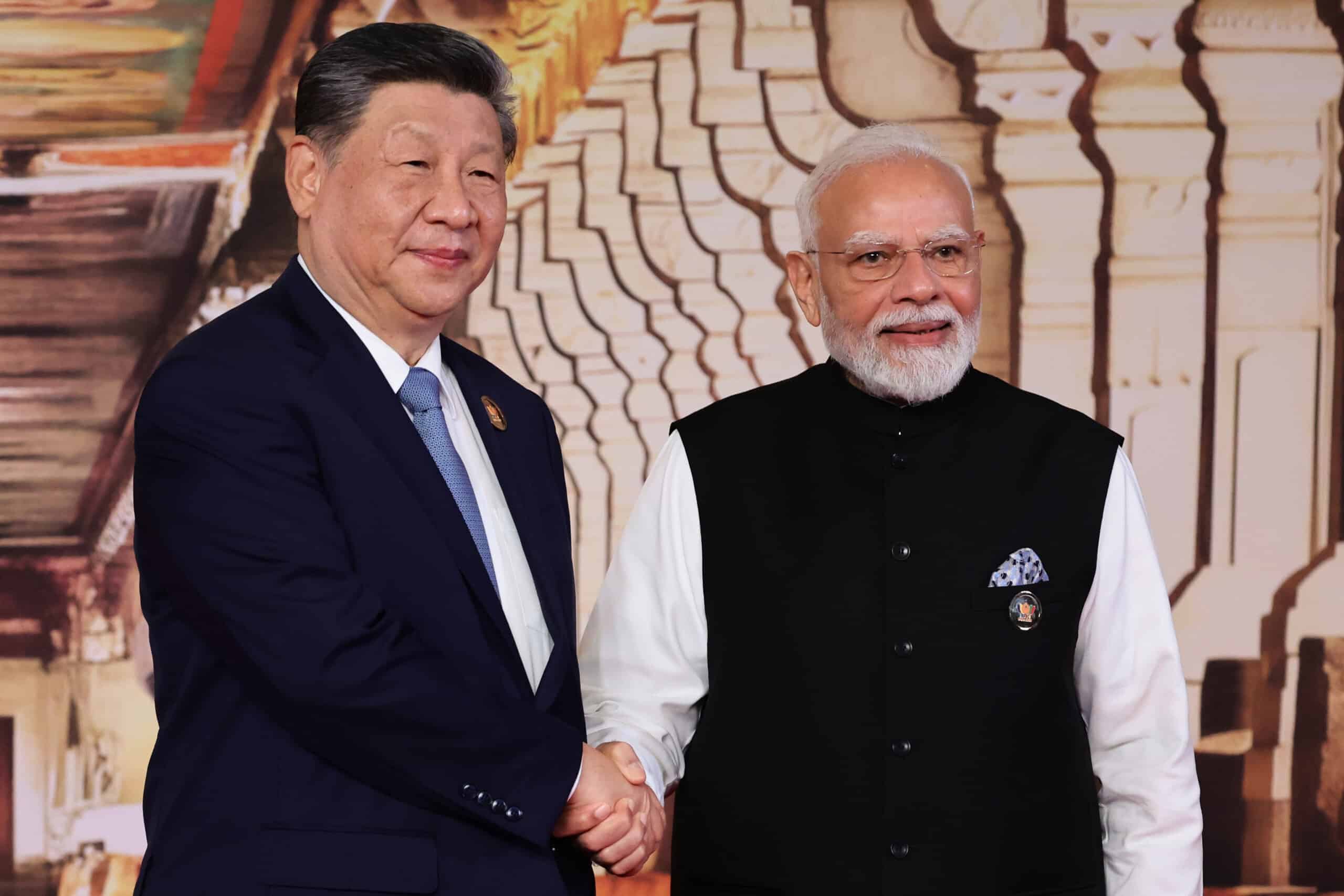
With a Leninist political system dominated by a strongman leader, China under Xi Jinping makes and manages foreign policy using an institutional structure different from that of other great powers, particularly those in the democratic West.
The most striking difference is that the foreign ministry in China is not the pivotal institution formulating and coordinating foreign policy. The Leninist nature of China’s political system means that “foreign policy powers rest with the Party Central.” In other words, it is the leadership of the Chinese Communist Party (CCP) or the Party Central which sets foreign policy goals and makes foreign policy decisions in China. The primacy of the Party and its supreme leader in the policy structure and process makes regime security the overriding driver behind Chinese foreign policy.
Under the overall leadership and direction of the Party Central, several institutional blocs contribute to the making of foreign policy, including various departments of the Party, ministries in the Chinese government, provincial governments, and the People’s Liberation Army (PLA). The party departments most involved are the International Liaison Department, United Front Work Department, and Propaganda Department.
Although the PLA is technically the military wing of the Party and doubles as China’s national defense force, it is too significant in its own right to be listed as just another department of the Party. The key government ministries are Foreign Affairs, Commerce, State Security, Finance, and the People’s Bank of China.

While the Ministry of Foreign Affairs does play a coordinating role, particularly in implementation, other ministries provide input on policy-making in ways somewhat similar to comparable ministries in other great powers. To support the implementation of foreign policy, the Party also enlists entities outside the formal government to aid in diplomacy, including for-profit companies, “non-government organizations,” think tanks, and even individuals.
When the People’s Republic was founded in 1949, the Party Central functioned as the highest authority on foreign policy. But China incrementally departed from this practice as it deepened the Dengist period of “reform and opening up.”

From the 1990s until the Xi era, decentralization and the professionalization of the foreign policy and security establishments weakened the Maoist state structure. To support the rapid expansion of China’s external activities, the Ministry of Foreign Affairs was allowed to take on more foreign policymaking functions in addition to policy implementation. Chinese diplomats came to pride themselves as career professionals rather than party apparatchiks and took a more pragmatic and professional, in contrast to an ideological, approach.
The relaxation of party control over foreign policy meant that provincial governments and major companies, state-owned or private, were also able to undertake large-scale foreign business ventures on a commercial basis, often with little regard to Beijing’s geopolitical goals. At the same time, endemic corruption blunted the effectiveness of the PLA as a foreign policymaker, a process furthered by suggestions in the 1990s that the military be nationalized, which would have given it more autonomy from the Party, suggestions which came from within the PLA itself.

When Xi took power, he found these various components of the foreign policy system below the Party Central jealously guarding their, albeit still limited, scope for foreign policymaking. Xi went about restoring the Party Central’s dominance, granting himself a prominent role, which was reaffirmed at an internal ministerial level meeting in 2023, the Central Foreign Affairs Work Conference, confirming the strategic importance of “head-of-state diplomacy.”
After that meeting, the Ministry of Foreign Affairs pledged “complete devotion” to “safeguarding head-of-state diplomacy” and to “pressing on with the implementation of General Secretary Xi’s major initiatives,” a reference to the Belt and Road Initiative (BRI) and global initiatives on development, security, and civilization.
[Xi] substituted the collective leadership of the Politburo Standing Committee by his strongman rule. While the Politburo Standing Committee formally remains the highest authority in foreign policy, Xi has turned it into an echo chamber.
On paper, the very top of the foreign policy system has remained unchanged throughout Xi’s reorganization. The Politburo Standing Committee, the top-ranked party organ, is still formally the highest foreign policy authority and represents “the Party Central.” However, by 2017, Xi had for all intents and purposes replaced collective leadership by his strongman rule, giving him a much tighter grip across the Chinese bureaucracy, including the foreign policy system.

In addition, Xi added new foreign policy institutions and changed the process and culture of foreign policymaking. These new institutions include a network of party organs called “central coordination organizations” that make and coordinate foreign policy. The Central State Security Commission, which Xi established in 2013, and the Central Leading Small Group on Foreign Affairs, which he upgraded to a “Central Commission” in 2018, are the leading foreign policymakers. They play a key role in assuring that regime security remains central to foreign policymaking and implementation. The Ministry of Foreign Affairs has again become primarily responsible for implementing foreign policies.
It is worth highlighting that, as in the governments of all great powers, the strongest advocates of pragmatism in making foreign policy are the professional diplomats. The elevation of party institutions at the expense of the foreign ministry has thus made the system much more responsive to Xi’s overriding concerns about his security as leader and the security of the regime.
The other basic change Xi made to the foreign policy apparatus was to install Xi Thought as the ideological guide for foreign policy. He succeeded in this by incessantly indoctrinating and monitoring individuals across government via the Party’s muscular disciplinary enforcers.
On the one hand, this has reinvigorated the United Front as a methodology for managing China’s engagement with the world. On the other hand, Xi has instilled in Chinese diplomats a “dare to fight” spirit against perceived slights to China’s dignity. This has turned them into what Western media have called “wolf-warriors.” In this book, we trace the cause of “wolf-warrior diplomacy” to the structural changes to China’s foreign policy system, which have created incentives for and put pressure on Chinese diplomats to prioritize political loyalty to Xi and uphold his ideology over professional competence where they see a clash.
Just as Xi has made the Party into the vanguard defending regime security, he has also put the Party on the frontline of diplomacy. This ended the post-Mao practice of keeping the Party itself out of the international spotlight by ostensibly leaving the government or the foreign ministry to manage China’s international interactions. That post-Mao arrangement served to obfuscate the Party’s role in foreign policymaking to better accommodate the sensibilities of other countries.
Such accommodation is not a priority for Xi. Under his rule, the Party now engages with foreign political leaders and business dignitaries directly, frequently, and often independently from the foreign ministry. The Party also rallies all sectors in China and the Chinese diaspora to support “the China Dream” of “national rejuvenation.” Moreover, Xi has accorded greater significance to the restructured and more disciplined PLA, which has enhanced his ability to project power into the foreign policy system.
In other words, Xi has put the Party back at the center of foreign policymaking. Others conscripted to support foreign policy, be they regional governments, businesses, international relations think tanks, or non-government organizations, are required to embrace the leadership of the Party and adhere to Xi Thought. By removing constitutional and political hurdles for himself to rule for life, China’s foreign policy system has become increasingly leader-centric.
Changing the Foreign Policy Structure at the Top

While Xi shares a belief in the Maoist maxim that “foreign policy powers rest with the Party Central,” this is neither a constitutional nor a legal requirement. Strictly speaking, the maxim is out of line with the People’s Republic of China (PRC) constitution, which stipulates that the National People’s Congress, the legislative branch, is “the highest organ of state power.” This implies that the legislative branch, not any party organ, should be the top-most foreign policy authority. But the reality of a Leninist party-state means that the Party can monopolize foreign policy powers at will.
In practice, the National People’s Congress only comes into play for pro forma ratification of the most important policy matters decided by the Party. This is why the foreign ministry can be, and is most of the time under Xi, restricted to implementing policies made by the Party. Its main function is to “add flesh to the bones” of the Party’s foreign policy, according to Lu Ning, a former assistant to a vice-Foreign Minister.
Between the Maoist and the Xiist eras, the Politburo Standing Committee routinely made important foreign policy decisions. It is the topmost party organ with seven or nine members, chaired by the CCP General Secretary.
For over two decades under Jiang Zemin (General Secretary, 1989–2002) and Hu Jintao (General Secretary, 2002–2012), the Standing Committee served as the platform for collective leadership. Party elites from the dominant factions, including factions competing for power with the General Secretary’s faction, held seats at the Standing Committee. They each took up a policy portfolio, of which they were the de facto leaders respectively. They were expected to observe age and term limits designed to preempt anyone from holding onto power indefinitely. They constrained the power of the General Secretary as well, ensuring that he was not much more than the “first among equals” of the Standing Committee members.
This arrangement created a political culture of robust discussion, negotiation, bargaining, and compromise, resulting in policymaking based on consensus, even though the process could involve vicious factional infighting. On the whole, the committee members guarded against the General Secretary imposing his will against collective wisdom on foreign policy as on all policy areas.
Protecting the security of Xi as supreme leader has thus become the starting point of regime security, officially presented as “national security,” and the overriding driver shaping China’s foreign policy.
The power dynamics behind this are illustrated by a telling episode during Jiang Zemin’s tenure as General Secretary. In the 1990s, the committee prevented him from establishing a State Security Commission inspired by the U.S. National Security Council and chaired by himself. His fellow members in the Politburo Standing Committee were apparently concerned that this new commission would give him scope to usurp their prerogative to decide on matters of state security.
Even after two major incidents — the bombing of the PRC Embassy in Belgrade by the United States (1999) and the collision of a Chinese naval fighter with an American EP-3 surveillance aircraft (2001) — Jiang still failed to establish such an institution. He only managed to create a “sub-group” on state security in the Central Leading Small Group on Foreign Affairs, which remained under the supervision of the Politburo Standing Committee.
Collective leadership became more entrenched under Hu Jintao. This was not only because Hu was overshadowed by Jiang for part of his tenure as General Secretary, but also because he pioneered experiments using “intra-party democracy.” For example, in 2003, Hu committed every member of the Politburo Standing Committee, including himself, to deliver an annual work report to the 200 strong CCP Central Committee, and hence subject to their scrutiny.

Collective leadership under Jiang and Hu resulted in a strong status quo bias in foreign policymaking, which guarded against dramatic swings in China’s approach to the world. This sustained the “hide and bide” foreign policy strategy that Deng Xiaoping put in place in 1990. However, as the power gap between China and the United States narrowed significantly by the end of Hu’s tenure, the “hide and bide” approach came under increasing strain. Veteran China scholar Susan Shirk concluded that some powerful factions in the Party exploited Hu’s weak leadership to impose their hawkish preferences onto China’s foreign policy system, which marked the beginning of the derailing of the “hide and bide.”
Xi decisively replaced “hide and bide” by an assertive alternative, branded “great power diplomacy with Chinese characteristics.” He substituted the collective leadership of the Politburo Standing Committee by his strongman rule. While the Politburo Standing Committee formally remains the highest authority in foreign policy, Xi has turned it into an echo chamber.

He started the process in 2015 when he imprisoned Zhou Yongkang, who had recently retired from the Standing Committee. This ended the hith-erto unbroken post-Mao convention that accorded full immunity to current or retired Standing Committee members. The next step Xi took was to elevate himself to the position of supreme leader. He maneuvered to have himself formally recognized as the “core” of the Party in 2016. With this he put forth the “four consciousnesses”—“politics, the overall situation, the core, and keeping in line”—effectively imposing a new standard for “political discipline” on party members, particularly those at the top.

The year after Xi consolidated power and formally unveiled Xi Thought at the 19th Party Congress (2017), he proclaimed it “the guiding thought” of China’s foreign policy approach. Its first principle is to “uphold the Party Central’s authority and strengthen the Party’s centralized and unified leadership over external work.” This is consistent with the “two upholds” and “two establishes,” the twin pairs of behavioral codes that demand party members’ absolute loyalty to Xi.
By 2018, Xi clearly ended collective leadership when he required members of the Politburo and its Standing Committee report annually to him instead of the Central Committee, while he was not required to answer to any institution. This not only turned Hu’s “intra-party democracy” experiment on its head, but also made Xi’s authority practically unchallengeable.

This process deepened as Xi broke the post-Mao convention and started a third term as the top leader in 2022, when he also packed the Politburo and its Standing Committee with his protégés. With these changes, major foreign policy strategies and policies became “personally formulated, planned, and pushed forward” by Xi, especially the BRI, the forging of “the common destiny for humankind,” and the modernization of the PLA as an instrument to support China’s global strategy.
This implies that the national interest and security of China have become an extension of those of the Communist Party and Xi. Protecting the security of Xi as supreme leader has thus become the starting point of regime security, officially presented as “national security,” and the overriding driver shaping China’s foreign policy.
Central Coordination Organizations
Xi has reinforced his dominance in foreign policymaking by consolidating control over the Party’s network of central coordination organizations. The most important two were created by Xi himself: the Central State Security Commission and the Central Commission for Foreign Affairs. Both are structurally subordinate to the Standing Committee, but they dilute the power of the Standing Committee in actual policymaking.

Being the least formalized parts of the Party’s upper echelons, their composition, structure, and modus operandi are the least well established and regulated. This has provided opportunities for Xi to assert his dominance and set policy parameters.
Before Xi, “the Party Central” generally meant the Politburo or its Standing Committee. After Xi consolidated power, he effectively became the Party Central, acting on his own or alongside his hand-picked top-level coordination organizations.
Xi openly states that he uses these organizations not only to “coordinate” policy but to carry out “top-level design” as well. Increasing the prominence of the two commissions in the policy process has enabled Xi to “give full play to the Party’s role as the leadership core—superintending the whole situation and coordinating all sides.” Before Xi, “the Party Central” generally meant the Politburo or its Standing Committee. After Xi consolidated power, he effectively became the Party Central, acting on his own or alongside his hand-picked top-level coordination organizations.
Other China specialists have offered an alternative perspective on the relationship between Xi and the upper echelons of the Party. Huron University College professor Alfred Chan argues that Xi employs central coordination organizations to “consolidate” the “first among equals” arrangement. To Chan, although Xi chairs these organizations, he must still “depend on” other Standing Committee members to serve as deputy chairs.
This seems logical, but our research shows the changing power dynamics have overwhelmingly enhanced Xi’s dominance. His control over central coordination organizations is staggering.
Xi’s immediate predecessor, Hu Jintao, chaired two of these organizations when he was the top leader. Right before Hu, Jiang Zemin chaired two and co-chaired one with his Premier, Zhu Rongji. In contrast, Xi is the sole chair of 11 central coordination organizations, six of which can be easily classified as parts of China’s foreign policy and security establishment. If these organizations merely coordinate policy under the Standing Committee’s supervision, it would not make sense for Xi to commit so much of his limited time to chair so many of them.
Excerpted from China’s Global Strategy under Xi Jinping by Steve Tsang and Olivia Cheung. Copyright © 2026. Reprinted with permission of the publisher, Oxford University Press. All rights reserved.

Steve Tsang is Director of the China Institute at SOAS University of London. He is also an Emeritus Fellow of St Antony’s College at Oxford, and a Fellow of the Academy of Social Sciences. He previously served as the Head of the School of Contemporary Chinese Studies and as Director of the China Policy Institute at the University of Nottingham.

Olivia Cheung is Lecturer in Politics at the Department of European and International Studies and Affiliate of the Lau China Institute at King’s College London. She is also China Fellow at the Centre for Security, Diplomacy and Strategy, Vrije Universiteit Brussel.