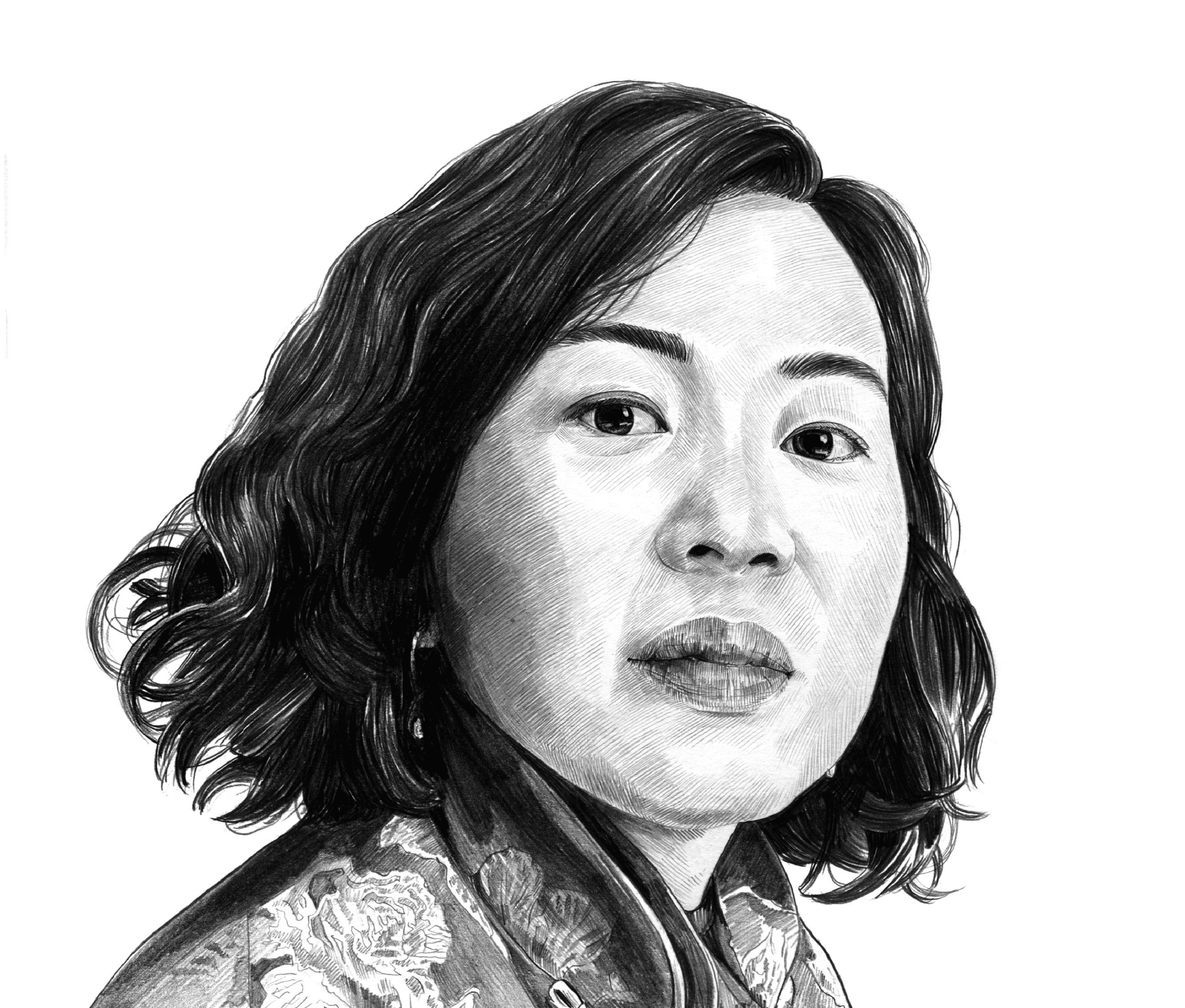
Born and raised in Hong Kong, Yi-Ling Liu has covered AI and the Chinese society for Associated Press and led the China desk at Rest of World. She spent several years in Beijing, where her work on Chinese society, technology, and internet culture appeared in the New York Times Magazine, the New Yorker and other publications. She is a New America Fellow and an Overseas Press Club Foundation Scholar, and is currently a journalist-in-residence at the Tarbell Center for AI Journalism. Her new book, The Wall Dancers: Searching for Freedom and Connection on the Chinese Internet, tells the stories of people who navigate the boundaries of Chinese cyberspace.

Illustration by Kate Copeland
Q: What made you start this book, and what are you trying to document?
A: I decided to move to China back in 2017. I found that the reality on the ground was very different from the headlines that I was reading. The depiction of China, especially Chinese technology, was often at one of two extremes — either this superpower and economic juggernaut of boundless opportunity, or this techno-authoritarian regime where people have no agency of their own. I wanted to actually document the society that I was living in — all its richness and dynamism.
In particular, I found myself being drawn to people who were “dancing in shackles.” This was a metaphor used by journalists in the early 2000s to describe the experience of writing and reporting under state censorship. But then I found myself listening to all kinds of people use this phrase to describe their experience: musicians, science fiction writers, software engineers. It resonated with me because it captured the experience of living in a place that would swing wildly between freedom and control.
I noticed that this dance was at its most dynamic on the internet. I came to know the people who were really good at navigating this terrain as ‘wall dancers’, which is what ended up being the title of the book.

In the book, you also describe China’s cyberspace as a walled garden. What do you mean by that? And how is the Chinese internet different from foreign perceptions of it?
A lot of people outside of China are aware of the Great Firewall of China as this boundary that prevents information from the outside world from going inside. But there’s an assumption that within the Great Firewall, it’s just a barren landscape where nothing exists and grows. I found that the walled garden metaphor was much more apt because even within the firewall, a parallel online universe has emerged.
China definitely has innovation, cultures, communities, viral slang, entirely of its own. The most obvious way that this has manifested itself is in the different platforms that have emerged: instead of Twitter, there’s Weibo, instead of Facebook, there’s WeChat, instead of ChatGPT, there’s DeepSeek and Doubao, even though they’re definitely not equivalents. There’s a sense that an entirely different array of plants and fauna are growing in this ecosystem that’s unlike what exists outside.

What were the initial hopes for the internet in China and how have things turned out differently?
The book begins in the 90s when the story of the Chinese internet and the World Wide Web, for that matter, was very much one of romance. There was this idea of technology bringing about freedom, and the internet being a force of liberalization. There was a feeling there would be an inevitable arc whereby, if everyone got online, we would be freer and more open and more connected. It goes without saying, that’s not how things have panned out.
This applies not just to the Chinese internet, but the world wide web as well. Even as late as 2009 to 2011, we thought of Weibo as a social media platform that was going to be a harbinger of free speech. Now it’s overrun with incels and patriotic trolls with small pockets of interesting content. X used to be known as a throbbing networked intelligence, and now it’s described by journalists as a hell site or a cesspool, controlled by the whims of one of the most powerful men in the world. The internet has become more closed, polarized and siloed.

You profile five characters in the book. What drew you to them? What do they represent? In particular, how did you meet Ma Baoli, a small town cop who founded one of the biggest gay dating apps in China?
I was very interested in focusing on the margins — the underground, the edges, not the center or the mainstream — because these are the spaces where the most creative dances have bloomed, where people were really thinking out of the box. That’s why I focused on queer communities, feminist activists, underground hip hop, science fiction writers. These felt like fertile spaces for new and imaginative ideas.
That being said, a lot of my subjects also have one foot in the mainstream, they understand how the center works. They can code switch. It means that they are creative and adaptable, and can identify leverage points for change.
Ma Baoli is a perfect example of that. On the one hand, he certainly occupies the margins. He was the chief executive of a gay dating app and ran an underground gay website for most of his early career. But on the other hand, he also worked as a policeman, which is the ultimate center of authority. He knew how to speak the language of authority and navigate red lines, and how to grow the queer community that he was leading without crossing any boundaries.
| MISCELLANEA | |
|---|---|
| FAVORITE BOOKS | Recent favorite: The Loneliness of Sonia and Sunny, Kiran Desai All-time favorite: The Overstory, Richard Powers |
| FAVORITE FILMS | Recent favorite: Mrs. Doubtfire All-time favorite: Yiyi |
| FAVORITE SONGS | Recent favorite: Here is Someone, Japanese Breakfast All-time favorite: A Case of You, Joni Mitchell (and the Prince & James Blake versions) |
I actually wrote an article for The New York Times Magazine back in 2020 on Blued, the platform that he founded. They didn’t agree to an interview with him, even though they were friendly. I wrote that piece by speaking to everyone who knew the company but didn’t actually work there, like investors, ex-employees, users, but more broadly, people who are interested in and understand queer life in China. It could have been a straight business profile, but it ended up being a much more expansive look into queer online life in China. After I wrote that piece, eventually for the book, they agreed to speak with me.
What is the state of the Great Firewall today? It seems like censorship is stricter than ever, but in some ways the wall is also more porous. What purpose does the wall still serve?
The wall is definitely stronger and more rigid than it ever has been. When we think about the early days of the Great Firewall, the most concrete layer is a filter that prevents information from coming in, such as a list of banned websites. But obviously since then, it has expanded to encompass an entire sophisticated censorship system. That includes not just the filter, but also the top-down censorship regulators who are issuing censorship directives, and the tens of thousands of rank and file content moderators at each of these social media companies that are deleting things one by one. With the rise of AI, that process is becoming increasingly automated, even though human judgment is still part of it.
…many Chinese internet users are hyper-aware that their internet is enclosed behind a wall… They will go out of their way to “jump the wall,” to seek alternative truths and sources of information outside of their bubbles.
A big part of it that we forget about is the psychic self censorship that a lot of people have internalized. If you grew up within the system, you intuitively know where those lines are. A lot of that is still very relevant. Even if you do know that your information ecosystem is censored and curtailed, it’s not convenient to go out and look for other sources of information.

I would say that the Firewall has always been porous. But what’s changed today is that even though the Chinese internet is still enclosed within this firewall, it has expanded beyond its borders. A lot of Chinese tech companies are going overseas.
TikTok is the ultimate example of that. This Chinese company had to exist within China’s specific ecosystem, but now it’s arguably the most important social media app in the world. And the debate is, to what extent is it still subject to China’s Firewall? And now, after the sale, to what extent is it subject to American political influence?
But it’s not just TikTok. Temu is huge and is doing SuperBowl ads. Xiaohongshu is influencing tourism trends in Thailand and food trends in Dusseldorf. BYD is making inroads everywhere from Thailand to the Middle East, with cars connected to the internet. Alibaba’s [AI model] Qwen is being used by the Airbnb CEO.
So everyone, not just Chinese people in the diaspora, but certainly people who are using Chinese internet tools, are going to have to learn to navigate the Chinese web even if they don’t live in China themselves. That requires a much deeper familiarity with how the Chinese Internet actually works.
Posts in Weibo‘s recommended section.
What about Chinese people, living within this ecosystem — has the Firewall and the narratives it allows and promotes affected how they viewed the world?
It definitely depends on the person, where they are from, who their communities are, what they believe in — everyone’s experience of the Firewall is radically different. So I’m wary of generalization.
It is possible to say though, that the Firewall has insulated many Chinese internet users from easily accessing information from the outside world. It’s not that this is not possible — but that it’s inconvenient: it takes time, energy and resources to “jump the Firewall” and use a VPN. So many users stay within its confines and don’t explore the internet’s fringes and corners. And on mainstream social media feeds, worldviews have become increasingly heterogeneous, scrubbed of alternative, provocative views, and increasingly nationalist.
That being said, many Chinese internet users are hyper-aware that their internet is enclosed behind a wall — in contrast to other internet users who assume their internet is free and open, when it is in reality, not. They will go out of their way to “jump the wall,” to seek alternative truths and sources of information outside of their bubbles.

There used to be a time when foreign outlets covering breaking news in China would cite a top comment in Weibo to take the pulse of China. Does that work today?
A lot of reporters, myself included, no longer turn to Weibo as much. I do still think it’s very rich, and there are a lot of conversations taking place there, but it seems like the most exciting conversations are now on Xiaohongshu. Even two to three years ago, Xiaohongshu was still used predominantly by young women. It seemed to focus more on lifestyle and shopping and travel. But now it’s hardly that. It has become an all encompassing search engine.
And so I’d say, now the place that a lot of China reporters will go to to figure out what’s happening the Chinese web would probably be that.
You have noted how the U.S. internet is also becoming more similar to the Chinese one. Can you tell us more about that?
A lot of the forces that affect the Chinese internet are hardly unique to China, and are very much affecting the U.S. internet as well. We see this amplification of illiberal voices, the spread of misinformation, the retreat from the public sphere.
We’re moving from a world where social media has hacked our attention to a world in which AI is now hacking our attachment patterns by creating this relationship of dependency and companionship.
One of the most alarming things that I’ve noticed is the collaboration between political power and the tech elite to push for their own particular agenda, as opposed to that of its users. One example is just seeing a lot of American Silicon Valley CEOs essentially kowtow to the Trump administration after his inauguration last year, and align their rhetoric with the policy directives of that administration.
That reminded me of the relationship of interdependency and patronage between the Chinese government and Chinese tech companies. It’s alarming because it reveals that technology is increasingly in the hands of people in power, and they’re able to carve out their own turf and take over what we once saw as the open space of the web.
What impact is AI having on the Chinese internet and social media?
There’s an optimistic answer and there’s a pessimistic one, which is unfortunately more realistic.
The biggest thing that AI might do is deepen inequality, particularly between those who are building the technology and those who are using it. This is something I’ve definitely noticed both in China and Silicon Valley: the people who are building the technology have a lot of agency. They are very competitive and often quite excited about how the technology is panning out. There’s a sense of ‘I’m really in control of how things are going to go.’

Whereas the people who are not part of Zhongguancun [a tech hub in Beijing] or Silicon Valley are feeling increasingly disempowered. They have no sense of how these algorithms are going to shape their life, and they have no choice in whether or not to participate. We’re moving from a world where social media has hacked our attention to a world in which AI is now hacking our attachment patterns by creating this relationship of dependency and companionship. I’m really worried about the radical changes to the economic system and structural inequality as a result of these AI technologies.
The optimistic answer is no one really truly understands this technology, and it will continue to evolve. Individuals are extremely creative and have a lot of ingenuity in terms of how they use it. Vibe coding is one example: anyone who has these tools can use them to their advantage and figure out novel ways to use instead of being used by the technology. So there’s some promise there. But that’s just a small silver lining I see in this.
Is there anything unique to the Chinese ecosystem? Or do you see mostly parallels in terms of AI’s impact on both China and the U.S.?

What’s unique about the Chinese landscape is its governance tools. Right now, AI governance in the U.S. is a free for all, where the companies are emboldened to do whatever they want. In China, the government has released an algorithm registry that tracks every single generative AI tool that is available. The amount of regulatory tools that are in the hands of Chinese policymakers will allow for a much different relationship between regulators and companies.
There are a lot of other differences on the innovation and business side. For example, China’s really good at building hardware and the U.S. is good at software. China has a really limited venture capital ecosystem and so their whole thing is building a ton of apps and commercializing them really quickly, infusing them into everyday use cases as quickly as possible.

In the U.S., you have star researchers spinning off and making AGI labs and promising a technology that’s going to be super intelligent — and raising a ton of capital. People in the AI space focus on those differences: I have been more drawn to their similarities, because people aren’t talking about them as much.
To go back to the analogy in the book’s title. What does the dance look like now? Do you think there’s still room on the Chinese internet for people to express themselves or push back, and what does that look like?
The dance today is a very personal and internal process which requires people to truly think, what do I actually believe in? What do I know? What is true in an information ecosystem that is completely shaped by algorithmic control and is pumping information into your brain? It’s a dance with a very penetrative internet ecosystem that’s basically telling you what to think — and we need to figure out what these systems want us to think. The dance is about the ability to continue to nurture solidarity and connection with other people in a system that is continually trying to isolate people from one another and polarize people.
There are so many different types of experiences, and there’re so many ways of being, and we can see [China] in all its complexity through individual lives and stories, as opposed to some very reductive headlines that often appear in the news.
A lot of it is also about how do I protect my own private life from a state that is so capable of surveilling and encroaching on that private sphere? That’s everything from literal tools, such as using Signal to escape surveillance, or drawing boundaries around one’s private life and knowing what can remain untouched by the state or the market. Everyone goes about it in a different way. There’s no one way to do it.
Who is the book intended for?
You can think of it as con-centric circles. At the core, and this might feel a bit selfish, the book is for myself, in that I usually start writing something when I am looking for something in the world. This is the book that I wish someone had written when I first moved to China in 2017. But then outside of that circle, I would say it’s for other people who identify as wall dancers, who feel like this experience speaks to them. It allows them to feel seen, and know this experience is not one that is deeply lonely, but one that many people have navigated.
It’s also for people who don’t understand China or the Chinese internet at all, but are empathetic, nonfiction readers who want to better understand what life is like across the Pacific. That really informs my writing as well, because there are a lot of things that need to be contextualized and explained and given context for. And for them, what I really want to get across is that China’s not a monolith. There are so many different types of experiences, and there’re so many ways of being, and we can see this country in all its complexity through individual lives and stories, as opposed to some very reductive headlines that often appear in the news.

Rachel Cheung is a staff writer for The Wire China based in Hong Kong. She previously worked at VICE World News and South China Morning Post, where she won a SOPA Award for Excellence in Arts and Culture Reporting. Her work has appeared in The Washington Post, Los Angeles Times, Columbia Journalism Review and The Atlantic, among other outlets.