A planned rule by the Trump administration could lead to a dramatic rise in the number of Chinese companies subject to U.S. export controls — and a big headache for American firms selling products into China.
Right now, only companies explicitly named on the Commerce Department’s trade blacklist, known as the ‘Entity List,’ face export controls, limiting what American companies can legally sell to them without a license. But the new, so-called ‘50 percent rule’ would impose the same controls on transactions with any company that is majority owned by firms on the Entity List.
Proponents say that the 50 percent rule is necessary, given the ease with which Chinese companies have managed to flaunt U.S. export controls by setting up new subsidiaries faster than Commerce can add them to its list. A Commerce official confirmed last month that the department has prepared a draft rule.
But the change could have cascading and unpredictable effects, with tens of thousands of companies potentially being swept up in the new rules. Large Chinese companies on the Entity List like Huawei and Semiconductor Manufacturing International Corporation (SMIC) have hundreds of subsidiaries worldwide that export control enforcers already have difficulty monitoring.
“We’re going from looking at entities in isolation on a list to looking at them in terms of networks,” said Mark Nakhla, chief research officer at Kharon, a sanctions compliance firm, in an online event last month.
To examine just how expansive the 50 percent rule could be, The Wire traced the structures of Huawei and SMIC, counting the number of majority-owned subsidiaries that would be subject to the rule. Data from WireScreen, The Wire’s sister company, show that the two firms combined have more than 130 majority-owned subsidiaries that of the two firms could be affected.
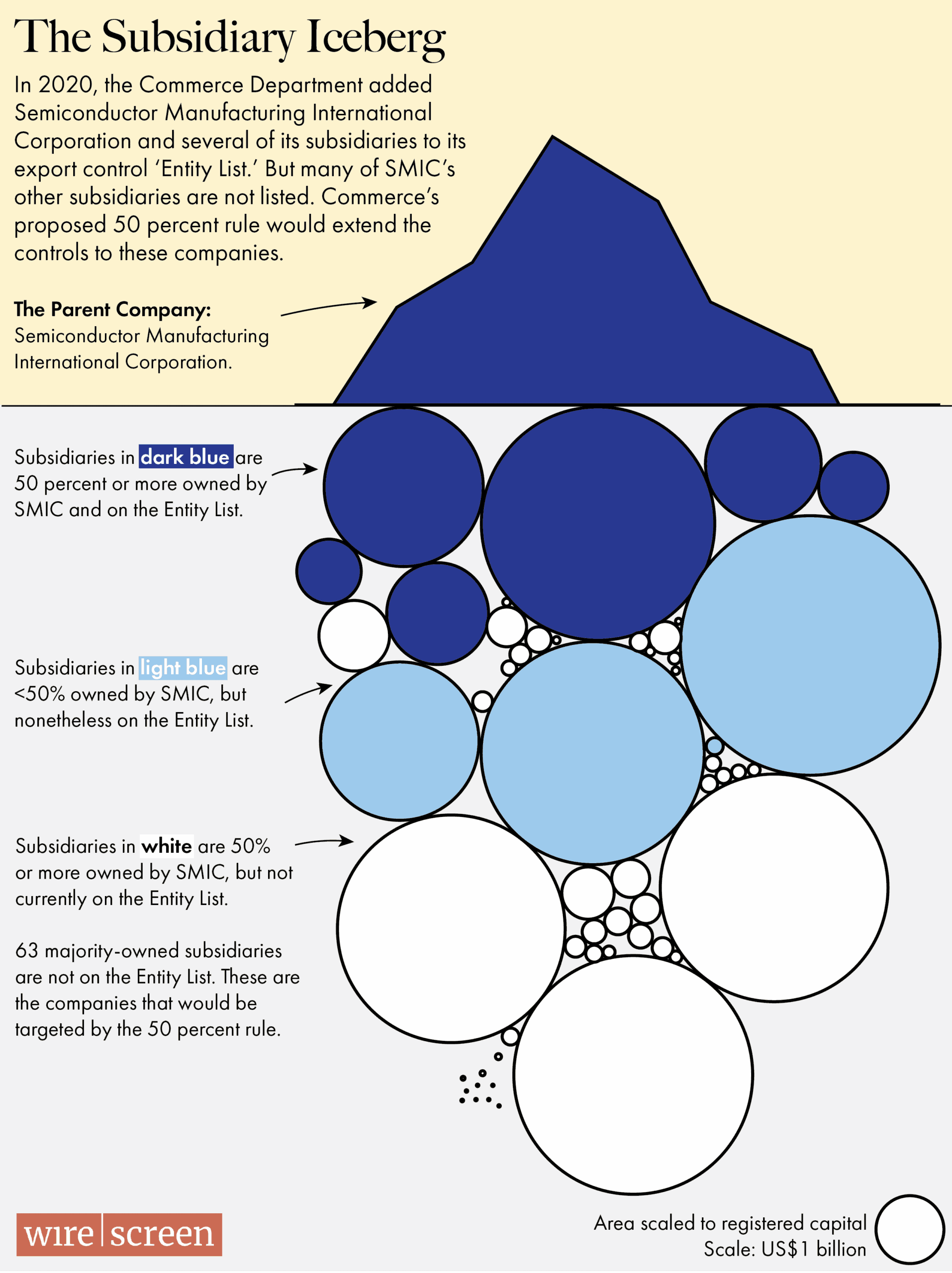
Shanghai-headquartered SMIC is at the forefront of China’s chip indigenization drive. The company was added to the Entity List in December 2020 alongside 10 of its subsidiaries for their alleged involvement in China’s military-civil fusion initiative. The Biden administration added two more SMIC subsidiaries last year.
But several of SMIC’s largest subsidiaries by registered capital have so far eluded the Entity List. Two such companies, with a combined registered capital of $10.5 billion, were incorporated after SMIC’s initial entity listing. A third, with $5 billion in registered capital, was incorporated just days before the listing was announced in 2020.
COLLATERAL DAMAGE

Also under SMIC’s umbrella: two private schools in Beijing and Shanghai. Founded in 2001 for the children of SMIC employees, the schools now enrol external students and offer international curricula including American Advanced Placement (AP) classes. SMIC Private School Beijing employs 300 teachers including 50 expatriate staff, according to its website.
Under the 50 percent rule, the two schools, which are wholly-owned subsidiaries of SMIC, could be subject to U.S. export controls, which could include placing restrictions on Americans working for companies on the Entity list.
Previous U.S. administrations have hesitated to impose such sweeping restrictions. Matthew Axelrod, former assistant secretary for export enforcement at Commerce’s Bureau of Industry and Security (BIS), raised this concern at an event in May.
“The real argument that I see on the other side is that the national security harm… exists in items going to one division [of a company], but not the other division,” he said. “If the goal is to… restrict what’s necessary to restrict, but not more than that, this can get tricky… and I think it certainly is something that might end up happening.”
THE OWNERSHIP QUANDRY
Sanctions compliance experts say that a major source of uncertainty is exactly how ‘50 percent’ ownership will be defined: whether it’s a direct, indirect, or cumulative stake could make a big difference in who gets caught up in the new rule’s auspices.
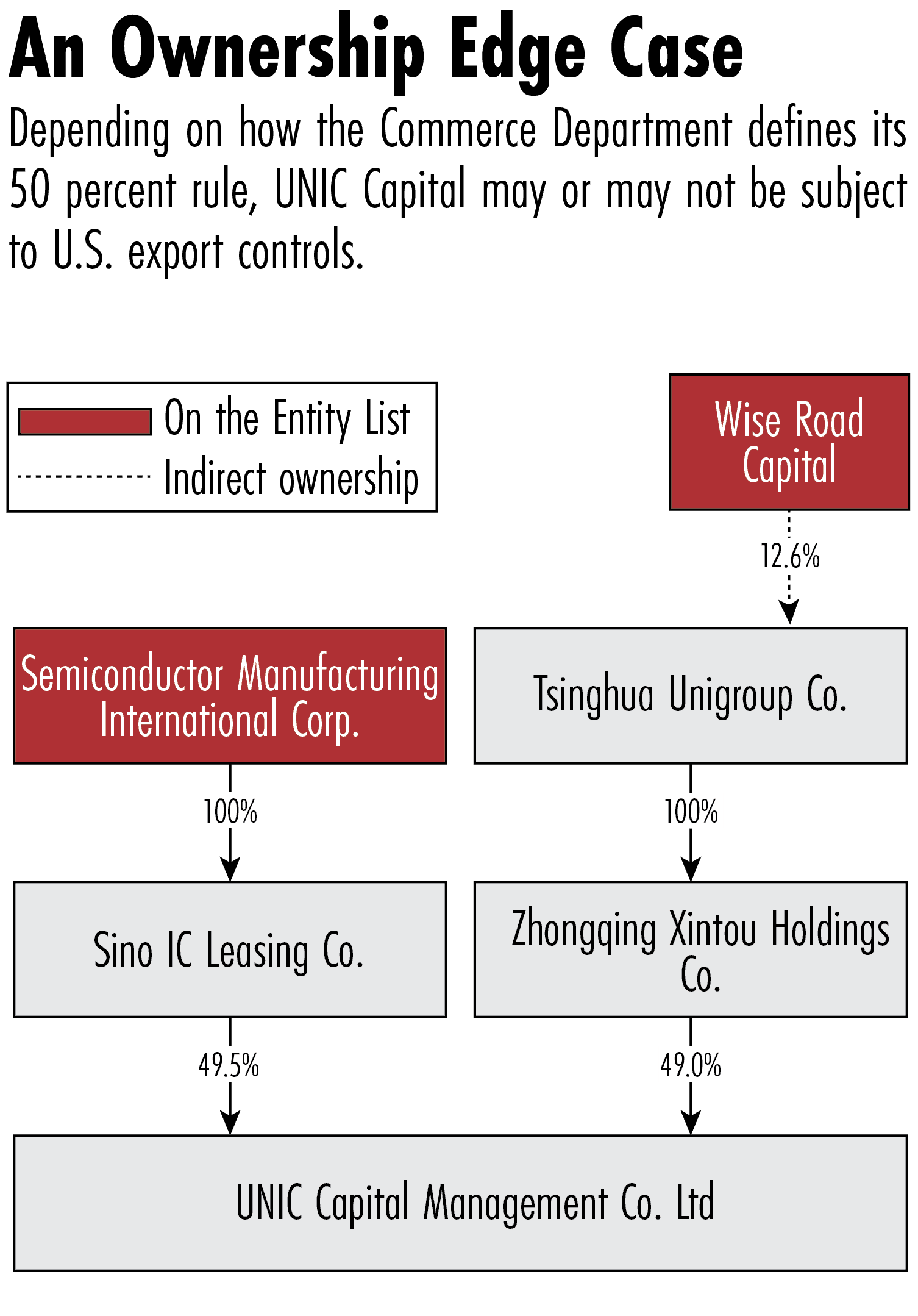
UNIC Capital is an example of the complexity of defining ‘50 percent’. The investment firm plays a key role in financing China’s indigenous chipmaking efforts. SMIC has a 49.5 percent stake in the firm — putting UNIC barely below the threshold to be sanctioned under the 50 percent rule.
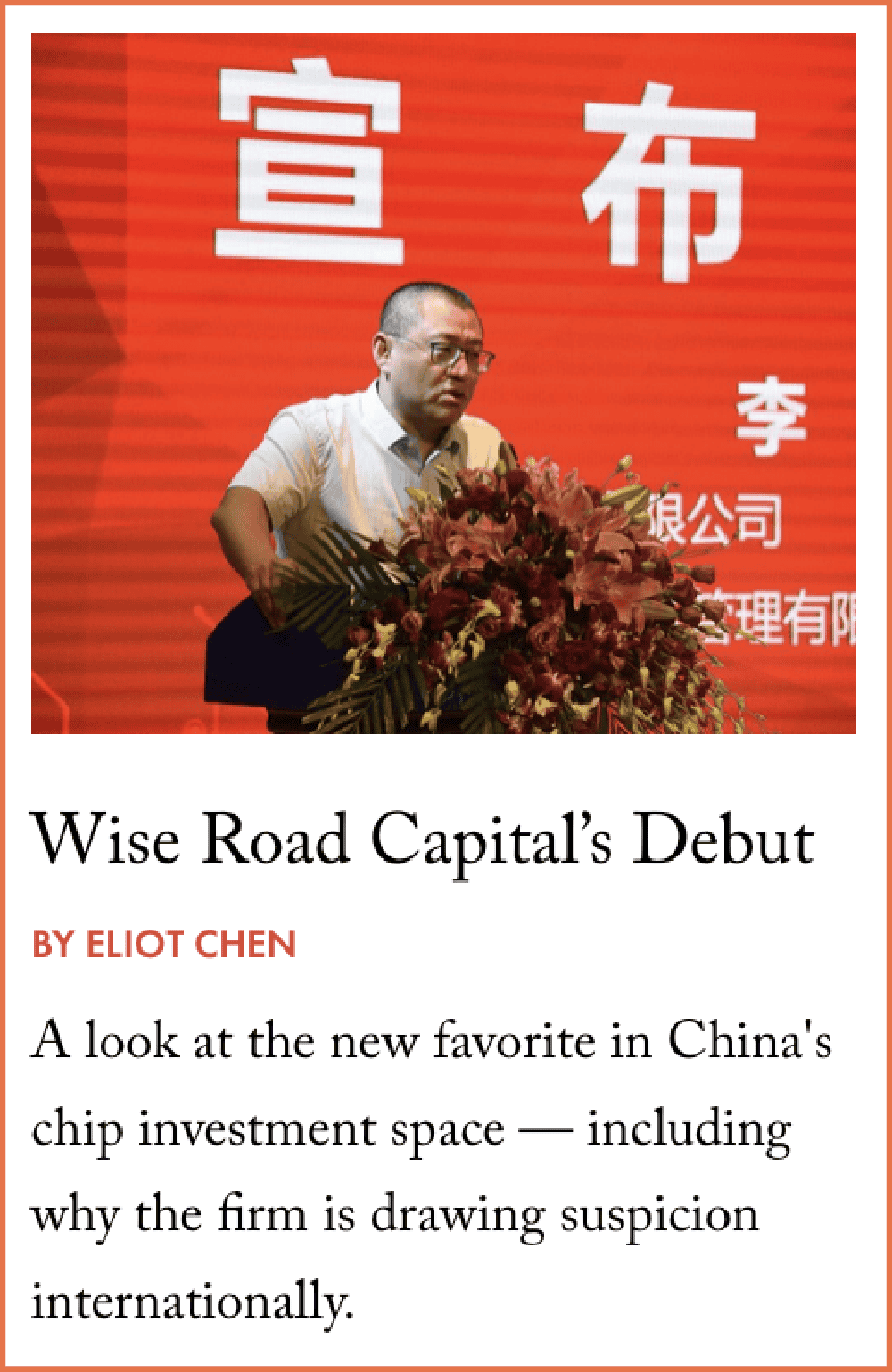
However, UNIC’s other major shareholder is Tsinghua Unigroup, another Chinese chipmaking giant. One of Unigroup’s shareholders is Wise Road Capital, a Chinese investment firm and prolific acquirer of foreign chip companies, which has a 12.6 percent stake.
In December, Commerce added Wise Road to the Entity List. Its indirect stake in UNIC means that UNIC is cumulatively 55.7 percent owned by entity listed companies — putting it above the 50 percent rule’s threshold. Whether UNIC ends up subject to export controls will hinge on how Commerce defines its 50 percent rule.
HUAWEI HUNTING
Few companies have been hounded as tenaciously by Commerce as Huawei. Since 2019, the department has added more than 140 Huawei subsidiaries to its blacklist. Nonetheless, it has struggled to keep up with Huawei’s expansive footprint, which includes over 120 overseas subsidiaries.
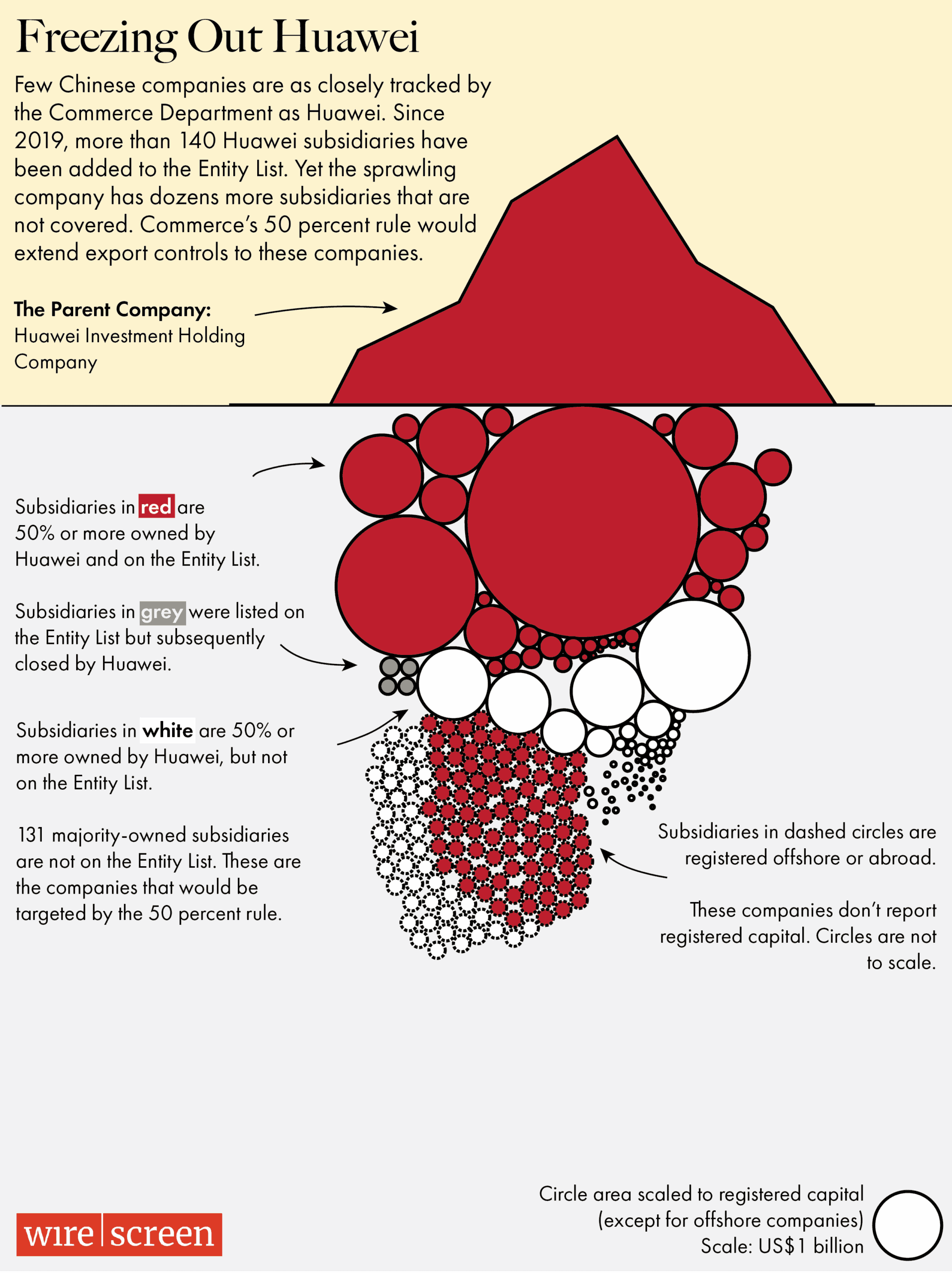
Tracking offshore subsidiaries is critical to Washington’s efforts to crack down on the smuggling of chips and chipmaking equipment to China via third countries. Commerce has added dozens of overseas Huawei affiliates to the list, but many others are unlisted — something the 50 percent rule would aim to address.
But for U.S. companies, the spectre of having to trace Huawei’s complex ownership network not just inside China, but to far flung jurisdictions, creates its own challenge — namely, soaring compliance costs.
“The Trump administration seems to be shifting the burden of responsibility,” says Thea Kendler, a partner at Mayer Brown who served as assistant secretary for export administration at BIS during the Biden administration. “Instead of the government approving or denying licenses, a lot of burden is being placed on industry to figure it out themselves… The government is expecting a great deal of KYC [know your client] and due diligence by industry that I don’t think they’re positioned for right now.”

Eliot Chen is a former staff writer at The Wire. Previously, he was a researcher at the Center for Strategic and International Studies’ Human Rights Initiative and MacroPolo. @eliotcxchen