Julian Gewirtz was a senior policymaker in the Biden administration, serving as senior director for China and Taiwan Affairs at the National Security Council, the senior advisor to the principal deputy national security advisor, and deputy China coordinator at the State Department. He’s also an Oxford-trained historian who wrote two books about the Deng Xiaoping era before entering government. In his spare time, he writes poetry and has published a book of poems. We spoke recently in New York. Below is a condensed transcript of our conversation.

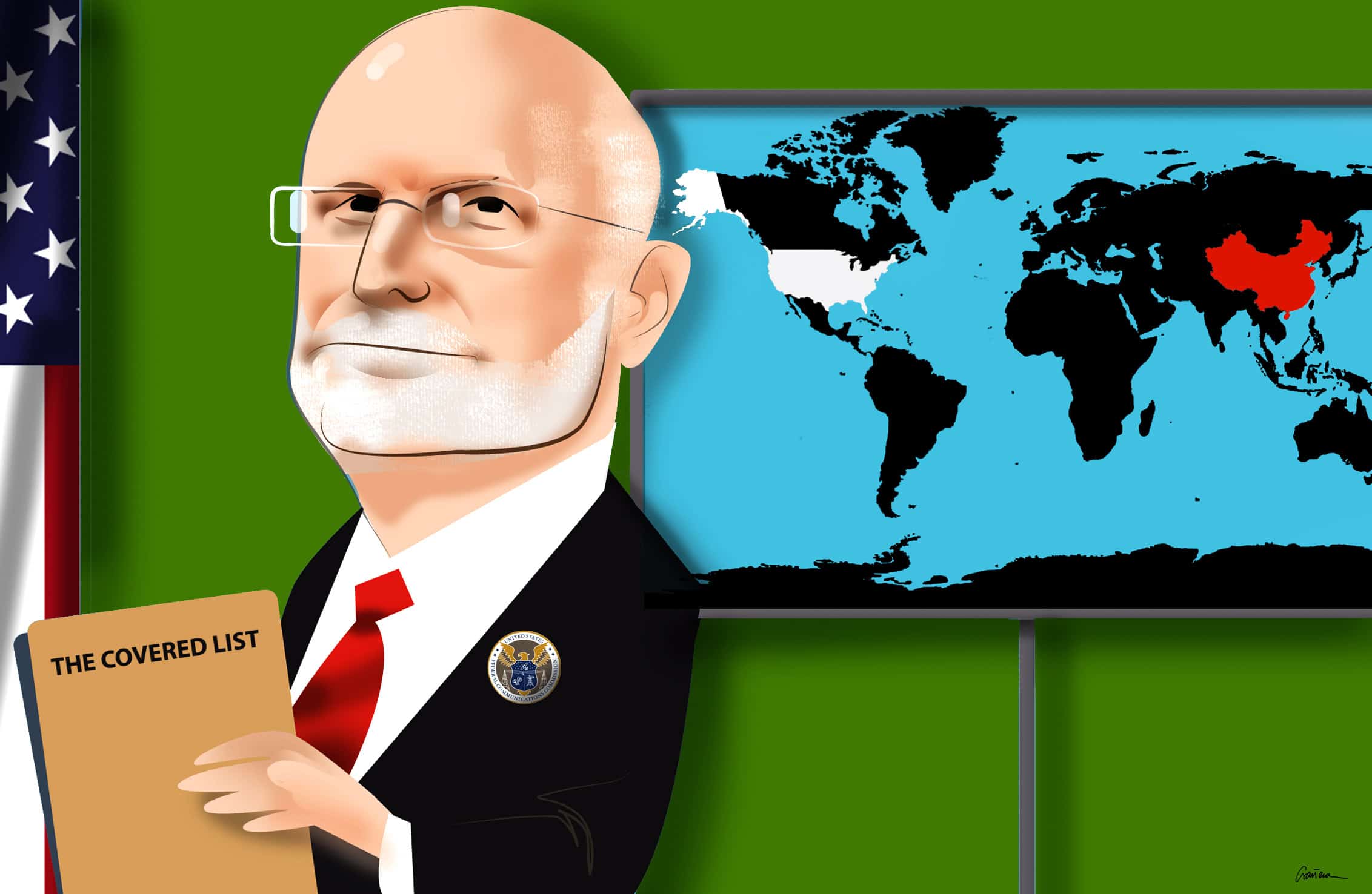
Illustration by Lauren Crow
One focus of yours during the Biden administration was its China strategy, which is often abbreviated to invest, align, compete. Do you still think that was the right formulation? Would you have done anything differently knowing the way that things would change under Trump?
‘Invest, align, compete’ is a pithy way of framing what was quite a broad bipartisan consensus around how to approach the China challenge. The Biden administration concluded that the United States was in a protracted international competition with China that touched on almost every domain of national power: economic, military, technological, diplomatic, values, etc. And for the United States to maintain an enduring competitive edge, we went about doing a few things with concerted purpose.
First, making major investments domestically in the United States, including a particular focus on key technologies — such as the CHIPS and Science Act and the Inflation Reduction Act.
Second, strengthening our global network of alliances and partnerships, for mutual benefit and in each of our respective national interests. In a prolonged competition, that network is a significant strength that China cannot match.
| BIO AT A GLANCE | |
|---|---|
| AGE | 35 |
| BIRTHPLACE | New Haven, Connecticut |
| FORMER POSITION | Former senior China policy official at the White House and State Department |
And third, harnessing those strengths to take major steps to advance American interests vis-à-vis China. That meant, to name a few, taking important actions to strengthen deterrence in the Indo-Pacific; in the technology domain, introducing a range of novel and quite significant policies; and in the economic domain, responding to China’s massive industrial overcapacity. These are goals shared by other countries around the world.
This was an effective strategy that showed results over those four years.

Beijing saw that the United States was meaningfully strengthening some of our core sources of national power at home. It was very concerned that the United States was building coalitions, strengthening its relationships, and addressing specific challenges from China. It’s important to point out that a lot of our relationship-building was actually because of actions of China’s that pushed other countries to feel increasingly uncomfortable with their relationships with China and then to come up with their own national strategies, which sometimes involved closer partnership with the United States as a way of dealing with that pressure from China.
The ”invest, align, compete” formulation doesn’t explicitly include another important part of how the Biden administration approached our China strategy, which was to manage competition through diplomacy with Beijing. The goal there was to do what we could to ensure that — given the dynamics of intense U.S.-China competition that we were all experiencing and that were visible to the public every day — that competition didn’t veer into a conflict that neither side wanted. We could deliver direct, tough messages, and describe quite clearly to Chinese counterparts what our policies were and were not aiming toward, and even in an environment of very low trust, take on some of China’s misperceptions and inject information into their system that might not come through any other channel.

The approach of the second Trump administration so far has retained elements of that work but not with the coherence or resolve that is needed for an effective China strategy. Rather than defunding science and technology research, it should be outpacing China in investing in this area that Xi Jinping calls “the main battlefield of international competition.” Rather than alienating and extorting U.S. allies and partners, it should be coordinating with them on China policy. I don’t think that they have yet developed a clear theory of the case or overall China policy, and the administration’s messaging and messengers on China have been highly variable.
The Wall Street Journal reported that Chinese Foreign Minister Wang Yi recently tried and failed to establish a line of communication with then National Security Advisor Mike Waltz. Wang had that line with your former boss, Jake Sullivan. How important was that?

That channel was very important and quite distinctive. In the long history of U.S.-China relations, it has been rare to have a channel that functions for discussions at both the strategic and tactical levels, even when our disagreements are profound. We thought carefully about when and how messages should go through that channel and when and how they should go through the other Cabinet-level channels or lower-level channels. It showed how vital it is for senior officials in the United States and China, including but not limited to the leader level, to have channels of communication with clear purpose to discuss our policies, build some stability into the relationship, and to convey our resolve and make clear certain things that we will not brook, that we will not accept, where there will be consequences. It’s one thing to do that publicly from a podium. It’s another thing for an empowered and authoritative U.S. official to do it face-to-face with a Chinese official.
Does China view communication and other aspects of cooperation as potential forms of leverage?
| MISCELLANEA | |
|---|---|
| FAVORITE FILM | I really loved 1917 |
| CURRENT READ | Sunil Amrith’s The Burning Earth |
| FAVORITE MUSIC | Fleetwood Mac |
| MOST ADMIRED | Maybe… Marie Curie. This month, Harvey Milk also comes to mind. |
In a prior era of U.S.-China relations, there was a certain view of cooperation or dialogue on the U.S. side that hoped to hive off the more contentious areas of the relationship. I always think back to the toast that then National Security Advisor Brent Scowcroft gave in his very controversial late 1989 trip to Beijing, in the period right after Tiananmen, where he said, “We seek to outline broad areas where agreement is possible, and to isolate for another time those areas of disagreement.” I don’t think that view has had much purchase for the bulk of the past decade, and that’s because U.S. policymakers of both parties are acutely aware that Beijing relentlessly seeks to find leverage — often, where none exists.
Beijing’s belief that because the United States has a particular view of how competition should go, or sees crisis communications channels as in both of our interests, is actually a misperception on Beijing’s side. They have been confronted with the fact that sometimes things they believe are [sources of] leverage with the United States — maybe because they were decades earlier, or maybe just because of Beijing’s own misperceptions — are not actually.
That doesn’t mean the United States and China won’t work together in some areas when it is clearly in both of their interests to do so. We both have an interest in averting the worst impacts of climate change and AI risks, for example. Our view in the Biden administration was that we should be open to those areas, given their importance to humanity, but also realistic about what is likely to be accomplished bilaterally.
One area in which China has responded to the current trade war is by pitching itself as a potential partner to Europe or to U.S. allies in Asia. How likely is it that what the Trump administration is doing on trade will bring the rest of the world together without the U.S., rather than bring the U.S. and allies closer together and leave China out?
There have been reports that some Trump administration officials believe their policies are going to rally the world to push back on Chinese economic practices. But I don’t yet see much evidence in practice. If they were trying to achieve that goal, would they plausibly be going about it the way that they have, which is placing tariffs on the whole world all at once, then pursuing a trade deal with China while negotiating inconsistent bilateral deals with partners, rather than designing a coordinated approach or collective economic measures on China?
The core tension around a lot of this, which China sometimes caricatures as a desire to “keep them down,” is really a profound concern about the speed, scale and intentions of China’s pursuit of national power in a few key domains; and how it will, and has already, harmed the interests of other countries.
It’s obviously still a highly changeable situation, but they also have, outside of the economic domain, put tremendous doubt and anxiety into the minds of many European and even Asian allies about U.S. commitments. They have questioned, for instance, U.S. commitments to NATO. And so the likelihood is very high that the policies that the Trump administration has pursued to date have the effect of causing intensified hedging and distance from the United States among U.S. allies over time, rather than building a durable coalition to compete with China.

Beijing knows it can benefit from this and is trying to exploit this opportunity, but I also don’t think it’s necessarily the case that Beijing will be successful to the extent that some have suggested. Beijing is taking some steps toward that end. Xi Jinping went to Southeast Asia. They are preparing for an EU-China summit in July, and have made some modest concessions already and are dangling others to our European partners. We should continue to watch this very closely, but I also do not see, at least yet, Beijing taking the full range of steps that could cause a massive shift in its direction.
So the likelier trend is of increased multipolarity, fragmentation, and smaller multinational groupings of countries filling spaces left by weakened international institutions and [the] fractured international order. This is a world of self-interested superpowers looking to shake down countries around the world, and each other, for whatever they can get. I have an essay in Foreign Affairs where I talk about this “mercenary multipolarity.” It will be deeply concerning if China is able to leverage this dynamic to significant diplomatic gain, and this is an opportunity that this administration is affording China.
What could China do to improve its relations with U.S. allies? How would that look in practice?
Thankfully my job is not to advise the Chinese government. It’s a question better asked directly to U.S. allies, and based on my conversations with those governments, I think they would answer in a few ways. They’d say Beijing could stop behaving coercively toward them. They’d say Beijing could stop its most troubling economic practices and take steps to balance their economic and trade relationships, rather than the massive industrial overcapacity that is threatening many of their economies and ours; and it could stop certain of its actions in the security domain that put pressure on others’ sovereignty or flout international rules and norms. And some, particularly in Europe, would say that Beijing could also stop supporting Russia as it wages war on Ukraine.

There has been, at certain moments, a softening of Beijing’s tone diplomatically. There was a lot of attention given to the idea that Beijing had dropped the so-called Wolf Warrior style. But I don’t think anyone who’s been in the room conducting diplomacy with China in recent years would say that the shift away from Wolf Warrior diplomacy has been total. It’s been partial, at most.
As you note, China is not indicating that it’s going to back off pushing on other countries’ territorial sovereignty. It’s not indicating that it’s going to stop its massive export machine. Does that suggest that the Trump administration has some room to continue with the approach that it’s taking?
Beijing’s assessment right now is that the United States is dismantling, fairly systematically, the sources of its strength. The United States, in their view, is dismantling its alliance relationships and alienating much of the world. It is dismantling aspects of the U.S. science and technology ecosystem, cutting funding to some of our great universities, and making it very unappealing, if not outright impossible, for foreign talent to come do research in those universities. And it is eliminating arms of U.S. influence around the world, from USAID to Voice of America. China’s view is that the United States is, in a sense, unilaterally disarming in a number of these key areas.

At the same time, by threatening to seize Canada and Greenland and openly rejecting many aspects of the international order, the Trump administration is undermining the U.S. ability to push back on Beijing’s violations of international rules and norms.
From Beijing’s perspective, this is a moment when they believe they can let that self-sabotage play out. They will be opportunistic in ways that are deeply concerning, but rather than needing to launch a new systematic global bid for leadership, they feel that position is currently, in a way, being handed to them. So, to your question, we should take no comfort from China’s way of approaching this moment.
Do you think the U.S. has now figured out where it wants its relationship with China to head 10 or 20, years from now?
In the Biden administration, our view was that rather than one fixed “end state,” the long-term trajectory of U.S.-China relations should be toward securing a “steady state” favorable to U.S. interests. It is not clear to me how the current administration would answer that question. There are, at least within the senior echelons of the administration, a number of different views, ranging from folks who believe that China is extremely weak because of economic issues, to folks who see China as a formidable challenger that we need to really marshal all our national power to push back on.

Has China now figured out what kind of state it wants to be?
Xi Jinping has a fairly clear sense of what he would like China to be. He’s described this repeatedly, under the heading of the “Great Rejuvenation of the Chinese Nation.” That is to say, a leading global power ruled by the Chinese Communist Party, with a developed economy, a dominant position in global manufacturing, dominance in advanced technology, a first tier military and the ability to exert its will and to have a sphere of influence in Asia, and then also to look after its growing interests around the world. His views are shaped by Party history and ideology, including Marxism-Leninism and his belief that China is a civilization-state that deserves certain prerogatives.
Some of these goals obviously are not going to be acceptable to other countries, but that is what the Chinese Communist Party sees itself as generally working toward. Of course it’s an open question whether China will achieve all of these goals. They are certainly making a concerted effort, which has already had a profoundly unsettling effect on many, many countries around the world.

The core tension around a lot of this, which China sometimes caricatures as a desire to “keep them down,” is really a profound concern about the speed, scale and intentions of China’s pursuit of national power in a few key domains; and how it will, and has already, harmed the interests of other countries.
You’ve written that the seeds for many of the initiatives that you just described were sown during the 1980s. What do you think knowing where these ideas emerged from tells us about where they could evolve to?
The 1980s were profoundly different from the current moment in China, as I describe in Never Turn Back. They were a time of ferment and openness and debate about the direction that China might take. Instead of the monolithic “China model” that we know today — of authoritarian political rule paired with this rapid growth-oriented economic system — there were many different so-called “China models” that were being debated and considered.

But it wasn’t all so different from now. The period right after the Tiananmen crackdown of 1989 was a time that was formative for Xi Jinping, his vision of China and for the Chinese Communist Party as a whole. It was a time of a siege mentality in the face of global opprobrium. It was a time of economic retrenchment in favor of greater state control. It was a time when the idea of political reforms separating the party and the government, which had been considered earlier in the 1980s, was rejected outright, and party supremacy was stressed. And of course, it was the time when the Soviet Union collapsed and sent shockwaves through the socialist world. Those events following so soon after Tiananmen really entrenched a view in the Chinese Communist Party that China was going to be the lone major socialist survivor in a capitalist world. And they assumed the world would be deeply uncomfortable with an increasingly powerful China ruled by the Chinese Communist Party, which determined that it was the only entity that could take China forward and was willing to do so through sometimes very brutal means. And that moment is the foundation of essential aspects of Xi Jinping’s worldview.
Another interesting part of the 1980s story is the way that it has been rewritten. What are the consequences of erasing narratives the party doesn’t like?
In writing Never Turn Back, I made use of a quotation from 1984 by George Orwell, which goes, “Who controls the past controls the future. Who controls the present controls the past.” The control over narratives about the past, about how things became the way they are today, is deeply connected to control over a narrative about, and the ability to attain, how things ought to be in the future.

Xi Jinping’s version of Orwell’s point reflects a bit more of a siege mentality: “Destroying a country begins with going after its history.” In other words, those who seek to undermine the political power of an authoritarian leader or party will do so by complicating or criticizing or undermining its historical narratives. That’s why the Chinese Communist Party has developed this whole category of political crime called “historical nihilism,” which is any effort to belittle or undermine, in its view, the CCP’s history.
Xi Jinping is an absolutist in multiple senses of the word, and his view is very much that if you start to let those alternative ideas develop, they can expand rapidly into very concerning directions. Mao Zedong’s line, “a single spark can light of prairie fire,” is central to the entire framework for how the CCP governs society. When I first started traveling to China in the mid-2000s, I met people, whether journalists or lawyers, who ended up on the wrong side of the system as it changed over time. People who appeared to represent the best of China were denied the opportunity to continue doing what they wanted to do. Some ended up in jail. That had a profound impact in showing me firsthand how the CCP today handles debate and dissent.
Julian Gewirtz reads his poem Spend during an event presented by ChinaFile and the CCA, March 11, 2025.
You’re also a poet, and your work on China has also infused your poetry. As far as I can tell, you might be the only American poet to have written about Xu Lizhi, the former Foxconn worker who died by suicide. Has your poetry informed your work in government?
Poetry is something that I have always done. It’s something that I will always do, and is a part of who I am, but the part of my brain I used in writing Your Face My Flag is different from what I use when I study China or work on U.S. foreign policy. One of the things that has inspired me is a long tradition of people, both in the United States and many other countries, who have multiple pursuits but also want to serve their countries and contribute to making a positive difference in the world that way. I think we’re at our best as humans when we foster our creativity and explore different domains. I’ve been committed to that idea throughout my life and will do my best to maintain that commitment in the future.

Noah Berman is a staff writer for The Wire based in New York. He previously wrote about economics and technology at the Council on Foreign Relations. His work has appeared in the Boston Globe and PBS News. He graduated from Georgetown University.