Cape Girardeau, a town of 40,000 in southeastern Missouri, is normally far from the center of the competition between the United States and China. But last Friday, it joined the frontlines.
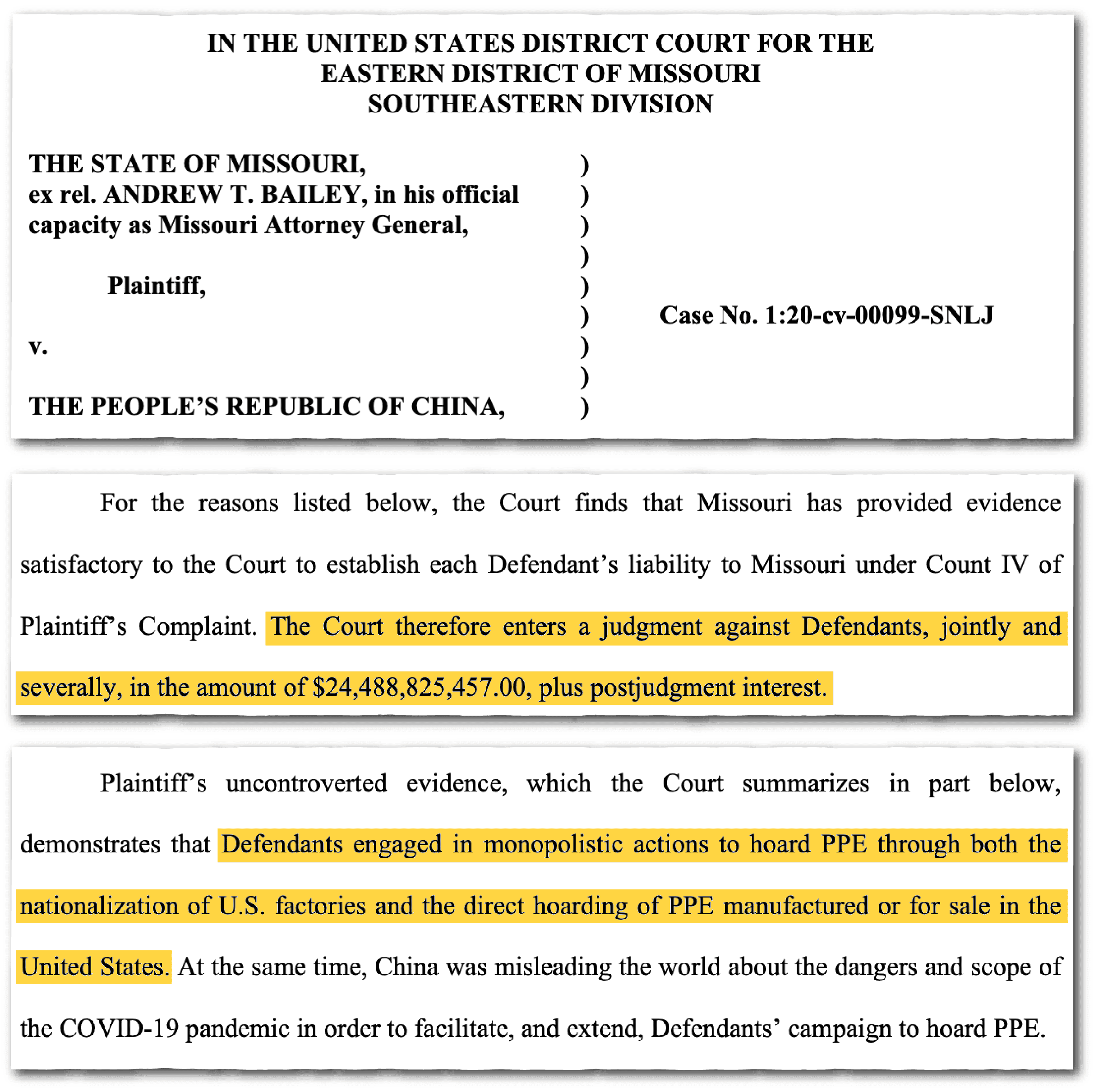
On March 7, a federal judge in the Mississippi River town ruled in favor of Missouri in a lawsuit against the Chinese government. For hoarding personal protective equipment during the Covid pandemic, China owed the state some $24.5 billion, plus interest, Judge Stephen N. Limbaugh ruled.
China “engaged in monopolistic actions to hoard PPE through both the nationalization of U.S. factories and the direct hoarding of PPE manufactured or for sale in the United States,” wrote Limbaugh, a cousin of famed conservative commentator Rush Limbaugh, in his judgement. As a result, Missouri “suffered significant harm in the form of lost net general tax revenue.”
None of the nine co-defendants in the suit, including China’s central and local governments, as well as the Wuhan Institute of Virology and the Chinese Academy of Sciences, showed up in court.
The federal nature of the ruling means Missouri could attempt enforcement by seizing Chinese assets throughout the United States. And with politicians across the country, particularly in Republican-led states, keen to enact some kind of retribution on China for its perceived wrongdoing during the pandemic, others could soon file copycat suits, experts say.
In practice, it could prove tricky for states to collect on any favorable judgments — Beijing is unlikely to start funneling billions of dollars to American states, after all. Some legal analysts argue that cases such as the one in Cape Girardeau therefore amount to little more than political stunts.
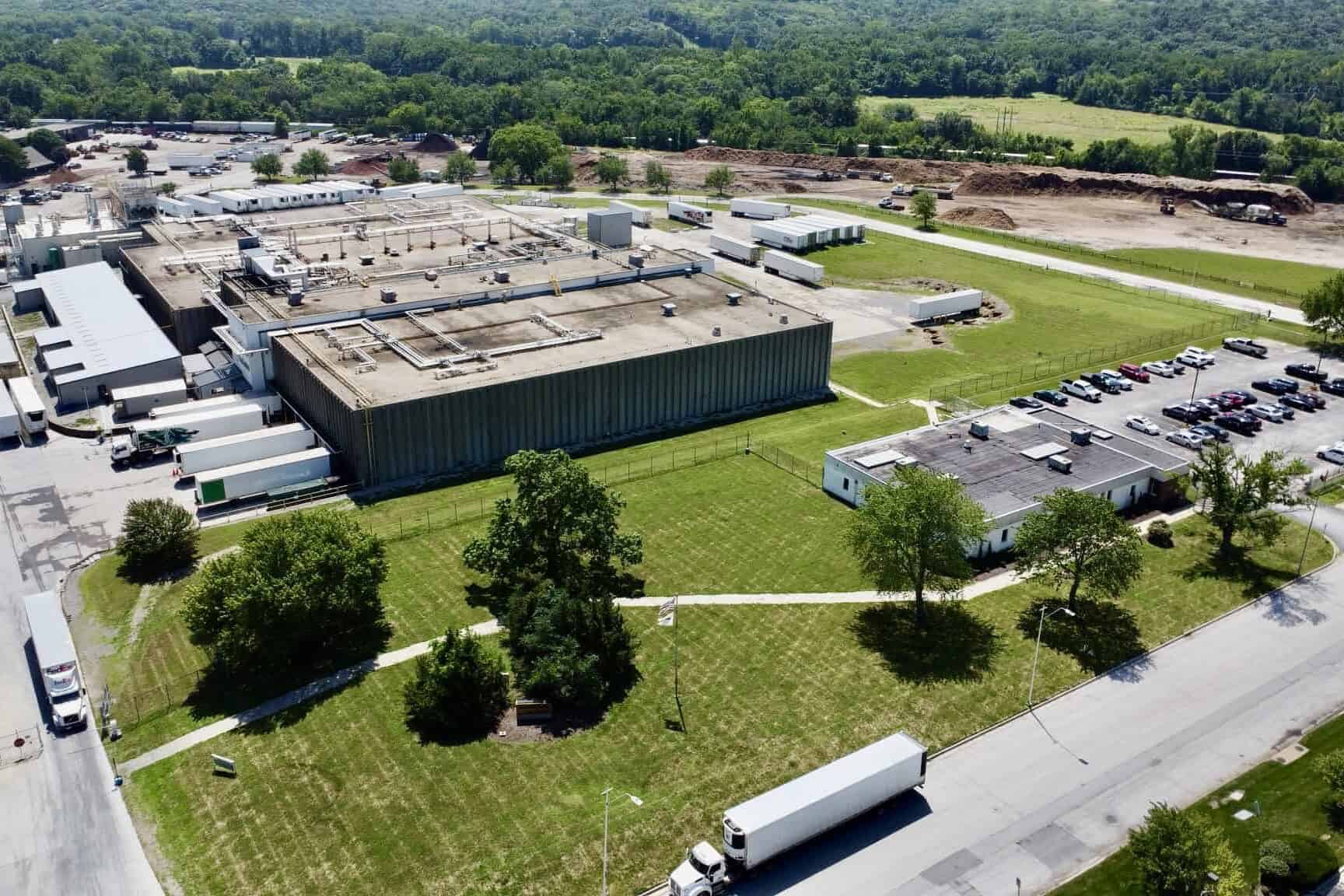
Even so, Missouri’s attempts to bring home the bacon could yet bring it into conflict with Smithfield Foods, a Nasdaq-listed pork producer whose majority shareholder is a Chinese company. Smithfield owns 32,500 acres of agricultural land in Missouri, making it the state’s second-largest foreign-owned landholder, and the most obvious target for lawmakers looking to seize “Chinese” land.
“There’s a great harassment value for Missouri here, because they can go around to courts all over the country, and file actions to try to execute on Chinese-owned property,” says William Dodge, a professor at George Washington University Law School and the author of a book on transnational litigation.
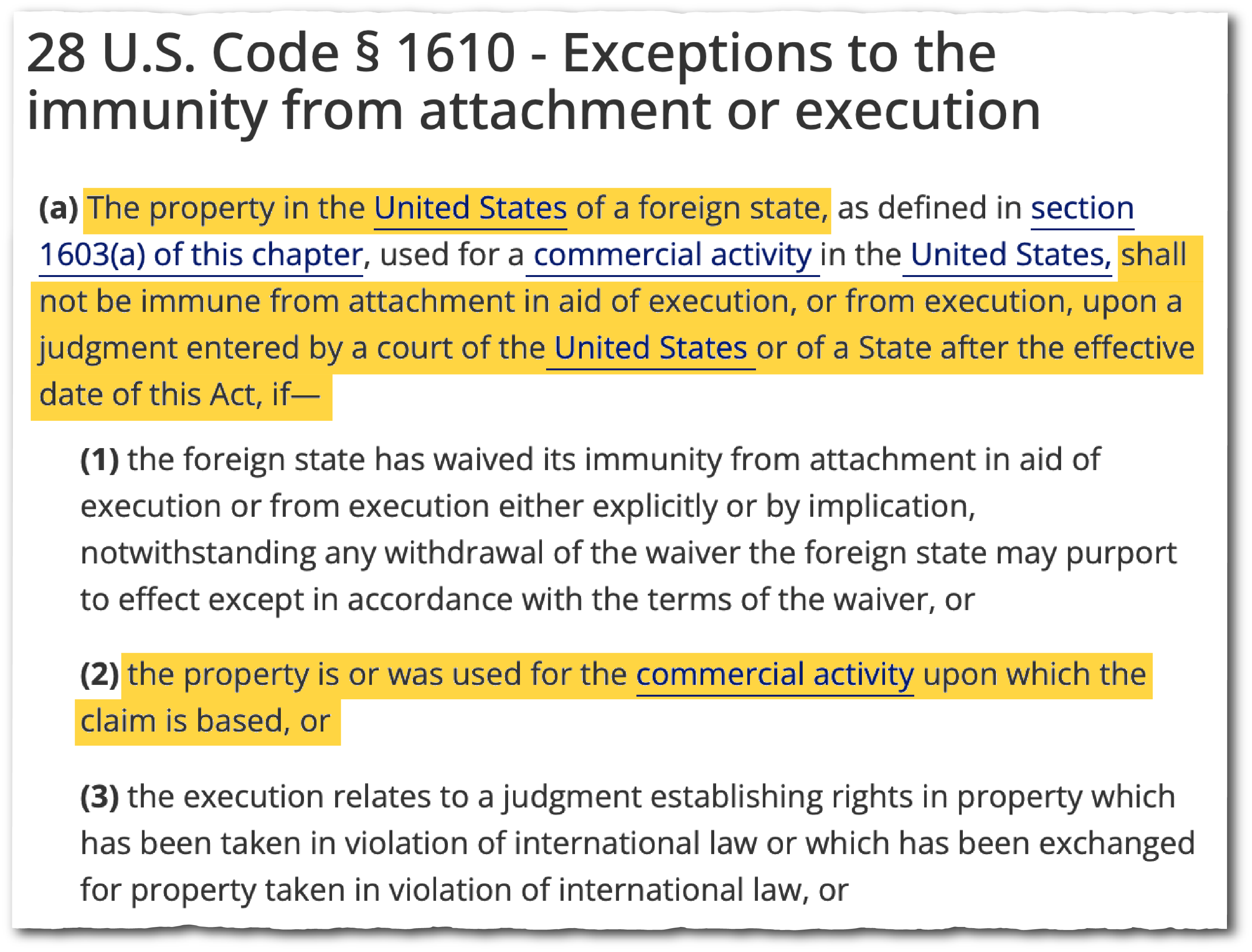
Foreign countries are usually immune from lawsuits in the U.S. under the Foreign Sovereign Immunities Act (FSIA), which Congress passed in 1976. But the law contains a carve-out for countries’ commercial activities that cause direct effects in the United States, the exception under which Missouri successfully sued China.
Still, Missouri faces two clear difficulties in collecting the billions it is owed on paper. The first is that it can’t seize the property of any company or government entity that is not named in the suit.
The second is that the statutory authority that allows it to enforce collection, a section of the FSIA, requires that the assets seized from a foreign government were used for the same commercial activity on which the suit was based. Missouri would thus have to prove that any Chinese government assets it seizes were used to hoard PPE.1The same restriction does not apply to a country’s “agencies or instrumentalities,” like the Chinese Academy of Sciences. But it’s not clear whether CAS or any of the other institutions named in this suit has any assets in the U.S. to seize.
“Just because you can bring the suit without encountering immunity doesn’t mean you can execute the judgment without encountering immunity,” says Michael Ramsey, an expert on the litigation of transnational claims at the University of San Diego School of Law.
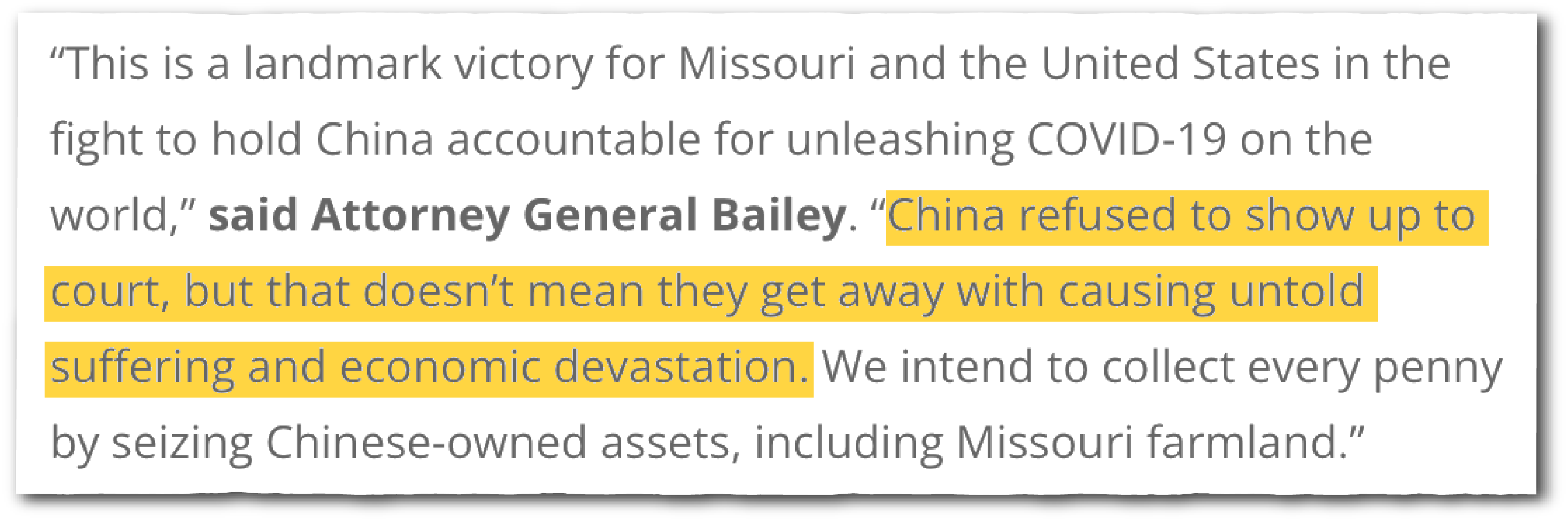
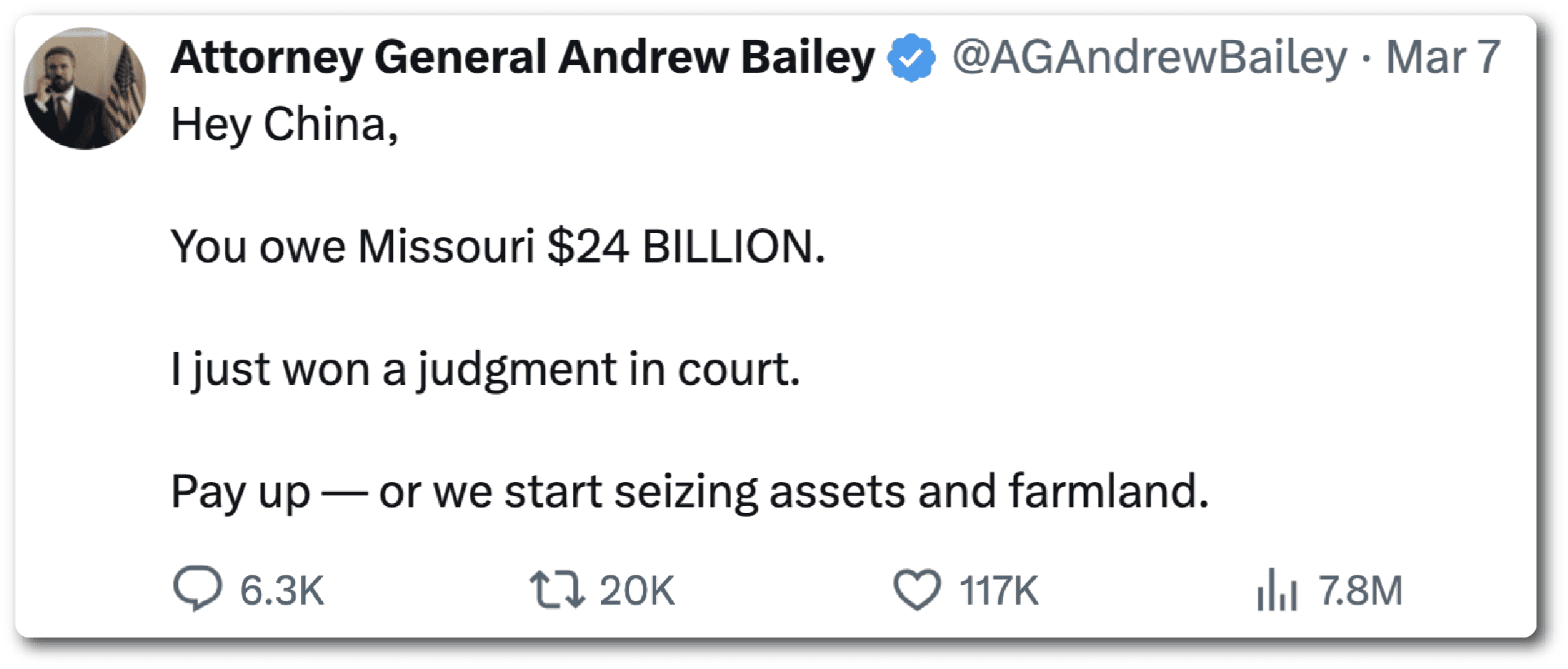
These issues haven’t deterred Missouri officials. “We intend to collect every penny by seizing Chinese-owned assets, including Missouri farmland,” the state’s Attorney General Andrew Bailey said in a statement last Friday.
Asked how Missouri would achieve this goal while complying with the FSIA, a spokesperson for the Attorney General’s office said “We look forward to collaborating with the Court, the Trump Administration, and state partners to identify assets, such as Chinese-owned farmland, for seizure if the PRC keeps its head in the sand and does not pay up.”
…it would be counterproductive for international relations if private citizens in the United States were suing sovereign nations, forcing them to avail themselves of our sovereign jurisdiction, and then potentially collecting on a civil judgment.
Michael Parker, a national security lawyer at law firm Arktouros
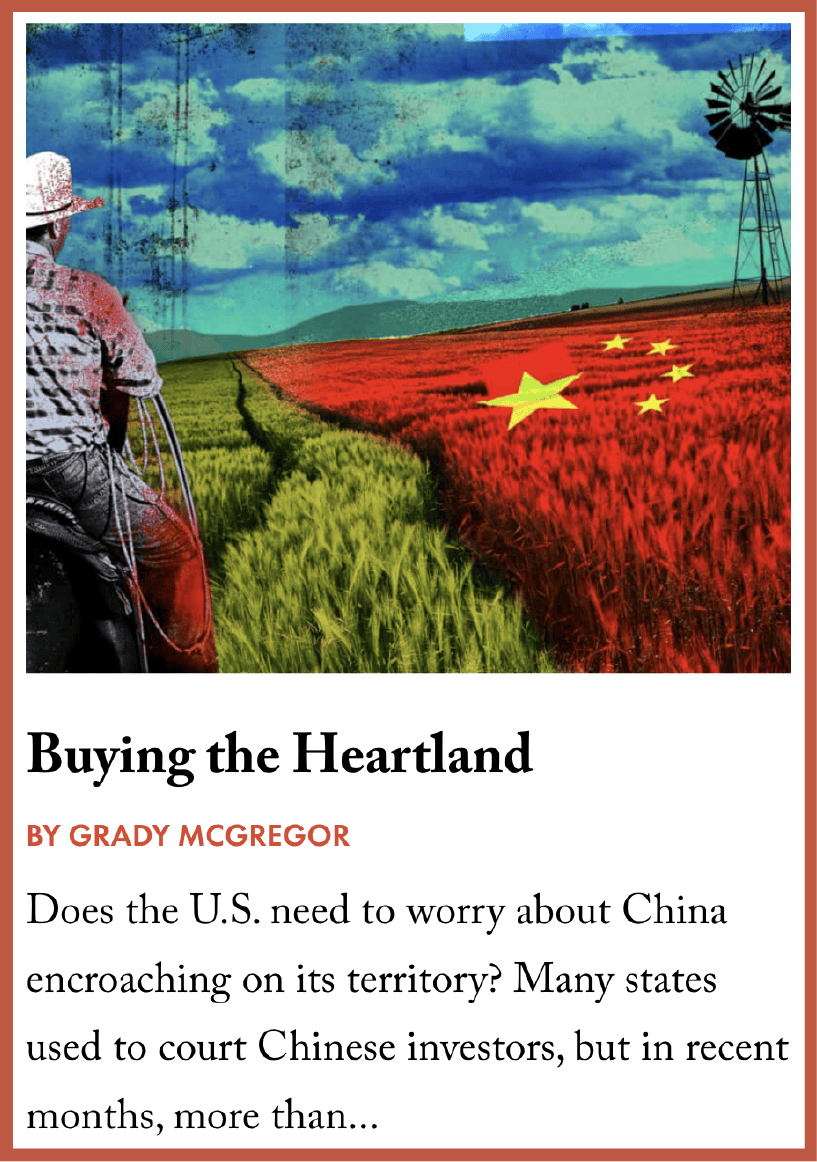
The judgement comes as calls grow across Capitol Hill to restrict Chinese ownership of U.S. agricultural property. Soon after taking office, U.S. Secretary of Agriculture Brooke Rollins said “Chinese purchase of our farmland” was at the “very, very top” of her list of priorities.
China Not In Top Ten Largest Foreign Landholders
| Country of foreign ownership | Agricultural landholdings (million acres) | Value (billion $) |
|---|---|---|
| Canada | 15.4 | $16.35 |
| Netherlands | 5.2 | $7.60 |
| Italy | 2.7 | $5.50 |
| United Kingdom | 2.6 | $5 |
| Germany | 2.5 | $7.50 |
| Denmark | 2 | $2.50 |
| Portugal | 1.2 | $2.90 |
| France | 1.4 | $3.10 |
| Switzerland | 1.1 | $1.90 |
| Luxembourg | 0.9 | $1.70 |
Note: Data is as of 2023. Source: U.S. Department of Agriculture
The $24.5 billion award, equal to almost half Missouri’s 2024 budget, gives the state a big runway. The figure comes from a report authored by a University of Missouri economics professor that determined China’s hoarding of PPE had caused the state $8 billion in damages. Because the defendants didn’t appear in court, the judge accepted that number as uncontested — and determined that Missouri could recover triple the amount.
A spokesperson for the Chinese embassy in Washington said China “will never accept” the judgement and that the country “reserves the right to take reciprocal countermeasures under international law to safeguard its legitimate interests.”
In practice, targeting Missouri farmland would mean going after Smithfield Foods, the maker of Nathan’s Famous hot dogs — and the owner, through a subsidiary, of 99 percent of the state’s Chinese-owned farmland, according to a 2023 report by the Missouri Department of Agriculture.
Smithfield, which said it sold about a third of its U.S. farmland last year, declined to comment on the case.
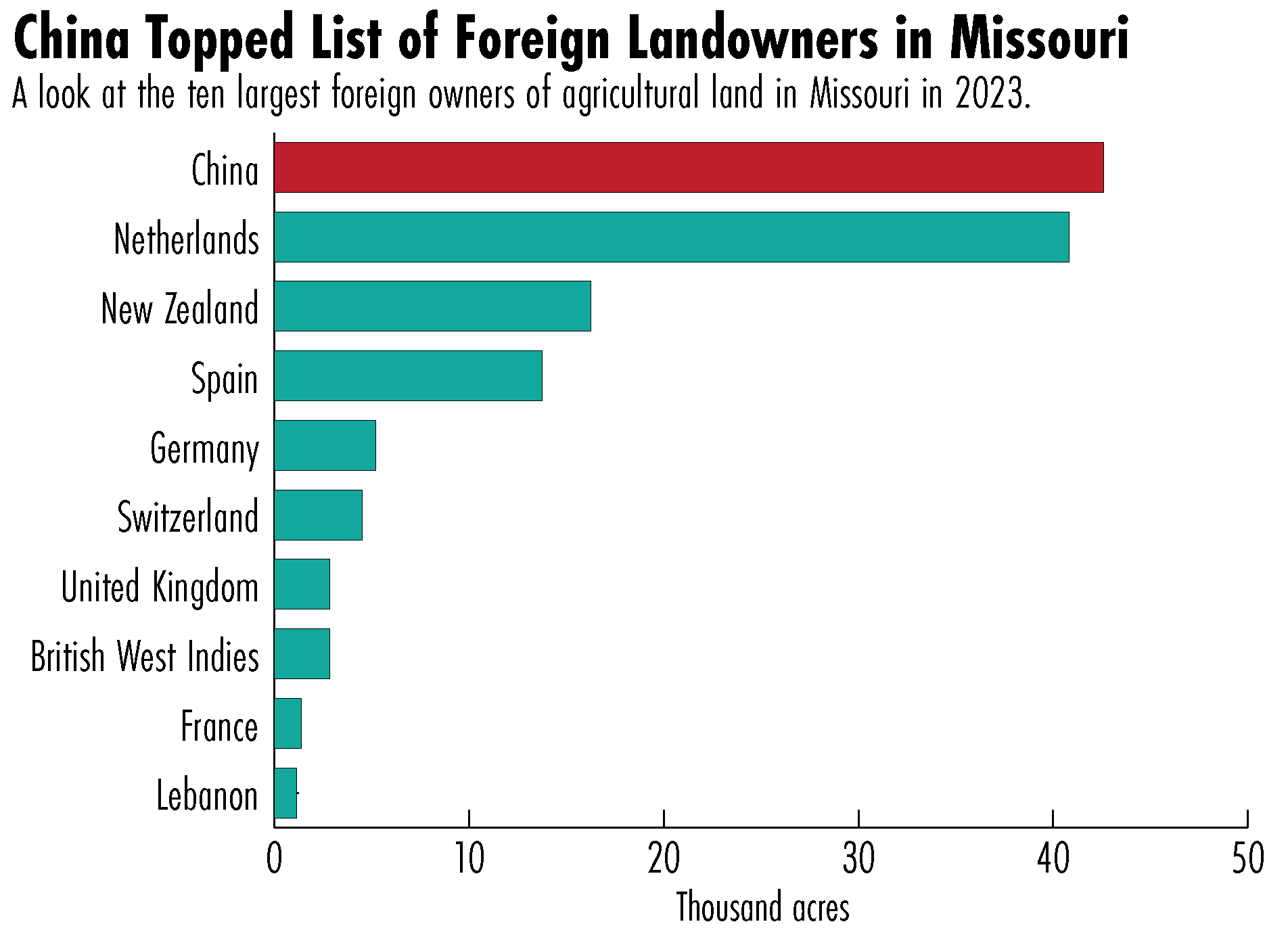
Source: Missouri Department of Agriculture
After clearing U.S. review for national security risks, Chinese company Shuanghui International wholly acquired Smithfield in 2013 for $4.7 billion plus $2 billion in debt — still the largest ever Chinese takeover of a U.S. company. Shuanghui changed its name to WH Group in January 2014 and listed in Hong Kong later that year. The company does not have obvious Chinese state ownership, though its major shareholders include opaque investment managers in the British Virgin Islands, according to its most recent annual report.
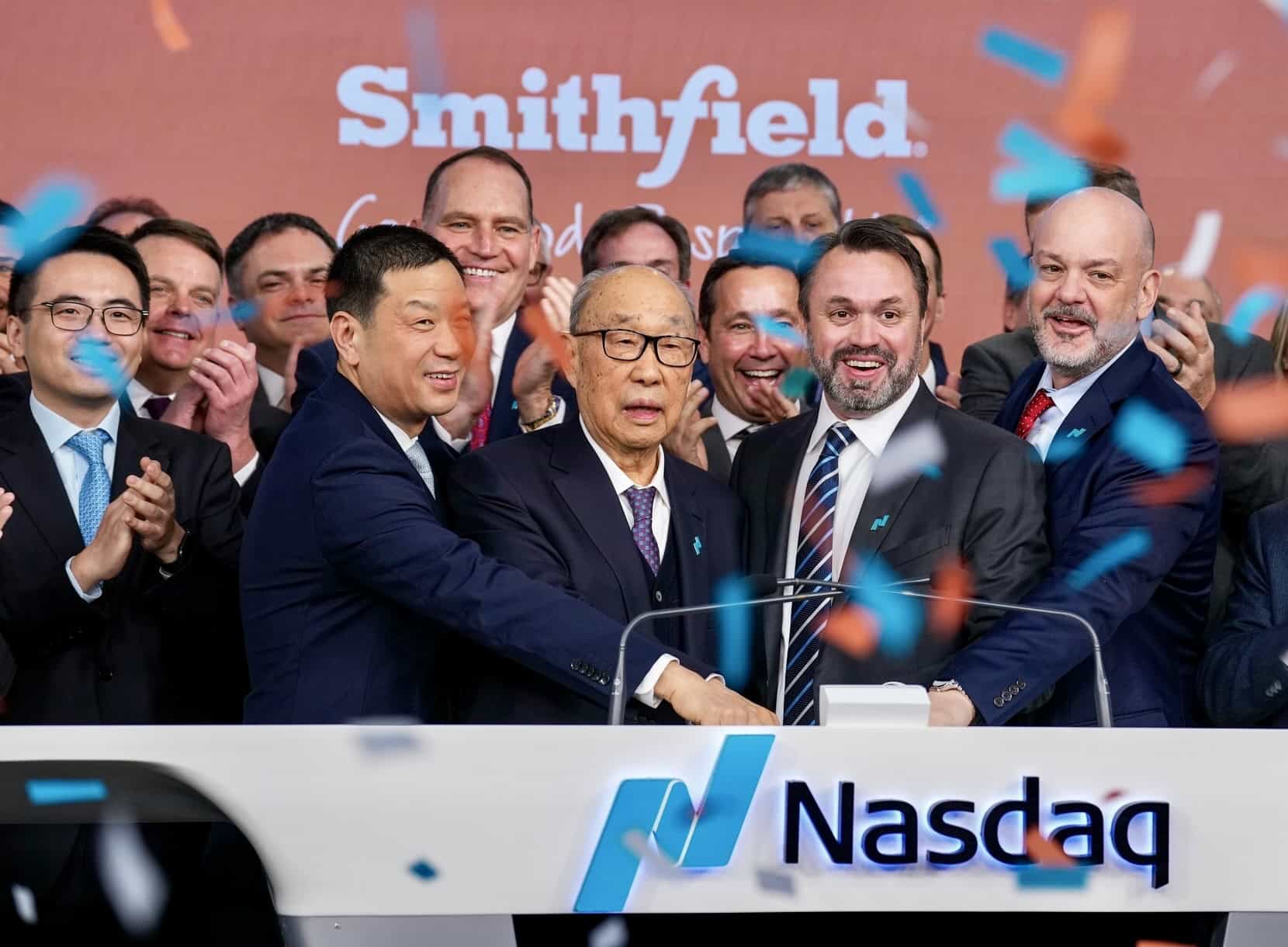
WH Group does, though, have connections to the Chinese Communist Party. Two top executives at the company, Wan Long and Ma Xiangjie, are party members, according to the most recent annual report by Shuanghui Development, a mainland Chinese subsidiary of the company that WireScreen shows is 4.3 percent beneficially owned by state entities. Wan, the WH Group’s chief executive and chairman, and Ma, the company’s executive director, together control interests in more than half of the shares in the firm, its 2023 annual report shows.
WH Group did not respond to requests for comment. A Smithfield spokesperson said “WH Group is not a Chinese state-owned enterprise and does not undertake any commercial activities on behalf of the Chinese government.”
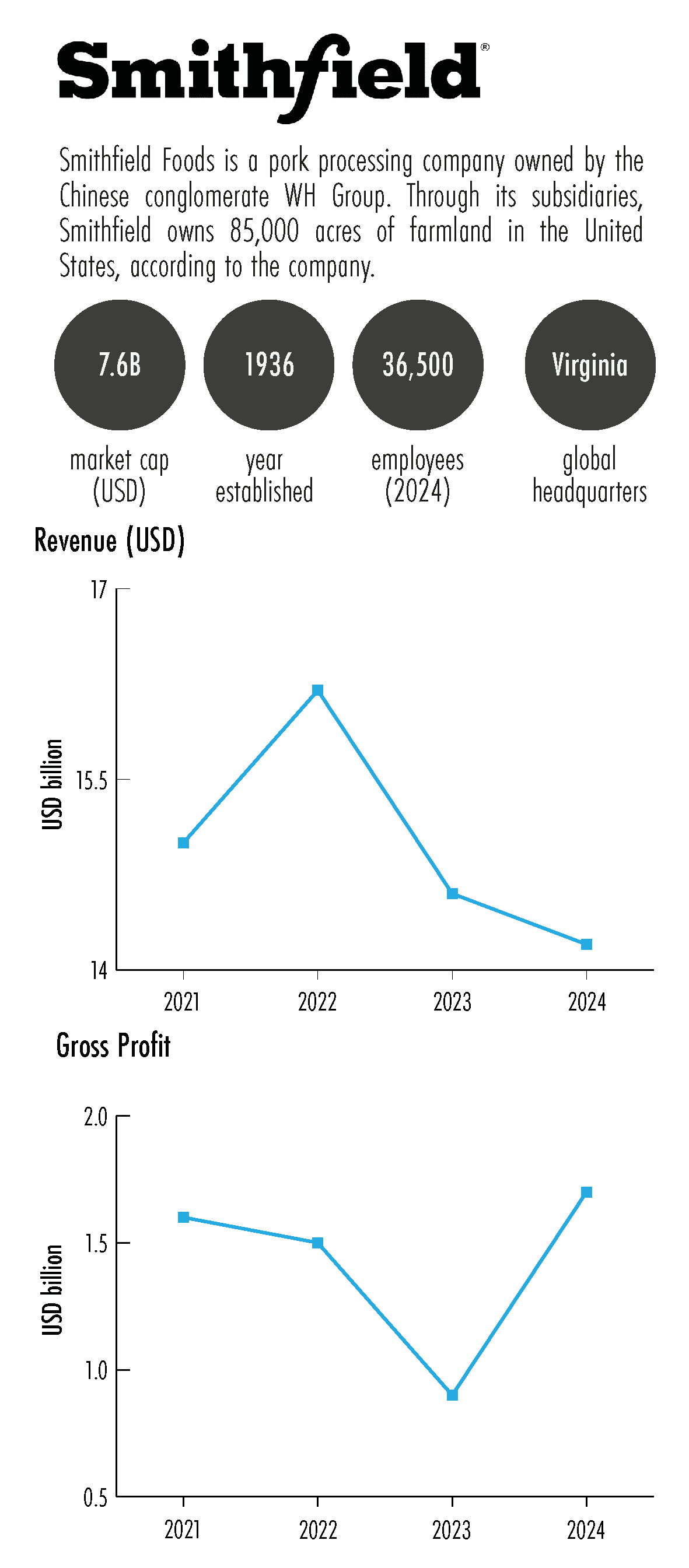
Any efforts by Missouri’s government to seize the Smithfield land are all but certain to run into legal trouble, lawyers say, as WH Group was not a co-defendant in the suit and there is no evidence it was involved with the hoarding of PPE.
“If it’s a separate legal entity, you can’t enforce the judgment against it,” says Daniel C.K. Chow, a business law professor at Ohio State University.
Missouri may also decide that Smithfield’s assets in the state are not worth the trouble. Missouri farm real estate cost an average of $4,800 per acre last year, according to the Department of Agriculture’s land values survey. That makes Smithfield’s total acreage in the state worth around $150 million, less than 1 percent of the $24.5 billion judgement.
Yet if Missouri were to be successful in seizing assets, the case’s consequences could go well beyond money.
“In general, it would be counterproductive for international relations if private citizens in the United States were suing sovereign nations, forcing them to avail themselves of our sovereign jurisdiction, and then potentially collecting on a civil judgment,” says Michael Parker, a national security lawyer at law firm Arktouros. “Should a judge in the state of Missouri be able to set foreign policy for the entire United States of America?”
The case’s outcome could increase the likelihood of similar suits, against both China and other would-be foreign foes. Mississippi filed suit against China on similar grounds in 2020; its case is progressing through federal courts.
“If you adopt a broader interpretation of the commercial activity exception, it’s going to encourage more of these lawsuits,” says Ohio State’s Chow, the author of a casebook on international business transactions. “This is a very dangerous precedent.”

Noah Berman is a staff writer for The Wire based in New York. He previously wrote about economics and technology at the Council on Foreign Relations. His work has appeared in the Boston Globe and PBS News. He graduated from Georgetown University.