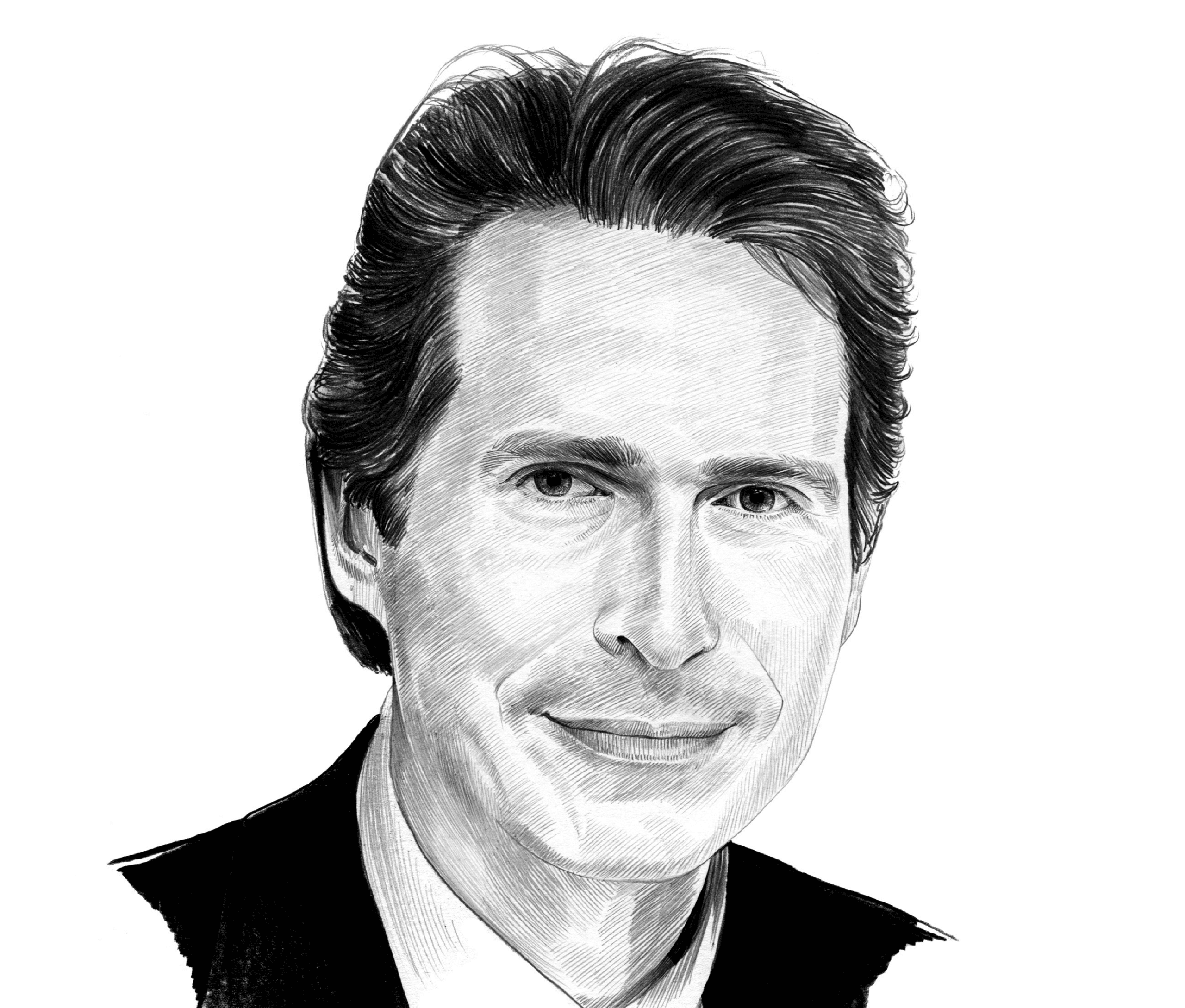
Larry Kudlow, director of the National Economic Council in the first Trump administration, has carved out a career that combines Wall Street, government and conservative media. As a young man, he worked for the Federal Reserve and Wall Street before becoming an associate director in Ronald Reagan’s Office of Management and Budget. He then returned to Wall Street and became Bear Stearns’ chief economist and an advocate for supply-side economics. After overcoming a publicized addiction to alcohol and cocaine, he launched a media career commenting on economics and finance. Tapped by President Trump to head the NEC, he worked on high-profile China issues, including negotiating the Phase One trade deal and prodding domestic and foreign telecom systems to drop Huawei Corp. equipment. He is now the host of Kudlow on the FOX Business Network.

Illustration by Kate Copeland
Q: Let’s start with Trump 1.0. What were his goals regarding China? And how well do you think he accomplished them?
A: His biggest goal with China in the first term was to ring the bell as a warning — really a multi-pronged warning — that China was cheating on trade. They had been taking advantage of their status in the World Trade Organization. Not only were their tariffs higher, but their non-tariff barriers were very, very high. We didn’t have much market access and American business ownership was treated badly. You had a lot of intellectual property theft and forced transfer of technology. They also weren’t buying our goods; they weren’t buying our commodities.
China never should have gotten ‘most favored nation’ privilege. And meanwhile, they were selling cheap goods to the United States, and that was doing damage to our manufacturing heartland and causing employment problems and wage problems.
[As part of the deal for China to join the World Trade Organization, the U.S. granted China ‘most favored nation’ status — a fancy term for the lowest tariffs offered to U.S. trading partners — which didn’t need to be renewed annually as had been the case previously.]

Even before he got into politics, Trump talked about that. He decided early on to do something about it though he waited a year to get the tax cuts and tax reform through, and there was also the misbegotten attempt to end Obamacare. In the second year, when I came into the administration, it was full speed ahead.
If that was his concern, how well do you think he did?
In terms of ringing the bell and making sure that the country knew that China had an adversarial relationship on trade and other matters, I think he succeeded very, very well. I think that has become part of the American political lexicon. Joe Biden didn’t change that.
…for better or worse, Trump believes and still believes that he can do business with Xi Jinping on a very personal level. Trump is a trade hawk, but he wants to do business.
In terms of specifics, as somebody who was on that China trade team, the so-called Phase One deal, it had a lot of good things in it. When Covid came, it was ignored. And then when Trump was defeated by Biden, the Chinese ignored it.

[Former U.S. Trade Representative] Bob Lighthizer has said that with some of the intellectual property items, the Chinese made progress and kept their word, but not on the promise of $200 billion in purchases of U.S. goods. That wasn’t even close. We did a story in the Wall Street Journal saying that Vietnam was the big winner from the trade war because so much investment went from China to Vietnam. Sometimes it was literal transshipping. Sometimes it was legitimate Chinese factory owners setting up factories in Vietnam, which got a ton of investment because of the trade war.
[With transshipping, items are shipped from China to Vietnam and relabeled as if they came from Vietnam to avoid tariffs.]
I basically agree with that. I think the biggest problem was transshipping. [To stop that, in the new Vietnam trade deal], there’s a 40 percent tariff on anything that’s transhipped through Vietnam.

But your other point is true. Vietnam has grown up and we have pretty good trade relations with them. And they were one of the earliest countries to make contact with Trump. [Generally, Vietnam now is facing 20 percent tariffs on exports to the U.S.]
| BIO AT A GLANCE | |
|---|---|
| AGE | 78 |
| BIRTHPLACE | New York, N.Y. |
| FORMER POSITION | Director, National Economic Council under President Trump. |
| CURRENT POSITION | Host of shows on Fox Business and WABC77. |
One other thing, though. Bob Lighthizer set up a very good adjudication process for intellectual property theft, with judges or monitors. China never followed through on that. They were supposed to have set up a whole infrastructure to deal with complaints and resolutions.
In these interviews, I have put it to Biden officials that, whatever your disagreements were with Trump, this was a deal signed by the United States. Why didn’t they try to enforce it?
Right. 100 percent.That is such an important point. This is not about politics. The United States government signed a deal with the PRC government. To ignore that was a tremendous slap in the face.
Their answers were generally that the Chinese weren’t ready to talk unless the U.S. was going to reduce its tariffs. They weren’t ready to reduce the tariffs, but clearly, they didn’t push it.
To finish off this subject, there was a Phase One Deal. Do you think if Trump had won re-election, there would have been a Phase Two? [Phase Two talks were supposed to deal with structural issues like subsidies and the activities of state-owned businesses. China never expressed interest in such discussions and the U.S. stopped pushing for them in the Phase One negotiations.]
I don’t know. I think there would have been a big push to implement Phase One. We would never have let them get away with ignoring the whole thing. Trump would have imposed larger and larger tariffs if there wasn’t any implementation to his satisfaction.

Lighthizer would have pushed hard. I would have pushed hard. I came into the Trump administration pretty much as a free trader, and then Lighthizer showed me facts and figures and the importance of technology to the U.S. economy and what China was doing.
I was the guy along with [National Security Advisor] Robert O’Brien who got rid of Huawei, I was the guy with O’Brien who got China out of the thrift savings plan. To be perfectly honest with you, I had no idea as a private citizen who was kind of a free market, free trade guy that it was as bad as Trump made it out to be.
[In Trump’s first term, the U.S. pressed foreign nations and U.S. rural telecom companies to rip out 5G Huawei Corp. 5G telecommunications equipment because of concerns Huawei could eavesdrop on communications. The federal government also stopped investing in Chinese stocks as part of its retirement Thrift Savings Plan.]

In the national security realm, you mentioned O’Brien. Trump also hired people like [former deputy national security advisor] Matt Pottinger and Secretary of State Mike Pompeo, who were clearly very hawkish on China. But I never looked at Trump like that. To me, his worldview was that country after country was ripping off the U.S. In trade, China was the biggest one of all of them. So, China became the number one target. But I didn’t see him as a China hawk in the Pompeo-Pottinger mold.

My take on Trump is that he is actually a free trader and an internationalist. He has business interests all over the world. People said he was an isolationist and this and that. I have argued in the Washington Post and Wall Street Journal that his goal was to reduce barriers. He believed in reciprocity — you lower your barriers; we’ll lower our barriers. But if you don’t, then we won’t.
I was at the meeting with Justin Trudeau. It was my first G7 meeting in Canada in June 2018. He talked about that openly. I remember him looking at me and saying, ‘You’ve argued this for 25 years.’ And I said, ‘That’s correct.’ And he said, ‘I happen to agree.’

That’s more nuanced than a super-hawkish foreign policy view that might have been held by Mike Pompeo or Matt Pottinger. I also feel that, for better or worse, Trump believes and still believes that he can do business with Xi Jinping on a very personal level. Trump is a trade hawk, but he wants to do business.
He loves using tariffs because he doesn’t have to go through a lengthy legislative process and he has a lot of autonomy and authority. He also has come to believe — and maybe I understand this better now— that with respect to tariffs, he wants countries to pay a bit of a price, a toll, for entering the U.S. economy and dealing with the all-powerful U.S. consumer. He’s making good revenue money doing it.
I didn’t hear much of that in the first term. In my conversations with him recently and also watching him operate, I think the idea is a modest toll, like 15 to 20 percent. That’s the range he’s settling on in the main. It’s not Smoot-Hawley, which was a 60 percent tariff. It’s a 15 to 20 percent tariff, which could conceivably come down over time.

[The Smoot-Hawley Tariff Act of 1930 raised around 900 import tariffs by an average of 40 to 60 percent and has been seen as deepening and lengthening the Great Depression.]
I remember having this conversation with you in the first term. I don’t see how you can say he’s a free trader when, as you say, he’s looking at at least 15 percent tariffs on everybody. I don’t mean this pejoratively, but he has a protectionist viewpoint.

I think in the long run, those tolls might come down. Not in the short run.
But on the other side, it’s fair to say that these other countries, in a significant manner, are lowering their barriers. So at least we’re getting more American market business access to their markets. That’s a free trade thing. And they’re reducing tariffs on us, which is a free trade thing. So, there is a free trade element to it.
But no, you’re right, he’s not going back to some classical definition of free trade. Our average tariff was about 2.5 percent. It’s going to go up to somewhere between 15 and 20 percent. In that sense, that’s not free trade. But that’s the price he wants them to pay for lower barriers to us.

But there’s one other point, and I think it’s a clever part of these deals. He’s insisting that these countries make direct investment commitments into the United States, and they are big numbers.
We import about $3 trillion worth of goods, more or less, so a 15 percent tariff would give you $400 billion or so in revenues per year to use. I’m not being precise, but here’s my point: Those proposed investments dwarf the tariffs. That’s a sidebar development that we didn’t use in the first term but is very clever. That changes the whole complexion of these deals.
Let’s face it. A tariff is a tax, okay? I know everyone’s worried about inflation. I’m not. Tariffs historically are like taxes. They are recessionary. They are deflationary. If I had a big tax hike in the United States, I wouldn’t be worried about inflation. I’d be worried about deflation and recession.

But that tax will be more than offset by these big numbers in the direct investment programs. How is that going to be done? I don’t know. But it’s a brand new wrinkle.
In the first term, you could say the Chinese purchases were sort of the same. They said they were going to buy a gazillion tons of soybeans and LNG, but they didn’t. The question is, do you believe the EU, South Korea and others will be investing new money or is this what they were already going to invest anyway in the United States?
That’s a good question. I don’t know enough about all the commitments that are being made. This is all happening quickly and recently, so none of us can really catch up. We will eventually. They’ll have to publish a lot of stuff. But it seems to me the answer is yes, this is new money. It’s more than just the normal trade flows.
In the first term, I was the big LNG salesman. Whenever we’d have a bilateral lunch in the cabinet room with a leader, particularly from Europe but sometimes from Asia, Trump would look at me and say, ‘Go.’ And I’d make my pitch. We wanted to sell our liquified natural gas to them. It’s a clean burning fuel, which Europe finally acknowledged. If they needed help in building a reservoir or a port, we could do that too. We could do anything they wanted.
When Trump unveiled Liberation Day… A lot of people in the media wrote that all these countries were going to talk to China… That didn’t happen. Our government was deluged with phone calls, deals, offers… It was like the global instinct was to go to America.
Many of them said, yeah, we like the idea, but nothing ever happened. And then I would say — either myself or [National Security Advisor] John Bolton — we want you to buy ours, not Russia’s. That’s in your interest; that kind of thing.
| MISCELLANEA | |
|---|---|
| FAVORITE BOOK | God and Man at Yale by William F. Buckley Jr. |
| FAVORITE FILMS | Godfather, Chariots of Fire, Gladiator. |
| FAVORITE MUSIC | Popular classics including Louis Armstrong, Ella Fitzgerald, Nat King Cole, and Roy Orbison. |
| MOST ADMIRED | Jesus Christ, Bill Wilson, Ronald Reagan, Donald Trump. |
The number that came out of the Scotland conversation [with the E.U. on trade] was $750 billion in energy purchases, which I assume is almost entirely LNG. That’s a much, much bigger number than anything I ever heard before, which tells me this is new money or new commitments.
Although it would require quite a bit of investment in new production. I don’t think the U.S. produces as much LNG as all these deals say they’re going to buy.
Well, not at year one, for sure. But remember, in the One Big Beautiful Bill, you’ve got 100 percent expensing for equipment and factories. That’s going to be a big help to doing all this.
Let’s talk about the global economy. What do you think the impact is on the global economy, especially developing countries, when you have the U.S. putting up tariffs at 15 or 20 percent while China is overproducing and exporting at prices nobody can touch. What happens to countries like Indonesia or India when on the one hand, it’s harder to get into the U.S. market, and on the other hand, they’re getting deluged with Chinese goods?

The short answer is they need to play ball with us. I think that’s basically what’s happening with some exceptions. When Trump unveiled Liberation Day — a most unfortunate name — he had all those big numbers with calculations that I don’t agree with. A lot of people in the media wrote that all these countries were going to talk to China and walk away from the U.S. That didn’t happen. Our government was deluged with phone calls, deals, offers. They didn’t go to China. It was like the global instinct was to go to America.
Why do you think that is?
I think it’s because we’re the greatest country in the world and have a president right now who people have come to respect.

My second point is a lot of these countries have been angry at China for years. Europe is a good example because China has been subsidizing cheap electric vehicles and selling them to Europe and destroying the European EV business.
They also don’t trust China on foreign policy. China is financing Russia’s war against Ukraine by buying discounted oil. Then there is what is happening with Hong Kong and the Uyghurs and a litany of human rights abuses. So, they don’t trust China. In my view, China has looked worse and worse. The U.S. ain’t perfect, but the instinct of the world was to come to talk to us.
By the way, as you well know, China’s economy has never recovered from the property crash. I don’t have time to follow all the details, but you read all these stories in the Wall Street Journal. One of my favorites was when China stopped publishing all these economic statistics when it didn’t like them.
Imagine if we decided to forego second quarter GDP because it fell by 1 percent instead of going up by 2 or 3 percent. Xi is clamping down on state control of the economy. When I worked on Wall Street years and years ago, really the ’80s and ’90s, China routinely used to post GDP estimates of 12 percent, 15 percent. Now the estimates are what, 5 percent? And I don’t know if anybody believes that. A lot of these countries that are in discussion with us want to bet on an economic winner. China looks like a big economic loser.
[The interview was conducted before President Trump fired the head of the Bureau of Labor Statistics, Erika McEntarfer after BLS published data and revisions showing the U.S. economy was adding jobs at a much slower pace than generally assumed. “McEntafer had faked the Jobs Numbers before the Election to try and boost Kamala’s chances of Victor, Trump claimed in a Truth Social posting. In another posting he accused her of concocting “A SCAM!’ Kevin Hassett, Trump’s director of the National Economic Council said Trump “wants his own people there.”]

[In response, Kudlow added in an email: ‘Trump is right to overhaul the BLS. E.J. Antoni is a smart guy,’ referring to Trump’s controversial choice to head the agency.]
You said before that Trump could do business with Xi. What did you mean by that?

Trump thinks he can get on the horn and talk Xi into good deals. I want to tread gingerly here, but I think he used to think the same thing with Putin. What’s happened is he’s been completely disillusioned with Putin. I don’t know about Xi, but his rhetoric about Xi has changed.
[The interview was conducted before the recent summit meeting between Putin and Trump in Alaska where Trump didn’t get a cease fire or impose harsh sanctions, as he said he was considering. Instead he said he was pushing for an overall deal, which Putin has sought.]
[In an email, Kudlow added: ‘Events are moving fast with Putin and the Ukraine war. Let’s see if Mr. Trump can get a peace deal to end the war. If anyone can do it, he can.’]
Changed in what way?

I think it’s tougher. He’s not running to talk to him. One of the things he said the other day — I don’t know if it was kind of a throwaway — he said I’d like to go to China, but not necessarily to meet with Xi. Now, you and I don’t really believe that he would go to China and not talk to Xi. But he said that. He never said that before. He was dissing him. That’s what he was doing: I know him.
With Putin, it’s more blatant because he’s very angry at Putin and wants to end that war. I’m a Reagan guy. I started my whole political career 40 years ago with Reagan. I believe personal diplomacy has a place. But it can only go so far. Leaders will represent their national interests, their ideologies and their values.

I always thought President Trump, at least in my experience in the first term, was a little too personalized. A little too, ‘I can charm you into coming around to my point of view.’ There’s a place for that. I get it. But it’s just a place. I don’t think that’s the biggest thing.
You never know with Trump, because he schmoozes a lot. But it seemed like he went out of his way too much personally with the Chinese. Do you think he’s become more skeptical of the Chinese?
Yes. 100 percent.
I was told by people like [former State Department official] Miles Yu that when the Phase One deal was signed in Washington in January 2020, some in your group came to believe that the Chinese knew at the time that Covid spread through the air. So, the Chinese delegation was essentially endangering the life of the president. Was that the case?
I don’t know. There was a lot of suspicion. But at the time we signed, the proverbial Covid roof hadn’t fallen in yet. That came sometime in March. There were rumors; there was talk. I don’t think it was uppermost in our minds.

I had an interview with Robert O’Brien where he talked about what’s now called a ‘reverse Kissinger’. He said that when he and Pottinger were in Russia, they would talk to the Russians about how the Chinese have long memories and they remember that the czars took thousands of square miles of Chinese territory. They were laying the groundwork that maybe the U.S. and Russia could work together on China. Obviously, the Ukraine war screwed that all up.
A video released by the White House covering President Trump and Putin’s meeting in Alaska, August 15, 2025. Credit: The White House via X
But I wondered if you think that that idea motivated Trump when it came to Putin. He seemed so forgiving when it seemed clear that Putin wanted to conquer Ukraine.
I’d give that one a ‘perhaps.’ The reason there may be something to it is because President Trump often suggested publicly that Russia be readmitted into the Group-of-7 so it became the Group-of-8 again. I don’t know that he was 100 percent in favor of it, but he would raise it. The Europeans were very much opposed to it.
As a former Reagan guy, I tend to be much more hawkish on Russia. I don’t trust them, and I never will. It’s not personal, it’s institutional, and it’s sovereign. I was always sort of semi-horrified that Russia had picked off Crimea. What did the United States do about it? Nothing. Russia picked off a big chunk of Georgia, and what did we do about it? Nothing. So why should we let them back into the G7?
I always thought President Trump, at least in my experience in the first term, was a little too personalized. A little too, ‘I can charm you into coming around to my point of view.’ There’s a place for that. I get it. But it’s just a place.
I think President Trump is going to take some very, very stern measures against Russia in the very near future.

A lot of people have talked about secondary sanctions. Some of the talk about hitting India with 50 percent tariffs maybe reflects that. Do you think he would do something like that with China? What would China’s role be in getting tougher on Russia?
I don’t know that I can answer that, but I have to believe that subject is being discussed right now as the president decides whether and how long to extend the trade talks with China.
We had a dinner sometime in the spring of 2024, when he was in court in downtown New York. It was a very small dinner in his apartment one night, just three or four people. I said, ‘Sir, I just want you to know that China, through their oil purchases, is financing two wars against the United States and its allies. One of them is Russia-Ukraine, and the other one is Iran-Israel. Without China, both of those countries would be vastly weakened.’ He knew that. He nodded his head and said something.

Let’s talk about some of the cast of characters in the White House now. You’ve had Treasury Secretary Scott Bessent on your show several times. You also said that you thought Trump’s initial proposed tariffs were way too high. What role do you think Bessent has played in this trade strategy?
Prominent. Increasingly prominent and knowledgeable. It took him a while to get up to speed. He’d never been in the federal government before. But he’s a very, very smart fellow.
Scott keeps one sharp eye on the stock market. Not that Trump doesn’t, but I think Scott’s position improved inside the administration when the stock market declined in April. Scott was somebody that could reach out and talk to people in the market, go on the shows and have a soothing influence. That’s very similar to the influence that some people thought I had in the first term. Scott has it in the second term.
They would send you out there when the market was going crazy.
There are some people they would not send out; there are some people they would send out. Scott is probably first on the list they’d send out. He’s become a close advisor.
And what about [White House trade advisor] Navarro? You had some run-ins with him in the first administration. Initially, in this term, he was on TV shows quite a bit and seemed to have a fair amount of influence on the so-called reciprocal tariffs, and maybe even came up with that cockamamie formula.
Cockamamie is not a bad word and it came from Navarro’s shop. I think I’ve used that word, cockamamie, myself. I was trying to figure the thing out and I couldn’t for the life of me. Then I showed it to some people who are quantitatively much smarter than I am, and they couldn’t figure it out either.

What do you think his influence is now? In the first term, he had to sneak into the Oval office, but now he’s much more of a trusted advisor.
I think Peter’s around. He has a very hard line, hawkish view. I can’t gauge whether his influence is up or down. I noticed that when they made an announcement about Mexico and tariffs, Peter’s name wasn’t mentioned. I’ve seen a few instances of that, but I’m sure he has access to the president.
When we were doing the China negotiations, when the president wanted to be very hardline and scare the hell out of the Chinese, he’d put Peter front and center. But when he wanted to pull back and reach something more accommodating, you might see me or Treasury Secretary Mnuchin. He was playing with us and that’s pretty clever.

Bob Davis, a former correspondent at The Wall Street Journal, covered U.S.-China relations beginning in the 1990s. He is the author of Broken Engagement, a collection of The Wire China interviews. Earlier, he co-authored Superpower Showdown, with Lingling Wei, which chronicles the two nations’ economic and trade rivalry. He can be reached via bobdavisreports.com.