China and the U.S. are on divergent paths when it comes to energy, with Beijing prioritizing renewables while the Trump administration focuses on promoting oil and gas. The question is: whose power system is set to prove more resilient?
China is set to add more solar and wind power capacity than any other country this year, and has started constructing a hydroelectric plant nearly six times the size of the Three Gorges Dam. Meanwhile, President Trump’s recently passed ‘Big Beautiful Bill’ slashes solar tax credits, and the Environmental Protection Agency is moving to dismantle the Obama-era legal foundations for federal regulation of greenhouse gas emissions.
In this week’s Big Picture, The Wire where these developments and others leave the respective Chinese and U.S. power grids — as well as the obstacles each country faces, and who may now hold the upper hand in the global energy race.
VOLTAGE VAULT
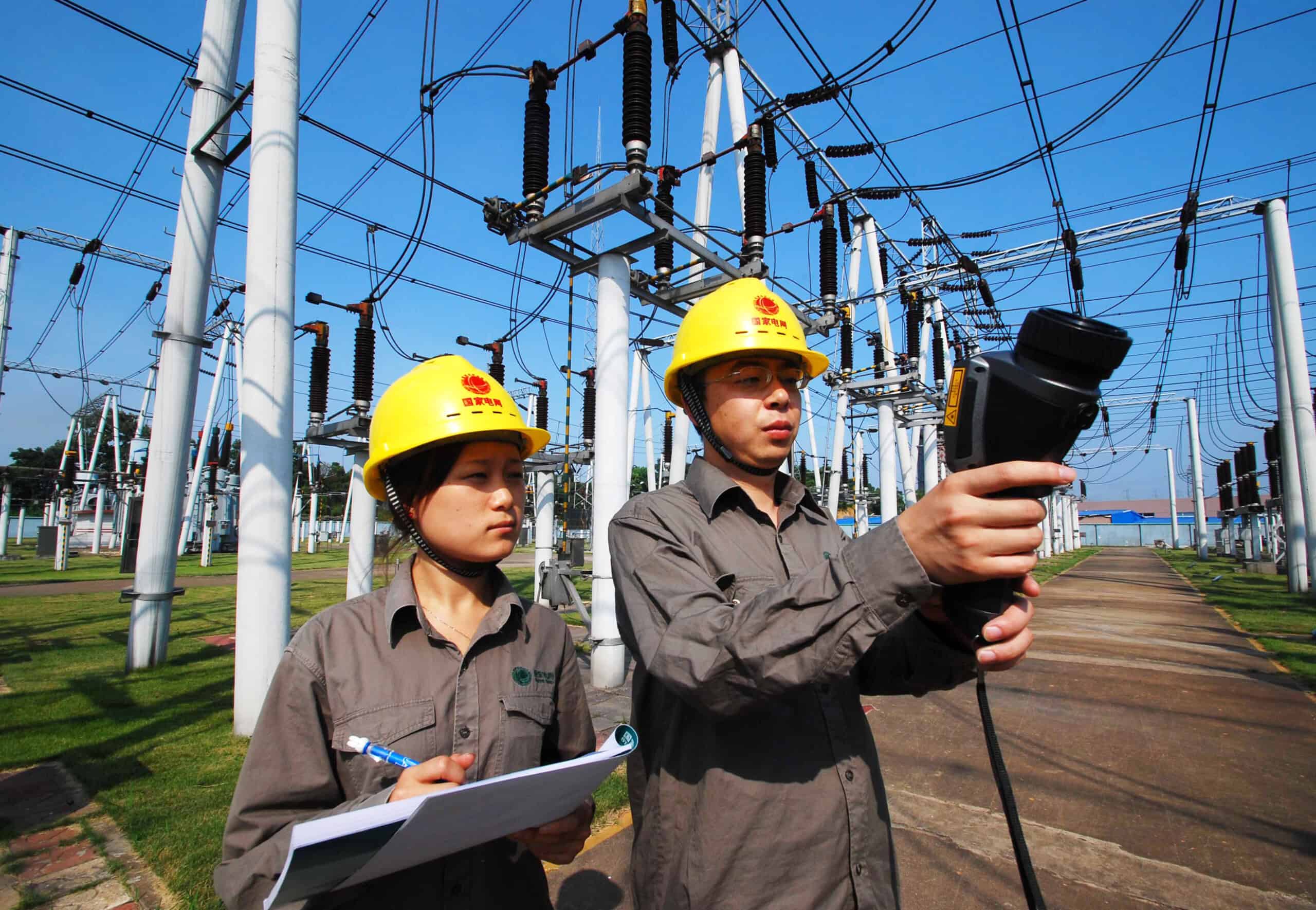
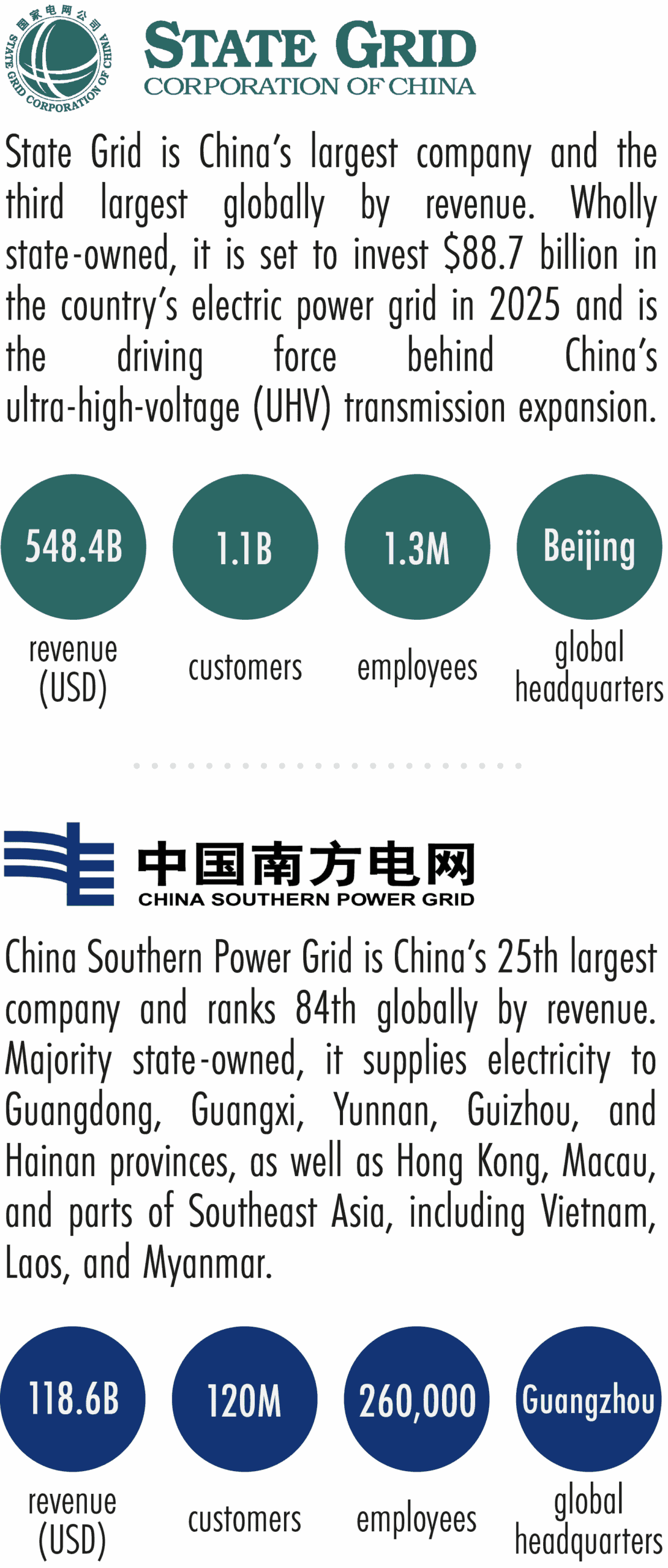
China is racing to build a unified, centralized national electricity grid. Just two state-owned companies — China State Grid (SGCC) and China Southern Power Grid (CSG) — oversee nearly the entire national system. This top-down approach has helped to enable the rapid development of ultra-high voltage (UHV) transmission lines in recent years, bringing electricity more quickly from generation hubs in the west of China to the country’s more heavily populated eastern region.
In contrast, the U.S. grid is fragmented. It consists of three loosely coordinated systems, governed by a patchwork of utilities, regional operators, state regulators, and federal agencies. The country currently has no UHV transmission lines.
| Line | Description | Voltage | Length (km) | Operational Since |
|---|---|---|---|---|
| Changji-Guquan | Starting in Xinjiang in the northwest, this line runs through Gansu, Ningxia, Shaanxi, and Henan, ending in Anhui province in eastern China. | ±1100 kV | 3,324 | September 2019 |
| Jiuquan-Hunan | This line links Jiuquan in western Gansu province to Xiangtan in central Hunan province, running through Shaanxi, Chongqing, and Hubei along the way. | ±800 kV | 2,383 | June 2017 |
| Hami-Chongqing | The Hami-Chongqing line directs power from Xinjiang, in the northwest, through Gansu, Shaanxi, and Sichuan, to the terminal in Chongqing, in the southwest. | ±800 kV | 2,260 | June 2025 |
| Hami-Zhengzhou | This line begins in Xinjiang, and passes through Gansu, Ningxia, Shaanxi, and Shanxi, before terminating in Zhengzhou, Henan province, central China. | ±800 kV | 2,210 | January 2014 |
| Baihetan-Zhejiang | Staring in southeast China’s Sichuan province, this line goes through Chongqing, Hubei, Anhui, and ends in the eastern province of Zhejiang. | ±800 kV | 2,121 | December 2022 |
The disjointed system means building a new transmission line in the U.S. “can take five years if everything goes well, which is an eternity,” says Ismael Arciniegas Rueda, Senior Economist at RAND. Major delays and bottlenecks can slow efforts to connect clean energy sources to the grid, slowing both decarbonization efforts, and restrict essential maintenance of the U.S. grid.

POWERING THROUGH
In 2023, China generated more than twice the electricity of the United States. But power generation alone does not tell the full story. What increasingly matters is grid resilience: the system’s ability to absorb shocks, minimize outages, and reliably transmit power across vast geographies amid volatile patterns of demand.
The U.S. should learn how the Chinese do it in order to beat them at their own game. Just like China studied Europe to become number one in high-speed rail.
Ismael Arciniegas Rueda, Senior Economist at RAND
“I go to a lot of events and conferences, and have begun to see this difference in language,” says Saqib Saeed, Head of Research at energy market advisory firm PTR. “It used to be all about ‘energy transition.’ Now it’s ‘grid resilience’ everywhere.”

Standard reliability metrics — such as the System Average Interruption Duration Index (SAIDI), which measures the average duration of power outages, and the System Average Interruption Frequency Index (SAIFI), which measures the average number of outages per year — show diverging trends. The United States has made little progress in reducing outages in recent times, while China has greatly improved over the past five years.
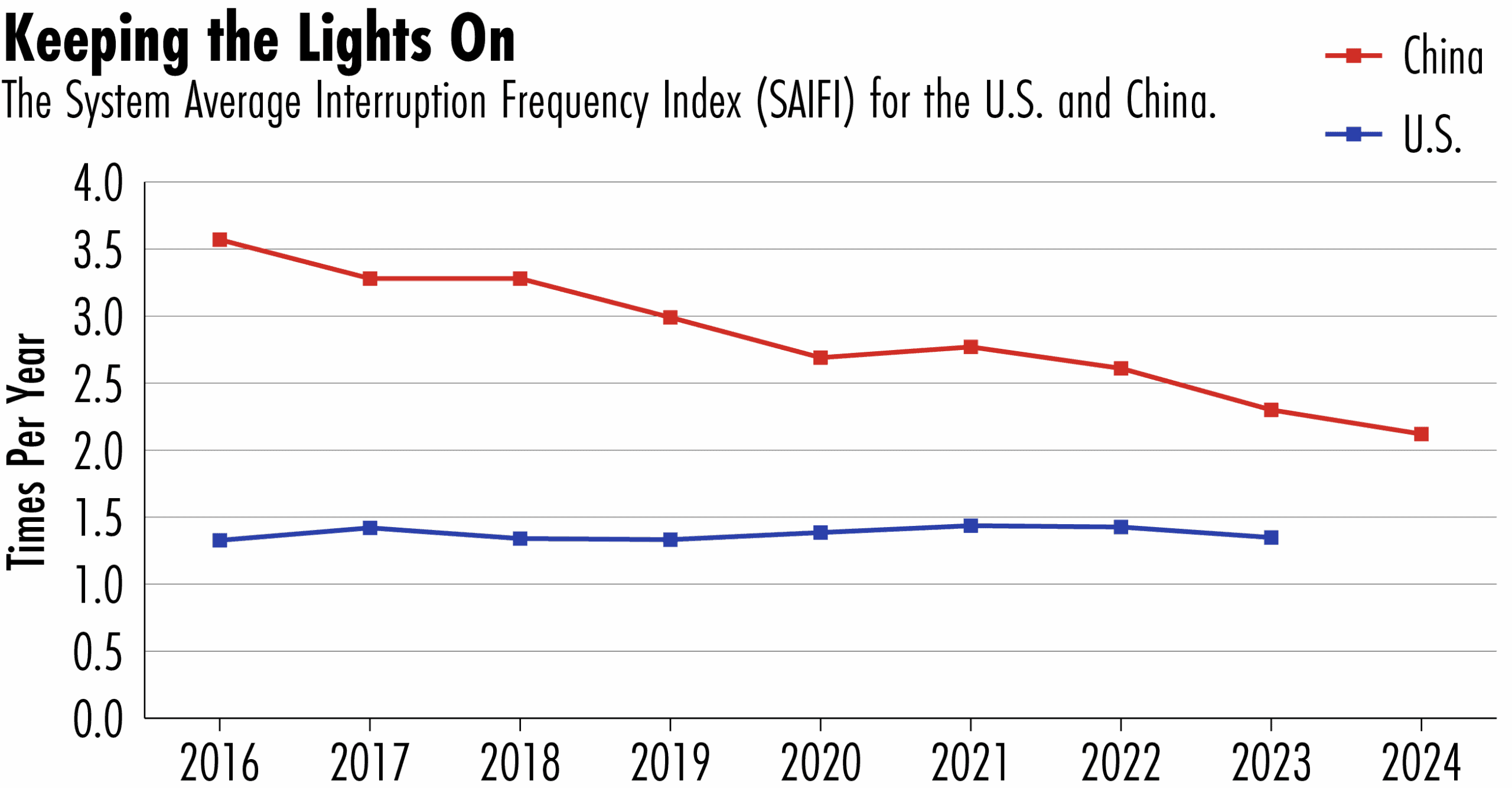
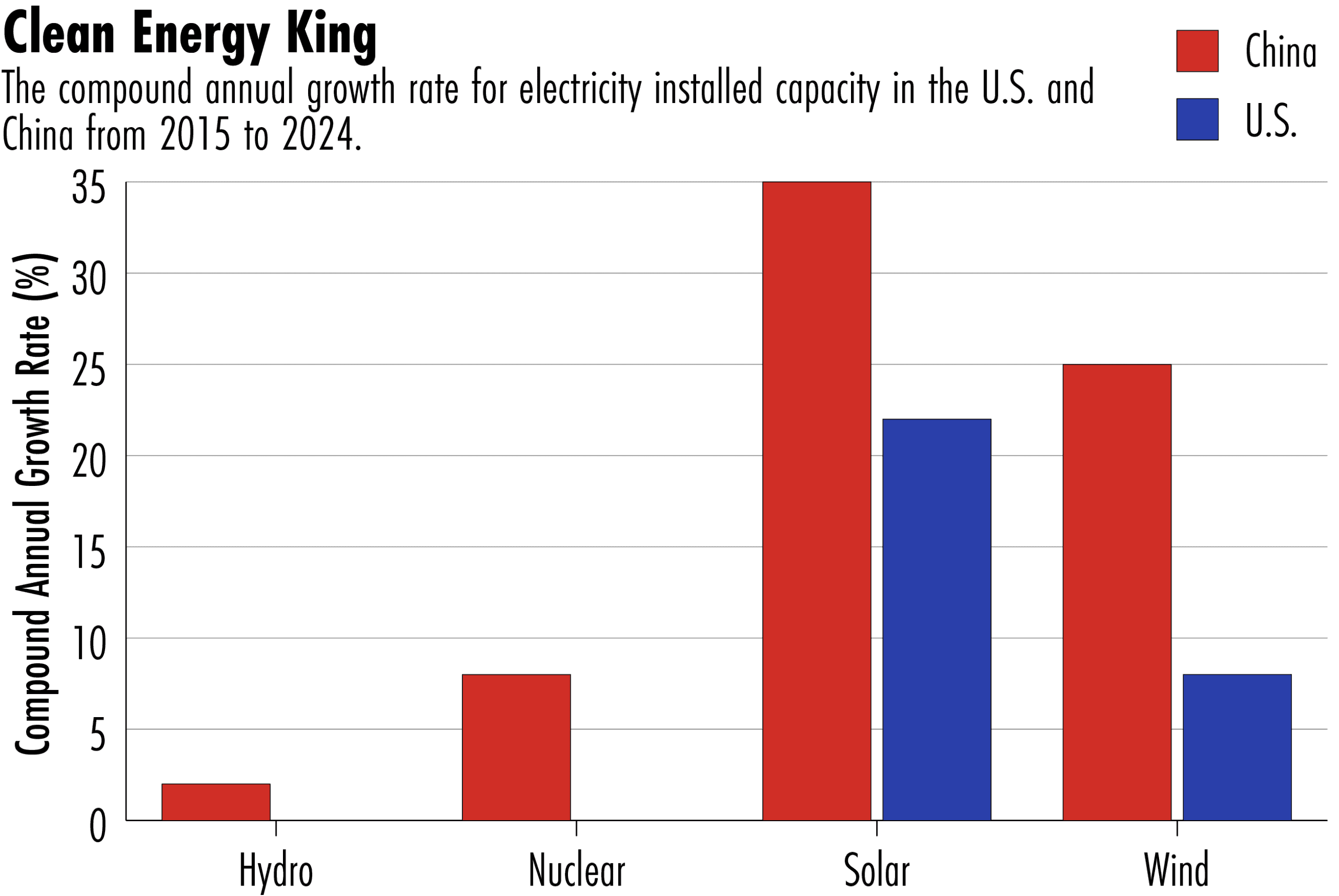
These improvements reflect more than the pace of implementation of power lines. China’s edge lies in its portfolio approach to energy — a mix of solar, hydro, wind, nuclear and coal backed by massive investment — which helps to ensure security of supply.
“Energy security is paramount,” says RAND’s Arciniegas Rueda.
One important factor for China is its access to critical components in the renewables supply chain — like rare earths — giving it a manufacturing advantage when it comes to products like solar panels and wind turbines. This has helped China to prioritize cleaner energy and, in turn, to create a system resilient enough to support power-hungry industries like AI data centers.
The U.S., meanwhile, has slowed its pace of renewables installation, in part to reduce dependence on Chinese-made hardware. But the country’s aging infrastructure poses its own risk.
“70 percent of critical components in the U.S. power grid are operating beyond the end of their life span,” says Saeed, adding that simply shifting toward natural gas as an energy source will not solve these structural issues. “A majority of the equipment in the U.S. power grid is operating beyond the end of its life span, especially transformers.”
“In China, you don’t have any of these problems,” says Saeed.
The fact that China is at an early stage in its grid-building is another part of its strength. Unlike the U.S. or Europe, it isn’t burdened by legacy infrastructure, allowing it to set global standards in modern grid design. China has already collaborated with Pakistan and much of Latin America to build out their grids.
“The U.S. should learn how the Chinese do it in order to beat them at their own game,” says Arciniegas Rueda. “Just like China studied Europe to become number one in high-speed rail.”

Yet China’s energy ambitions create challenges. Even as its grid becomes more integrated, it faces curtailment issues — where renewable energy is produced but cannot be used or stored efficiently and is wasted — underlining the importance of building still more new transmission lines and storage capacity. Although considerable long-term progress has been made, solar and wind curtailment experienced its largest year-on-year increase last year since 2014.

Dean Minello was a summer staff writer for The Wire based in New York. He is a junior at Princeton University studying Public & International Affairs with a minor in East Asian Studies, and does research at Princeton’s Center for Contemporary China. Proficient in Mandarin, Dean is interested in authoritarian politics, human rights, and U.S.-China relations.