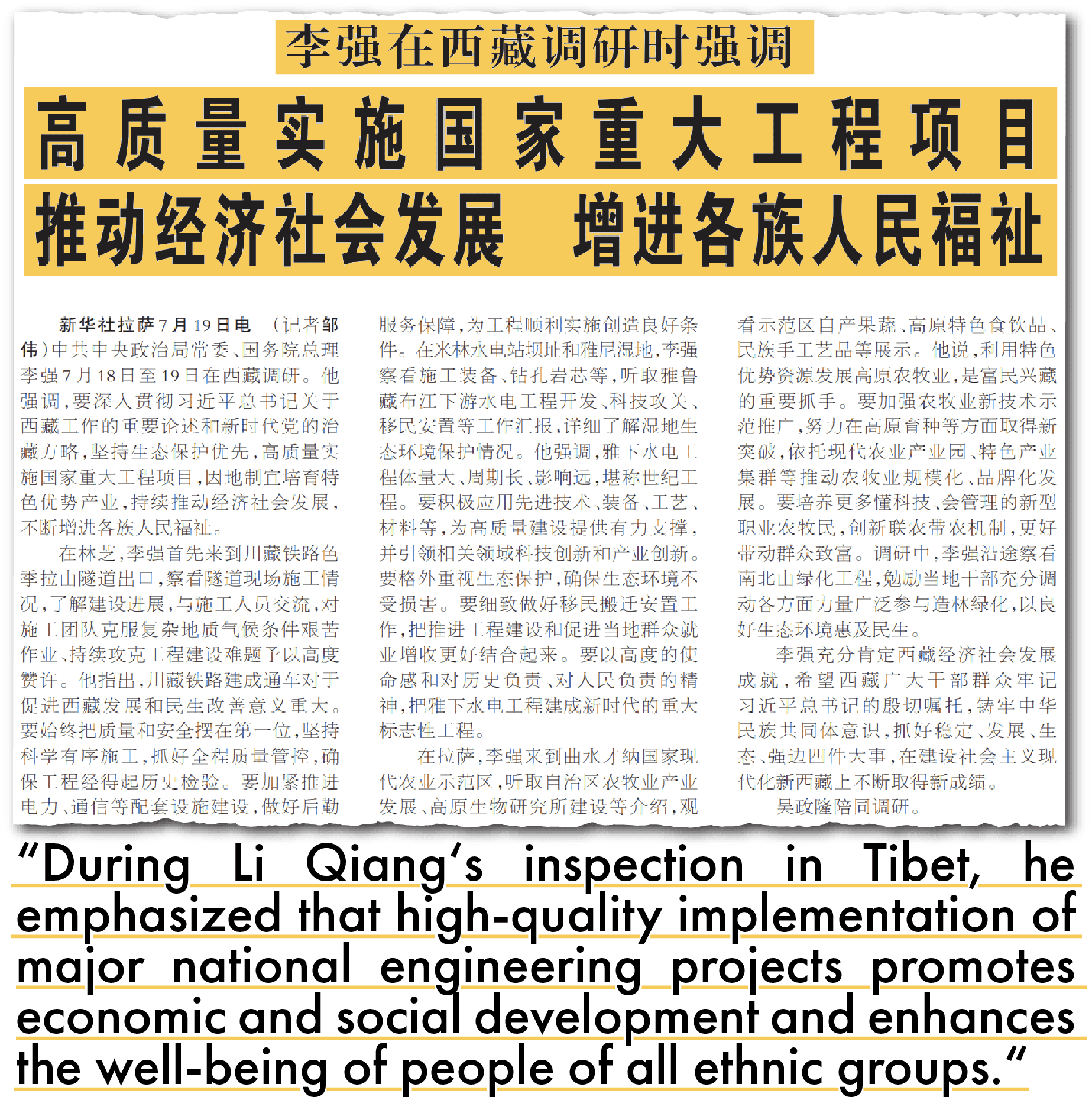
Chinese premier Li Qiang described it as the “project of the century.” And by the numbers, China’s largest hydroelectric project, for which Li broke ground on Monday, certainly lives up to the billing.
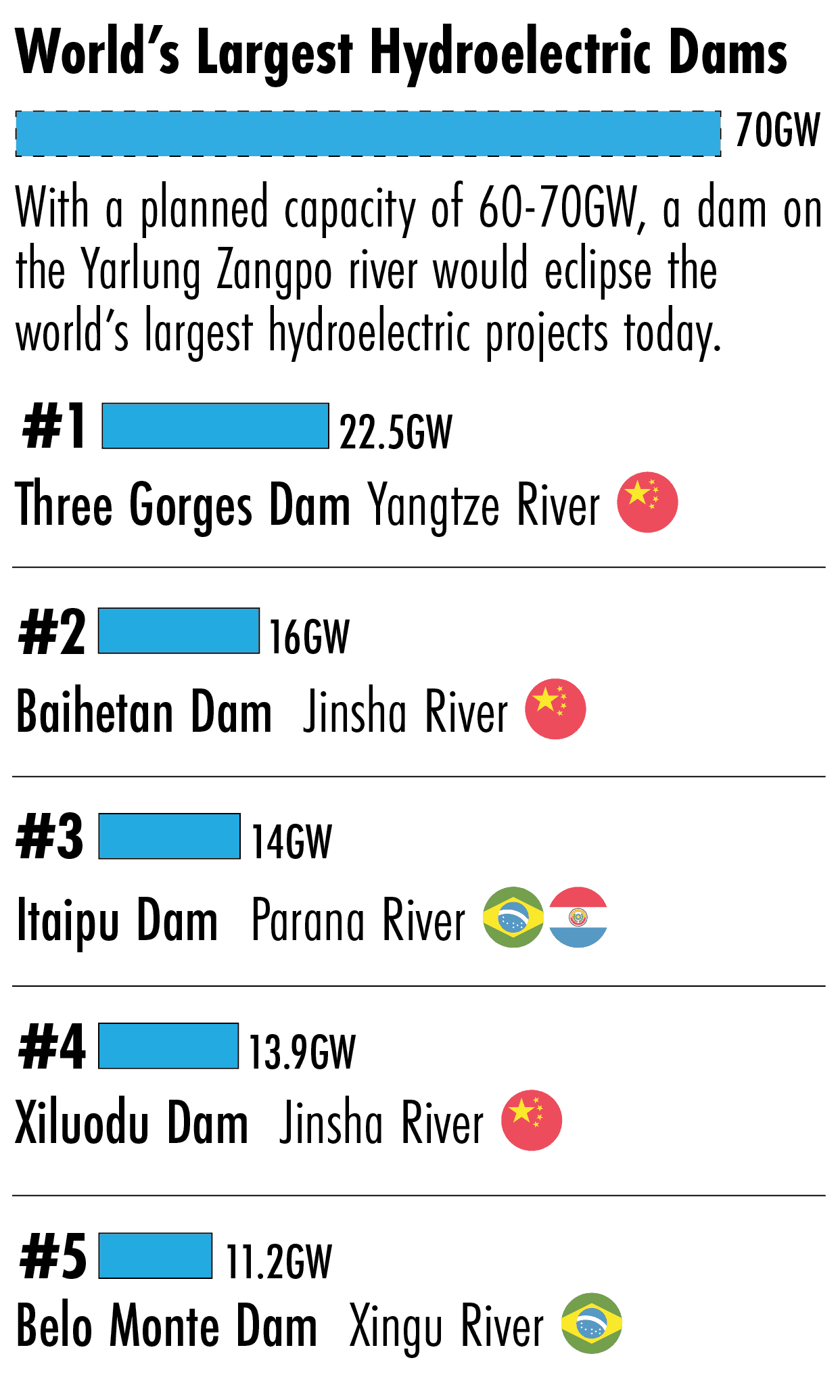
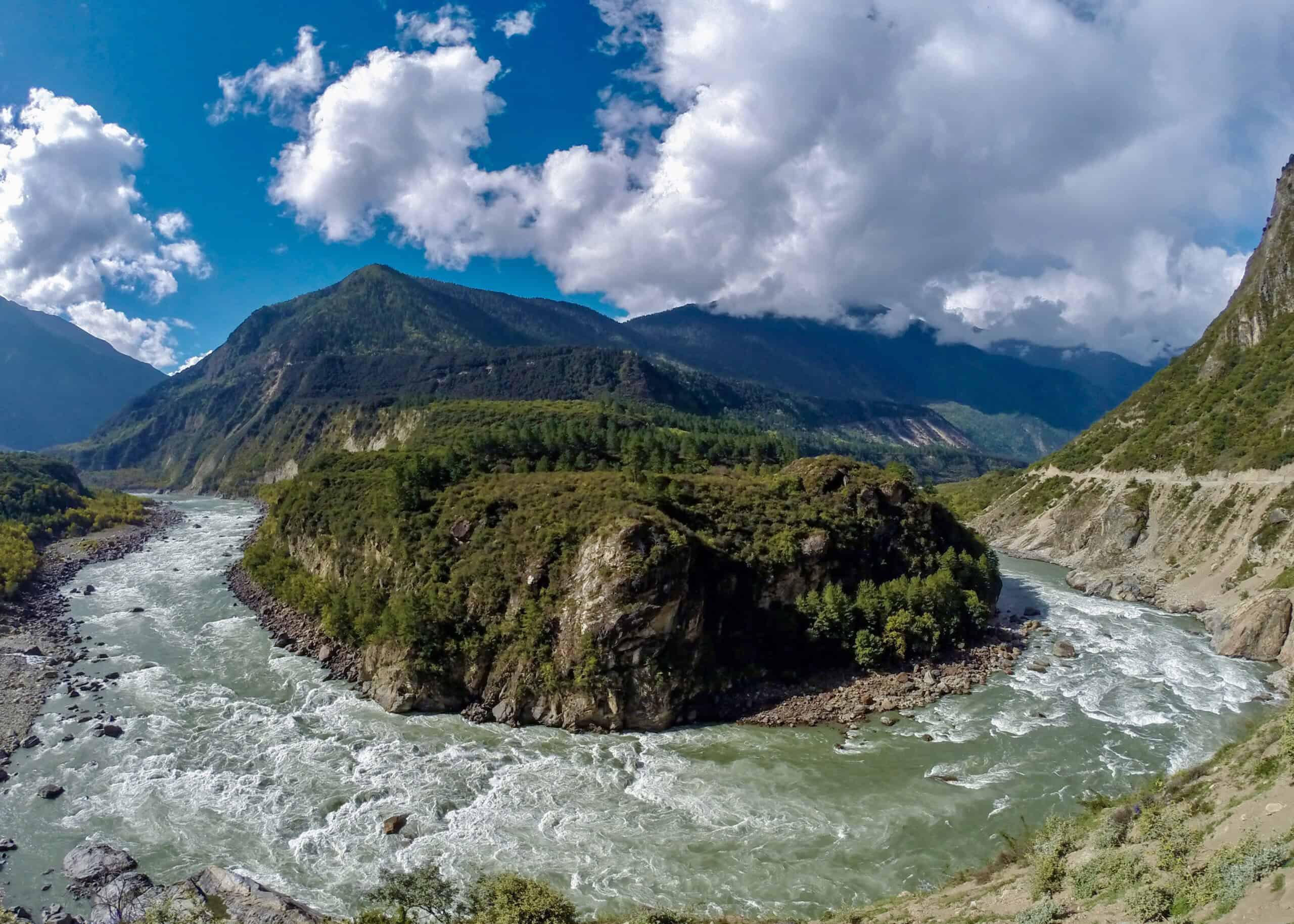
Built on the Yarlung Zangpo, a tributary of India’s Brahmaputra and Bangladesh’s Jamuna rivers, the dam complex will include five cascading power stations on the cusp of the Tibetan Plateau. Once completed, the system can generate up to 70 gigawatts of electricity — more than the entire installed power capacity of Poland. The enormous undertaking will cost an eye-watering $167 billion — over quadruple the bill for the Three Gorges Dam, the controversial hydroelectric mega-project China constructed in the early 2000s.
But while that dam was built to meet a developing China’s desperate need for energy to power its breakneck industrialization, the country today has become an energy powerhouse, leading the world in clean energy production, from nuclear to wind and solar. In May alone, the country installed 93 gigawatts of solar power — more energy than the Yarlung Zangpo project will provide upon its completion a decade from now.
So why is Beijing pressing ahead with such a complex hydropower project in a geographically remote, seismically active, and geopolitically sensitive part of the country?
CCTV coverage of the commencement of construction on China’s hydroelectric mega-project. Credit: CCTV
“The Chinese strategy has been to build more of everything,” says Belinda Schäpe, a China policy analyst with the Centre for Research on Energy and Clean Air, a Helsinki-based think tank. “And this project ticks a lot of boxes. Its economic contribution will drive investment into the region…along with roads and railways at a time when there is a lot of pressure on heavy industry to find a market for its products.”
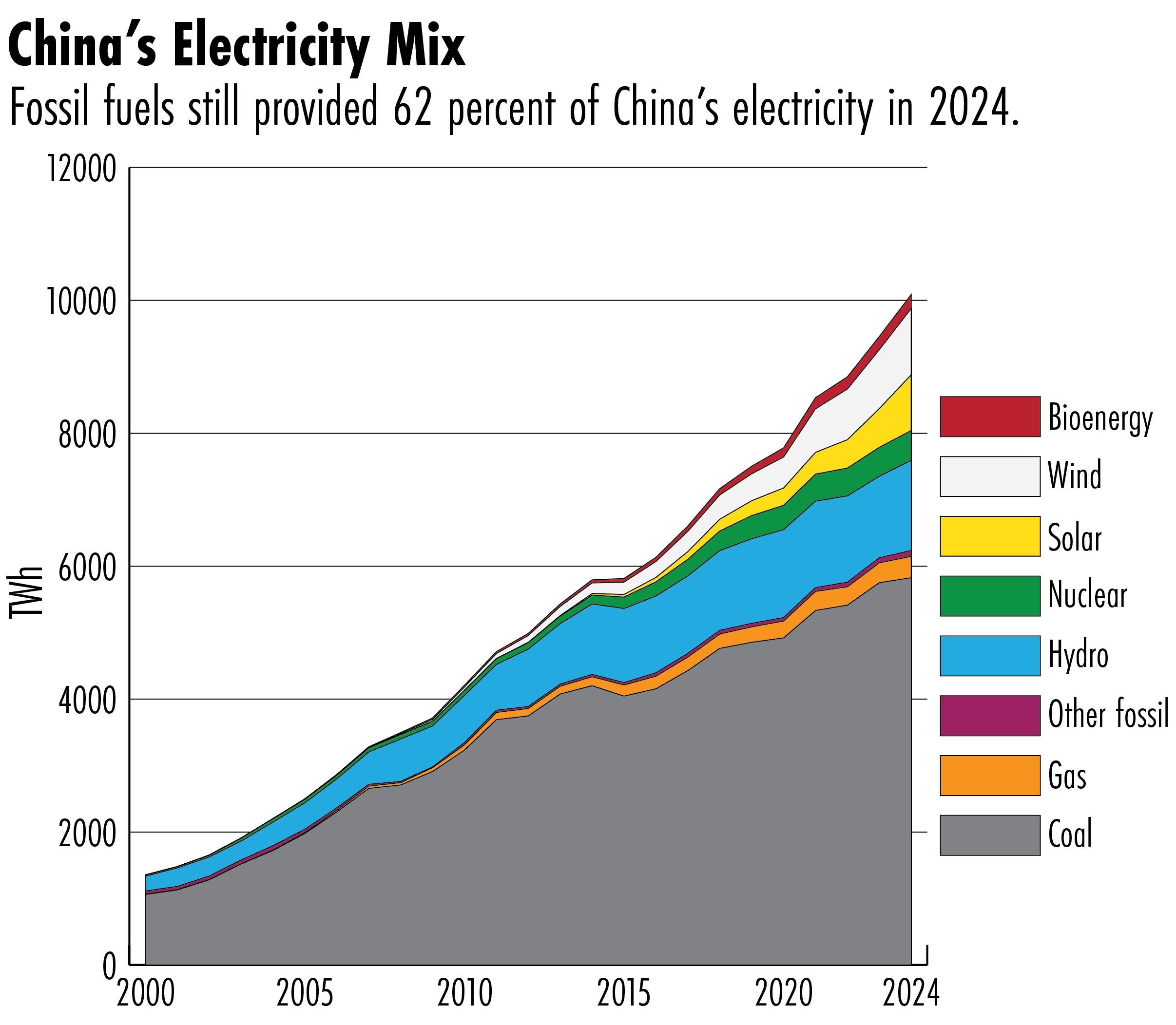
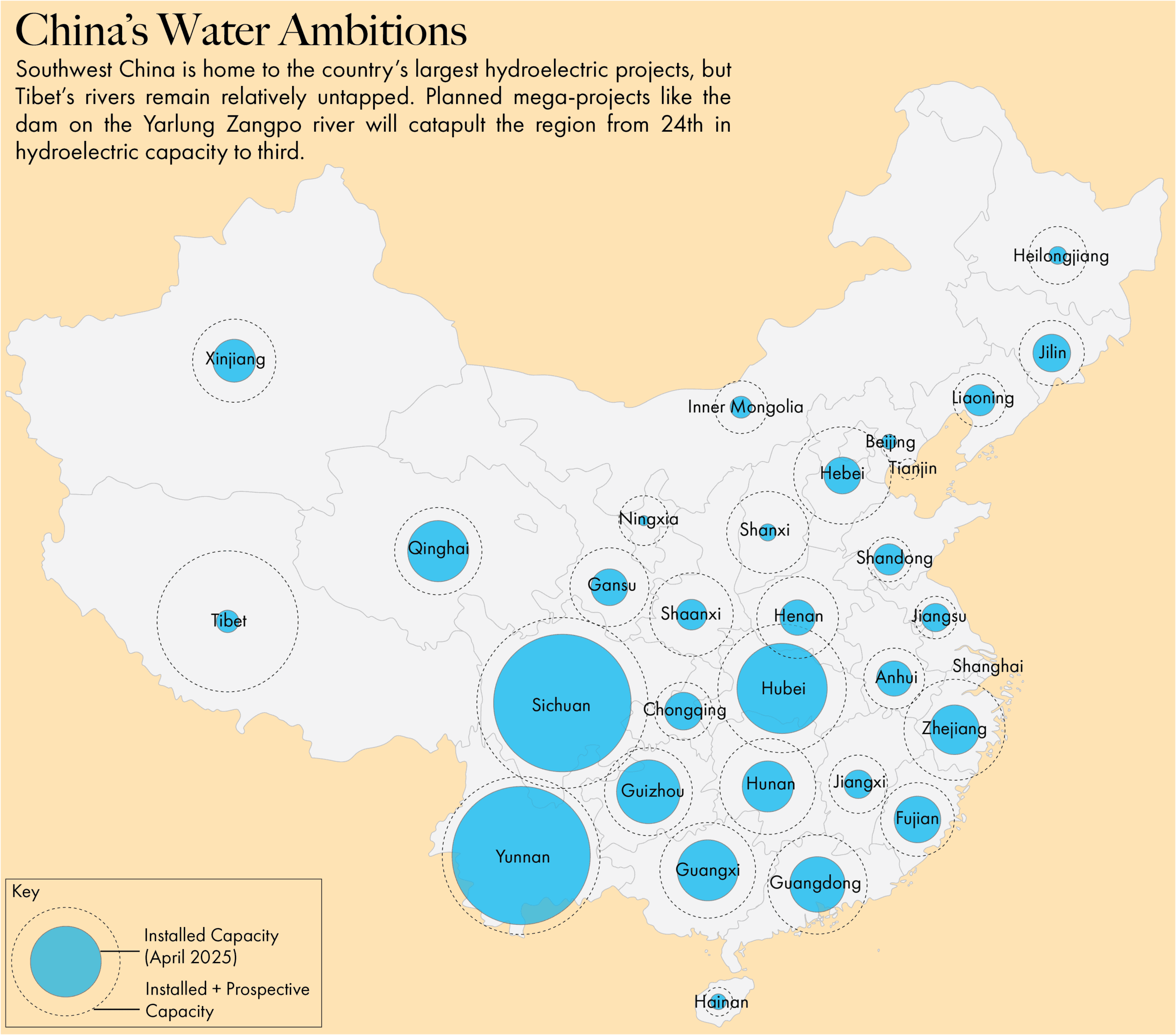
Hydropower is already China’s largest renewable energy source, contributing 13 percent of its total energy capacity in 2024. The bulk of its hydropower currently comes from the country’s southwest provinces of Sichuan and Yunnan, whose tangle of rivers and proximity to population centers have to date attracted China’s utility giants.
But China is running out of undeveloped major potential hydro sites, forcing companies to look farther afield. Tibet remains one untapped frontier. The source of many of Asia’s most important rivers — including the Yangtze and the Mekong — ranks just 24th out of China’s 31 provinces and regions by installed hydro capacity, according to data from Global Energy Monitor. Completion of the Yarlung Zangpo mega-dam, as well as other hydro projects planned for the region, would catapult it to third.
The dam project’s launch also reflects Beijing’s continuing penchant for big infrastructure projects to support the Chinese economy. The cost of the project works out to an average annual investment of RMB 120 billion ($16.7 billion) out to 2035 – equivalent to nearly half of Tibet’s entire 2024 gross domestic product (GDP). On those figures, it could add 0.15 percentage points on average to China’s GDP growth over the next decade, Zhou Junzhi of brokerage China Securities estimates.
Its economic contribution will drive investment into the region…along with roads and railways at a time when there is a lot of pressure on heavy industry to find a market for its products.
Belinda Schäpe, a China policy analyst with the Centre for Research on Energy and Clean Air, a Helsinki-based think tank
Beijing has offered few details about how the mega-dam will be financed. Past hydroelectric projects have been funded through lending by China’s state-owned development banks, repaid with future hydro power revenues.
But Yarlung Zangpo has already proved a boon for China’s construction and heavy industry firms, hit hard by the slowdown in China’s real estate market. Shares in Shanghai-listed Power Construction Corp, a state-owned enterprise that specializes in hydropower projects, rose by their daily limit of 10 percent on Monday after the groundbreaking — it closed up 32 percent for the week on Friday. Huaxin Cement, one of China’s oldest cement companies, is up 15 percent this week. Chinese iron ore and steel rebar futures have also soared.
“The way the project is being framed domestically is definitely more as an investment opportunity, given the economic challenges China faces at the moment,” says Schäpe.
Technical advances also help explain why Beijing has decided to pursue the Yarlung Zangpo project now. Proposals to dam the river stretch back decades, according to Charles Parton, a former British senior diplomat who has spent years tracking water politics in China. Indeed, groundwork began back in 2009, when the central government spent close to 1 billion yuan ($156 million) on a highway to the sparsely populated county where the dam will be built.
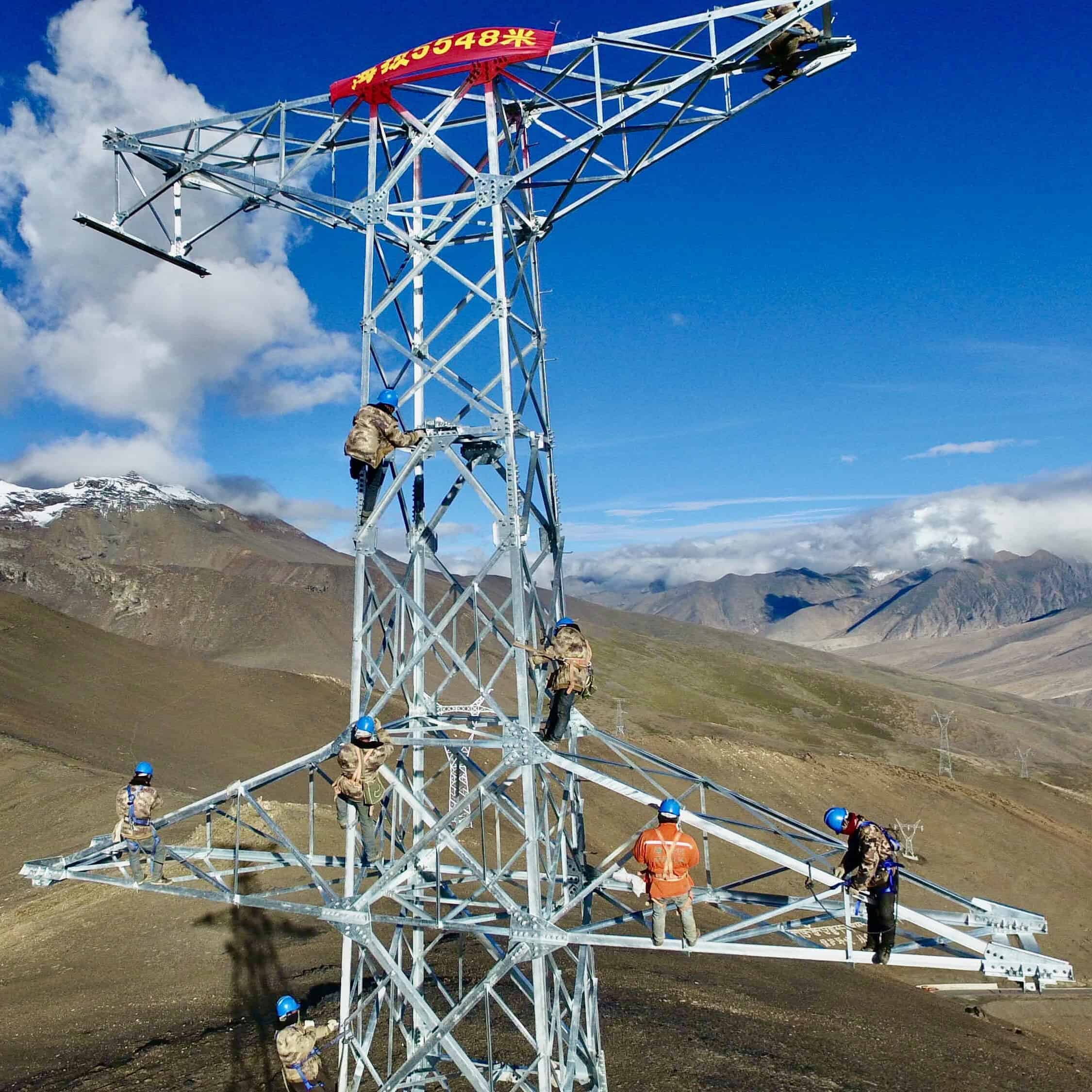
Until recently, the challenge of transmitting the enormous amounts of energy from rural Tibet to China’s power hungry eastern provinces thousands of miles away has held the project back, Parton says. Now, though, China has become a leader in designing and constructing ultra-high voltage transmission (UHV) lines — “electric highways” which allow the efficient transportation of electricity across vast spans. At the end of 2024, the country was operating 42 UHV lines, the longest of which begins in Tibet and stretches 1,901 kilometers — almost the distance from New York City to Miami.
Given China’s expertise with UHV, the challenge of extending the lines to the Yarlung Zangpo project is likely to be “incremental,” says Ismael Arciniegas Rueda, a senior economist at RAND.

Some analysts have warned of other technical and environmental challenges. Even if the dam is built to withstand earthquakes, “other uncontrollable events such as riverbank collapses, landslides, and mudslides… can pose a significant threat to the project structure and may lead to severe secondary disasters,” Fan Xiao, a leading Chinese geologist, argued in a 2022 article.
A thornier obstacle for Beijing may be the diplomatic costs of damming a waterway that is a tributary to neighboring India and Bangladesh’s most important rivers.
The major issue is not that a project like this will be destructive downstream. It’s that, in the absence of data transparency and path for regional diplomacy, it’s pretty inevitable that in the context of a warming climate it will stoke tensions.
Sam Geall, a fellow at the Oxford Institute for Energy Studies
China’s plans have incensed politicians in India: Tapir Gao, a member of India’s ruling Bharatiya Janata Party, has called the dam “monstrous” and a potential disaster for northeastern India and Bangladesh. In response, a Chinese Foreign Ministry spokesperson said this week that China would engage in “cooperation with downstream countries on sharing hydrological data, flood prevention and disaster reduction.”

Sam Geall, a fellow at the Oxford Institute for Energy Studies, reckons fears about the project’s impact on India’s water access are overplayed, given that the river changes and expands significantly further downstream in India.
“This is not a project where China effectively has its hands on the tap,” he says. “It’s not as if China can exert that much control over the flow of the river downstream.”
Geall notes that China has devised ways to mitigate tensions over its dams with its neighbors, such as an agreement with five southeast Asian countries on the Mekong river that gives them access to real-time data on water levels. But that will be harder to achieve with India, given the two countries’ frosty relations.
“The major issue is not that a project like this will be destructive downstream,” he says. “It’s that, in the absence of data transparency and path for regional diplomacy, it’s pretty inevitable that in the context of a warming climate it will stoke tensions.”

Eliot Chen is a Toronto-based staff writer at The Wire. Previously, he was a researcher at the Center for Strategic and International Studies’ Human Rights Initiative and MacroPolo. @eliotcxchen