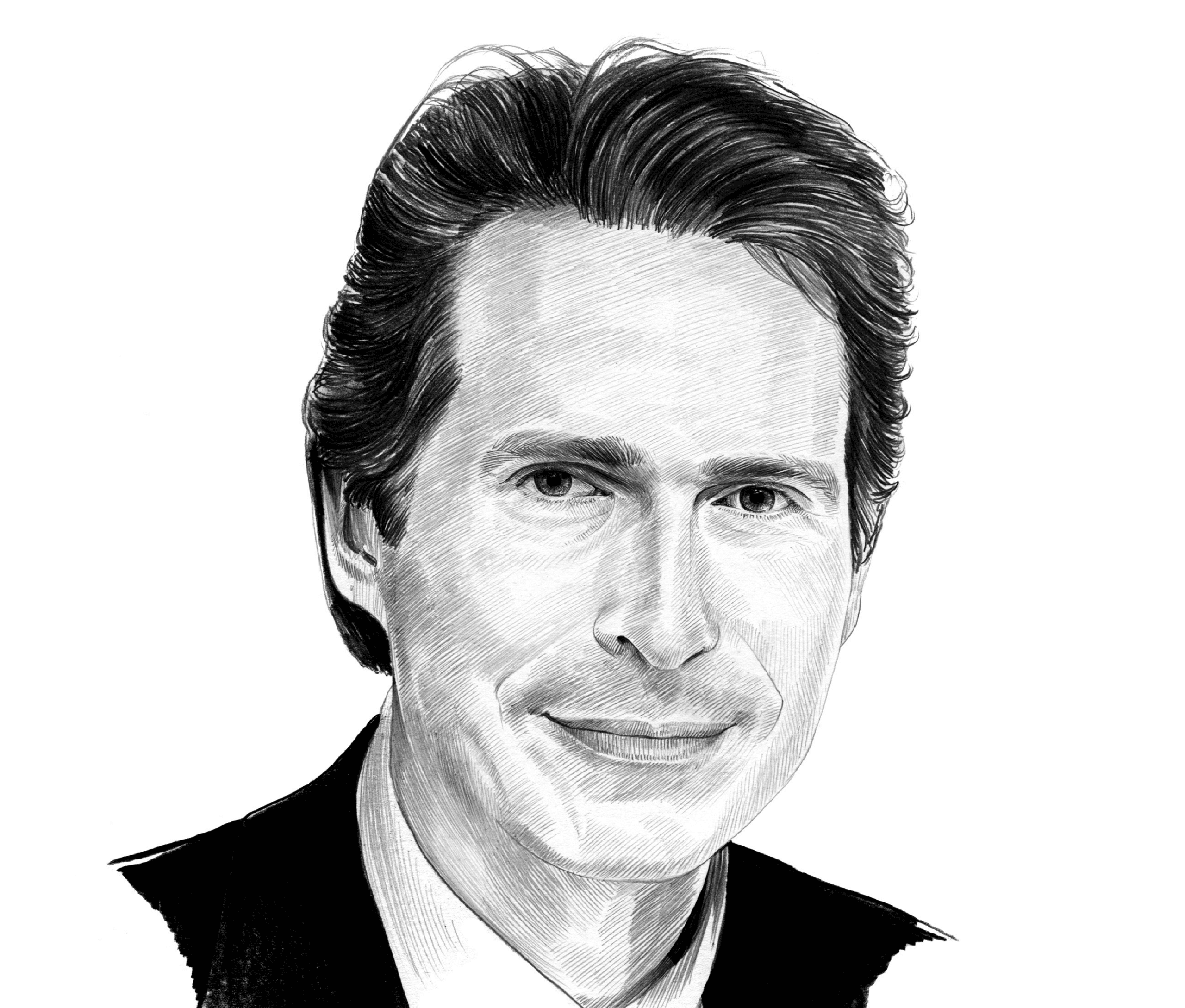
Some years ago, Elbridge “Bridge” Colby, the newly christened top policy official in the U.S. Department of Defense, met a People’s Liberation Army officer in Beijing and asked him whom he believed was the greatest Chinese leader. Colby, a history buff, grand strategist and self-described “conservative realist”, recalled in a 2023 interview that the officer’s answer was “Mao Zedong, because, even though he made mistakes and did some bad things, he was the one who got up at the proclamation of the People’s Republic and said, ‘China has stood up.’”

President Xi Jinping has made no secret of his own admiration for Mao — nor of his determination to finish Mao’s revolutionary mission by “re-unifying” Taiwan with China. If Colby has his way, that will not happen, at least not on his watch.
Today Colby, a graduate of Harvard College and Yale Law School with stints in government and Washington think tanks, is under secretary of defense for policy, often referred to as the Pentagon’s third most powerful civilian position. But with two manifestly inexperienced civilian superiors — former Fox News anchor Pete Hesgeth and Stephen Feinberg, a billionaire hedge fund founder — Colby, 45, may end up wielding far more influence in shaping U.S. defense policy than his predecessors.
If so, that could result in a total reorientation of American military might towards Colby’s overwhelming strategic priority of countering China — lesser interests be damned. Like his big boss in the White House, he intends to dramatically shake things up.
[Colby] is somebody who grew up thinking about foreign policy. Even his worst enemies have to concede that he’s not a provincial.
Edward Luttwak, a geopolitical consultant
“Senior leaders at the Pentagon have been asking me, ‘What are Secretary Colby’s views on things?’” says Oriana Skylar Mastro, a fellow at the Freeman Spogli Institute for International Studies at Stanford University who knows Colby well. “They’re trying to figure out what his objectives are going to be, which suggests that he can have a sizable influence on the direction of the department.”

Chief among Colby’s contentions is that Washington has not taken the Chinese threat seriously enough in the military realm over the last two decades. Colby, who did not respond to requests for an interview, blames this on “hubris”. As he often points out, the U.S. has not faced a rival with a similarly sized economy since Great Britain 150 years ago; China is the only country that has both the means and the will to truly threaten American security and prosperity. This means that Washington needs to triage its finite defense resources away from Europe and the Middle East and towards East Asia. It is high time for U.S. policymakers to eat humble pie, recognize America’s constraints and plan accordingly.
“I think people don’t actually think that the Chinese are so formidable a threat,” he said on a think tank podcast in 2023. “You see it on both sides [of the aisle]. ‘Oh, we have the best military in the world; we can handle this; we’re America.’ No! We could actually lose.”

Since Barack Obama, American presidents have hoped to “pivot to Asia.” Economists and geostrategists had long ordained that the region would become the world’s preeminent market, with Beijing aiming to dominate it. “The United States is a Pacific power and we are here to stay,” Obama declared in 2011. But while predictions about Asia’s importance have borne out, events elsewhere kept America stretched thin: the Arab Spring, Afghanistan, Ukraine, Israel. Colby has made his name by loudly, and often pugnaciously, arguing that Washington finally walk the walk and quit with all of that.
“The ‘unipolar moment’ is over,” he wrote in his 2021 book, The Strategy of Denial: American Defense in an Age of Great Power Conflict. “Above all, that is because of the rise of China.”
Defense Secretary Hegseth has been emphasizing Asia too. His first overseas trip, to much fanfare, was to the Philippines, Guam and Japan. And last month, at the Shangri-la Dialogue in Singapore, Hegseth warned that a Chinese invasion of Taiwan “could be imminent”, while stressing that the U.S. aimed “to prevent war” through deterrence with allies. “But if deterrence fails, and if called upon by my commander in chief, we are prepared to do what the Department of Defense does best, to fight and win decisively,” he said.

But though rhetorically grand, material changes on the ground have been lacking. Several defense experts pointed out that, a week after Hegseth’s Asia tour, the Pentagon shifted a carrier strike group away from the Pacific to the Middle East to deal with the Houthis in Yemen. Soon after that, Chinese Coast Guard forces landed on Sandy Cay, a contested territory in the South China Sea, and unfurled a Chinese flag, with no response from Washington.
Colby is also reportedly leading a review of AUKUS, the much-touted submarine and advanced technology development deal with Australia and the United Kingdom. AUKUS was conceived principally as a response to China’s rising naval prowess. But Colby, who has criticized the deal in the past for being too generous with some of America’s most advanced military technology, may end up scrapping it.
“The major posture change that we’ve seen thus far in this administration is moving forces from Asia to the Middle East,” says Zack Cooper, a senior fellow at the American Enterprise Institute. “That was a surprise to many of us who expected to see them do the opposite.”
MEET THE PRIORITIZERS
Even before he was confirmed in April, Colby had become the most prominent of the “prioritizers”, a group of mostly young, conservative foreign policy thinkers who advocate for a less-is-more approach in a multipolar world, with a near-singular focus on deterring China. They abhor the “primacists” of the Reaganite and War on Terror mold, who contend that America remains the world’s indispensable and fully capable global policeman. Colby and his fellow prioritizers have made common cause with the “restrainers”, a more isolationist faction on the right. The current administration contains representatives from all three ideological factions, battling it out. Some see this as a recipe for policy incoherence.
“In a lot of administrations, you would sort out in a campaign the logic of how an administration is going to think about the world,” says Cooper. “But in the Trump administration, we’re seeing a variety of officials with very different views and they are all competing for influence.”

More befitting a politician than an intellectual, Colby has sat for countless press and podcast interviews lambasting the overreach of his primacist foes. On X, he is a frequent and pugilistic poster. He blames the primacists for dragging America into pointless wars in Iraq and Afghanistan while neglecting the China threat. Beijing boasts the world’s largest navy, a frightening nuclear arsenal, hypersonic missiles and a military industrial base that dwarf’s America’s. Moreover, Xi Jinping wants to be ready to invade Taiwan by 2027, according to U.S. intelligence reports. “[T]he hour is so late and the problem is so urgent,” he has said, in explanation of his perpetual agonising about China.
“When he was appointed to this position in the Pentagon, given the lack of knowledge of other Trump appointees, Colby certainly stood out as someone who is a serious person,” says Susan Shirk, a former a former State Department official and the author of Overreach: How China Derailed Its Peaceful Rise.
Trump and Colby hate some of the same things: neoconservatives, George W. Bush’s foreign policy and the grand strategy of liberal hegemony.
Stephen Wertheim, a senior fellow at the Carnegie Endowment for International Peace
“He is somebody who grew up thinking about foreign policy,” adds Edward Luttwak, a geopolitical consultant who knows Colby. “Even his worst enemies have to concede that he’s not a provincial. He’s not somebody who suddenly leapt out of Arkansas because Trump likes him.”

It is not only influential Americans who are listening to Colby’s megaphone in search of policy clues. “In all of the meetings that I have with Asian interlocutors — officials in Japan, South Korea and Taiwan — he’s almost the only U.S. official that’s brought up,” says David Sacks, a fellow for Asia studies at the Council on Foreign Relations. “The perception in the region is that what he says matters and is reflective of policy, which actually gives its own momentum to those positions.” At the recent Shangri-la Dialogue in Singapore, adds Cooper, “Bridge came up very frequently” in sideline discussions with foreign officials.
In reams of articles and essays, Colby approaches grand strategy with a chilly and uncompromising logic. In his assessment, prioritizing China requires difficult decisions. Given the scale of Beijing’s capabilities, America has only so many military resources that it could marshall in the event of a war over Taiwan or contested shipping lanes in the South China Sea, which China illegally claims sovereignty over. Colby has argued that optimizing these resources towards deterring or battling China should require, among other painful trade-offs, abandoning Ukraine to its fate or allowing Iran to go nuclear. Among primacists, both recommendations are received as near-apostasies.

“[Colby’s ideas are a] geostrategic self-harm that emboldens our adversaries and drives wedges between America and our allies for them to exploit,” said Sen. Mitch McConnell (R-KY) in a statement, after voting against Colby’s confirmation. “Make no mistake: America will not be made great again by those who are content to manage our decline.” McConnell also voted against four other Trump nominees: Hesgeth, Tulsi Gabbard, Robert F. Kennedy Jr. and Lori Chavez-DeRember.
Supporters say Colby is simply giving America the medicine that it needs, however unpleasant the taste. “He is about recognizing the reality of the world, which is that we are now facing peer competitors,” says Jennifer Kavanagh, an Asia-focused expert at Defense Priorities, a non-interventionist think tank. “It’s a balance of power view of the world rather than a U.S. primacy view of the world.”

Colby’s heterodox convictions have endeared him to President Trump and other leaders of the MAGA movement. Like him, they advocate for a contractual, values-free approach to foreign affairs. In their view, the past decades of American interventionism, led by a trigger-happy elite power-drunk on gauzy visions of democracy promotion, have done everything but put “America first.” “Unipolarity, not having any constraints, made us stupid,” Colby has said of the post-Cold War period in Washington.
“Trump and Colby hate some of the same things: neoconservatives, George W. Bush’s foreign policy and the grand strategy of liberal hegemony,” says Stephen Wertheim, a senior fellow at the Carnegie Endowment for International Peace.

This inter-Republican battle was on vitriolic display around Colby’s appointment hearing. In February, far-right activist Charlie Kirk called out Sens. Tom Cotton (R-AK) and Roger Wicker (R-MS) for reportedly attempting to torpedo Colby’s confirmation. “This is the next deep state plot against Trump,” Kirk seethed on X. Donald Trump Jr., the president’s eldest son, joined in. “Any Republican opposing @ElbridgeColby is opposing the Trump agenda,” he tweeted. “Why the opposition to Bridge?” Elon Musk wondered on the platform.
Trump Jr. further boosted Colby in an op-ed. “In past years, Colby would be stabbed in a political dark alley,” he wrote. “But now with the MAGA movement awake and alive to the deep state, we can — and must — fight back.”
In a final seal of MAGA approval, Colby was introduced at his confirmation hearing by Vice President J.D. Vance (Colby has close relationships with Vance and the Republican Senator Josh Hawley.) “Bridge predicted what we would be talking about five years down the road, ten years down the road,” the vice president said. “He saw around corners that very few other people were seeing around.” Colby’s confirmation passed on a 54 to 45 vote, which included three Democrats in favor.

Colby’s rise tracks a hard pivot in conservative foreign policy. As Trump’s return reshapes America’s role in a fractured, multipolar world, Colby’s relentless focus on China is primed to take center stage. He has championed a hawkish, Asia-first strategy that sidelines democracy promotion in favor of raw military deterrence. Some describe him as a visionary for a new era. Others see a dangerous ideologue on the rise.
“Where the U.S. pulls back, there’s a vacuum,” John Bolton, Trump’s first term national security advisor, told The Wire China. “One of two things is going to happen. Either our adversaries fill it or you get anarchy. The Chinese are going to take advantage.”
STRATEGIC AMBIGUITY
Colby speaks during a panel on American military power, January 24, 2024. Credit: Heritage Foundation
Colby has roots in Asia. He spent some of his childhood in Tokyo, where his family had relocated for his father’s job with the American investment bank, First Boston. For high school he returned to the U.S. to attend Groton, an elite private academy in Massachusetts. As a young man interested in Vietnam War history, Colby developed “a sense of the limits of American military power,” he has said. He became enamored with the work of John Mearsheimer, a prominent realist at the University of Chicago. While working at a high school newspaper, he came out against the U.S. intervention in Kosovo. “I had an aversion to the use of military and American power to these very aggressive liberal or neoliberal global aims,” Colby has said.
After 9/11, he would argue with fellow conservatives who supported Operation Iraqi Freedom. His former classmate, the New York Times columnist Ross Douthat, recalled these arguments in a 2021 column. “Nightly in our unkempt apartments he argued with the hawks — which is to say all of us — channeling the realist foreign policy thinkers he admired, predicting quagmire, destabilization and defeat.” In 2003, before law school, Colby saw that American quagmire firsthand while on staff with the Coalition Provisional Authority in Baghdad. He argued that it was a misallocation of American resources and a destabilizing factor in the Middle East.
He’s very savvy about policy but he also understands Washington broadly and this administration and the people in the Trump orbit in particular. The challenge now is: can he actually put his own personal views in place in an administration where the grand strategy is contested?
Jacob Stokes, a senior fellow at the Center for New American Security
In public appearances, Colby can appear stern and combative. But colleagues say that he does not take himself so seriously in private. Mastro, the Stanford fellow, recalled a trip to China with him on an academic trip about a decade ago. During it, Mastro recalls, Colby poked fun at his own blue-blooded pedigree: blonde, Ivy-educated, with the aristocratic name Elbridge Andrew Colby III. His famous ancestry went unsaid: his grandfather, William Colby, led the CIA under presidents Nixon and Ford (Colby’s father, Jonathan, is a senior adviser at the Carlyle Group, a defense-friendly private-equity giant; his wife, Susana, is the former president of a Brazilian federal economic institute.)

In 2010 Colby joined the Center for Naval Analysis, a U.S. Navy think tank, where his professional focus gravitated to nuclear deterrence. Three years later, he moved to the Center for New American Security, a left-leaning think tank founded by Michele Flournoy, Obama’s under secretary of defense for policy, and Kurt Campbell, Biden’s Asia czar. He also worked for WestExec Advisors, a consultancy founded in 2017 by Flournoy and Biden’s secretary of state, Antony Blinken.
In 2015, the Wall Street Journal reported, Colby was considered as a national security advisor for the Jeb Bush campaign. He was reportedly rejected due to his aversion to neoconservatism. When Trump, the sole neoconservative-adverse candidate, won, Colby was invited into the administration. At the Pentagon, he worked as deputy assistant secretary of defense for strategy and force development under General James Mattis.

While there, Colby oversaw the development of the 2018 National Defense Strategy. This tone-setting guidance outlines the Pentagon’s approach to achieving a president’s national security objectives. The guidance was notable for shifting U.S. defense strategy away from global terror to a focus on “great power competition.” The “central challenge facing the Department of Defense and the joint force [is] the erosion of U.S. military advantage vis a vis China and Russia,” the guidance stated.
After a year in government, Colby returned to CNAS. But he soon left to start his own think tank. The Marathon Initiative, co-founded alongside another former Trump official, Wess Mitchell, is based on “the conviction that strategy is possible and, in situations such as today in which America cannot simply outspend or overwhelm its rivals, more necessary than ever,” says its website.
In 2021 Colby expanded on the themes laid out in the 2018 National Defense Strategy in his first book, The Strategy of Denial. For a long, technical rumination on U.S. defense policy, it made a big splash. The foreign policy writer Robert Kaplan called it “exceptional,” comparing Colby’s “theoretical mastery” to Hans Morgenthau, an influential 20th century scholar on international relations. Former congressman and China hawk Mike Gallagher deemed it “an essential read.” Among national security types, Colby had already established some renown for spearheading the 2018 National Defense Strategy. His book raised his profile even higher.
Russia’s full-scale invasion of Ukraine, in 2022, further inflated it. At a time when much of Washington was rallying behind the embattled Ukrainians and calling for President Biden to send more military aid, Colby argued vehemently, on X and elsewhere, against doing so, citing a need to retain American military stockpiles for the China threat. “Despite protestations to the contrary, it’s increasingly clear that Ukraine is indeed a distraction from our stated priority: Asia, China, and Taiwan,” he tweeted in January 2023. “We can admit it and try to adapt. Or we can deny it and pay the price later.”

Colby continued his drumbeat call to disengage from Ukraine through the 2024 election. He also made his support for Donald Trump loud and clear; to anyone paying attention, it was obvious that he was jockeying for a job. A week after election day, Colby appeared on Tucker Carlson’s longform interview program in what looked like an audition.
Elbridge Colby appears on ‘The Tucker Carlson Show’, November, 2024. Credit: Tucker Carlson
“We stand on the possible precipice of World War III, and we need a fundamental change before we ram right into the iceberg,” Colby warned. “The Washington blob establishment can get us into wars and crises, but they can’t fix the problem.”
“Elbridge Colby, I wish you were running the State Department,” Carlson gushed.
A few days later, Colby was on Laura Ingraham’s program on Fox News, another influential MAGA figure. With his perfectly combed hair, fluent grasp of the issues and steely stare, Colby looked, as Trump likes to say, “straight out of central casting.”
Elbridge Colby appears on the ‘Ingraham Angle’ show, November 13, 2024. Credit: Fox News
“He’s very savvy about policy but he also understands Washington broadly and this administration and the people in the Trump orbit in particular,” says Jacob Stokes, a senior fellow at CNAS. “The challenge now is: can he actually put his own personal views in place in an administration where the grand strategy is contested?”
“Colby has intellectualized Trump’s reflexes in respect to the Indo-Pacific,” adds Andrew Latham, an international affairs scholar at Macalester College. That is not an easy thing to do for a president who, as Latham notes, “hates intellectuals”.

ISLAND HOPPING
In Colby’s grand strategic mental map, nowhere has taken up more space than Taiwan. If the People’s Republic were to seize control of the independently-governed island, this would grant China a stranglehold over vital maritime trade routes, control over the world’s semiconductor supply, and upend America’s network of alliances in Asia. It would also break up what is known as the first island chain, an important strategic bulwark for the U.S. and its Pacific allies, according to defense experts. In his writings and public appearances, Colby has long described this scenario as a “disaster for American interests.”
“In such a scenario, global trade and commercial flows will gravitate toward and around China,” he warned in a speech at the Miami National Conservative Conference in 2022. “It will be the gatekeepers to the world’s largest market area with unmatched scale, which of course is key to economic development.”

“If I were secretary [of defense], I would say every day, ‘How are we getting better on the Taiwan fight? Are we buying the right things? Are we buying enough ammunition?’” he said in 2023. “Then I would push the Taiwanese really hard to buy the right [weapons].”
But over the last year, Colby’s hawkishness has seemed to soften. “Americans may be prepared to support a defense of Taiwan, but it has to make sense,” he tweeted in August. “And the best thing for that is Taiwan doing more for its own defense.” This tweet and others raised eyebrows among national security colleagues. Then, at his confirmation hearing, Colby seemed to downplay Taiwan as “not an existential interest” for America, further sowing suspicions that he had flip-flopped. Observers were puzzled.
…there’s not yet evidence that the president’s views are aligned with the preferences of Bridge Colby. To the contrary, what we’ve seen is Bridge Colby aligning his views to those that he understands to be the president’s.
Ryan Hass, a senior fellow at the Brookings Institution
“He wrote a book saying, essentially, that defending Taiwan is the highest priority,” says Bolton. “But more recently he’s been saying, ‘Well, maybe we can’t even defend Taiwan.’ So I don’t know what his position is at any given moment.”
Elbridge Colby discusses Taiwan during a hearing to confirm his nomination to be Under Secretary, March 4, 2025. Credit: Senate Committee on Armed Services
Some wondered if Colby was adjusting his views to better align with President Trump’s, who has complained that Taiwan is “ripping off” the U.S. in trade and is a drain on American defense resources. During a Washington Post interview last year, the president remarked that Taiwan’s defense spending should be at ten percent of its gross domestic product, a fantastically high figure. During his confirmation hearing, Colby recommended the same figure.
“Is Taiwan ever going to reach 10% of GDP on defense? No,” says Sacks, of CFR. “Is that a reasonable expectation of Taiwan? No. But because Trump said it, it has to be held up now as the standard.” (Taiwan has since vowed to raise defense spending to 3 percent of GDP, from 2.5 percent.)

Colby has remarked that he thinks little about politics, focusing strictly on matters of strategy and logic. But to some his actions seemed to run counter to that claim. “I think Bridge has morphed over time, for legitimate reasons,” says a former defense official and friend of Colby’s who requested anonymity. “He believes there are not enough resources for a globalist foreign policy. That’s a legitimate argument. But he’s also morphed for less legitimate reasons which is to align himself with the Trump orbit.”
“There is a Colby pre-appointment and a Colby post-appointment,” says Mastro, of Stanford. “It’s unclear if Bridge’s preferences are still the same, that we should focus on the Indo-Pacific, and I’m not sure how much this administration is actually going to do that.”

Still, there are signs that Colby’s long-argued sinocentric views are making headway in the Pentagon.
The interim National Defense Strategy, though distributed prior to Colby’s confirmation, is in clear line with his thinking. The official who likely drafted it, Alexander Velez-Green, is a close associate of Colby’s (he and two other known prioritizers have since taken top positions in the Pentagon.)
“Denial of a Chinese fait accompli seizure of Taiwan — while simultaneously defending the U.S. homeland — is the Department’s sole pacing scenario,” the interim guidance read.
The guidance, which was leaked to the Washington Post, recognizes that to achieve this would require “tolerating more risk” in other theaters like Europe and encouraged European countries to take a larger role in managing NATO, which Colby has long advocated. (Colby and Velez-Green are currently at work on the 2025 National Defense Strategy, which is expected to be published in late August.)
Based on his past views, defense experts expected that Colby would encourage the Pentagon to reduce the U.S. troop presence in Europe and the Middle East; increase investment in small, dispensable systems like drones that would be useful in a war with China; and substantially cut funding for the U.S. Army, which would be less important in such a war compared to the Navy and Air Force. None of this, however, has happened yet.
“When it comes to making decisions on how the United States is going to deal with an emergent issue, it’s the president’s views that matter most and there’s not yet evidence that the president’s views are aligned with the preferences of Bridge Colby,” says Ryan Hass, a senior fellow at the Brookings Institution. “To the contrary, what we’ve seen is Bridge Colby aligning his views to those that he understands to be the president’s.”

Brent Crane is a journalist based in San Diego. His work has been featured in The New Yorker, The New York Times, The Economist and elsewhere. @bcamcrane