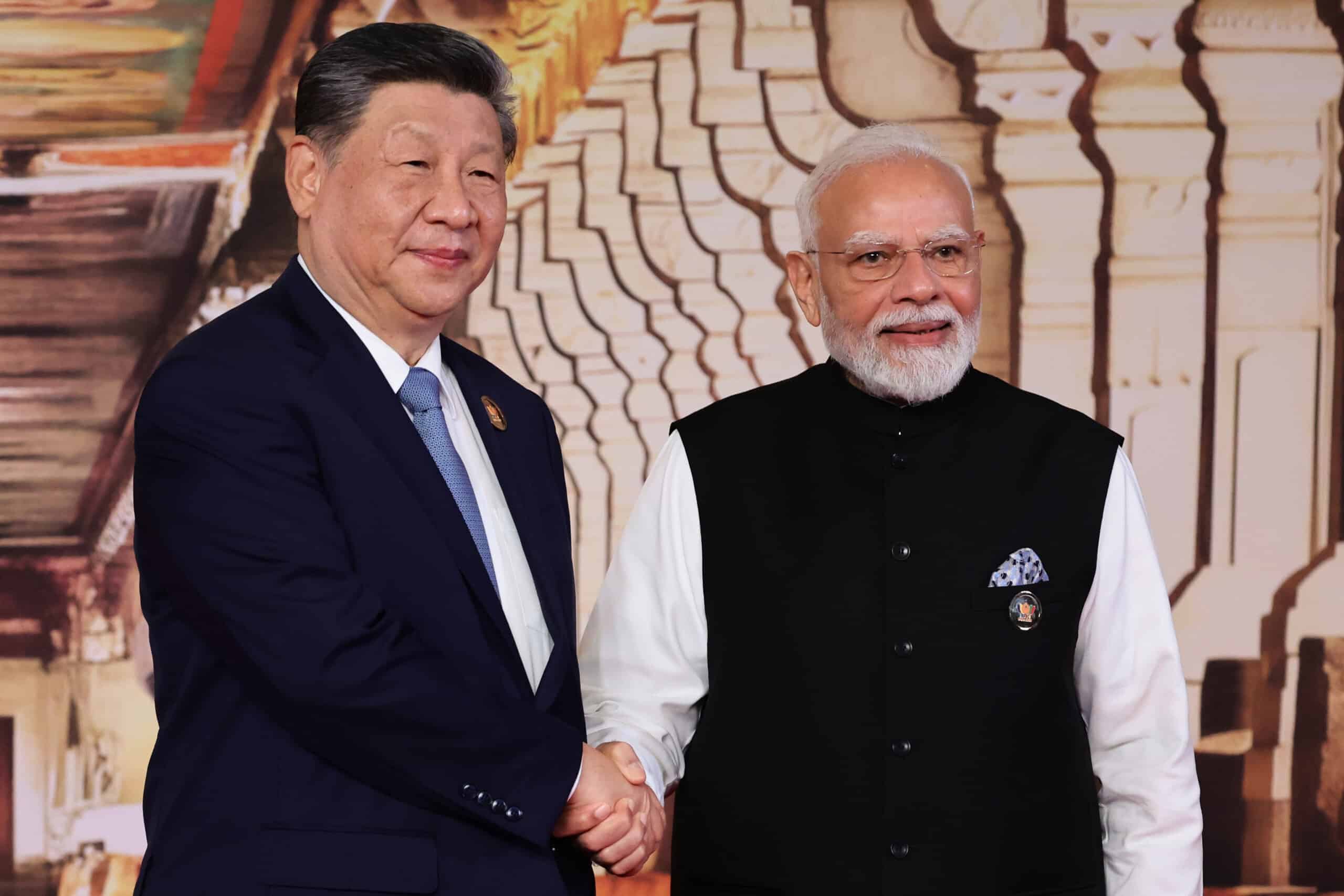
On February 14, as the ninth Asian Winter Games drew to a spectacular close, few watching Chinese state television would have recognized the stocky, open-shirted man sitting beside Premier Li Qiang in the VIP box of Harbin’s Convention and Exhibition Center.
Mark Brown, prime minister of the Cook Islands, wasn’t in Heilongjiang’s frozen capital for sport — nor its famous ice sculptures.
Prime Minister of the Cook Islands, Mark Brown, meets with Chinese Premier Li Qiang in Harbin, Heilongjiang, February 14, 2025. Credit: CCTV中国中央电视台
No leader of the south Pacific archipelago, home to just 15,040 people, had visited China for a decade. And Brown, who took office in 2020, would head home the next day with something he believed was worth the wait: a nine-point, five-year ‘comprehensive strategic partnership’ that, among other things, would allow Chinese researchers to survey the Cook Island’s 756,000-square-mile exclusive economic zone (EEZ), about the same size as Mexico.
Scientists already knew the region was flush with rocks, roughly the shape and appearance of avocados. They contain metals vital to rare-earth supply chains already dominated by China, such as cobalt and manganese, as well as nickel and copper.

The Cook Islands believes there are seven billion tons of these undersea “nodules” in its EEZ, worth as much as $10 trillion — half the sector’s global value, according to Boston-based management consultancy Arthur D. Little. But nobody knows for sure; no company has figured a way to mine them profitably. Forging partnerships with Chinese groups was, therefore, “very important for us as we move to a new and emerging sector which is, of course, our seabed”, Brown told China state television.
A few months later, China’s quiet moves in the Cook Islands were followed by a much louder riposte from U.S. President Donald Trump. On April 24, the president signed an executive order to enable the stockpiling of metals found in nodules, including cobalt and nickel. By promising to buy them, Trump is providing seabed miners with a critical incentive to invest in new operations.

“President Trump wanted to negotiate with Ukraine on some of the minerals … but now things get murky,” Chris Tang, a professor at UCLA’s Anderson School of Management, said of the administration’s clamor for rare-earths.
“Greenland is also more complicated. Excavating rare-earths on U.S. soil is a no-go because a lot of environmentalists are blocking mining,” adds Tang. “So where do they go?” One answer to this question is “to the bottom of the Pacific Ocean”, whether in international waters or EEZs like the Cook Islands’.
For his part, President Xi Jinping has stressed the need “to master key technologies in deep-sea access” to unlock the ocean’s “hidden treasures”. China is an influential member of the International Seabed Authority (ISA), a Kingston, Jamaica-based body comprising 167 member states.

The U.S. is not. It never joined the ISA and in signing his executive order, President Trump was deliberately snubbing its hesitancy to mine in international waters. This could prove diplomatically disastrous in the South Pacific, a region whose island states are increasingly leaning towards Beijing. It could also turn the high seas into a Wild West where, according to Tom LaTourrette, a senior physical scientist at the RAND Corporation, “only pirates and lawyers win”.
By contrast, Xi’s courtship of Brown was inspired. EEZs such as the Cook Islands’ are not subject to the ISA ban, giving China a partnership that could lead to joint mining operations.
Chilly Reception

But when Brown wouldn’t reveal the deal’s finer points upon his return home, islanders grumbled about a Chinese takeover and lawmakers drafted a vote of no-confidence. New Zealand, with which the Cook Islands has been in “free association” since 1965, admitted it was “blindsided” by Brown’s deal, and said that constitutional arrangements require him to consult Wellington before signing anything.
Under the terms of the free association arrangement, New Zealand “must be involved in matters of disaster, defense and foreign affairs”. A 2001 “Joint Centenary Declaration” further requires the Cook Islands and New Zealand to “consult regularly on defense and security issues”.

Hundreds protested outside parliament in Rarotonga, the country’s main island. Cook Islanders are New Zealand citizens and speak a dialect of the latter’s Māori language. Some 80,000 Cook Islanders — five times more than the Cook Islands’ own resident population — live in their far larger neighbor. Some demonstrators waved their New Zealand passports, while others held placards reading “Stay connected with NZ”.
On February 22, a day after Chinese warships conducted a controversial live-fire drill between Australia and New Zealand, Brown released the partnership. It revealed that Beijing had, indeed, secured a maritime presence in the Cook Islands’ EEZ. “We are not a child,” Brown said in parliament, admonishing what he characterized as New Zealand’s paternalism. Such issues, he added, “are about our increasing sovereignty as a country, and about our self-determination”. On February 26, Brown survived the no-confidence vote.

The affair is a tremendous win for China and has shaken up the politics of the Pacific Ocean. It has driven a wedge between the Cook Islands and New Zealand, one of China’s main competitors for hegemony in the South Pacific. Brown is pressing for a reevaluation of the Cook Islands’ relationship with Wellington and expects to win several concessions. Seabed mining, Brown has said, “is part of our journey [towards] sovereign independence”.
While three Pacific island nations — the Marshall Islands, Palau and Tuvalu — recognize Taiwan, Brown was caught on camera last September assuring China’s ambassador to the Pacific, Qian Bo, that he would “correct” a regional communiqué that mentioned Taiwan. “We’ll remove it,” he told Qian.
Even if [China Minmetals Corporation is] not at the top of the class in terms of the technology, they’re going to do it at scale in a way that nobody else can.
Isaac B. Kardon, a senior fellow at the Carnegie Endowment for International Peace in Washington DC
China has also won the chance to examine what could be one of the richest mineral deposits on earth. Three Chinese behemoths will lead the charge: China Ocean Mineral Resources R&D Association, Beijing Pioneer Hi-Tech Development and China Minmetals Corporation.
From New Zealand’s perspective, the ease with which China carved off a slice of its own “realm” was a stark example of Beijing’s ability to tip the scales of political power in the Pacific. A spokesperson at the Chinese embassy in Wellington told The Wire China that while Beijing was “very respectful [of] the traditional links between New Zealand and the Cook Islands”, it will develop its bilateral relationship with Rarotonga based on the latter’s status as “an independent sovereign nation … We have nothing to hide”.
It will “take time to implement” the strategic partnership’s seabed mining deal, the spokesperson added. “There is some cooperation going on, but so far there hasn’t been any concrete result.”
Mark Brown did not respond to repeated email and phone requests for comment. His foreign secretary Tingika Elikana told Cook Islands News on May 12 that “we haven’t engaged with China [on] the next steps” of the deal.

China Ocean Mineral Resources R&D Association, Beijing Pioneer Hi-Tech Development and China Minmetals Corporation did not respond to requests for an interview.
With operations in over 60 countries, Minmetals has played a central role in the development and maintenance of China’s rare earths dominance, which currently accounts for 61 percent of global production and 92 percent of processing.
The group’s size alone may give it a decisive edge in seabed mining, an industry whose paths to profit are as unclear as the ocean depths at which it works. “Even if they’re not at the top of the class in terms of the technology,” says Isaac B. Kardon, a senior fellow at the Carnegie Endowment for International Peace in Washington DC , “they’re going to do it at scale in a way that nobody else can.”

For some western seabed miners, a colossal sunken treasure chest awaits those bold enough to try and unlock it. With one mining ship, says Hans Smit, president and CEO of Houston-based Ocean Minerals LLC, “we will produce five percent of the current world [cobalt] supply for 50 years, without running out”.

Others are less enthusiastic. Prices for cobalt and nickel, critical for the production of electric vehicle batteries, are already falling as terrestrial production increases. Advances in battery technology could also render both metals obsolete overnight. Even then, says investor and deep-sea explorer Victor Vescovo, “imagine the cost … to reactivate a mothballed mine compared to investing billions to start a new industry on the seafloor”.
“[Seabed miners] act like they’re going to save the world,” he adds, “And they’re not even going to scratch [the seabed].”
Vernian dreams
In his 1869 novel Twenty Thousand Leagues Under the Sea, French novelist Jules Verne mentioned “mines of zinc, iron, silver and gold” on the seabed. Just four years later, sailors aboard Britain’s HMS Challenger dredged up large quantities of “peculiar black oval bodies”, rich in manganese oxide, from depths of around 16,000 feet near the Canary Islands.

The Challenger continued to the Pacific on a legendary circumnavigation, skirting a 1.7 million square mile tract of ocean between Hawaii and Mexico. The area was packed with nodules and would later be named for the Clarion and Clipperton fracture zones (seabed scars formed by past tectonic activity) between which it lay. It would be almost a century, however, until a U.S. firm called Deepsea Ventures tested the world’s first deep sea mining system in the Atlantic, off the coast of South Carolina in 1970. Deepsea Ventures harvested cobalt, nickel and manganese needed to power fighter jets at a cost of $15m ($123m today).
Deepsea Ventures ran out of cash. But the U.S., Soviet Union, Japan, China and a handful of European nations dispatched ships to the Clarion-Clipperton Zone, or CCZ.

Pacific Island nations, many of whose EEZs were believed to be littered with nodules, also saw the chance to manifest their own Vernian dreams. “The discovery and extraction of minerals from the seabed around our Islands may become a possibility,” Sir Albert Henry, the Cook Islands’ first prime minister, said in 1974. “In the event of that possibility becoming a reality, it would be only fair and just for the Cook Islands to receive the benefits from the seabed.”

Alarmed by this oceanic free-for-all, the UN hastily adopted its Convention on the Law of the Sea (UNCLOS) in 1982. This included the formation of the ISA, which is tasked with ensuring that seafloor resources benefit “mankind as a whole” while giving “preferential treatment” to poorer nations “in the event of financial benefit”. One hundred and sixty-seven countries ratified UNCLOS. The U.S. did not.
At the time, the prospect of seabed riches was not on China Minmetals’ agenda.
Minmetals was founded in 1950 with a mission to “serve and reinvigorate [China] through mining.” An import-exporter of metals, minerals, hardware and business materials, Minmetals diversified upon China’s opening up in 1978 into real estate and engineering. It also aggressively bought mining rights around the world — especially from the 1990s when, having fallen behind the U.S. and other competitors in fossil fuels, China pivoted to the excavation of rare earth metals required by emerging renewable energy industries.

In 2009 Minmetals bought ailing Australian copper, zinc and goldminer OZ Minerals. Three years later, it acquired the large Kinsevere Copper Mine in the Democratic Republic of Congo. In 2014, Minmetals bought Peru’s Las Bambas Copper Mine, one of the world’s largest, to which it has since added nickel and cobalt operations in Papua New Guinea, a Botswana copper mine and British miner Anglo American’s Brazilian nickel assets. Throughout, Minmetals has faced accusations of environmental and labor abuses.
This entire time, the U.S. sat outside the ISA while China worked the system from within. In 2015, Minmetals penned a 15-year contract with the ISA to explore parts of the CCZ. Chinese miners now hold five of 30 such contracts, more than any other nation. Three are in the CCZ, with one each in the west Pacific and Indian Ocean. China is the ISA’s biggest financial backer and has a large delegation in Kingston.
China’s ISA Contracts for Deep-Seabed Exploration
| Contractor | Location | Mineral Type | Contract | Contract Area (sq kilometers) | Start Date | Valid Through |
|---|---|---|---|---|---|---|
| China Ocean Mineral Resources and Development Association | Clarion-Clipperton Zone | Polymetallic nodules | Click to View | 75,000 | May 2001 | May 2021 |
| China Ocean Mineral Resources and Development Association | Southwest Indian Ridge | Polymetallic sulphides | Click to View | 10,000 | November 2011 | November 2026 |
| China Ocean Mineral Resources and Development Association | Western Pacific Ocean | Cobalt-rich ferromanganese crusts | Click to View | 3,000 | April 2014 | April 2029 |
| China Minmetals Corporation | Clarion-Clipperton Zone | Polymetallic nodules | Click to View | 72,745 | May 2017 | May 2032 |
| Beijing Pioneer Hi-Tech Development Corporation | Clarion-Clipperton Zone | Polymetallic nodules | Click to View | 74,052 | October 2019 | October 2034 |
Since 2020 technicians have also trained at the ISA-China Joint Training and Research Centre in Qingdao — one of the stops on Mark Brown’s whirlwind trip earlier this year.

In 2024 a group of 346 U.S. politicians and military leaders, including former Secretary of State Hillary Clinton, former Defense Secretary Chuck Hagel and former National Intelligence Director John Negroponte signed an open letter claiming that China had “taken advantage of our absence [at the ISA] to undermine critical U.S. economic and national security interests”.
All this is part of a wider push to extend President Xi’s Belt and Road Initiative, thus far directed westwards across the Eurasian landmass, eastward. In doing so, China hopes to carve a “blue economic passage” through the South Pacific.
While New Zealand is the Cook Islands’ biggest aid donor, giving $219m between 2008 and 2022, China was the second-most-generous with $112m over the same period. Mark Brown’s partnership also came with a $1.5m pledge from China to open a ferry line between Rarotonga and some of the country’s most isolated northern atolls. Meanwhile, the Cook Islands have received $95,000 in aid from the U.S. over those 14 years.
dumbo octopuses and $770 million vacuum cleaners
The ISA is supposed to have jurisdiction for any activity on the “high seas” — the technical term for international waters. The CCZ lies in such an area.
Musk or someone will go, ‘This is how you break the monopoly of minerals from China. This will make America great again. We’ll be the first country to mine the seafloor for critical minerals.’ And you can just see a guy like Trump going, ‘That sounds awesome.’
Victor Vescovo, an investor and deep-sea explorer
Yet all sovereign nations are free to do as they please within their own EEZs — which, in the case of the 14 small island nations of the South Pacific, constitute around ten percent of the world’s oceans. Already among the countries most affected by the many effects of global warming — rising sea levels, droughts and dwindling fisheries — they are also wary of the many environmental questions surrounding seabed mining.
A “dumbo” octopus swimming in the CCZ. Credit: National Oceanic and Atmospheric Administration
Mining vehicles, which crawl along the ocean floor vacuuming up nodules, run over organisms and kick up sediment, disturbing ecosystems about which very little is known. The highest-profile western mining company, The Metals Company (TMC) of Canada, says that life has returned to its test sites after a single year. Scientists not associated with the industry point out, however, that over half a century after Deepsea Ventures’ operations off South Carolina, its site remains deeply scarred. The CCZ seabed is home to a diverse range of life, from sponges to sea cucumbers and cat-sized “dumbo” octopuses.
In 2015, Palau created a 193,000-square-mile marine sanctuary, banning fishing or mineral exploitation. In 2017, the Cook Islands similarly designated its patch of the Pacific, naming it Moana Marae or “Sacred Ocean” in Māori. Despite broad commitments to sustainability and the environment, neither the strategic partnership with China, nor its accompanying memorandum on strengthening “blue economy” cooperation, mentions the marae. The generally poor environmental and labor record of China’s mining companies is feeding fears that its seabed miners could harm the ocean environment. (Beijing’s own environment ministry has slammed Minmetals in particular as a “repeat offender” at home.)

“The [environmental] needs of our people seem to be dropping further and further down the priority list,” says Louisa Castledine, of Rarotonga-based Ocean Ancestors, of the Cook Islands’ China deal. There is also concern that Chinese seabed mining could provide cover for other activities. In 2021 the research vessel Dayang Yihao, on a four-month sortie for Minmetals, veered out of the CCZ and into the U.S. EEZ near Hawaii, remaining there for five days.
Surveying those depths would potentially allow the People’s Liberation Army to predict U.S. naval movements. “In the undersea domain, U.S. submarine capabilities [and] submarine warfare capabilities continue to be generations ahead of China’s,” says Isaac Kardon at Carnegie. “I think they’re looking for … asymmetric ways to blunt that advantage.

The ISA has been deadlocked for years on drafting a legal framework for seabed mining because, miners say, of pressure from nations with big terrestrial extraction industries. “[The ISA] may argue that they’re doing it from an environmental [position],” says Oliver Gunasekara, CEO of California-based miner Impossible Metals. “But when you have countries like Chile taking the lead — the world’s biggest copper producer — they’re clearly doing it to protect the mining industry.”
Nauru, Kiribati and Tonga have joined the Cook Islands in welcoming seabed mining exploration in their waters. Without ISA approval, miners cannot work in nodule-rich areas on the high seas, like the CCZ, but they would be able to proceed in EEZs.

Costs are also high. An undersea mining vehicle currently costs up to $20 million and support vessels around $500 million; the cost of the technical gear needed to connect the two runs to about $250 million.
This plays into a key Chinese advantage: western miners must show investors — or, in TMC’s case, shareholders — a route to profit. Minmetals doesn’t. In 2024 it had profits of just $766 million compared to revenues of $132 billion.
Choke point
On April 4, in response to U.S. President Donald Trump’s sweeping trade tariffs, China placed export controls on seven categories of rare earth minerals used in the defense, EV and energy industries. The White House could no longer ignore Beijing’s command of some of the most important materials on earth. The only active rare earth mine in the U.S. is in Mountain Pass, California. Even at full capacity, it produces in a year what China does in a single day.
“[If] anybody has a monopoly,” says miner Hans Smit, “it’s not good for Joe Average.”
April 4 was a “red flag,” adds Chris Tang at UCLA. “The U.S. realised that if they don’t have access to these critical minerals, there could be potential problems down the road.”
Inaction is not an option; demand for rare earths is projected to double from 2020 to 2040, according to the International Energy Agency.

With the White House’s recent Ukraine minerals deal contingent on an end to the war with Russia, seabed mining is seen by some as a way to wrest rare earths superiority from Beijing. Top Trump officials including Marco Rubio and Mike Waltz were strong advocates for the sector before his second term began.
After the ISA again failed to pass regulations allowing for seabed mining in the high seas at its 30th session this March, Trump prepared his executive order to enable U.S. stockpiling of seabed-sourced minerals.
China’s foreign ministry hit back a few days later, saying that the seabed’s resources “are the common heritage of mankind”. But Trump’s move appears to have forced the ISA into action. In April its secretary-general, Leticia Carvalho of Brazil, promised seabed mining regulations by the end of the year.

“I thought it was somewhat ironic — at least odd — that China came out publicly stating that the U.S. should follow the ISA in the UNCLOS framework,” says RAND’s Tom LaTourrette, “given that they haven’t always played well with others”. China has been particularly disdainful of UNCLOS in asserting its expansive territorial claims across the South China Sea.
The Metals Company appears to be the main beneficiary of Trump’s order. CEO Gerard Batton recently appointed Silicon Valley investor Steve Jurvetson, a close friend of Elon Musk, to his board of directors. The firm’s announcement on March 27, that it would seek U.S. approval alone to mine the CCZ, was viewed with “deep concern” by Carvalho.

Trump responded to her concern with his executive order. “Musk or someone will go, ‘This is how you break the monopoly of minerals from China. This will make America great again. We’ll be the first country to mine the seafloor for critical minerals,’” says Vescovo. “And you can just see a guy like Trump going, ‘That sounds awesome.’”
TMC claims it is sitting on a $31 billion goldmine, with the potential for seabed mining to cover all U.S. demand for cobalt and nickel. But experts are unconvinced. Prices for both metals have fallen significantly over the past year, and both China and Indonesia have mothballed terrestrial mines to prevent them from dropping further. China’s “cost basis is going to be lower than anyone else’s,” says Vescovo. “Not only that, if anyone ever threatens their dominance, they’ll just tank the price and make it uneconomic.”
The U.S, is playing a catch-up game. It will take some time. Maybe they’re better off [using] newer technology to leapfrog it.
Chris Tang, a professor at UCLA’s Anderson School of Management
Not that seabed mining is currently economic. Impossible Metals claims its AI-powered vehicles, which hover over the seabed rather than scrape it like an underwater snow plow, will mine the abyss with a lighter environmental touch. But the California-based firm also says it will spend $1.6 billion over 13 years before turning a profit.

Even if seabed miners realize their wildest dreams, once mined rare earths have to be processed and China still commands almost all rare-earth processing capacity. “All the nodules in the world aren’t going to help the U.S. and its allies if they’re all sent to China [for processing],” says LaTourrette. “This would simply be exacerbating the … existing situation.”
Chris Tang doesn’t think seabed mining is the route to breaking China’s monopoly on rare earths either. Rather, he says, the U.S. should do what it has always done best: innovate.
The Joint Center for Energy Storage Research, in Nashville, Tennessee, has won 30 patents for lithium-sulfur batteries since 2013, which could obviate the need for cobalt or nickel. “The U.S, is playing a catch-up game,” says Tang. “It will take some time. Maybe they’re better off [using] newer technology to leapfrog it. ”

Sean Williams is a British reporter and photographer based in New Zealand. His work has been published by The New Yorker, Harper’s Magazine, GQ, The Daily Beast, The New Republic, Wired, The Economist and more. @swilliamsjourno