Wearing two gold necklaces, a blue blazer draped over a fitted black shirt, and sporting short, curly brown hair glistening with a gel polish, Brady Bates looked more Wolf of Wall Street than a champion of children’s public health.

That may be why in early February, Arizona state senators looked skeptical as Bates — the owner of nicotine vaping device company Fifty Bar — tried to convince their five-member Public Safety Committee to vote against a proposed bill that would create a registry for vapes that can be sold in the state. If passed, the bill would wipe him and thousands of other vape sellers out of business, Bates argued, harming Arizona’s economy in the process.
Supporters of the bill, such as local school board member Markus Ceniceros, said a registry would help curb a vaping epidemic among the state’s youth. Things had gotten so bad in his district, Ceniceros said, that administrators had seen fit to put vape detectors in elementary school bathrooms.

Bates responded that he too wanted to get vapes out of schools. But, he cautioned lawmakers, the devices have become one of the best ways for adult smokers to quit smoking traditional cigarettes.
“We’re demonized as the bad guys in this game. And we’re really not… adults want access to flavors too,” explained Bates, whose company’s flavor offerings include Baja Slushie, Sour Peach Ringz, and Cookie Butter. “I feel truly in my heart that this is a healthier alternative to smoking combustible cigarettes. This is something that could save lives.”
Then discussion turned to what some legislators saw as an even bigger problem: where exactly were these vapes coming from?

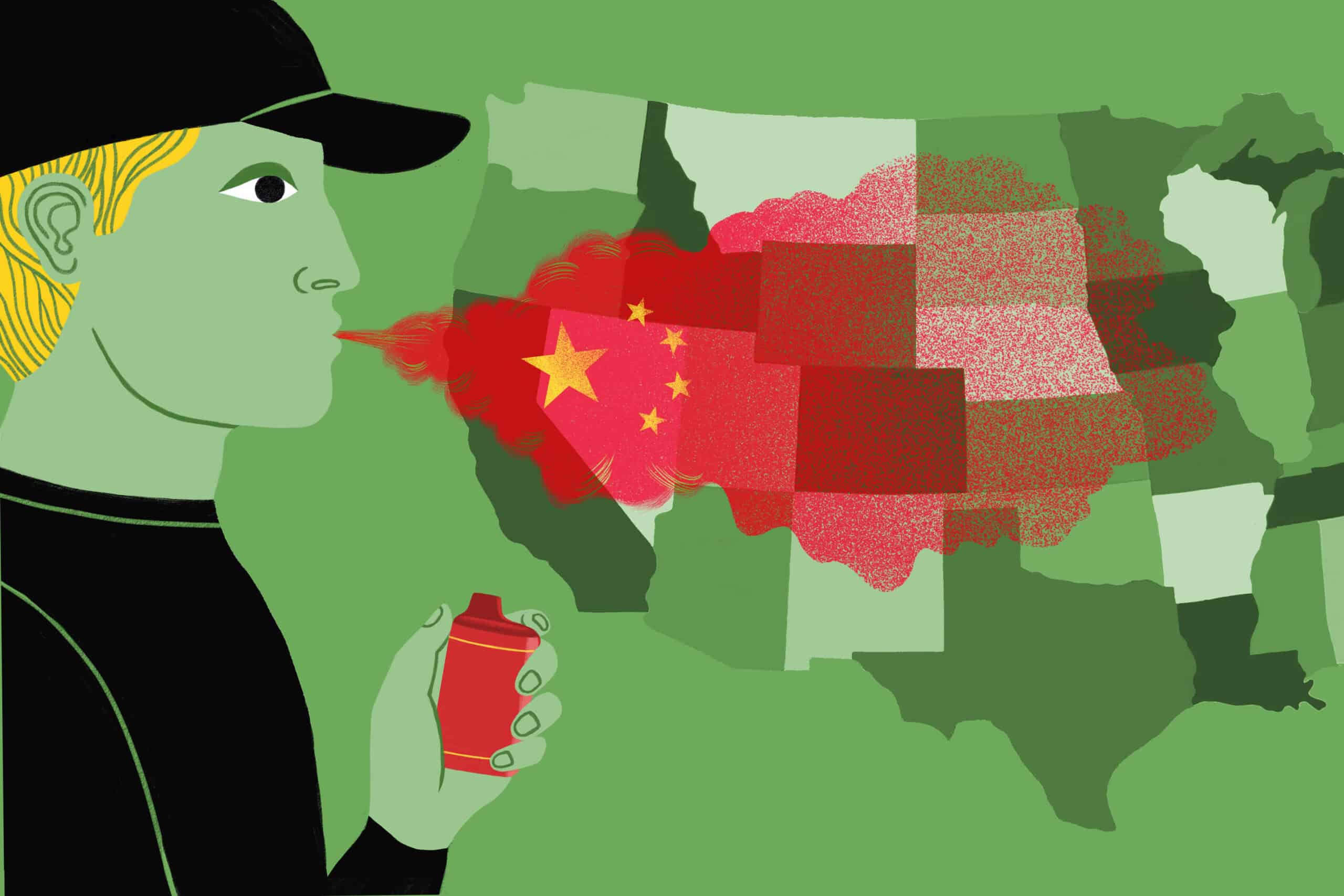
The answer: China. In recent years, Chinese firms have built a sophisticated vape manufacturing base in the southern city of Shenzhen that exports billions of dollars worth of products to the United States and elsewhere. At home, the vapes they produce have been banned since 2022 — fueling suspicion within American communities that China is seeking to exploit the country’s youth, and sparking rhetoric that echoes concerns about Chinese involvement in the fentanyl trade.
“It is clear from the packaging, the flavors, the designs… that they are strategically targeting our young Americans,” Jobe Dickinson, a retired police officer and vice president of the Border Security Alliance, a group focused on curbing smuggling and securing the U.S.’s southern border, told the Arizona senate panel.

To this point, Bates could at least claim partial cover: his company isn’t Chinese. Fifty Bar brands itself as “American Made” and vows to “unleash the spirit of American craftsmanship” in its mission statement. The patriotic messaging is so central that the company even sells red “Make Vaping American Again” hats.
But when Senator Kevin Payne, the leader of the Arizona senate committee and author of the bill, pressed Bates about how he makes the vapes, he conceded that he, like most of his industry peers, sources them from China.
“We’ve had to…but we’re looking at ways to get that done in the USA,” he said. Despite his arguments, the five-member panel voted 4-1 in favor to pass the bill out of committee.

Debates like this one in Arizona are happening in virtually every state house across the United States. Policy responses may vary, but they all reflect the same core problem: a surge of Chinese-made vapes has flooded the American market and the federal government has been slow to respond.
Indeed, many experts argue that Washington helped create the problem. Near the end of his first term, President Donald Trump sought to curb teen vaping, whose spread up till then had been driven by the rapid rise of Juul, a San Francisco-based startup.
But a desire to ensure that adults would still be able to access vapes, as well as pushback from industry groups, led the Food and Drug Administration to issue only a watered-down guidance in January 2020 that specifically banned the sale of unauthorized “cartridge-based” e-cigarettes, or vapes like Juul that rely on users to purchase new cartridges to keep using them.
We warned that they needed to go broader and they needed to include disposable vapes in that ban as well, because it was clear that there was a huge loophole there and that companies were going to drive boatloads of product through with disposable devices.
Esther Agbaje, a staff attorney with the Public Health Law Center at Mitchell Hamline School of Law in Minnesota
Importantly, the guidance did not address disposable vapes — devices that can be thrown away after hundreds of puffs — which represented a small but growing share of the market. The omission may have been a concession to vape industry groups or simply an oversight, but even then some were concerned.

“We warned that they needed to go broader and they needed to include disposable vapes in that ban as well, because it was clear that there was a huge loophole there and that companies were going to drive boatloads of product through with disposable devices,” Esther Agbaje, a staff attorney with the Public Health Law Center at Mitchell Hamline School of Law in Minnesota. “Lo and behold, that’s what we’ve seen.”
Chinese manufacturers took advantage. New disposable vapes from brands like Elf Bar and Puff Bar began to pop up on convenience store shelves across the U.S., in devices able to hold more nicotine content, longer-lasting batteries, and a wider variety of flavors than Juul ever offered.

The FDA’s loophole does not prevent either the agency or other branches of the federal government from cracking down on the influx of Chinese vapes. In fact, the FDA has not approved the vast majority of vapes entering the United States.
“These are not legal products. They are essentially getting smuggled in, ” says Daniel Aaron, a law professor at the University of Utah.
Yet the Chinese companies that currently dominate the U.S. vaping market have seemingly opted to ignore FDA regulations. Matthew Ma, chief executive of Ecigator, a Shenzhen-based e-cigarette manufacturer, says Chinese vape makers face minimal resistance when bringing their products into the U.S. “We know that the United States has many regulations, but the authorities never care about them,” he told The Wire China.

In a statement to The Wire, the FDA said it has “taken numerous actions against products from international firms, including Chinese companies responsible for some of the most popular e-cigarettes with youth”, adding that it is currently “streamlining” efforts across the government on e-cigarette enforcement. U.S. Customs and Border Protection did not respond to requests for comment.
Even so, while Juul and other U.S. vape manufacturers have spent years attempting to get vapes approved by the FDA, the market for Chinese-manufactured disposable vapes has flourished. In 2024, Chinese manufacturers exported $3 billion worth of vape products to the American market, according to data supplied to The Wire by independent research firm ECigIntelligence. The American market’s turn towards disposables has also been swift: One study by the Centers for Disease Control and Prevention estimated that from 2020 to 2022 they went from making up a quarter of the e-cigarette market to over a half.
A look inside Shenzhen-based GeekVape’s smart manufacturing factory. Credit: GeekVape
American industry giants are crying foul: In its 2024 fourth quarter earnings statement, Altria estimated that illicit vapes make up over 60 percent of the e-vapor category, making its goal to transition away from traditional cigarettes much harder. In a letter to the U.S. Trade Representative sent in March, R.J. Reynolds estimated the influx of vaping products from China had cost the domestic tobacco industry some $19 billion.
The story of the vape industry is, in many ways, a classic U.S.-China business tale — Chinese firms learning from and iterating on a successful American product until U.S. companies are eventually pushed out of their own market.

This time around, instead of complaining about intellectual property theft, leading figures in the vaping ecosystem blame the U.S. government for crafting rules that have mainly benefited Chinese entrants and harmed American innovators.
Chinese companies, meanwhile, have built a sophisticated network of manufacturers, shipping firms, and U.S.-based distributors — including partners like Fifty Bar — to evade American regulations and continue flooding the market with vapes.

Regulators and lawmakers are beginning to understand the scope of the multi-billion-dollar vape import industry and to take steps to address it. But the advent of President Trump’s second administration makes their success uncertain, given his pledge to “save vapers” on the campaign trail. Instead, it is his escalating trade war with China that could, albeit indirectly, offer the best hope of blowing the Chinese vape threat off course.
A vapor revolution
The e-cigarette was originally a Chinese innovation.
In 2003, a pharmacist and ex-smoker in Northeast China named Han Li fell asleep while wearing a nicotine patch. Waking up from hours of nightmares, Han began to think of alternative ways to get his nicotine hit. His solution: a cigarette-shaped device that would vaporize nicotine, an idea he soon patented. The e-cigarette was born.

But Han’s e-cigarette did not immediately upend the smoking industry. The vaping revolution was instead born the following year, in a Stanford business school thesis presentation during which grad students Adam Bowen and James Monsees debuted their idea to create a safer, vapor alternative to cigarettes. The pair spent the next eleven years developing their idea and refining prototypes until they came up with the Juul — a pen-sized, battery-charged device that could be endlessly refilled with nicotine cartridges.
Containing far fewer carcinogens and toxins, Juuls and other e-cigarettes also proved to be healthier than traditional cigarettes. “The vast majority of research indicates that while e-cigarettes are not safe, they are far less harmful than combustible tobacco,” says Abigail Friedman, a health policy professor at Yale University.

The Juul was an instant hit after it was released in 2015, with it and other e-cigarette companies generating $260 million in sales that year. By 2018, their collective sales had skyrocketed to $2 billion. As Juul’s popularity surged, the devices began appearing all over the nation’s colleges, high schools, and even middle schools. That same year, then-FDA Commissioner Scott Gottlieb declared teen vaping an “epidemic.”
In China, Han’s e-cigarette had finally hit the market in 2009 through his company, Beijing Ruyan, helping to spark the vape industry’s growth in Shenzhen, for years the country’s key manufacturing center for products from televisions to air conditioners. By 2014, Chinese manufacturers were producing 300 million e-cigarettes per year for the domestic and global markets.
Three years after that, by which time the Shenzhen hub was producing 95 percent of the world’s e-cigarettes, Juul itself outsourced much of its production to China. Until that point, Shenzhen’s industry had focused on vapes that were larger than Juuls and more complicated to produce. Juul’s success prompted other Chinese manufacturers to focus on creating more discreet and convenient models.
“Factories from Shenzhen recognized that people liked the Juul. The manufacturers and other brands started to learn from Juul and started following their style,” says Ma, the Ecigator CEO.
Soon after came a vital development. In 2018, Zhang Shengwei, a vape entrepreneur in Shenzhen, launched the Elfbar 600, a vape that mimicked Juul’s look, but which — crucially — could be thrown away after it was used. That launch came at the perfect time. In 2020 came the FDA’s guidance that cracked down on cartridge-based vapes like Juul, leaving a gaping hole in the American e-cigarette market for Zhang’s disposable Elf Bar.

The market shift was dramatic. In May 2019, Juul had a 75 percent share of the American vape market. By 2024, that had fallen to 24 percent. American youth, in particular, preferred the Chinese disposable brands: in 2024, the FDA reported that Elf Bar was the top vape brand among middle and high school vape users, used by 36 percent of students three times the number that used Juul.

The widespread use of these devices in schools is no accident, argues Robert Jackler, a professor at the Stanford University School of Medicine. Posts and ads featuring Elf Bar and other Chinese-made vapes have targeted young consumers on social media in recent years.
“You see lots of happy-looking, probably AI-generated teenagers, glamorizing the vapor products,” said Jackler. “Is this going to appeal to a 50 year old, two-pack-a-day Marlboro smoker? Maybe. But it’s certainly going to appeal to young people.”
Zhang’s company Heaven Gifts soon became the dominant vape manufacturer in Shenzhen, with his empire widening to include dozens of major brands including Puffbar and Lost Mary. By 2023, Heaven Gifts alone accounted for 9 percent of the American vape market, according to data shared with Reuters, a figure that likely undercounts Zhang’s influence given his major stakes in numerous other brands including GeekVape.

While U.S. regulators have provided the carrot for Zhang and other vape manufacturers to grow, their Chinese counterparts have wielded the stick. In 2022, the Chinese government banned the sale of all flavored e-cigarettes in the country, spurring firms like Heaven Gifts to export more to survive.
You see lots of happy-looking, probably AI-generated teenagers, glamorizing the vapor products. Is this going to appeal to a 50 year old, two-pack-a-day Marlboro smoker? Maybe. But it’s certainly going to appeal to young people.
Robert Jackler, a professor at the Stanford University School of Medicine
Beijing’s decision was likely motivated by the influence of China’s state tobacco monopoly the China National Tobacco Corporation, whose revenues account for 7 percent of China’s government budget and whose brands include the Zhonghua and Zhongnanhai cigarettes that are ubiquitous in China.

“China National is probably the most powerful company in China period, number one,” says Ray Yip, the former director of the China Program at the Bill & Melinda Gates Foundation. “They can decide to put you out of business very easily. But if you make vaping products selling to other countries, more power to you. That’s not going to impinge on CNTC’s profit.”
The nicotine network
Since Shenzhen-based vape manufacturers now primarily target export markets, the Chinese government has little incentive to monitor their operations. In 2022, Beijing introduced a licensing system that consolidated thousands of factories into roughly 600, weeding out some lower-quality producers. But experts say that oversight remains minimal.
“It’s a Pandora’s box,” says Barnaby Page, editorial director for ECigIntelligence, a firm that researches the vaping industry, explaining that vape producers share little information regarding safety standards and quality control measures in the manufacturing process. “Who knows what’s really happening in those factories.”

Chinese vaping firms have also proven remarkably agile, constantly adapting to stay one step ahead of American regulators.
Shenzhen vape manufacturing is broken down into Original Equipment Manufacturer, OEMs, and Original Design Manufacturers, or ODMs. A company might opt for the OEM process if it wants to design a unique vape. It is also typically used by major brands like NJOY — a vape company owned by U.S. tobacco giant Altria — that are more concerned with meeting FDA standards and producing vapes that are legal for the American market.
An Instagram post from freight forwarding company Wutongda Technology, showing vape products from brands like GeekVape and Vaporesso being prepared for transport. The post is captioned “We’ll get your vapes there in a puff!” Credit: Wutongda Technology
Companies less focused on originality and more intent on minimizing costs typically choose the ODM process, which accounts for the vast majority of vapes entering the U.S. market. ODM factories produce generic vape molds that brands in the U.S. and elsewhere can easily customize and label as their own. This model allows new brands to emerge rapidly, and enables major players like Heaven Gifts to rebrand products quickly in response to regulatory pressure. For example, after the FDA cracked down on Elf Bar imports in 2023, nearly identical devices under the name EBCreate started to appear on U.S. shelves.
“It’s a bit like whack-a-mole for the FDA to keep track of,” says Jonathan Foulds, a public health sciences professor at Penn State University, College of Medicine.
To get products to the U.S., vape manufacturers rely on a network of Shenzhen-based freight forwarding shipping companies like Hosto Logistics, Wutongda Technology, and TipTop International Freight Forwarder. The companies boast on their social media pages and websites about quick delivery times and their ability to get shipments past U.S. customs through employing a team of specialized customs clearance workers. Instagram posts from employees also show that the freight forwarders ship vapes for major brands like Heaven Gifts and GeekVape.

Hosto Logistics, Wutongda Technology, and TipTop International Freight Forwarder did not respond to requests for comment.
In a recent interview with a vaping-focused media outlet 2Firsts, Hosto’s co-founder Lily Qian said that FDA measures taken in 2019 had pushed freight forwarders to assume more control over the shipping process. According to Qian, Hosto now provides “dedicated line service,” meaning that the firm provides door-to-door delivery services from China to the U.S. while assuming responsibility for warehouse costs and customs inspections.
To bring products into the U.S., vaping companies often employ a few authorized customs brokers to handle customs paperwork and sign off on the shipments. They then rely on a network of distributors and wholesalers that sell the vapes to convenience stores and vape sellers across the country: One such is Happy Distro (it’s also known as Happy Global), a firm headquartered in Texas that also has offices in Shenzhen, Shanghai, and Tianjin, according to its website.

Happy Distro claims that it supplies vapes to over 700 cities in 30 U.S. states, but its website does not currently list the brands of vapes it distributes. Archived versions of Happy Distro’s website show that the firm has been a main distributor for unauthorized vape brands like GeekVape and Elf Bar. The firm employs dozens of H-1B visa holders, a visa lottery program that facilitates foreign workers to be employed in specialized operations, according to the Department of Labor’s website.
Happy Distro did not respond to a request for comment.
Cracking down?
Authorities in New York, at least, have begun to tie together the web of Chinese vape manufacturers, shippers, and distributors in an effort to crack down on illicit vape sales in the state.

In February, New York Attorney General Letitia James launched a lawsuit to sue 13 companies, including Happy Distro, involved in the manufacture, distribution, and retail of flavored vapes in the state. The lawsuit accuses Happy Distro of subverting New York’s ban on flavored vapes through shipping them to the state via a network of subsidiaries and affiliates, and of deliberately marketing vape products to minors.
“For too long, these companies have disregarded our laws in order to profit off of our young people, but we will not risk the health and safety of our kids,” said James, in a statement on the lawsuit.
New York’s action is one of the first attempts to crack down on the network that facilitates the illicit trade of vapes in the U.S.. But to date, it is one of the few states to ban flavored vapes altogether, giving James a clear case to bring against companies accused of violating the ban.

Like Arizona, the vast majority of other states have been or are considering using registry laws, which create lists of vapes that can be sold within their borders. Some state registry lists are more restrictive, and allow just the 34 vapes that the FDA has so far authorized via its Premarket Tobacco Product Applications (PMTA) process. But because the PMTA process is notoriously slow and restrictive (even Juul is waiting for approval), other states have expanded their lists to include vapes still on the waiting list.

Some industry watchers believe that big tobacco firms are promoting the use of registries to protect their market shares — the three big tobacco companies Altria, R.J. Reynolds, and Japan Tobacco are behind all of the vapes that have so far received PMTA approval — and that their use won’t address the root of the issue.
“These state registry bills are kind of just a sham and give people an opportunity to cast a vote and say, I’m doing something to fight this problem” said Agbaje, from the Mitchell Hamline School of Law. “[The Chinese vapes] are already illegal. It’s about enforcement.”
That will likely need to come at the federal level. Recently, there has been some evidence that the U.S. government is taking the problem seriously.
Last June, under the Biden administration, the FDA and Justice Department announced an interagency task force to combat the illegal distribution and sale of e-cigarettes. The task force has since reported multiple seizures of e-cigarette shipments from China, including a major bust last October in which authorities confiscated $76 million worth of merchandise, including Geek Bar, which has become the number one selling disposable vape on the American market. Still, the seizures represent a small fraction of the billions of dollars worth of illicit Chinese-manufactured vapes entering the U.S. each year.
If the U.S. became completely closed off to Chinese manufacturers, then Shenzhen would be hit very hard, because I don’t see where else that volume of product could go. Another possibility, of course, is offshoring from China. And these products could easily be assembled in a market like Indonesia or Malaysia.
Barnaby Page, editorial director for ECigIntelligence, a firm that researches the vaping industry
Congressional action on the issue is also gaining steam. Last year, the House Select Committee on China launched an inquiry into vape imports from China and a bi-partisan group of senators proposed legislation that would create more oversight of the industry.
Senator Dick Durbin presents flavored vapes during a hearing on youth vaping, Credit: U.S. Senate
During a heated hearing on youth vaping last year, senators from both sides of the aisle grilled FDA, Department of Justice, and other agency officials for failing to stop the flow of illicit Chinese vapes into the country. Senator Dick Durbin (D-IL) had his staff purchase vapes with flavors like Red Bull and Watermelon Bubble Gum and brought them to the hearing, demanding to know how such illegal products were still entering the country.
“What in the hell have you been waiting for?” Durbin asked one DoJ official, criticizing the agency’s apparent lack of enforcement.
One answer: a pending Supreme Court decision.

On April 2, the Court unanimously ruled in favor of the FDA’s authority to ban flavored vapes in a case brought by two e-cigarette manufacturers. The case did not involve major Chinese vape producers, but lawyers say it could make it easier for the federal government to rein in the industry.
“Enforcement will be much simpler,” said Ben Wolf, a former FDA lawyer and partner at Alston & Bird. “It’s much easier for boots on the ground. If they see a flavored vape in a shop, they can pull it from the shelves, rather than having to go into the shop and parse through what’s acceptable.”
But stepping up enforcement against illicit Chinese vape imports demands both political will and significant resources — neither of which experts believe the Trump administration is likely to devote to vaping.

Since being elected, Trump has said little on the issue — and U.S. Health and Human Services Secretary Robert F. Kennedy Jr. hasn’t clarified his position either. Elon Musk’s push via the Department of Government Efficiency to shrink the federal bureaucracy may also be weakening the FDA’s ability to police the vaping industry. In April, the agency’s top tobacco official, Brian King, was placed on administrative leave, and dozens of others at the FDA’s Center for Tobacco Products have been dismissed.
“Obviously that will make enforcement more difficult,” says Micah Berman, a law professor at Ohio State University’s College of Public Health. The FDA did not respond to a request for comment.
Intentionally or not, the best hope of curbing illicit vape imports could prove to be the Trump administration’s escalating trade war with China.
Trump’s May 2 decision to abolish the de minimis loophole, a trade provision that has allowed shipments under $800 in value to enter the U.S. tariff-free and with minimal inspections, is set to take effect, shutting off one of the avenues that Chinese vape importers use to skirt American tariffs, says Rob Handfield, a supply chain management professor at NC State University. Trump’s sweeping 145 percent tariffs on Chinese imports could in turn cripple vape exports overnight.
Even so, some predict China’s fast-moving manufacturers will likely find ways to adapt.
Brady Bates on how President Trump ‘saved flavored vaping’, February 12, 2019. Credit: State of Arizona
“If the U.S. became completely closed off to Chinese manufacturers, then Shenzhen would be hit very hard, because I don’t see where else that volume of product could go,” said Page, of ECigIntelligence. “Another possibility, of course, is offshoring from China. And these products could easily be assembled in a market like Indonesia or Malaysia.”
In February, Bates, the CEO of Fifty Bar, was confident Trump would have the industry’s back, even as regulatory scrutiny swirled.
“Trump saved flavored vaping in 2019 and I’m convinced he’ll do it again,” said Bates in the February Arizona Senate hearing. “I’m convinced that he’ll do it again because this industry is vast and it’s large and it’s powerful.”

Grady McGregor is a freelance writer for The Wire China based in Washington, D.C. He was previously a staff writer at Fortune Magazine in Hong Kong, writing features on business, tech, and all things related to China. Before that, he had stints as a journalist and editor in Jordan, Lebanon, and North Dakota. @GradyMcGregor