In 1985, I was invited to work as a “foreign expert” in Beijing for the magazine China Pictorial, which was published by the Foreign Languages Press under China’s Ministry of Culture. China Pictorial was a government-owned propaganda publication distributed through embassies overseas. It stretched to 24 pages a month, consisting of grainy pictures with paragraph-long captions about China’s happy national minorities and agricultural achievements.
China Pictorial.
The magazine had about 300 employees. I had previously worked at Business Week in New York, which ran to about 64 pages each week and, though famously overstaffed, had about a third as many employees.
The 300 staffers at China Pictorial were distributed through 18 language sections, including Indonesian, even though the Indonesian edition had not been published since China broke off relations with Indonesia after the 1965 coup attempt, which President Suharto accused China of supporting. The Indonesian section still employed five translators. One of them fixed radios for everyone else and took a lot of naps on the cot he had installed in the office. Another wrote poetry. And another would spend the days walking up and down the halls kicking the skirting boards and muttering.
Employees received basic healthcare at the office clinic, where a huge whiteboard kept track publicly of how many condoms each employee had taken in a given month. All the young and unmarried staff lived in the office, generally sleeping on top of desks, because there was a shortage of housing available to them from China Pictorial. Those who had been lucky enough to be allocated an apartment (that usually happened a few years after getting married or after turning 40) had small cold-water flats owned and managed by the magazine in a nearby compound.
A propaganda poster from 1983 highlighting studying as a regulation for workers. Credit: BG E13/277, Landsberger Collection, chineseposters.net
There was little to do each day, but people were required to show up, so they played ping pong, chain-smoked, played cards and snoozed in the office. Food was so basic that a major topic of conversation was where some delicacy, sweet potatoes or fish, for example, could be bought. Marriage or travel required written permission from the office leader, and everyone had to spend Saturdays in “political study” discussing in what way their thoughts might not support the Communist Party.
Several people applied to be permitted to leave and find another job, but permission was never granted; the magazine received government subsidies based partly on headcount and, since there were no other jobs, it didn’t want to be responsible for unemployment.
Staff received pay each month in cash. The ¥10 note was the largest then printed, and the average editor, photographer, or translator got six tens, now the equivalent of less than U.S.$10 per month.
About a month into my tenure at the magazine, an officemate told me his father had died of tuberculosis. “But that’s normally curable,” I said. “Didn’t the doctor diagnose it correctly?” The colleague laughed. “We are farmers. We don’t have money to see doctors.”
With one sentence, my belief in Maoism as the system that made people’s lives better was thrown into doubt. It was my first realization that “socialism” in China was reserved for the urban privileged.
…the rapid improvements lulled everyone, Chinese and foreign, into believing that China could never return to the bad old days.
I lingered in China, first to learn the language, then because I married there. But in 1988, I told the Hindi translator I’d married that I needed to go back to the U.S. to recharge. I was mentally exhausted by trying to fit in. At the time, we had only one day off a week. I would look forward to sleeping in, but around 7.30 a.m. each Sunday, my new in-laws would appear at the front gate (no one had telephones back then) ready to stay all day, cooking, napping, taking baths in my hot-water apartment, and watching TV. I was obliged to speak Chinese constantly, which made me feel stupid, as my vocabulary was very limited.

So we moved to Washington, D.C., to rejoin what I viewed as the real world. Then, in 1993, an investment association called the U.S.-China Business Council invited me to head their China operations in Beijing. At the time, there were few Americans available who knew anything about China, so they were willing to hire a journalist-cum-magazine-editor for much more money than I had ever earned.
The Council, as we called it, had been a fairly sleepy D.C. association dedicated to improving U.S.-China ties, but during my time there — 1993 to 1998 — foreign investment in China was exploding. The Chinese government had changed seemingly overnight from closed, suspicious, internally tyrannical, and externally belligerent to actively and disarmingly soliciting foreign investment and trade. The whole nation mobilized to appear more hospitable to foreigners, swapping Mao suits for Western sports jackets and learning English.

I spent my time lobbying for China to be granted Most Favored Nation status and enter the international trading system as a peer. With my employer, we argued that economic opening would bring political freedoms. In those years, everyone — Chinese and foreign — was filled with hope for democracy, reinforced by messages from the Chinese government. China was shedding restrictions and prohibitions, and it felt as if the entire nation had awoken from the Maoist slumber and wanted to make up for lost time. People were disarmingly open about the problems of their country and admiring of the West.
Within China, foreigners were the first to get phones at home and had special license plates and never got traffic tickets. They got privileged access to government leaders. A foreign visitor to a city in the provinces would be showered with gifts and feted at banquets. In the capital, the most lowly foreign factory manager could meet with a high official of state and be treated like Henry Kissinger, provided an official interpreter, and earnestly asked his or her view about the economy while beautiful young women replenished the jasmine tea in lidded enamel cups. When pushing my son around in a carriage in the early years, people would stop me on the street and say, “He will be very smart and very handsome. He has American blood!”

This sort of special treatment charmed and bemused foreigners, and all of this change, choice and freedom was intoxicating. The creeping capitalism made Beijing look like a film going from black-and-white to color. Dreary urban markets selling cabbage and potatoes burst into cornucopias of fruits, vegetables and meats. Where timid customers once had to beg “comrade” store clerks to sell them long underwear or a shirt in the only available color (pale blue), suddenly there were hypermarkets exploding with colorful knit sweaters and blouses.
People began to eat better, dress better, skip political study sessions, and even get Saturdays off. Ration coupons disappeared, and so did the ever-present fear of saying something the Party might not like. There started to be dances, music, real films and books of poetry.
It was easy to become an entrepreneur, and I started a publishing company, a CRM software company, then an online media company in rapid succession. Foreign investors and clients welcomed these businesses as footholds in the vast and confusing local terrain.
It lasted a long time, and those ¥60 pay packets got fatter, until Chinese people could imagine buying cars and electronics and going overseas for fun. The rules that had kept people tethered to their employers were dispensed with, and people went looking for jobs they preferred with people they found compatible. Parents saw their children moving far beyond their own stations in life, and the rapid improvements lulled everyone, Chinese and foreign, into believing that China could never return to the bad old days.

By then, I had two children and an older stepson, a big extended family, a dog, a house, and two cars. Our family lived in a foreign neighborhood that might have been “Mayberry,” where we wheeled around on bicycles, stopped for espresso macchiato at Starbucks, and shopped at a grocery store selling foreign goods like Italian basil and dishwasher detergent. We roasted a turkey at Thanksgiving even though the imported bird cost more than our couch. We enjoyed the freedom to watch foreign movies — albeit pirated — attend church and hold sports events, freedoms that Chinese people did not have.
We rationalized the disparities — both between us and Chinese people and those that still existed between urban and rural Chinese people — because we assumed all the change under way would gradually lift China out of poverty.
That turned out to be an illusion.
BEATING BACK THE FLAMES
There is an old story in China about a train whose last car is on fire and has to keep accelerating in order to stop the fire from moving forward.
In 2008–9, the fire was a smoldering pile of unpayable loans that China had ignored for a decade. Political leaders had demanded top-line growth that could be achieved only by stoking the economy’s engine with new debt, and the faster the economic train could move, the more it could blow back the licking flames.
But Chinese acceleration had been fuelled by the global economy. And one day everything went belly-up.

On September 15, 2008, the U.S. investment bank Lehman Brothers filed for bankruptcy. People watched on TV as hundreds of the former kings of commerce left the building in New York in a walk of shame carrying cardboard boxes full of their belongings. Lehman had been the cynosure of the banking industry, viewed as the most perfect of banks, and now stood at the center of a maelstrom. In the simplest terms, unfettered crony capitalism had created a monster.

Watching the storm from behind the walls of the Zhongnanhai compound at the heart of Beijing, Chinese political leaders quaked in their tasseled loafers. How could they have ignored the long and ignominious history of financial crises in capitalist systems? And it got worse: a month after the Lehman collapse, stock markets across the world plunged. Banks looked like they might fail, and hundreds of millions of people would lose their savings.
Cratering international demand would mean less cash crossing the border into China. At the height of the crisis, in October 2008, Chinese leaders must have gone to bed imagining angry bank depositors rushing towards Tiananmen Gate with cleavers.
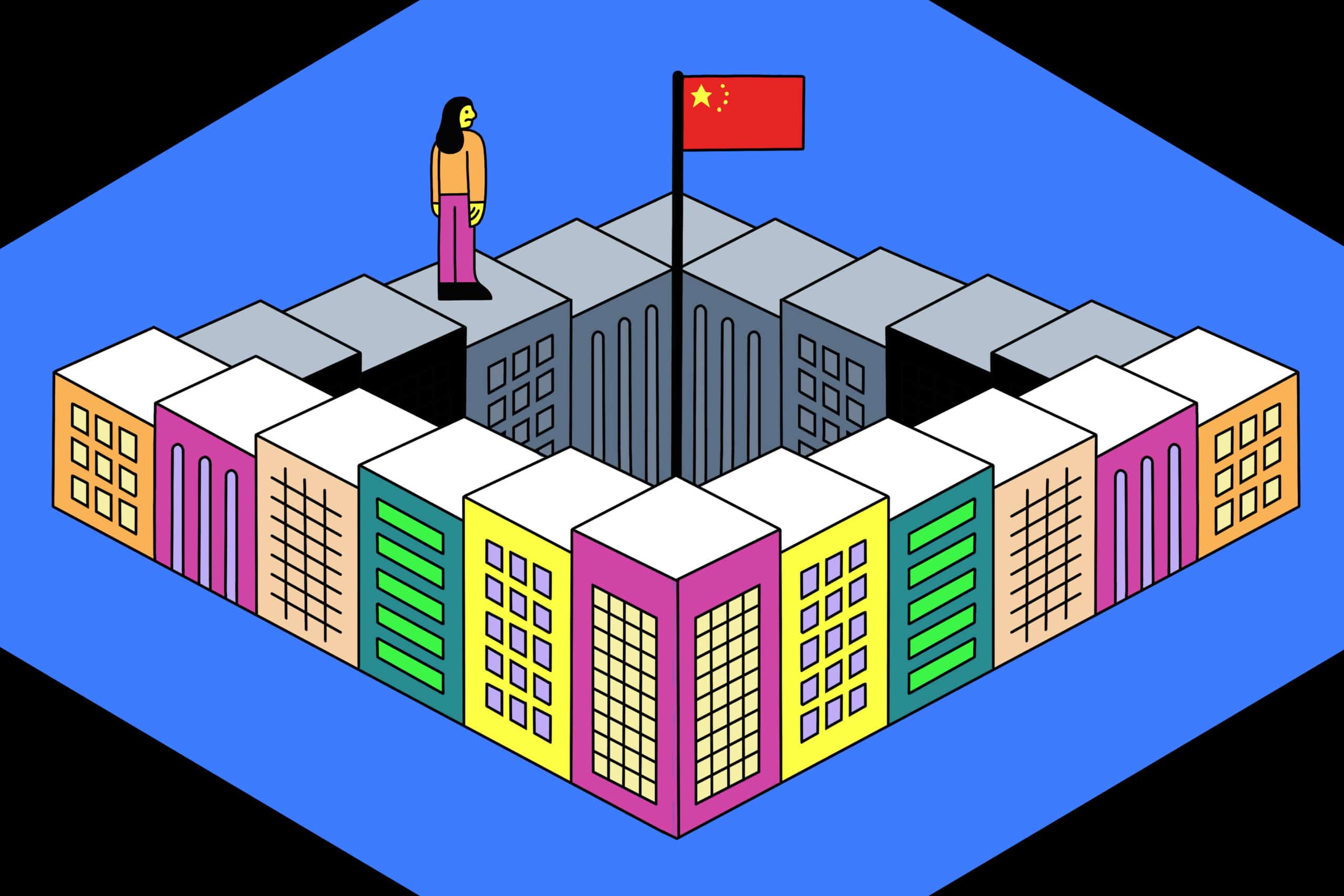
With the global financial crisis, Chinese policymakers saw that the train was going slow and might be consumed. They had to find a way to create financing within China. They decided to roll down the security grilles at the borders, seal off the economy, and make sure no angry mobs would come for blood. Planners argued that the economy had grown excessively dependent on exports, and China needed to return to self-reliance. The nation would create its own demand and generate its own growth. To make this happen, the government printed money and threw it in fistfuls at local governments. What was already a property feast became a feeding frenzy.

The first-order need was to reassure both the Chinese people and the world that, whatever happened in the West, China would be fine. The State Council approved an investment plan of ¥4 trillion, a number intended more to impress and reassure than to represent any real intention.
Next, authorities had to get the money moving. The central government called on local governments urgently to submit wish lists for their favorite projects (within two weeks) for review. Central authorities laid out general areas for investment and top-level amounts they would invest. Provinces provided a lengthy array of shovel-ready projects that totalled around ¥25 trillion, since there was no downside to overshooting. The locals were happy to hand over lists whether or not they were practical.

The stimulus plan China assembled in early November gave local governments a political mandate to spend money. Counties, cities and provinces went searching for plausible excuses. Mostly, they dusted off blueprints they’d already prepared for the next Five-Year Plan, focusing on two top-line targets: heavy infrastructure and growth substitution via industrial investment and property. The plans strongly favored rail and subways, gas pipelines, highways, and power plants. By mid-December, the central government approved the first tranche of investment.
Because the construction was self-justifying, governments had only the vaguest plans for how these facilities might be used. Many projects were built for reasons other than market demand and without market research or projections. For example, Tianjin built three terminals for luxury cruise liners even though none docked at the city. Yunnan Province laid out a 150-kilometer canal just to fill a fanciful moat around a new hotel. A city in the dunes of the Gobi Desert dug out a reservoir and filled it with water so that imaginary visitors could sail boats.
The Beijing-Tianjin Express Railway shows how desire for speed overruled common sense. The original plan was for a 200-kilometer-per-hour line. That was upgraded to 300 kilometers per hour for a 75 percent higher budget. The boost theoretically would shorten the ride by 10 minutes, but since the acceleration-deceleration cycle is 26.2 kilometers, compared with 8.9 kilometers for a 200-kilometer-per-hour train, the advantage of this extra speed for the 120-kilometer trip is next to nothing. The cost per minute gained was about ¥900 million.
Cities built new airports with no flights, schools without students, libraries with no books. There were highways and bridges to nowhere, and ghost cities full of empty apartment towers. Already, by 2012, China had three times the length of highways per unit of GDP as the EU, twice that of the United States, and eight times that of Japan.

The funding was so extravagant that money had to be pushed out to engorged local government and company accounts, then rules had to be made to force them not to simply hold the cash. Loans were abundantly available, and banks hired call centers to offer unsecured loans to consumers. By making loans, banks actually create money, and money creation in 2008–9 was beyond anything the world had seen before. The fiscal spending on the stimulus was dwarfed by the rush of credit through China’s banks. In five short years, Chinese banks added assets — loans — worth the entire value of the U.S. banking system, which had taken 150 years to create in a country with a much larger economy.
…the property market became a stage on which governments and financial institutions played out a pantomime designed to present the appearance of a healthy commercial market.
With much of this bumper crop of cash flowing to real estate — meaning land, construction, building materials, housing sales and mortgages, and everything else attached to property — real estate development plugged in for China’s growth-substitution aspirations. Chinese governments used real estate development as a substitute for declining industrial output, lagging household consumption, and stagnant productivity growth.
All of this means that, for more than a decade following the financial crisis, the task for China’s government was to freeze up the markets, trap value in property, and make sure that consumers felt rich on paper without actually being able to pull cash out of the market. That enabled banks to maintain the high book value of property that buoyed their loan books. Everyone understands that cratering property prices are what cause debt to be unsupportable. And so the property market became a stage on which governments and financial institutions played out a pantomime designed to present the appearance of a healthy commercial market.
After property giant Evergrande first defaulted in 2021, however, the pantomime became much harder to keep going.
TWISTED FATE
My family and I left China in 2014, but it took me years to understand that I was an unwitting player in an elaborate and dramatic confection. This country, which had seemed so malleable, so interested in change, was actually a sprawling, ancient kingdom with deeply ingrained traditions indifferent to the proselytizers of capitalism. China had not changed institutionally, and the post-1979 experiment with capitalism was just that: an experiment that, when deemed to be no longer useful, would be discarded.

Credit: Jimmy Carter Library
Just as China has turned away from its earnest wooing of the West, so the West has become disillusioned with China. The rapid and stunning changes to the physical landscape have done little to improve access to healthcare, education, or to provide social mobility for the great majority.
Throughout the years of investment fever, China neglected its social infrastructure. The central government’s capital resources were directed at building visible, physical infrastructure, like roads and buildings, but left unfunded were invisible targets, like public education, healthcare, retirement and unemployment. Instead of providing rural children with eyeglasses, for example, or giving undernourished people a multivitamin each day, governments poured money into constructing rural clinics that lacked staff with medical skills. Instead of requiring 12 years of education and making academic high school free, governments handed out subsidies to build unused training facilities.
Given the imperative to push capital investment, China’s educational curriculum, quality of healthcare, and efficiency of financial services all deteriorated. The gains in health, education, and other types of well-being that were so prominent in the 1980s and 1990s fell off in the 2000s and may have even gone backward.

By neglecting the simple expenditures that would have prepared its poorer populations for the next stage of growth, China faces an intractable problem for the years ahead. The stage has been set for China to fall back into reliance on cheap labor and low-value exports. This will not only be tragic for the Chinese people — the effects on the rest of the world will be just as momentous.
Indeed, understanding China’s effects on the world economy and governance has only just begun. Offshoring industries and manufacturing to China in the 1990s and 2000s hammered prices in the West and reduced the negotiating power of labor. Whole cities in the United States and Europe have been hollowed out, with the predictable social problems that follow the departure of jobs. Western political systems have found themselves ill-equipped to govern companies operating outside their jurisdictions, and the massive profits realized by corporations and Western bankers in China, instead of being invested in needed infrastructure back home, have filled the pockets of corporate barons.The emergence of China as an economic power has been coincident with the rise of billionaire oligarchs, and the West has suffered a crisis of faith in democracy and has tilted towards authoritarianism as a result.
Without being China’s fault, all these international effects are associated with China’s emergence in the global economy. Like a film being run backwards, as much as China’s integration into the world economy changed lives across the world, so will its shrinkage and retraction.
Excerpted from Wild Ride: A short history of the opening and closing of the Chinese economy by Anne Stevenson-Yang. Copyright © 2024 by Bui Jones Books. Reprinted by permission.

Anne Stevenson-Yang first moved to Beijing in 1985. In more than 25 years of living and working in China, she founded companies in publishing, software and online media. Today, she runs J Capital Research USA and is the author of China Alone: China’s Emergence and Potential Return to Isolation and Hello, Kitty, a collection of short stories on China’s economic rise.